
Passage Ranking Explained: How One Section Can Rank on Its Own
Passage ranking is an AI system Google uses to judge individual sections of a web page, so one well-written passage can help a long page rank for a narrow query. Google announced it in October 2020 and launched it for US English in February 2021. It is a ranking change, not a separate index: Google still indexes whole pages.
What is passage ranking?
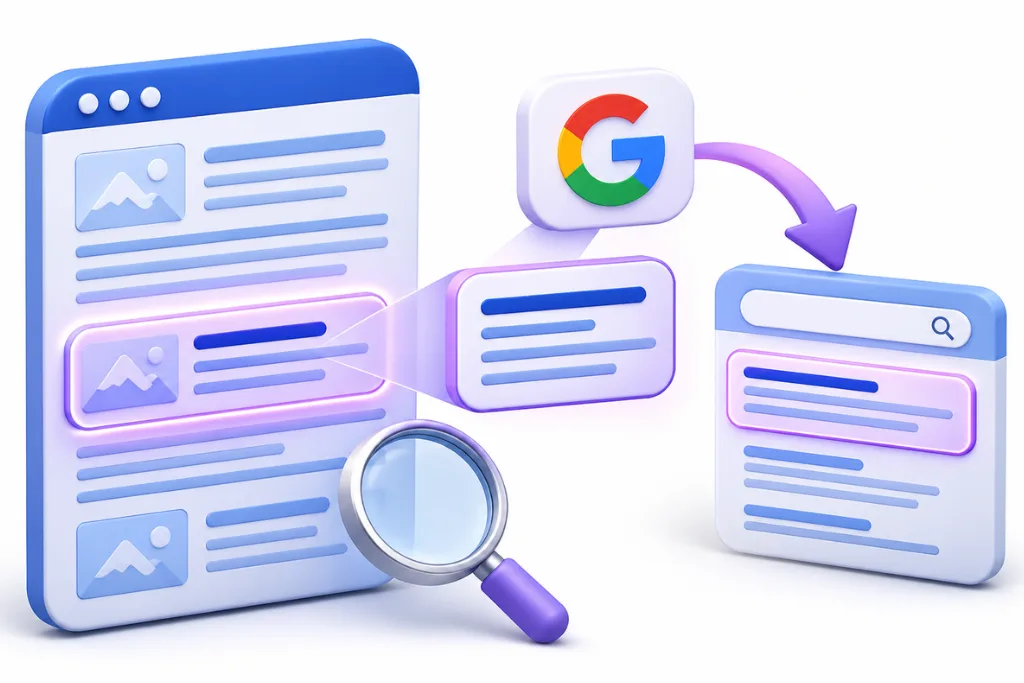
Passage ranking lets Google look inside a long page and find the one section that answers a very specific search. That section can then help the whole page rank for that query. Google lists it as one of its named ranking systems.
Google explains it in its guide to Google Search ranking systems. “Passage ranking is an AI system we use to identify individual sections or passages of a web page,” it says. The aim is to better understand how relevant a page is to a search.
A quick note on the name. If you search for “passage ranking” today, you will also see research pages about the academic task with the same name, such as Microsoft’s MS MARCO dataset. This article is about Google Search’s passage ranking system, not that research task.
Why Google built it
Some searches are very specific. SEOs often call them “needle in a haystack” queries. The best answer may sit in one paragraph halfway down a long page that is mostly about something broader.
Before passage ranking, a page like that could be overlooked, because the page as a whole did not look focused on the narrow question. Passage ranking helps Google notice that buried answer.
This sits inside a bigger story about how Google reads meaning, which we cover in our pillar guide on how search engines understand content, from words to entities.
How passage ranking works: from a long page to one relevant section
Google still crawls and indexes your page as one document. When someone searches, Google can also weigh how well individual sections match the query. If one section is a strong match, the page can rank higher for that search than it would on its overall focus alone.
The confirmed timeline
Here is what Google has actually said, in order:
- 15 October 2020: At Search On, Prabhakar Raghavan said Google had made “a breakthrough in ranking” and could now better understand the relevancy of specific passages. Google said it “will improve 7 percent of search queries across all languages as we roll it out globally” (Google, Search On 2020).
- 10 February 2021: Google confirmed passage ranking was live for US English queries (Search Engine Land).
- 11 February 2021: Danny Sullivan said more English-speaking countries would follow “in the near future” (Search Engine Roundtable).
The 7 percent figure was Google’s forecast at announcement. We found no later figure from Google, so treat it as a 2020 projection.
What Google has not said
Google’s public documentation does not describe the model it uses, the size of a passage, or how passage scores are blended with page signals. You will see articles name specific retrieval formulas or word counts. Those are guesses. Google describes passage ranking as a way to judge how relevant a page is, so the page is still what ranks.
Passage ranking vs passage indexing: why Google renamed it
Google first called this system “passage indexing”. It changed the name because the old one was not accurate (Search Engine Land). Nothing is stored as a separate passage index.
A Google spokesperson described it as “a ranking change, not an indexing change”, and confirmed that Google still indexes full pages (Search Engine Land).
What this means in practice
- Your page is indexed once, as a whole page.
- Passages are a way of scoring relevance, not separate URLs.
- You cannot submit, request or check “passage indexing” in any Google tool.
Passage ranking vs featured snippets vs AI Overviews
Passage ranking decides whether a page is relevant enough to rank. A featured snippet shows a passage from a page that already ranks. AI Overviews write a new answer and link to several sources.
A Google spokesperson put the first difference simply to Search Engine Land: featured snippets pick a passage from a page already judged relevant, while passage understanding helps judge whether the page is relevant at all (Search Engine Land). Martin Splitt also covers the difference in his Q&A with Search Engine Journal.

|
Passage ranking |
Featured snippet |
AI Overview | |
|
What it does |
Scores a section to judge how relevant the page is |
Shows an extract from a page that already ranks |
Writes a summary answer from several pages |
|
What you see |
A normal result for the whole page |
A highlighted box with an extract at the top |
An AI answer with source links |
|
Can you opt in? |
No, it runs on its own |
No markup gets you in, but you can opt out |
No special markup needed |
|
Source |
Google says there are “no additional requirements to appear in AI Overviews or AI Mode, nor other special optimizations necessary” (AI features and your website). For a deeper look at the third column, read our guide on how Google AI Overviews choose their sources.
Which pages benefit most
Long pages that cover several subtopics gain the most. Think of in-depth guides, long FAQs and service pages that answer many questions on one URL. Short pages with one clear focus likely see less change, because their relevance is already easy to judge.
Common UAE examples
Many Dubai and Abu Dhabi service pages are long. They often mix the sales pitch with real answers that people search for, such as:
- fees and government charges
- timelines and processing days
- which emirates, free zones or areas are served
- required documents
- differences between mainland and free zone options
When those answers sit deep inside generic paragraphs, they are hard for Google to match and hard for readers to find. Passage ranking gives such a section a better chance, and clear structure helps it further.
A worked example: one Dubai service page, one buried answer
A buried answer under a vague heading is easy to miss. Naming the question and the entities in that section fixes most of the problem. Here is a hypothetical example to show the idea; it is illustrative, not a client result.
Imagine a Dubai company formation page of about 2,500 words. It covers mainland setup, free zones, visas and bank accounts. Somewhere in the visa part sits one sentence about how many visas a small free zone licence allows.
Before
The section heading reads “Our Visa Services”. The paragraph opens with two lines about the team’s experience. The useful answer appears in the fourth sentence and refers to “this package” without naming the free zone or licence type.
A person searching for that exact visa question would be unlikely to see this page rank. Even if Google finds the passage, the passage does not say clearly what it is about.
After
The rewrite keeps the same page and the same facts. Only the section changes:
- The heading becomes a plain question that names the licence type and the free zone.
- The first two sentences answer that question directly.
- The free zone, licence type and visa limit are named in full, not as “this package” or “it”.
- Supporting detail, such as conditions and next steps, follows below.
The section now explains itself, so Google and a reader can both understand it without reading the rest of the page. If you want this kind of restructuring done across a long site, our website content writing team rewrites service pages section by section.
How to help Google understand each section
Make every section easy to understand on its own. Use a clear heading, answer early, keep one idea per section, and name things in full. This is ordinary good writing, and it also helps readers who skim.
Write descriptive headings
A heading should tell Google and the reader what the section covers. “Visa allowance for a free zone licence” works better than “More info”. Keep the hierarchy simple: H2s for main topics, H3s for the questions inside them.
Put the answer near the top
Open each section with the direct answer, then add detail. A reader who lands mid-page through a search should get what they came for in the first lines.
Keep one idea per section
When a section mixes fees, timelines and documents, no part of it is a strong match for any one query. Split mixed sections so each covers one question well.
Name entities clearly
Use the full name of the service, place or product instead of “it” or “this”. A passage that carries its own context is easier for Google’s language systems to match to a query.
For the wider page checklist, read on-page SEO, element by element, or ask our on-page SEO optimisation team to review your key pages.
Passage ranking myths to ignore
Many passage ranking myths come from advice repeated across agency and tool blogs. Google has said SEOs do not need to change anything for passage ranking (Search Engine Land). Its 2026 AI optimisation guide likewise says content does not need special pieces or markup.
Myth 1: There is a separate passage index
There is not. It is “a ranking change, not an indexing change”, and Google indexes full pages.
Myth 2: You need passage schema
Google documents no passage schema. Its guide to optimizing for generative AI features also says structured data is not required for generative AI search.
Myth 3: Every section must be a fixed number of words
You will see rules such as “answers of 40 to 60 words” or “sections of 120 to 180 words”. Google has never stated these. Its AI optimisation guide says, “There’s no requirement to break your content into tiny pieces for AI to better understand it.”
Myth 4: Longer pages always win
The same guide says, “There’s no ideal page length.” A long page only gains if its sections are genuinely useful. Padding a page to cover more queries tends to bury the answers people came for.
Myth 5: FAQ schema will make passages rank
Since August 2023, FAQ rich results “will only be shown for well-known, authoritative government and health websites” (Google Search Central blog). A clear FAQ section can still help readers. The markup will not give most businesses a special result.
Passage ranking in the age of AI Overviews and AI Mode
The idea behind passage ranking carries over to AI search: systems look for the part of a page that answers a specific question. What does not carry over is any special markup or format. Google says no extra optimisation is needed for AI features.
What carries over
Google says AI Overviews and AI Mode may use a “query fan-out” technique, running several related searches to build one answer (AI features and your website). Each of those searches is narrower than the original question. A page with clear, self-contained sections likely has more chances to match one of them. We explain the process in our post on query fan-out in Google AI Mode.
AI tools also split pages into chunks before deciding what to quote. Our guide to how AI chunks and embeds web pages shows why clear sections survive that split better.
What does not carry over
There is no passage tag, no AI-only format and no required section length. Plain sections with clear headings serve classic search and AI features alike.
Arabic and bilingual pages in the UAE
Treat each language version as its own set of self-contained sections. An Arabic section should answer its question fully in Arabic, without leaning on English text nearby. Mixed-language paragraphs make each passage harder to match.
Google’s 2021 launch covered US English queries first, and we found no detailed language rollout list from Google since. Its 2020 announcement did describe the change as covering “all languages” once rolled out globally.
Practical tips for bilingual sites
- Keep Arabic and English on separate URLs or clearly separate sections, not mixed line by line.
- Write Arabic headings that people would actually search, not word-for-word translations of English headings.
- Name local entities, such as the emirate, free zone or authority, in the form Arabic searchers use.
- Check right-to-left layout so headings and lists stay in order.
If you run a site in both languages, our international and multilingual SEO service covers structure, hreflang and Arabic keyword research.
How to check if passages are working
Google does not report passage ranking directly. You can still see its likely effect in Search Console by looking for narrow, long-tail queries landing on a long page. A manual search check then shows which section matches.
Step 1: Look at queries per page in Search Console
Open the Performance report, filter to one long page, and view the Queries tab. Look for specific questions that match one section rather than the page’s main topic. Rising impressions for those questions after you rewrite a section are a useful signal.
Step 2: Watch for section links in results
Clicking a featured snippet “takes the user directly to the section of the page that appeared in the featured snippet”, according to Google’s featured snippets documentation. Google’s snippet documentation also describes “Read more” deep links to a specific section. If your results show these, they point to the section Google matched. Treat that as a hint, not proof of passage ranking.
Step 3: Run a manual check
Search the narrow question yourself on google.ae. Note whether your page appears, which section it matches, and whether an AI Overview cites it. Repeat after changes, and record the date, because results shift.
FAQ
Google announced passage ranking on 15 October 2020 and said it would improve 7 percent of queries across all languages once rolled out globally. It went live for US English queries on 10 February 2021. Google said more English-speaking countries would follow, and we found no full rollout list since.
Google lists passage ranking as one of its ranking systems, not as a separate factor you can optimise. It helps Google judge how relevant a page is to a specific query. The page itself is still what ranks.
Yes, they are the same system. Google first called it passage indexing, then renamed it because the old name was not accurate. It is a ranking change, and Google still indexes whole pages.
Passage ranking helps Google decide whether a page is relevant enough to rank for a query. A featured snippet shows an extract from a page that Google has already judged relevant. A passage can help a page rank as a normal result without ever appearing in a snippet box.
Not much. Google said SEOs do not need to change anything for it. The practical step is to make long pages easier to scan, with descriptive headings, early answers and one idea per section.
Yes. Google supports a data-nosnippet attribute on span, div and section elements, which stops that text being used as a snippet. To block snippets for the whole page, use the nosnippet rule, which Google says also stops the content being used as direct input for AI Overviews and AI Mode.
Search Console has no passage ranking report. Filter the Performance report to one long page and look for narrow, question-style queries that match a single section. Then search those queries yourself to see which section Google is matching.
No. Google’s AI optimisation guide says there is no requirement to break content into tiny pieces and no ideal page length. Clear, self-contained sections with good headings are a sensible approach for both classic search and AI features.
Sources
- Google: Search On 2020
- Google Search Central: A guide to Google Search ranking systems
- Google Search Central: Optimizing for generative AI features
- Google Search Central: AI features and your website
- Google Search Central blog: Changes to HowTo and FAQ rich results
- Google Search Central: Featured snippets and your website
- Google Search Central: Control your snippets in search results
- Google Search Central: Robots meta tag and data-nosnippet specifications
- Search Engine Land: Google passage ranking now live in US English search results
- Search Engine Land: How Google indexes passages of a page and what it means for SEOs
- Search Engine Roundtable: Google passage ranking live
- Search Engine Journal: Google passage ranking, 16 key points from Martin Splitt