
Keyword Research for UAE Businesses: A Step-by-Step Process That Ties Keywords to Revenue
Most keyword research starts with a tool and a list sorted by search volume. That is how businesses end up ranking for words that bring visitors but no customers. A better starting point is your price list.
This guide walks through a keyword research process built for UAE businesses. It starts from what you sell and what a customer is worth. It uses free tools first, covers English and Arabic properly, and ends with a page map you can hand to a writer. To show it working, we follow one example business, a dental clinic in Dubai, using real Google data we pulled in October 2026.
What is keyword research for a UAE business?
Keyword research for a UAE business means finding the words customers type into Google and AI tools, in English and Arabic, and deciding which ones deserve a page. Start from what you sell and what a lead is worth. Expand seed terms with free tools, check the results page for intent, then score, cluster and map each group to one page.
Google is where that research pays off. It held 93.47% of the UAE search market in September 2026, with Bing at 3.96%, so Google’s own tools and results pages are the right place to do the work.
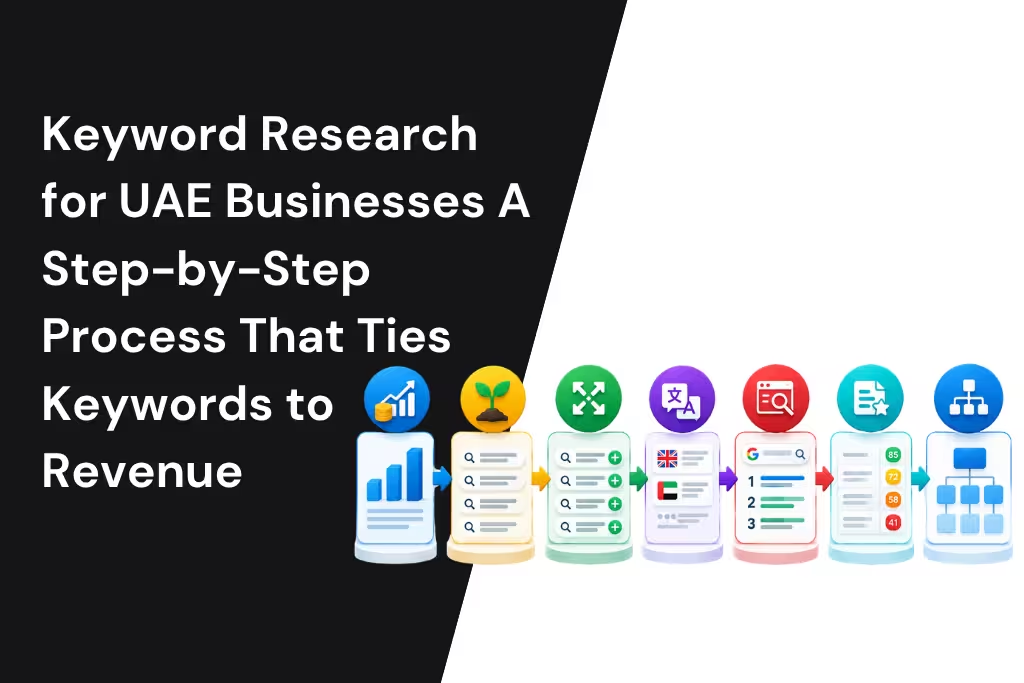
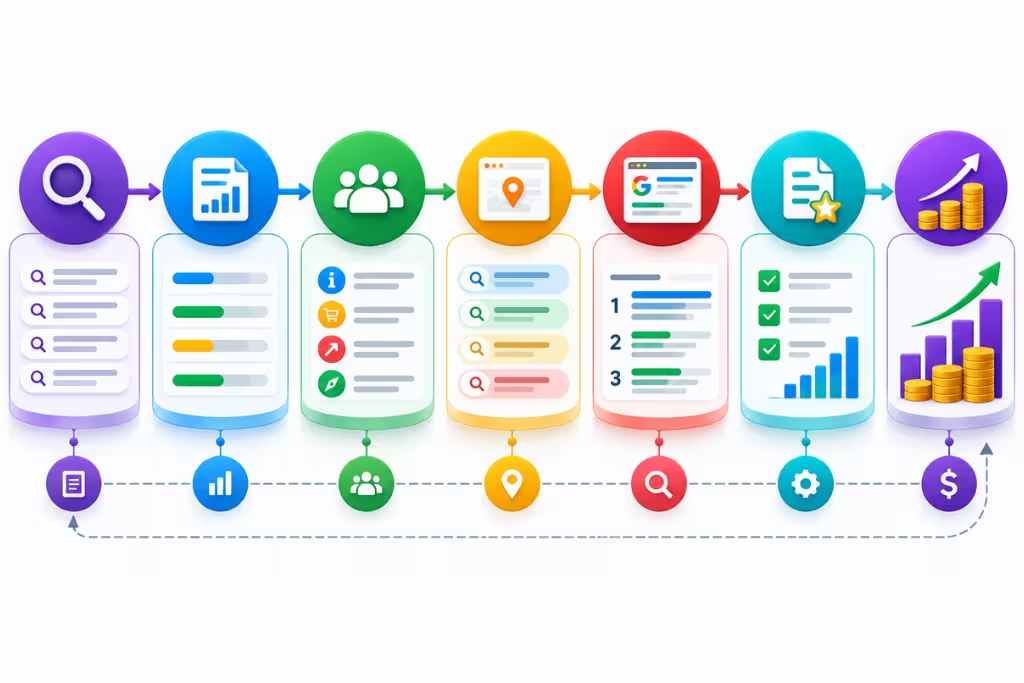
The process has seven steps:
- Start with revenue: list what you sell and what a customer is worth.
- Collect seed keywords from customers, sales calls and Search Console.
- Expand for free with autocomplete, People Also Ask, Google Trends and Keyword Planner.
- Research English and Arabic separately, including how people actually spell.
- Check intent by reading the results page for each keyword.
- Score each keyword by demand, intent and value.
- Cluster and map each group of keywords to one page.
Step 1: Start with revenue, not search volume
Before opening any tool, write down two things: what you sell, and what each sale or lead is worth to you.
For our example clinic, the list starts like this. The prices are typical published ranges from Dubai clinics on Google in October 2026, not one clinic’s fees:
| Service | Typical published price in Dubai | Source of the range |
|---|---|---|
| Teeth whitening | AED 399 to 1,900 | Dubai clinic price pages in Google results |
| Single dental implant | AED 4,500 to 8,500 | The most common range in clinic cost guides on Google UAE (some ads start lower, at AED 2,500) |
| Check-up and cleaning | Your own fee | Low value alone, but the start of a long relationship |
A clinic using this process would use its own fees and add one more number: roughly how many enquiries turn into paying patients. Multiply the two and you get the value of a lead, which is the number Step 6 uses. Even a rough estimate is enough to show that one implant enquiry is worth several whitening enquiries before you look at any search volume.
If you skip this step, you will default to the biggest numbers in a tool. For a dental clinic, that means chasing “dentist” and “dental clinic”, which are the hardest searches to win and the least specific about what the person needs.
Step 2: Find seed keywords from customers and your own data
Seed keywords are the short starting terms you expand from. The best ones come from people who already pay you, not from a tool:
- Customer language: the words patients use on the phone, in WhatsApp messages and in reviews. “Tooth implant” and “dental implant” are the same service but not always the same search.
- Sales and front desk: the questions asked before someone books. “Does insurance cover implants?” is a seed keyword.
- Your service list: one seed per service, in English and Arabic.
- Search Console: if your site already gets impressions, the Performance report shows the exact queries people used to find you, with clicks, impressions, click-through rate and average position for each.
Search Console is the most underused free source. Open the Performance report, set the country filter to the United Arab Emirates, and sort queries by impressions. Queries with high impressions and an average position between 8 and 20 are often the quickest wins, because Google already connects your site to them. One limit to know: Search Console leaves out rare queries to protect searchers’ privacy, as Google explains in its deep dive on Performance data. Treat the list as a strong sample, not every search.
Step 3: Expand for free: autocomplete, People Also Ask, Trends and Keyword Planner
You do not need a paid tool to build a solid keyword list. Four free sources cover most of what a UAE business needs.
Google autocomplete
Type each seed into Google and note every suggestion. Then add letters (“dental implants a”, “dental implants b”) or question words (“how much”, “is”, “can”) to see more. Autocomplete reflects what people actually search, adjusted for location. When we typed “dentist in” from Dubai, Google suggested the emirates first (Dubai, Sharjah, Abu Dhabi, Ajman), then neighbourhoods such as Karama, International City, Al Rigga and Silicon Oasis.
People Also Ask and related searches
Search your seed and expand the People Also Ask box. For “dental implants dubai”, Google UAE asked “How much does a dental implant cost in Dubai?” and “Is implant teeth painful?”. At the bottom of the page, “People also search for” listed “full mouth dental implants cost in Dubai”, “same day dental implants Dubai” and “all on 4 dental implants Dubai”. Each one is a keyword, and most are a section or a page waiting to be written.
Google Trends
Google Trends shows relative interest over time, not absolute volume, but it is free, works by country and is very good at comparing options. Set the location to United Arab Emirates and compare up to five terms. We compared five dental terms in the UAE over the last 12 months: “teeth whitening dubai” scored 17.3, “invisalign dubai” 8.9, “dental implants dubai” 1.9 and “dental implant cost dubai” 0.08. Trends also shows when a term is too small to measure: “teeth whitening price dubai” scored zero, which means low volume, not no searches.
Google Keyword Planner
Keyword Planner gives estimated monthly volumes and suggests related keywords. It sits inside Google Ads, and Google usually asks you to finish account setup, including billing details, before you can use it, though you do not have to run ads. Two settings matter for the UAE:
- Location: set it to United Arab Emirates, or a specific emirate. Google says average monthly searches depend on the location you choose.
- Close variants: Google groups a keyword with its close variants, so “dental implant dubai” and “dental implants dubai” share one number.
Accounts with little or no ad spend may see volume ranges rather than exact figures. Ranges are still enough to compare options.
Step 4: English, Arabic and Arabizi: research both languages properly
In the UAE, English and Arabic searches for the same service behave differently, and translating your English list into Arabic misses how people actually type. Research Arabic as its own market.
We compared five Arabic ways of searching for a dentist on Google Trends (UAE, last 12 months):
| Arabic query | Meaning | Relative interest |
|---|---|---|
| عيادة اسنان | dental clinic | 62.3 |
| دكتور اسنان | dentist (everyday “doctor”) | 26.9 |
| طبيب اسنان | dentist (formal word) | 1.4 |
| زراعة اسنان | dental implants | 0.2 |
| طبيب أسنان | dentist (formal, with hamza) | 0.1 |
The first lesson: people use the everyday word. “دكتور اسنان” was searched about 20 times more than the formal “طبيب اسنان”, That formal word is what a translation tool would give you. The second: people skip the hamza. “أسنان” written correctly scored lower than the version without it. An Arabic page written in perfect formal Arabic can still miss how customers type.
Compared directly, English still dominates for this service in the UAE: “dental clinic” scored 86.2 and “dentist” 49.1, against 5.9 for “عيادة اسنان”. Arabic demand is smaller for this service. Fewer competitors may target it well, so it is worth testing rather than ignoring.
Arabizi (Arabic typed in English letters and numbers, such as “3” for ع) is the least predictable. On 16 October 2026 we searched “zera3at asnan dubai” (dental implants Dubai) and Google handled it well: it corrected the spelling and returned Arabic implant pages from Dubai clinics. A day earlier, “ta2jeer sayarat dubai shahri” (monthly car rental) went wrong: the classic results matched a rental company called Tajeer instead of the meaning. Check your most important Arabizi terms on Google before building pages for them.
What to do with this:
- Build Arabic keyword lists from Arabic sources (autocomplete in Arabic, Arabic People Also Ask, Arabic reviews), not from translation.
- Test spelling variants, including with and without hamza, and dialect words alongside formal ones.
- Give Arabic pages their own keyword targets, and connect English and Arabic versions with hreflang.
If you run a bilingual site, our international and multilingual SEO team builds Arabic keyword research from native sources.
Step 5: Check intent by reading the results page
A keyword list tells you what people type. The results page tells you what they want. Before you assign a keyword to a page, search it on Google from the UAE and look at what ranks.
Our example shows why this matters. We searched two implant keywords from Dubai in October 2026:
| Keyword | What Google showed | What it means |
|---|---|---|
| dental implants dubai | Clinic service pages, two price-led ads (one offering implants “from AED 2500”, below the typical range), and People Also Ask questions about cost | The searcher wants a provider: target it with a service page |
| how much does a dental implant cost in dubai | Mostly clinic cost-guide articles quoting price ranges, plus ads | The searcher wants an answer first: target it with a cost guide that links to the service page |
One topic, two page types. If you try to rank one page for both, it will usually do neither well. Our guides to the types of search intent and informational, navigational and transactional queries go deeper on reading intent.
Three quick rules for reading a results page:
- Mostly service or product pages: commercial intent. Target with a service, category or product page.
- Mostly guides and articles: informational intent. Target with a blog post or guide.
- A map and local pack at the top: local intent. Your Google Business Profile matters as much as your page, which our guide to local SEO in Dubai covers.
Competitor, seasonal and branded keywords
Three more sources are worth a quick pass before you score anything.
Competitor keywords. List three or four Dubai competitors and read their service menus and page titles: each one is a keyword they have chosen to target. Search your main keywords and note who keeps appearing. Paid tools such as Semrush and Ahrefs show the keywords a competitor ranks for in the UAE database, which saves time. The free version of this step already reveals most gaps.
Seasonal keywords. Demand in the UAE moves with Ramadan, Eid, summer travel, back to school, White Friday and Dubai Shopping Festival. Check each important keyword in Google Trends over five years with the location set to the UAE. If it rises at the same time every year, plan the page or update a few weeks before the peak.
Branded and non-branded keywords. In Search Console, filter out queries that contain your brand name. What is left shows how new customers find you. A site that only gets branded clicks has no organic growth yet, however good the total looks.
Why tools disagree on volume, and how to judge difficulty
Put the same keyword into Keyword Planner, Semrush and Ahrefs and you will get three different numbers. None of them is wrong in the way people assume. Each tool estimates volume from its own data and methods, and Keyword Planner groups close variants together. Arabic is weaker still: users have reported that some popular tools show little or no Arabic volume data.
Treat volume as a rough guide for comparing keywords, not a forecast of traffic. In practice:
- Compare within one tool. Use the same source for every keyword on a list so the numbers are at least consistent with each other.
- Check Search Console once you rank. Your own impressions are the most reliable number you will ever get.
- Do not ignore very low-volume keywords. Ahrefs reports that keywords with fewer than 10 searches a month make up almost 93% of its US keyword database. Google says about 15% of the searches it sees every day are new. Many valuable, specific searches never show up as a number in any tool.
Keyword difficulty scores have the same problem: each tool calculates them differently. A better check is to look at who ranks. If the first page is all large hospital groups and directories, a new clinic site will struggle. If you see small clinic pages and thin content, you have a realistic chance.
Step 6: Score keywords by business value
Now combine demand, intent and value into one simple score. You do not need complicated software. A spreadsheet with four columns is enough:
Score = demand × intent weight × value per lead
- Demand: volume from Keyword Planner, or relative interest from Google Trends if you have nothing else. Use one source for every row.
- Intent weight: 1 for informational searches (definitions, how-to), 2 for commercial searches (comparing, checking prices, choosing a provider), 3 for “ready now” searches such as “near me” or “book”.
- Value per lead: your average case value multiplied by the share of enquiries that become customers, in thousands of AED.
Here is the example clinic. Demand comes from the Step 3 Trends comparison, case values are the midpoints of the published price ranges, and we assume 3 in 10 enquiries book for both services. That close rate is an example: use your own figure for each service.
| Keyword | Demand (Trends, UAE) | Intent weight | Case value (AED) | Value per lead (AED ’000) | Score | Target page |
|---|---|---|---|---|---|---|
| teeth whitening dubai | 17.3 | 2 | 1,150 | 0.35 | 12.1 | Whitening service page |
| dental implants dubai | 1.9 | 2 | 6,500 | 1.95 | 7.4 | Implants service page |
| dental implant cost dubai | 0.08 | 2 | 6,500 | 1.95 | 0.3 | Cost guide, linking to the implants page |
The result is not “chase the biggest keyword” and it is not “only chase high value”. Whitening wins on demand. Implants had about a ninth of the demand, yet scored more than half as high, because each case is worth so much more. The cost-guide keyword scores low on its own, but it earns a place as the supporting page that sends researchers to the implants page.
Swap in your own fees, close rates and Keyword Planner volumes and the order may change. The ranking should come from your business, not from a tool’s default sort.
Free template: download our keyword research template (Google Sheets) with the scoring formula built in.
Step 7: Cluster keywords and map each cluster to one page
Your scored list will have keywords that mean the same thing. “Dental implants dubai”, “dental implant clinic dubai” and “tooth implant dubai” should not each get their own page. Group them, then give each group one page.
A simple way to cluster: search two keywords and compare the first page of results. If most of the same URLs rank for both, Google treats them as one topic, so they belong on one page. If the results are different, they need separate pages.
For the example clinic, the page map starts like this:
| Cluster | Keywords in the group | Page |
|---|---|---|
| Implants (service) | dental implants dubai, tooth implant dubai, same day dental implants dubai | /dental-implants-dubai/ |
| Implant cost (guide) | dental implant cost dubai, how much does a dental implant cost in dubai | /blog/dental-implant-cost-dubai/ |
| Whitening (service) | teeth whitening dubai, teeth whitening price dubai | /teeth-whitening-dubai/ |
| Arabic implants | زراعة اسنان دبي and variants | /ar/… (Arabic implants page) |
When two of your pages target the same cluster, they compete with each other, and Google may switch between them or rank neither well. If Search Console shows two of your URLs getting impressions for the same queries, merge them or give each a clearly different focus.
Keyword research when AI Overviews take the click
AI Overviews now appear on many searches. When the research for this guide was done on 13 October 2026, both “keyword research” and “keyword research uae” showed one in Google UAE. They change which keywords are worth chasing.
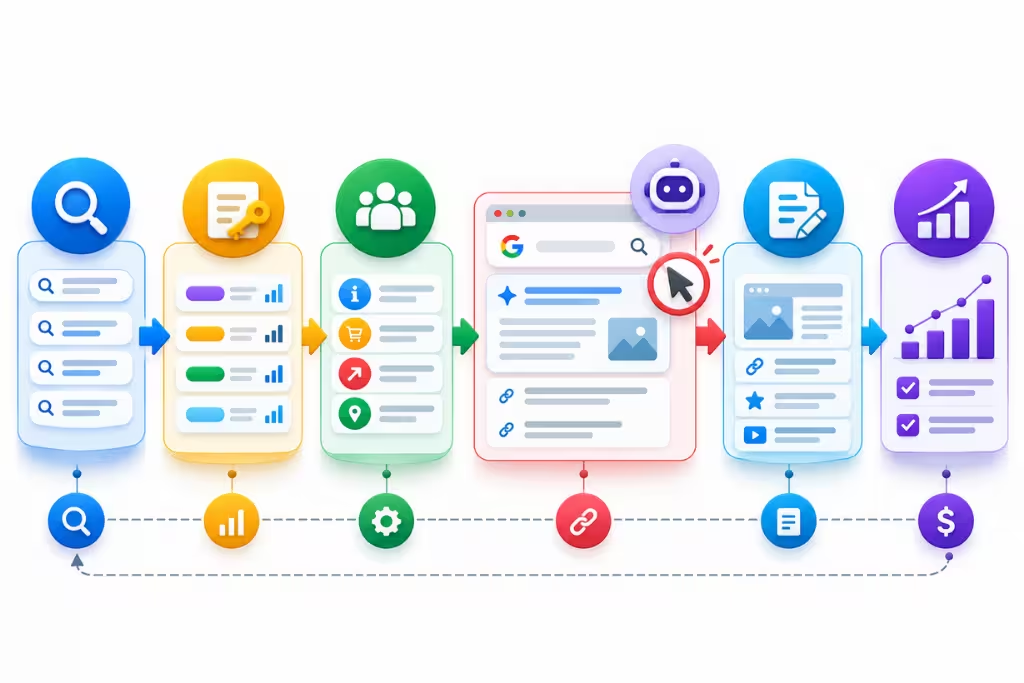
When an AI summary appears, people click less. A Pew Research Center study tracked the browsing of 900 US adults in March 2025. Users clicked a traditional result in 8% of visits when an AI summary appeared, against 15% when it did not. That is US data, so treat it as a direction, not a UAE forecast.
What it means for your list:
- Simple definitions lose clicks. “What is a dental implant” is easy for an AI summary to answer. It may still be worth covering, but do not expect much traffic from it.
- Decision and local keywords hold up better. Prices, comparisons, “near me” and booking searches still send people to websites, because they need to choose a provider.
- For informational keywords, aim to be cited. Clear, self-contained answers under each heading give AI Overviews something to quote and link.
Our guides to how Google AI Overviews work and AI SEO for Dubai businesses explain how citations are chosen.
Using ChatGPT and Gemini for keyword research: what works and what to verify
What works well:
- Brainstorming seed keywords and customer questions you had not thought of.
- Suggesting Arabic, dialect and Arabizi variants to test.
- Grouping a long list into rough clusters.
- Drafting questions for an FAQ section.
What to verify:
- Search volumes. Chatbots do not have reliable volume data and will sometimes invent numbers. Check every figure in Keyword Planner, Trends or Search Console.
- Arabic spelling. A chatbot will usually give you formal Arabic. As our Trends test showed, the formal word can be the one people search least.
- Intent. Only the live results page tells you what Google rewards.
Treat AI as a fast research assistant, not a data source. The same rule applies to Google’s own guidance on content: write for people first, not because a topic simply “seems trending”, as Google’s guide to helpful content puts it.
Turning keyword research into results
Keyword research only pays off when it becomes pages. Turn each cluster into a brief with its keywords, intent, People Also Ask questions and value score, and build the highest-scoring pages first. Then check in Search Console and GA4 which pages bring enquiries, and feed that into next quarter’s list.
If you would rather hand this over, our SEO content and copywriting team turns keyword maps into pages, and our SEO services cover the full plan from research to reporting.
Frequently asked questions
1.Can I do keyword research for free?
Yes. Google autocomplete, People Also Ask, Google Trends and Search Console are free, and Keyword Planner only needs a Google Ads account with billing details, without running ads. For most small UAE businesses, these cover the whole process in this guide.
2. How do I do keyword research step by step?
Start with what you sell and what a customer is worth. Collect seed keywords from customers and Search Console, then expand them with free tools. Research English and Arabic separately and check the results page for intent. Finally, score each keyword by demand, intent and value, group them into clusters and give each cluster one page.
3. Which AI tool is best for keyword research?
ChatGPT and Gemini are both good for brainstorming seeds, questions and Arabic variants. Neither has reliable search volume data, so verify every number in Keyword Planner, Google Trends or Search Console before you act on it.
4. Is keyword research still relevant with AI search?
Yes, but the targets shift. Simple definitions lose clicks to AI Overviews, while price, comparison, local and booking searches still send visitors to websites. Keyword research is how you find which searches still drive business and which ones to answer for citations.
5. Should I target Arabic or English keywords in the UAE?
It depends on your customers, so check both. English often has more volume, but Arabic can have less competition. Research Arabic from Arabic sources, not translation, because everyday words and spellings often beat the formal versions.
6. How long does keyword research take?
For a small business with a handful of services, the free process in this guide takes a few hours to a day. Larger sites with many products or two languages take longer, mostly in the clustering and mapping steps.
7. What are the best keyword research tools?
Start with the free ones: Google Keyword Planner, Search Console, Google Trends, autocomplete and People Also Ask. AnswerThePublic and Ubersuggest have free tiers for question and keyword ideas. Semrush and Ahrefs are the most complete paid options, with UAE databases and competitor data. Whatever you use, check its Arabic coverage, because it varies a lot between tools.
8. How can I find trending keywords?
Use Google Trends with the location set to the United Arab Emirates and look at “Rising” related queries for your main topics. Compare a few terms over 12 months and five years to separate a lasting trend from a seasonal spike.
9. Is SEO dead now with AI?
No. AI Overviews take some clicks, especially on simple definitions, but people still click through to choose providers, compare prices and book. SEO now also means being clear and specific enough for AI answers to cite you.
10. Where should keywords be placed on a page?
Put the main keyword in the title tag, the H1 and the first paragraph, and use related keywords naturally in subheadings and body text. Do not repeat a phrase for its own sake: Google matches meaning, so covering the topic fully matters more than exact repetition.
Sources
- StatCounter: Search engine market share, United Arab Emirates (September 2026)
- Google Ads Help: Use Keyword Planner
- Google Ads Help: Keyword Planner search volume and forecasts
- Search Console Help: Performance report
- Google Search Central (2022): A deep dive into Search Console performance data filtering and limits
- Google Search Central: Creating helpful, reliable, people-first content
- Ahrefs: Long-tail keywords
- Pew Research Center (2025): Google users are less likely to click on links when an AI summary appears
- Google Trends: trends.google.com (UAE comparisons run 16 Oct 2026)
- Google UAE results pages and price snippets for dental keywords, checked from Dubai, 16 Oct 2026