
How Google Uses NLP to Read Your Pages, and What That Means for Writers
NLP SEO means writing so Google’s language systems can understand what a page means, not only which words it contains. Google uses models such as BERT, neural matching and passage ranking to read words in context, spot entities like places and services, and match them to searcher intent. Clear, complete answers beat repeated keywords.
What is NLP in SEO?
NLP stands for natural language processing. It is the branch of computing that lets machines read and make sense of human language. In SEO, it means Google’s systems try to work out what your page means, so your job is to write pages that are easy to understand.
The term causes confusion. Some people mix it up with neuro-linguistic programming, a coaching method with no link to search. Others meet it as a sales label for a tool that gives drafts an “NLP score”. Neither is what Google does.
Here is the plain version. Google has built several language systems over the past decade. They help it work out what a searcher wants and which pages answer that need. Google does not describe any of them as counting repeated phrases. They are built to read meaning, context and the things you talk about.
If you want the wider picture first, our pillar guide on how search engines understand content, from words to entities and meaning covers the full journey. This post zooms in on language and on what writers should change.
How Google reads a page: words, entities, context and passages
Google breaks a page into small units of text and works out which real things those words refer to. It reads each word in light of the words around it and judges each section on its own. Each step rewards clear writing.
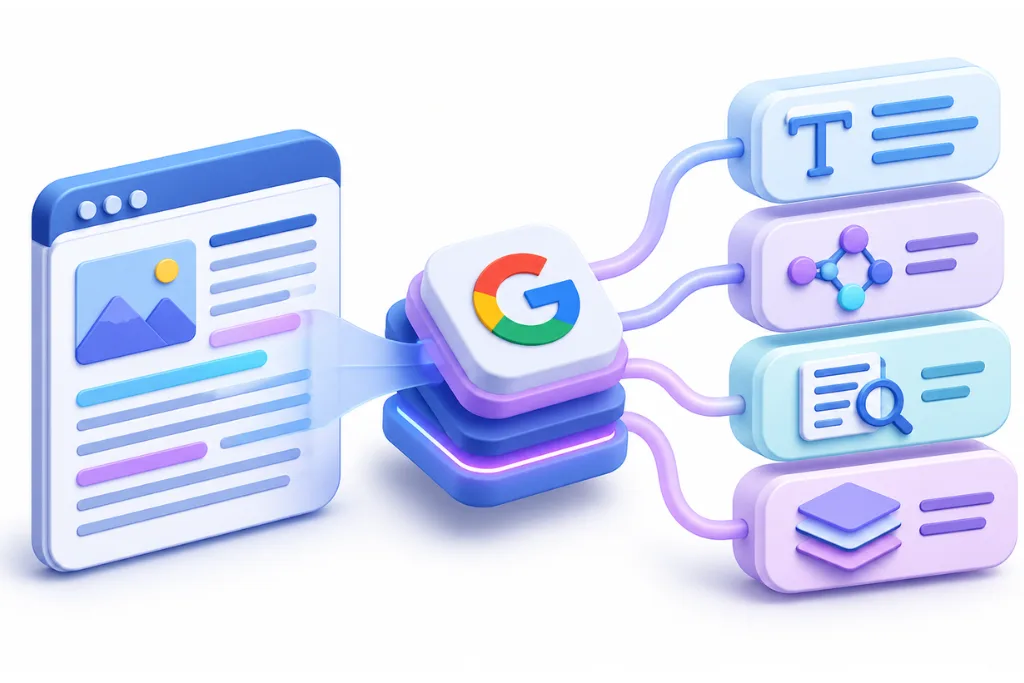
Take one sentence a Dubai firm might write: “We fit out offices in Business Bay, from design to handover.” Here is roughly what happens to it.
Words and tokens
Language models in general start by splitting text into tokens. A token is a word or a piece of a word. It is the raw material the model works with. Real text is messy, too: Google says about 1 in 10 daily queries are misspelled.
Entities
Next, Google looks for entities. An entity is a real thing with an identity: a place, a company, a person, a product or a service. In our sentence, “Business Bay” is a place in Dubai and “office fit-out” is a service. Spotting these tells Google what the page is about in a way that plain keywords cannot.
Context
Then each word is read in context. The word “fit” means something very different in “fit out offices” and “keep fit”. Models like BERT read the words on both sides of a term to settle which meaning you intend. This is how Google deals with words that have more than one sense.
Passages
Finally, Google can judge a single passage on its own. A long page may hold one paragraph that answers a narrow question very well. Passage ranking lets that paragraph count even if the rest of the page is about something wider.
The same steps run on the searcher’s side too. Our guide on how search engines understand search queries, intent, context and meaning explains that half of the match.
The language systems Google confirms
Google names its main language systems in its own ranking systems guide and blog posts. The ones that matter for writers are RankBrain, neural matching, BERT, passage ranking and MUM. MUM is the odd one out, because Google says it is not used for general ranking.
|
System |
Year |
What it does |
Used in ranking? |
Source |
|
RankBrain |
2015 |
First deep learning system in Search |
Yes |
Google, How AI powers great search results |
|
Neural matching |
2018 |
Matches queries and pages by concepts, not exact words |
Yes |
Google, How AI powers great search results; ranking systems guide |
|
BERT |
2019 |
Reads each word in context, using the words before and after it |
Yes, in ranking and retrieval |
Google BERT announcement |
|
Passage ranking |
Announced 2020 |
Judges single passages within a page |
Yes |
Google Search On 2020 |
|
MUM |
2021 |
Multitask model trained across 75 languages |
Not for general ranking |
Google MUM announcement; ranking systems guide |
A few details are worth knowing. When Google launched BERT in October 2019, it said BERT would help Search understand one in 10 English searches in the US. Its example was “2019 brazil traveler to usa need a visa”, a query where a small word like “to” changes the meaning. By February 2022, Google said BERT was used in ranking and retrieval for almost every English query.
RankBrain arrived in 2015 and neural matching in 2018, per the same 2022 post. MUM was announced in May 2021 as 1,000 times more powerful than BERT. Google’s guide to Search ranking systems describes each system, and says MUM is not used for general ranking.
Passage understanding was announced in October 2020, with Google saying it would improve 7% of queries across languages. The research behind BERT is public too, in the BERT paper by Devlin and colleagues.
Entities and the Knowledge Graph: things, not strings
Google stores facts about real things in its Knowledge Graph. When your page names entities clearly, Google can connect your words to those things. That tells Google which place, brand or service you mean when a word could point to more than one.
Google launched the Knowledge Graph in May 2012 under the phrase “things, not strings”. At launch, it held 500 million objects and 3.5 billion facts about them. The idea is simple. A string is a run of letters. A thing is a place, brand or person with known traits and links to other things.
For a writer, this is the heart of entity SEO. Name the things you mean in full. Say “Dubai International Financial Centre” before you say “DIFC”. Name your service, your area and the problems you solve. Link related ideas in the same paragraph, so the connection is plain. This is the base of semantic SEO too: writing for meaning and the links between ideas.
What changed for writers
Writers used to chase keyword density, the share of words that matched a target phrase. Today, Google’s systems read context and concepts, so clarity and coverage do more than repetition. Keyword density is no longer a useful target.
Three shifts matter most.
- From repetition to clarity. BERT reads words in context, so you no longer need the exact phrase ten times. Use it where it reads naturally, alongside the variants people actually say.
- From one keyword to one topic. Neural matching links pages to concepts, so a page can rank for searches it never quotes word for word, if it covers the topic well.
- From page to passage. Passage ranking means each section should work on its own, with a clear answer near the top.
Google’s guide to creating helpful, reliable, people-first content backs this up. It says content should be made for people first. It also says Google has no preferred word count, and that writing to hit a set length is a warning sign.
Before and after: one service paragraph rewritten
The fastest way to see NLP SEO is to rewrite a weak paragraph. Below is a typical Dubai service paragraph, written for this article as an example. It is not from a real client.
Before
“We are the best fit out company in Dubai. Our fit out company in Dubai offers fit out services in Dubai for all your needs. As a leading fit out company Dubai businesses trust, we deliver quality fit out Dubai solutions at the best price. Contact the top fit out company in Dubai today.”
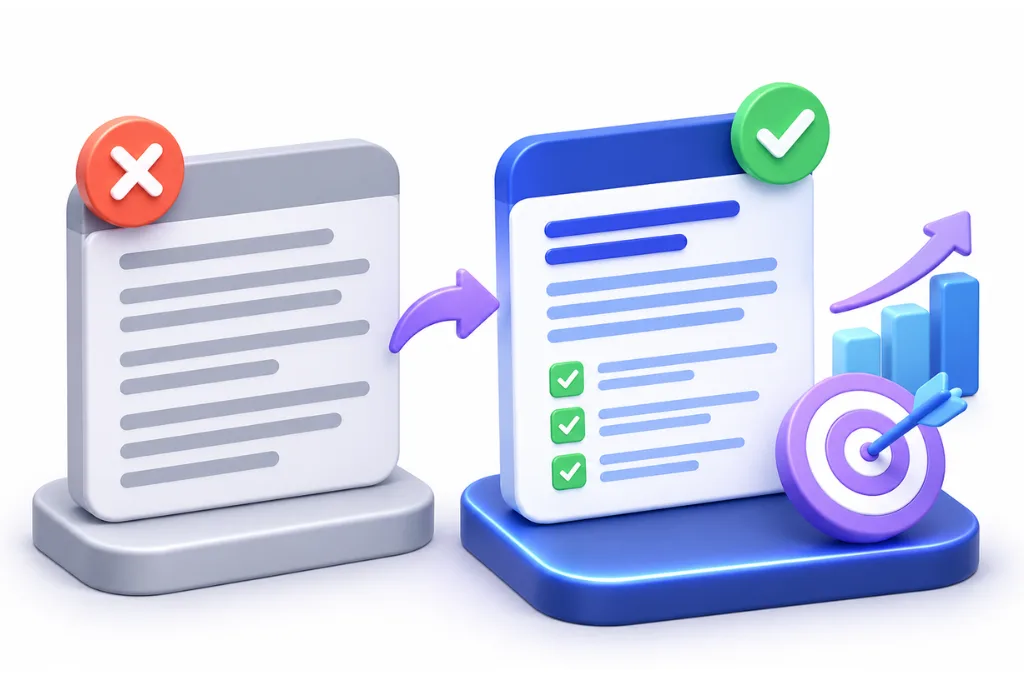
This reads as if it was written for a keyword counter. It uses “fit out company in Dubai” three times and close variants three more. Yet it names no neighbourhood, no type of space and no step in the work. Google can tell the topic, but it learns almost nothing it could use to answer a real question.
After
“We design and fit out offices for small and mid-sized firms in Business Bay, Jumeirah Lakes Towers and Dubai Silicon Oasis. Most clients come to us with a shell-and-core unit and a move-in date. We handle the layout, the drawings your building management asks for, the joinery, lighting and data cabling, then hand over a working office. If you are moving into a free zone building, we plan the work around its own fit-out rules.”
What changed
- Entities appear. Three Dubai areas, a type of client, a type of unit and named parts of the job.
- Context removes doubt. “Fit out” now sits next to “offices”, “layout” and “joinery”, so its meaning is clear.
- The passage answers real questions. Who is this for, where, and what is included.
- The topic is still clear. “Fit out offices” appears once, in a natural sentence, and the Dubai areas carry the location.
A real page would go further. It would add facts only the firm knows, such as typical timelines from its own projects. That kind of original detail fits Google’s people-first guidance, and no tool can supply it. If your team wants this kind of rewrite done for them, our website content writing services cover it.
NLP SEO myths: keywords, scores and the Natural Language API
Much of what is sold as “NLP SEO” is not something Google has ever confirmed. NLP keywords, LSI keywords and salience or sentiment scores come from tools, not from Google’s guidance. The biggest trap is treating Google’s Cloud Natural Language API as if it showed how Search ranks you.
Confirmed vs claimed
|
Idea |
Where it comes from |
What to do |
|
BERT, neural matching, RankBrain, passage ranking |
Confirmed in Google’s ranking systems guide |
Write clearly, in context, with strong passages |
|
MUM |
Confirmed, but not used for general ranking |
Do not chase it |
|
Entities and the Knowledge Graph |
Confirmed by Google since 2012 |
Name things in full and link related ideas |
|
“NLP keywords” lists |
Tool vendors |
Use as topic prompts, not a quota |
|
LSI keywords |
SEO folklore |
Ignore the label; cover the topic |
|
Salience or sentiment “score” for ranking |
Tool vendors, with numbers like those of the Cloud API |
Do not treat as a ranking signal |
|
A fixed word count |
Tool habits |
Google says it has no preferred word count |
The Natural Language API trap
Google sells a product called the Cloud Natural Language API. You paste in text and it returns entities, sentiment and more. Some NLP SEO tools show similar entity, salience and sentiment numbers, which is why they get mixed up with Search. It is a separate Cloud product for developers. Its numbers are not ranking scores.
Here is what the numbers mean, per Google’s Natural Language API basics. Sentiment score runs from -1.0 (negative) to 1.0 (positive). Magnitude runs from 0 upward with no cap and shows how much emotion the text holds. Salience appears only as a value for each entity, showing how central it is to that text.
These are useful for a quick read of a draft. If the API thinks your service page is mostly about “price”, that tells you something about your focus. But Google has not said these numbers affect rankings, and the API is not part of Search. Chasing a higher salience number or a more cheerful sentiment score is not a ranking plan.
8 writing habits that help Google understand a page
The habits that help Google read a page are the same ones that help people. Lead with the answer, name things clearly and keep one idea per paragraph. None of them need a special tool.
- Answer first. Put a two or three sentence answer at the top of the page and each section.
- Name entities in full. Write the full name of a place, brand or service before you shorten it.
- Keep one idea per paragraph. Short paragraphs make each passage easy to judge on its own.
- Make pronouns clear. If “it” could mean two things, use the noun again.
- Write descriptive headings. A heading should say what the section answers, not tease it.
- Define terms once, in plain words. A one-line definition helps readers and models alike.
- Cover the related questions. Think about what the searcher asks next and answer it on the page.
- Add structured data where it fits. Schema markup, such as Organization or Article, states facts in a form machines read directly.
We apply the same list in our content marketing and SEO copywriting work.
Arabic and bilingual pages in the UAE
Arabic pages need the same clarity, plus care with how people really search. In the UAE, the same need may be typed in Modern Standard Arabic, in Gulf dialect, in Arabizi (Arabic written in Latin letters) or in a mix with English. Your pages should match the language your buyers use.
Arabic is built on word roots. One root can carry many related words through prefixes, suffixes and patterns. So a single exact-match form of a keyword covers even less of how people search in Arabic. Write natural sentences and use the terms your audience uses, rather than forcing one form again and again.
Dialect matters too. Modern Standard Arabic is the formal written form. Gulf Arabic is what many people speak and sometimes type. A searcher may also write an Arabic word in Latin letters. Our guide on how Google interprets Arabic and transliterated search queries covers how this plays out in search.
For bilingual sites, a few habits help:
- Write each language on its own page. Do not mix two full languages in one block of body text.
- Translate meaning, not words. A literal translation of an English service page often reads badly in Arabic.
- Keep entity names consistent. Use the same Arabic and English names for your brand, areas and services across pages.
- Mark each language version. Use hreflang tags so Google knows which page serves which language and region.
A clear, natural Arabic page is usually easier for people and machines to read than a stiff translation of the English one.
NLP, AI Overviews and LLMs
Large language models (LLMs), the technology behind tools like ChatGPT and Gemini, are a newer form of NLP. Google now shows AI Overviews above the results for many searches. In our view, the habits that help Google read a page also make a passage easier to quote in an AI answer.
When we checked Google UAE on 16 November 2026, an AI Overview sat at the top for both “nlp seo” and “how does google use nlp”. For “nlp seo” it gave a short definition and a few principles, such as intent over keywords and entity recognition. For “how does google use nlp” it explained two things: understanding queries and intent, and analysing content through entities and the Knowledge Graph. Sources cited included Semrush, Search Engine Land and several YouTube videos.
So what is the same, and what is new?
- The same: Google still needs to understand your words, your entities and your intent.
- New for writers: a short answer under a clear heading stands on its own. That is why this article opens each section with one, and we suggest you do the same.
- New for writers: facts and examples that only you have give an AI answer a reason to cite your page rather than one that says the same thing.
LLM stands for large language model. It is one type of NLP system, not a rival to it. ChatGPT and Gemini are LLMs, and BERT is an earlier, smaller language model. The point for writers is the same across all of them: make your meaning easy to pull out.
How to check Google understood your page
Search Console gives you good clues about whether Google understood your page. Look at the queries that bring impressions to that URL. If they match your topic and spread into related questions, Google most likely read the page the way you meant.
Here is a simple check:
- Open the Performance report in Google Search Console.
- Filter by the page URL, then open the Queries tab.
- Read the full list, not just the top 10. Look for related questions you answer but never quote word for word. That is a good sign.
- Look for odd queries. If a fit-out page shows up for “fitness centre Dubai”, a word on the page may be read in a different sense, though other causes are possible.
- Search your main query on Google UAE yourself. Check which pages rank, and whether an AI Overview appears and which sources it cites.
If the spread is narrow or off-topic, return to the writing habits above. Clarify entities, tighten each section’s opening answer and add the questions searchers ask next. If you want help reading these reports, our SEO services page explains what we cover.
FAQ
Yes. Google uses several natural language systems in Search, including RankBrain, neural matching, BERT and passage ranking. They help Google understand what a query means and which pages answer it. Google describes these systems in its public ranking systems guide.
NLP in SEO means writing so Google’s language systems can understand your page’s meaning, entities and context. It shifts the focus from repeating keywords to giving clear, complete answers that name the places, services and ideas a searcher cares about.
Yes. ChatGPT is a large language model, and large language models are a type of natural language processing system. NLP is the wider field, and LLMs are one of its newest and largest tools.
The question compares a part with the whole. An LLM is one kind of NLP model, so it is not better or worse than NLP. LLMs handle a wider range of tasks than older NLP methods, while smaller models such as BERT are built for narrower jobs.
Yes. Every search, AI Overview and chat answer depends on machines reading language, which is what NLP does. The methods have moved from rule-based systems to large models, and Google still lists language systems such as BERT in its ranking systems guide.
No. A tool can help you spot gaps or check which entities a draft stresses, but it does not show how Google ranks you. Clear writing, named entities and full answers matter more than any score.
There is no Google guidance that says a positive tone lifts rankings. Sentiment scores come from tools such as the Cloud Natural Language API, which is a separate product from Search. Write in the tone that suits your reader and your topic.
Not as a target. Google’s language systems read words in context and match pages by concept, so repeating a phrase adds little. Use your main term where it reads naturally and spend the effort on clear, complete answers.
They overlap heavily. NLP SEO focuses on how Google’s language systems read your words, while semantic SEO focuses on covering a topic’s meaning and the links between ideas. In practice, both lead to the same habits: clear answers, named entities and full coverage.
Sources
- Google: Understanding searches better than ever before (BERT)
- Google: MUM, a new AI milestone for understanding information
- Google: How AI powers great search results
- Google Search Central: A guide to Google Search ranking systems
- Google: Search On 2020, how AI is making Search more helpful
- Google: Introducing the Knowledge Graph, things, not strings
- Devlin et al.: BERT, Pre-training of Deep Bidirectional Transformers for Language Understanding
- Google Cloud: Natural Language API basics
- Google Search Central: Creating helpful, reliable, people-first content