
Do Clicks Affect Google Rankings? What the Evidence Actually Shows
Yes, clicks affect Google rankings, but not through your raw click-through rate. Google says it uses aggregated, anonymized interaction data to judge relevance. US court records show a system called NavBoost learns from about 13 months of click data. The CTR you see in Search Console is a report metric, not that ranking signal.
Is CTR a ranking factor?
Google does not use raw click-through rate as a simple ranking factor, but it does learn from clicks. Its own documentation says it uses aggregated, anonymized interaction data, and US antitrust trial records show a system called NavBoost uses about 13 months of click data to refine rankings. Search Console CTR is a report metric, not that signal.
That answer has changed. For years, the common verdict was “CTR is not a ranking factor”, and many top results still repeat it. Then came expert testimony in court in 2023, a large document leak in 2024 and a court ruling in 2025. Together they show clicks matter, though not as a simple CTR score.
This post sits under our guide to how search engines understand queries, intent and meaning. That guide covers what Google reads before the click. Here we cover what Google learns after it.
What Google has said publicly about CTR and dwell time
Google’s public line has two parts. Its Search analyst Gary Illyes has dismissed CTR and dwell time as ranking factors, while its own documentation says it uses interaction data. Both can be true, because one is about simple metrics and the other is about processed signals.
The “made up” comment
In a 2019 Reddit AMA, Google’s Gary Illyes was blunt. As Search Engine Roundtable reported, he said: “Dwell time, CTR, whatever Fishkin’s new theory is, those are generally made up crap.”
What Google’s How Search Works page says
Google’s own How Search Works page on ranking results tells a fuller story. It says Google uses “aggregated and anonymized interaction data to assess whether search results are relevant to queries”. It adds that this data is turned into signals that help its machine-learned systems estimate relevance.
So Google is not saying clicks are ignored. Our reading is that raw metrics like CTR are not used as they are. The data is pooled across many users and turned into signals before it touches rankings.
What the antitrust trial showed about NavBoost and clicks
The US antitrust case against Google put its own documents on the public record. They show that a system called NavBoost has used clicks to improve rankings for many years. They also show it relies on large amounts of data gathered over time.
Lehman’s ranking newsletter
In October 2023, economist Michael Whinston gave direct testimony for the government. He quoted a 2016 internal newsletter by Google engineer Eric Lehman. It said “Navboost is the original click exploitation system and still the most potent”. It also said “Exploiting user feedback, principally clicks, has been the major theme of ranking work”.
The same testimony quotes Google’s Amit Singhal from 2006: “Navboost has locked out small players from the ranking game.” We read that as a sign Google saw its click data as an edge over smaller search engines.
Nayak, Kim and the 13 months of data
Two exhibits from the 2025 remedies phase add detail. A record of a 31 January 2025 call with Google’s Pandu Nayak (exhibit PXR0357) says NavBoost “uses most recent 13 months of data”. The same record says Google “avoids simply predicting clicks because clicks are easily manipulated”. It also says RankBrain and DeepRank are used “to generate signals”, a sign that machine learning sits between raw clicks and final rankings. Our post on how Google’s algorithm has changed over time puts RankBrain in that history.
A record of an 18 February 2025 call with Google’s HJ Kim (exhibit PXR0356) describes the ABC signals: anchors, body and clicks. The C is described as, historically, how long a user stayed at a linked page before bouncing back to the results page. For the wider list of systems and signals, see our guide to how Google ranks and displays results.
The 2025 remedies ruling
On 2 September 2025, Judge Amit Mehta issued his memorandum opinion on remedies. It says Google “will have to make available to Qualified Competitors certain search index and user-interaction data”. The dataset is a narrowed one. Still, the court treated user interaction data as a key search asset worth sharing with rivals.
What the 2024 API leak added
In May 2024, a leak of Google’s internal API documents showed the names of many click fields Google stores. It listed fields named goodClicks, badClicks and lastLongestClicks. It did not show how much any of these fields count.
What was in the documents
Rand Fishkin of SparkToro broke the story on 27 May 2024. The Content Warehouse API documents ran to over 2,500 pages with 14,014 attributes. They had been public on GitHub from 27 March to 7 May 2024. They refer to NavBoost, Glue, goodClicks, badClicks, lastLongestClicks, squashed and unsquashed clicks, and metrics based on Chrome.
One model, QualityNavboostCrapsCrapsClickSignals, lists fields such as impressions, clicks, goodClicks, badClicks, lastLongestClicks, unicornClicks and unsquashedClicks.
Good clicks, bad clicks and the last longest click
The field names are clear enough to explain in plain words. A good click likely means the searcher found what they needed. A bad click likely means they came back fast and tried something else. The last longest click is the result a searcher clicked last and stayed on longest, which suggests their search ended there.
What the leak does not prove
Fishkin himself points out that the documents do not show the weight of any feature. A field in an API can be used heavily, lightly, or not at all. Treat the leak as proof that Google stores these click types, not as a recipe for rankings.
The evidence ladder: confirmed, likely, unproven and myth
Not every claim about clicks has the same proof behind it. The table below grades each claim by its best source. Google’s own words and court records sit at the top, and claims with no source at all sit at the bottom.
|
Claim |
Best source and date |
Verdict |
|
Google uses aggregated, anonymized interaction data for relevance |
Google, How Search Works |
Confirmed by Google |
|
NavBoost uses clicks and has been a key ranking system |
Whinston testimony quoting Lehman (2016), Oct 2023 |
Confirmed in court records |
|
NavBoost uses the most recent 13 months of data |
Nayak call record, Jan 2025 |
Confirmed in court records |
|
Time on a page before returning to results is the C in ABC signals |
Kim call record, Feb 2025 |
Confirmed in court records |
|
Google stores goodClicks, badClicks and lastLongestClicks |
API leak, May 2024 |
Likely used, weight unknown |
|
Longer views can score a result above shorter views |
Patent US8661029B1, filed 2006 |
Unproven in use |
|
Click logs can train a ranking model |
Joachims, Cornell, 2002 |
Confirmed in research |
|
Your Search Console CTR directly moves your position |
No source |
Myth |
|
GA4 bounce rate is used to rank pages |
No source |
Myth |
|
Buying clicks or CTR bots lifts rankings |
Nayak call record: Google avoids predicting clicks because they are “easily manipulated” |
Myth |
|
RankEmbed BERT is trained on real users’ click and query data |
Marie Haynes on Liz Reid’s appeal declaration, Jan 2026 |
Likely |
Two older sources explain why clicks were always likely to matter. Thorsten Joachims showed in a 2002 Cornell paper that click logs can be turned into preference data to train a ranking function. Google’s patent US8661029B1, filed in 2006 and granted in 2014, scores results by comparing longer views against shorter ones.
There is newer reporting too. In January 2026, Marie Haynes wrote about Liz Reid’s appeal declaration in Search Engine Journal. In her reading, RankEmbed BERT is trained on click and query data from real users. That is one author’s reading of a filing, so we grade it as likely, not confirmed.
Search Console CTR is not the ranking signal
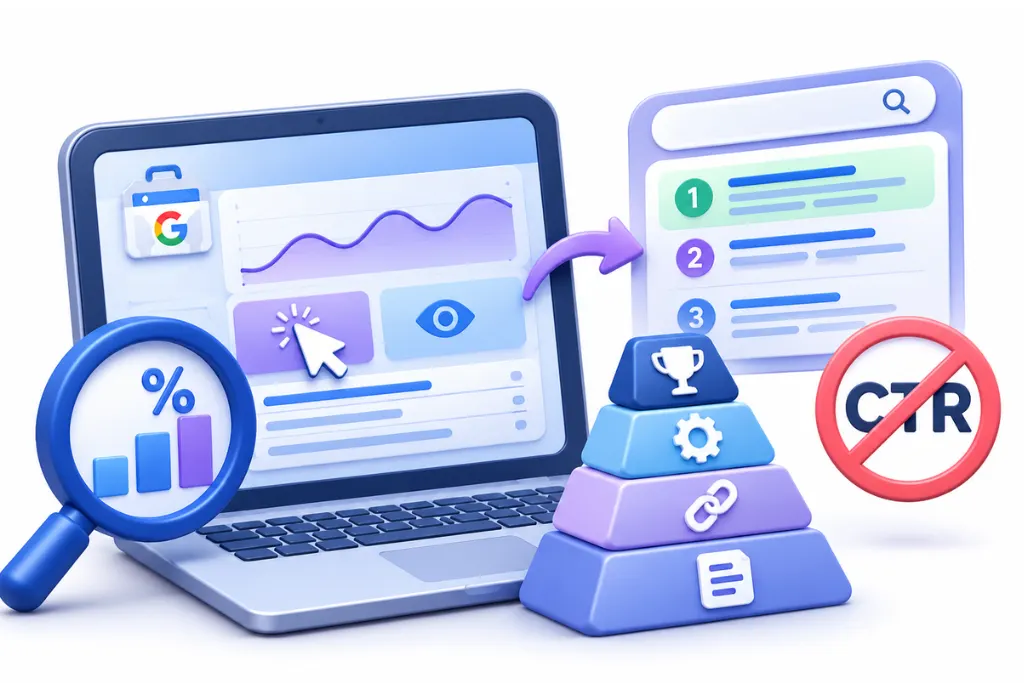
The CTR in Search Console is a simple report: clicks divided by impressions. Google’s internal signals are pooled across many users and turned into signals before use. A low CTR in your report is usually a sign of where you rank and what sits above you, not a penalty.
What the report actually measures
Google’s Performance report help page defines CTR as “the click count divided by the impression count”. An impression is counted each time your site appears in the results. Average position is the average position of your topmost result.
That makes CTR mostly a function of position. A page on page four can earn impressions and very few clicks, because searchers rarely go that deep. You can track these numbers alongside the rest of your reporting using our guide to measuring SEO performance.
What else pulls CTR down
Several things lower CTR without saying anything about page quality:
- Position: the lower you rank, the fewer people reach you.
- SERP features: AI Overviews, video packs, maps and ads can sit above your link.
- Brand: searchers often click names they know, so branded queries tend to behave differently from non-branded ones.
- Query mix: one page can rank for dozens of queries, some of which it barely fits.
When we checked Google UAE for “ctr ranking factor” on 15 November 2026, an AI Overview sat at the top, followed by a video pack. Any page ranking for that term competes with both before a searcher reaches the blue links.
Dwell time, pogo-sticking and bounce rate
Google can see what happens on its own results page. It can see a click, and whether the searcher came back and clicked something else. We found no evidence that it uses your GA4 bounce rate.
Dwell time and pogo-sticking
Dwell time is the time between clicking a result and returning to the results page. Pogo-sticking is when a searcher bounces between several results, which suggests none of them helped. Kim’s call record describes the C signal in similar terms: historically, how long a user stayed before bouncing back. The leaked fields for good, bad and last longest clicks fit the same idea.
Why GA4 bounce rate is different
GA4 bounce rate and engagement rate are measured on your site by your analytics tag. Our reasoning: many sites do not use Google Analytics, so it would make a patchy ranking signal. We found no Google statement, court exhibit or leak entry that links GA4 bounce rate to rankings. Use it to improve your pages, not to guess your rankings.
Why buying clicks and CTR bots backfire
Click services and CTR bots promise to raise rankings by faking searches and clicks. The evidence points the other way. Court records show Google treats clicks as easy to manipulate and avoids relying on them directly.
Nayak’s call record says Google avoids simply predicting clicks because they are “easily manipulated”. The leaked documents list squashed and unsquashed click fields, though they do not explain how these are used. NavBoost also works over 13 months of data, so in our view a short burst of fake clicks would be a small part of a large pool.
If a freelancer offers you CTR bots or a click package, treat it as a red flag. There is a business cost as well. You pay for traffic that never buys, you muddy your own reporting, and you learn nothing about what real searchers want.
How to earn better clicks honestly
Match the title to what the searcher wants, promise only what the page delivers, and then solve the task fully. This is what turns a click into a good click or a last longest click.
Match intent in the title
A title that fits the query earns the click from the right people. Before you write one, decide which type of search intent the query has. Someone searching “how to calculate ctr” wants the formula, not a history of SEO.
Promise what the page delivers
A clickbait title may lift CTR for a while. If searchers return to the results and click another page, those look like bad clicks. Keep the title and description honest, and put the answer near the top of the page. Our on-page SEO optimization work focuses on this match between title, snippet and content.
Satisfy the task
Google’s human raters judge pages on whether they meet the searcher’s need, and our guide to search quality evaluation principles explains what they look for.
How to test a title change in Search Console without fooling yourself
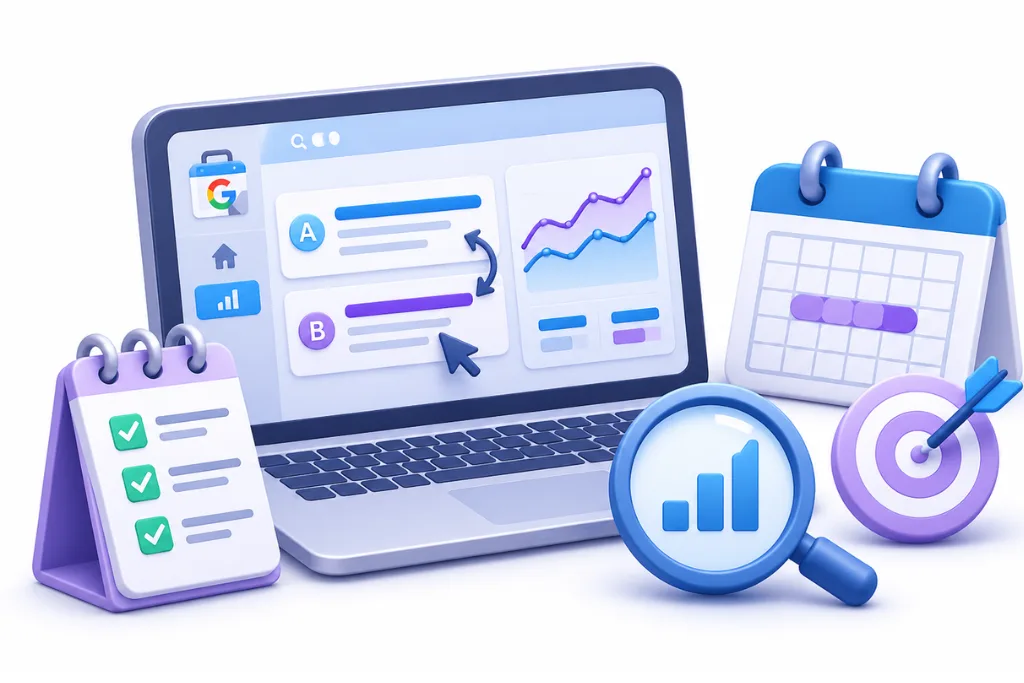
To test a new title, compare 28 days before and 28 days after the change for the same page and queries. Only trust a CTR change if average position stayed about the same. If position moved, the CTR change is probably about position, not your title.
The 28-day method
- Pick a page with steady impressions and a stable average position over the past two months.
- Note its CTR and average position for the last 28 days, filtered to that page and its main queries.
- Change only the title and meta description. Do not edit the content or links in the same window.
- Wait 28 days after Google shows the new title, then compare the same filters.
- Count it as a result only if position held steady and impressions stayed in a similar range.
Leave out branded queries, since they behave differently. Watch for seasonality too. In the UAE, Ramadan, summer and year-end can shift demand on their own.
A worked example from our own data
Our ranking pillar shows why position comes first. In Search Console, from 14 August to 13 November 2026, queries containing “how google rank” earned 570 impressions and 0 clicks. Average position was 39.6, and 569 of those impressions went to that one page.
At position 40, no title change will fix that. Searchers rarely reach page four, so this query set has no clicks to improve and gives Google a weak sample at best. The job for that page is rankings first: stronger content, better internal links and more authority. A title test makes sense once a page reaches the first page.
What this means for UAE websites
Small local queries and Arabic queries may not carry enough clicks to say much, so links, content and your Business Profile likely carry more weight there. Click systems work on aggregated data over many searches. This section is our reasoning from the evidence, not a published Google rule.
Low-volume local queries
A narrow query like “seo agency in Dubai Marina” likely gets far fewer searches than a broad one. NavBoost pools 13 months of data, but a small query still gives a thin sample. For queries like this, relevance and authority are likely to decide more than clicks do.
Arabic and English results
Many UAE businesses run bilingual sites. An Arabic query and its English version are different searches, with different results and different click patterns. Each language version of a page likely builds its own history, so a strong English page probably does not lend its clicks to the Arabic page.
The local pack
For “near me” and service searches, the map pack often appears above the blue links. Many of those clicks go to your Google Business Profile rather than your website. Keep the profile accurate, active and well reviewed, because it is often the first thing local searchers choose.
Where clicks fit among Google’s ranking signals
Clicks are one input among many. The evidence suggests they help Google refine the order of pages it already finds relevant. A page with no impressions on page one gets few clicks, so content, links and intent match come first.
Our SEO audit sorts your low-CTR pages into two groups. Some need a better title. Others need better rankings first.
FAQ
NavBoost is a Google ranking system that uses click data to refine results. Court records describe it as the original click exploitation system and say it uses the most recent 13 months of data. It works on clicks pooled across many searchers, not on any single visit.
A good click likely means the searcher found what they needed and stayed. A bad click likely means they came back to the results quickly and tried another page. These field names appear in the 2024 leak, but the documents do not show how much each one counts.
It is the result a searcher clicked last and stayed on longest during a search. That suggests the search ended there because the page answered the question. The field appears in the leaked documents, so it is something Google stores, with its weight unknown.
No. CTR rises and falls with position, SERP features, brand and season, so a higher CTR can follow a ranking gain rather than cause it. Only a test that holds position steady can tell you whether a new title earned more clicks.
It depends on your position, your brand and what sits above you in the results. The same CTR can be strong for one query and weak for another. Compare pages at similar positions on your own site rather than using a universal benchmark.
The evidence says no. Court records show Google avoids relying directly on clicks because they are easily manipulated, and NavBoost pools 13 months of data. Fake clicks also cost money and distort your own reporting.
Divide clicks by impressions and multiply by 100. A page with 50 clicks from 1,000 impressions has a CTR of 5 percent. Search Console calculates this for you in the Performance report.
Yes, according to a record of a January 2025 call with Google’s Pandu Nayak. The record says RankBrain and DeepRank are used to generate signals. Machine learning systems like these sit between raw clicks and the final ranking.
Not as a number you can measure in analytics. Court records describe a click signal based on how long a user stayed on a page before returning to the results. Google measures that on its own results page, so focus on fully answering the search rather than on time on page.
Yes. Fewer clicks may reach your page when an AI Overview sits above it. The evidence suggests the clicks you do get still feed Google’s view of whether your page satisfied the search. Write for the searchers who click through and make sure the page ends their search.
Sources
- Google: How Search Works, Ranking results
- Google Search Console Help: Performance report (Search results)
- Search Engine Roundtable: Google’s Gary Illyes on CTR and dwell time (2019)
- US Department of Justice: Direct testimony of Prof. Michael Whinston, US v. Google LLC (Oct 2023)
- US Department of Justice: Exhibit PXR0357, Pandu Nayak call record (Jan 2025)
- US Department of Justice: Exhibit PXR0356, HJ Kim call record (Feb 2025)
- Judge Amit Mehta: Memorandum opinion on remedies (Sep 2025)
- SparkToro: Leaked Google Search API documents (May 2024)
- Content Warehouse API: QualityNavboostCrapsCrapsClickSignals
- Google Patents: US8661029B1, Modifying search result ranking based on implicit user feedback
- Thorsten Joachims: Optimizing Search Engines using Clickthrough Data (2002)
- Search Engine Journal: User data is important in Google’s ranking systems (Jan 2026)