
Predictive Models
DATA & BI ANALYTICS .> Predictive Models and data forecasting
Predictive Models & Data Forecasting
Build strategic foresight with AI-driven predictive models—helping UAE businesses anticipate trends, optimize decisions, and stay ahead of the curve.
Business-Led Models
We model what matters—sales, churn, risk, or behavior—based on your goals.
Integrated Data Sources
We connect marketing, sales, and ops data for cross-functional accuracy.
UAE Business Context
Our forecasting considers seasonal trends, economic patterns, and local market behavior.
Why Choose Us
Data That Looks Forward
Our predictive models go beyond reports—they analyze patterns, detect signals, and forecast outcomes so you can act smarter, faster, and with more certainty.
“The forecasts helped us prevent losses and act on opportunity windows.”
Kareem Fadel
―Operations Director

Custom Predictive Model Design
We build statistical and machine learning models tailored to your KPIs—forecasting outcomes like sales, churn, or demand based on real-time and historical data.
- Fully tailored logic
- KPI-aligned predictions
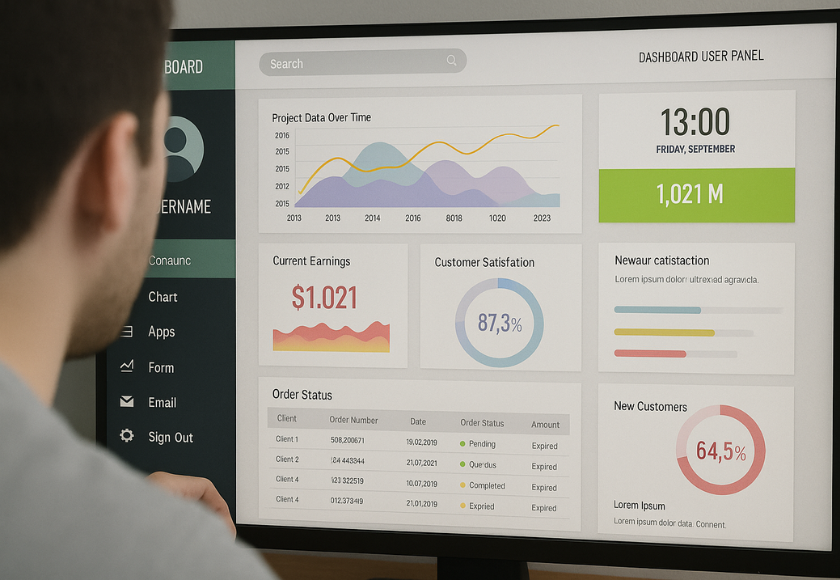
Forecast Dashboards & Alerts
Interactive dashboards with forecast visualizations and smart alerts to help you see what’s ahead and respond before it happens.
- Scenario modeling
- Trend alerts built-in
Our Services
Explore UAE Predictive Modeling Services
Whether you’re forecasting growth, preventing risk, or optimizing strategy—our UAE-based predictive modeling services deliver insight you can act on.

Sales Forecasting Models
Predicting monthly, quarterly, or seasonal revenue based on historic and live inputs.
Churn Prediction Models
Identifying customers likely to leave based on usage patterns, engagement, and signals.
Demand Forecasting
Anticipating product/service demand to align inventory, supply chain, and marketing.

Retention Prediction Models
Forecasting which segments will stay loyal based on interaction trends.
Campaign Performance Prediction
Modeling expected ad or email campaign outcomes before launch.

Predictive BI Integration
Embedding models into dashboards for ongoing insight, alerts, and decision triggers.
Predictive Models
Predictive Models: Forecasting Brand Outcomes with Strategic Intelligence in the UAE
In a market that moves as fast and as intelligently as the UAE, brands cannot afford to operate reactively. Predictive models enable strategic foresight—using data, behavior patterns, and trend indicators to anticipate outcomes before they happen. At Octopus, we design and implement predictive models tailored to branding, marketing, audience engagement, and business growth. These models transform uncertainty into planning power, allowing leadership to guide, calibrate, and accelerate performance with clarity.
Why Predictive Models Matter for UAE Brands
Dubai and Abu Dhabi lead the region in data-driven innovation. From AI-powered services to fintech ecosystems and hyper-personalized commerce, the UAE economy rewards brands that think ahead. Predictive models help you understand not just what is, but what’s likely next. They guide timing, targeting, resourcing, and messaging—ensuring you move from insight to action with speed.
Whether you’re launching a new product, entering a new audience vertical, optimizing media spend, or preparing for a leadership transition, predictive modeling lets you simulate scenarios and choose your strategic path with intelligence and foresight. For legacy brands, predictive models reveal where audience sentiment is shifting. For startups, they clarify which audience segments are emerging as high-value or high-risk. For enterprises, predictive modeling is the key to long-term resilience in rapidly shifting economic cycles.
Types of Predictive Models We Build
At Octopus, we develop multiple categories of predictive models depending on client goals. These include audience behavior forecasting, where we anticipate how key user segments are likely to respond to brand campaigns, content releases, or service updates. Channel performance modeling allows us to estimate the future return on investment, engagement quality, or conversion rate for each marketing platform based on historical velocity and competitive benchmarks.
Content performance modeling focuses on projecting which themes, tones, or formats are likely to sustain or increase visibility and credibility across your brand ecosystem. Sentiment prediction uses language patterns, time-of-day posting behavior, and campaign positioning to estimate mood response and tone evolution. Lead quality scoring models are essential for high-ticket brands that depend on qualified, behavior-aligned prospects, while brand health indexing models help us model future changes in brand trust, relevance, and equity value based on your planned brand activity and macro-environmental shifts.
Each model is built to reflect your actual performance trajectory, data availability, brand lifecycle, and strategic direction. Our goal is not to impress with algorithmic complexity—but to empower with interpretive accuracy and decision value.
Strategic Inputs and Data Signals
Predictive models are only as powerful as their inputs. Octopus works with clients to gather and structure data from internal systems, platform analytics, CRM platforms, public sentiment, and category trend signals. We look at cross-channel engagement, campaign timing, search velocity, audience clusters, and metadata patterns.
We integrate both structured inputs (like analytics and CRM fields) and unstructured signals (like social commentary, webinar Q&As, event feedback, and voice-of-customer interviews). We also layer in regional context, including platform penetration, seasonal behavior, and macro signals like Expo or Ramadan campaign surges.
Our input mapping includes creative timing, CTA structures, influencer sentiment, competitor actions, and algorithm changes. We use this to calibrate confidence ranges, define context curves, and create multi-path forecasts with dynamic thresholds.
Model Design, Calibration, and Testing
Octopus builds models using a blend of business logic, behavioral heuristics, regression analysis, clustering, and time-series forecasting. We begin with simple interpretive maps—showing where performance inflected historically and why. We then prototype model frameworks, simulate outputs, and test predictive accuracy against your past six to twelve months of data.
Our calibration process stress-tests predictions against edge cases, such as product recalls, unexpected campaign virality, platform outages, or political shifts. We ensure that models are flexible enough to adapt while staying rooted in causality—not just correlation. We also provide model documentation and confidence interpretation training, so your team can trust the tool and explain its output to other stakeholders.
Predictive Dashboards and Scenario Mapping
We deliver predictive models through dynamic dashboards and visual decision maps. These dashboards allow stakeholders to input new variables—like revised budgets, content pivot plans, or timing changes—and instantly simulate the impact. Outputs are displayed as confidence intervals, growth trajectories, channel path trees, and persona influence shifts.
Scenario mapping includes multi-path forecasts for best case, worst case, and expected case. Visualizations include time-to-impact, budget sensitivity, message fatigue risk, and competitive response timelines. These tools help you make real-time adjustments, preparing your team to pivot fast without losing coherence or confidence.
Integration with Strategic Planning
Predictive modeling becomes most valuable when embedded in planning cycles. Octopus uses quarterly and campaign planning sessions to turn forecast outputs into strategy choices. We use predictive inputs to inform message hierarchies, audience phasing, media spend allocation, and team structure recommendations.
For leadership teams, our models offer a future-facing lens that allows more assertive vision-setting. For creative and content teams, predictions clarify timing, narrative arc, and fatigue points. For performance and growth teams, the models identify underused platforms, over-invested channels, and unrealized high-yield formats.
Optimizing Over Time
Models do not remain static. Octopus runs ongoing back-testing cycles to ensure predictive validity improves. We assess drift by comparing predicted versus actuals every 30, 60, and 90 days. We also refine models based on environmental shifts: from consumer sentiment to media pricing changes, influencer engagement trends, or search intent pivots.
With each round of calibration, model confidence improves. We integrate feedback from campaign results, team reviews, and market developments. Over time, predictive modeling becomes a dynamic asset—not just a data tool, but a strategic advantage.
Team Enablement and Decision Confidence
Predictive modeling must be understood, not just used. Octopus provides team training on interpreting forecasts, communicating probability, explaining caveats, and using prediction to drive collaboration. We build model visualization tools and decision playbooks that make adoption easier across leadership, marketing, and brand teams.
Our goal is to ensure that predictive modeling strengthens confidence—not just forecasting precision. We help teams see further, act faster, and align better. We bridge the gap between intuition and analytics, helping leadership ask smarter questions and take better-aligned action.
Why Octopus for Predictive Models in the UAE
Octopus combines strategic thinking, brand intelligence, data modeling, and visual communication into one integrated system. We understand the nuances of UAE audiences, platforms, and performance expectations. Our predictive models are not built in isolation—they’re embedded in strategy, creative, leadership, and execution. They’re easy to use, easy to understand, and hard to ignore.
We bring together data clarity and brand ambition. We design models that move with your business—tracking today and forecasting tomorrow. In a region that thrives on transformation, predictive models give you the advantage of anticipation.
Choose Octopus for predictive modeling in the UAE—and move from reactive marketing to proactive leadership with data-driven direction and strategic foresight.
Let's get started
be part of the future
Outpace your rivals with Octopus Marketing Agency – be the brand that leads, not follows

Got a question? Get your answers
Quick answers to questions you may have. Can’t find what you’re looking for? Check out our full documentation.
01. What are predictive models in data analytics?
Predictive models use historical data, statistical algorithms, and machine learning techniques to forecast future outcomes or trends, helping businesses make data-driven decisions.
02. How do predictive models work in data analytics?
They analyze patterns in existing datasets and apply algorithms to predict what is likely to happen in the future, such as customer behavior, market trends, or risk levels.
03. What are common data models used in predictive analytics?
Common models include linear regression, decision trees, logistic regression, random forests, support vector machines (SVM), and neural networks.
04. What are predictive analytics models for quantitative data?
These models handle numerical data to predict continuous outcomes—examples include time series forecasting, regression models, and ARIMA for financial data.
05. How are predictive models used in software engineering?
They’re used to estimate project timelines, predict software defects, assess code quality, optimize testing, and identify risks in development lifecycles.
06. Can predictive models be applied to sports betting?
Yes, predictive models are used in sports betting to forecast outcomes of matches or events using statistical data like team performance, player stats, and historical trends.
07. What do predictive models in machine learning involve?
They involve supervised learning techniques that train on labeled data to predict outputs, such as classification (e.g., spam detection) or regression (e.g., sales prediction).
08. What kind of data is used in predictive analytics?
Structured numerical or categorical data from CRM systems, transaction logs, sensors, or social media analytics are commonly used for building predictive models.
09.What are some real-world examples of predictive analytics?
Examples include fraud detection in banking, customer churn prediction in telecom, demand forecasting in retail, and disease prediction in healthcare.
10.What tools are used to build predictive models?
Popular tools include Python (with libraries like scikit-learn, XGBoost), R, SAS, IBM SPSS, RapidMiner, and platforms like Azure ML and Google Cloud AI.
11.How accurate are predictive models?
Accuracy varies by use case and data quality. Models are evaluated using metrics like RMSE, precision, recall, F1-score, and ROC-AUC to assess performance.
12. What is the role of feature selection in predictive modeling?
Feature selection improves model performance by choosing only the most relevant variables, reducing overfitting, and enhancing interpretability.
13. Can predictive models adapt over time?
Yes, models can be retrained with new data to improve accuracy and adapt to evolving trends, especially in dynamic environments like finance or e-commerce.
14. How does data quality affect predictive analytics?
Poor-quality data leads to inaccurate predictions. Clean, consistent, and complete data is crucial for building reliable and useful models.
15. What are limitations of predictive models?
Limitations include overfitting, reliance on historical data, bias in training sets, and inability to account for sudden external changes (like pandemics).
16. How are predictive models validated?
They are validated using techniques like cross-validation, hold-out testing, and comparing performance on unseen data sets to ensure generalizability.
17. Are predictive models used in marketing?
Yes, they’re widely used for customer segmentation, campaign targeting, lead scoring, personalization, and forecasting conversion rates.
18. What industries benefit from predictive analytics?
Industries like finance, healthcare, retail, manufacturing, sports, education, and software engineering use predictive analytics for decision-making and optimization.
19. How do predictive models differ from descriptive models?
Descriptive models explain what happened in the past; predictive models forecast what is likely to happen next based on historical data.
20. Can predictive models be automated?
Yes, AutoML platforms like DataRobot, H2O.ai, and Google AutoML allow non-experts to build and deploy predictive models using automated workflows.