Types of SEO for Businesses in Dubai and Abu Dhabi: Local, Multilingual and Ecommerce
The main types of SEO are technical, on-page and off-page SEO. Every website needs these three. On top of them sit specialised types that adapt the work to your market. These are local SEO for nearby customers, multilingual and international SEO for Arabic, English and GCC audiences, and ecommerce SEO for online stores. Most UAE businesses need the core three plus one or two layers.
That is the short answer. The harder question is which type to fund first. Agencies often sell each type as a separate package, so it can feel like you are choosing between products. You are not. You are choosing where your next dirham of effort goes.
This guide explains each type in plain English, shows who needs it in the UAE, and ends with a decision matrix for common business models. If you are new to the subject, start with our guide to what SEO is and how it works in Dubai and Abu Dhabi, then come back here.
The main types of SEO are technical SEO, on-page SEO and off-page SEO, which form the foundation of every website’s search visibility. Businesses can build on these with specialised approaches such as local SEO for nearby customers, multilingual and international SEO for Arabic- and English-speaking audiences across the UAE and GCC, and ecommerce SEO for online stores. Most UAE businesses need the core three types alongside one or two specialised approaches, depending on their business model, target audience and growth objectives. The best starting point is to prioritise the SEO activities that address the biggest barriers to visibility and generate the greatest business value, rather than treating every type as a separate package to purchase.
What are the types of SEO?
SEO splits into two groups. The core types (technical, on-page and off-page) apply to every website. The context types (local, multilingual, international and ecommerce) adapt that core to where your customers are, what language they search in and how they buy.
Google describes SEO as “helping search engines understand your content”. Every type below is a different route to that goal.
Here is the full picture in one table.
| Type of SEO | What it covers | Who needs it in the UAE |
|---|---|---|
| Technical SEO | Crawling, indexing, speed, mobile, site structure | Every website |
| On-page SEO | Content, titles, headings, internal links, search intent | Every website |
| Off-page SEO | Links, mentions, reviews, digital PR | Every website |
| Local SEO | Google Business Profile, maps, reviews, location pages | Clinics, restaurants, salons, showrooms, service firms |
| Multilingual SEO | Arabic and English versions, hreflang, Arabic keyword research | Brands serving Arabic and English speakers |
| International (GCC) SEO | Country targeting, domain structure, regional versions | Brands selling to Saudi Arabia, Qatar, Kuwait and beyond |
| Ecommerce SEO | Category and product pages, filters, product data | Online stores and brands on Amazon.ae or Noon |
| Industry SEO | Sector rules and search patterns | Real estate, healthcare, hospitality, B2B, enterprise |
Labels like mobile, voice and white hat SEO come up too. We cover them near the end.
The core three every website needs: technical, on-page and off-page SEO
Quick answer: Technical SEO makes sure Google can find, load and index your pages. On-page SEO makes each page clearly relevant to a search. Off-page SEO builds the trust signals, like links and reviews, that tell Google other people vouch for you.
Think of these three as the foundation of a building. Local, multilingual and ecommerce SEO are floors you add on top. If the foundation is weak, extra floors will not help.
Technical SEO
Technical SEO is the work your visitors never see. It covers crawling, indexing, page speed, mobile layout, redirects, canonical tags, XML sitemaps and site structure. If Google cannot load or understand a page, nothing else you do for that page counts.
Google’s Core Web Vitals set clear speed targets: a Largest Contentful Paint within 2.5 seconds, an Interaction to Next Paint under 200 milliseconds and a Cumulative Layout Shift under 0.1. They are good benchmarks for any UAE site.
On-page SEO
On-page SEO is everything on the page itself. That means the topic, the title tag, the headings, the body copy, images, internal links and how well the page matches what the searcher wants. A page about “dental implants in Dubai Marina” should answer that need clearly, not drift into general dentistry.
We cover this element by element in our on-page SEO guide.
Off-page SEO
Off-page SEO is about reputation. It covers links from other websites, brand mentions, press coverage, directory listings and reviews. For local results, Google says prominence is partly based on “how many websites link to your business and how many reviews you have.”
If your budget is tight, read on-page vs off-page SEO: what to fix first.
You need this if: you have a website. All three apply to every business, from a single café to a GCC retailer.
First three moves:
- Check Google Search Console for pages that are not indexed.
- Match each key page to one clear search and fix its title and headings.
- Earn a few relevant local links, such as partners, associations and press.
Why the types of SEO are really layers on one base
Quick answer: Local, multilingual, international and ecommerce SEO are not separate products. They are the same technical, on-page and off-page work, adjusted for location, language and the way your customers buy.
Three questions decide which layers you need.
- Where are your customers? One neighbourhood, one emirate, the whole UAE, or the wider GCC?
- What language do they search in? English, Arabic, or both?
- How do they buy? Do they visit, call, book online, add to cart, or buy through a marketplace?
A dental clinic in Jumeirah answers “one area, both languages, they visit”. That points to local SEO plus multilingual SEO. An online perfume store shipping to Riyadh answers “UAE and KSA, both languages, add to cart”. That points to ecommerce, multilingual and international SEO.
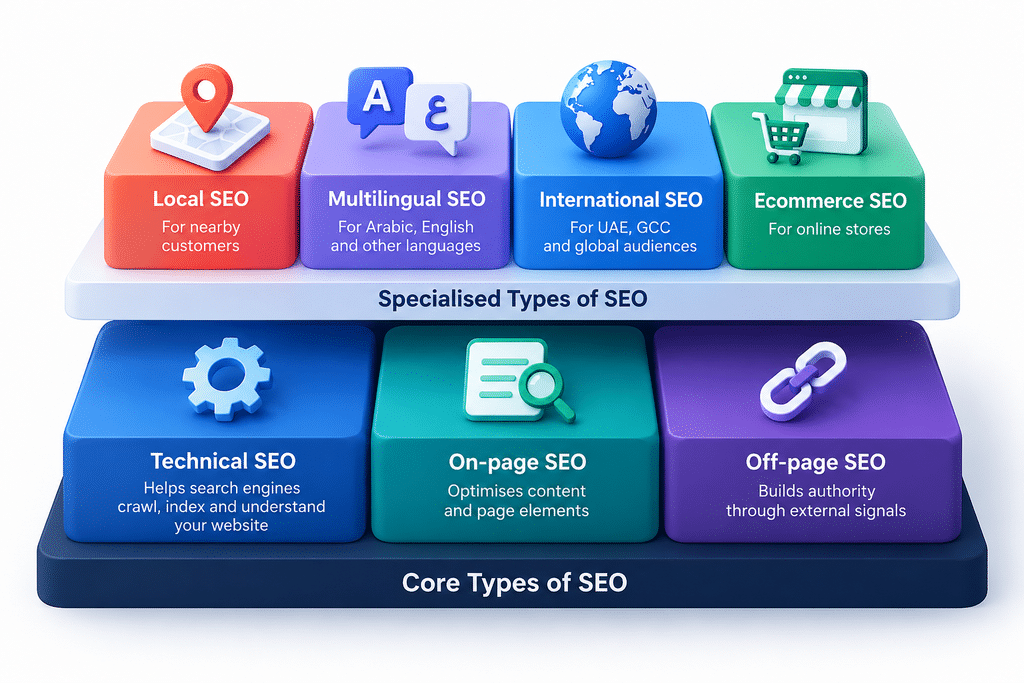
The base work never goes away. The layers change what that work looks like. For example, local SEO still needs good technical health, but it adds a Google Business Profile and location pages.
Local SEO in Dubai and Abu Dhabi
Local SEO helps your business appear when people nearby search for what you offer, especially in Google Maps and the map results on Google Search. It relies on your Google Business Profile, reviews, accurate details and pages for each location you serve.
Local SEO is the type UAE business owners search for most, though volumes are small. We compared five type names in Google Trends for the UAE over the last 12 months. “Local seo” was the only one with regular interest. “Technical seo”, “ecommerce seo”, “arabic seo” and “international seo” were all close to zero.
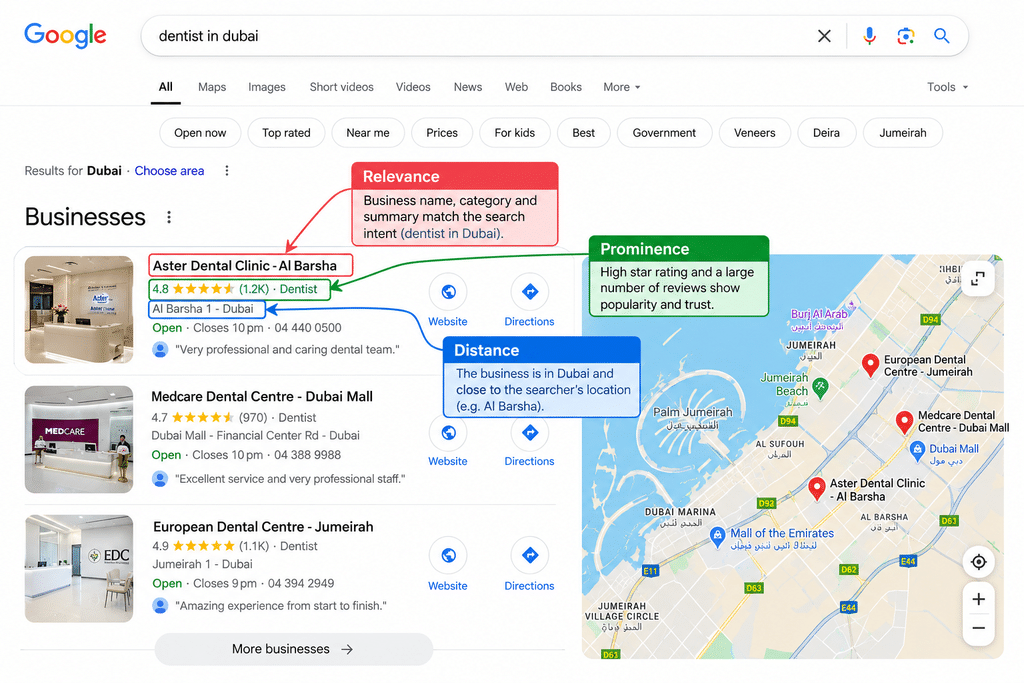
You can see why when you search. On 19 October 2026, we searched “dental clinic jumeirah” from the UAE. Google showed a Places box with three clinics, each with a star rating, review count, address and opening hours, above most of the regular results. For a local business, that box is often the first thing a customer sees.
How Google ranks local results
Google says local results are “mainly based on relevance, distance, and popularity”. Its help page explains three factors:
- Relevance: how well your profile matches the search.
- Distance: how far you are from the person searching.
- Prominence: how well known your business is, including links and reviews.
You cannot change distance. You can improve relevance with accurate categories, services and descriptions. You can build prominence with reviews, replies and local mentions. Google adds that “businesses with complete and accurate info are more likely to show up in local search results.”
Branches, emirates and free zone addresses
Many UAE businesses have more than one branch, or a branch in Dubai and another in Abu Dhabi. Each real location should have its own Business Profile and, ideally, its own page on your website. We explain the setup in our guide to Google Business Profile optimisation for multi-location businesses.
Be careful with addresses. Many UAE companies hold a licence in a free zone, such as a flexi desk in DMCC or DIFC. Google’s guidelines say a location you do not operate from is not eligible for a profile. An office in a co-working space only qualifies if it has clear signage, receives customers and is staffed during business hours. If your licence address is a desk that customers never visit, list your real branch instead, or set the profile up as a service-area business.
You need this if: customers come to you, or you go to them, within a set area. Clinics, restaurants, salons, gyms, car services, showrooms and home services all fit.
First three moves:
- Claim and complete a Google Business Profile for every real location.
- Ask happy customers for reviews and reply to every one.
- Build one useful page per location or area you serve.
For depth, read local SEO in Dubai: the complete guide. For budgets, see what local SEO costs in the UAE.
Multilingual SEO: ranking in Arabic and English
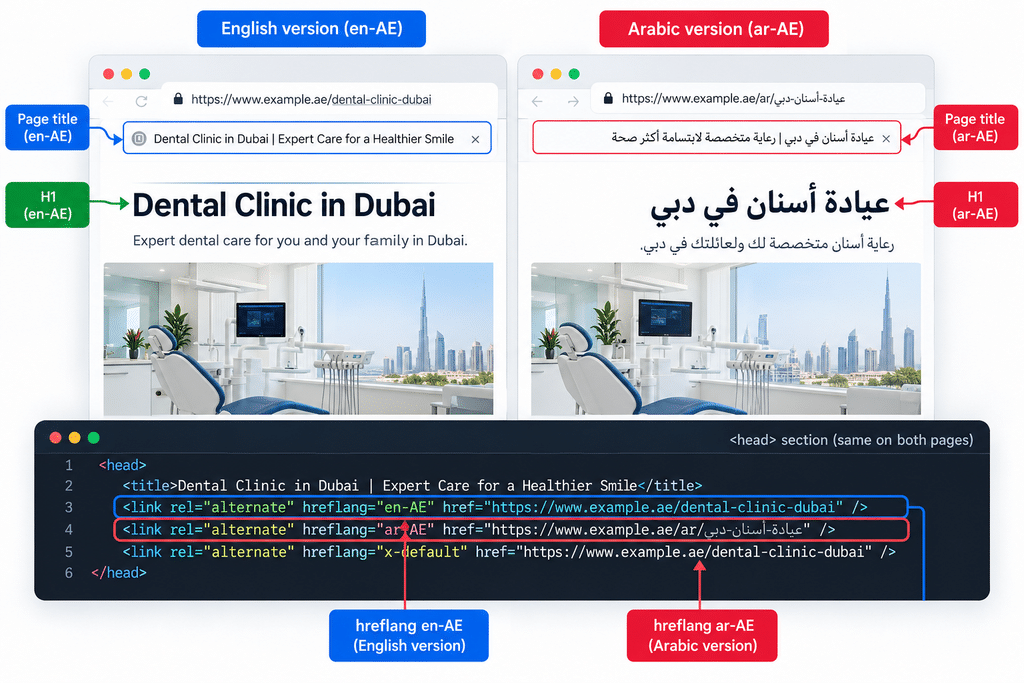
Multilingual SEO means building real Arabic and English versions of your pages. You research keywords in each language separately. Then you use hreflang tags so Google shows each searcher the right version.
Arabic and English searches in the UAE often return different results. On 19 October 2026, we searched “dental clinic dubai” and its Arabic equivalent from the UAE. The English search returned English clinic home pages. The Arabic search returned Arabic pages, such as the /ar/ versions of clinic and hospital websites. An English-only site has no page to offer for that Arabic search.
Translation is not enough
Arabic keyword research is its own job. People do not search in Arabic by translating English phrases word for word. Start with how your Arabic-speaking customers describe the problem, then build pages around those terms.
Dialect matters too. Formal Modern Standard Arabic is the safe default for most business pages. Some brands add Gulf phrasing to feel closer to local readers. Avoid copy that sounds Egyptian or Levantine if your audience is Emirati or Saudi. This is why many brands use transcreation, where a native writer adapts the message, rather than straight translation.
Google’s guide to multilingual sites says it uses the visible content of a page to decide its language. So an Arabic page needs real Arabic text, not an English page with an Arabic menu. Arabic pages also need a proper right-to-left layout, so check forms, tables and buttons in both directions.
Hreflang, explained simply
Hreflang tags tell Google which pages are language or region versions of each other. Google’s rules are clear:
- Use ISO 639-1 language codes and ISO 3166-1 Alpha 2 region codes. So it is ar-AE and en-AE, not ar-UAE.
- The language always comes first. You cannot set a country on its own.
- Each version must list itself and every other version. If the pages do not link back to each other, Google may ignore the tags.
- Use x-default for a fallback page, such as a language selector.
You need this if: a meaningful share of your customers prefer Arabic, or you serve government, family or Emirati audiences. If you can only afford one language at first, start where most of your buyers are, then add the second properly rather than half-translating.
First three moves:
- Research Arabic keywords from scratch, not from your English list.
- Write or transcreate your key pages with a native Arabic writer.
- Add hreflang tags to both versions and check they point to each other.
International and GCC SEO: serving the UAE and Saudi Arabia
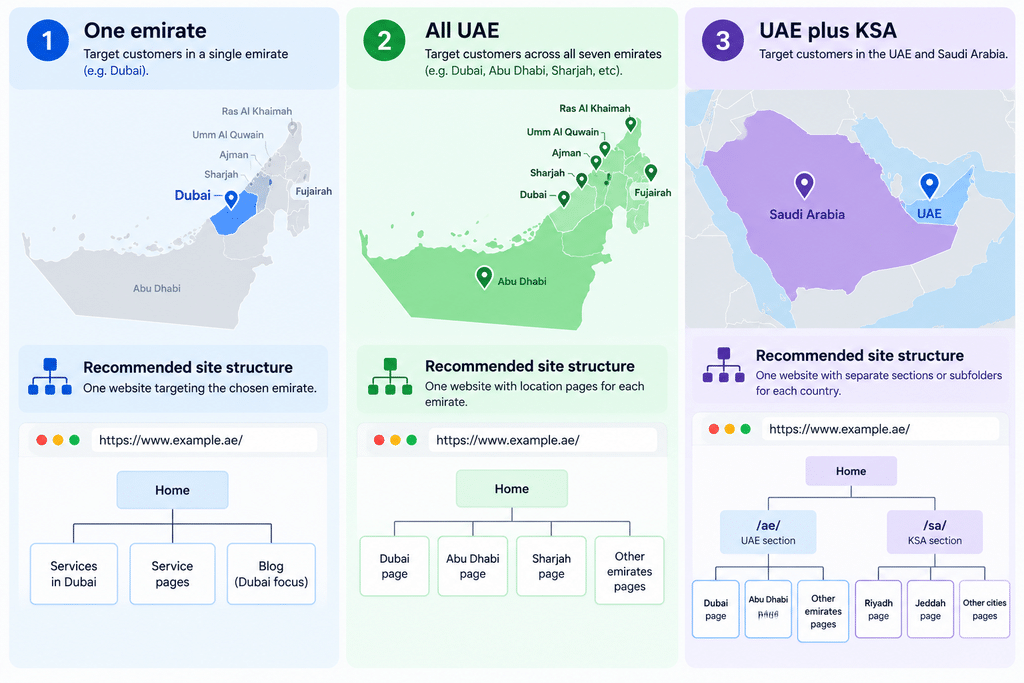
International SEO helps the right country version of your site rank in each market. For UAE brands, it usually means deciding how to serve Saudi Arabia and other GCC countries: a separate country domain, a subdomain, or a subfolder on your main site.
Multilingual SEO is about language. International SEO is about country. A UAE brand selling in Saudi Arabia may need both. That could mean Arabic and English for the UAE, plus Arabic and English for KSA. Prices, delivery terms and stock often differ too.
Country domain, subdomain or subfolder?
Google lists the trade-offs in its guide to multi-regional sites. Here they are, redrawn for a UAE and KSA brand.
| Structure | Example | Pros | Cons |
|---|---|---|---|
| Country domain (ccTLD) | brand.ae and brand.sa | Clear country signal, easy to keep separate | Costs more, eligibility rules, each domain targets one country, more to maintain |
| Subdomain | sa.brand.com | Easy to set up, can use different servers | Users may not know if “sa” means a language or a country |
| Subfolder | brand.com/en-sa/ | Easy to set up, low upkeep, one site to maintain | Country signal is less obvious from the URL, one server location, harder to separate later |
| URL parameter | brand.com?loc=sa | None worth having | Google says it is not recommended |
For many growing brands, subfolders on one strong domain are the simplest place to start. A separate .sa domain makes more sense when the Saudi business runs as its own operation, with its own team, stock and content.
Two more points from Google are worth knowing. First, Google ignores location meta tags. Use hreflang (for example, ar-SA and en-SA for Saudi pages) to show which pages belong to which market. Second, a country domain can only target one country. A .ae domain tells Google the site is for the UAE, so it is a weak choice for reaching Saudi searchers.
You need this if: you sell, ship or take bookings from customers outside the UAE, or plan to within a year.
First three moves:
- Decide which countries matter now and which come later.
- Pick one site structure and stick with it.
- Build each country version with its own prices, delivery details and hreflang tags.
Ecommerce SEO: categories, products and marketplaces
Ecommerce SEO helps your category and product pages rank for shopping searches. It covers site structure, product data, structured data, reviews and filter pages, and it should work alongside, not against, your Amazon.ae or Noon listings.
Google has a full guide to SEO for ecommerce sites. It covers sharing product data with Google, ecommerce structured data, URL structure, site structure, reviews and pagination. It is free, and it is the best checklist a store owner can get.
Category pages and filters
Category pages often bring more search traffic than single product pages, because they match broader searches like “abayas online UAE” or “running shoes Dubai”. Give each important category a clear title, a short helpful intro and clean internal links.
Filters are where many stores go wrong. Colour, size and price filters can create thousands of near-identical URLs. Google’s advice is simple: if you do not need filter URLs indexed, stop them from being crawled. It also says to “return an HTTP 404 status code when a filter combination doesn’t return results.”
Platform matters as well. If you run Shopify, read nine Shopify SEO issues we see in Dubai. For Magento, see our Magento SEO technical checklist.
Your own store vs Amazon.ae and Noon
Many UAE brands sell on their own site and on marketplaces. Marketplace listings can rank on Google too, so you may compete with yourself. A good rule: use marketplaces for reach and quick sales, and use your own store for brand searches, repeat customers and the customer data marketplaces do not share. Write unique descriptions for your own site rather than copying marketplace listings word for word.
AI shopping answers are a growing channel too. Our guide to AI SEO for ecommerce explains how products get recommended by AI tools.
You need this if: you sell products online, on your own store, on marketplaces or both.
First three moves:
- Fix how filter and sort pages are crawled and indexed.
- Add Product structured data with price and stock.
- Write unique copy for your top categories and best sellers.
Industry SEO for UAE sectors
Industry SEO adapts the core work to the rules and search patterns of a sector. In the UAE, the most distinct cases are real estate, healthcare, hospitality, B2B and large enterprise sites.
Real estate. Broad property searches are dominated by big portals. When we searched “apartments for sale dubai marina” from the UAE on 19 October 2026, Bayut, Property Finder and Dubizzle all appeared in the top five. Brokers rarely beat them on broad terms. They win on narrower searches: specific buildings, communities, off-plan projects, and guides that portals do not write.
Healthcare. Clinics depend on local SEO and trust: accurate doctor and service pages, clear contact details and steady reviews. Many also need Arabic pages.
Hospitality. Hotels, restaurants and attractions compete with booking platforms. Strong Business Profiles, photos and pages for tourists in their own language help.
B2B. Buyers search less often but with more intent. A few deep pages that answer real buyer questions beat many thin ones.
Enterprise. Sites with thousands of pages need technical SEO at scale. Templates, internal links and clear team ownership matter more than any single page.
You need this if: your sector has its own rivals in search, such as portals or booking sites, or its own rules about what you can say.
Other types of SEO you will hear about
Mobile, voice, image, video, white hat, black hat and AI search optimisation are also called types of SEO. Most are parts of the core three. White hat and black hat describe whether methods follow Google’s rules.
Mobile SEO. The UAE is a mobile-first market. DataReportal counted 23.0 million cellular mobile connections in the UAE in late 2025, with internet use at 99 percent of the population. Mobile SEO is part of technical SEO: fast pages, readable text and buttons that work on a phone.
Voice, image and video SEO. Voice searches read like questions, so clear answers near the top of a page help. Images need descriptive file names and alt text. Videos need good titles and descriptions.
White hat, black hat and grey hat SEO. These terms describe ethics, not channels. White hat follows Google’s rules. Black hat breaks them. Google’s spam policies ban practices like cloaking, keyword stuffing, link spam and scaled content abuse. Sites that break them “may rank lower in results or not appear in results at all.” Grey hat sits in between, and the risk is rarely worth it.
AI search optimisation (GEO). Generative engine optimisation is about being cited in AI answers from tools like ChatGPT, Gemini and Google’s AI Overviews. Google says there are no extra requirements or special optimisations needed to appear in AI Overviews or AI Mode. Good core SEO is the starting point. Read GEO vs SEO: where the two actually differ and what AI SEO means for Dubai businesses.
Which type of SEO does your business need?
Start with the core three, then add the layer that matches how your customers find and buy from you. A local business adds local SEO first. A store adds ecommerce SEO. A brand serving Arabic speakers or GCC markets adds multilingual and international SEO.
Use this matrix as a starting point. It assumes your technical, on-page and off-page basics are in place or being fixed.
| Business model | Fund first | Add next | Later |
|---|---|---|---|
| Single clinic or salon | Local SEO | Multilingual (Arabic pages) | Content on treatments or services |
| Multi-branch restaurant group | Local SEO for every branch | Reviews and menu pages per branch | Multilingual pages for tourists |
| Real estate broker | Pages for specific communities and projects | Local SEO for your office | Multilingual and GCC buyer pages |
| UAE online store | Ecommerce SEO | Multilingual (Arabic store) | Marketplace and AI shopping visibility |
| Store shipping to KSA | Ecommerce SEO | International (Saudi version) | Arabic content for each market |
| B2B firm | On-page content for buyer questions | Off-page authority and PR | GCC pages if you sell regionally |
| GCC brand with several markets | International site structure | Multilingual with hreflang | Industry and local layers per country |
If the matrix points to local SEO, our local SEO services team can audit your profiles and location pages. If it points to Arabic or GCC work, see our international and multilingual SEO services. For stores, start with our ecommerce SEO services.
Not sure where your site stands today? An SEO audit shows which foundation issues to fix before you add any layer.
What each type needs from you: team, budget and timeline
Every type needs some time from your team. Technical SEO needs developer hours. Multilingual SEO needs native Arabic writers. Local SEO needs a steady habit of collecting and answering reviews. Results take months, not weeks, and no one can guarantee a top ranking.
| Type | Main resource | Ongoing effort |
|---|---|---|
| Technical SEO | Developer time | Fixes after audits, checks after every site update |
| On-page SEO | Writer and editor | New and refreshed pages |
| Off-page SEO | PR and outreach | Steady link and mention building |
| Local SEO | Front desk or branch staff | Reviews, replies, profile updates, photos |
| Multilingual SEO | Native Arabic writer | Every new English page needs an Arabic version |
| International SEO | Developer plus local market input | Separate prices, stock and content per country |
| Ecommerce SEO | Developer and merchandiser | Product data, categories, filters, seasonal pages |
Budget follows effort. Local SEO for one branch costs far less than a bilingual store in two countries. For local SEO price ranges, see what local SEO costs in the UAE.
On timing, be wary of any promise. Google itself says “no one can guarantee a #1 ranking on Google.” Ask any provider what results they expect, by when, and how they will measure them.
Frequently Asked Questions
What are the four types of SEO?
The four types most guides list are technical SEO, on-page SEO, off-page SEO and local SEO. The first three apply to every website. Local SEO applies to any business that serves customers in a set area, which covers most UAE businesses with a physical location.
How many types of SEO are there?
There is no official number. Most experts agree on three core types (technical, on-page and off-page) and several specialised types, such as local, multilingual, international, ecommerce and industry SEO. Labels like mobile, voice and image SEO are usually parts of the core three.
What is SEO in the UAE?
SEO in the UAE is the same practice as anywhere else: helping search engines understand and rank your pages. What changes is the context. UAE businesses often need Arabic and English pages, strong local profiles in each emirate, and a plan for GCC customers.
Which type of SEO is best for a small business in Dubai?
For most small businesses with a physical location, local SEO gives the fastest practical return, because it targets nearby people who are ready to visit or call. Fix your technical and on-page basics first, then focus on your Google Business Profile and reviews.
Do I need Arabic SEO if my website is mainly in English?
It depends on your customers. If a meaningful share of them search in Arabic, an English-only site cannot appear for those searches. Start with your most important pages in proper Arabic, research Arabic keywords separately, and connect both versions with hreflang tags.
What is the difference between local SEO and international SEO?
Local SEO targets customers in a specific area, such as one emirate or neighbourhood. International SEO targets customers in different countries, such as the UAE and Saudi Arabia. A brand can need both: local SEO for its UAE branches and international SEO for its Saudi online store.
Should I focus on local SEO or traditional SEO?
If your customers come from a set area, start with local SEO. If you sell across the UAE or online, traditional (national) SEO matters more. Many businesses need both: local SEO for branch searches and wider SEO for product or service searches.
What are the best free SEO tools to start with?
Google Search Console shows how your site appears in search. PageSpeed Insights checks speed and Core Web Vitals. Google Business Profile shows how people find your listing. Google Analytics 4 tracks what visitors do. Together they cover most of what a small business needs.
Can I do SEO on my own?
Yes, many basics are DIY friendly. You can complete your Business Profile, ask for reviews, improve page titles and write helpful content. Technical fixes, Arabic transcreation and GCC site structure usually need specialist help, because mistakes there are harder to spot and undo.
Is SEO replaced by AI?
No. AI tools like ChatGPT can help with research and drafts, but they do not replace a strategy. AI search tools also rely on web pages for their answers. Google says there are no special requirements to appear in AI Overviews beyond normal SEO best practice. Strong core SEO is still the starting point for AI visibility.