How Websites Earn Authority and Trust in Google: Links, Brand and E-E-A-T
Website authority is how much Google trusts a site to give reliable answers on a topic. Google has no public authority score. Moz Domain Authority, Ahrefs Domain Rating and Semrush Authority Score are third-party estimates built mostly from backlinks. Google itself looks at links, reputation and signs of trust, and says trust matters most.
If someone has told you your “DA is too low”, or offered you a pack of high-DA links, this guide is for you. We will separate what SEO tools measure from what Google says it rewards. Then we will show how a UAE business can build real authority in a sensible order, without buying links or chasing a number.
This page is part of our series on how search works. If you are new to SEO, start with what SEO is and how it works for businesses in Dubai and Abu Dhabi.
Website authority develops over time through helpful content, relevant backlinks, credible mentions, and a clear connection between related pages. Businesses should build authority in a sensible order by publishing useful, experience-based content, earning links from relevant and trustworthy websites, strengthening internal linking, and maintaining a technically sound website. Avoid buying links or focusing exclusively on third-party metrics such as Domain Rating (DR), because these are SEO tools’ estimates rather than official Google ranking factors. For businesses in Dubai and Abu Dhabi, locally relevant content and genuine industry relationships can also help establish credibility and improve search visibility. This page is part of our series on how search works.
What is website authority?
Quick answer: Website authority is the trust and standing a site has earned on a topic. It comes from who links to you, what people say about your brand, and how clearly your pages show real experience and honesty. Google does not publish an authority score, so any number you see comes from an SEO tool.
The word “authority” gets used in two different ways, and that causes most of the confusion.
The first meaning is a tool score. Moz, Ahrefs and Semrush each crawl the web, count links and turn what they find into a score out of 100. These scores are useful for comparing sites. They are not what Google uses.
The second meaning is real-world authority. This is the reputation your business has with customers, the media, your industry and, as a result, with Google. It is built from links, mentions, reviews and the quality of your content. You cannot see it as one number, but you can build it on purpose.
Google vs SEO tools: what DA, DR and Authority Score actually measure
Quick answer: DA, DR and Authority Score are estimates made by SEO tool companies, mainly from backlink data. Google does not use any of them. Google’s own documentation says it uses PageRank and other link systems, plus site-wide signals, but it has never published a single authority score.
|
Metric |
Who makes it |
Scale |
Main inputs |
Used by Google? |
|
Domain Authority (DA) |
Moz |
100-point scale |
Dozens of factors, including linking root domains and total links |
No. Moz says DA “is not a Google ranking factor” |
|
Domain Rating (DR) |
Ahrefs |
0 to 100 |
Strength of a site’s backlink profile compared with other sites in the Ahrefs index |
No. It is an Ahrefs metric |
|
Authority Score (AS) |
Semrush |
1 to 100 |
Link power, estimated organic traffic and six spam checks |
No. It is a Semrush metric |
|
siteAuthority (2024 leak) |
Google, internal |
Unknown |
Unknown |
Appears to exist as a site-level attribute. Its weight is unknown |
|
PageRank and link analysis |
|
Not published |
How pages link to each other |
Yes. Google says PageRank “continues to be part of our core ranking systems” |
|
Site-wide signals |
|
Not published |
Not disclosed |
Yes. Google says “Site-wide signals and classifiers are also used” |
The scores disagree because each tool has its own link index and formula. For example, one site could show three quite different numbers in Moz, Ahrefs and Semrush on the same day. None of them is wrong. They are measuring different samples of the web in different ways.
The scores are relative. Semrush says Authority Score is best used to compare domains, not to judge a site as good or bad on its own. A “good” score is one that is close to the sites you compete with for the same searches.
Google has said it does not use DA. In 2020 John Mueller of Google said, “We don’t use domain authority at all in our algorithms”, as Search Engine Journal records.
What the 2024 Google leak changed
In May 2024, internal Google documentation covering 2,596 modules and more than 14,000 attributes leaked online. Google confirmed the documents were real on 29 May 2024. It also warned against drawing conclusions from information that may be out of context, outdated or incomplete.
One attribute got a lot of attention: siteAuthority. SEO analyst Mike King pointed out that this looks like a site-level quality measure, even though Google staff had publicly denied having a website authority score.
So what is the honest reading? Google does seem to keep some site-level signals. That fits its own public line that site-wide signals are used. But nobody outside Google knows how siteAuthority is calculated or how much weight it carries. There is no evidence that it works like Moz DA. The lesson is not “chase a score”. The lesson is that the overall quality and reputation of your whole site matters, not only each page on its own.
The three things that build real authority: links, brand and E-E-A-T trust
Quick answer: Real authority rests on three things you can build: links from relevant, trusted sites, a brand that people mention, search for and review, and pages that clearly show experience and honesty. Each one supports the others.
- Links. Other websites pointing to yours. This is the oldest signal and still part of Google’s core systems.
- Brand reputation. What the rest of the web, and your customers, say about you. Mentions, reviews, press coverage and branded searches all sit here.
- E-E-A-T trust. What your own pages show about who you are, how you work and why people should believe you.
Many link packages only work on the first of these. A business can see its DA go up and still see no change in leads. Strong links with a thin brand and weak trust signals is like a stool with one leg.
Links as signals: PageRank, link quality and link spam
Quick answer: Google still uses links to judge how important and relevant a page is. A link from a trusted, relevant site that chose to link to you is worth far more than many links from unrelated or paid sources. Buying links to manipulate rankings breaks Google’s spam policies.
How PageRank works in plain English
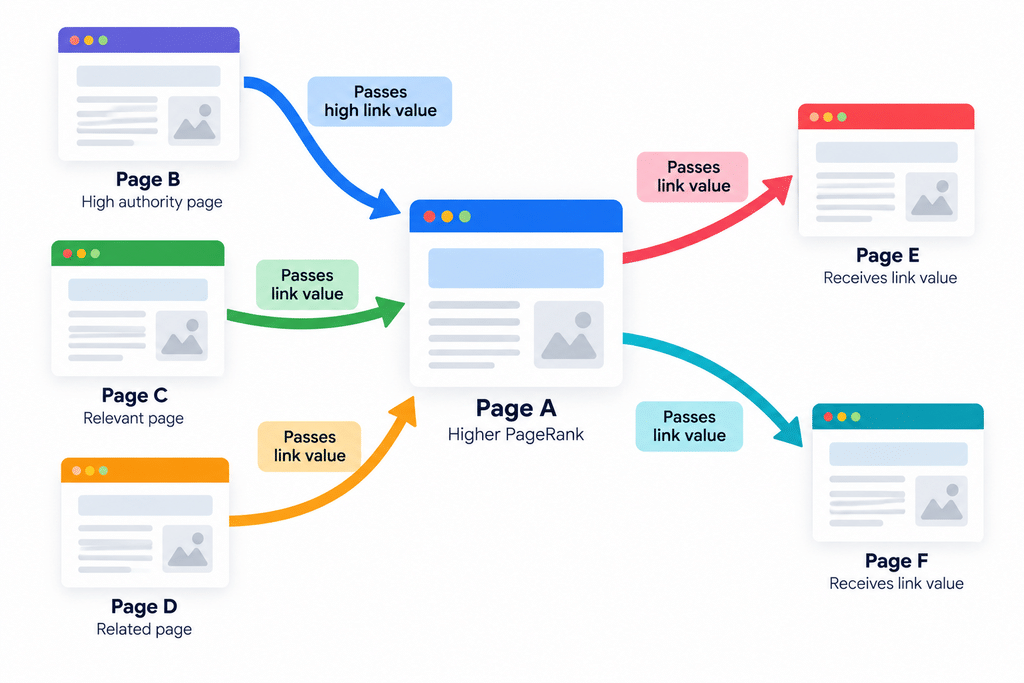
PageRank was described by Google’s founders, Sergey Brin and Larry Page, in their 1998 Stanford paper. The idea is simple. A link is like a vote. A page that gets votes from important pages becomes more important itself. Each page splits its voting power across the pages it links to.
Google says PageRank has “evolved a lot” since then. It is one of several link analysis systems, which also help Google work out what a page is about. But the core idea still holds: links pass value, and not all links pass the same amount.
What makes a link count
Not every link is worth chasing. A useful link usually has most of these traits:
- Relevance. The linking site covers your industry, your city or your customers.
- Editorial choice. A real person decided to link to you because your page helps their readers.
- Trust. The linking site has its own reputation, real traffic and real readers.
- Context. The link sits inside useful text with clear anchor text, not in a footer or a list of 200 links.
- Variety. Links come from many different sites over time, not 50 links from one network in a week.
Links matter more than many owners think. In an Ahrefs study of its own index, 96.55% of pages got zero traffic from Google, and having no backlinks was one of the three main reasons the study gave. Links still count. They just have to be the right kind.
If you want to know where links sit compared with fixing your own pages, our guide on on-page vs off-page SEO and what to fix first covers that choice.
Links that can hurt you
Google’s spam policies define link spam as links created mainly to manipulate rankings. Its examples include:
- Buying or selling links for ranking purposes, including paying with money, goods or services
- Sending someone a product in exchange for a post with a link
- Excessive link swaps (“link to me and I’ll link to you”)
- Automated programs that create links to your site
- Advertorials and press releases with links that pass ranking credit
- Low-quality directory or bookmark site links
Paid links are fine when they are labelled. Google says buying links for advertising and sponsorship is normal, as long as the link carries rel=”sponsored” or rel=”nofollow”. Google prefers sponsored for paid placements and asks site owners to use rel=”ugc” for comments and forum posts.
So when a link seller in Dubai promises “DA 70 backlinks, dofollow, AED X each”, you now know what that is. It is a paid link that is meant to pass ranking credit, which is exactly what the policy describes.
Brand authority: mentions, reviews and entity signals
Quick answer: Brand authority is how well known and well regarded your business is across the web. Mentions in news and industry sites, reviews, a consistent business identity and people searching for your name all help Google understand that you are a real, trusted entity.
Google does not only read links. It also tries to understand entities: real people, places and organisations, and how they connect. When your business is clearly defined and widely mentioned, Google can be more confident about who you are. We explain how this works in how search engines understand content, from words to entities.
Here is what brand authority looks like in practice:
- Mentions. Your brand named in news stories, industry articles, podcasts and event pages, with or without a link.
- Reviews. Google reviews and reviews on trusted industry platforms. For local search, Google says prominence is “based on info like how many websites link to your business and how many reviews you have”.
- Branded searches. People typing your business name into Google. This is a sign of real demand for your brand.
- A clear identity. The same business name, address and phone number everywhere, plus Organization structured data. Google says this markup helps it understand your organisation, and its sameAs property can point to your official profiles elsewhere.
- Knowledge Panel. When Google shows a panel about your business, it is a sign that Google recognises you as an entity.
The quality rater guidelines show how seriously Google takes reputation. They tell raters that “reputation research is especially important for detecting untrustworthy websites”. Raters do not change rankings directly. Google is clear that “no single rating can directly impact” how a page ranks. But the guidelines show what Google wants its systems to find.
E-E-A-T in practice: showing experience, expertise and trust
Quick answer: E-E-A-T stands for experience, expertise, authoritativeness and trust. Google says E-E-A-T “itself isn’t a specific ranking factor”, but its systems look for a mix of signals that match it. Of the four, Google says “trust is most important”.
E-E-A-T is often sold as a checklist or a plugin. It is neither. It is a way of describing what makes content believable. Google’s own guidance puts it plainly: trust is the core, and the other three “contribute to trust”.
We cover how Google’s quality raters think about E-E-A-T in our guide to search quality evaluation principles. Here we focus on what you can put on your pages.
Answer Google’s Who, How and Why questions
Google suggests you ask three questions about your content.
- Who created it? Show a real author with a byline, a short bio and a link to a profile page. Make it clear who owns the website.
- How was it created? If you tested a product, ran a project or used data, say so. Show photos, numbers or steps that prove first-hand work.
- Why was it created? Content should exist to help a reader, not only to rank. If a page has no purpose beyond “we need a blog post on this keyword”, readers notice quickly.
Trust signals a UAE business website should show
Trust is easier to show than most people think. A visitor, a quality rater or an algorithm should be able to find these quickly:
- Your registered company name as it appears on your trade licence
- A physical address and a +971 phone number that match your Google Business Profile
- Your VAT registration number (TRN) where it is relevant, for example on invoices and quotes
- A real About page with the team, history and credentials
- Clear contact, privacy, terms and refund pages
- Author pages for anyone who writes advice on your site
- Reviews and case studies you can stand behind
- HTTPS across the whole site and pages that load and work well on mobile
None of these will rank a page on its own. Together they remove reasons to doubt you.
Topical authority: why a smaller site can outrank a high-DA site
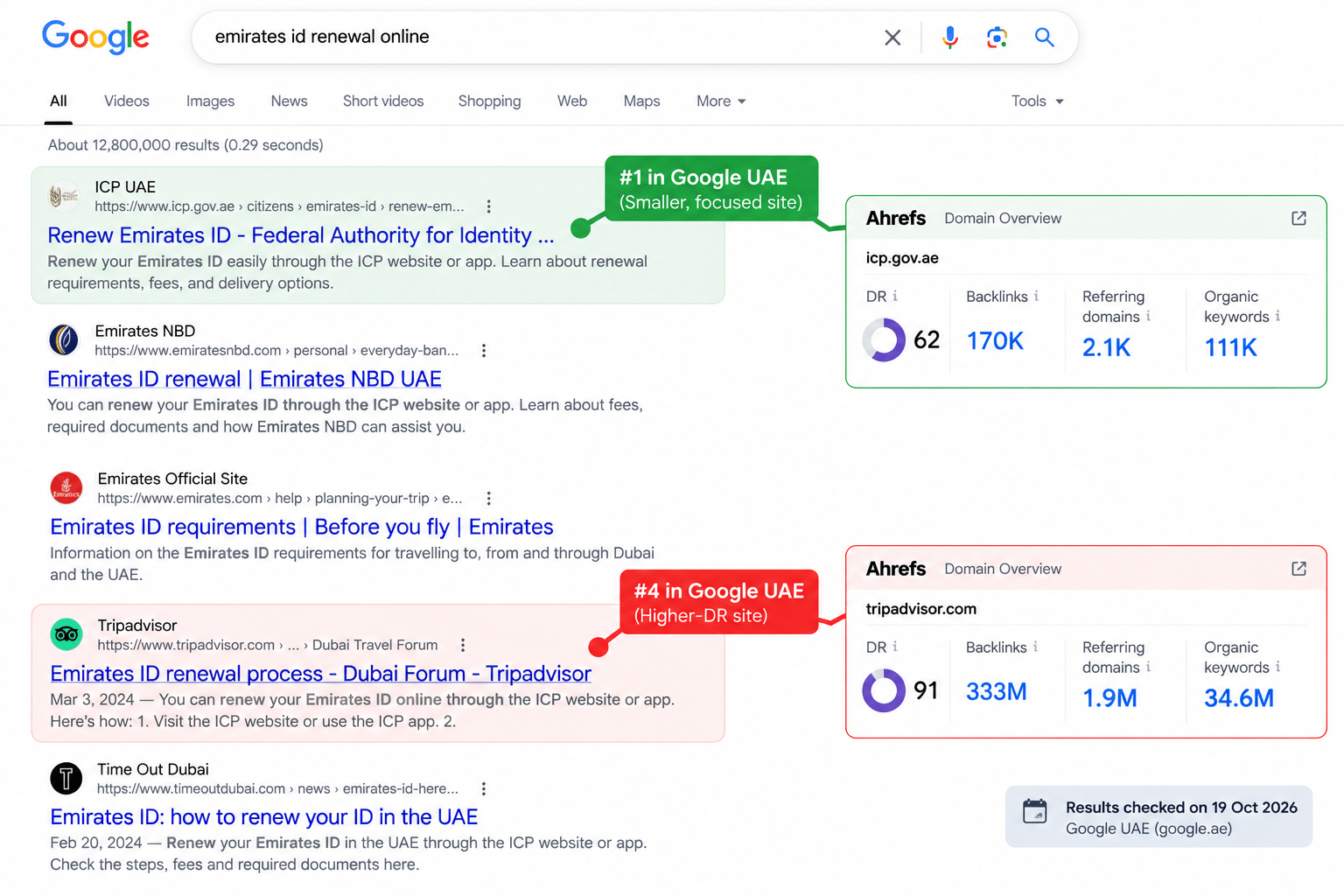
Quick answer: Google ranks pages for specific searches, though site-wide signals also play a part. A small site that covers one topic deeply, matches what the searcher wants and earns a few relevant links can beat a large site with a higher DA that only touches the topic once.
“Why does a site with a lower DA rank above mine?” There are three usual reasons.
- Relevance beats raw strength. The smaller site’s page is a closer match to the exact search.
- Intent match. The smaller site gives searchers what they want, such as a price, a comparison or a step-by-step guide, while the bigger page answers a different question.
- Topical depth. The smaller site has many connected pages on the topic, so Google sees it as a specialist.
That third reason is what people call topical authority. You build it by covering a subject properly: a main guide, supporting articles that answer each sub-question, and clear internal links between them. We show the method step by step in how to build a topical map.
Website authority for UAE businesses
Quick answer: In the UAE, authority grows fastest from local proof. That means a clear legal identity, consistent business details, reviews, coverage in UAE media and official listings. Add useful content in English and Arabic where your customers need it.
Use local media and associations. Coverage in outlets such as Gulf News, Khaleej Times, The National or Zawya builds your reputation with UAE customers, because these are well-known local publishers. It also tends to lead to more mentions and links. Industry associations, event organisers and university partners are often easier first targets.
Claim the listings you are entitled to. If your licence comes from a free zone such as DMCC, DIFC or ADGM, or you are a Dubai Chamber member, check whether you appear in their public registers or member directories, where these are offered. These confirm that you are a real, licensed business. Treat them as trust signals, not as link building.
Get your Google Business Profile right. For local searches, Google says reviews and links feed into prominence. Our guides to local SEO in Dubai and Google Business Profile optimisation for multi-location businesses go into the detail.
Think about language. Many UAE buyers search in English, and some search in Arabic. If part of your audience searches in Arabic, proper Arabic pages (not machine translations) give Arabic sites a reason to link to you and mention you.
Be careful with link offers. The UAE has plenty of sellers offering “guest posts on UAE news sites”. Ask whether a paid link will be marked rel=”sponsored”. If it will not, and it passes ranking credit, it is link spam under Google’s policy. Walk away.
In Google Trends for the UAE over the last 12 months (checked 17 October 2026), “website authority” drew far more interest than “domain authority”. Volumes are small, but people are asking the right question.
A realistic build order for small and mid-sized businesses
Quick answer: Fix trust basics on your own site first, then build local reputation and mentions, then earn links with content worth citing. Authority builds over months, not weeks, and the order matters more than the speed.
Treat this as a sensible order, not a promise of results.
Months 1 to 3: make your site worth trusting
- Fix the trust signals listed above: trade licence name, TRN where relevant, address, phone, About page, authors, policies
- Make sure your business details match everywhere, starting with your Google Business Profile
- Add Organization structured data with sameAs links to your official profiles
- Start asking happy customers for reviews as part of your normal process
- Map your main topic and publish the core guide plus the first supporting articles
- Run a basic audit to catch technical problems. Our SEO audit guide for Dubai explains what to check
Months 4 to 6: build local reputation
- Claim chamber, free zone and genuine industry listings
- Pitch your expertise to UAE trade media, podcasts and event organisers
- Turn existing relationships (suppliers, partners, clients) into mentions and links where they make sense
- Keep publishing supporting articles and link them to your main guide
Months 7 to 12: earn links with assets worth citing
- Create one or two linkable assets, such as original UAE data, a useful tool or a detailed local guide
- Use digital PR to get that asset covered by relevant publishers
- Find mentions of your brand without links and politely ask for a link where it helps readers
- Review what earned links and coverage, and do more of that
The point is order. Links pointing to a site with weak trust signals and thin content are worth less than they could be. A site that already looks credible turns every new mention into more value.
How to measure authority without chasing a score
Quick answer: Track the things that show real authority growing: more referring domains from relevant sites, more branded searches, more reviews, rankings for your core topic, and citations in AI answers. Use tool scores only to compare yourself with competitors.
Here is a simple scorecard you can check every month or quarter.
|
What to track |
Where to find it |
What good looks like |
|
Top linking sites |
Google Search Console, Links report (free) |
More relevant UAE and industry sites over time |
|
Referring domains |
Ahrefs, Semrush or Moz |
Steady growth, not sudden spikes |
|
Branded search clicks and impressions |
Google Search Console, filter queries by your brand name |
Rising month on month |
|
Reviews |
Google Business Profile and industry platforms |
A steady flow of genuine reviews |
|
Topic rankings |
Search Console or a rank tracker |
More pages ranking for your main topic, not just one |
|
Knowledge Panel |
A Google search for your brand |
Present and accurate |
|
AI citations |
Manual checks in Google AI Overviews, ChatGPT and Gemini |
Your pages cited for your core questions |
The last row is worth watching as more searches end in an AI answer. Our guide on how Google AI Overviews choose sources explains how to check your visibility there.
Tool scores still have a place. If your DA or DR is far behind the sites that rank for your main searches, links are part of the gap. Just do not treat the score as the goal.
Myths that waste budget
Quick answer: The most expensive myths are that DA is a Google ranking factor, that buying high-DA links is a safe shortcut, and that adding author schema creates E-E-A-T. None of these is true.
Myth 1: “DA is a Google ranking factor.” As covered above, both Moz and Google say it is not.
Myth 2: “More high-DA links always help.” A link from a high-DA site that has nothing to do with your business, sells links to anyone and gets no real traffic may do nothing. If it was paid for and passes ranking credit, it breaks Google’s spam policies.
Myth 3: “Author schema is E-E-A-T.” Structured data helps Google read who wrote a page. It does not create expertise. A real author, real experience and accurate content do that.
Myth 4: “A low score means we can’t rank.” Smaller, focused sites often outrank bigger ones when their pages match the search better.
Frequently asked questions
What is DA and PA in SEO?
DA (Domain Authority) and PA (Page Authority) are Moz scores. DA estimates how strong a whole domain is in search, and PA estimates the same for a single page. Both are based mainly on link data. Neither is used by Google.
What is the difference between DA and PA?
DA scores the whole website. PA scores one page. A new blog post on a strong site can have a low PA and a high DA, because few links point to that page yet.
What is a good domain authority for a website, and how much DA and PA is good?
There is no fixed good number for DA or PA. A good score is one close to, or above, the sites and pages that rank for the searches you want. A local clinic in Dubai competes with very different sites than a national news publisher.
Does domain authority still matter?
It matters as a comparison tool, not as a ranking factor. It can tell you whether your link profile is far behind your competitors. Google does not use it to rank pages.
How can I check the domain authority of a website?
Use the free checkers from Moz, Ahrefs or Semrush. Expect different numbers from each, because each tool uses its own data and formula. For your own site, the free Links report in Google Search Console shows which sites link to you.
How do I tell if a website has authority?
Look beyond the score. Check who links to it, whether well-known publishers mention it, how many genuine reviews it has, whether real experts write its content, and whether it ranks for many searches on its main topic.
What is an authoritative website?
An authoritative website is one that people and other sites trust on a topic. It is cited by respected sources, written by people with real experience, and honest about who runs it.
How can I increase my site’s authority or build domain authority?
Follow the build order above: trust basics first, then local reputation, then links earned with content worth citing. Tool scores such as DA rise mainly when you earn links from more trusted sites, so the same work lifts both. Avoid buying links that pass ranking credit.
Can Google reviews and business listings improve my website’s trust?
They help, especially for local search. Google says the number of reviews and links to your business feed into local prominence. Consistent listings also confirm that you are a real business.
{ “@context”: “https://schema.org”, “@type”: “FAQPage”, “mainEntity”: [ { “@type”: “Question”, “name”: “What is DA and PA in SEO?”, “acceptedAnswer”: { “@type”: “Answer”, “text”: “DA (Domain Authority) and PA (Page Authority) are Moz scores. DA estimates how strong a whole domain is in search, and PA estimates the same for a single page. Both are based mainly on link data. Neither is used by Google.” } }, { “@type”: “Question”, “name”: “What is the difference between DA and PA?”, “acceptedAnswer”: { “@type”: “Answer”, “text”: “DA scores the whole website. PA scores one page. A new blog post on a strong site can have a low PA and a high DA, because few links point to that page yet.” } }, { “@type”: “Question”, “name”: “What is a good domain authority for a website, and how much DA and PA is good?”, “acceptedAnswer”: { “@type”: “Answer”, “text”: “There is no fixed good number for DA or PA. A good score is one close to, or above, the sites and pages that rank for the searches you want. A local clinic in Dubai competes with very different sites than a national news publisher.” } }, { “@type”: “Question”, “name”: “Does domain authority still matter?”, “acceptedAnswer”: { “@type”: “Answer”, “text”: “It matters as a comparison tool, not as a ranking factor. It can tell you whether your link profile is far behind your competitors. Google does not use it to rank pages.” } }, { “@type”: “Question”, “name”: “How can I check the domain authority of a website?”, “acceptedAnswer”: { “@type”: “Answer”, “text”: “Use the free checkers from Moz, Ahrefs or Semrush. Expect different numbers from each, because each tool uses its own data and formula. For your own site, the free Links report in Google Search Console shows which sites link to you.” } }, { “@type”: “Question”, “name”: “How do I tell if a website has authority?”, “acceptedAnswer”: { “@type”: “Answer”, “text”: “Look beyond the score. Check who links to it, whether well-known publishers mention it, how many genuine reviews it has, whether real experts write its content, and whether it ranks for many searches on its main topic.” } }, { “@type”: “Question”, “name”: “What is an authoritative website?”, “acceptedAnswer”: { “@type”: “Answer”, “text”: “An authoritative website is one that people and other sites trust on a topic. It is cited by respected sources, written by people with real experience, and honest about who runs it.” } }, { “@type”: “Question”, “name”: “How can I increase my site’s authority or build domain authority?”, “acceptedAnswer”: { “@type”: “Answer”, “text”: “Follow the build order above: trust basics first, then local reputation, then links earned with content worth citing. Tool scores such as DA rise mainly when you earn links from more trusted sites, so the same work lifts both. Avoid buying links that pass ranking credit.” } }, { “@type”: “Question”, “name”: “Can Google reviews and business listings improve my website’s trust?”, “acceptedAnswer”: { “@type”: “Answer”, “text”: “They help, especially for local search. Google says the number of reviews and links to your business feed into local prominence. Consistent listings also confirm that you are a real business.” } } ] }