
What Is SEO? How It Works for Businesses in Dubai and Abu Dhabi
Search engines have become an important starting point for people researching products, comparing services and deciding which businesses to contact. For businesses in Dubai and Abu Dhabi, appearing when potential customers search for relevant services can create opportunities to attract qualified visitors, generate enquiries and build long-term online visibility.
However, having a website does not automatically mean that customers will find it on Google. Search engines must be able to discover the website, understand its content and determine whether its pages are relevant to a particular search. This is where search engine optimisation (SEO) becomes important.
SEO helps businesses improve their visibility in unpaid search results by making their websites more accessible, relevant, useful and trustworthy. It involves several connected activities, including technical website improvements, content optimisation, authority building and local search optimisation.
For businesses operating in the UAE, SEO also involves understanding local search intent, the needs of English- and Arabic-speaking audiences, mobile browsing behaviour and the way Google presents different types of search results.
This guide explains what SEO means, how Google Search works, the main types of SEO, and how businesses in Dubai and Abu Dhabi can approach organic search strategically. It also explores the relationship between SEO and Google Ads, the impact of AI-powered search, realistic timelines and the practical steps businesses can take to get started.
What Is SEO? Definition and Meaning in Digital Marketing
SEO stands for Search Engine Optimisation. It is the process of improving a website so that search engines can discover, understand and present its pages to people searching for relevant information, products or services.
In simple terms, SEO helps a business become easier to find through unpaid search results.
For example, imagine that someone in Dubai searches for an interior design company, a property consultant in Abu Dhabi or a digital marketing agency near their office. Google evaluates numerous pages and presents results that its systems consider relevant to the search.
A business with well-structured pages, helpful content, accessible website technology and strong local relevance may have a better opportunity to appear for suitable searches.
SEO does not involve paying Google for each organic click. Instead, businesses invest in improving their websites, publishing useful information, strengthening their reputation and maintaining their technical performance.
It is important to understand that SEO does not guarantee a first-page ranking. Google determines its search results algorithmically, and rankings can change as search intent, competition, content and ranking systems evolve.
What Does SEO Stand For?
SEO stands for Search Engine Optimisation. It is also commonly written as search engine optimization in American English.
The term describes a collection of practices intended to help search engines understand a website and help users find relevant pages.
SEO can include:
- Researching the terms and questions potential customers use when searching.
- Creating useful website content that addresses those needs.
- Improving page titles, headings, URLs and internal links.
- Making websites accessible to search engine crawlers.
- Improving loading performance and mobile usability.
- Building legitimate authority through relevant references and mentions.
- Optimising a business’s local presence through its Google Business Profile.
- Measuring organic visibility, website visits and business outcomes.
These activities work together. Publishing content without making it accessible to search engines may limit its visibility, while a technically sound website with little useful content may struggle to satisfy customer needs.
What Is SEO in Digital Marketing?
SEO is a digital marketing channel that helps businesses reach people through organic search.
Unlike some forms of advertising that interrupt an audience with promotional messages, SEO can connect a business with people who are already looking for information or considering a purchase.
For example, a person searching for “how to choose a property management company in Dubai” may be researching options before contacting a provider. A helpful article can introduce the business and answer the person’s questions.
Someone searching for a specific service with a clear location and immediate need may be further along in the buying journey. A well-optimised service page could help that person understand the offering and submit an enquiry.
SEO therefore supports several stages of the customer journey, from initial research to comparison and conversion.
It also complements other digital marketing activities, including content marketing, paid search, social media, email marketing and conversion rate optimisation.
What Is SEO in Simple Words? A Business Example
Consider a fictional accounting consultancy based in Abu Dhabi.
The company has a website describing its services, but most new clients come through referrals. Its website receives limited organic traffic because the service pages are vague, the content does not answer common customer questions, and the business has not developed a consistent search strategy.
The company could approach SEO by:
- Researching the questions businesses ask when looking for accounting support.
- Improving its service pages to explain the services, intended customers and next steps.
- Creating useful resources about relevant accounting processes and business requirements.
- Improving website structure, page speed and search engine accessibility.
- Maintaining an accurate Google Business Profile where eligible.
- Monitoring Google Search Console to understand which searches generate impressions and clicks.
Over time, these improvements may help Google understand the website more clearly and help potential customers discover relevant pages.
The result is not guaranteed, and the timeline depends on factors such as competition, website history and the quality of implementation. However, the example demonstrates the purpose of SEO: connecting useful business information with relevant search demand.
How Does SEO Work? Understanding Google’s Search Process
To understand SEO, it helps to understand how Google finds and presents information.
Google describes its core search process through three main stages: crawling, indexing and serving search results. These stages explain how a page can move from being discovered by a search engine to potentially appearing in response to a user’s query.
Not every page passes through every stage. A page might be inaccessible to a crawler, excluded from indexing or simply not selected for a particular search result.
Step 1: Crawling — How Google Discovers Your Website
Crawling is the process through which search engines discover and access webpages.
Google uses automated systems, including Googlebot, to fetch pages and explore links. A page may be discovered through links from other pages, an XML sitemap or other known URLs.
For businesses, the first requirement is to ensure that important website pages can be accessed by search engines.
Potential problems include:
- Pages accidentally blocked by robots.txt.
- Broken internal links that make important content difficult to discover.
- Server errors that prevent pages from loading.
- Incorrect redirects that send crawlers to irrelevant destinations.
- JavaScript implementations that prevent important content from being rendered or accessed as expected.
- Poor website architecture that leaves important pages disconnected from the rest of the site.
An XML sitemap can help search engines discover important URLs, although submitting a sitemap does not guarantee crawling or indexing.
Dubai business example: A real estate consultancy publishes separate pages for property management, residential sales and commercial leasing. If those pages are linked from the main navigation or relevant service sections, search engines have clearer paths to discover them.
If important pages exist without meaningful internal links, discovering them may become more difficult.
Step 2: Indexing — How Google Understands and Stores Your Pages
After discovering a page, Google may process its content and decide whether to include it in its search index.
Indexing involves understanding information such as the page’s content, images, language and relationship to other pages. Google may also consider canonical signals when determining which URL represents the preferred version of similar or duplicate content.
A page can be crawled without being indexed. Google may exclude pages because of technical directives, duplicate content, quality considerations or other indexing decisions.
Businesses can improve their chances of appropriate indexing by:
- Publishing original, useful content.
- Providing clear and descriptive page titles.
- Maintaining logical website navigation.
- Using appropriate canonical tags.
- Avoiding unnecessary duplicate URLs.
- Ensuring that important pages return the correct HTTP status.
- Providing appropriate language versions for multilingual websites.
- Reviewing indexing reports in Google Search Console.
Abu Dhabi business example: A consultancy maintains separate pages for corporate advisory and personal financial planning. Each page should explain its own service clearly rather than repeat almost identical content with only a few words changed.
Distinct, useful pages make it easier for visitors and search engines to understand what each page offers.
Step 3: Serving Search Results — How Google Selects Pages to Show
When someone searches on Google, its systems evaluate available information and select results intended to be relevant and useful for that query.
The results can vary according to the wording and intent of the search. A query seeking a definition may return educational articles, while a query expressing a local service need may display business listings, maps and service pages.
Google considers numerous signals and ranking systems. There is no single ranking factor that guarantees a position, and the exact weighting of individual signals is not fully public.
Businesses can work towards stronger search visibility by improving:
- Relevance between the page and the search query.
- The usefulness, clarity and completeness of the content.
- Website accessibility and technical quality.
- Internal navigation and content organisation.
- Reputation and relevant external references.
- Local business information and prominence, where local search applies.
- The overall experience for visitors.
For example, a page explaining the basics of property investment may be relevant to an informational search but may not be the most appropriate result for someone looking to contact a property investment consultant immediately.
SEO requires understanding the purpose behind a search, not simply repeating a keyword throughout a page.
Crawling, Indexing and Ranking: What Can a Business Control?
| Search stage | What happens | What a business can improve |
| Crawling | Search engines discover and access pages | Internal links, crawl accessibility, sitemaps and server reliability |
| Indexing | Search engines process and potentially store pages | Original content, canonicalisation, page quality and technical directives |
| Serving results | Search systems select and display relevant results | Search intent, content usefulness, authority, local relevance and user experience |
These stages are connected, but they are not interchangeable. A website must not only be accessible; its pages also need to offer value relevant to the searches for which the business wants to appear.
For a deeper technical explanation, see our guide to how search engines crawl, index and rank content.
What Are the Main Types of SEO? Four Essential Pillars
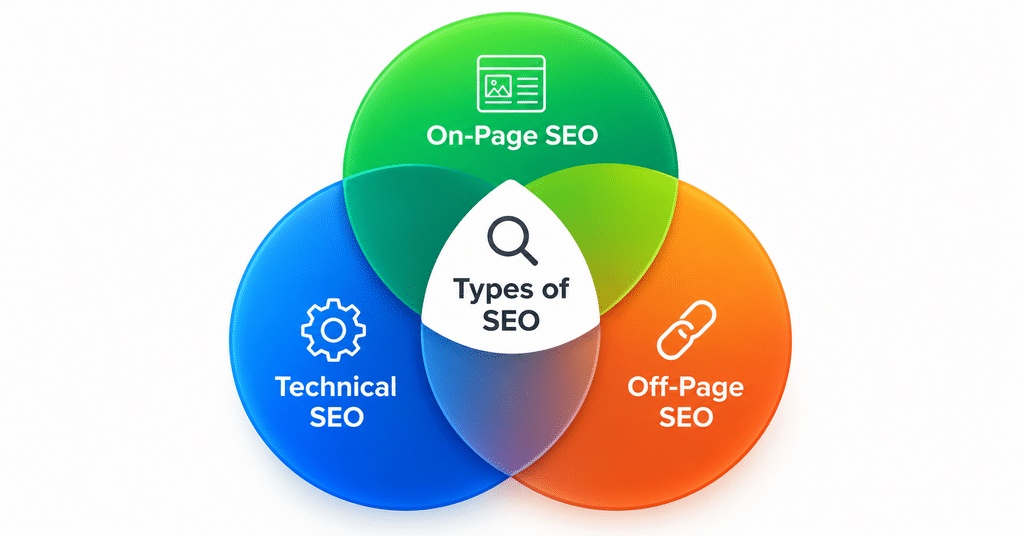
SEO is often divided into four major areas: technical SEO, on-page SEO, off-page SEO and local SEO. Each area addresses a different part of search visibility, and the most effective approach depends on how these activities work together.
For businesses in Dubai and Abu Dhabi, these pillars provide a practical framework for identifying website problems, improving content, establishing credibility and reaching customers in relevant locations.
1. Technical SEO: Making Your Website Accessible
Technical SEO focuses on the website infrastructure that allows search engines to access, render and understand pages.
A website may have excellent content, but technical issues can prevent search engines from discovering or processing important information effectively.
Key areas include:
- Crawlability: Ensuring search engine crawlers can access important pages.
- Indexability: Avoiding unintended directives that prevent valuable pages from being indexed.
- Site architecture: Organising pages into logical categories and hierarchies.
- Page speed: Improving loading performance and responsiveness.
- Mobile usability: Ensuring content and navigation work well on smartphones.
- HTTPS: Securing connections between the website and its visitors.
- Canonicalisation: Helping search engines understand the preferred URL when similar pages exist.
- Redirects and errors: Resolving unnecessary redirect chains, broken links and server errors.
- Structured data: Describing eligible content and entities in a format search engines can interpret.
Core Web Vitals are also useful performance indicators. They measure loading performance, responsiveness and visual stability through Largest Contentful Paint (LCP), Interaction to Next Paint (INP) and Cumulative Layout Shift (CLS).
A Dubai e-commerce business, for example, might have hundreds of product pages. If filters create thousands of unnecessary URL variations, or important product pages cannot be reached through internal links, the website may become more difficult to manage and crawl efficiently.
A technical audit helps identify such problems and prioritise fixes according to their potential impact.
Technical SEO does not mean that every website needs an elaborate technical setup. The objective is to ensure that search engines can access the right pages and that visitors can use the website without unnecessary friction.
2. On-Page SEO: Helping Pages Match Search Intent
On-page SEO involves improving the content and elements of individual webpages so that they communicate their purpose clearly.
It starts with understanding what the audience wants to achieve when searching.
For example, someone searching for “what is commercial property management” probably wants an explanation. Someone searching for “commercial property management company Abu Dhabi” is more likely to be comparing providers.
These searches have different intentions and may require different pages.
Important on-page SEO elements include:
- Title tags: Descriptive titles that communicate the page’s subject.
- Meta descriptions: Concise summaries that can help users decide whether to click a result.
- Headings: A logical H1, H2 and H3 structure that makes content easier to navigate.
- Main content: Helpful, accurate information that addresses the reader’s needs.
- Keyword relevance: Using natural language that reflects the topic and the terms people search for.
- Internal links: Connecting related pages and helping users navigate the website.
- Image alt text: Describing meaningful images appropriately for accessibility and context.
- URL structure: Keeping URLs understandable and consistent.
Keyword optimisation does not mean inserting the same phrase repeatedly. Search engines can interpret related concepts and variations, so content should focus on explaining the topic accurately.
For example, an article about digital marketing for businesses in Abu Dhabi may naturally discuss lead generation, online visibility, customer acquisition and conversion measurement. These related concepts help explain the subject without forcing awkward keyword repetitions.
The same principle applies to content depth. A page should answer the questions relevant to its purpose rather than add unnecessary paragraphs simply to reach a target word count.
3. Off-Page SEO: Building Authority and Credibility
Off-page SEO covers activities outside your own website that can contribute to its reputation and search visibility.
One important component is earning relevant backlinks: links from other websites that point to your content.
Search engines can use links as signals when evaluating pages, but not all links are equally useful. A relevant, editorially earned reference from a credible publication may provide more meaningful value than a large number of unrelated links created solely to manipulate rankings.
Off-page activities can include:
- Publishing genuinely useful resources that others may reference.
- Building relationships with relevant publishers and industry organisations.
- Earning coverage through digital public relations.
- Contributing expert insights to relevant industry publications.
- Creating original research that attracts legitimate citations.
- Maintaining consistent and accurate business information across relevant platforms.
- Building brand recognition through appropriate marketing channels.
Consider a Dubai-based architecture firm that publishes an in-depth guide to sustainable commercial building design. If an industry publication references the guide because it contains useful information, the resulting editorial link may help people discover the business and contribute to its authority.
By contrast, buying large quantities of low-quality links or participating in manipulative link schemes can create search-policy risks.
Off-page SEO should focus on reputation, relevance and genuine value rather than chasing backlink counts.
4. Local SEO: Reaching Customers in Your Service Area
Local SEO helps businesses improve their visibility for searches associated with a particular location.
It is especially relevant to businesses that serve customers in defined geographic areas, such as clinics, restaurants, real estate agencies, professional service providers and home maintenance companies.
A key component is the Google Business Profile, which allows eligible businesses to manage how their information appears across Google Search and Maps.
Local SEO activities include:
- Claiming and maintaining an eligible Google Business Profile.
- Providing accurate business details and contact information.
- Selecting relevant business categories.
- Keeping opening hours and service information current.
- Encouraging genuine customer reviews without manipulation.
- Responding appropriately to customer feedback.
- Maintaining consistent business information across relevant directories.
- Creating useful location-specific pages where they serve a real audience need.
- Earning relevant local references and mentions.
Google explains that local results are primarily based on relevance, distance and prominence.
Relevance concerns how well a business matches the search. Distance considers how far the business is from the searcher or the location specified. Prominence relates to how well-known the business is, with information such as reviews and links potentially contributing.
A company cannot fully control all these factors. For example, a business cannot guarantee that it will appear first in Maps for every person searching across Dubai.
It can, however, improve the accuracy of its business information, explain its services clearly and build a credible local presence.
For more detail, read our guide to local SEO in Dubai.
How the Four SEO Pillars Work Together
| SEO pillar | Primary purpose | Example for a UAE business |
| Technical SEO | Help search engines access and process the website | Fixing indexing issues on a Dubai property website |
| On-page SEO | Make pages useful and relevant to search intent | Improving an Abu Dhabi consultancy’s service pages |
| Off-page SEO | Build reputation and earn relevant references | Gaining editorial coverage in a relevant business publication |
| Local SEO | Improve visibility for geographically relevant searches | Maintaining an accurate Google Business Profile for an eligible local business |
The four pillars are complementary rather than independent ranking systems. A strong SEO strategy considers which activities will address the website’s actual needs, instead of applying every tactic indiscriminately.
Why Is SEO Important for Businesses in Dubai and Abu Dhabi?
SEO can help businesses become discoverable when potential customers are researching information, evaluating providers or looking for a specific product or service.
The value is not limited to website traffic. A well-planned strategy aims to attract visitors whose needs align with what the business offers.
The UAE also provides a relevant digital context for this approach. DataReportal’s Digital 2026: The United Arab Emirates, published in November 2025, reported 11.3 million internet users and 99% internet penetration. These figures indicate a highly connected market, but they should not be interpreted as evidence that every business will generate customers through SEO.
The commercial opportunity depends on the industry, audience, search demand, competition and quality of execution.
1. Reach Customers Who Are Already Searching
Search visibility can connect businesses with people who have an identifiable question or need.
For example, a business owner in Dubai may search for accounting software, a corporate legal adviser or an office fit-out contractor. These searches can reveal what the person needs and how far they may have progressed in the decision-making process.
An informative article can support early research, while a relevant service page can help a person who is ready to compare providers.
This makes search intent an important part of SEO planning.
Instead of targeting only broad, high-volume terms, businesses should identify searches that are relevant to their products, services and customer journey.
2. Build Credibility Before the First Conversation
Potential customers often assess a company online before contacting it.
They may review its services, read educational content, examine customer feedback or look for evidence of experience.
A useful, well-organised website can help answer these questions before a sales conversation begins.
For a professional services company in Abu Dhabi, this might involve publishing clear service descriptions, explaining its process, introducing qualified team members and providing relevant examples of previous work.
Such information supports the visitor’s decision-making process. It does not guarantee that the business will be trusted or selected, but it gives potential customers more information on which to make a judgement.
SEO also benefits from accuracy. Misleading claims, fabricated testimonials and unsupported expertise can undermine credibility rather than strengthen it.
3. Create an Asset That Can Continue Attracting Visitors
Paid campaigns generally require ongoing expenditure to maintain advertising visibility. SEO involves a different investment model.
When a page earns organic visibility, it may continue attracting visitors without a separate payment for every click. However, creating and maintaining that visibility still requires resources.
Businesses may need to invest in content production, technical maintenance, research, reporting and updates. Competitors may also improve their websites, and search systems can change.
SEO should therefore be understood as an ongoing marketing investment rather than a one-time task that produces permanent rankings.
Its long-term value depends on whether the website continues to meet user needs and attract relevant demand.
4. Support More Relevant Enquiries
Not all website visits are equally valuable.
A page attracting thousands of unrelated visitors may contribute less to business growth than a page attracting a smaller number of people who need the company’s services.
For this reason, SEO should connect visibility with meaningful outcomes.
A Dubai-based B2B company might measure qualified enquiries, consultation requests and relevant phone calls rather than relying exclusively on total traffic.
An online store may focus on organic product discovery, completed purchases and revenue.
By connecting search performance with business objectives, companies can make better decisions about which pages and topics deserve further investment.
5. Compete More Effectively in a Diverse Market
Dubai and Abu Dhabi include businesses serving local residents, expatriates, tourists, international investors and organisations operating across borders.
These audiences may search in different languages and use different terminology when looking for similar services.
A business may need to explain its offering to several audience groups, but this does not mean that every company must publish content in every language.
The appropriate approach depends on actual customer demand, service capability and commercial priorities.
For instance, a professional service provider that regularly serves Arabic-speaking customers may benefit from well-written Arabic pages. A specialist business serving an international audience may prioritise English content initially.
SEO research helps businesses determine which audiences and queries are worth targeting.
6. Complement Other Marketing Channels
SEO can work alongside paid search, social media, email marketing, public relations and referral activity.
A company might use Google Ads to test demand for a service while developing organic landing pages that answer the same audience’s questions. Search Console data can later help identify queries that deserve more detailed content.
Similarly, an educational article can support social media distribution, email campaigns and sales conversations.
This integrated approach helps businesses use customer insights across multiple channels rather than treating SEO as an isolated activity.
What Does SEO Look Like in a Real Dubai Google Search?
A Google results page is not simply a list of ten blue links. Depending on the query, device, location and available search features, users may encounter sponsored listings, map results, AI-generated summaries, organic pages, images, videos and other elements.
Understanding these different placements helps business owners distinguish SEO from paid advertising and local visibility.
Consider an illustrative search for a service provider in Dubai. The exact layout will depend on the query and current search results.
Google Ads: Sponsored Search Results
Sponsored search results are advertisements displayed through Google Ads.
Advertisers can set budgets, target relevant audiences and participate in advertising auctions. Their placement depends on factors such as the auction, bid and ad quality, rather than organic SEO alone.
A sponsored listing may appear above organic results, but paying for an advertisement does not automatically improve a website’s organic ranking.
Businesses can use paid search when they need campaign visibility, want to test offers or wish to reach specific audiences while their organic strategy develops.
Local Pack: Businesses Displayed on Google Maps
For searches with local intent, Google may show a map and a selection of nearby or relevant businesses.
The local pack can help users compare business names, locations, ratings and other available information.
An eligible business’s Google Business Profile can influence the information available to Google, while local ranking depends on factors including relevance, distance and prominence.
The local pack is distinct from ordinary organic website listings. A company can have strong organic visibility without appearing prominently in the local pack, and vice versa.
AI Overviews: AI-Generated Search Summaries
Google may display AI-generated summaries for certain searches.
These summaries can combine information from multiple sources to provide an overview of a topic and may include links to supporting webpages.
For businesses, this creates another way in which information may be discovered. However, inclusion is not guaranteed, and AI-generated summaries do not appear for every query.
The content should remain accurate, accessible and useful regardless of whether an AI summary is displayed.
Organic Results: Unpaid Website Listings
Organic results are webpages selected by Google’s search systems in response to a query.
SEO primarily focuses on improving a website’s ability to earn visibility in these unpaid results.
A business may attract organic visits through service pages, educational articles, product listings or other relevant resources.
The most appropriate page depends on the searcher’s intent. A detailed guide may be suitable for an informational query, while a service page may better meet a query expressing a clear need to hire a provider.
The practical lesson: Businesses should understand which search placements matter for their objectives. Paid ads, local listings, AI Overviews and organic results have different eligibility requirements and mechanisms. A realistic strategy identifies the opportunities that align with the business rather than assuming every placement can be controlled through SEO.
SEO in the UAE: English, Arabic and Local Search Intent
Language and location can affect how businesses organise their websites and communicate with potential customers.
For companies operating in Dubai and Abu Dhabi, language decisions should be based on audience research and business needs rather than the assumption that a bilingual website is always necessary.
Should UAE Businesses Target English and Arabic Searches?
The answer depends on whom the business serves.
A company serving customers who search in English may initially prioritise English-language content. A business that regularly serves Arabic-speaking customers may benefit from Arabic content that explains its services clearly and naturally.
Some organisations need both languages because they serve distinct audience groups. Others may have a more specialised audience whose language preferences are concentrated in one language.
Before investing in translation, businesses should consider:
- Which languages existing customers use.
- Whether the business can serve enquiries in those languages.
- Which products or services have meaningful demand.
- Whether search queries differ between language groups.
- Whether the company can maintain the accuracy of translated content.
- Whether the website can provide a consistent experience in each language.
The objective is not to produce as many translated pages as possible. It is to make relevant information available to the audiences the business can genuinely serve.
How Arabic SEO Works for Bilingual Websites
Arabic SEO requires more than translating English keywords word for word.
People may use different phrases, terminology and levels of formality when searching in Arabic. Content should reflect the language and context of the intended audience.
For example, a professional service provider may need Modern Standard Arabic for formal informational content, while research may reveal other commonly used expressions in customer searches.
A bilingual website should also have a clear URL structure. Some websites use separate language subdirectories, such as /en/ and /ar/, while others use different domains or subdomains.
For appropriate multilingual or multi-regional pages, hreflang annotations can help Google understand the relationship between language and regional alternatives.
Businesses should also check that:
- Arabic pages contain properly translated and useful information.
- Navigation labels and forms work correctly in right-to-left layouts.
- Users can switch between language versions easily.
- Each language version has appropriate metadata.
- Translated URLs and internal links point to the correct pages.
- Important content is not available only through a language switcher that search engines cannot access.
A bilingual strategy should be maintained as an ongoing publishing and website management responsibility.
Why Google Business Profile Matters for Local Visibility
Google Business Profile helps eligible businesses manage information shown on Google Search and Maps.
An accurate profile can help people understand what a business does, where it operates and how to contact it.
Businesses should maintain appropriate categories, accurate hours, relevant service details and current contact information. They should also follow Google’s eligibility and representation policies.
Reviews can provide useful information to prospective customers, but businesses should seek genuine feedback and avoid fabricated reviews or incentives that violate platform policies.
It is also important to keep website information consistent with the business profile. Conflicting addresses, phone numbers or opening hours can confuse customers and make it harder for them to contact the company.
How Google Maps Rankings Differ from Organic Rankings
Local map results and organic website results are related but distinct.
A business with a strong website may not appear in every nearby search because distance and local relevance influence map visibility. Similarly, a business profile may appear in Maps even when the website has limited organic visibility for broader informational searches.
Businesses should therefore measure local visibility separately from general organic performance.
Useful indicators include profile interactions, calls, direction requests where relevant, website visits, local search queries and enquiries that can be attributed to local discovery.
The appropriate metrics depend on the business model and available reporting.
SEO vs Google Ads: Which Is Better for UAE Businesses?
SEO and Google Ads can both help businesses reach people using Google, but they operate differently.
SEO focuses on earning organic visibility through relevant content, technical accessibility and other search optimisation activities. Google Ads provides paid advertising placements according to campaign settings and advertising auctions.
Neither channel is automatically better for every business. The right choice depends on budget, timeline, customer demand, competition and business objectives.
| Factor | SEO | Google Ads |
| Placement | Organic search results | Sponsored placements |
| Cost | Content, technical work, expertise and ongoing maintenance | Advertising spend plus campaign management costs where applicable |
| Time to visibility | Usually develops over time | Can begin after campaigns are approved and eligible to serve |
| Duration | Visibility may persist but requires maintenance | Paid visibility generally ends when campaigns stop serving |
| Main strength | Building sustained organic discovery | Controlling campaign targeting and budget |
| Main limitation | Rankings and timing are not guaranteed | Traffic depends on advertising eligibility, budget and auction performance |
| Measurement | Organic impressions, clicks, qualified traffic and conversions | Impressions, clicks, conversion data and campaign cost |
Can SEO and Google Ads Work Together?
Yes. The channels can complement each other when they are planned around the same business objectives.
Google Ads can provide faster opportunities to test search demand for a service or offer. Campaign data may reveal which queries, landing pages and messages attract relevant enquiries.
SEO can then support longer-term organic visibility by improving the corresponding service pages and publishing content that addresses related questions.
For example, a Dubai-based consultancy may run a paid campaign for a specialist service while creating an educational guide explaining when that service is needed. The service page supports people who are ready to enquire, while the guide helps people who are still researching.
The two channels should not be judged solely by traffic volume. Businesses should compare the relevance and commercial value of the leads generated, taking into account each channel’s costs and attribution limitations.
Do You Need SEO If You Already Run Google Ads?
Running Google Ads does not remove the need to consider SEO.
Paid campaigns can generate visibility while the budget is available, but they do not automatically establish organic visibility. Conversely, an organic strategy does not eliminate the need for paid advertising in every situation.
A business with strong organic visibility may still use Google Ads for seasonal campaigns, new service launches or competitive searches. A new business may rely more heavily on paid campaigns while it improves its website and builds organic visibility.
A balanced decision starts with the business’s customer acquisition goals and the performance of each channel.
For a related comparison, see our guide to SEO vs SEM in Dubai.
SEO, AI Overviews and ChatGPT: What Has Changed?
AI-powered search has changed how people can discover and consume information online. Search experiences may now summarise topics, combine information from multiple sources and provide conversational responses to follow-up questions.
For business owners, this raises an important question: is traditional SEO still worth investing in when people can get answers directly from AI tools?
The answer is yes, but businesses should understand what SEO can and cannot control.
Does AI Mean SEO Is Dead?
No. AI-generated answers have changed parts of the search experience, but they have not eliminated the need for websites that provide useful information.
Search engines still need to discover and interpret content. People still need accurate service details, product information, professional expertise and trustworthy sources when making decisions.
The practical challenge is that appearing in a search experience does not always lead to a website visit.
A user may receive enough information from an AI summary to answer a simple question without clicking a link. For businesses, this makes it important to distinguish between visibility, website traffic and actual commercial outcomes.
SEO should continue to focus on helping the right audience discover relevant information, while measurement should account for changes in how users interact with search results.
How Google AI Overviews Affect Website Traffic
AI Overviews can change the layout of a results page and the prominence of traditional organic listings.
A July 2025 Pew Research Center study examined browsing behaviour among a sample of US adults. It found that users clicked a traditional search result in 8% of visits when an AI summary appeared, compared with 15% when it did not.
These figures provide evidence that AI summaries can influence clicking behaviour in the studied context. They are not a universal click-through rate, nor should they be treated as a specific forecast for Dubai or Abu Dhabi businesses.
The effect can differ depending on the query, industry, available results and whether the user needs more detailed information.
For example, a simple definition may be answered directly in a summary. A person comparing service providers, assessing a complex business decision or looking for a quotation may still need to visit individual websites.
Businesses should therefore consider which content serves a clear purpose beyond repeating information that can be summarised easily.
How Businesses Can Improve Their Visibility in AI Search
Businesses can strengthen the usefulness and clarity of their online information by:
- Publishing accurate, original and helpful content.
- Explaining services, products and expertise clearly.
- Making important pages accessible to search engines.
- Using descriptive headings and logical website structures.
- Providing evidence for factual claims.
- Maintaining consistent business information across appropriate platforms.
- Developing relevant resources that answer specific audience questions.
- Monitoring available search and referral data to understand changing discovery patterns.
These are sensible content and website practices, not a guarantee of AI citations.
Google’s guidance on AI features states that there are no additional technical requirements or special optimisation requirements for appearing in AI Overviews or AI Mode beyond the established eligibility and search fundamentals. A page’s inclusion in an AI-generated answer cannot be guaranteed.
What Is the Difference Between SEO, AEO and GEO?
Several terms are used to describe optimisation for search engines, answer engines and generative AI systems.
- SEO (Search Engine Optimisation): Improving a website’s ability to earn visibility in organic search results.
- AEO (Answer Engine Optimisation): A commonly used industry term for structuring information so answer-focused systems can identify and present useful responses.
- GEO (Generative Engine Optimisation): A term used for improving the likelihood that content or brand information will be discovered, understood or referenced in generative AI experiences.
The definitions of AEO and GEO can vary between practitioners. They should not be treated as universally standardised systems with guaranteed outcomes.
In practice, these activities overlap. Accurate information, clear structure, useful content and accessible pages can support discoverability across different search experiences.
Businesses should avoid paying for vague promises of guaranteed ChatGPT mentions or AI Overview placements. A more reliable strategy is to strengthen the underlying quality and clarity of their digital presence.
For a deeper explanation, explore our guide to the evolution of search from traditional SEO to AI-powered discovery.
How Long Does SEO Take to Show Results?
SEO does not follow a fixed timetable. Some changes can affect search visibility relatively quickly, while others require months of work before meaningful results become apparent.
Google’s SEO Starter Guide explains that some changes may take effect within hours, while others can take several months. This is why businesses should avoid treating a particular number of weeks or months as a guarantee of ranking improvements.
The time required depends on the condition of the website, the competitiveness of the target searches, the quality of the work and how Google processes the changes.
What to Expect in the Early Stages
A practical SEO programme usually progresses through several overlapping stages.
Stage 1: Website assessment and prioritisation
The business reviews its technical health, existing search visibility, website structure, content and commercial priorities. The aim is to identify problems and opportunities rather than make changes without a clear reason.
Stage 2: Technical and content improvements
Important issues are addressed, key pages are improved, and the website is made easier to navigate. Search engines may need time to recrawl and process the changes.
Stage 3: Visibility and traffic development
The business monitors whether important pages are being indexed, whether relevant queries generate impressions and whether organic clicks begin to change.
Stage 4: Conversion improvement and refinement
As data accumulates, the business identifies which pages attract relevant visitors, where users encounter friction and which topics deserve further investment.
These stages are a planning framework, not a promise that every website will follow the same progression.
Why SEO Timelines Differ Between Websites
Several factors can influence how quickly a website gains meaningful visibility.
- Website history: An established website may have existing pages and search signals, while a new domain may have little history.
- Technical condition: Serious crawling or indexing problems can delay progress.
- Competition: Competitive commercial queries may require substantial improvements to content, reputation and website quality.
- Search intent: A page that does not meet the purpose of a query may struggle regardless of how often the target phrase appears.
- Content quality: Thin, inaccurate or repetitive content may not provide sufficient value.
- Implementation speed: Recommendations cannot produce their intended effects if important changes are never implemented.
- Search demand: A low-volume query may produce limited traffic even when the page ranks well.
For a small business in Abu Dhabi, improving a neglected but important service page may be a sensible early priority. For a competitive e-commerce website, technical improvements, category content and product discovery may require a broader programme.
Which Early Indicators Should You Track?
Businesses should evaluate progress using more than rankings alone.
Early indicators include:
- Important pages becoming indexed.
- Growth in relevant search impressions.
- More organic clicks for appropriate queries.
- Improvements in search visibility for priority pages.
- Better engagement with relevant landing pages.
- Increased enquiries, calls or qualified leads.
Rankings can help explain performance, but a ranking change does not automatically translate into revenue.
Similarly, an increase in impressions without an increase in clicks may indicate that the content is appearing for more searches but is not attracting additional visits. The business should investigate the queries, page relevance and search-result presentation before deciding what to change.
The objective is to build a clearer understanding of how SEO contributes to business outcomes.
Can You Do SEO Yourself, or Should You Hire a Professional?
Business owners can perform many foundational SEO tasks themselves. Whether professional support is worthwhile depends on the website’s complexity, the available skills, the time required and the potential value of improved search visibility.
SEO does not automatically require an agency, but it does require a structured approach and a willingness to learn, test and maintain the website.
Basic SEO Tasks Business Owners Can Handle
A business can begin with a number of practical activities.
1. Understand customer searches. List the questions customers ask before contacting the company. Use these questions to identify relevant page topics and content gaps.
2. Improve important pages. Make service descriptions specific, explain the intended customer, answer common questions and provide a clear next step.
3. Write descriptive page titles. Ensure that each important page has a title that accurately reflects its content.
4. Improve internal linking. Connect related articles, service pages and useful resources so visitors can find the next relevant page.
5. Review website accessibility. Check for broken links, incorrect redirects and unintended indexing restrictions.
6. Set up Google Search Console. Use it to monitor impressions, clicks, queries, indexing information and search performance.
7. Maintain local business information. If eligible, keep the Google Business Profile accurate and respond appropriately to customer reviews.
8. Track enquiries. Monitor meaningful conversions, such as contact forms, calls, quotation requests and WhatsApp enquiries where tracking is appropriately configured.
These tasks can establish a foundation without requiring an extensive campaign.
When Is Professional SEO Support Useful?
Professional support may be helpful when a website has complex technical problems, operates in a competitive market, needs a substantial content strategy or requires reliable reporting across multiple channels.
For example, a large e-commerce store may need support with product URL variations, duplicate content, structured data, internal linking and crawl management.
A multilingual business may need help organising language versions and evaluating how different audiences search.
A company investing in SEO for several months may also benefit from independent reporting that connects implementation work with visibility, traffic and conversions.
The important consideration is not whether an agency uses complicated terminology. It is whether the work addresses identifiable problems and contributes to the business’s objectives.
How to Choose an SEO Provider in the UAE
Before hiring a provider, ask questions that reveal how the work will be planned and evaluated.
- What technical, content and competitive issues will you investigate first?
- Which pages and search topics will receive priority, and why?
- What will be delivered in the first month?
- How will progress be measured after three and six months?
- Who will implement recommendations?
- Will the business retain ownership of its website, domain and analytics accounts?
- Will reporting include organic enquiries and conversions, not just rankings?
- How will the provider follow Google’s search spam policies?
- What assumptions or limitations could affect the proposed strategy?
Google’s guidance on hiring an SEO specifically identifies warning signs such as guaranteed first-place rankings, deceptive practices and secrecy about the work being performed.
A credible provider should explain its methods, set realistic expectations and give the business enough visibility to understand what is happening.
For Octopus Marketing Agency, the purpose of an SEO audit is to identify website issues and opportunities before recommending a course of action, rather than promising a specific ranking in advance.
How Much Does SEO Cost for a Business in Dubai?
SEO costs vary according to the scope of work, website size, competition, required expertise and business objectives. A small service business with a straightforward website may need a different level of support from a large e-commerce company targeting several markets and languages.
There is no single SEO budget that suits every business in the UAE.
What Influences SEO Costs?
Several factors affect the resources required for an SEO programme:
- Website complexity: Large websites, e-commerce stores and multilingual platforms may require more technical work.
- Competition: Highly competitive commercial searches can require substantial content development and authority-building efforts.
- Content requirements: Researching and producing accurate, expert-led content takes time and resources.
- Technical improvements: Website migrations, indexing issues and complex architecture may require specialist implementation.
- Geographic scope: A company targeting one local service area has different needs from one serving multiple emirates or international markets.
- Reporting and conversion tracking: Businesses may need additional work to connect search activity with enquiries, sales and revenue.
When comparing proposals, look beyond the monthly price. Review the deliverables, implementation responsibilities, reporting process and expected business outcomes.
A low-cost package that produces irrelevant content or manipulative links may create little value. A more expensive package is not automatically better either.
Is SEO Worth the Investment?
SEO can be worthwhile when relevant search demand exists, the website can serve that demand effectively and the business can invest in improvements over time.
A useful way to evaluate the investment is to connect SEO performance with qualified enquiries and sales.
For example, a B2B consultancy should consider the value of relevant leads generated through organic search, the proportion that become customers and the resources required to attract them.
However, attribution is not always straightforward. Customers may discover a business through organic search, return through another channel and convert later. Reporting should account for these journeys where the available data allows.
The key question is not simply whether rankings have improved. It is whether SEO is helping the business reach relevant customers and supporting sustainable growth.
Where Should a UAE Business Start With SEO? A Five-Step Checklist
Businesses do not need to implement every SEO technique at once. A focused starting point helps establish priorities and reduces the risk of spending resources on activities that do not address the website’s most important problems.
Step 1: Check Your Website’s Technical Health
Start by reviewing whether important pages can be accessed, crawled and indexed.
Check for broken links, incorrect redirects, indexing restrictions, duplicate URLs and performance problems. Google Search Console can help identify indexing issues and show how the website performs in Google Search.
Prioritise problems that affect important pages rather than attempting to fix every minor technical warning immediately.
Step 2: Research Your Customers’ Search Intent
Identify what potential customers want to know, compare or purchase.
Separate informational searches from searches with clear commercial or local intent. A guide answering a general question should not be forced to behave like a service page, and a service page should not be overloaded with unrelated educational content.
For businesses in Dubai and Abu Dhabi, consider whether the audience searches in English, Arabic or both.
Step 3: Improve Your Most Important Pages
Review your main service pages, category pages and educational resources.
Make sure each page explains its subject clearly, answers relevant questions and offers a useful next step. Improve titles, headings, internal links and supporting information where necessary.
Avoid creating multiple pages that repeat the same content without serving a distinct audience need.
Step 4: Strengthen Authority and Local Presence
Publish useful resources, develop relevant industry relationships and seek legitimate editorial references.
If your business is eligible for a Google Business Profile, ensure its information is accurate and up to date. Encourage honest customer feedback and respond professionally.
For multilingual websites, review whether each language version is useful, accessible and properly connected to the others.
Step 5: Measure Search Performance and Business Outcomes
Use Google Search Console to understand search impressions, clicks, queries and average position.
Use Google Analytics 4 or another suitable analytics platform to evaluate website visits and configured conversions.
Where appropriate, measure qualified enquiries, phone calls, quotation requests, WhatsApp contacts and sales.
Review performance regularly and use the results to decide what to improve next.
For further guidance, explore our resources on measuring SEO performance and building an effective SEO strategy.
Conclusion:
SEO helps businesses become more discoverable by making their websites accessible, relevant and useful to people searching for information, products and services.
For businesses in Dubai and Abu Dhabi, an effective approach involves more than adding keywords to webpages. It requires understanding customer intent, maintaining a technically sound website, publishing helpful content, building legitimate authority and improving local visibility where appropriate.
Businesses should also recognise how search behaviour is evolving. AI Overviews and other AI-powered experiences are changing how information is presented, but clear content, accurate business information and sound technical foundations remain important.
The most useful starting point is to understand the website’s current condition, identify the searches that matter to the business and establish a way to measure meaningful results.
If you want to understand what may be limiting your website’s search visibility, explore our guide to SEO audits and diagnostics. A structured assessment can help identify the next improvements worth prioritising.
Frequently Asked Questions About SEO in the UAE
1. What Is SEO and Why Is It Used?
SEO stands for Search Engine Optimisation. It helps search engines discover, understand and present relevant webpages in organic search results. Businesses use SEO to improve their online visibility, reach people searching for relevant products or services and attract qualified website traffic.
2. Is SEO Paid or Free?
Organic search placement is not purchased through a per-click payment to Google. However, SEO is not necessarily free. Businesses may spend money on content, technical development, specialist expertise, tools and ongoing website maintenance. The cost depends on the work required.
3. How Does SEO Work for Small Businesses in the UAE?
Small businesses can begin by improving their key service pages, answering common customer questions, maintaining their website’s technical health and using Google Search Console. Eligible local businesses can also maintain an accurate Google Business Profile. The best priorities depend on the business’s audience, location and competition.
4. Can I Do SEO Myself for Free?
Yes. Business owners can perform many foundational SEO tasks themselves using resources such as Google’s SEO Starter Guide and Google Search Console. They can improve page titles, create helpful content, fix basic website issues and review search performance. More complex technical work may require additional expertise.
5. How Long Does SEO Take to Show Results?
SEO timelines vary. Google explains that some changes may take effect within hours, while others can take several months. Meaningful ranking, traffic and conversion improvements depend on factors such as website condition, competition, content quality and implementation. No provider can guarantee a specific ranking or timeline.
6. Is SEO Worth It for a Small Business in Dubai?
SEO may be worthwhile when potential customers search for the business’s products or services and the website can provide relevant information. Small businesses should evaluate the opportunity based on search demand, competition, available resources and the commercial value of qualified leads. Rankings alone are not sufficient to determine return on investment.
7. Do UAE Businesses Need Arabic SEO, or Is English Enough?
It depends on the target audience. Businesses serving customers who search in Arabic may benefit from useful Arabic-language pages, while others may initially prioritise English. Research customer language preferences and search behaviour before deciding. If a website supports both languages, ensure that its content, navigation and URL structure are managed appropriately.
8. What Is the Difference Between SEO, AEO and GEO?
SEO focuses on improving visibility in organic search results. AEO generally refers to optimising information for answer-focused search experiences, while GEO describes efforts to improve discoverability in generative AI systems. The terminology varies across the industry, and these activities overlap in their emphasis on useful, accurate and accessible information.
9. Does SEO Help a Website Appear in Google AI Overviews?
SEO fundamentals can help Google discover and understand website content, which is relevant to eligibility for AI-powered search features. However, appearing in an AI Overview is not guaranteed. Google states that no additional technical requirements or special optimisation are necessary specifically for AI Overviews or AI Mode beyond its established guidance.
10. What Should I Track to Know Whether SEO Is Working?
Track relevant search impressions, organic clicks, priority-page performance, qualified website visits and conversions. Depending on your business, conversions may include enquiries, calls, WhatsApp contacts, bookings or purchases. Google Search Console and an analytics platform can help connect search visibility with user activity and business outcomes.