
SEO Audit Dubai: The Complete Guide to Finding and Fixing SEO Issues

If your website is not generating the organic visibility, qualified traffic, leads, or enquiries you expect, the problem may not be your SEO strategy alone. Often, the first step is understanding what is already happening beneath the surface. An SEO audit in Dubai provides a structured assessment of your website’s technical health, on-page SEO, content quality, internal linking, backlinks, local search presence, performance, user experience, and search visibility.
A website can look polished while still having serious SEO issues. Search engines may struggle to crawl important pages, indexing may be incomplete, canonical tags may be incorrectly implemented, internal links may not distribute authority effectively, or technical problems may prevent valuable content from performing. At the same time, a business can publish large volumes of content without addressing search intent, content gaps, keyword cannibalization, or competitor opportunities.
For businesses operating in Dubai and across the UAE, these challenges can become even more important. Local search behaviour, bilingual audiences, competitive commercial markets, mobile users, Google Business Profile visibility, location-based searches, and increasingly AI-powered search experiences all influence how customers discover businesses online.
A professional SEO audit brings these factors together into one clear picture. Rather than guessing why a website is underperforming, an audit identifies existing SEO problems, prioritizes opportunities, and establishes a practical foundation for future optimization.
What Is an SEO Audit?
An SEO audit is a comprehensive analysis of a website’s ability to be discovered, crawled, indexed, understood, and ranked by search engines. It examines both technical and content-related factors that influence organic search performance.
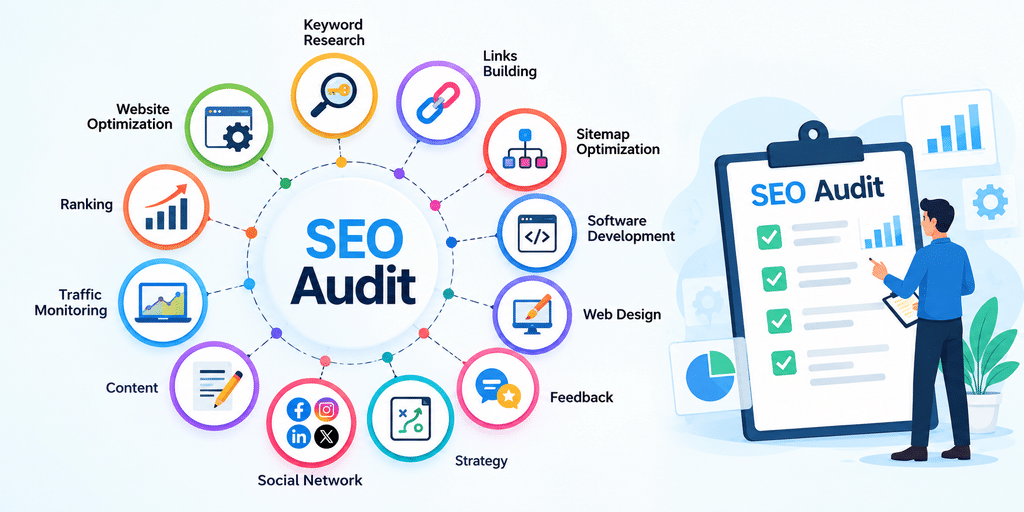
A complete website SEO audit typically covers crawlability, indexability, robots.txt configuration, XML sitemaps, canonical tags, redirects, broken links, URL structure, page speed, Core Web Vitals, mobile usability, JavaScript rendering, title tags, meta descriptions, headings, keyword optimization, content quality, internal linking, structured data, backlinks, local SEO, analytics, conversion tracking, and competitor performance.
The purpose is not simply to produce a long list of errors. A useful SEO audit connects technical findings to business outcomes. A missing canonical tag matters because duplicate URLs can create indexing and relevance problems. A slow page matters because poor performance can affect user experience and search performance. A weak internal linking structure matters because important pages may receive insufficient contextual signals and authority.
The same principle applies to content. A page may contain a target keyword but still fail to satisfy search intent. Another page may rank for several keywords but compete with another URL on the same website. A content audit can reveal thin content, duplicate content, outdated information, weak topical coverage, and opportunities to build stronger topic clusters.
For businesses in Dubai, an SEO audit can also examine local search signals, Google Business Profile optimization, NAP consistency, local citations, location pages, reviews, Google Maps visibility, and city-specific search opportunities.
Why an SEO Audit Matters for Dubai Businesses
Dubai has a highly competitive digital market. Businesses across professional services, real estate, hospitality, healthcare, technology, finance, retail, eCommerce, construction, education, and other sectors compete for attention across Google, Maps, social platforms, and emerging AI-powered search environments.
A website that is technically sound but poorly aligned with customer intent can lose visibility to a competitor with a clearer structure and stronger content. Likewise, a website with strong content can struggle if search engines cannot efficiently crawl and index its pages.
An SEO audit Dubai strategy therefore needs to look beyond individual keywords. It should evaluate how the entire website supports search visibility and business objectives.
For example, a Dubai-based service business may need to appear for searches that combine a service with a location. An eCommerce company may need stronger category and product-page architecture. A professional firm may need authoritative service pages and supporting educational content. A local business may need stronger Google Business Profile signals and consistent local citations.
The audit provides the evidence needed to determine which issues deserve attention first.
A strategic SEO audit does not treat every technical warning as equally important. Some issues can have a direct impact on crawling, indexing, rankings, or conversions. Others may be low-priority recommendations with limited commercial impact. The goal is to separate critical problems from routine optimization and focus resources where they can create meaningful improvements.
Crawlability and Indexability Audit
Search engines need to discover and access your website before they can evaluate its pages. Crawlability is therefore one of the first areas examined during a technical SEO audit.
The audit reviews how search engine crawlers navigate the website and whether important pages are accessible. It also checks for unnecessary crawl paths, blocked resources, problematic URL parameters, excessive duplicate URLs, redirect chains, broken links, and other issues that can create crawl waste.
The robots.txt file is reviewed to determine whether it allows search engines to access important content while preventing unnecessary crawling where appropriate. A poorly configured robots.txt file can unintentionally block valuable sections of a website, while an overly permissive configuration can allow search engines to spend resources on pages that provide little value.
XML sitemap analysis is another important part of the process. The sitemap should contain relevant, indexable URLs and should be accessible to search engines. It should also be consistent with the website’s canonical structure and overall information architecture.
Indexability checks examine which pages are actually eligible to appear in search results and whether important URLs are being indexed. Google Search Console can provide valuable information about indexed pages, excluded URLs, crawl issues, manual actions, and other search visibility signals.
Index bloat is another consideration. Large websites can accumulate unnecessary pages generated by filters, tags, archives, parameters, internal search results, duplicate URLs, or CMS functionality. These pages may increase crawl complexity without contributing meaningful value.
A professional SEO audit identifies these patterns and recommends practical ways to improve crawl efficiency and indexation.
Technical SEO Audit
Technical SEO provides the foundation on which other SEO activities operate. Even excellent content may struggle when a website has serious technical problems.
A technical website audit examines status codes, redirects, canonical tags, URL structures, JavaScript rendering, mobile usability, HTTPS implementation, XML sitemaps, robots.txt, site architecture, internal links, crawlability, indexing, and performance.
HTTP status codes are reviewed to identify unnecessary 404 errors, server errors, redirect chains, redirect loops, and other response issues. Redirects should guide users and crawlers toward the correct destination without creating unnecessary complexity.
Canonical tags are particularly important on websites with multiple versions of similar content. Filters, pagination, product variations, parameters, and CMS-generated URLs can create duplicate or near-duplicate pages. A canonical strategy helps communicate the preferred version of a page.
JavaScript SEO is increasingly relevant for modern websites. If important content or links depend heavily on client-side rendering, it is important to understand how search engines process that content. A JavaScript rendering audit can identify potential issues that affect discoverability or indexability.
Site architecture is also examined. A logical hierarchy helps users and search engines understand the relationship between pages. Important commercial pages should not be buried deep within the site structure without appropriate internal links.
Website Speed and Core Web Vitals
Website performance influences both user experience and the broader quality of a website’s search experience. A page that takes too long to load can create friction before a visitor even sees the content.
An SEO audit can use tools such as Google PageSpeed Insights and GTmetrix to identify performance issues. Common areas include image size, image formats, caching, render-blocking resources, JavaScript execution, CSS delivery, server response time, and unnecessary third-party scripts.
Core Web Vitals provide specific performance signals related to loading, interaction, and visual stability. LCP, INP, and CLS should be monitored as part of a broader website performance assessment.
Image optimization is often an immediate opportunity. Large images can consume significant bandwidth, particularly on mobile devices. Compression, modern image formats, responsive image delivery, and appropriate lazy loading can improve page performance.
Caching can also reduce repeated server processing and improve response times. Depending on the website platform, appropriate caching solutions can make a measurable difference.
However, performance optimization should be approached strategically. A faster website is useful when it improves the experience of real users and removes technical barriers. Performance metrics should therefore be evaluated alongside conversion behaviour, engagement, device usage, and page-level business importance.
On-Page SEO Audit
On-page SEO determines how clearly individual pages communicate their topic, purpose, relevance, and value.
An on-page SEO audit examines title tags, meta descriptions, headings, URLs, content structure, keyword usage, search intent, internal links, images, anchor text, and other page-level signals.
Title tags should clearly describe the page while naturally reflecting the primary topic. Meta descriptions should help users understand what they can expect from the page rather than functioning as a simple keyword list.
Heading structures should establish a clear hierarchy. A strong H1 communicates the primary topic, while H2 and H3 headings divide the subject into logical sections.
URL structures should remain concise, descriptive, and readable. Unnecessarily long or parameter-heavy URLs can make websites harder to understand and manage.
Keyword placement also matters, but modern SEO is not about repeating a phrase as many times as possible. Search engines increasingly evaluate the broader meaning and usefulness of content. A page targeting “SEO audit services Dubai” should naturally cover related concepts such as technical SEO audit, website SEO analysis, crawlability, indexing, on-page optimization, backlink analysis, local SEO, content quality, and SEO recommendations when those topics are genuinely relevant.
The objective is semantic relevance rather than keyword stuffing.
Content Quality and Search Intent
Content is one of the most visible parts of an SEO strategy, but publishing more content does not automatically create better organic performance.
A content SEO audit examines whether pages satisfy the intent behind the searches they target. Search intent may be informational, commercial, navigational, transactional, or local.
For example, someone searching “what is an SEO audit” may need an educational explanation. Someone searching “SEO audit company Dubai” may be evaluating service providers. Someone searching “technical SEO audit services Dubai” may have a more specific commercial requirement.
These audiences should not necessarily receive the same page.
A strong content audit identifies whether each URL has a distinct purpose. It looks for thin pages, duplicate content, outdated information, weak topical coverage, content gaps, and keyword cannibalization.
Cannibalization occurs when multiple pages compete for similar search intent without clear differentiation. Instead of automatically creating another page, the better solution may involve consolidating content, improving internal linking, redefining page intent, or differentiating the topics.
Content should also demonstrate usefulness and relevance. Search-focused writing should answer real customer questions, explain important concepts clearly, and provide enough context for the reader to make an informed decision.
For Dubai and UAE businesses, content can be localized around relevant services, industries, locations, customer needs, and regional search behaviour without forcing geographic keywords into every sentence.
Internal Linking Audit
Internal links connect the different parts of a website and help users discover related information.
An internal linking audit examines whether important pages receive appropriate contextual links from relevant content. It also identifies broken internal links, orphan pages, excessive links, weak anchor text, and inefficient authority flow.
A strong internal linking structure can connect service pages with supporting educational content, location pages with relevant services, category pages with products, and related articles within topic clusters.
Anchor text should be descriptive and relevant to the destination page. It should help users understand what they will find after clicking.
Internal linking also supports site architecture. If an important service page has few internal links while less important pages receive many, the website may not be communicating its priorities effectively.
The audit can therefore identify opportunities to improve internal link equity flow and create stronger relationships between related pages.
Structured Data and Schema Markup
Structured data helps communicate specific information about a page in a format that search engines can process more consistently.
A schema markup audit examines whether relevant structured data is implemented correctly and whether the markup reflects the visible content on the page.
Depending on the business and page type, relevant schema may include Organization, LocalBusiness, Service, Product, Article, BreadcrumbList, FAQPage, or other appropriate types.
Structured data should not be treated as a shortcut to rankings. Its value comes from helping search engines understand entities, relationships, page types, and specific information.
Validation is therefore important. Incorrect, incomplete, misleading, or mismatched structured data can create implementation problems.
As AI-powered search evolves, structured data can also form part of a broader AI search readiness strategy. However, schema should work alongside accessible content, strong site architecture, authoritative information, and clear entity signals rather than being treated as a standalone solution.
Mobile SEO Audit
Mobile optimization is essential because a large proportion of users access websites from smartphones.
A mobile SEO audit reviews responsive design, viewport configuration, mobile navigation, touch targets, content visibility, page speed, layout stability, and overall usability.
A page that works well on a desktop screen may still provide a poor mobile experience. Text can become difficult to read, navigation can become frustrating, buttons may be too small, and important content can be hidden behind unnecessary interface elements.
Mobile performance should also be assessed using real-world conditions where possible. A website that loads quickly on a high-speed office connection may behave differently on mobile networks and less powerful devices.
The objective is to ensure that users can discover information, understand the offer, navigate between pages, and complete important actions without unnecessary friction.
Backlink and Off-Page SEO Audit
A backlink audit evaluates the external websites that link to your domain and the overall quality and relevance of your backlink profile.
The analysis can include referring domains, anchor text, link relevance, link growth patterns, potentially harmful links, and competitor backlink profiles.
Tools such as Ahrefs Site Explorer can help identify referring domains and backlink opportunities. Competitor backlink analysis can reveal industry publications, directories, associations, partnerships, editorial opportunities, and other sources that may be relevant to a business.
The purpose is not to collect the largest possible number of links. Link quality, relevance, authority, and context matter.
A backlink audit can also identify potentially problematic patterns. Not every low-quality link automatically requires action, and decisions about disavowal should be approached carefully rather than mechanically.
For businesses in competitive Dubai markets, off-page analysis can provide useful context for understanding why competing pages may have stronger authority signals.
Local SEO Audit for Dubai Businesses
Local SEO is especially important for businesses that serve customers in specific locations.
A local SEO audit examines Google Business Profile information, business categories, NAP consistency, local citations, reviews, location pages, Google Maps visibility, local keywords, and other geographic signals.
NAP refers to name, address, and phone information. Consistency across important directories and business platforms helps reduce confusion about business identity and location.
The Google Business Profile should accurately represent the business, its category, services, location, contact information, and other relevant details.
Local citations can also be reviewed across core platforms and industry-specific directories. Relevant citation sources may include major search platforms, business directories, social networks, and regional resources.
Reviews are another important part of local search visibility and customer decision-making. An audit can examine review volume, rating trends, response activity, and competitive differences without treating reviews as an isolated ranking tactic.
Local content should also reflect genuine customer needs. Service-area pages, city-focused content, location-specific FAQs, and useful regional information can support local search visibility when they provide genuine value.
Competitor SEO Analysis
An SEO audit becomes more useful when website performance is considered within the competitive landscape.
Competitor analysis can examine keyword visibility, content structure, backlink profiles, service pages, local signals, search intent coverage, and ranking opportunities.
The purpose is not to copy competitors. It is to understand the market.
A keyword gap analysis can identify relevant searches for which competitors have visibility but your website does not. A content gap analysis can reveal topics that customers are searching for but your current content does not address adequately.
Competitor backlink analysis can identify industry-relevant referring domains. Content comparisons can show whether competitors answer important customer questions more comprehensively.
For Dubai businesses, competitor analysis can also reveal how companies position themselves around location-based searches such as SEO Dubai, SEO services Dubai, SEO agency Dubai, SEO audit company Dubai, and industry-specific commercial queries.
This information can help build a more focused SEO strategy based on actual search demand and competitive conditions.
Analytics and SEO Performance Tracking
An SEO audit should connect technical and content findings to measurable business outcomes.
Google Analytics can provide information about organic traffic, user engagement, landing pages, conversions, and other performance indicators. Google Search Console provides data around search queries, impressions, clicks, indexing, coverage, and search performance.
Conversion tracking is particularly important for service businesses. Traffic alone does not demonstrate commercial success. Calls, form submissions, enquiries, bookings, purchases, and other meaningful actions provide stronger business context.
Call and form tracking can help determine whether organic traffic is producing qualified leads. Landing-page analysis can identify pages that attract visitors but fail to move them toward the next step.
An SEO report should therefore distinguish between visibility metrics and business outcomes.
Ranking improvements can be useful indicators, but rankings fluctuate and do not always translate directly into revenue. A more complete measurement framework connects search visibility, organic traffic, engagement, conversions, lead quality, and business performance.
AI Search and SEO Audits
Search behaviour is expanding beyond traditional blue-link results. AI-powered search experiences, conversational search, generative search, and AI-generated answers are becoming increasingly relevant to how people discover information.
An SEO audit can therefore include an AI search readiness assessment.
This may involve reviewing whether important content is accessible to relevant crawlers, whether the website communicates clear entities and relationships, whether information is structured logically, and whether content provides direct, reliable answers to common questions.
AI search optimization, Generative Engine Optimization, Answer Engine Optimization, and traditional SEO overlap in several areas, but they should not be treated as identical concepts.
A strong foundation remains important: crawlable pages, useful content, clear information architecture, authoritative references, structured data where appropriate, and strong brand signals.
Businesses may also want to monitor how their brand appears in AI search environments such as ChatGPT, Google AI Overviews, Perplexity, and Gemini. The objective should be to understand visibility and citation patterns rather than relying on assumptions about how AI systems select sources.
For UAE businesses, this can become particularly relevant where customers search conversationally for local services, companies, recommendations, and comparisons.
Arabic and English SEO in the UAE
The UAE has a multilingual digital environment, making language strategy an important consideration for many businesses.
An SEO audit can evaluate whether English and Arabic experiences are clearly structured and whether language-specific content is genuinely useful to each audience.
Simply translating an English page word for word may not always produce the best search experience. Search behaviour, terminology, phrasing, and user intent can differ between languages.
Technical implementation should also be reviewed. Language and regional variations need appropriate signals so search engines can understand which version is intended for which audience.
For businesses targeting both local and international customers, a bilingual SEO strategy can support broader search visibility while maintaining clear brand communication.
E-Commerce SEO Audit
ECommerce websites require additional layers of SEO analysis because they often contain large numbers of product, category, filter, and variation pages.
An eCommerce SEO audit can examine product page optimization, category architecture, faceted navigation, duplicate content, canonical tags, structured data, internal linking, product descriptions, image optimization, site speed, mobile performance, and indexing.
Shopify SEO audit and WooCommerce SEO audit requirements can vary depending on platform configuration, installed applications, themes, plugins, and customization.
Product pages should provide useful information rather than relying solely on manufacturer descriptions. Category pages should help users understand the product range while supporting relevant search intent.
Filters and faceted navigation require particular attention because they can create large numbers of URLs. Without a clear crawl and indexation strategy, these URLs can generate unnecessary crawl paths and duplicate content.
How Often Should You Perform an SEO Audit?
There is no universal schedule that applies to every website.
The appropriate frequency depends on website size, platform complexity, publishing activity, technical changes, migration activity, competitive pressure, and business goals.
A small website may benefit from a comprehensive audit periodically alongside ongoing monitoring. Larger websites and eCommerce platforms may require more frequent technical checks.
An SEO audit is particularly valuable before and after a major website migration, redesign, domain change, CMS migration, international expansion, or significant information architecture update.
It can also be appropriate after a substantial traffic decline, unexpected ranking changes, indexing problems, or major changes in search visibility.
Regular monitoring should complement comprehensive audits. Google Search Console, analytics, crawling tools, performance platforms, and backlink monitoring can help identify new issues between major audit cycles.
What an SEO Audit Report Should Include
A useful SEO audit report should turn complex technical findings into practical priorities.
The report should clearly explain the issue, affected URLs or sections, potential impact, recommended action, and priority.
Technical findings may cover crawlability, indexability, robots.txt, XML sitemap, canonical tags, redirects, status codes, JavaScript rendering, Core Web Vitals, mobile usability, and site architecture.
On-page findings may include title tags, meta descriptions, headings, URL optimization, keyword usage, content quality, search intent, internal linking, and content gaps.
Off-page analysis may cover backlink profiles, referring domains, link quality, competitor backlinks, and potential risk areas.
Local SEO findings may include Google Business Profile optimization, NAP consistency, citations, local content, reviews, and location-based visibility.
The most useful reports also distinguish between critical issues, high-priority opportunities, medium-priority improvements, and ongoing recommendations.
A report should not overwhelm a business with technical terminology without explaining what the finding means commercially.
Common SEO Problems Found During Website Audits
Many websites share recurring SEO problems. These include blocked pages, missing XML sitemaps, incorrect canonical tags, broken links, redirect chains, duplicate URLs, thin content, poor internal linking, missing metadata, weak heading structures, slow pages, mobile usability issues, indexing inconsistencies, duplicate content, keyword cannibalization, and low-quality backlinks.
Other issues may be less visible. A website may have valuable pages that are effectively orphaned because no internal links point toward them. A service page may target a keyword but fail to address the underlying search intent. A local business may have inconsistent information across directories. An eCommerce website may generate thousands of low-value filter URLs.
These problems demonstrate why a comprehensive SEO audit should evaluate the website as a connected system.
Fixing isolated issues without understanding their relationships can lead to wasted effort. For example, rewriting page titles will not solve a crawlability problem. Publishing new content will not necessarily solve cannibalization. Building backlinks will not correct a broken website architecture.
The audit establishes the sequence in which problems should be addressed.
SEO Audit for Websites Not Ranking on Google
When a website is not ranking, the first question should not automatically be “Which keyword should we add?”
There may be a deeper issue.
The website could have indexing restrictions, weak topical relevance, insufficient authority, poor search intent alignment, technical performance problems, weak internal links, duplicate pages, or content that does not provide enough value compared with competing results.
A ranking analysis should therefore consider technical, content, authority, relevance, and competitive factors together.
For a Dubai business, the audit may also examine whether the website is targeting realistic location-based search terms and whether local signals support the intended geographic audience.
A structured audit replaces assumptions with evidence.
How Much Does an SEO Audit Cost in Dubai?
SEO audit pricing in Dubai can vary considerably depending on the size and complexity of the website, the depth of analysis required, the number of pages, technical complexity, eCommerce functionality, international targeting, local SEO requirements, competitor analysis, and reporting requirements.
A basic website assessment may cover a smaller set of high-level issues, while a comprehensive technical SEO audit can involve crawling large websites, reviewing indexation, analyzing templates, evaluating content, studying backlinks, examining competitors, and producing prioritized recommendations.
Businesses should therefore compare audit scope rather than looking only at the headline price.
An affordable SEO audit can be useful when the scope matches the business requirement. A larger enterprise website may require a much deeper technical SEO analysis. The important question is what will actually be examined and how actionable the resulting recommendations will be.
A professional SEO audit should make clear what is included, what is excluded, which tools or data sources are used, and what the final deliverables contain.
How Long Does an SEO Audit Take?
The time required depends primarily on website complexity and audit depth.
A small brochure website can be reviewed relatively quickly, while a large eCommerce platform with thousands of URLs, multiple templates, filters, international versions, and extensive content requires considerably more analysis.
The audit process typically includes data collection, crawling, technical analysis, indexing review, content assessment, on-page analysis, internal linking evaluation, backlink analysis, competitor research, local SEO assessment where relevant, and report preparation.
The objective should not be to finish as quickly as possible. A useful audit needs enough analysis to distinguish symptoms from underlying causes.
Why Choose a Strategic SEO Audit Approach?
An effective SEO audit should be more than a checklist of warnings.
The value comes from connecting each finding to the website, the market, the search landscape, and the business objective.
At Octopus, the approach is grounded in strategy, data, and performance signals rather than assumptions. The audit process considers technical SEO, content, search intent, site architecture, authority, local visibility, user experience, and emerging AI search considerations as connected parts of the digital ecosystem.
The focus is on clarity. Businesses should understand what is working, what is limiting performance, what should be fixed first, and where future growth opportunities exist.
For Dubai and UAE businesses, this also means considering regional search behaviour, local competition, Arabic and English audiences where relevant, Google Business Profile visibility, and the growing role of AI-powered discovery.
The objective is not to create a report that sits unused. The objective is to create an actionable SEO roadmap.
Turning an SEO Audit Into an SEO Strategy
An audit identifies the current state. The next step is turning those findings into an implementation plan.
Technical issues should be prioritized according to their impact and effort. High-impact indexing or crawlability problems may require immediate attention. Performance improvements can then be coordinated with development teams. Content gaps can become part of an editorial roadmap. Internal linking opportunities can be incorporated into content updates.
Competitor research can inform keyword targeting and content development. Local SEO findings can shape Google Business Profile and citation work. Backlink analysis can identify relevant authority-building opportunities.
This creates a connected SEO strategy rather than a collection of disconnected tasks.
A strong roadmap can also establish measurable KPIs. These may include organic impressions, clicks, qualified traffic, conversions, indexed pages, Core Web Vitals, local visibility, relevant keyword coverage, and AI search visibility.
The precise metrics should reflect business objectives.
Building a Stronger Search Foundation
SEO performance is rarely determined by a single factor.
Technical health, content relevance, internal linking, authority, user experience, local visibility, site performance, and business credibility work together.
That is why a comprehensive SEO audit is useful before investing heavily in additional optimization. It establishes the condition of the existing website and identifies constraints that may otherwise remain hidden.
For businesses competing in Dubai, the process can be even more valuable because search competition is often closely connected to location, service category, customer intent, and brand authority.
A website that provides a strong technical foundation and genuinely useful content is better positioned to adapt as search behaviour evolves.
Conclusion
An SEO audit in Dubai gives businesses a clearer understanding of what is helping or limiting their search visibility.
From crawlability and indexability to technical SEO, Core Web Vitals, mobile optimization, on-page SEO, content quality, internal linking, schema markup, backlink profiles, local SEO, competitor analysis, analytics, and AI search readiness, a comprehensive audit examines the factors that influence how a website is discovered and understood.
The most valuable outcome is not simply a list of errors. It is a prioritized understanding of what needs attention, why it matters, and how it can support broader business goals.
For Dubai and UAE businesses, that foundation can support stronger organic visibility, better search experiences, more relevant traffic, and a clearer path toward sustainable digital growth.
At Octopus, we approach SEO as a strategic business discipline. We do not guess. We use data, strategy, and performance signals to identify opportunities and create a practical roadmap aligned with the brand and market.
Whether the challenge is a technical SEO problem, declining Google rankings, weak local visibility, poor website performance, content gaps, indexing issues, or the need to prepare for AI-powered search, a structured audit provides the evidence needed to move forward with clarity.
A stronger SEO strategy starts with knowing exactly where the website stands.
Frequently Asked Questions
01. What is an SEO audit?
An SEO audit is a comprehensive evaluation of a website’s technical SEO, on-page optimization, content, backlinks, user experience, and search visibility. It helps identify issues that may prevent a website from ranking effectively and provides a roadmap for improvement.
02. Why is an SEO audit important for businesses in Dubai?
An SEO audit helps Dubai businesses identify search performance issues, improve website visibility, and understand how effectively their website targets relevant local and industry-specific searches. It can also uncover technical and content issues affecting organic traffic and conversions.
03. What does a complete SEO audit include?
A comprehensive SEO audit typically covers technical SEO, keyword targeting, on-page SEO, content quality, internal linking, site architecture, mobile usability, page speed, structured data, backlinks, local SEO, and indexing.
04. How often should a website undergo an SEO audit?
A full SEO audit can be conducted periodically, while important technical, content, ranking, and indexing issues should be monitored continuously. Businesses may also benefit from an additional audit after a major website redesign, migration, algorithm change, or significant decline in organic traffic.
05. What are common SEO issues found during an audit?
Common issues include broken links, crawl errors, duplicate content, missing metadata, poor internal linking, slow-loading pages, incorrect canonical tags, indexing problems, weak content, missing structured data, and mobile usability issues.
06. Can an SEO audit improve Google rankings?
An audit itself does not directly improve rankings. Instead, it identifies problems and opportunities that can be addressed through SEO implementation. Fixing technical issues, improving content, strengthening relevance, and enhancing website usability can support better organic search performance over time.
07. What is included in a technical SEO audit?
A technical SEO audit examines areas such as crawlability, indexability, XML sitemaps, robots.txt, HTTPS, canonicalization, redirects, URL structure, Core Web Vitals, mobile usability, JavaScript rendering, structured data, and website architecture.
08. Does an SEO audit include local SEO for Dubai businesses?
Yes. A local SEO audit can review Google Business Profile optimization, local landing pages, NAP consistency, location-based keywords, local citations, reviews, structured data, and other signals relevant to businesses targeting customers in Dubai and the wider UAE.
09. How long does an SEO audit take?
The timeframe depends on the size and complexity of the website. A small business website can generally be reviewed more quickly, while large e-commerce, enterprise, or multi-location websites require a more detailed analysis of thousands of URLs and technical elements.
10. What happens after an SEO audit?
The audit findings can be organized into a prioritized SEO action plan. Critical technical issues are typically addressed first, followed by on-page improvements, content opportunities, internal linking, authority-building activities, and ongoing performance monitoring.
