
Shopify SEO in Dubai: 9 Common Issues Holding Back Organic Sales

Dubai’s ecommerce market is competitive, mobile-first, and increasingly dependent on shoppers finding the right product at the right moment. For a Shopify store, strong products and professional web design alone do not guarantee organic sales. Technical SEO problems, weak search intent alignment, thin collection content, poor site architecture, slow performance, weak internal linking, and insufficient trust signals can all prevent a store from reaching potential customers through organic search.
Shopify SEO in Dubai therefore needs to be approached as a complete search and conversion system rather than as a keyword-placement exercise. Effective Shopify SEO services connect technical optimization with content strategy, search intent, ecommerce architecture, product-page optimization, collection-page optimization, internal linking, structured data, Core Web Vitals, indexation, and conversion-focused user experience. A product page needs to be discoverable, a collection page needs to satisfy commercial intent, internal links need to communicate relationships between pages, structured data needs to accurately describe products, and the overall website needs to provide enough useful information for shoppers to make confident purchasing decisions.
For businesses looking for professional Shopify SEO Dubai support, the challenge is not simply getting more visitors from Google. The more important objective is attracting relevant shoppers who are actively looking for the products or categories a business offers. A specialized Shopify SEO agency Dubai can approach that objective by identifying technical barriers, mapping keywords to the correct Shopify pages, strengthening commercial content, improving organic visibility, and creating a clearer path from search discovery to product evaluation and purchase.
Shopify SEO in Dubai is the process of optimizing a Shopify ecommerce store so search engines and AI-powered search systems can discover, understand, evaluate, and surface its products, collections, and business information for relevant searches. Effective Shopify SEO services cover technical SEO, search intent, Shopify site architecture, product-page optimization, collection-page optimization, internal linking, structured data, Core Web Vitals, indexation, local relevance, and ecommerce content quality.
The most common issues holding back organic sales from a Dubai Shopify store include duplicate Shopify URLs, thin collection pages, slow page performance, missing or conflicting structured data, weak internal linking, poor search-intent alignment, generic product descriptions, indexation and redirect problems, and insufficient local or international search signals. Addressing these issues helps important Shopify pages become easier to crawl, understand, index, and match with relevant commercial searches while creating a better experience for potential customers.
For businesses looking for Shopify SEO Dubai support, the objective should be more than increasing organic traffic. A specialized Shopify SEO agency Dubai can combine technical audits, keyword and search-intent mapping, Shopify architecture improvements, product and collection optimization, structured-data implementation, Core Web Vitals improvements, internal-linking strategies, indexation monitoring, and content development to create a technically accessible, semantically clear, locally relevant, and trustworthy Shopify store that can turn organic search visibility into sustainable ecommerce sales.
The Search Quality Evaluator Guidelines provide an important framework for understanding why these factors matter. The guidelines explain that high-quality Main Content should demonstrate appropriate effort, originality, talent or skill, and accuracy where accuracy is important. They also emphasize that search results should satisfy the user’s actual purpose rather than merely matching words in a query. This principle is particularly relevant to ecommerce because ranking for a keyword has limited commercial value when the resulting page does not actually answer the shopper’s needs.
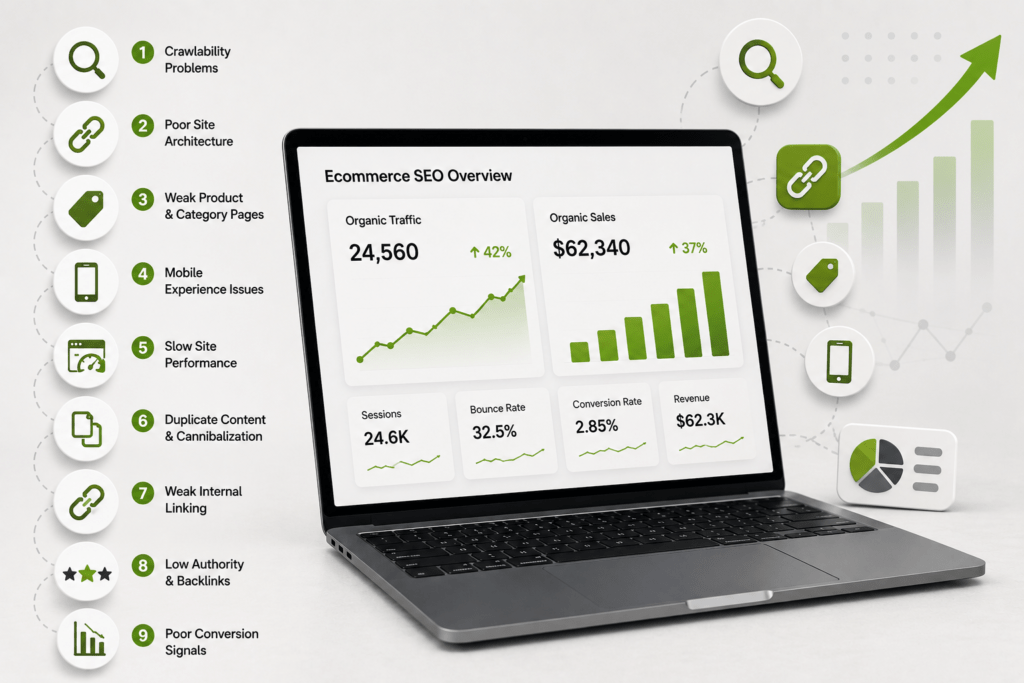
For a Dubai Shopify business, organic growth therefore starts with removing the barriers between search engines, shoppers, and the products the business wants to sell. The right Shopify SEO services can address those barriers systematically, while a focused Shopify SEO Dubai strategy can ensure that technical improvements, content, local relevance, and commercial search intent work together. Whether optimization is handled internally or through a Shopify SEO agency Dubai, the objective remains the same: make the right pages easier to discover, easier to understand, easier to trust, and more capable of turning organic search visibility into sustainable ecommerce sales. The nine problems below represent some of the most common barriers standing between Shopify stores and that goal.
Duplicate Shopify URLs Are Splitting Your SEO Signals
A Shopify store can unintentionally create multiple URLs that lead to substantially the same product. This commonly happens when products are accessed through collection paths as well as their primary product URLs. The product may appear at a clean /products/ URL while another path can be generated through collection navigation.
From a shopper’s perspective, this difference may be invisible. From an SEO perspective, unnecessary URL variations can make the website’s architecture harder to understand. Search engines need to determine which URL should represent the product, which URL should receive internal authority, and which URL should appear in search results.
This becomes particularly important for a Dubai ecommerce store with a large catalogue. A store selling fashion, electronics, cosmetics, furniture, watches, accessories, or specialist products may have hundreds or thousands of individual product pages. If every product can be reached through several URL variations, the number of crawlable URLs can grow much faster than the number of genuinely useful pages.
Canonicalization helps communicate the preferred version. However, a canonical tag should not be treated as an excuse for inconsistent architecture. Internal links should generally reinforce the preferred product URL rather than repeatedly pointing search engines and users toward secondary versions.
A technical Shopify SEO audit should begin by identifying which URLs represent the same underlying product. The preferred URL should then be established and reinforced throughout navigation, collection pages, related-product links, breadcrumbs, XML discovery, and other internal pathways.
Filtered navigation and parameter-based URLs deserve separate attention. Not every automatically generated URL needs to rank. A temporary filter combination that provides no meaningful standalone value does not need to compete with a carefully structured collection page.
The goal is not to reduce the number of URLs simply for the sake of having fewer URLs. The goal is to create a clear hierarchy in which search engines can understand which pages are important and shoppers can consistently reach the correct destination.
This approach also supports the broader quality principle described in the Search Quality Evaluator Guidelines. Search engines should help people find what they are looking for rather than leading them through unnecessary or confusing pathways.
For a Shopify store targeting Dubai, URL clarity is therefore not merely a technical housekeeping exercise. It is part of creating a website in which product authority is concentrated instead of diluted across unnecessary variations.
Thin Collection Pages Are Wasting Valuable SEO Real Estate
Collection pages are some of the most valuable SEO assets on an ecommerce website because they can target broader commercial searches than individual product pages. Yet many Shopify stores treat collection pages as little more than product grids.
A shopper searching for a category does not always know which individual product to buy. A search such as “women’s running shoes Dubai” represents a broader commercial need. The shopper may want to compare styles, brands, prices, features, sizes, delivery options, and use cases before selecting a specific product.
A collection page can satisfy that intent, but only if the page provides enough context.
A grid of products communicates availability, but it does not necessarily explain the category. Useful collection content can establish what the category contains, who the products are intended for, what characteristics shoppers should consider, and how the available products differ.
The supplied Search Quality Evaluator Guidelines reinforce the importance of Main Content. Main Content is the part of a page that directly helps the page achieve its purpose, and the quality of that content plays a major role in evaluating the page.
For an ecommerce collection, the purpose is not simply to contain keywords. The purpose is to help people understand and navigate the category while facilitating shopping.
A stronger collection page can introduce the category in a concise, useful paragraph, provide relevant buying context, and then allow shoppers to browse products without forcing them through a wall of text. Supporting content can appear below the product grid when that arrangement protects the shopping experience.
The exact word count should depend on the category rather than an arbitrary SEO formula. A collection that can be explained effectively in a few hundred words does not need unnecessary filler simply to reach a target. The Search Quality Evaluator Guidelines explicitly recognize that satisfying content can be short or long depending on the query and purpose.
Dubai-specific context can make collection content more useful when it is genuinely relevant. Depending on the business, shoppers may care about UAE delivery, local availability, product suitability, payment options, sizing, warranty information, or regional buying considerations.
The strongest collection pages therefore perform two jobs simultaneously. They organize products for shoppers while providing search engines with meaningful context about the category.
That is far more valuable than adding a generic paragraph containing repeated variations of the same keyword.
Slow Pages and Poor Core Web Vitals Are Turning Visitors Away
A website visitor does not experience a Core Web Vitals report. A website visitor experiences a page that either becomes usable quickly or makes them wait.
Performance is particularly important for Shopify stores because ecommerce journeys frequently begin on mobile devices. A potential customer may discover a product through Google, open the result on a phone, compare the page with competing stores, and decide within seconds whether to continue.
A slow storefront introduces friction at exactly the wrong moment.
Large images, excessive Shopify apps, third-party scripts, tracking technologies, heavy theme customizations, unnecessary animations, and poorly optimized code can all contribute to slower loading. The result can be especially frustrating on mobile connections.
The supplied competitor research associated with the brief highlights the commercial importance of page speed and cites widely referenced research linking delays with lower conversion performance. The exact commercial effect varies between websites, but the underlying relationship is straightforward: unnecessary friction can reduce the number of visitors who reach the point of purchase.
Core Web Vitals provide useful ways to evaluate real-world page experience. Largest Contentful Paint helps assess how quickly the main content becomes visible, Cumulative Layout Shift measures unexpected movement during loading, and Interaction to Next Paint evaluates responsiveness.
These metrics should not be treated as an isolated SEO checklist. The larger objective is to make the store faster and easier to use.
One of the first places to investigate is the Shopify app ecosystem. An app that provides a valuable business function may be worth its performance cost, but unused or redundant applications can create unnecessary scripts. Removing an app that is no longer needed can sometimes be more valuable than endlessly optimizing small pieces of page code.
Images are another major opportunity. Product photography is essential for ecommerce, but oversized image files can create unnecessary loading delays. Images should be appropriately compressed and delivered at dimensions that make sense for the actual design.
The most important above-the-fold content should also be prioritized. A shopper should not have to wait for several unrelated scripts or decorative elements before understanding what the page offers.
Performance should then be monitored after major theme, app, analytics, and merchandising changes. A store can become slower without anyone deliberately changing its SEO strategy.
For Shopify SEO in Dubai, performance is therefore closely connected to organic sales. Search visibility gets the visitor through the door, but a fast and responsive storefront helps prevent that visitor from leaving.
Missing or Conflicting Schema Markup Makes Product Information Harder to Interpret
Structured data can help search engines understand the information represented on an ecommerce page. Product pages contain many structured attributes, including product names, prices, availability, brands, ratings, reviews, and identifiers.
When those details are represented accurately through structured data, search engines have clearer machine-readable information about the page.
Problems arise when structured data is missing, incomplete, duplicated, or inconsistent with what the shopper actually sees.
Shopify themes, apps, review systems, and SEO tools can sometimes contribute overlapping schema implementations. One system may generate Product markup while another application adds a second version. In other cases, structured data may contain information that does not accurately reflect the visible page.
Accuracy is particularly important because ecommerce pages influence purchasing decisions. The Search Quality Evaluator Guidelines state that informational Main Content should be accurate, while high-quality results need to satisfy the purpose of the query.
A Shopify schema audit should compare structured data against the actual product page. If a product is unavailable, structured information should not imply availability. If a rating is represented, the rating should correspond to legitimate visible review information. If a price is included, it should be consistent with the relevant product information.
The objective is not to add as much schema as possible. The objective is to provide accurate, useful machine-readable information.
Breadcrumb structured data can also help communicate the relationship between a product and its category hierarchy. Product markup can describe relevant product information. Organization information can help establish business identity where appropriate.
The strongest implementation is usually the simplest accurate implementation.
Structured data should support the page rather than become a technical layer disconnected from the shopper’s experience.
For a Dubai ecommerce business, schema is therefore most valuable when it reflects a well-maintained product catalogue. Clean structured data cannot rescue incomplete specifications, generic descriptions, inaccurate availability, or weak product information.
Technical clarity and content quality need to work together.
Weak Internal Linking Is Leaving Valuable Products and Content Isolated
Internal links tell both shoppers and search engines how different pages on a Shopify website relate to one another. When internal linking is weak, valuable content can become isolated even when the individual pages are well optimized.
An ecommerce website naturally contains several levels of search intent. A blog article may answer an informational question. A collection page may satisfy a broader commercial search. A product page may address a specific transactional query.
Those pages become more useful when they are connected.
Imagine a Dubai furniture retailer publishing an article about choosing a dining table for a small apartment. The article can explain the decision-making process and then naturally guide readers toward appropriate dining table collections. Those collections can then connect shoppers with individual products.
This creates a logical journey from information to commercial consideration to transaction.
Internal linking should remain contextual rather than mechanical. A link should exist because it helps the reader continue the journey. Descriptive anchor text can explain what the destination contains without sounding artificial.
The supplied competitor research identifies the blog-to-collection-to-product pathway as a useful structure for Shopify ecommerce websites. This approach also creates opportunities to distribute internal authority toward commercially important pages.
Orphaned products deserve particular attention. A product that exists in the catalogue but receives little meaningful internal linking may be harder to discover and harder for search engines to understand within the site’s overall hierarchy.
The homepage can support important commercial categories. Collection pages can connect related categories and priority products. Product pages can connect complementary products and useful buying guides. Editorial content can introduce readers to relevant collections and products.
This does not mean every page needs dozens of links. Excessive internal linking can make pages difficult to navigate and reduce the value of each individual connection.
The better principle is relevance.
If a link helps someone understand, compare, evaluate, or purchase something, it has a reason to exist.A well-connected Shopify store becomes easier to navigate for shoppers and easier to interpret as a coherent ecommerce entity.
Poor Search Intent Alignment Is Bringing the Wrong Traffic
Traffic can increase while sales remain flat.
That situation often indicates a search-intent problem rather than a pure visibility problem. A Shopify store may rank for relevant-looking keywords while attracting visitors whose actual goals do not match the page they land on.
Search intent exists at different stages of the customer journey. Someone searching for information about how to choose a product is behaving differently from someone searching for a specific product model and location.
A query such as “how to choose running shoes” is primarily informational. A query such as “best running shoes for beginners” may indicate comparison and evaluation. A query such as “women’s running shoes Dubai” is more commercially oriented, while a query containing a specific product and purchase language can be strongly transactional.
The page type should reflect that intent.
A blog guide can answer educational questions. A collection page can organize category-level commercial choices. A product page can provide detailed information about a specific product.
The Search Quality Evaluator Guidelines distinguish between different types of user intent and emphasize that results should satisfy what the user is actually trying to accomplish.
This also helps prevent keyword cannibalization. If multiple pages are competing for the same search intent without a clear distinction, the website can send mixed signals about which page is the best destination.
A practical Shopify SEO strategy therefore starts with page-level intent mapping. Each important page should have a clear reason for existing and a clear search audience.
Keyword research can identify language people use, but search-result analysis reveals what type of content Google considers appropriate for that language.
If the results for a query overwhelmingly contain category pages, creating another generic article may not be the strongest strategy. If the results are dominated by detailed guides, a thin collection page may not satisfy the searcher.
The goal is not simply to rank for more terms.
The goal is to make sure the person who searches for a term arrives at a page that genuinely answers the reason behind that search.
That alignment is particularly valuable for Dubai ecommerce businesses because commercial traffic is expensive to acquire through advertising and highly competitive in organic search. The more accurately a store matches intent, the more efficiently its organic visibility can contribute to revenue.
Generic Product Descriptions Are Making Your Store Look Interchangeable
A product page can have an optimized title, attractive images, structured data, and a technically sound Shopify setup, yet still struggle to generate organic sales when the product description is generic. Many ecommerce businesses rely heavily on manufacturer-supplied descriptions, which means the same wording can appear across multiple online stores selling the same product. When a Dubai Shopify store uses identical or minimally edited descriptions, the page has fewer opportunities to demonstrate what makes the business useful or different from competing retailers.
Generic product descriptions also fail to address the questions that shoppers ask before making a purchase. A statement such as “made with premium materials and designed for everyday use” provides very little decision-making value because it could describe thousands of products. A stronger product page explains what the product actually does, who it is designed for, what problem it solves, which features matter, how it compares with alternatives, and what customers should know before purchasing. For a Shopify store targeting customers in Dubai, relevant information about UAE availability, delivery, returns, warranty coverage, sizing, specifications, or product suitability can make the page substantially more useful when those details genuinely apply.
The Search Quality Evaluator Guidelines place significant importance on the quality of Main Content and explain that high-quality content can demonstrate effort, originality, talent or skill, and accuracy where appropriate. This principle is particularly relevant to ecommerce product pages because the written content is part of the information shoppers use to evaluate whether a product is appropriate for their needs. Simply reproducing manufacturer copy may communicate basic specifications, but it does not necessarily demonstrate the additional value provided by the retailer.
A stronger Shopify product description begins with the information supplied by the manufacturer but goes further by adding original context. If a product has a technical feature, the description can explain what that feature means in practical terms. If the product is available in several sizes, the page can explain how shoppers can choose between them. If two models are frequently compared, the content can clarify the important differences. If customers commonly ask whether the product is suitable for a particular use, that question can become part of the product-page content when the answer can be supported accurately.
Customer reviews can also reveal the information shoppers actually care about. When customers repeatedly ask whether a bag can accommodate a laptop, whether a chair is suitable for extended working hours, whether a particular appliance fits a certain space, or how a product compares with another model, those questions provide useful insight into the information missing from a generic description. Addressing genuine customer questions can make the product page more helpful while naturally introducing relevant semantic terms and long-tail search phrases.
Original product photography can strengthen this approach even further. Manufacturer images can be useful, but original photographs, demonstrations, measurements, comparisons, and usage examples can give shoppers information they cannot obtain from a standard catalogue description. For a Dubai ecommerce brand, showing the actual product experience can also help distinguish the store from competitors selling the same item with identical supplier materials.
The objective is not to make every product description extremely long. Length alone does not create quality. The objective is to make the Main Content sufficiently useful for the product’s purpose. A straightforward product may require only concise specifications and practical explanations, while a technically complex or expensive product may justify considerably more detailed information. The content should expand when additional information helps a shopper make a better decision, not simply because an SEO target requires more words.
A product page should ultimately function as a decision-support resource rather than a catalogue entry. Instead of telling shoppers only that a product is “high quality,” the page should demonstrate what the product offers, explain why particular features matter, address realistic concerns, and provide accurate information that supports the purchase decision. When a Dubai Shopify store replaces generic manufacturer descriptions with original, useful, and trustworthy product content, the store creates a stronger experience for shoppers while giving search engines substantially more meaningful information about the page.
Indexation, Redirects, and Sitemap Problems Are Hiding Your Best Pages
One of the most frustrating Shopify SEO problems occurs when a page that deserves organic visibility is not being indexed correctly. A store can invest significant time and resources in creating a valuable collection page, detailed product page, buying guide, or other useful resource, only to discover that search engines are not treating the page as expected. When an important page is not properly discovered, crawled, or indexed, even excellent content can struggle to generate organic traffic and sales.
Indexation problems can appear for several reasons, including theme changes, URL changes, product removals, application installations, redirect configurations, noindex directives, robots.txt settings, and other technical modifications. Shopify provides automated functionality for several technical SEO elements, but automation does not remove the need for regular monitoring. A technically generated sitemap or default configuration can still require investigation when important pages are unexpectedly excluded from search.
Google Search Console is particularly useful for identifying indexed and excluded URLs, indexing anomalies, redirect issues, errors, canonical selections, and sitemap-related problems. Important product and collection pages should be reviewed individually when necessary, especially when organic visibility drops or a newly published page fails to appear in search. If a high-value page is unexpectedly excluded, the underlying reason should be understood before investing additional time in content creation, link building, or other SEO activities.

Redirects are equally important because ecommerce websites change continuously. Products can be discontinued, renamed, replaced, moved into different collections, or removed from the catalogue. When an old URL has accumulated search visibility, backlinks, or user recognition, simply deleting the URL can create an unnecessary dead end. A relevant redirect can guide visitors toward the most appropriate replacement while helping search engines understand that the old location has been replaced by another relevant destination.
The important distinction is between removing a genuinely obsolete page and accidentally removing a valuable page. If a discontinued product has a highly relevant replacement, redirecting the old URL to that replacement can provide a better experience than allowing the old page to return an error. However, redirecting unrelated URLs simply to preserve traffic can create a poor user experience and weaken the relevance of the destination. Redirect decisions should therefore be based on the relationship between the old page and the new destination.
Robots.txt and noindex controls also require careful handling. Low-value search-result URLs, certain filter combinations, or other automatically generated pages may not need to appear in search results, but blocking important product or collection pages can create a much more serious SEO problem. A Shopify store should distinguish between URLs that provide meaningful value to searchers and URLs that exist primarily as technical variations.
The Search Quality Evaluator Guidelines emphasize understanding the purpose of a webpage and evaluating how well the page achieves that purpose. From an SEO perspective, this reinforces the importance of ensuring that useful pages are accessible and discoverable. A product page created to help someone evaluate and purchase a product cannot fulfil that purpose effectively if search engines cannot discover or index the page.
Indexation should therefore be treated as an ongoing part of Shopify SEO rather than a one-time technical task. Whenever a business adds products, launches collections, changes themes, installs applications, restructures categories, modifies URLs, or removes old content, the potential indexing consequences should be considered. Technical changes that appear minor from a design or development perspective can sometimes influence how search engines access and interpret important pages.
A strong ecommerce website is not merely a website filled with high-quality pages. A strong ecommerce website also makes sure that search engines can discover, crawl, interpret, and index those pages appropriately. For a Dubai Shopify store competing for valuable organic searches, protecting that discoverability can be just as important as creating the content itself.
Dubai Stores Are Missing Local, International, and Emerging Search Opportunities
A Shopify store targeting Dubai needs to communicate its market clearly without turning every page into a repetitive location-keyword exercise. Local relevance is about more than simply adding the word “Dubai” to a title tag, heading, or product description. Depending on the business and its customers, local relevance can involve UAE delivery information, local product availability, currency, payment methods, customer support, return policies, warranty terms, and geographic service coverage. When these details are genuinely relevant to the customer journey, they can make the website more useful while also strengthening the overall trustworthiness of the ecommerce experience.
For a Dubai Shopify store, commercial information can play an important role in helping potential customers understand whether the business is actually suitable for them. A shopper may want to know whether a product can be delivered to their location, which currency will be used during checkout, how returns are handled, or how customer support can be contacted if something goes wrong. These details are not simply additional SEO text. They answer practical questions that can influence whether a visitor feels comfortable purchasing from the store.
The Search Quality Evaluator Guidelines specifically emphasize the importance of identifying who is responsible for a website and finding appropriate contact and customer service information. The guidelines explain that customer service information is particularly important for websites that handle transactions because users need a way to ask questions or obtain help when problems occur. For an ecommerce business in Dubai, making business identity, customer support, delivery, payment, returns, and other relevant commercial information easy to find can therefore contribute to a stronger overall user experience.
International SEO becomes relevant when a Shopify business genuinely serves customers beyond Dubai or the UAE. Shopify Markets can support international ecommerce operations, but localization needs to be planned carefully so that different market versions remain understandable and technically consistent. Creating multiple regional versions simply to generate more URLs does not automatically create additional SEO value. Each localized version should exist because it serves a genuine market, language, currency, product availability, or customer experience requirement.
Language and regional variations should therefore reflect real differences rather than superficial changes. A store serving customers in different countries may need localized currencies, delivery information, product availability, language, or commercial policies. When those differences are meaningful, separate market experiences can provide genuine value. When they are not meaningful, creating unnecessary versions can make the website architecture more complicated without providing a better experience for shoppers.
Hreflang can help search engines understand the relationship between appropriate localized versions of a page when multiple language or regional versions genuinely exist. However, incorrect implementation can create confusion rather than solve it. Localization should therefore be approached as part of the wider website architecture rather than treated as an isolated technical tag.
Emerging AI search experiences introduce another dimension to ecommerce visibility. The supplied research highlights increasing interest in AI-generated search results and AI-assisted shopping experiences, but the durable lesson is not that Shopify businesses need a completely separate collection of “AI keywords.” A stronger approach is to make the underlying business and product information clear, consistent, structured, and trustworthy so that search engines and other systems can understand the business accurately.
A product should have consistent naming, specifications, identifiers, pricing information, availability, and category relationships. The business itself should communicate a consistent identity across relevant digital properties. Useful buying guides can explain which products solve particular problems, how products differ, and what customers should consider before purchasing. When this information is organized clearly, it becomes easier for both human shoppers and machine systems to interpret the business and its catalogue.
For example, an ecommerce brand selling running shoes can explain product characteristics, intended use cases, sizing considerations, technology, materials, and meaningful differences between models. This information can help a shopper decide which product is appropriate while also giving search systems a clearer understanding of the products represented on the website. The value comes from the quality and clarity of the information rather than from attempting to predict or manipulate a particular AI-generated answer.
The goal should not be to manipulate AI recommendations or create content solely because a business expects an AI system to reference it. The stronger long-term strategy is to make the underlying business information accurate and useful enough that search engines, shopping systems, and customers can interpret it correctly. Clear product information, strong technical architecture, structured data, useful content, and consistent business details provide a much more sustainable foundation.
For Dubai Shopify stores, local SEO, international SEO, traditional search, and emerging AI interfaces therefore share a common foundation. The website needs clear entities, useful and original content, accurate product information, strong technical architecture, understandable market signals, and trustworthy commercial information. When those elements work together, the Shopify store becomes easier for search engines to interpret and easier for customers to trust, regardless of whether the customer discovers the business through a conventional search result, a shopping experience, a local query, or an emerging AI-powered search interface.
FAQ
1. Is Shopify good for SEO in Dubai?
Shopify can provide a strong foundation for ecommerce SEO in Dubai, but the platform itself does not guarantee organic visibility or sales. The results depend on how the Shopify store handles technical architecture, product and collection content, internal linking, page performance, indexation, structured data, search intent, and local market relevance. A technically sound Shopify store with useful, original content and a clear customer journey has a stronger foundation for attracting relevant organic traffic and turning that traffic into sales.
2. How long does Shopify SEO take to produce results?
There is no fixed timeline for Shopify SEO because results depend on factors such as the website’s existing authority, technical condition, competition, content quality, search intent, backlink profile, and the scale of SEO improvements. Technical fixes can sometimes produce noticeable changes sooner when an indexing or crawling issue is preventing important pages from appearing correctly. Content development and authority building generally require more time. For a Dubai ecommerce business, SEO performance should therefore be evaluated through organic impressions, relevant rankings, qualified traffic, conversions, and revenue rather than relying on a specific number of weeks or months.
3. How much content should a Shopify collection page have?
A Shopify collection page should contain enough original and useful content to explain the category and satisfy the searcher’s intent, but there is no universal word count that automatically makes a page high quality. The Search Quality Evaluator Guidelines emphasize the usefulness and quality of Main Content rather than an arbitrary length requirement. A strong collection page can explain what the category contains, who the products are suitable for, important buying considerations, and how shoppers can navigate toward relevant products. Additional paragraphs should contribute meaningful information rather than exist simply to increase the page’s word count.
4. Should a Dubai Shopify store use the keyword “Shopify SEO Dubai” on every page?
No. The phrase should only be used where it accurately matches the purpose and search intent of the page. Repeating the same keyword across product pages, collection pages, blog articles, and other unrelated URLs can make the website’s content unnatural and blur the distinction between different page purposes. A Shopify SEO service page can naturally target terms related to Shopify SEO, ecommerce SEO, technical SEO, keyword research, Core Web Vitals, structured data, and Dubai ecommerce, while a product page should primarily focus on helping the customer understand and evaluate the product. A page-specific approach creates a clearer semantic structure and provides a better experience for users.
5. Can AI-generated content hurt Shopify SEO?
AI-generated content can create quality problems when it is published at scale without meaningful human review, original information, or added value. The Search Quality Evaluator Guidelines emphasize effort, originality, skill, accuracy, and usefulness when assessing the quality of Main Content, and they identify content created with little effort, little originality, and little added value as a potential low-quality characteristic. AI can be useful for research, organization, drafting, and ideation, but Shopify content should still be reviewed and strengthened with accurate product information, genuine business knowledge, original examples, customer insights, and relevant expertise. The goal should be useful and trustworthy content rather than simply producing a large volume of AI-written pages.
Conclusion
The nine Shopify SEO issues discussed in this article are closely connected. Duplicate URLs can make product architecture harder to understand, while thin collection pages can leave important commercial searches underserved. Slow page performance can create friction after a visitor arrives, and weak structured data can make product information harder for search engines to interpret. At the same time, poor internal linking can isolate valuable pages, search-intent mismatches can attract visitors who are unlikely to convert, and generic product descriptions can make a Shopify store look interchangeable with competing retailers.
Indexation problems can create another serious obstacle because even well-optimized pages cannot generate organic visibility if search engines cannot properly discover, crawl, or index them. For businesses operating in Dubai, the challenge also extends to local and international relevance. Clear information about the business, products, delivery, customer service, markets, and other commercial details can help create a more useful and trustworthy ecommerce experience.
The solution is not simply to add more keywords or publish more pages. Effective Shopify SEO in Dubai requires technical SEO, useful content, search intent, website performance, internal linking, structured data, indexation, and commercial trust to work together. Each important page should have a clear purpose, provide genuinely useful information, and make it easy for both search engines and shoppers to understand what the page offers.
The Search Quality Evaluator Guidelines reinforce this approach by emphasizing the importance of helpful Main Content, effort, originality, skill, accuracy, and the ability of a page to satisfy its intended purpose. For an ecommerce website, that means a collection page should help shoppers understand a category, a product page should help shoppers evaluate a purchase, and informational content should answer genuine questions rather than exist simply to capture additional keywords.
For a Dubai Shopify business, the ultimate objective is therefore bigger than achieving higher rankings. The objective is to create a store where the right customer can discover the right page, understand the product or category, trust the information provided, and move naturally toward a purchase. When technical foundations, content quality, search intent, user experience, and commercial credibility reinforce one another, organic traffic has a much stronger opportunity to become sustainable organic revenue.