
How to Build a Topical Map: The Method Behind Sites That Rank for Everything
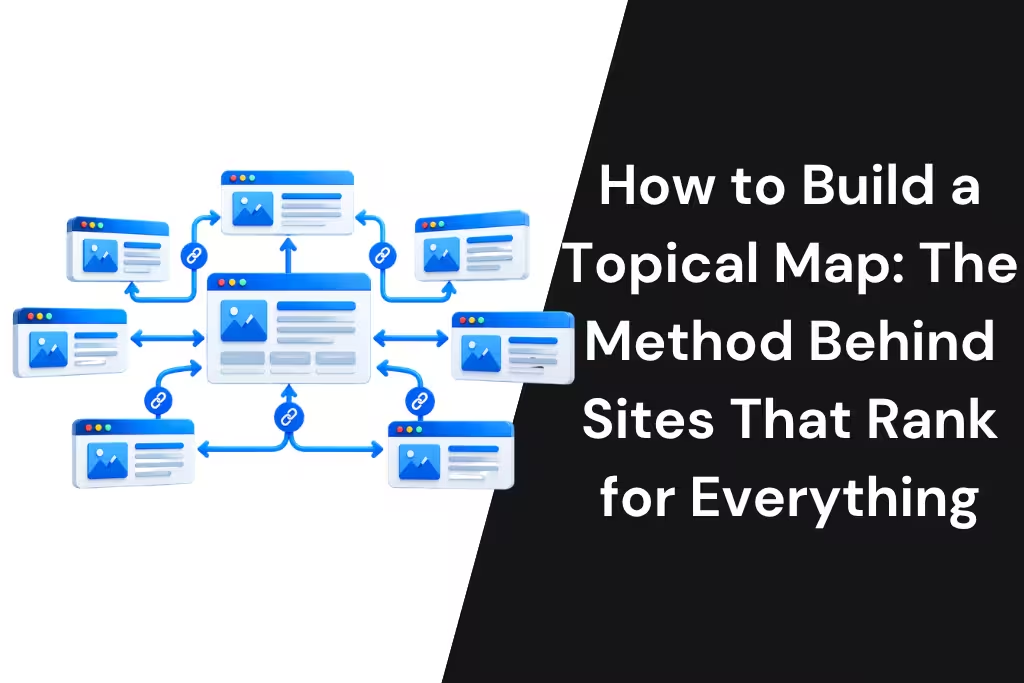
A topical map in SEO is a plan of every topic and question a website should cover, grouped into pillars and clusters, with one page per search intent and clear internal links between them. It helps show search engines and AI tools what the site is about. It also helps a business publish in the right order instead of chasing random keywords.
Quick note before we start: this is about SEO, not topographic maps. Search “topical map” in the UAE and Google will happily show you contour lines and hiking trails. We mean the content plan.
And a second note, on the title. No site ranks for everything. A good topical map does something narrower and more useful. It helps you rank for the things your business should be known for, and it stops you wasting months on the rest.
Below is the method we use, step by step. After that comes our own map, the one behind this blog, row by row.
What is a topical map in SEO?
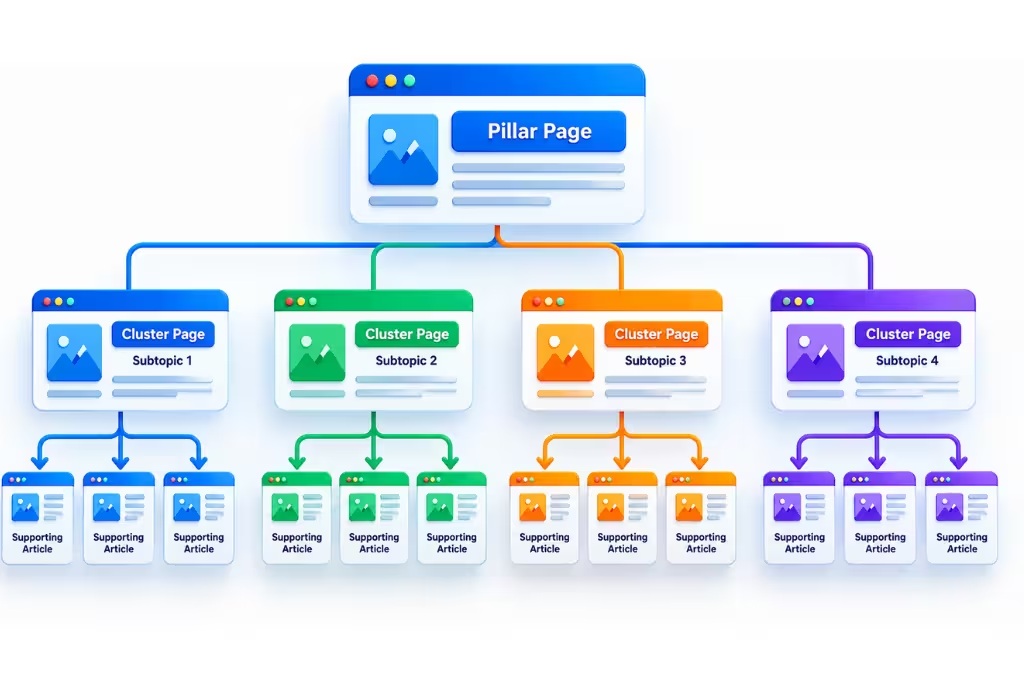
Every page on a topical map has one job, one main query and a place in a hierarchy. Pillars sit at the top. Clusters sit under each pillar, and supporting posts sit under each cluster.
Think of it as the floor plan for your content. A keyword list tells you what people type. A topical map tells you which page answers it, which page sits above it, and which pages it should link to.
A working map usually holds these parts:
- Central entity. The main thing the site is about. For us, that is search, and how businesses get found in it.
- Pillars. The big attributes of that entity. Each gets one broad page.
- Clusters. Groups of closely related questions inside a pillar. Each cluster has a lead page, which we call the cluster seed.
- Single-intent pages. One page per question or task, each with a target keyword and a search intent.
- Links. Rules for which pages point to which, and with what anchor text.
- Status. Where each page sits: planned, briefed, written, live.
The SEO world borrowed a lot of this vocabulary from Koray Tuğberk Gübür and his Holistic SEO work. You do not need every term to build a good map. We explain the few that matter as we go.
Topical map vs keyword list vs content calendar
A keyword list shows demand, a topical map shows structure, and a content calendar shows timing. You need all three, in that order. Most sites jump from the first to the third and skip the part that holds everything together.
| Keyword list | Topical map | Content calendar | |
|---|---|---|---|
| Answers | What do people search? | Which page covers what, and how do pages connect? | When does each page go live? |
| Unit | A query | A page with one intent | A publish date |
| Shows hierarchy | No | Yes: pillar, cluster, supporting | No |
| Prevents overlap | No | Yes, one intent per page | No |
| Works with zero-volume topics | Poorly | Yes | Only if the map feeds it |
| Changes | When demand shifts | When the business or search changes | Weekly |
That gap is the reason to build a map. Keyword lists can’t tell you that two keywords belong on the same page. Calendars can’t tell you that the post you scheduled for Thursday already exists under a different title.
What Google actually says about topics, authority and site structure
Google documents a “topic authority” system for news only. For everyone else, its guidance asks whether your site has a clear focus, uses a logical structure and links pages with descriptive anchors. A topical map is a way to meet that guidance on purpose.
A lot of topical map content treats “topical authority” as a single score Google gives your site. Google has not said that. The table below sets out what it has said, with sources.
| Common claim | What Google documents |
|---|---|
| “Google gives every site a topical authority score.” | Google’s news topic authority post (May 2023) describes a system for news queries in specialised areas such as health, politics or finance. Its ranking systems guide lists no general topic authority system. |
| “Publish more pages and you will rank.” | Google’s helpful content guidance lists this as a warning sign: “Are you producing lots of content on many different topics in hopes that some of it might perform well in search results?” |
| “Focus does not matter, only links do.” | The same page asks: “Does your site have a primary purpose or focus?” |
| “Structure is just for users.” | The SEO Starter Guide says that for sites with more than a few thousand URLs, grouping similar topics in directories can help Google. It also says the vast majority of new pages Google finds are found through links. |
| “Anchor text on internal links is irrelevant.” | Google’s link best practices say internal link anchor text can help “both people and Google make sense of your site more easily.” |
| “AI search needs content chopped into tiny chunks.” | Google’s guide to generative AI features says there is “no requirement” to break content into tiny pieces, and no ideal page length. |
Put simply, “topical authority” is a useful SEO idea, and many practitioners report strong results from building it. But it is an inference from how search works, not a published Google metric. A topical map helps because it gives your site focus, structure and clean internal links, which are things Google does document.
Our guide to topical authority goes deeper on the theory. This post stays on the method.
Step 1: Start with source context and central entity
Before you list a single topic, write down what your business is and what it wants to be known for. That is your source context. Then name the one central entity every page will connect back to.
Source context is the reason your site exists in the eyes of a reader. A Dubai law firm, a skincare brand and an SEO agency could all write about “contracts”. Each would cover it in a different way, because each sells something different.
Ask three questions:
- What do we sell, and to whom?
- Which subject would a buyer expect us to explain better than anyone?
- Where do we draw the line, so we don’t drift into topics that bring traffic but no customers?
For Octopus, the answers were: we sell search, social and AI marketing services to UAE businesses. The central entity for our SEO map is the search engine itself, and how a business gets found in it. Everything else hangs off that.
Write the source context in one or two sentences at the top of your map. Every topic you add later gets checked against it. Our post on source context and central entity covers this step in more depth.
Step 2: Turn entity attributes into pillars, then split core and outer sections
List the main attributes of your central entity and turn each one into a pillar. Then mark which pillars sit closest to revenue (the core section) and which give wider context (the outer section). Build the core first.
An attribute is a property of the entity. A search engine discovers pages, understands queries, understands content, ranks results, changes over time. Each of those is an attribute, and each became a pillar on our map.
That is very different from naming pillars after your services. “SEO services”, “local SEO” and “technical SEO” are things you sell. They make poor pillars because they mix intents and copy your menu. Attribute pillars follow how a reader learns the subject, and they give every service page a natural set of posts to link from.
Once the pillars are listed, split them:
- Core section. Pillars closest to what you sell. These get built first and linked to service pages.
- Outer section. Pillars that add depth and context. They support the core and widen your reach.
On our SEO map, how pages earn relevance, how sites earn authority and how SEO programs are run sit closest to revenue. History and update types sit further out.
We cover this split in more detail in our post on core and outer sections.
Step 3: Find every subtopic and question, even when tools show zero volume
Collect questions from Google autocomplete, People Also Ask, AnswerThePublic, AI chat prompts and your own Search Console data. Group them by meaning, not by volume. In smaller markets like the UAE, many valuable topics show zero in keyword tools.
Most guides skip this problem, and it hits UAE businesses hardest. Keyword tools are built on large markets. Ask one about a niche B2B topic in Dubai and it will often show little or no volume. Build only on volume and your map ends up with a handful of pages.
We hit this while researching this very post. Over the past 12 months, Google Trends gave “topical map” and “topical authority” an average UAE interest of 0. “Seo” scored 56. Worldwide, interest in “topical map” peaked at the end of May 2026. Interest is clearly growing worldwide, even if UAE data is too thin to measure.
So use sources that capture questions, not volume:
- Google autocomplete. Type your seed term and work through the alphabet. Note every suggestion that fits your source context.
- People Also Ask. Expand the box and keep clicking. Each click loads more questions.
- AnswerThePublic. Good for “how”, “can”, “vs” and “for” patterns. It also shows the prompts people type into AI tools.
- AI chat tools. Ask ChatGPT or Gemini what a buyer in your market would ask. Treat the output as ideas to check, not as data.
- Search Console. The queries you already get impressions for are a sign Google sees you as relevant. Filter out branded queries so you see what new readers search.
- Sales and support questions. The questions your team answers on WhatsApp every week are often the best topics of all.
Two Search Console features help here. The branded queries filter (available to all eligible sites since March 2026) splits branded from non-branded traffic. Query groups in the Insights report bundle variations of the same question together. Google notes query groups only appear for properties with a large volume of queries, so smaller sites may not see them yet.
Bilingual markets. If you publish in English and Arabic, research both. Arabic searches are not a translation of English ones, and phrasing differs between formal Arabic and Gulf dialect. Map them as page pairs inside the same cluster, rather than as a separate map. Link each pair with hreflang, the tag that tells Google which language version to show. Each pair shares one intent.
By the end of this step you should have a long, messy list. That is fine. The next step turns it into pages.
Step 4: Give every page one job
Group questions that share the same intent onto one page. Split questions that need different answers onto different pages. If two existing pages compete for the same intent, merge them, split them by intent, or link one to the other.
We call this the single-intent rule. Each page answers one main question or helps with one task. Supporting questions can sit on the same page as long as they serve that main job. In Koray’s terms, the main job is the page’s macro context, and the smaller points inside it are the micro context. Our post on macro and micro context explains both.
A quick test for whether two queries belong on one page: search both and compare the top 10. A common rule of thumb: if most of the same URLs rank for both, treat them as one intent. If the results are very different, they need separate pages. We cover this in our post on keyword clustering by SERP overlap.
The merge, split or link rule. When two pages overlap, decide with three questions:
- Same intent, same reader? Merge them. Keep the stronger URL and redirect the weaker one.
- Same topic, different intent? Split them. Rewrite each so it clearly serves one job, and link between them.
- Related, but one is a step inside the other? Link them. The broader page summarises the narrower one in two or three sentences and points to it.
We hit this ourselves. Our map plans a 40-point technical SEO audit checklist, and a broad SEO audit guide for Dubai is already live on the blog. Same topic, different job: one explains the process, the other is a checklist you work through. So the rule says split and link, and the new post must not repeat the guide.
Here the map earns its keep. Cannibalisation is cheap to prevent in a spreadsheet and expensive to fix after both pages are live.
Step 5: Set linking rules and a publishing order
Link every supporting post up to its cluster seed and pillar, link siblings where it helps the reader, and use anchor text that describes the destination. Publish pillars and core clusters first, then fill in depth.
Write your linking rules into the map so writers don’t have to guess:
- Up. Every supporting post links to its cluster seed and its pillar.
- Down. Each pillar links to every cluster seed under it. Each seed links to its supporting posts.
- Across. Siblings link when one genuinely helps a reader of the other. Don’t link everything to everything.
- Bridges. A link to another pillar needs a sentence that explains why the reader should care. Semantic SEOs call this a contextual bridge.
- Anchors. Describe the destination page. “Our guide to search intent” beats “click here” or a bare keyword.
- Service pages. Two or three per post at most, and only where the reader’s next step is to get help.
Then set the order. Start with the pillar and cluster seeds in your core section. Fill each cluster before moving to the next, so every new post has somewhere to link. In our view, three connected posts in one cluster are worth more than ten scattered across the map.
If you run a large site, link maintenance is the part that slips. Our internal linking and clustering service automates that work.
Worked example: the Octopus Marketing topical map, row by row
Our SEO map has 211 rows: 10 pillars plus a set of root documents, 40 clusters, and one row per planned page. Each row carries the page’s keyword, intent, level and status, plus the full brief.
Most topical map guides use a made-up niche. We would rather show a real one.
Where we started. By mid-2026 our blog had grown to more than 300 posts, all filed under a single “Blog” category. Branding, social media, AI and SEO sat side by side, with nothing to show how one post related to the next.
The structure now. We built a separate map for each subject we want to be known for. The SEO map is the largest. The AI SEO map has 83 rows and the social media map has 108.
The SEO map breaks down like this:
| Level | Rows | What it is |
|---|---|---|
| Root | 3 | Broad entry pages, such as our search engine marketing guide |
| Pillar | 11 | One per pillar, plus our main What Is SEO? guide |
| Cluster seed | 40 | The lead page of each cluster |
| Supporting | 157 | Single-intent posts under each cluster |
The 10 pillars are written as plain statements of how search works:
- How search engines discover, crawl and index pages
- How search engines understand queries
- How search engines understand content
- How pages earn relevance
- How sites earn authority and trust
- How results are ranked and displayed
- How location, language and commerce change search
- How search systems change over time
- How organic performance is measured
- How SEO programs are planned and run
Notice that none of them is a service name. Each one is an attribute of the central entity, the search engine.
One cluster, opened up. This post sits in pillar 3, cluster C, “Topical structure”. That cluster holds seven pages:
| Page | Level | Target keyword |
|---|---|---|
| What is topical authority, and how long does it take to build? | Cluster seed | topical authority |
| How to build a topical map (this post) | Supporting | topical map seo |
| Source context and central entity | Supporting | source context seo |
| Core section vs outer section | Supporting | core section outer section seo |
| Macro context and micro context | Supporting | macro context seo |
| Contextual bridges | Supporting | contextual bridge seo |
| Cost of retrieval | Supporting | cost of retrieval |
Each page has one job. This post explains the method and gives each of the other concepts a few sentences, then hands off. That is the single-intent rule in action.
The columns. Every row starts with the same 12 fields. These are number, title, slug, pillar, cluster, level, format, target keyword, search intent, location focus, status and brief wave. The brief then fills nearly 50 more columns. They cover topic validation, audience and keywords, competitor research, the content brief, a content inventory, and results at 30, 60 and 90 days.
Statuses. Each row moves through the same stages: newly mapped, to write, in brief, brief ready, article prepared, published. As of mid-October 2026, 8 rows on the SEO map are published and most of the rest are still “to write”. That is normal. A map is a plan for a year or more, not a month.
How a clean topical map helps in AI Overviews and ChatGPT
AI search tools quote passages from pages that answer questions clearly. A map gives each page one job, a direct answer near the top and links to related pages. That makes your content easier to find, understand and quote.
When someone asks Google’s AI Mode a question, it often runs many related searches in the background. We explain this in our post on query fan-out in Google AI Mode. A topical map that covers the follow-up questions around a subject gives you more chances to be one of the pages those searches find.
AI systems also work at the passage level. They break pages into sections, compare them with the question, and quote the best match. Our guide on how AI chunks and embeds web pages covers how that works.
Google itself says you don’t need to chop content into tiny pieces for AI. Its systems can handle several topics on one page. What helps is plain writing and clear structure, which a single-intent map gives you by design:
- A direct answer under each main heading, like the short answers in this post
- One page per intent, so the right page is obvious
- Internal links that show which pages relate, and how
- Consistent names for the same things across the whole site
For how Google picks the sources it shows, see how Google AI Overviews work.
Keeping the map alive: measure, consolidate, prune and add
Review the map every month. Measure performance by cluster, not just by page. Merge pages that compete, update or remove pages that no longer earn their place, and add new rows when new questions appear.
A map that never changes goes stale fast. Search changes, your services change, and readers start asking new questions. So the map needs the same regular care as your website.
Measure by cluster. Add up impressions, clicks and ranking queries for every page in a cluster. A single post may look weak while the cluster as a whole grows. In Search Console, filter by the page paths in that cluster. Use the branded filter so brand searches don’t hide what is really happening.
Consolidate. When two pages split clicks for the same queries, apply the merge, split or link rule from Step 4.
Prune. Some old posts fall outside your source context, earn no traffic and help no reader. Update them, merge them into a stronger page or remove them. Decide one by one. A post with links from other sites or steady leads stays, whatever the traffic says.
Add trending nodes. New questions appear all the time. A new Google feature, a new AI tool, a new regulation in your sector. Add them as new rows in the right cluster, then brief and publish them while interest is high. These are often called trending nodes, as opposed to the evergreen quality nodes that form the base of the map.
Keep the status column honest. If a row says “published”, link it. If it says “to write”, don’t link to it yet. That one habit keeps your internal links clean.
The method in one checklist
- Write your source context and list the pillars.
- Collect questions from every source, not just keyword tools.
- Give every page one job and settle any overlap.
- Set linking rules and build the core first.
- Track each row’s status and review the map monthly.
For larger sites, our SEO and content AI agents can handle outlines, clustering and internal link suggestions across a large site.
FAQ
1. How many pages should a topical map include?
As many as it takes to cover your subject without overlap, and no more. A local service business might need a few dozen pages. Our SEO map has 211 rows because the subject is broad. Start with your core section and grow from there. On an existing site, list your live pages first and assign each one a row.
2. How long does it take to build a topical map?
For a business that knows its market, a first version can take days rather than months. Research and grouping take the most time. The map then keeps changing for as long as you publish. How long it takes to see results is a separate question, which we cover in our topical authority guide.
3. Is a topical map only for big websites?
No. Small sites have the most to gain, because they can’t afford to waste posts. Even a 20-page site gains from knowing which page does which job and how they link.
4. What is the difference between a topical map and a content calendar?
A topical map decides what pages you need and how they connect. A content calendar decides when each one goes live. Build the map first, then fill the calendar from it.
5. Do I still need backlinks if I have a topical map?
Yes. A map helps Google understand what your site covers. Links from other sites still help show that your site is trusted. Google’s ranking systems guide lists link analysis and PageRank among its systems.
6. Should a UAE business build separate topical maps for English and Arabic?
Usually not. Use one map, with English and Arabic versions of a page as a pair inside the same cluster. Research Arabic queries on their own, though, since people phrase them differently. Link the pairs with hreflang.
Sources
- Google Search Central Blog: Understanding news topic authority (23 May 2023)
- Google Search Central: Creating helpful, reliable, people-first content (updated 5 Oct 2026)
- Google Search Central: SEO Starter Guide (updated 10 Dec 2025)
- Google Search Central: SEO link best practices (updated 10 Dec 2025)
- Google Search Central: A guide to Google Search ranking systems (updated 10 Dec 2025)
- Google Search Central: Optimizing for generative AI features in Google Search (updated 10 Jul 2026)
- Google Search Central Blog: Introducing Query groups in Search Console Insights (27 Oct 2025)
- Google Search Central Blog: Introducing the branded queries filter in Search Console (20 Nov 2025, updated 11 Mar 2026)
- Holistic SEO: What is Topical Authority? by Koray Tuğberk Gübür
- Google Trends: “seo”, “topical authority”, “topical map”, “keyword research”, UAE and worldwide, past 12 months (checked 16 Oct 2026)