
Generative Engine Optimization vs SEO: Where the Two Actually Differ
Search is no longer limited to a page of blue links. People increasingly turn to ChatGPT, Gemini, Perplexity, Google AI Overviews, and other AI-powered search experiences to ask questions and receive direct, synthesized answers rather than a list of websites to explore.
That shift has created an important question for businesses investing in organic visibility: Is Generative Engine Optimization (GEO) simply SEO under a new name, or does it represent a genuinely different discipline?
The answer is more nuanced than the common explanation that “SEO gets rankings, while GEO gets citations.” While that distinction is useful, it does not explain what actually separates the two approaches.
At a fundamental level, SEO focuses on making a website discoverable, relevant, and competitive in search results. GEO focuses on making a brand’s information clear, credible, and useful enough for AI systems to understand, retrieve, and incorporate into generated answers.
In simple terms, SEO optimizes the destination; GEO optimizes the information an AI system can confidently understand and reuse.
For businesses operating in competitive markets such as Dubai, this distinction is becoming increasingly important. Strong Google rankings still play a major role in driving organic traffic and demand, but customers are also discovering businesses through AI-generated answers. As a result, GEO and SEO should not be viewed as replacements for one another. They are complementary strategies that address different layers of the modern search journey.
The businesses best positioned for this shift will be those that continue building strong search visibility while also structuring their expertise, content, and brand information so AI-powered search systems can accurately recognize and reference them.
Generative Engine Optimization (GEO) is the practice of structuring information so AI systems such as ChatGPT, Gemini, Perplexity, and Google AI Overviews can find it, trust it, and include it in generated answers. It differs from traditional SEO in its unit of optimization: SEO optimizes whole webpages to rank in search results, while GEO optimizes individual claims, definitions, statistics, and passages to be retrieved and reused inside AI-generated responses.
- SEO’s goal: get a page discovered, ranked, and clicked.
- GEO’s goal: get specific information discovered, trusted, and cited.
- They are not competitors. SEO builds the underlying source; GEO makes that source usable inside AI answers.
- A #1 Google ranking does not guarantee AI visibility, because ranking (search engine selection) and retrieval (AI answer construction) are separate events.
- The most effective GEO content is answer-first, evidence-backed, and self-contained — each key claim should make sense even when lifted out of its surrounding page.
What Is Generative Engine Optimization?
Generative Engine Optimization (GEO) is the process of structuring and strengthening online information so that generative AI systems can discover, interpret, trust, retrieve, and potentially reference it when constructing an answer.
Traditional search asks one question:
Which pages should appear for this query?
Generative search asks a different one:
What information belongs in the answer to this question, and which sources support it?
That change in the underlying question changes the entire optimization target.
A traditional search result can earn its ranking through a mix of relevance, authority, technical accessibility, and dozens of other signals applied to the page as a whole. A generative answer, by contrast, may draw only a few sentences, a statistic, a definition, or a single recommendation from that same page. The full page isn’t necessarily the unit that matters anymore — a single well-formed passage can outweigh it.
This is why recent GEO discussions frame the shift explicitly: from page-level optimization to passage-level, or information-level, optimization.
SEO vs GEO: The Fundamental Difference
The clearest way to see the difference is to line up what each discipline is actually trying to accomplish.
| Traditional SEO | Generative Engine Optimization |
| Get a page discovered | Get information discovered |
| Rank a URL | Become part of an answer |
| Win a position in search results | Win inclusion in a generated response |
| Earn clicks | Earn mentions, citations, or recommendations |
| Optimize pages | Optimize reusable information |
| Focus on keywords and links | Focus on relevance, evidence, context, entities, and extractability |
| Measure rankings, impressions, clicks, traffic | Measure AI visibility, mentions, citations, and answer presence |
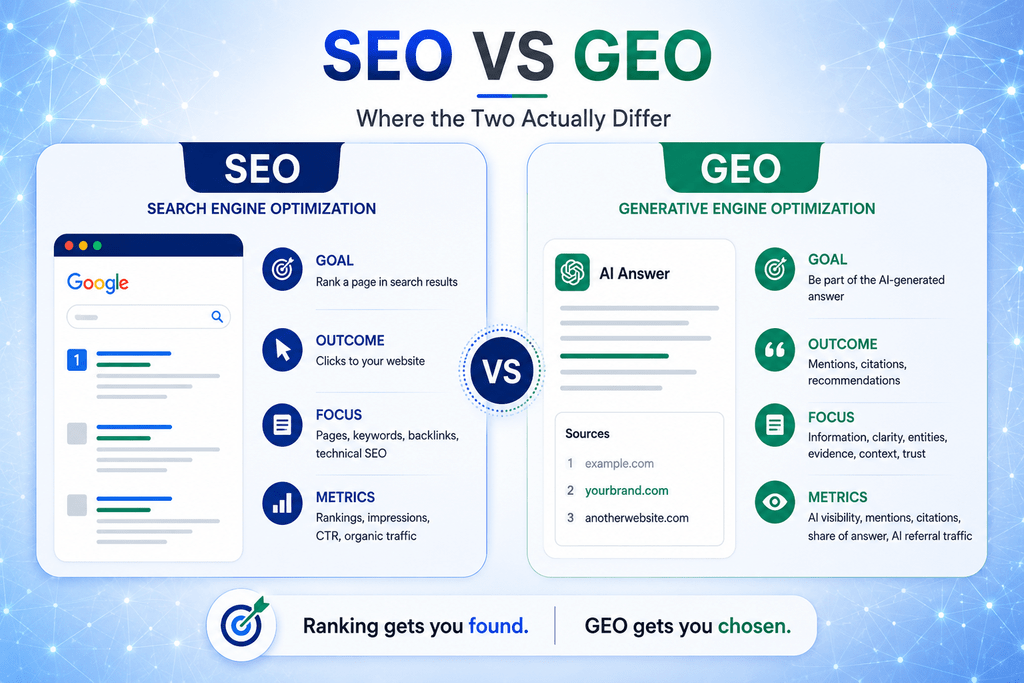
None of this makes SEO irrelevant. It means the search experience now has more than one visibility layer.
A page can rank on page one of Google and still never surface in an AI-generated answer. Conversely, a single passage buried on page four of the search results can be exactly what an AI system pulls into a response. Rank position alone no longer tells the whole story of search visibility.
SEO Follows the Page. GEO Follows the Information.
Most “GEO vs SEO” explainers stop at “SEO = rankings, GEO = citations” directionally correct, but it doesn’t explain why the two behave so differently. The real difference is the unit of optimization.
SEO treats the webpage as the primary destination. The goal is to make that page relevant enough, authoritative enough, and technically accessible enough to earn a spot in the results.
GEO operates on smaller units. An AI system assembling an answer might pull:
- A definition from one paragraph
- A statistic from another
- A comparison from a table
- An expert statement from an article
- A factual claim corroborated elsewhere on the web
The final answer can stitch together fragments from several different sources which is exactly why clear, self-contained, verifiable information units matter more than ever.
Compare these two sentences. A traditional SEO sentence is often written to work a keyword in naturally:
“Dubai digital marketing services help businesses improve their online visibility.”
A GEO-friendly information unit answers a specific question directly and completely:
“Dubai businesses typically use SEO to improve organic rankings, while GEO focuses on increasing a brand’s likelihood of appearing in AI-generated answers through clearer, evidence-backed information.”
The second version is easier to lift out and reuse because it makes a complete, standalone claim — no surrounding context required to understand it.
The Search Journey Is Changing
The traditional search journey can be simplified to:
Query → Search engine → Ranking → Page → Click
Generative search introduces a different path entirely:
Question → Retrieval → Relevant information → Evidence → AI synthesis → Answer
That second pathway changes what “visibility” even means. A business is no longer competing purely for:
Position 1 vs. Position 2 vs. Position 3
It’s also competing to become:
The source the AI chooses to explain the concept in the first place.
This is increasingly described in the industry as a shift from competing for a slot in a list to competing for a slot inside the generated response itself.
Why a #1 Google Ranking Doesn’t Guarantee AI Visibility
This is one of the most common misconceptions about GEO.
A company can have excellent technical SEO, strong keyword rankings, a solid backlink profile, healthy organic traffic, high domain authority, and comprehensive content coverage and still have limited visibility inside AI-generated answers.
Why? Because ranking and retrieval are not the same event.
A search engine may correctly determine your page is the strongest overall result for a query. But when an AI system goes looking for a specific claim, statistic, definition, or recommendation to incorporate into its response, that information needs to be easy to find inside the page not just present somewhere in 3,000 words of copy.
If the relevant answer is buried, phrased ambiguously, left unsupported, out of date, or drowned out by unnecessary surrounding text, the AI system may simply move on to a source that made the same point more clearly.
This is why content built for generative search tends to favor answer-first structures, concise explanations, clearly named entities, supporting evidence, and information that’s independently corroborated elsewhere.
Does GEO Replace SEO?
No — and for most businesses, treating it that way would be a mistake.
SEO remains the foundation, because AI systems still need access to web content in the first place. Crawlability, indexing, site architecture, content quality, authority, and relevance still matter just as much as they always have.
In fact, current GEO commentary increasingly emphasizes how much of the underlying work overlaps with competent SEO. The real difference is what you do with that foundation, and how you measure whether it’s working.
A useful way to frame it:
SEO builds the source. GEO improves the source’s usefulness inside AI answers.
Rather than spinning up a separate website or an entirely new content library for “AI search,” most businesses are better served by making their existing SEO assets more useful to both search engines and AI systems.
What Changes When You Add GEO to an SEO Strategy?
1. Content becomes more answer-oriented
Traditional SEO content is often built for comprehensive topical coverage. GEO still values depth but individual sections also need to stand on their own, answering:
- What is the claim?
- What does it mean?
- Why is it true?
- What evidence supports it?
The less interpretation an AI system has to do, the more usable the passage becomes.
2. Entities matter more
AI systems need to understand what a company, product, service, location, or person actually represents. That makes consistent entity information across your website and external sources genuinely important.
For a Dubai-based business, that might mean consistency around:
- Company name
- Services offered
- Locations served
- Industries covered
- Areas of expertise
- Leadership team
- Awards and recognitions
- Publications and third-party mentions
The goal isn’t repeating the entity’s name more often it’s making that entity clear and corroborated wherever it appears.
3. Third-party corroboration becomes strategically important
Your website is only one representation of your brand. AI systems may encounter your business through industry publications, directories, interviews, reviews, research reports, news coverage, and partner sites.
That means GEO extends well beyond on-page work. A brand with a beautifully written website but a thin external footprint can struggle to establish the kind of consistent authority that a brand with repeated independent confirmation of its expertise builds naturally.
4. Content needs to be extractable
Because AI-generated answers are often assembled from smaller information units, formatting becomes a genuine ranking-adjacent factor. Structures that tend to perform well include:
- Clear, question-based headings
- Concise definitions
- Comparison tables
- Explicit, standalone claims
- Supporting statistics with sources
- Clearly attributed expert statements
- Structured FAQs
- A logical content hierarchy
This doesn’t mean every paragraph needs to be short it means the important information can’t be hidden inside it.
What SEO Still Does Better
GEO isn’t a reason to abandon SEO fundamentals. SEO is still critical for discovery, demand capture, and driving website traffic:
- Technical SEO helps search engines access and interpret a site
- Keyword research identifies what people are actually searching for
- Internal linking establishes relationships between pages and topics
- Backlinks and mentions strengthen domain authority
- On-page optimization aligns content with search intent
- Page experience still influences both rankings and user trust
- Strong rankings still create the visibility that AI systems can potentially retrieve from
The practical strategy was never “SEO or GEO.” It’s SEO + GEO.
A Better Way to Think About the Difference
Instead of asking:
“Should I invest in GEO instead of SEO?”
Ask:
“What happens to my content after a search engine or AI system finds it?”
That single question reveals the real distinction. SEO is primarily concerned with winning visibility in the search result. GEO is concerned with what happens after when an AI system needs information to construct an answer.
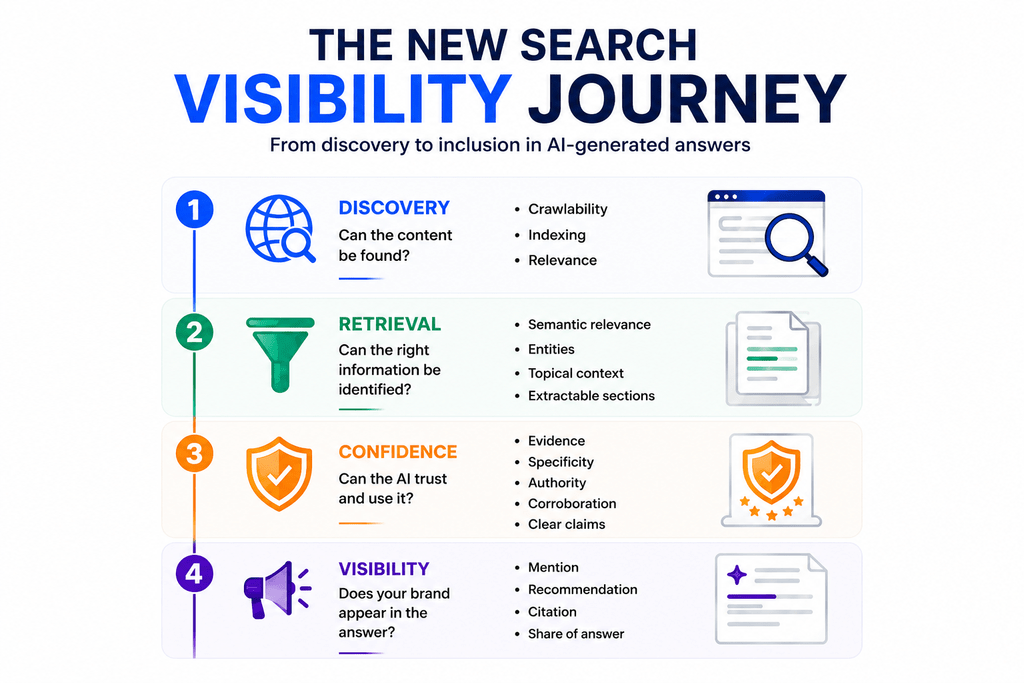
That distinction maps neatly onto a four-stage model:
Stage 1 — Discovery: Can the content be found? (SEO: crawlability, indexing, architecture, relevance)
Stage 2 — Retrieval: Can the right information be identified? (SEO + GEO: semantic relevance, entities, topical context, content structure)
Stage 3 — Confidence: Can the AI system treat the information as useful and trustworthy? (GEO: evidence, specificity, authority, corroboration, consistency)
Stage 4 — Visibility: Does the brand actually appear in the generated response? (GEO: mentions, citations, recommendations, share of AI answers)
This four-stage framework is far more useful than treating GEO as a grab-bag of “AI SEO tricks.”
What This Means for Businesses in Dubai
Dubai is a particularly interesting market for this shift, because companies here compete across local, regional, international, and highly commercial search journeys simultaneously.
A potential customer might Google:
“best digital marketing agency in Dubai”
While another customer, further along in their research, asks an AI assistant:
“Which digital marketing agencies in Dubai are best for B2B companies?”
Those two experiences are not the same. The first produces a competitive ranking environment. The second produces a curated recommendation a much narrower, higher-stakes moment of visibility.
A Dubai LLM optimization company shouldn’t treat GEO as simply bolting “AI keywords” onto existing pages. The work needs to connect technical SEO, content quality, entity clarity, third-party authority, and AI-visibility tracking into one strategy.
Likewise, a Dubai AI search agency should be able to explain not just how to move rankings, but how a business can build a stronger footprint across the information sources and content formats that shape modern AI-assisted discovery. It’s no surprise that agencies across the market are increasingly marketing integrated SEO, GEO, and LLM optimization services as a single offering, rather than three separate ones.
How to Measure GEO vs SEO
This is one of the sharpest practical differences between the two disciplines.
Traditional SEO comes with well-established metrics:
- Keyword rankings
- Impressions
- Clicks
- Organic sessions
- Click-through rate
- Conversions
GEO introduces a different set of questions:
- Is the brand mentioned in AI-generated answers?
- How often is it cited?
- Which prompts trigger visibility?
- Which competitors show up instead?
- Is the brand recommended for important commercial queries?
- Which specific pages or passages are being referenced?
- Does AI-referred traffic actually convert?
GEO reporting can’t simply be a copy of a ranking report it needs to track AI visibility alongside traditional organic performance. Some GEO platforms and agencies are already building out concepts like citation rate, AI share of voice, prompt-level monitoring, and AI referral tracking to make this measurable.
Can Existing SEO Content Be Optimized for GEO?
Yes and this is one of the most practical, actionable points in this entire discussion.
Businesses don’t need to rewrite their entire content library from scratch. Start with pages that already have:
- Strong topical relevance
- Existing organic visibility
- Important commercial intent
- Authoritative, well-researched information
- Useful proprietary data
- Clear demonstrated expertise
- Existing backlinks or mentions
Then look inside those pages for the information that could answer high-value questions more directly. A 3,000-word service page may already contain everything needed to answer ten valuable questions — it just hasn’t been structured to surface those answers clearly.
The GEO opportunity is to make those existing answers:
Clearer → More self-contained → Better evidenced → Easier to retrieve
This approach avoids the trap of building a completely separate “GEO version” of every page you already have.
The Biggest Mistake: Treating GEO Like a Keyword Strategy
The easiest way to get GEO wrong is assuming the fix is simply sprinkling phrases like “ChatGPT optimization”, “AI search optimization”, or “generative engine optimization” across every page.
That doesn’t create useful information — it just adds noise. AI systems don’t need content that announces it’s optimized for AI. They need content that answers questions accurately and clearly.
The strongest GEO strategy isn’t more AI terminology. It’s better information architecture, stronger evidence, clearer entities, more complete answers, and stronger authority signals.
GEO Is Not About Gaming AI
Another common misconception: that GEO is about finding a loophole to manipulate ChatGPT, Gemini, or other systems into featuring a brand.
That approach is unlikely to produce durable results. AI systems change. Retrieval mechanisms change. Ranking logic changes. Chasing today’s exploit is a short-term game.
The safer, more durable strategy is building information that stays valuable regardless of which interface a customer happens to use:
- Be useful
- Be specific
- Be credible
- Be consistent
- Be easy to understand
Those five qualities benefit search engines and human readers equally — and they don’t expire the next time a model gets updated.
The Future Isn’t SEO vs. GEO
Framed as a debate, this whole conversation is slightly misleading. Businesses aren’t choosing between two separate channels they’re adapting to two different ways information becomes visible.
Traditional search hands users a set of destinations. Generative search hands users a synthesized answer.
That creates two distinct opportunities:
SEO: Get the page found and clicked. GEO: Get the information understood and used.
The strongest digital strategies connect both.
Conclusion
Framing SEO and GEO as competing strategies can be misleading. Businesses are not choosing between two separate channels; they are adapting to two different ways information is discovered, interpreted, and presented.
Traditional search directs users to destinations pages, websites, and resources they can explore. Generative search takes a different approach, synthesizing information from multiple sources and delivering a direct answer within the search experience.
This creates two complementary opportunities:
SEO: Make your content discoverable, crawlable, and compelling enough to earn visibility and clicks.
GEO: Make your information clear, credible, and structured enough to be understood, retrieved, and incorporated into AI-generated answers.
The most effective digital strategies do not treat SEO and GEO as alternatives. They build strong content and authority that can perform across both traditional search results and generative search experiences.
Frequently Asked Questions
Is GEO the same as SEO?
No. GEO and SEO share many technical and content foundations, but they optimize for different visibility outcomes. SEO primarily focuses on search rankings and organic clicks, while GEO focuses on making information suitable for retrieval and inclusion in AI-generated answers.
Does GEO replace traditional SEO?
No. SEO remains an important foundation for website discovery, indexing, authority, and organic visibility. GEO extends that foundation toward AI-powered search experiences.
Does a number-one Google ranking guarantee AI visibility?
No. Strong Google rankings can help a page become discoverable, but they don’t guarantee an AI system will select or cite that page for a particular answer.
How is GEO different from LLM optimization?
LLM optimization can refer broadly to optimizing how large language models process or interact with information and applications. In a search-marketing context, GEO specifically focuses on increasing a brand’s visibility within AI-generated search answers.
Can existing SEO content be used for GEO?
Yes. Existing SEO content can often be improved for GEO by making important answers more explicit, strengthening evidence, improving structure, clarifying entities, and building supporting authority across the web.
What should a Dubai business look for in a GEO agency?
Look for an agency that combines technical SEO, content strategy, entity and authority development, AI-search monitoring, and measurable visibility reporting rather than one that treats GEO as a collection of keyword changes.
What should a Dubai AI search agency measure?
A useful measurement framework combines traditional SEO metrics with AI-search visibility metrics such as brand mentions, citations, answer presence, competitor visibility, prompt-level performance, and AI-referred traffic.