
PPC Management in Dubai: What Agencies Charge and What You Get
PPC management in Dubai has become an important part of customer acquisition for businesses that need measurable visibility rather than waiting months for organic traffic to develop. For companies looking for a reliable ppc agency Dubai businesses can work with, understanding the difference between basic advertising and comprehensive ppc management services is essential. Yet the question “How much does PPC management cost in Dubai?” rarely has a single answer. The monthly management fee can vary considerably depending on advertising spend, campaign complexity, number of platforms, industry competition, targeting requirements, creative production, conversion tracking, landing-page work, and the amount of strategic attention an account requires. A professional pay per click agency may also offer a broader range of ppc services, including keyword research, campaign setup, bid management, conversion tracking, remarketing, performance analysis, and ongoing optimization.
For a Dubai business, the real cost of PPC is therefore larger than the agency invoice. The complete investment includes the PPC management fee, the advertising budget, tracking and analytics infrastructure, creative assets, landing-page optimization, and the internal sales resources required to convert generated leads into customers. When comparing ppc services, businesses should look beyond the monthly management fee and examine what the agency actually delivers. A low management fee can look attractive initially but become expensive if poor campaign structure, irrelevant traffic, weak conversion tracking, or slow optimization causes advertising money to be wasted.
The supplied competitor research places typical Dubai PPC management fees at approximately AED 5,000 to AED 20,000 per month, excluding advertising spend, with some PPC audits starting at approximately AED 3,500. These figures should be treated as market benchmarks from the supplied research rather than fixed industry rates. The appropriate price for a business depends on what the ppc agency Dubai provider is actually responsible for and how complicated the account is. A business comparing different ppc management services should therefore evaluate campaign scope, platforms managed, reporting frequency, optimization activities, conversion tracking, creative support, and strategic involvement alongside the quoted price.
That distinction matters because search users are not simply looking for a number. Someone searching for PPC management in Dubai may want to compare agencies, understand pricing models, determine an appropriate advertising budget, assess whether PPC is profitable, or decide whether a pay per click agency is worth the proposed fee. The strongest resource therefore needs to address the entire decision rather than repeat a generic price range. This approach also aligns with the Search Quality Evaluator Guidelines, which emphasize understanding user intent and providing content that genuinely satisfies the purpose of the page.
PPC management in Dubai refers to the strategy, setup, monitoring, optimization, and reporting of paid advertising campaigns for businesses targeting customers in Dubai and the UAE. A PPC agency Dubai provider may manage Google Ads, paid search, Shopping, Performance Max, remarketing, paid social campaigns, conversion tracking, keyword research, bid management, and campaign optimization.
PPC management services are generally priced separately from advertising spend. Based on the supplied competitor research, typical Dubai PPC management fees can range from approximately AED 5,000 to AED 20,000 per month, excluding media spend, while some PPC audits may start at around AED 3,500. Actual pricing depends on campaign complexity, advertising budget, number of platforms, industry competition, targeting requirements, creative work, tracking, landing-page optimization, and reporting requirements.
PPC services can include campaign strategy, keyword research, account audits, campaign setup, ad creation, audience targeting, negative-keyword management, bid optimization, conversion tracking, remarketing, performance reporting, and ongoing testing. A pay per click agency may charge through a fixed monthly retainer, percentage of advertising spend, performance-based pricing, project-based fees, or hourly consulting.
The total cost of PPC is therefore calculated by considering both the PPC management fee and advertising spend. Businesses should evaluate PPC agencies based on qualified leads, conversions, CPA, CPL, ROAS, revenue, tracking quality, campaign optimization, transparency, and relevant experience rather than choosing an agency solely on the lowest management fee.
What Is PPC Management and What Does a PPC Agency Actually Do?
PPC management is the ongoing process of planning, creating, monitoring, testing, measuring, and improving paid advertising campaigns. Google Ads may be the most recognizable platform associated with PPC, but professional PPC management services can involve several channels, including paid search, shopping campaigns, display advertising, remarketing, paid social campaigns, and other forms of performance marketing. The agency’s job is not simply to make an advertisement appear when someone searches for a keyword. The broader responsibility is to connect advertising spend with commercially valuable actions.
A properly managed PPC campaign begins before an advertisement is written. The agency needs to understand the business model, target customers, products or services, geographic market, competitive environment, sales process, margins, and conversion goals. Keyword research then identifies the searches that may indicate commercial intent. Search terms are evaluated according to relevance, intent, competition, expected value, and the likelihood that the visitor will become a meaningful prospect or customer.
Campaign structure is another important component. An account selling several services in Dubai may need separate campaigns or ad groups so that the advertisement, keyword, landing page, and conversion objective remain closely aligned. A poorly structured account can mix unrelated search terms, making budget allocation and performance analysis more difficult. Professional management therefore includes decisions about campaign segmentation, match types, negative keywords, bidding strategies, geographic targeting, audiences, devices, schedules, and budget distribution.
An agency also needs to monitor what actually happens after an advertisement receives a click. A click is not the final objective. For a lead-generation business, the meaningful outcome may be a phone call, enquiry form, WhatsApp conversation, consultation request, or qualified sales opportunity. For an e-commerce business, the objective may be a profitable purchase. This makes conversion tracking, analytics, attribution, and CRM integration important parts of serious PPC management.
The Search Quality Evaluator Guidelines place substantial emphasis on the quality of Main Content, including effort, originality, skill, and accuracy. Although the guidelines are designed for evaluating webpages rather than PPC agencies specifically, the underlying principle is useful here: useful content should help the visitor accomplish the purpose for which the page exists. A PPC management resource should therefore help a business owner make a better purchasing decision instead of merely encouraging the reader to contact an agency.
PPC Management Is Different From Simply Running Google Ads
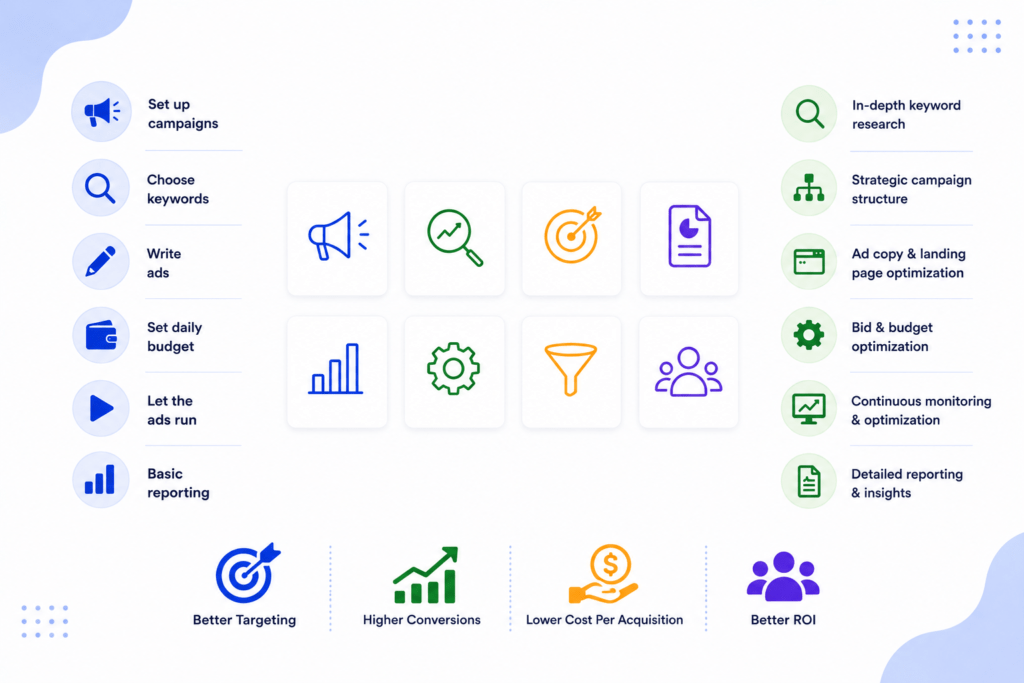
Opening a Google Ads account is relatively straightforward. Building a sustainable acquisition system is considerably more involved. A business can create advertisements, select keywords, assign a budget, and begin receiving traffic without having a well-developed strategy for determining whether the traffic is valuable.
Professional management introduces a continuous feedback loop. Search terms reveal what potential customers actually type. Conversion data shows which searches produce actions. Sales information reveals which conversions become genuine opportunities. Performance data then informs the next round of keyword selection, bidding, targeting, creative development, and budget allocation.
This is particularly important in Dubai because different audiences may search in English or Arabic, while businesses may target different areas, customer segments, industries, and purchasing stages. A campaign targeting high-value commercial searches in Dubai may require a different structure from a campaign designed to generate inexpensive top-of-funnel traffic across the UAE.
A business owner who is worried about paying an agency every month should therefore ask a simple question: What work is being performed every month that improves the probability of generating profitable customers? If the answer is simply “we monitor the account,” the scope may be too narrow. If the answer includes search-term analysis, negative-keyword development, bid management, testing, conversion analysis, landing-page recommendations, audience refinement, creative experimentation, budget reallocation, and business-level reporting, the management fee becomes easier to evaluate.
How Much Does PPC Management Cost in Dubai?
The most useful way to understand PPC pricing in Dubai is to separate management fees from advertising spend. These are two different expenses. The advertising budget is paid to the advertising platform to purchase exposure and clicks, while the management fee compensates an agency or specialist for planning and operating the campaigns.
Based on the supplied competitor research, businesses in Dubai may encounter PPC management pricing in the region of AED 5,000–20,000 per month, excluding media spend. Some providers may charge less for smaller accounts or limited services, while larger or more sophisticated programs can command higher fees. An audit or initial account review may be priced separately, with the supplied research identifying examples beginning around AED 3,500.
The range is wide because “PPC management” can mean very different things from one agency to another. A small local business running a handful of search campaigns may need relatively limited account management. An e-commerce company with hundreds or thousands of products may require feed management, shopping campaign optimization, product segmentation, creative testing, remarketing, analytics, and revenue-level reporting. A multinational organization targeting several markets may have an even more complex operating environment.
Advertising spend is another major factor. A company spending AED 10,000 per month on advertising does not necessarily require the same management workload as a company spending AED 200,000. Larger budgets create more data, but they also create greater financial consequences when campaigns are poorly optimized. More campaigns, more platforms, more products, more audiences, and more geographic markets can increase the amount of strategic and operational work required.
Industry competition also influences the economics. Some commercial keywords can be highly competitive, meaning advertisers may need to spend more to generate sufficient visibility. However, high CPC does not automatically mean that PPC is unprofitable. The important question is whether the resulting traffic produces conversions at an acceptable acquisition cost.
For example, suppose one campaign produces leads at AED 75 while another produces leads at AED 150. At first glance, the first campaign appears superior. But if the AED 75 leads rarely become customers while the AED 150 leads frequently convert into high-value sales, the second campaign could produce the stronger return. This is why CPL, CPA, conversion rate, ROAS, customer value, and eventual revenue need to be considered together.
The real pricing question is therefore not “Which Dubai agency charges the least?” It is “Which management arrangement gives the business enough strategic capability, execution, measurement, and optimization to make the advertising budget work harder?”
What Determines the Price of PPC Management?
PPC agency pricing is influenced by several interconnected factors. The first is the size of the advertising account. A small campaign with a few tightly defined services can be relatively straightforward to manage. A large account with hundreds of keywords, multiple locations, numerous campaigns, several audiences, and significant daily spend requires more monitoring and more frequent optimization.
The number of platforms also matters. Managing Google Search alone is different from managing Google Search, Shopping, Performance Max, Display, YouTube, Meta Ads, and other paid media channels simultaneously. Every additional platform introduces another advertising interface, targeting system, creative requirement, reporting environment, and optimization process.
The business model is equally important. Lead generation often requires tracking forms, calls, enquiries, appointments, and qualified opportunities. E-commerce introduces product feeds, shopping campaigns, purchase values, product margins, catalog management, and revenue attribution. B2B businesses can have long sales cycles, meaning the PPC agency may need CRM and offline conversion data to determine which leads eventually become customers.
Geographic targeting can also increase complexity. A Dubai business may target only a particular service area, while another company may want campaigns across Dubai, Abu Dhabi, Sharjah, and the wider UAE. Businesses expanding across the GCC may require additional market segmentation and localized messaging.
Language is another consideration. English and Arabic campaigns may require different keyword research, advertisements, landing-page experiences, and audience considerations. Simply translating an English campaign into Arabic does not automatically create a strong Arabic PPC strategy.
Landing-page requirements can also influence the fee. Some agencies only manage advertising platforms, while others provide or coordinate conversion rate optimization, landing-page recommendations, copy testing, design changes, and technical improvements. These services can materially change the scope of work.
Finally, the level of reporting and strategic involvement affects price. A business receiving a simple monthly report has a different service requirement from a company expecting weekly performance analysis, strategic meetings, forecasting, attribution analysis, testing plans, and detailed recommendations.
This is why comparing two proposals based only on the monthly retainer can be misleading. A AED 5,000 proposal and a AED 10,000 proposal may not represent two versions of the same service. They may represent two completely different levels of involvement.
The Five Common PPC Agency Pricing Models
PPC agencies generally use several different approaches to charging clients. Understanding these models makes it easier to compare proposals and identify which arrangement fits a particular business.
The first model is a fixed monthly management fee. Under this structure, the client pays a predetermined amount every month for an agreed scope of work. The advantage is predictability. The business knows what management will cost regardless of whether advertising spend changes slightly. Fixed pricing can work well when campaign scope and workload are reasonably stable.
The second model is percentage-of-ad-spend pricing. Under this arrangement, the agency’s fee is linked to the advertising budget. If media spend increases, the management fee may increase as well. This can align the agency’s workload with the size of the account, although businesses should understand whether minimum fees, tiered percentages, or additional charges apply.
The third model is performance-based pricing. Here, some portion of the agency’s compensation is connected to agreed performance metrics. This can sound attractive because the client may feel that the agency has more incentive to generate results. However, performance arrangements require extremely clear definitions. The parties need to establish what counts as a conversion, how attribution works, what happens when sales cycles are long, and which factors are outside the agency’s control.
The fourth model is project-based pricing. This can be appropriate for one-time audits, account restructures, tracking implementations, migrations, or major campaign launches. A business that does not need ongoing management may prefer this arrangement.
The fifth model is hourly consulting. Businesses may hire PPC specialists for strategic advice, account reviews, troubleshooting, or internal team training. Hourly arrangements can work when the business already has an internal marketing team but needs external expertise for specific challenges.
No pricing model is automatically superior. The correct structure depends on the business’s objectives, account complexity, internal resources, advertising budget, and appetite for predictable versus variable costs.
What Should a PPC Management Package Include?
A PPC management package should begin with strategy rather than advertisements. Before launching or restructuring a campaign, an agency should understand what the business considers a valuable customer and how the sales process works. This foundation influences keyword selection, campaign structure, landing-page recommendations, conversion definitions, and reporting.
An initial PPC account audit can identify wasted spend, irrelevant search terms, weak campaign structures, poor bidding decisions, tracking problems, underperforming advertisements, and opportunities for improvement. For a new account, research replaces the historical audit and focuses on market demand, competitors, search intent, keywords, audiences, and customer behavior.
Keyword research is another fundamental component. Good PPC management does not mean collecting the largest possible list of keywords. It means identifying searches that are sufficiently relevant to the business and mapping those searches to appropriate advertisements and landing pages. Negative keywords are equally important because they help prevent advertising spend from being used on irrelevant searches.
Campaign structure should reflect the business and the searcher’s intent. A company offering different services may benefit from separating those services so that each campaign has relevant advertisements and landing pages. The same principle applies to e-commerce products, locations, audience segments, and different stages of the buying journey.
Ad copy and creative development should also be part of the conversation. Strong advertisements communicate relevance, value, differentiation, and a clear next step. Testing allows the agency to determine which messages resonate more effectively rather than assuming that the first version will remain optimal indefinitely.
Conversion tracking is particularly important. Without accurate tracking, an agency may optimize toward clicks instead of outcomes. A business should understand whether the PPC team can track meaningful actions through Google Ads, analytics platforms, CRM systems, phone calls, forms, purchases, or other relevant conversion mechanisms.
Reporting should then connect advertising activity with business outcomes. A useful report should help the client understand what happened, why it happened, what changed, what is being tested, and what should happen next. The report should not simply present dozens of numbers without interpretation.
How Much Should a Business Spend on PPC Advertising in Dubai?
There is no universally correct PPC advertising budget for every Dubai business. The appropriate amount should be connected to customer economics and the volume of demand available in the market.
A sensible approach begins with the value of a customer. If a company knows approximately how much gross profit a new customer generates, management can establish an acceptable acquisition cost. The business can then work backward from its sales target to estimate how many qualified leads or purchases are required.
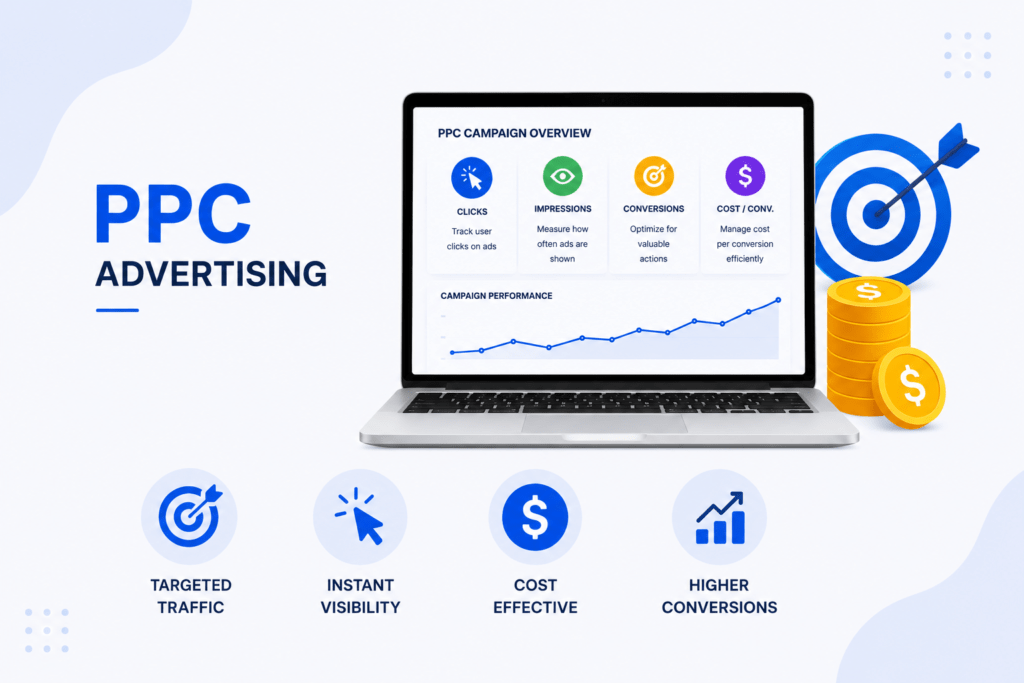
For a lead-generation company, this means understanding the relationship between clicks, leads, qualified leads, sales opportunities, and customers. A campaign might generate 100 leads, but if only 20 are qualified and four become customers, the business needs to understand the economics of those four customers rather than celebrating the initial lead volume.
The supplied competitor research references an approximately AED 6,000-per-month minimum per market or channel as a recommendation for generating meaningful campaign data. That figure should be understood as a source-specific recommendation rather than a universal requirement. Some businesses may need more, while highly focused campaigns in smaller markets may operate differently.
Budget also needs to account for the learning process. PPC management is an optimization activity. Search terms, audiences, advertisements, bids, landing pages, and budgets can be adjusted as evidence accumulates. A budget that is too small to generate useful data can make optimization difficult, particularly when conversion volumes are low.
At the same time, increasing the budget simply because an agency recommends it does not guarantee better results. Additional spend should have a business rationale. The agency should be able to explain what additional demand exists, which campaigns can absorb more budget, what performance level is expected, and how marginal spend will be evaluated.
A responsible PPC strategy therefore treats the advertising budget as an investment that needs to earn its place. The objective is not to spend the largest possible amount. The objective is to spend enough to capture valuable demand while maintaining acceptable acquisition economics.
What Results Should You Expect From PPC Management?
PPC can begin generating visibility and traffic quickly, but that does not mean a business should expect fully optimized profitability immediately. Paid advertising produces data rapidly, but data still needs to be interpreted and acted upon.
The supplied competitor material references a reported increase in website traffic within approximately 48 hours, potential conversion improvements within two to three weeks, and stronger optimization around approximately 90 days. These are source-specific observations rather than guarantees. Actual results depend on search demand, budget, industry, conversion rates, landing pages, competition, tracking quality, and the quality of campaign execution.
The first performance indicators often include impressions, clicks, click-through rate, cost per click, and search-term activity. These metrics help an agency understand whether advertisements are reaching relevant users. They are useful, but they are not sufficient to determine profitability.
Conversion data becomes more important as sufficient traffic accumulates. The business needs to know which campaigns generate enquiries, purchases, calls, appointments, or other valuable actions. From there, cost per lead, cost per acquisition, conversion rate, and revenue become increasingly important.
Lead quality is especially important for service businesses. A campaign that generates hundreds of low-intent enquiries may look impressive in a dashboard while creating a significant burden for the sales team. Conversely, a campaign that generates fewer but more qualified leads may be more profitable.
This is why a PPC agency should ideally connect advertising data to business outcomes. If the CRM shows which leads became customers, that information can improve optimization. The agency can begin distinguishing between conversions that look identical inside an advertising platform but have very different commercial value.
The Search Quality Evaluator Guidelines emphasize that high-quality content should achieve its purpose well and demonstrate effort, originality, skill, and—where applicable—accuracy. A similar principle can be applied to evaluating PPC reporting: a report should help the business understand and act on performance rather than simply demonstrate that the agency has produced a report.
How to Choose the Best PPC Management Agency in Dubai
Choosing a PPC agency should begin with relevance rather than promises. A company that has experience with a business model similar to yours may understand the sales cycle, customer objections, conversion process, and performance metrics more effectively than an agency that simply claims to manage every industry.
Independent reputation is another important consideration. The Search Quality Evaluator Guidelines specifically instruct evaluators to investigate reputation using independent sources rather than accepting a website’s self-promotional claims at face value. The same discipline is useful when selecting a marketing agency. Reviews, independent publications, credible case studies, industry recognition, and customer experiences can provide additional context.
Case studies should be examined carefully. A case study saying that traffic increased by 300% may sound impressive, but the business owner should ask what happened to qualified leads, sales, revenue, CPA, or ROAS. Growth in traffic is useful only when it contributes to the business objective.
A prospective client should also ask who will actually manage the account. Some agencies sell senior-level strategic expertise but delegate most day-to-day work to junior staff. That does not necessarily make the service poor, but the client should know who is responsible for optimization and who will make important decisions.
Transparency is equally important. The client should understand who owns the advertising account, who has access to the data, how reporting works, how changes are documented, and how the agency communicates important performance developments.
A Dubai-focused agency should also demonstrate an understanding of the local market when local expertise is relevant. This may include familiarity with Dubai search behavior, local competition, geographic targeting, English and Arabic campaigns, and the commercial expectations of UAE businesses.
The strongest agency is therefore not necessarily the one with the most awards or the lowest price. It is the agency whose expertise, operating process, reporting, communication, reputation, and commercial approach fit the business.
Questions to Ask a PPC Agency Before Signing a Contract
Before signing a PPC management agreement, ask the agency exactly what the monthly fee includes. The answer should be specific enough that two people could read the proposal and understand the expected work. “Campaign optimization” is vague; “weekly search-term review, negative-keyword updates, bid analysis, advertisement testing, budget allocation, and monthly strategic reporting” is considerably clearer.
Ask how success will be measured. If the agency focuses exclusively on impressions, clicks, and CTR, ask how those metrics connect to leads, purchases, revenue, or other business outcomes. Surface-level metrics can be useful for diagnosis, but they should not become substitutes for commercial performance.
Ask how frequently optimization takes place. PPC accounts change continuously as search behavior, competition, budgets, and campaign data change. The agency should be able to describe its optimization process rather than simply saying that the account is “monitored.”
Ask about conversion tracking before campaigns launch. Incorrect tracking can make good campaigns look bad and poor campaigns look successful. A serious PPC provider should be able to explain exactly what counts as a conversion and how those conversions are validated.
Ask about account ownership. The business should understand whether the advertising account belongs to the client, the agency, or another entity and what happens to the account if the relationship ends.
Finally, ask what happens when performance falls. Every PPC campaign can experience periods of weaker performance. The important question is whether the agency has a process for identifying the cause, communicating the issue, testing alternatives, and reallocating resources.
PPC Management for Different Types of Dubai Businesses
PPC management requirements change substantially depending on the business model. A real estate company, for example, may need to generate high-value enquiries rather than immediate online purchases. Campaigns may focus on property types, locations, developments, investment intent, and buyer qualifications. Lead quality and CRM integration can therefore be more important than simply maximizing lead volume.
E-commerce businesses have different requirements. Product advertising can involve shopping feeds, product titles, images, product categories, inventory, purchase values, and ROAS. An e-commerce agency needs to understand not only advertising performance but also product-level economics. A product generating sales at an attractive revenue figure may still be problematic if margins are too low.
Education companies can use PPC to attract prospective students searching for programs, courses, qualifications, or institutions. Here, lead quality and enrollment rates can be more meaningful than raw enquiry numbers. A campaign may need remarketing and carefully developed messaging because prospective students can take considerable time to make a decision.
Local service businesses often depend on geographic intent. A customer searching for a service in Dubai may have immediate commercial intent, making location targeting, phone calls, enquiry forms, and local landing pages important.
B2B companies can face an even longer conversion cycle. A paid search visitor might submit an enquiry today but become a customer months later. For these businesses, connecting advertising data to the CRM can provide a much better picture of campaign quality than judging PPC solely by form submissions.
These differences are why businesses should be cautious when an agency presents a generic PPC package without asking detailed questions about the business model. The Search Quality Evaluator Guidelines emphasize that content quality should be judged in relation to the purpose and type of page rather than through a one-size-fits-all approach. PPC management deserves the same contextual thinking.
Red Flags That a PPC Management Agency May Not Be Worth the Fee
One of the clearest warning signs is a promise of guaranteed results without explaining the assumptions behind the guarantee. PPC performance depends on factors that an agency may not fully control, including search demand, competition, pricing, product-market fit, website experience, sales execution, and customer behavior.
Another warning sign is reporting that focuses exclusively on clicks and impressions. Those metrics can be valuable indicators, but a business paying for customer acquisition should ultimately understand what the traffic produced.
Poor conversion tracking is another serious concern. If the agency cannot reliably identify valuable actions, campaign optimization becomes much less dependable. An account may appear successful because it records every minor interaction as a conversion, while the sales team receives few meaningful opportunities.
A lack of experimentation is also worth questioning. PPC management should involve learning. Advertisements can be tested, keywords refined, audiences adjusted, landing pages improved, and budgets reallocated. If nothing changes regardless of performance, the business should ask what the management fee is actually paying for.
Extremely low fees can also require scrutiny, although low pricing by itself does not prove poor quality. The relevant question is whether the proposed fee can realistically support the promised scope. If an agency offers extensive multi-platform management, frequent optimization, custom creative, landing-page work, detailed reporting, and strategic consulting for an unusually small fee, the client should ask how that workload will be delivered.
Another red flag is an agency that refuses to explain who owns the account or how the client can access its own advertising data. Transparency should be established before the relationship begins.
The broader principle is trust. The Search Quality Evaluator Guidelines state that untrustworthy pages have low E-E-A-T and emphasize that reputation, expertise, authoritativeness, and trust should be considered together. A business should apply the same skepticism to claims made by PPC providers: verify important claims, investigate reputation, and understand exactly what is being purchased.
How to Compare PPC Management Agencies in Dubai
A practical comparison should consider strategy, experience, pricing, tracking, reporting, optimization, creative capability, reputation, communication, ownership, and scalability. Price should be only one part of the decision.
Suppose Agency A charges AED 6,000 per month and Agency B charges AED 10,000. If Agency A manages Google Search only, provides basic reporting, and does not assist with conversion tracking, while Agency B manages several campaigns, conducts structured testing, integrates CRM data, provides strategic reporting, and coordinates landing-page optimization, the two prices are not directly comparable.
The same principle applies to advertising spend. An agency charging a percentage of spend may become more expensive as the account grows, while a fixed retainer may become more attractive for a high-spend account. Conversely, a fixed fee may be disproportionately expensive for a very small account.
The proposal should therefore be converted into a scope comparison. Ask what happens during onboarding, what happens every week, what happens every month, how often campaigns are reviewed, what testing is performed, what reporting is delivered, who attends meetings, what technical implementation is included, and what services are billed separately.
The agency’s ability to explain performance matters as much as the numbers themselves. A strong PPC partner should be able to say not just that CPA increased, but why it increased, which campaigns contributed to the change, what evidence supports the diagnosis, and what action is being taken.
A useful agency relationship should also become more sophisticated over time. Early work may focus on tracking, campaign structure, keyword research, and initial testing. As data accumulates, the focus can move toward segmentation, customer quality, attribution, budget scaling, and profitability.
The Real Cost of Cheap PPC Management
Cheap PPC management can be valuable when the scope genuinely matches the business’s needs. The problem occurs when a low fee creates insufficient strategic attention while the advertising budget remains substantial.
Imagine a hypothetical Dubai company spending AED 50,000 per month on advertising. An agency offering a very low management fee may save the company several thousand dirhams compared with a more comprehensive provider. But if weak search-term management causes even a modest percentage of the advertising budget to be wasted every month, the apparent management saving may disappear quickly.
Poor conversion tracking can create another hidden cost. If the business cannot distinguish valuable leads from low-quality interactions, the advertising budget may be allocated based on incomplete information. Landing-page problems can create another layer of inefficiency: the advertising may attract the right audience, but visitors may leave because the page is confusing, slow, or poorly aligned with the advertisement.
Slow optimization can also be costly. PPC is competitive, and conditions change. Competitors adjust bids, new advertisements enter the market, search behavior changes, and certain keywords become more or less valuable. An account that is rarely reviewed can continue spending according to yesterday’s assumptions.
The key lesson is that management cost and media efficiency are interconnected. Saving AED 2,000 in agency fees is not necessarily a saving if the business loses AED 10,000 through preventable advertising inefficiency.
That does not mean every expensive agency is good or every inexpensive agency is bad. It means the business should evaluate total acquisition economics rather than the agency retainer in isolation.
Building a PPC Management Budget That Makes Business Sense
The most reliable way to establish a PPC budget is to start with the business outcome and work backward. Instead of asking an agency, “How much should we spend?” a company can first determine how many customers it wants, what a customer is worth, and what acquisition cost is commercially acceptable.
For example, if a business wants 20 new customers and historically converts approximately 10% of qualified leads into customers, it may need roughly 200 qualified leads. If the acceptable cost per qualified lead is AED 200, the corresponding acquisition budget would be approximately AED 40,000. The actual numbers will vary, but the framework connects advertising investment to a business objective.
The next question is whether the available search demand can support that budget. An agency should examine keyword volumes, competition, CPCs, historical account data, audience size, and conversion rates to estimate whether the target is realistic.
The business should also reserve some capacity for experimentation. A campaign that allocates every dirham to existing winners can become overly conservative. Testing new keywords, advertisements, audiences, landing pages, or campaign structures can reveal additional opportunities.
However, experimentation needs discipline. Testing should have a hypothesis and a measurement framework. Otherwise, “testing” can become an excuse for spending money without learning.
Budget reviews should also happen at the business level. If a campaign produces many leads but few customers, simply increasing the budget is unlikely to solve the underlying issue. The business may need better qualification, a stronger landing page, improved sales follow-up, different targeting, or a revised offer.
The best PPC management therefore treats the budget as a dynamic resource. Money should move toward campaigns, audiences, products, and search terms that demonstrate stronger commercial potential, while underperforming areas are investigated and improved or reduced.
FAQ
1. How much does PPC management cost in Dubai?
Based on the supplied competitor research, PPC management in Dubai commonly falls around AED 5,000–20,000 per month, excluding advertising spend, although actual pricing varies significantly. Smaller accounts, limited-scope services, one-time audits, and consulting arrangements may cost less, while complex multi-platform or enterprise campaigns can cost more. The most important factor is not whether the fee falls inside the range but what work the fee includes.
2. What is included in PPC management services?
A comprehensive PPC management service can include account auditing, strategy, keyword research, campaign structure, advertisement creation, audience targeting, bid management, negative-keyword analysis, conversion tracking, remarketing, landing-page recommendations, testing, budget optimization, and reporting. Businesses should always request a written scope because different agencies use the phrase “PPC management” to describe different services.
3. How do I choose a reliable PPC management agency in Dubai?
Start by reviewing relevant experience, independent reputation, case studies, reporting methodology, conversion tracking capabilities, communication process, account ownership, and pricing structure. The Search Quality Evaluator Guidelines emphasize the importance of independent reputation research rather than relying only on claims made by a website about itself. For a PPC agency, that means looking beyond its own testimonials and examining credible external evidence wherever available.
4. Are affordable PPC management services in Dubai worth it?
They can be, provided the scope is appropriate and the agency can manage the account effectively. Low management fees become problematic when they are accompanied by limited optimization, poor tracking, generic reporting, or insufficient attention to the account. A business should compare total acquisition economics rather than choosing purely on the basis of the lowest monthly retainer.
5. How long does PPC take to produce results?
PPC can generate impressions and clicks quickly, but meaningful optimization generally requires sufficient data and testing. The supplied competitor research describes traffic increases potentially occurring within days and stronger optimization around a longer period, but these should not be treated as guaranteed timelines. Results vary according to budget, demand, competition, conversion rates, landing-page quality, tracking, and campaign execution.
Conclusion
PPC management in Dubai is not simply a question of finding the cheapest agency or selecting a monthly package with the largest list of services. The real decision is about building an acquisition system that connects advertising spend with commercially valuable outcomes.
The supplied market research indicates that businesses may encounter PPC management fees of approximately AED 5,000–20,000 per month, excluding advertising spend. But that number becomes meaningful only when the scope behind it is understood. A business needs to know whether the fee includes strategy, keyword research, campaign management, creative testing, conversion tracking, landing-page optimization, reporting, and ongoing performance improvement.
Advertising spend should be evaluated separately from management fees, but the two costs should ultimately be considered together. An inexpensive agency that allows significant media waste may cost more than a higher-priced provider that consistently improves campaign efficiency. Similarly, a high management fee does not automatically indicate high quality.
The strongest approach is to evaluate PPC through business metrics. Clicks and impressions can explain traffic, but qualified leads, customers, acquisition costs, revenue, and return on advertising spend explain business performance. A reliable agency should be able to connect those metrics and explain what the data means.
For businesses comparing PPC management agencies in Dubai, the most important questions are therefore straightforward: What exactly am I paying for? How will success be measured? Who will manage the account? How will conversions be tracked? What evidence supports the agency’s claims? What happens when performance declines? And ultimately, can the agency help turn advertising expenditure into profitable customer acquisition?
A useful PPC resource should do more than repeat industry terminology. The Search Quality Evaluator Guidelines emphasize that high-quality Main Content should serve a beneficial purpose, demonstrate effort and originality, and be accurate and trustworthy where accuracy matters. Applying those principles here means giving Dubai businesses enough practical information to compare pricing, understand agency responsibilities, identify risks, and make a more informed PPC investment decision.