
Seasonal Search Demand in the GCC: Planning Around Ramadan, DSF and White Friday
Seasonal keywords are searches whose volume rises and falls at the same time every year because of holidays, weather or events. In the UAE the biggest search seasons are Ramadan and Eid, White Friday, National Day, the Dubai Shopping Festival and back to school. Seasonal pages should be live and indexed four to six weeks before each peak.
What are seasonal keywords?
Seasonal keywords are search terms that spike at a predictable time each year and stay quiet for the rest of it. They follow the calendar, so you can plan for them months ahead. In the GCC, that calendar is shaped by Ramadan, the Eids, retail sales, school terms and the summer heat.
There are two kinds, and both matter for planning.
- Explicit seasonal keywords name the event. “Iftar buffet Dubai”, “White Friday sale UAE” and “DSF offers” only make sense at one time of year.
- Implicit seasonal keywords do not name a season, yet demand still moves with it. “AC repair Dubai” is a good example for the UAE summer. Nothing in the words tells you this, so you only find it in the data.
Seasonal demand sits on top of normal search intent. Our guide on how search engines understand search queries, intent and context explains why the same words can carry different meanings. For a deeper look at how intent moves over time, see when search intent changes.
Google holds 95.42% of UAE search share and Bing 2.71%, according to StatCounter (October 2026). So Google’s own tools show almost all UAE search engine demand.
The GCC search calendar at a glance
The UAE search year has a few large peaks and several smaller ones. Ramadan is by far the biggest, followed by short retail spikes in Q4 and long waves around DSF and back to school. The table below lists each event with its date, when demand starts and when we suggest your page is ready.
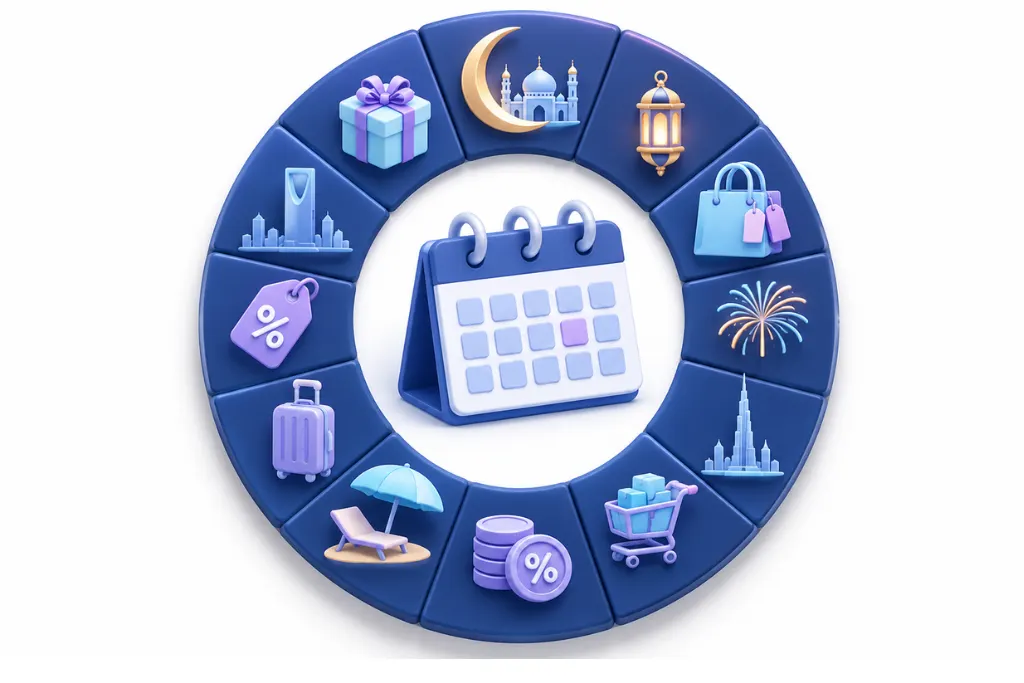
Dates come from official or press sources. Demand and peak timing come from our analysis of Google Trends UAE data, pulled 15 Nov 2026, covering 9 Nov 2025 to 15 Nov 2026. The publish-by column is our recommendation. Islamic dates for 2027 are forecasts and depend on moon sighting.
|
Event |
Date |
Demand starts |
Peak |
Publish by (our advice) |
|
11.11 Singles Day |
11 November, fixed |
Not charted, check your data |
Around 11 November |
Early October |
|
White Friday |
Late November, set by each retailer |
Rising through October |
The sale weeks in late November |
Early October |
|
UAE National Day |
2 and 3 December 2026 |
Late November |
Late November to early December |
Early November |
|
Dubai Shopping Festival |
4 Dec 2026 to 17 Jan 2027 |
By late November |
A long plateau through December |
Early November |
|
Ramadan 2027 |
About 8 Feb 2027 (forecast) |
Late December, about six weeks out |
The week Ramadan starts |
Late December |
|
Eid Al Fitr 2027 |
9 or 10 Mar 2027 (forecast) |
During Ramadan |
The days before Eid |
With your Ramadan page |
|
Back to school, spring |
April |
Weeks before the peak |
Mid April |
Early March |
|
Eid Al Adha 2027 |
16 or 17 May 2027 (forecast) |
Not charted, check your data |
The days before Eid |
Early April |
|
Back to school, autumn |
Late August |
Weeks before the peak |
Late August to early September |
Mid July |
The National Day dates come from the UAE Government portal. The DSF dates come from TradeArabia’s report on the 32nd edition. The 2027 Islamic dates come from Khaleej Times, citing the UAE Astronomy Centre.
Keep two points in mind when reading the data. Each Trends index is relative to its own chart, so a Ramadan score of 100 cannot be compared with a White Friday score of 76. And this analysis covers the UAE only. Saudi Arabia, Qatar and Kuwait share Ramadan and the Eids, but their national days, sales and school calendars differ, so pull Trends data for each country you target.
Ramadan and Eid: demand peaks in the start week, so build earlier
In our 2026 data, UAE searches for Ramadan peaked in the week the month began, not in the middle of it. Demand started climbing about six weeks before. That means your Ramadan pages need to be live and indexed well before the first fast.
What the 2026 data shows
Ramadan 2026 began on Wednesday 18 February, as the UAE moon-sighting committee confirmed (Khaleej Times). Our analysis of Google Trends UAE data, pulled 15 Nov 2026, shows how interest in “ramadan” built up around that date.
- Interest sat at 2 to 4 in November and December 2025.
- It rose to 7 from 4 January, 12 on 1 February and 20 on 8 February.
- It hit 100 in the week of 15 February, the week Ramadan began.
- It dropped to 25 the next week, held at 15 to 18 until mid March, then fell to 1 from 22 March.
So the biggest week of the year arrived in the first days of the month. A page that only goes live that week has little time to be crawled and ranked before demand falls.
Three phases of the month
We plan Ramadan content in three phases. Before the month, focus on dates, timetables, gifts and offers. During the month, cover iftar and suhoor plans, opening hours and daily needs. In the last ten days, shift to Eid gifts, outfits and family plans.
Rising related queries in Trends included “ramadan time table 2026”, “moon sighting ramadan 2026” and “when is ramadan 2027 uae”. People look for dates well before the month starts.
Why the season is worth the effort
Think with Google reported 7.2 billion searches during Ramadan 2023 across Egypt, Saudi Arabia and the UAE, up 21%. Retail Ramadan searches grew 2.8 times from 2019 to 2023. The same report cites TGM Research (2023) showing that 1 in 5 people start preparing 3 to 4 weeks before Ramadan. It also reports that 64% of UAE consumers planned to spend more.
Keep the tone of these pages respectful. Ramadan is a religious month first. Helpful timings, clear opening hours and calm offers serve people better than loud sales copy.
White Friday, 11.11 and National Day: the Q4 sales
White Friday is a sharp spike that lasts one to two weeks. National Day sales are smaller and sit just after it. Because the spike is so short, your page must already rank before the sale weeks start.
The wave shape
In our Trends data, “white friday” reached 66 in the week of 16 November 2025 and 76 in the week of 23 November 2025. It then fell back to between 0 and 14 for most of the year. In October and November 2026 it was rising again, from 10 to 17, with a partial reading of 26 in the week we pulled the data.
Top related queries were “white friday sale”, “uae white friday”, “when is white friday” and “white friday amazon”. Retailers also use their own sale names, such as Yellow Friday, so check what your own customers type.
“National day sale” showed only small interest, between 9 and 14 from late November to early December. National Day falls on 2 and 3 December, per the UAE Government portal. It is a useful secondary page, not a main event for most brands.
11.11 Singles Day has a fixed date, which makes it easy to plan. We did not chart it in this analysis, so check your own Search Console data before you invest in a page.
Why it matters for ecommerce
A Khaleej Times report on a Flowwow and Admitad study of 4.5 million orders found that UAE shoppers spend nearly three times more per order than the MENA average during White Friday. The study also put the UAE average order at about $103, up from about $95. For online stores, that makes White Friday pages worth building early. Our e-commerce SEO services cover category and sale-page planning.
DSF and back to school: the long waves
DSF is a long, low wave that lasts about six weeks, and back to school has two separate peaks in the UAE. These seasons reward pages that stay useful for weeks. Summer also shifts the mix of searches, though we did not chart it here.

Dubai Shopping Festival
The 32nd edition of DSF runs from 4 December 2026 to 17 January 2027. It is organised by Dubai Festivals and Retail Establishment (DFRE), per TradeArabia. In our Trends data, “dubai shopping festival” reached 28 in the week of 30 November 2025. It stayed between 25 and 32 through December, dropped to 20 by 4 January and faded by late January.
That shape suits a page that stays useful for six weeks. Think event guides, offer roundups and store pages that update weekly, rather than one big launch day.
Back to school
“Back to school” peaked twice in our data. It reached 73 in the week of 12 April 2026, then 82 to 100 in the weeks of 23 to 30 August 2026. We have not confirmed the cause of the April peak in this analysis. If you sell uniforms, books, tech or tutoring, plan two campaigns, not one, and check which school calendar your customers follow.
Summer
Summer changes which products and services people look for in the UAE. Indoor activities, travel and cooling services are the obvious candidates. Check your own Trends and Search Console data to see how much your terms move, and check the official Dubai Summer Surprises dates each year before you build a page.
Seasonality beyond retail: services and B2B
Service and B2B firms have seasons too, even if they never run a sale. Ramadan hours, summer travel and year-end budgets can all change when clients search. Treat the points below as patterns to test against your own data.
- Ramadan working hours. The rising query “ramadan 2026 uae working hours” shows that people plan around shorter days. Clear hours on your site and Google Business Profile help clients reach you.
- Summer. If your enquiries dip in the summer months, use that quiet period to publish guides and refresh key pages, so they rank when demand returns.
- Q4 budgets. If your clients plan next year’s spend late in the year, pages on pricing, comparisons and planning can earn attention then.
- Clinics and property. Health, beauty and real estate demand can follow holiday and travel patterns. Each niche moves differently, so check your own Search Console data by month.
Quiet months are the best time for evergreen work. Use them to build the pages that seasonal pages will link to later.
How to find seasonal keywords for your own business
Start with Google Trends to see the shape of demand, then use Keyword Planner and Search Console to size it. Add autocomplete with event words to find the long tail. Each tool has limits, so use them together.
- Google Trends. Set the region to the UAE and the range to five years. Look for peaks that repeat in the same weeks. Compare a few related terms on one chart.
- Keyword Planner. Open the monthly searches chart for each term. Look for the months that sit well above the average.
- Autocomplete. Type your main product or service plus an event word, such as “ramadan”, “eid”, “white friday” or “summer”. Note what Google suggests.
- Search Console. Filter by query and view clicks by week over the longest range available. Terms that rise and fall around the same event are your own seasonal keywords.
Know the limits of each tool. Google Trends Help explains that data is scaled from 0 to 100 and based on a sample of searches. Low-volume terms show as 0, and Google adds noise to low-interest queries. Trends also compares terms only to each other. On one chart, “ramadan” was so large that White Friday and DSF showed 0 or 1.
Keyword Planner Help says that average monthly searches cover 12 months by default. A term with one big month can look small on average. Forecasts do take seasonality into account, so check the monthly chart, not just the average.
Search Console has its own limit. Google’s announcement of the new Search Console gives 16 months of performance data. That is enough for one year-on-year comparison, but not for a five-year pattern, so export your data after each season.
Traffic for seasonal topics comes from event terms and the long tail. Our guide to head terms vs long-tail keywords shows how to balance the two. Then rank your list using our method for search volume vs business value.
Check Arabic and transliterated versions of your event terms too, since they need their own research. Read how Google interprets Arabic and transliterated search queries. For the full process, see our keyword research guide for UAE businesses.
Hijri dates move: planning a calendar that shifts every year
Ramadan and the Eids follow the Islamic lunar calendar, so they arrive earlier in the Gregorian year each time. A plan built on “February” will slowly drift out of line. Plan by weeks before the start date instead.
The UAE Government portal states that Islamic holidays are set by moon sighting. You can see the shift in the dates. Ramadan began on 18 February 2026. The UAE Astronomy Centre forecasts that Ramadan 2027 will likely begin on 8 February 2027, about ten days earlier (Khaleej Times). Eid Al Fitr is forecast for 9 or 10 March 2027 and Eid Al Adha for 16 or 17 May 2027, all subject to moon sighting.
Here is a simple way to handle the shift.
- Set every Islamic event in your plan as “weeks before start”, not as a fixed month.
- Use the astronomy forecast to build the plan months ahead.
- Confirm the exact date when the moon-sighting committee announces it, then adjust offers and hours.
- Compare years by matched weeks, which we cover in the measurement section below.
For Ramadan 2027, six weeks before the forecast start falls in late December 2026, not early January as in 2026. Each year the start moves, it also overlaps with different school terms and retail events, so rebuild the calendar rather than copying last year’s.
One URL every year: seasonal pages that keep their rankings
Keep one permanent page for each event and update it every year. A new URL each year starts with no links and no history. A recurring URL builds both over time.
Google said this plainly in its 2020 best practices for Black Friday and Cyber Monday pages: “Use a recurring URL, not a new URL for each occurrence of the event.” Search Engine Journal reported the same advice. It applies just as well to Ramadan, White Friday and DSF pages.
- Use a clean URL with no year. For example, /ramadan-offers/ rather than /ramadan-offers-2026/.
- Update, do not delete. After the season, change the copy to say when the next event is expected. Keep the page live and indexed.
- Keep internal links. Link the page from your home page or main category during the season, and from a hub page all year.
- Build English and Arabic versions if your customers search in both languages.
- Use Event or Offer schema only where it fits. Mark up real events and real offers, not general guides.
Our content marketing and SEO copywriting team plans and refreshes recurring pages like these.
When to publish and refresh: a weeks-before checklist
Work backwards from the start of each event. Aim to have the page live and indexed four to six weeks before the peak, and closer to six weeks where demand ramps up early. For Ramadan 2027, that means late December 2026.

- 8 to 6 weeks before. Pick your keywords, plan new content and update last year’s page.
- 6 to 4 weeks before. Put the page live. Link it from strong pages and check that Google has indexed it.
- 2 weeks before. Refresh dates, offers, opening hours, stock and delivery cut-off details.
- Peak. Watch performance daily. Fix broken links, sold-out items and slow pages fast.
- After the event. Keep the page live, note what worked, export your data and set the date for next year’s update.
The Think with Google finding that 1 in 5 people start preparing 3 to 4 weeks before Ramadan supports this timing. If your page goes live only when the month begins, you miss the planning window and the peak week.
Measuring seasonal SEO without fooling yourself
Compare seasonal results by matched event weeks, not by calendar months. A Ramadan page in February 2027 cannot be fairly compared with February 2026, because the dates moved. Matched weeks show you whether the page truly improved.
Compare like with like
In Search Console, use the date compare option. After Ramadan 2027, compare its first four weeks with the first four weeks of Ramadan 2026. For White Friday, compare the sale weeks with last year’s sale weeks. Then look at clicks, impressions, click-through rate and average position for the seasonal queries. Because Search Console keeps 16 months, run these comparisons soon after each season and save the export.
Seasonal dip or real decline?
A drop after a peak is normal. To tell a seasonal dip from a real problem, check three things.
- Same weeks last year. If traffic fell by a similar amount at the same point last year, it is likely seasonal.
- Position, not just clicks. If average position holds steady while impressions fall, demand dropped, not your rankings.
- Non-seasonal pages. If your evergreen pages also fell, look for a wider issue, such as a technical fault or an update.
Watch branded spikes
Big events can also lift branded searches. Split your report into branded and non-branded queries, so a brand spike does not hide a weak seasonal page. Report the matched-week change, the main queries and what you will change next year. Our SEO services include this kind of seasonal reporting.
FAQ
Seasonal demand is interest in a product, service or topic that rises and falls at the same time each year. In the UAE it follows Ramadan, the Eids, retail sales, school terms and the summer heat. You can see it in Google Trends as peaks that repeat in the same weeks every year.
Explicit examples include “iftar buffet Dubai”, “White Friday sale UAE”, “DSF offers” and “back to school UAE”. An implicit example is “AC repair Dubai” in summer. Implicit terms do not name a season, so you find them in your data.
Aim to have Ramadan pages live and indexed about six weeks before the month begins. In our analysis of Google Trends UAE data for 2026, interest began rising about six weeks out and peaked in the start week. For Ramadan 2027, forecast to begin around 8 February subject to moon sighting, that means late December 2026.
White Friday falls in late November, and each retailer sets its own sale dates. In our Google Trends UAE data, interest peaked in the weeks of 16 and 23 November 2025. Check each store’s announced dates every year, as they can change.
The UAE Astronomy Centre forecasts that Ramadan 2027 will likely begin on 8 February 2027. This is a forecast, and the final date depends on the official moon sighting. Eid Al Fitr is expected on 9 or 10 March 2027.
Use Google Trends with the region set to the UAE to see when demand rises, and check rising related queries for new terms. Then open the monthly searches chart in Keyword Planner to size each term. Your own Search Console data shows which seasonal queries already bring you clicks.
Yes, if the season matches what you sell. One permanent page can rank again every year, and specific long-tail event terms let you target a clear need. Start with the one or two events that matter most to your customers.
Seasonal content targets demand that peaks at one time of year, such as Ramadan or White Friday. Evergreen content serves steady demand all year. Most sites need both, with evergreen pages linking to seasonal pages when the season comes.
Sources
- StatCounter: Search engine market share, United Arab Emirates (October 2026)
- UAE Government portal: Public holidays
- TradeArabia: Dubai Shopping Festival returns for 32nd edition from December 4 to January 17
- Khaleej Times: Ramadan, Eid Al Fitr and Eid Al Adha 2027 likely dates
- Khaleej Times: First day of the holy month, 18 February 2026
- Think with Google: Ramadan 2024 retail marketing tips
- Khaleej Times: UAE shopping trends during White Friday 2025
- Google Trends Help: FAQ about Google Trends data
- Google Ads Help: About Keyword Planner forecasts
- Google Search Central: Introducing the new Search Console (2018)
- Google Search Central: Best practices for Black Friday and Cyber Monday pages
- Search Engine Journal: Google recommends permanent URLs for Black Friday pages