Arabic SEO: A Complete Guide to Ranking Arabic Pages in the UAE and KSA
Arabic SEO is the work of making Arabic pages rank in Google, and get cited by AI search, for queries typed in Arabic. It covers how Gulf users search, Arabic keyword research, native writing, right-to-left setup and tracking Arabic traffic apart from English. It is not the same as translating your English pages.
If you are asking how to do SEO for an Arabic website, or what SEO in Arabic involves, this guide starts from the query. We look at how people in the UAE and Saudi Arabia type their searches, what Google does with Arabic text, and what that means for each part of your Arabic pages. Every statement of Google policy links to Google’s own documentation.
This guide is for business owners, marketing managers and in-house SEOs who already rank in English and want better results from their Arabic pages. If you are new to search, start with our guide to what SEO is and how it works in Dubai and Abu Dhabi.
Arabic SEO helps businesses improve the visibility of Arabic-language pages in Google Search and AI-powered search experiences. It involves understanding Arabic search queries in the UAE and Saudi Arabia, conducting Arabic keyword research, creating content that reads naturally to native speakers, implementing right-to-left (RTL) layouts, and tracking Arabic organic traffic separately from English. Arabic SEO requires more than translating English content because search intent, terminology, dialect, and user expectations can differ between languages and markets.
For businesses targeting Arabic-speaking audiences, an effective strategy starts with how people search. Keyword selection, page structure, Arabic content quality, technical implementation, and language targeting all contribute to making pages relevant and accessible to users. Google’s official documentation should guide technical decisions, while performance data helps identify opportunities to improve Arabic search visibility and engagement.
Why Arabic SEO is worth the effort
Arabic is one of the most widely spoken languages in the world. UNESCO says more than 400 million people use it every day. Yet Arabic is the content language of only 0.6% of websites whose language is known, according to W3Techs in October 2026.
That gap matters. A large audience served by a small share of web content can mean less competition for some Arabic queries. Both markets are also almost fully online. DataReportal puts the UAE at 11.3 million internet users and Saudi Arabia at 34.4 million, with 99% penetration in each at the end of 2025.
How UAE and Saudi users search
UAE users mostly search for business topics like SEO in English. Saudi users search in Arabic more than UAE users do, and they lean on loanwords such as سيو rather than the formal term. So your Arabic keyword list has to come from real queries, not from a translation of your English list.
We compared three ways of searching for the same topic in Google Trends over the last 12 months. The numbers below are average interest on Google’s 0 to 100 scale, checked on 21 October 2026. Each country is scaled on its own, so compare the terms within a row, not across rows.
|
Country |
“seo” (English) |
“سيو” (loanword) |
“تحسين محركات البحث” (formal Arabic) |
|
Saudi Arabia |
51 |
8.7 |
0.1 |
|
UAE |
58 |
0 |
0 |
The data shows two things. In the UAE, people look up SEO in English, and the Arabic forms barely register. In Saudi Arabia, Arabic searches are real, but people type the short loanword سيو (pronounced like “SEO”), not the textbook phrase تحسين محركات البحث (“search engine optimisation”). A page written only around the formal term would miss most of that Arabic demand.
Four ways to type one search
The same need can reach Google in at least four forms. Here is one intent, a business looking for SEO help in Dubai:
|
How it is typed |
Example |
What to know |
|
English |
seo dubai |
The default for many UAE business searches |
|
Arabic loanword |
سيو دبي |
Common in casual Arabic search |
|
Formal Arabic |
تحسين محركات البحث دبي |
Used in page copy far more than in searches |
|
Mixed script |
شركة seo دبي |
Arabic words with an English term inside |
Arabizi is a fifth form. It is Arabic written in Latin letters, with numbers standing in for sounds English lacks: 3 for ع and 7 for ح, as in “mar7aba” for مرحبا (hello). It is common in chat and social posts but less common in search, so learn to read it rather than build pages around it.
Short Arabic words can be ambiguous
When we searched سيو on Google from Dubai on 21 October 2026, most results were Arabic SEO agency pages. The second result was the Sharjah Electricity, Water and Gas Authority (SEWA). The Arabic People Also Ask box asked “ما معنى كلمة سيو؟” (“What does the word سيو mean?”).
So a short Arabic term can pull in very different results. Before you target one, search it yourself on google.ae or google.com.sa and read the page of results. If the results do not match your offer, use a longer phrase.
How Google reads Arabic pages
Google decides a page’s language from its visible text, not from the lang attribute or the URL. It can also show English pages in Arabic results with a machine-translated title and snippet. That means a weak Arabic page competes with your own English page as well as with your rivals.
Language comes from the visible text
Google’s guide to multi-regional and multilingual sites says: “Google uses the visible content of your page to determine its language.” It adds that Google does not use code-level signals such as lang attributes, or the URL, for this.
In practice, a page with an Arabic menu but English body copy reads as English. A page that mixes the two languages in every paragraph sends a confused signal. Keep one main language per page, and put the other language on its own URL.
Word forms and spelling variants
Arabic builds many related words from one root, and the article ال attaches to the front of words. Our guide on how search engines understand content explains how search engines handle word forms in general. Spelling adds another layer, because Arabic users often type the same word in more than one way:
|
Variant pair |
Example |
Why it happens |
|
أ / إ / ا |
أسعار or اسعار (prices) |
Many people skip the hamza when typing fast |
|
ة / ه |
قهوة or قهوه (coffee) |
The two endings look alike and are often swapped |
|
ى / ي |
مستشفى or مستشفي (hospital) |
Final ى and ي are often swapped, especially on phones |
|
With or without diacritics |
مَطْعَم or مطعم (restaurant) |
Diacritics are rarely typed in search |
Google can often connect these forms, but the results are not always the same. Check the results for each spelling of your main terms. If the results differ, the spellings carry different demand, and you should note both in your keyword list. Use the correct spelling in your copy, and let natural variation appear in FAQs and headings where it reads well.
English pages can show up in Arabic results
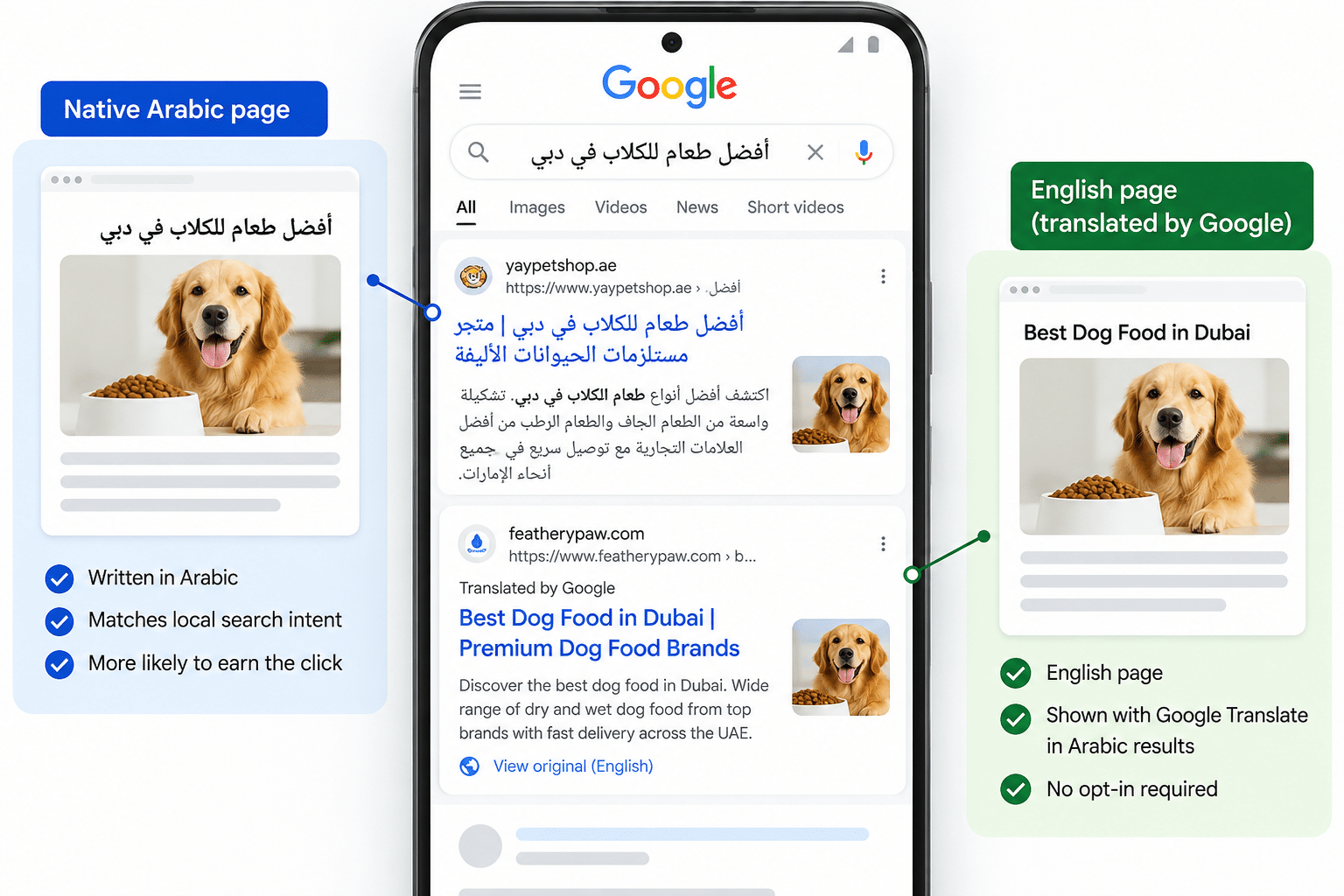
Google offers translated results. When a good answer exists in another language, Google may show it in the search results with a machine-translated title link and snippet. Arabic is one of the supported languages, and publishers do not need to opt in.
An Arabic searcher may see an English page, translated on the fly, next to native Arabic pages. If your Arabic page is thin or machine-made, a translated English result may win the click. You can opt out with the notranslate robots rule, but a better answer is a native Arabic page that deserves the click.
Arabic keyword research when tools show “no data”
Keyword tools often show zero or no volume for Arabic terms, because demand is split across spellings, dialects and mixed queries. Use Google autocomplete in Arabic, People Also Ask, Search Console queries and Google Trends to find the real terms. Then group the variants by intent before you write.
This is a common complaint in forums and Q&A threads about Arabic SEO. A tool shows “no data”, so the term looks worthless. Often the demand is there, but it is spread thin across five spellings, or it sits in a phrase the tool never suggested.
A practical process:
- Start from your English map, not your English words. List the intents your pages serve. Do not translate the keywords yet.
- Ask native speakers how they would search. Ask people in your target market, not only your translator. A Riyadh shopper and a Dubai shopper may use different words.
- Mine Google autocomplete in Arabic. Type the first word of each intent into google.ae or google.com.sa and note every suggestion. When we tested Arabic seeds in October 2026, autocomplete surfaced phrases like “تحسين محركات البحث seo سلة”, which joins the Arabic term, the English acronym and a Saudi store builder.
- Read the People Also Ask box in Arabic. Arabic searches often bring Arabic questions you can answer in an FAQ.
- Compare variants in Google Trends. Trends shows which spelling or dialect form is more popular in each country, as long as the terms have enough searches. Very low-volume terms show as 0.
- Check Search Console once your pages are live. Real impressions are the best keyword data you will get. See the measurement section below.
- Group variants into one target. Spellings and close synonyms that show the same results belong on the same page. Do not build a page per spelling.
For the full method, including how to tie keywords to revenue, read our guide to keyword research for UAE businesses.
MSA or dialect: which Arabic to write in
Use Modern Standard Arabic (MSA) as the base for most web pages, because readers across the Arab world understand it and it suits formal content. Add local terms where your buyers use them, such as product names, local services and FAQ questions. Let the search results for each keyword guide the choice.
MSA (الفصحى) is the written standard across the Arab world. It fits service pages, product specs, legal pages and anything that needs to sound trusted. Day to day, people speak Gulf (Khaleeji) Arabic in the UAE and a range of dialects in Saudi Arabia, and words can differ between cities.
Dialect matters most in the words people type. A simple rule is to write the page body in MSA, and mirror the searcher’s words in titles, headings and FAQs when the data supports it. Social posts and ads can lean further into dialect.
Writing and optimising Arabic pages
Write each Arabic page natively, or have a native writer rework the translation, then optimise it like any other page. Put the main term early in the title and H1, write a meta description that earns the click, and use Arabic headings, alt text and author details. Have a native speaker review every page before it goes live.
The basics of on-page SEO apply to Arabic too. The details below are where Arabic pages often fall short.
Titles. Google’s title link guidance says there is no fixed length limit, but titles are cut “as needed, typically to fit the device width.” Put the main Arabic term near the start so it stays visible. Write the title in Arabic, even if your brand name stays in English.
Meta descriptions. The same rule applies. Google’s snippet guidance sets no limit, but long descriptions get cut. Lead with the benefit, in the words your searcher uses.
Headings. Use real H2 and H3 tags in Arabic. Mirror the questions you found in autocomplete and People Also Ask.
Images. Write alt text in Arabic on Arabic pages. Translate any text inside images too, or replace those images.
Trust and local proof. Add an Arabic author bio, Arabic contact details and Arabic versions of key policies. Use local examples, prices in AED or SAR, and seasonal angles such as Ramadan and Eid where they fit.
Why raw machine translation is a risk
Google’s spam policies list scaled content abuse. That includes producing many pages “through automated transformations like synonymizing, translating, or other obfuscation techniques” when they add little value for users. Pushing a whole English site through a translation tool and publishing it unchecked fits that description.
Machine translation also reads badly in Arabic. It tends to produce stiff MSA, wrong terms for local products, and word order that sounds foreign. AI tools can speed up a first draft, but a native editor should shape the final page. Good content localisation adapts English content for Arabic readers rather than translating it word for word.
Arabic technical SEO basics
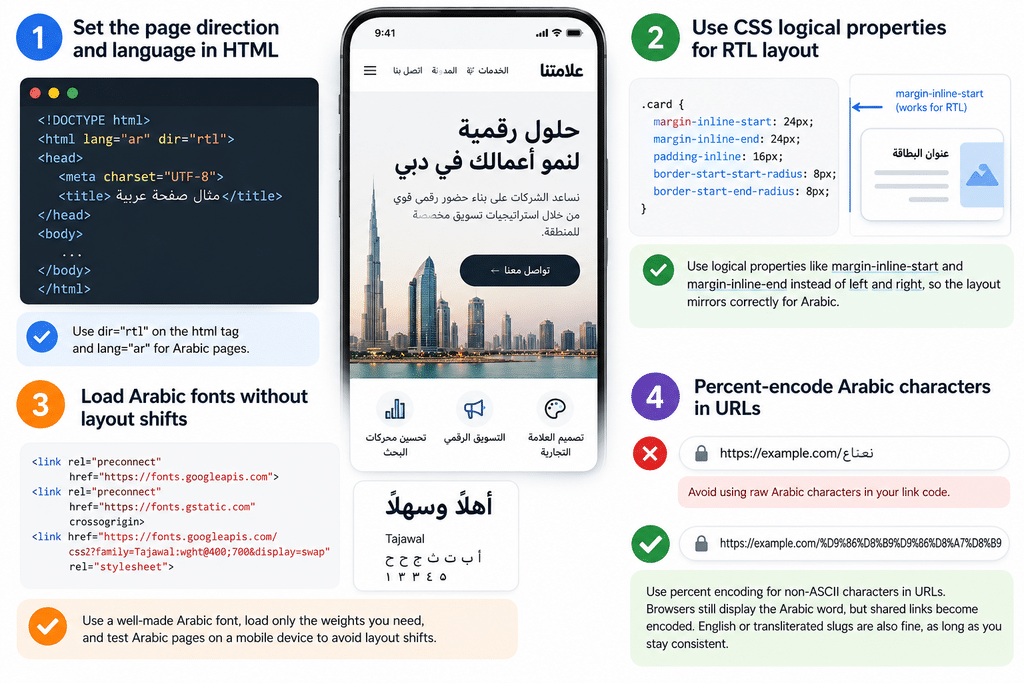
Set the page direction in HTML with dir=”rtl” on the html tag, and declare the language with lang=”ar”. Use CSS logical properties so the layout mirrors cleanly, load Arabic fonts without layout shifts, and percent-encode Arabic characters in links.
Direction belongs in the HTML
The W3C’s guidance on right-to-left text in HTML says: “Add dir=”rtl” to the html tag any time the overall document direction is right-to-left.” It also says not to use CSS to set the base direction, because direction is part of the meaning of the text.
<html lang=”ar” dir=”rtl”>
For layout, the W3C suggests using “start” and “end” rather than “left” and “right”. CSS logical properties such as margin-inline-start do this. The layout then flips correctly for Arabic without a separate stylesheet.
Fonts and page speed
Arabic web fonts are often larger files than Latin fonts. If a font loads late, text can jump as it swaps in, which hurts Cumulative Layout Shift, one of the Core Web Vitals. Use a well-made Arabic font, load only the weights you need, and test Arabic pages on a phone, not only on desktop.
Arabic in URLs
Google’s URL structure guidelines use an Arabic example. The guidance says non-ASCII characters “should be percent encoded” in links. The recommended form looks like this:
https://example.com/%D9%86%D8%B9%D9%86%D8%A7%D8%B9
The raw form, https://example.com/نعناع, is marked as the one to avoid in your link code. Browsers still show the Arabic word in the address bar, but shared links become long encoded strings. English or transliterated slugs are shorter. Either approach can rank, so pick one for the whole Arabic section and stay consistent.
Arabic and English on one site
Give each language its own URL, link the versions to each other with hreflang, and never switch language based on the visitor’s IP address. Each version should be complete and useful in its own language.
Most UAE businesses need both languages. The safest setup is a separate URL for each version, often in a folder such as /ar/. Google’s guide to localised versions sets the rules for hreflang:
- Language codes use ISO 639-1, such as ar or en.
- Region codes are optional and use ISO 3166-1 Alpha 2, such as AE or SA.
- “Each language version must list itself as well as all other language versions.”
- If two pages do not point to each other, Google ignores the tags.
- The x-default value covers visitors whose language matches none of your versions.
Google also says: “Don’t use IP analysis to adapt your content.” Automatic redirects based on location can stop Google from seeing your Arabic pages at all. Offer a clear language switch instead, and let the user choose.
Arabic names, entities and structured data
Tell Google that your Arabic and English brand names belong to the same business. Use Organization structured data with your main name, your other-language name in alternateName, and your official profiles in sameAs. Keep your Arabic name spelled the same way everywhere it appears.
Many Gulf businesses have an English trading name and an Arabic one, sometimes with several Arabic spellings in use. Inconsistent names split the signals that search engines and AI systems use to recognise your business.
Google’s Organization structured data supports both properties. It describes alternateName as “Another common name that your organization goes by” and sameAs as a URL on another site with more information about you. A simple example, using a made-up business:
{
“@context”: “https://schema.org”,
“@type”: “Organization”,
“name”: “Example Trading LLC”,
“alternateName”: “مثال للتجارة”,
“url”: “https://www.example.ae/”,
“sameAs”: [
“https://www.linkedin.com/company/example-trading”,
“https://www.instagram.com/exampletrading”
]
}
Use the same Arabic spelling on your Google Business Profile, your Arabic pages and your social profiles. Our guide to local SEO in Dubai covers how to set up your Business Profile so it supports this.
UAE vs Saudi Arabia, and Arabic SEO for online stores
Plan the two markets separately. In the UAE, many business searches happen in English, while Arabic search is measurably larger in Saudi Arabia, so Arabic pages matter more there. Online stores should also check what their platform allows for Arabic titles, descriptions and URLs.
Two markets, two plans
A UAE business may find that English pages bring most of its search traffic. A business selling into Saudi Arabia should expect a real share of demand in Arabic. Do not assume one Arabic page serves both markets. Word choice, prices, delivery terms and trust signals all differ. If you serve both, consider separate ar-AE and ar-SA versions of key pages.
Online stores
Arabic autocomplete suggests phrases such as “تحسين محركات البحث seo سلة”, so merchants on Salla (سلة) and Zid (زد), two popular Saudi store builders, do look for SEO help in Arabic. Whatever platform you use, check that you can:
- Edit the Arabic title and meta description for each product and category
- Write unique Arabic product descriptions instead of supplier copy
- Set clean, consistent URLs for Arabic products
- Show the store in right-to-left layout without broken elements
- Add product structured data to Arabic pages
Shopify and WordPress both support Arabic stores, usually through their translation features, apps or plugins. The common faults are duplicate product pages across languages and missing Arabic metadata. Our guide to Shopify SEO in Dubai covers the issues we see most often on Shopify stores.
How AI search picks Arabic sources
AI search tools such as Google AI Overviews and ChatGPT draw on pages they can find, trust and quote. Clear Arabic answers near the top of a page, consistent entity names and sourced facts make your Arabic content easier to cite.
When we checked on 18 October 2026, Google showed an AI Overview at the top of the results for “arabic seo” in the UAE, and no featured snippet. A strong English page may also be cited for an Arabic question, so both versions need to be good.
Give each main section a short, direct answer before the detail. Use clear headings that match how people ask the question. To learn how these systems choose what to quote, read our guides on how AI search engines generate answers and how Google AI Overviews choose their sources.
Measuring Arabic performance in Search Console and GA4
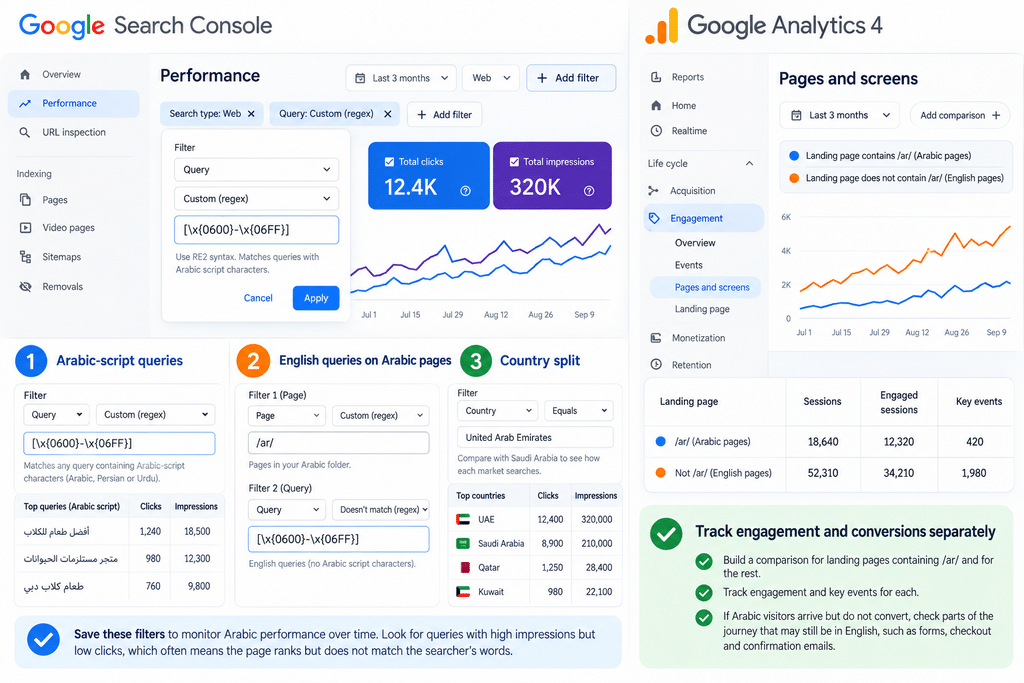
Measure Arabic separately from English, or Arabic gains and losses will hide inside your totals. In Search Console, filter queries by Arabic script and pages by your Arabic folder, then compare the same split in GA4.
In Search Console
The Performance report supports custom regex filters for queries and pages. Google’s Search Central blog confirms it uses RE2 syntax and supports both “matches” and “doesn’t match” filters. Three filters are worth saving:
- Arabic-script queries. Set the query filter to Custom (regex) and use [\x{0600}-\x{06FF}]. This matches any query containing Arabic-script characters. It will also catch Persian or Urdu queries, which use the same script.
- English queries landing on Arabic pages. Combine a page filter for /ar/ with a query filter that does not match the Arabic range. This shows which English searches reach your Arabic pages, a sign the matching English page may be weak or missing.
- Country split. Add a country filter for the UAE or Saudi Arabia to see how each market searches.
Watch for Arabic queries that bring impressions but few clicks. They often point to a page that ranks but does not match the searcher’s words.
In GA4
Build a comparison for landing pages that contain /ar/ and another for the rest. Track engagement and key events for each. If Arabic visitors arrive but do not convert, check the parts of the journey that may still be in English, such as forms, checkout and confirmation emails.
Arabic SEO checklist
Use this list before you publish any Arabic page:
- The keyword came from real Arabic searches, not a translation.
- You checked the search results for each main spelling.
- The page body is written or edited by a native speaker.
- The title and H1 start with the main Arabic term, and the meta description is in Arabic.
- Headings and FAQs mirror real Arabic questions.
- Image alt text and any text in images are in Arabic.
- The html tag has lang=”ar” and dir=”rtl”, and the layout works on a phone.
- Arabic URLs follow one consistent approach.
- Hreflang links the Arabic and English versions both ways.
- Search Console has saved filters for Arabic queries and pages.
Running Arabic and English side by side across a whole site takes planning. If you want a team to map it out with you, see our international and multilingual SEO service.
Frequenly Asked Question
Yes. AI Overviews and chat tools still pull their answers from web pages, so clear Arabic pages give them something to cite when people ask in Arabic.
It depends on how many pages you need, whether you write them from scratch or adapt English pages, and how much technical work your site needs. Native writing and editing is often a large share of it. A small audit of your current Arabic pages is a sensible first step before you set a budget.
Use Modern Standard Arabic for the body of most pages, and add the Gulf words your buyers type in titles, headings and FAQs when the data supports it.
AI can help with a first draft, but publishing raw machine translation at scale is risky. Google’s spam policies treat automated translation that adds little value as scaled content abuse. Have a native editor rework each page.
You can handle the technical parts yourself, such as hreflang, the dir attribute, structured data and Search Console filters. You need a native speaker for keyword research and for writing or reviewing the pages. Without one, you cannot judge whether a page reads naturally or targets the right words.
Arabic can be easier to rank in, because there is far less Arabic content on the web. It is harder to research and measure, because keyword tools show less data and demand is split across spellings and dialects. In the UAE, the Arabic search volume for many business topics is also lower than for English
Yes. Google indexes and ranks Arabic pages and detects the language from the visible text. Short or ambiguous Arabic terms can still return mixed results, so check your main keywords by hand.
Both can rank. Arabic slugs match the page language but become long encoded strings when shared, while English slugs are shorter. Choose one approach and keep it consistent.
