
Retrieval-Augmented Generation Explained for Marketers and SEOs
Introduction
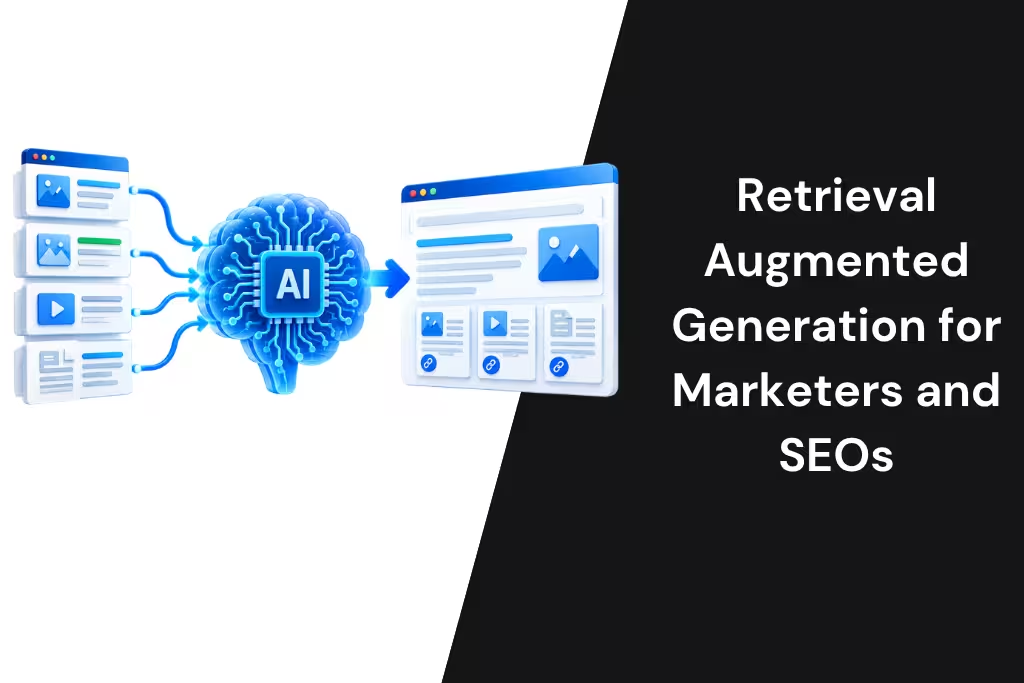
Retrieval-Augmented Generation (RAG) is an artificial intelligence technique that combines information retrieval with large language models (LLMs) to generate answers using relevant external information. Instead of relying entirely on information learned during training, a RAG system retrieves relevant documents from sources such as knowledge bases, product documentation, databases, or indexed web content and supplies that information to the language model as context. This approach can help AI systems produce more relevant, up-to-date, and context-specific responses, although it does not guarantee factual accuracy.
For marketers and SEO professionals, understanding RAG is increasingly useful because AI-powered search and answer systems can influence how people discover information, evaluate products, and interact with brands. Traditional search engine optimization focuses on improving the discoverability and relevance of web pages in search results, while RAG explains one way external information can be retrieved and used during AI-generated answer production. Understanding RAG in AI, semantic search, document retrieval, and AI citations can help marketing teams create more useful content, improve information accessibility, and evaluate their visibility across emerging AI search experiences.
This guide explains how Retrieval-Augmented Generation works, how it differs from traditional SEO and generative engine optimization (GEO), how marketers can improve content quality and accessibility, and how organizations can measure AI search visibility without assuming that any particular optimization guarantees rankings or citations.
What Is Retrieval-Augmented Generation (RAG)?
Retrieval-Augmented Generation (RAG) is an AI architecture that connects a language model with an external information retrieval system. The retrieval system searches a collection of documents or other knowledge sources for information relevant to a user’s question, and the language model uses the retrieved material to formulate a response. For example, if a customer asks an AI assistant about a company’s latest product specifications, a RAG-enabled application could retrieve the relevant product documentation before generating an answer. This allows the application to use information that may not have been included in the model’s original training data.
The three components of RAG explain how the process works. Retrieval identifies potentially relevant information from a knowledge source. Augmentation supplies that information as additional context alongside the user’s question. Generation uses the language model to produce a natural-language response based on the available context. These components work together to connect information stored outside the model with its ability to understand questions and generate readable answers. The exact implementation varies depending on the system, the retrieval technology, the available data, and the requirements of the application.
RAG Meaning in Simple Terms
A simple way to understand RAG is to compare it with a researcher answering a question. Rather than relying only on memory, the researcher first consults relevant reports, checks the available evidence, and then prepares an answer. A RAG system follows a similar pattern by retrieving information from an external knowledge source and making it available to a language model before answer generation. For example, a marketing team could build an internal AI assistant that retrieves approved brand guidelines, campaign documents, and product information to answer employees’ questions. The assistant can then use the retrieved documents to provide an answer that reflects the organization’s available information.
Why RAG Matters in Generative AI
Large language models are capable of producing fluent responses, but they may lack access to the latest information or specific details stored in external databases. RAG can help address this limitation by allowing an application to retrieve relevant information when a question is asked, rather than requiring the model to learn every new fact through additional training. However, the quality of the response still depends on whether the retrieval system finds useful evidence and whether the model interprets that evidence correctly. RAG therefore provides a practical way to connect large language models, external knowledge sources, and context retrieval while preserving the need for accurate documentation, reliable sources, and appropriate verification.
How Does Retrieval-Augmented Generation Work?
Retrieval-Augmented Generation works by connecting a user’s question to relevant information stored in external knowledge sources and using that information to generate an answer. A typical RAG pipeline includes four main stages: query understanding, information retrieval, context augmentation, and answer generation. Each stage contributes to the quality of the final response because the system must interpret the question correctly, find useful information, supply the information as context, and generate an answer that addresses the user’s needs. For marketers and SEO professionals, understanding this workflow helps explain how information from web pages, product documentation, and knowledge bases may be used by AI-powered applications.
Step 1 — Query Understanding
The first stage begins when a user submits a question or instruction. The system interprets the query to identify the user’s information need and determine what type of information could answer it. For example, a user asking, “Which running shoes are best for long-distance training?” may need information about cushioning, durability, weight, comfort, and price. Depending on the implementation, the system may rewrite the question, identify important concepts, or break a complex query into smaller searches. This process can improve retrieval by helping the system search for information that addresses the actual question rather than relying exclusively on the exact words entered by the user. Some AI search systems also use query fan-out to explore related questions, although this is not a mandatory component of every RAG implementation.
Step 2 — Information Retrieval
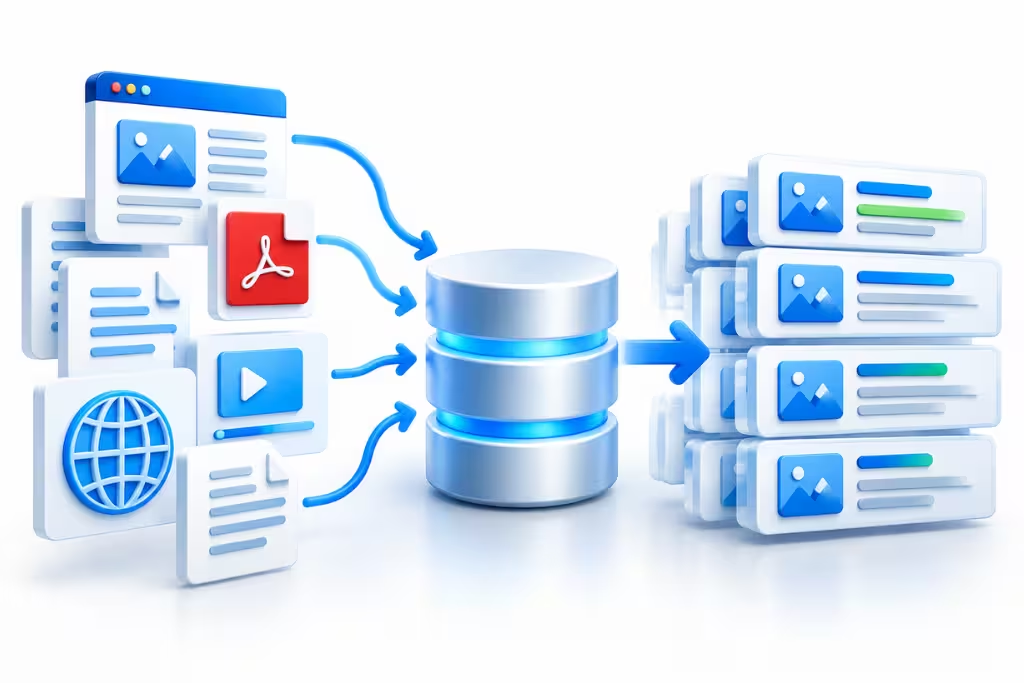
Once the system identifies the information need, the retrieval component searches available knowledge sources for relevant documents or passages. These sources might include internal company documents, indexed web pages, product catalogs, technical manuals, or structured databases. Depending on the system, retrieval may use keyword matching, semantic search, vector search, or a combination of techniques. Keyword search identifies matches between query terms and document content, while semantic search can help identify information related to the meaning of a query even when the wording differs. For example, a search for “ways to improve website visibility” could retrieve content about organic search optimization, content discoverability, and technical SEO. The retrieval system then selects candidate passages that may help answer the question. The usefulness of these passages depends on the relevance, accuracy, completeness, and accessibility of the underlying information.
Step 3 — Context Augmentation
After retrieving potentially relevant information, the system adds selected passages to the context provided to the language model. This stage is known as augmentation because the original question is supplemented with additional information that can guide answer generation. The retrieval system may organize passages, include metadata, remove irrelevant material, or prioritize particular documents before supplying the context. Document chunking can play an important role because large documents are often divided into smaller sections to make retrieval more targeted. However, chunks that are too short may lose important context, while excessively large chunks may contain unnecessary information. A well-designed retrieval pipeline attempts to provide enough relevant evidence for the language model to understand the subject and respond appropriately.
Step 4 — Answer Generation
In the final stage, the language model processes the user’s question alongside the retrieved context and generates a response. The model may summarize information, compare details, explain a process, or combine relevant facts from multiple passages into a coherent answer. For example, a customer-support assistant could retrieve a company’s refund policy and use the relevant provisions to explain how a customer can request a return. Some systems also provide source links or citations so users can inspect the supporting information. However, retrieval does not guarantee that the generated response will be completely accurate or that every source will be cited. The model may misunderstand the evidence, omit important qualifications, or generate claims that are not supported by the retrieved documents. For this reason, reliable source material, effective retrieval, and appropriate verification remain essential.
Understanding these four stages helps marketers recognize that AI-generated answers depend on more than the presence of a keyword on a webpage. The information must be available to the relevant system, retrievable for the question being asked, useful as context, and interpreted appropriately during generation. Improving content clarity and accessibility can support these goals, but it cannot guarantee that a particular page will be retrieved or cited.
Why Is RAG Important for Marketers and SEOs?
Retrieval-Augmented Generation is important for marketers and SEO professionals because it helps explain how external information can become part of an AI-generated answer. As businesses adopt AI-powered search experiences, conversational assistants, and automated customer-support tools, the ability to provide clear, relevant, and trustworthy information becomes increasingly valuable. RAG offers one approach to connecting large language models with external knowledge sources, allowing applications to retrieve information when a user asks a question. For marketers, this creates opportunities to improve product documentation, strengthen content quality, organize knowledge bases, and understand how brand information may be used in AI-powered experiences. However, not every AI search platform uses the same architecture, and content optimization alone cannot guarantee visibility in generated answers.
How RAG Connects External Information With AI Answers
Traditional language models generate responses using patterns learned during training and any additional context supplied at the time of a request. A RAG-enabled application can supplement that process by retrieving relevant information from external sources, such as company websites, product documentation, research reports, and internal knowledge bases. For example, imagine an online retailer that sells hundreds of electronic products. A customer asks whether a particular laptop supports two external monitors. An AI assistant connected to the retailer’s product documentation could retrieve the relevant technical specifications and use them to formulate an answer. This approach can help the assistant provide more specific information than a response based solely on general knowledge. For marketers, the example illustrates why accurate product descriptions, detailed specifications, consistent terminology, and well-maintained support pages matter. When information is organized clearly, it becomes easier for both human readers and retrieval systems to identify the details relevant to a question. Nevertheless, the outcome depends on whether the application can access the source, retrieve the correct information, and interpret it accurately.

RAG and the Shift Toward AI Search Visibility
AI-powered search experiences are changing how people interact with information online. Instead of always opening several webpages and comparing the results themselves, users may receive a synthesized response that summarizes information from one or more sources. In systems that retrieve external content, the relevance and quality of available information can influence which sources contribute to an answer. This makes AI search visibility an important area for marketers to monitor alongside conventional organic search performance. Businesses can assess whether their brands appear in relevant AI-generated answers, whether their pages are cited, and whether the information presented about their products or services is accurate. They can also monitor referral traffic from AI platforms where analytics data is available. These measurements should be interpreted carefully because a brand mention does not necessarily mean its website was retrieved, and a citation does not automatically demonstrate that the source drove a conversion. RAG provides a useful framework for understanding one part of this process, but AI visibility also depends on each platform’s search capabilities, source-selection mechanisms, and response-generation behavior. The practical priority for marketers is to publish useful, accurate, well-supported information and evaluate how effectively that information serves customers across different discovery channels.
RAG vs. Traditional SEO vs. GEO vs. AEO
RAG, traditional search engine optimization (SEO), generative engine optimization (GEO), and answer engine optimization (AEO) are related concepts, but they serve different purposes. RAG describes a technical approach that combines information retrieval with language-model generation, while SEO, GEO, and AEO describe strategies for improving how information is discovered, understood, and presented through different digital experiences. For marketers, understanding these distinctions helps clarify which activities belong to content optimization, which relate to AI system architecture, and which metrics can be used to evaluate performance. Rather than treating these approaches as competing alternatives, businesses can use them as complementary perspectives when developing a content strategy for both traditional search and AI-powered discovery.
RAG vs. Traditional Search Engine Optimization
Traditional SEO focuses on improving a website’s discoverability and performance in search engines. Common activities include researching keywords, improving technical accessibility, creating relevant content, developing internal links, earning reputable backlinks, and making webpages useful to visitors. RAG, by contrast, describes how an AI application retrieves external information and supplies it to a language model to help generate a response. A traditional search engine may return a list of webpages for a query, while a RAG-enabled assistant may retrieve relevant passages and use them to formulate a conversational answer. These processes can overlap when an AI application retrieves information from web content, but they are not identical. Not every RAG system accesses public websites, and not every search engine response is produced through RAG. For SEO professionals, the practical lesson is to maintain strong technical SEO fundamentals while creating content that answers questions clearly and accurately. Crawlability, relevant information, clear headings, and trustworthy evidence can make content more useful, but they do not guarantee inclusion in an AI-generated response.
RAG vs. Generative Engine Optimization (GEO)
Generative Engine Optimization (GEO) refers to strategies intended to improve how a brand, website, or piece of information is represented in generative AI responses. These strategies may include publishing original research, providing clear explanations, supporting claims with credible evidence, maintaining consistent brand information, and creating content that directly addresses users’ questions. RAG is different because it is a technical method for retrieving external information and using it during answer generation. GEO concerns how marketers can improve the quality and discoverability of information that AI systems might use, whereas RAG describes one way an application can access and incorporate external knowledge. The concepts intersect when a generative AI application retrieves content from sources that a marketer has optimized. For example, a company publishing a detailed comparison of its products may make its specifications and differentiating features easier for readers and retrieval systems to understand. Whether the content is retrieved, used, or cited still depends on the particular AI platform and its retrieval and generation mechanisms.
RAG vs. Answer Engine Optimization (AEO)
Answer Engine Optimization (AEO) focuses on making information accessible and suitable for systems that provide direct answers to users’ questions. Depending on the strategy, this can involve concise definitions, question-and-answer content, descriptive headings, structured information, and reliable supporting evidence. RAG can support answer generation by supplying relevant passages to a language model, but AEO is an optimization approach rather than a retrieval architecture. For instance, a company publishing a clear explanation of its return policy can help customers understand the rules and may make the information more useful to an answer-oriented application that retrieves company documentation. However, adding an FAQ section or using structured data does not automatically cause a page to appear in AI answers. The information must still be accessible to the relevant system, relevant to the query, and selected by its underlying processes. Marketers can therefore combine SEO, GEO, and AEO practices to improve content quality and discoverability while treating RAG as one possible technical mechanism through which external information reaches an AI-generated response.
Overall, RAG explains a technical process, while SEO, GEO, and AEO describe optimization approaches. Understanding the difference helps marketing teams avoid confusing content strategy with AI architecture and focus on practical priorities: publishing useful information, maintaining accessible websites, supporting claims with evidence, and measuring actual visibility rather than assuming that a particular technique guarantees AI citations.
How Does RAG Affect AI Search Visibility and Citations?
Retrieval-Augmented Generation can influence how external information contributes to AI-generated answers by allowing a system to retrieve relevant documents before generating a response. For marketers and SEO professionals, this process offers a useful way to understand the relationship between content discoverability, source selection, brand mentions, and AI citations. When an AI application retrieves information from websites or other knowledge sources, the relevance and quality of that information can affect how well the application answers a user’s question. However, being indexed, being retrieved, being used in an answer, and being cited are four different outcomes. Understanding these distinctions helps marketing teams develop realistic AI search visibility strategies and avoid assuming that publishing optimized content automatically results in citations.
How Retrieved Content Can Inform AI-Generated Answers
In a RAG-enabled application, the retrieval system searches available information sources for documents or passages relevant to a user’s question. The selected material is then supplied to the language model as context for generating an answer. For example, suppose a user asks an AI assistant to compare two project management platforms. A retrieval system may identify product documentation, pricing information, feature descriptions, and comparison pages that address the question. The language model can use this information to summarize differences between the platforms. For marketers, this example demonstrates why content should communicate essential facts clearly and accurately. Product specifications, service descriptions, pricing policies, original research, and detailed explanations can all help readers understand what a business offers. Clear headings, descriptive page titles, consistent entity names, and well-organized paragraphs also make information easier to navigate. These practices support content quality and can be useful when a retrieval system processes web content, although they do not establish a universal formula for being retrieved. Different AI applications may use different sources, indexing methods, ranking systems, and access permissions. Consequently, marketers should prioritize providing genuinely useful information rather than attempting to optimize for an assumed retrieval algorithm.
Why Being Retrieved Does Not Guarantee a Citation
Retrieval and citation are separate stages of an AI information workflow. A system may retrieve a webpage or document but decide not to include it in the final answer. It may use information from several sources, summarize facts without presenting every source, or generate a response that includes only a subset of the retrieved evidence. Some systems provide explicit citations, while others offer limited or no source attribution. Even when a citation appears, the cited page may not support every statement in the generated response. This distinction matters because marketers can otherwise mistake a visible brand mention for proof that their website supplied the information. A brand might be mentioned because it appears in a third-party article, an internal knowledge base, or information learned during model training rather than because its website was retrieved for that particular query. To evaluate AI visibility more carefully, teams can track brand mentions, links to their own webpages, citations to third-party sources, and the factual accuracy of generated descriptions as separate metrics. Testing a consistent set of questions across relevant platforms can help reveal patterns over time. However, results may vary with wording, dates, platform updates, and user context. RAG can help explain how information reaches a language model, but it does not guarantee that a source will be selected, used, or cited. Marketers should therefore combine practical content improvements with repeatable observation and measurement instead of treating any single AI response as definitive evidence of search visibility.
How to Optimize Website Content for RAG Systems
Optimizing website content for Retrieval-Augmented Generation involves making information accessible, relevant, accurate, and easy to understand. RAG systems retrieve information from available knowledge sources and provide selected content to a language model, which uses that context to generate an answer. For marketers and SEO professionals, this creates a practical opportunity to improve the quality and organization of existing content. Instead of focusing exclusively on keyword placement, businesses should ensure that important information is discoverable, answers specific questions, uses consistent terminology, and supports factual claims with reliable evidence. These practices can improve the usefulness of content for people and may benefit systems that retrieve web information, although different AI platforms use different architectures and retrieval methods. No single optimization technique guarantees that a webpage will be retrieved or cited.
Make Important Content Accessible to Crawlers
Content must be accessible to the relevant information retrieval system before it can be retrieved from a website. Marketers should therefore work with technical SEO teams to review crawl permissions, robots directives, page responses, internal links, and JavaScript rendering. Important product details, service descriptions, research findings, and support information should be available in formats that the intended systems can access. Website owners should also review platform-specific documentation because the requirements for search engines, AI crawlers, and other retrieval applications can differ. For example, a company may publish an extensive product guide, but essential specifications could be difficult to discover if they are hidden behind inaccessible interactions or omitted from the page’s rendered content. Reviewing crawlability and technical accessibility helps identify these problems. However, allowing a crawler to access a page does not necessarily mean that the crawler will index it, that an AI system will retrieve it, or that the content will appear in a generated answer. Accessibility is an important prerequisite where applicable, not a guarantee of AI search visibility.
Structure Content Into Clear, Self-Contained Sections
Well-structured content makes information easier for readers to scan and understand. It can also help retrieval systems identify passages that correspond to specific questions. Marketers should use descriptive headings, concise paragraphs, clear definitions, and direct explanations of important concepts. Each major section should provide enough context to make its central point understandable without requiring readers to consult several unrelated sections. For example, a page about email marketing automation could contain separate sections explaining campaign triggers, audience segmentation, personalization, reporting, and common implementation challenges. A heading such as “How Email Automation Triggers Work” communicates its subject more clearly than a vague heading such as “Additional Information.” Frequently asked questions can also address specific user concerns, provided the answers offer genuine value rather than repeating keywords. The objective is not to fragment every article into artificially short passages, but to create a logical information hierarchy that supports comprehension. Clear organization, relevant terminology, and complete explanations can make content more useful for both humans and retrieval-based applications.
Improve Topical Coverage and Entity Clarity
A strong content strategy should address the questions users have about a subject rather than publish isolated pages targeting similar keywords. Topic clusters can connect a comprehensive guide with supporting articles about definitions, practical applications, comparisons, troubleshooting, and related concepts. Internal links help readers navigate these relationships and provide additional context about how pages relate to one another. Consistent entity naming is equally important. If a business uses different names for the same product, service, or feature across multiple pages, readers may struggle to understand whether those references describe the same offering. Marketers should maintain consistent terminology and provide clear explanations when a product has multiple versions or names. For example, a software company could connect its main product page with detailed documentation, implementation guides, pricing information, and customer-support articles. This approach creates a more complete and coherent information environment. Although topical coverage and entity consistency can strengthen content quality, they should not be treated as confirmed ranking factors for every RAG system. Their immediate value is that they help users find and understand relevant information.
Support Claims With Reliable Sources and Evidence
Content that includes specific, verifiable information can be more useful than content that relies on vague statements or unsupported generalizations. Marketers should support factual claims with credible references, original research, documented product specifications, transparent methodologies, and appropriately attributed expert commentary. When publishing statistics, identify the original source and explain the context in which the numbers were collected. When describing a product, distinguish confirmed capabilities from planned features or promotional claims. This is particularly important for subjects where inaccurate information could affect financial decisions, safety, or other consequential outcomes. Google’s Search Quality Evaluator Guidelines emphasize the importance of main-content quality, accuracy, originality, and trustworthiness when evaluating informational pages. These principles provide a useful quality framework for marketing content, although they do not establish a specific RAG retrieval formula. Businesses should also avoid copying competitor material without adding meaningful value. Original explanations, practical examples, useful comparisons, and firsthand expertise can make content more distinctive and helpful.
Keep Important Information Accurate and Up to Date
Outdated information can undermine the usefulness of a page even when its structure is excellent. Product specifications may change, pricing policies may be revised, research findings may become obsolete, and links to supporting documents may stop working. Businesses should establish a regular review process for important pages and prioritize content that changes frequently or directly influences customer decisions. A product comparison guide, for example, may require more frequent review than an evergreen explanation of a basic marketing concept. Content teams should correct inaccurate statements, replace obsolete statistics, verify source links, and update examples when the underlying facts change. Displaying an updated date can help readers understand when a meaningful review occurred, provided the date reflects a genuine update rather than an automated timestamp change. Maintaining accurate information can improve customer confidence and reduce the risk that an AI application retrieves outdated material from an accessible knowledge source. Nevertheless, content freshness alone does not guarantee retrieval or citation; the information must also be relevant to the question and available through the system’s retrieval process.
The key takeaway: Build content for usefulness first. Ensure that important information is accessible, clearly organized, contextually complete, supported by reliable evidence, and maintained over time. These practices provide a sound foundation for SEO and may help systems that retrieve web content, without relying on unverified promises about how AI platforms select sources.
What Are Embeddings, Vector Search, and Content Chunking?
Embeddings, vector search, and document chunking are important concepts for understanding how some Retrieval-Augmented Generation systems identify relevant information from large collections of documents. When a user asks a question, a retrieval system needs to locate information that may answer the question, even when the wording differs from the wording used in the source material. Some systems accomplish this by representing text as numerical vectors, comparing semantic similarity, and retrieving selected passages from an indexed collection. Document chunking helps organize large documents into smaller units that can be searched independently. For marketers and SEO professionals, understanding these concepts provides useful context for explaining why clear content structure, consistent terminology, and complete passages matter. However, implementations vary, and not every RAG system uses vector databases or the same retrieval architecture.
How Vector Embeddings Represent Meaning
Vector embeddings are numerical representations of information generated by an embedding model. For text, these representations can encode patterns and relationships that help a system identify passages with similar meanings. For example, a user might search for “ways to increase website visitors,” while a relevant article uses the phrase “improving organic traffic.” A semantic retrieval system may recognize a relationship between these expressions even though they do not share exactly the same words. The embedding model converts text into vectors that can be compared using a similarity measure, allowing the system to identify potentially relevant content. In a RAG workflow, embeddings may be generated for documents during indexing and for queries when a user requests information. The retrieval system then compares the query representation with stored document representations to identify candidate passages. For marketers, the important distinction is that semantic similarity can help locate related information, but it does not establish that the information is accurate or sufficient to answer the question. A passage can be semantically relevant while containing outdated facts, incomplete explanations, or unsupported claims.
How Semantic Search Retrieves Relevant Content
Semantic search aims to identify information based on meaning and contextual relationships rather than relying only on exact keyword matches. Traditional keyword-based retrieval remains useful when queries contain specific product names, technical terms, or exact phrases, while semantic retrieval can help with broader questions and variations in wording. Some systems combine both approaches through hybrid retrieval to balance exact matching with semantic similarity. For example, a customer searching for “software that helps teams manage remote projects” might receive relevant information from pages discussing collaboration tools, distributed teams, and project management platforms. In a RAG system, the retrieval component can use these techniques to identify candidate documents before the language model generates a response. Vector databases are one technology used to store and search embeddings, although other indexing and retrieval systems are also possible. Marketers do not need to insert artificial variations of every keyword into their content. Instead, they should explain concepts naturally, use terminology their audience understands, and provide clear supporting details. These practices improve the usefulness of the content itself and can help readers understand relationships between related topics.
Why Document Chunking Matters for AI Retrieval
Document chunking is the process of dividing larger documents into smaller passages that can be indexed and retrieved separately. Instead of searching an entire lengthy guide as one unit, a retrieval system may identify the specific section that addresses a user’s question. Chunking strategies vary: documents may be divided by paragraph, heading, token count, or a combination of structural and technical rules. The choice can affect whether retrieved passages contain enough information to be useful. Very small chunks may omit important definitions or qualifications, while very large chunks may include unnecessary details that make the relevant information harder to isolate. For example, an article about a software product might contain separate sections explaining supported integrations, subscription plans, security features, and troubleshooting. Structuring those sections clearly can make it easier to identify the passage relevant to a particular question. Content creators cannot always control how external systems divide their webpages, but they can improve their own information architecture by using descriptive headings, coherent paragraphs, and clear explanations that preserve essential context.
What Reranking Does in a Retrieval Pipeline
Reranking is an additional step used by some retrieval systems to reorder candidate documents or passages according to their estimated relevance to a query. An initial retrieval stage may identify a relatively broad set of candidates, after which a reranking model evaluates the relationship between the question and each candidate more closely. The system can then prioritize the passages most likely to provide useful context for answer generation. For example, a search for information about enterprise software security might initially retrieve pages about general cybersecurity, password management, compliance, and specific product controls. Reranking may help prioritize the passages that directly address the user’s question. The exact methods and models used depend on the implementation, and reranking is not required in every RAG pipeline. For marketers, this reinforces an important point: publishing a page that mentions a relevant keyword does not necessarily make that page the best source for a specific question. Detailed explanations, precise terminology, appropriate context, and reliable supporting information make content more useful to readers and potentially more useful to retrieval systems.
Key takeaway: Embeddings can represent semantic relationships, vector search can help locate relevant information, chunking can organize documents into searchable passages, and reranking can prioritize candidate results. Together, these techniques explain how some RAG systems find information, but they do not guarantee that a particular webpage will be selected or cited.
RAG Use Cases in Digital Marketing
Retrieval-Augmented Generation (RAG) can support digital marketing by connecting AI systems with relevant information from product catalogs, knowledge bases, company documentation, research reports, and published content. Instead of relying exclusively on information learned during model training, a RAG-enabled application can retrieve selected information from an available source collection and use it to generate a context-aware response. This can be useful when answers depend on specific product details, current documentation, or company knowledge. For marketers and SEO professionals, RAG provides a practical way to understand how AI-powered discovery, personalized information experiences, and automated customer interactions may work. However, the benefits depend on the quality of the source material, retrieval configuration, access permissions, and answer-generation process. RAG is not a universal feature of every marketing platform, and implementing it does not automatically improve organic rankings or AI search citations.
RAG for E-commerce Product Discovery
E-commerce businesses often maintain large product catalogs containing specifications, pricing, availability, compatibility details, reviews, and buying guides. A RAG-based shopping assistant can retrieve relevant product information from these sources to answer questions in natural language. For example, a customer might ask, “Which lightweight laptop is suitable for travel and video calls?” If the system has access to structured product specifications and reliable supporting content, it may retrieve information about device weight, battery life, webcam quality, and connectivity before generating a recommendation. This can make product discovery more conversational than relying exclusively on filters and category pages.
For marketers, the quality of the underlying product information is essential. Product descriptions should explain important features clearly, specifications should be consistent across relevant pages, and compatibility claims should be supported by accurate documentation. If the product database contains outdated prices or contradictory specifications, the generated answer may repeat those errors. E-commerce teams should therefore maintain reliable product feeds, clearly distinguish confirmed specifications from marketing language, and regularly test common shopping questions. RAG can help surface useful information, but it does not replace inventory management, product-data governance, or human review for high-impact claims.
RAG for B2B Content Marketing and Lead Generation
B2B buyers frequently need detailed information before contacting a sales team. Their questions may involve integrations, implementation requirements, industry use cases, security controls, pricing models, and differences between competing solutions. A RAG-enabled assistant can retrieve relevant passages from product documentation, case studies, service pages, and approved sales materials to provide more specific answers. For example, a prospective buyer evaluating a customer relationship management platform might ask whether it supports a particular integration and what implementation involves. The system could retrieve the relevant integration guide and onboarding documentation, then formulate a response based on those sources.
Marketing teams can support this experience by creating content that addresses real buyer questions throughout the decision-making journey. Detailed solution pages, implementation guides, comparison pages, case studies, and FAQs can each serve a distinct informational purpose. However, teams should not treat every AI-generated answer as a qualified lead or assume that content retrieval proves commercial intent. Useful measurement should connect assistant interactions with meaningful outcomes, such as engagement with relevant resources, demo requests, and qualified inquiries. Access controls are also important when the retrieval system can access internal sales documents or customer information.
RAG for Customer Support and Marketing Automation
Customer support is another practical use case because answers often depend on documentation that changes over time. A RAG-enabled support assistant may retrieve information from troubleshooting guides, product manuals, help-center articles, and approved policy documents. When a customer asks how to configure a feature, the system can use the relevant instructions as context for its response. Marketing teams can contribute by maintaining a well-organized help center, identifying recurring questions, and ensuring that published guidance reflects the current product experience.
RAG can also support internal marketing workflows. An assistant connected to approved brand guidelines, campaign briefs, and product messaging may help team members locate existing information or draft content consistent with documented requirements. Such workflows need appropriate permissions and review procedures: retrieving an internal document does not make every detail suitable for public use, and generated copy should still be checked for accuracy, tone, confidentiality, and compliance. Teams should test how the system responds when information is missing or contradictory, and provide a clear escalation path for questions that require a human representative. The goal is to make reliable information easier to use, not to automate every interaction regardless of risk.
RAG for Competitor Research and Campaign Insights
Marketing teams can use retrieval-based systems to search and synthesize information from approved research libraries, campaign reports, customer feedback, and competitor materials that they are authorized to access. For example, an analyst might ask which objections appeared most frequently in recent sales-call summaries or which themes recur in customer reviews. A system could retrieve relevant excerpts and produce a preliminary summary, helping the analyst identify areas that deserve further investigation. This is an illustrative workflow, not a guarantee that RAG will correctly identify every pattern or provide a complete market assessment.
The reliability of the result depends on the collection being analyzed. Incomplete datasets, biased feedback, duplicated records, and outdated competitor information can distort the summary. Marketers should verify important conclusions against the underlying documents, check dates and context, and distinguish observed evidence from generated interpretation. Confidential information should be handled according to organizational policies, and competitor research should respect applicable laws, access restrictions, and platform terms. Used carefully, retrieval-based analysis can accelerate information discovery while leaving strategic judgment and final decisions with the marketing team.
Overall, RAG offers potential applications in product discovery, B2B education, customer support, internal knowledge access, and research synthesis. The strongest implementations begin with a specific user need, reliable source material, and a way to evaluate answer quality. For SEO professionals, the practical lesson is to create content that answers genuine questions clearly and accurately—while recognizing that RAG is one possible retrieval architecture, not a guaranteed route to visibility in AI-generated answers.
How to Measure AI Search Visibility and RAG Performance
Measuring AI search visibility requires more than checking whether a brand appears in a single AI-generated answer. For marketers and SEO professionals, a useful measurement framework combines brand mentions, source citations, referral traffic, answer accuracy, and changes in the quality of audience engagement. These metrics help distinguish whether content is being discovered, whether it contributes to AI-generated responses, and whether that visibility supports business goals. However, measurement can be difficult because AI platforms differ in how they retrieve information, display sources, and report referral visits. Some platforms may not expose retrieval logs or citation data, and a brand’s appearance in an answer does not prove that a specific RAG pipeline retrieved its website. Therefore, teams should treat AI visibility metrics as indicators of observable performance rather than direct proof of how an underlying model works.
Track Brand Mentions and AI Citations
Brand mentions and source citations are useful starting points for understanding how a company appears in AI-generated responses. A brand mention occurs when an AI answer names a company, product, or service. A citation occurs when the answer links to or explicitly identifies a source used to support its response. These outcomes are related but not identical: a brand may be mentioned without a website link, and a page may be cited without the brand receiving prominent attention in the answer.
Marketing teams can create a repeatable set of relevant questions based on their audience’s informational, comparative, and transactional needs. For example, a B2B software company might test questions such as “What should a small business look for in project management software?” and “How do project management platforms handle team reporting?” Teams can record whether the brand appears, which sources are cited, what context surrounds the mention, and whether the information is accurate. Because AI responses can vary over time and across sessions, a single test should not be treated as definitive evidence of visibility. Record the platform, date, query wording, and observed result so that comparisons remain meaningful.
It is also important to separate observation from causation. A citation shows that a source appeared in the response, but it does not necessarily reveal the complete retrieval process or prove that a specific optimization caused the citation. Consistent testing can help identify patterns and content gaps, but it should complement—not replace—traditional SEO reporting and direct business outcomes.
Monitor AI Referral Traffic
Referral traffic can help show whether AI-generated responses lead people to a website. Analytics platforms may identify visits from AI services through referral information, landing-page reports, or other available traffic-source classifications. The exact level of detail depends on the analytics setup and the referring platform. Some visits may be grouped under broader referral categories, while other visits may not preserve enough information to identify the original AI interaction.
To improve measurement, teams should establish a consistent approach to classifying AI-related traffic where the available data permits it. Review landing pages, engaged sessions, conversion events, and the actions visitors take after arriving. A rise in visits to a detailed comparison page, for example, may be more commercially meaningful than a rise in low-engagement visits to a general informational article. Where appropriate, use campaign parameters on links the organization controls, while recognizing that publishers cannot add tracking parameters to citations created by external AI platforms.
Referral traffic should be interpreted alongside other metrics. A website might receive relatively few visits from AI platforms while still earning brand mentions that influence audience awareness. Conversely, a page may receive visits without producing qualified leads or sales. Evaluating traffic quality helps teams determine whether AI-related discovery contributes to the wider marketing strategy rather than focusing only on visit volume.
Test Content Retrieval and Answer Accuracy
Visibility alone does not establish whether the information associated with a brand is correct. An AI-generated answer may cite a relevant page but misrepresent a product feature, omit an important qualification, or combine information from multiple sources incorrectly. Marketers should therefore evaluate the accuracy and completeness of answers to important customer questions, especially when the answers concern pricing, integrations, product capabilities, security, or service policies.
A practical review process begins by selecting questions that customers regularly ask. For each question, document the correct answer and the authoritative source that supports it. Then compare the AI-generated response with that reference, checking whether key details are accurate, whether relevant context is missing, and whether the cited source actually supports the claims. Classify findings into categories such as correct, partially correct, outdated, unsupported, or incorrect. This creates a useful record of recurring information gaps.
When teams have access to an internal RAG application, they may also be able to inspect retrieved passages, retrieval relevance, or other system logs. Those technical measures can help diagnose whether the system is retrieving suitable evidence. External AI search platforms generally do not provide the same level of access, so website owners should not assume they can inspect a platform’s internal retrieval process. For public AI answers, the practical focus is on observable responses, source quality, and factual accuracy.
Build a Repeatable AI Visibility Reporting Process
A consistent reporting process makes it easier to distinguish meaningful trends from isolated results. Start with a defined group of audience questions and test them periodically under documented conditions. Track brand mentions, citations, cited URLs, answer accuracy, referral traffic, and relevant conversions where data is available. Include traditional SEO indicators—such as organic impressions, clicks, rankings, and click-through rate—to understand how AI visibility relates to existing search performance.
A simple reporting table can include the following fields:
| Metric | What to record | Why it matters |
| Brand mentions | Whether and how the brand appears | Indicates observable brand presence |
| AI citations | Cited URLs and source context | Shows which pages are visibly referenced |
| Referral traffic | Visits attributed to AI platforms where identifiable | Helps assess website visits from AI discovery |
| Answer accuracy | Correct, incomplete, outdated, or incorrect claims | Highlights information quality problems |
| Conversions | Leads, sign-ups, or sales associated with visits | Connects discovery to business outcomes |
| Organic search performance | Impressions, clicks, rankings, and CTR | Maintains context from conventional SEO |
Assign ownership for collecting results, reviewing errors, and updating content. Compare results over consistent periods and document changes to pages, tracking methods, and testing queries. Where possible, distinguish correlation from causation: if citations rise after a content update, that is a useful observation, but it does not alone prove the update caused the change.
For the brief’s 90-day objective, teams can monitor progress toward a top-10 ranking for the primary keyword and a click-through rate above 3%, while reporting AI citations and referral activity as complementary measures. These are targets to evaluate, not guaranteed outcomes. The most useful framework connects visibility with accuracy, qualified engagement, and business impact rather than treating any single AI metric as a complete measure of success.
What Are the Limitations of Retrieval-Augmented Generation?
Retrieval-Augmented Generation (RAG) can help AI systems produce answers grounded in external information, but retrieval does not automatically make those answers accurate, complete, or trustworthy. A RAG system depends on several connected components: the quality of the source documents, the retrieval method, the relevance of the selected passages, and the language model’s ability to interpret the retrieved context. Problems at any stage can affect the final response. For marketers and SEO professionals, understanding these limitations is important because it prevents unrealistic expectations about AI search visibility. Publishing a well-structured webpage may improve its usefulness to readers and make its information easier to understand, but it cannot guarantee that an external AI system will retrieve, use, or cite that page.
Irrelevant or Incomplete Retrieved Information
One limitation of RAG is that a retrieval system may select information that is related to a question but does not adequately answer it. A passage might contain the right terminology while missing a critical qualification, comparison, or supporting detail. For example, someone asking whether a software platform integrates with a particular business application needs a clear, current compatibility statement—not simply a general page about integrations. If the retrieval system selects a broad overview instead of the specific documentation, the generated answer may be incomplete or misleading.
Retrieval quality can be affected by document indexing, query interpretation, ranking methods, metadata, and the way source documents are divided into chunks. Some systems use keyword retrieval, semantic search, hybrid methods, reranking, or other techniques to improve relevance, but no single method guarantees that the best evidence will always be selected. Even a strong retrieval process can fail when the underlying information is missing or poorly organized.
Content teams can reduce avoidable ambiguity by answering specific questions directly, placing important qualifications near the relevant claims, and maintaining clear relationships between related pages. Product pages should state supported features accurately, comparison articles should explain their evaluation criteria, and help documentation should distinguish between supported configurations. These improvements make content more useful to human readers and provide clearer source material for systems that may retrieve it. However, content publishers generally cannot control the retrieval configuration used by third-party AI platforms.
Outdated Sources and AI Hallucinations
RAG can provide a language model with external information, but it does not eliminate the possibility of fabricated, outdated, or incorrectly interpreted claims. A retrieved document may contain old pricing, discontinued features, superseded recommendations, or incomplete instructions. A model may also misinterpret the evidence, combine details from different passages incorrectly, or produce a statement that the sources do not support. In these cases, the presence of retrieved context does not guarantee a reliable answer.
Consider an illustrative example: a software company changes its subscription plans, but an older pricing page remains accessible in a document index. If a retrieval system selects that outdated page, an AI assistant might present obsolete pricing even though the company has published a newer version elsewhere. The problem may involve stale indexing, conflicting source documents, inadequate metadata, or the model’s handling of the retrieved evidence.
Organizations implementing their own RAG applications can reduce these risks through content versioning, scheduled index updates, source prioritization, access controls, and answer validation. They can also configure systems to acknowledge when evidence is insufficient instead of generating an unsupported answer. For website owners, maintaining accurate information and clearly identifying current product details is a practical step, although external platforms may refresh their sources on schedules the publisher cannot determine. Marketers should avoid assuming that a content update will immediately appear in AI-generated answers.
Why RAG Does Not Guarantee Rankings or Citations
RAG, search engine optimization (SEO), generative engine optimization (GEO), and answer engine optimization (AEO) are related in the broader context of information discovery, but they are not interchangeable. RAG describes an AI architecture that retrieves information to support generation. SEO focuses on improving a website’s visibility in search results, while GEO and AEO are commonly used to describe practices intended to improve the visibility or usefulness of content in AI-generated and answer-oriented experiences. These practices may overlap, but success in one area does not automatically produce success in another.
A webpage may rank well in a conventional search engine without appearing in an AI-generated answer. Likewise, an AI answer may mention a brand without linking to its website. The outcome depends on the particular platform, the user’s question, available sources, retrieval and ranking methods, answer-generation behavior, and other factors that publishers may not be able to observe. Some AI systems use retrieval-based architectures, while others may use different approaches or combine multiple techniques.
For this reason, marketers should avoid promises such as “optimize this page and it will be cited by AI.” A more credible strategy is to create accurate, accessible, well-organized content that answers real audience questions and supports claims with reliable evidence. Teams can then monitor conventional SEO performance alongside observable AI citations, brand mentions, referral visits, and answer accuracy. These measures help identify trends and opportunities without suggesting that a specific technical architecture or content tactic guarantees visibility.
Ultimately, RAG is a useful way to understand how some AI systems connect generated answers with external information, but it is not a universal solution to factual reliability or discoverability. The practical objective for marketers and SEO professionals is to make trustworthy information easier to find, interpret, maintain, and verify—while measuring outcomes realistically and acknowledging the limits of what can be controlled.
Conclusion
Retrieval-Augmented Generation (RAG) is an important concept for marketers and SEO professionals who want to understand how AI systems can retrieve external information and use it to generate context-aware answers. By connecting a language model with relevant documents, product information, knowledge bases, and other sources, RAG can help support responses that draw on information beyond the model’s internal training.
Understanding how RAG works also clarifies why content quality matters. Retrieval systems may use semantic search, embeddings, document chunking, and reranking to identify relevant passages. For website owners, practical priorities include creating clear page structures, answering audience questions directly, maintaining accurate information, supporting claims with reliable sources, and making important content accessible to crawlers where applicable. These practices strengthen the usefulness of content without guaranteeing that a particular AI platform will retrieve or cite it.
For marketing teams, the next step is to connect content improvements with measurable outcomes. Track conventional SEO metrics alongside observable AI citations, brand mentions, referral traffic, answer accuracy, and conversions where data is available. Review the results consistently, investigate information gaps, and update content when products, policies, or evidence change.
Most importantly, RAG is a retrieval-and-generation approach, not a ranking factor or a guaranteed path to AI visibility. Marketers can influence the clarity, accuracy, and usefulness of their own content, but they cannot fully control how external AI systems retrieve or present information. A sustainable strategy combines strong SEO fundamentals, helpful content, reliable evidence, and realistic measurement.
FAQ
Retrieval-Augmented Generation (RAG) is an AI approach that combines information retrieval with text generation. Before generating an answer, a RAG system retrieves relevant information from an available collection of documents or other data sources and provides that information as context to a language model. This can help the model answer questions using specific external information, such as product documentation, knowledge-base articles, or research reports. The quality of the response depends on the relevance and accuracy of the retrieved material and how well the model interprets it.
RAG typically involves retrieving relevant information, adding the selected material to the model’s context, and generating a response based on the question and retrieved evidence. Depending on the implementation, retrieval may use keyword search, semantic search, vector embeddings, hybrid retrieval, or reranking. The generated answer can be more context-specific when the system retrieves useful and current information. However, RAG does not eliminate hallucinations or guarantee that every answer is correct.
RAG is not itself a confirmed, universal search-ranking factor. It describes an approach used by some AI systems to retrieve information before generating responses. SEO focuses on helping websites become discoverable and useful through practices such as creating helpful content, maintaining accessible pages, and organizing information clearly. These practices may also make content easier for people and some retrieval systems to understand, but there is no guarantee that a webpage will be selected or cited in an AI-generated answer. SEO and AI visibility should therefore be measured separately, while recognizing where their objectives overlap.
RAG and fine-tuning address different aspects of an AI system. RAG supplies relevant external information at response time, while fine-tuning adjusts a model using additional training examples to influence its behavior, outputs, or task performance. RAG can be useful when answers depend on information that changes frequently, such as product documentation or company policies. Fine-tuning may be useful when a model needs to follow a particular style or perform a specialized task more consistently. The approaches can also be combined, depending on the application. Neither approach guarantees factual accuracy on its own.
No. AI search and answer systems can use different architectures, data sources, and retrieval methods. Some incorporate retrieval-based workflows, while others may combine several techniques. Website owners generally cannot determine or control the exact process used by every external platform.
To improve the usefulness and discoverability of website content, publish accurate information, use descriptive headings, answer specific audience questions, support important claims with reliable sources, and keep time-sensitive details updated. Make important pages accessible to crawlers where applicable, and organize related topics so readers can understand the connections. Monitor visible AI citations and brand mentions alongside organic search performance and referral traffic. These steps support a sound content strategy, but they cannot guarantee AI citations.