Introduction Search intent is the foundation of modern SEO because it reveals the purpose behind every search query. Whether a user wants to learn about a topic, visit a specific website, compare products, or make a purchase, Google aims to deliver results that best satisfy that intent. This means that successful SEO is no longer […]

Types of Search Intent in SEO: A Complete Guide to Better Rankings
Introduction Every search begins with a purpose. Someone searching for “what is SEO” wants information, while another searching for “buy SEO software” is ready to take action. This underlying goal is called Search Intent—the reason behind every search query. Understanding search intent helps search engines deliver results that best match what users are actually looking […]
Search Quality Evaluation Principles: The Complete Guide to Ranking Better in Google
Introduction Search quality evaluation principles define how Google assesses whether webpages genuinely help users achieve their goals. Instead of relying only on keywords or backlinks, modern search systems evaluate Content Quality, Search Intent, Trustworthiness, User Experience, and E-E-A-T (Experience, Expertise, Authoritativeness, and Trustworthiness). According to Google’s Search Quality Evaluator Guidelines (January 2025), the primary objective […]
Deterministic vs Probabilistic Signals in SEM: How Google Ads Uses Both to Improve Campaign Performance
Introduction Search engine marketing (SEM) has evolved significantly as privacy regulations, browser restrictions, and the decline of third-party cookies reshape digital advertising. While advertisers once relied heavily on deterministic signals—such as logged-in users, CRM data, and purchase history—Google Ads now combines these with probabilistic signals to maintain accurate targeting, attribution, and campaign optimization in a […]
SEM Algorithmic Ranking Systems: How Google Ads Determines Ad Rank and Maximizes Performance
Introduction Every time a user types a query into Google, an incredibly sophisticated auction occurs in milliseconds. Contrary to popular belief, the advertiser with the highest bid doesn’t automatically win the top position. Instead, SEM Algorithmic Ranking Systems evaluate dozens of signals—including Quality Score, Ad Rank, expected click-through rate (CTR), landing page experience, ad relevance, […]
Search Engine Databases & Indexes: How Search Engines Store, Organize, and Retrieve Information
Introduction Every time a user searches for information on Google, Bing, DuckDuckGo, or another search engine, the results appear in fractions of a second. Behind that seemingly simple experience lies one of the most sophisticated information retrieval systems ever built. Modern search engines process billions of searches daily while managing databases that contain hundreds of […]
Search Engine Lifecycle: How Search Engines Crawl, Index & Rank Content
Introduction The Search Engine Crawling, Indexing & Ranking Lifecycle is the foundation of modern search visibility. Every webpage that appears in search results has traveled through a complex sequence of systems involving website discovery, web crawling, content rendering, content processing, search indexing, query matching, and ranking evaluation. Search engines such as Google process hundreds of […]
Search Engine Marketing: The Complete Guide to Driving Traffic, Leads, and Revenue in 2026
Introduction Search Engine Marketing (SEM) remains one of the most effective digital customer acquisition channels in 2026 because it connects businesses with consumers at the exact moment purchase intent is highest. Unlike interruption-based advertising, SEM leverages search engine advertising, paid search campaigns, Google Ads, and PPC marketing to place relevant offers directly in front of […]
Search Engine Evolution: From Traditional SEO to AI-Powered Discovery
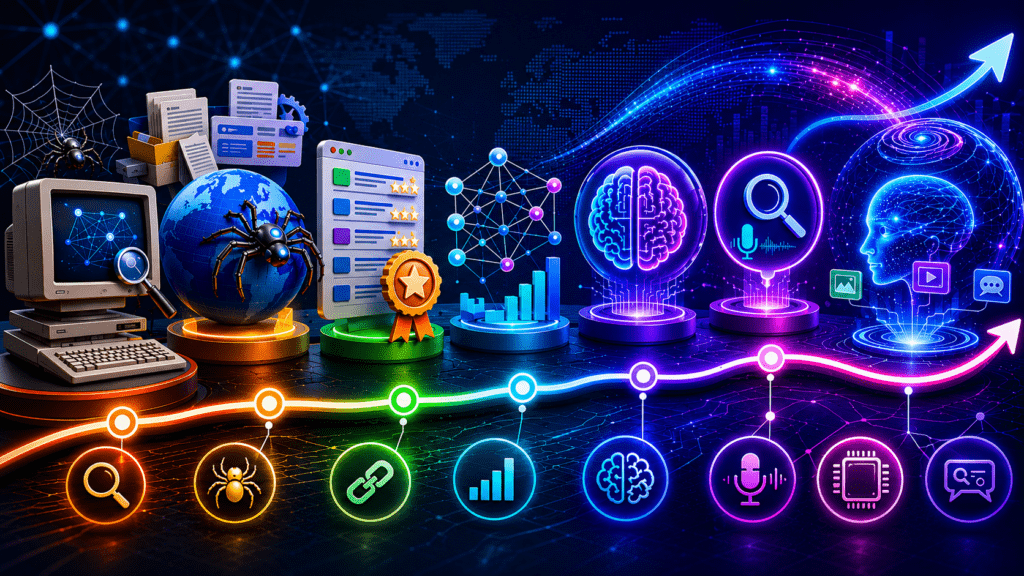
Introduction The story of Search Engine Evolution is the story of how humanity transformed information retrieval from simple keyword matching into sophisticated AI-powered discovery systems. In the early days of the internet, search engines acted as digital librarians, indexing webpages and returning results based largely on keyword frequency. Today, modern platforms leverage artificial intelligence, machine […]