
Deterministic vs Probabilistic Signals in SEM: How Google Ads Uses Both to Improve Campaign Performance

Introduction
Search engine marketing (SEM) has evolved significantly as privacy regulations, browser restrictions, and the decline of third-party cookies reshape digital advertising. While advertisers once relied heavily on deterministic signals—such as logged-in users, CRM data, and purchase history—Google Ads now combines these with probabilistic signals to maintain accurate targeting, attribution, and campaign optimization in a privacy-first environment.
Instead of treating deterministic vs probabilistic signals in SEM as competing methods, Google Ads uses both to power features like Smart Bidding, Performance Max, Enhanced Conversions, Consent Mode, and Data-Driven Attribution. Deterministic data provides verified user information, while probabilistic modeling leverages machine learning to predict user behavior when direct identifiers are unavailable, enabling campaigns to scale without compromising privacy.
This guide explains how deterministic signals in SEM and probabilistic signals in Google Ads work together, where each provides the most value, and how advertisers can use this hybrid approach to improve audience targeting, conversion measurement, and overall campaign performance in today’s AI-driven advertising ecosystem.
What Are Deterministic Signals in SEM?
Deterministic signals are verified, high-confidence data points that accurately identify a user or their actions. Unlike predictive models, these signals are based on direct interactions and authenticated information, making them one of the most reliable data sources for campaign targeting, attribution, and measurement. In Google Ads, deterministic signals typically originate from first-party data such as customer logins, CRM records, purchase history, hashed email addresses, and conversion events. Because these signals represent confirmed user identities or actions, they enable advertisers to deliver highly personalized experiences while improving campaign accuracy.
As privacy regulations limit third-party tracking, deterministic data has become increasingly valuable. Businesses that build strong first-party data strategies can provide Google Ads with trustworthy signals that improve audience segmentation, Smart Bidding, and conversion attribution. While deterministic signals may cover a smaller audience than probabilistic models, their precision makes them the foundation of Google’s advertising ecosystem.

First-Party Data: The Foundation of Deterministic Signals
First-party data is information collected directly from users through interactions with your business. Since it comes from your own digital properties, it is both privacy-friendly and highly reliable. Common examples include customer accounts, email subscriptions, loyalty programs, purchase history, CRM databases, and website login information.
Google Ads uses this data through features like Customer Match, allowing advertisers to upload hashed customer information and reach existing users across Search, YouTube, Gmail, and Display campaigns. Similarly, Enhanced Conversions securely sends hashed first-party customer data back to Google, improving conversion measurement even when traditional cookies are unavailable.
Businesses with rich first-party datasets gain a significant competitive advantage because Google’s machine learning algorithms have more accurate information to optimize bidding, audience targeting, and campaign performance.
Conversion Tracking and Authenticated User Signals
Another important category of deterministic signals comes from verified conversion events. Whenever a user completes a purchase, submits a lead form, signs up for a newsletter, or creates an account, Google Ads can associate those actions with authenticated conversion data through tools like Google Analytics 4 (GA4), Enhanced Conversions, Consent Mode, and server-side tagging.
For example, if a customer logs into an ecommerce website, browses products, and later completes a purchase after clicking a Google Search ad, that journey creates a deterministic signal because the identity and conversion are directly linked. These verified interactions help Google understand which keywords, audiences, and campaigns generate the highest-value customers, enabling more accurate reporting and smarter automated bidding.
By strengthening first-party data collection and implementing reliable conversion tracking, advertisers improve measurement accuracy while reducing their dependence on third-party cookies.
Why Deterministic Signals Matter
Deterministic signals offer unmatched accuracy because they are based on confirmed user information rather than statistical predictions. This makes them particularly valuable for audience segmentation, remarketing, attribution, and campaign optimization. Features such as Smart Bidding, Customer Match, and Data-Driven Attribution all benefit from high-quality deterministic data, allowing Google Ads to make better optimization decisions.
However, deterministic data also has limitations. It only represents users who have directly interacted with your business or consented to share identifiable information. As privacy regulations and browser restrictions reduce the availability of observable user data, advertisers can no longer rely on deterministic signals alone. This is why Google increasingly combines them with probabilistic modeling to fill measurement gaps while maintaining user privacy.
In short, deterministic signals provide the trusted foundation that powers Google’s AI systems. The richer your first-party data, the more effectively Google Ads can optimize campaigns, personalize experiences, and maximize return on ad spend (ROAS).
What Are Probabilistic Signals in Google Ads?
While deterministic signals rely on verified user information, probabilistic signals use machine learning and statistical models to estimate user behavior when direct identifiers are unavailable. Instead of identifying an individual with certainty, Google Ads analyzes patterns such as device type, browser, location, search intent, time of day, historical interactions, and contextual behavior to predict the likelihood of a conversion. This approach allows advertisers to continue measuring and optimizing campaigns even as privacy regulations and browser restrictions reduce access to user-level data.
Probabilistic signals have become increasingly important in Google’s privacy-first advertising ecosystem. They help fill measurement gaps caused by cookie limitations, consent choices, and cross-device browsing while ensuring user identities remain protected. Rather than replacing deterministic data, they complement it by expanding Google’s ability to understand audience behavior and improve campaign performance.
How Machine Learning Uses Probabilistic Signals
Google Ads leverages advanced machine learning models to analyze millions of anonymous interactions and identify patterns that indicate purchase intent or conversion likelihood. Instead of relying on a single identifier, these models evaluate multiple contextual factors simultaneously, including search queries, device characteristics, browsing behavior, geographic location, time of day, previous campaign performance, and aggregated audience trends.
For example, if users with similar search behavior, devices, and browsing patterns frequently convert after searching for a specific product, Google’s algorithms can predict that a new user exhibiting comparable behavior is also likely to convert. This enables Smart Bidding to adjust bids in real time, even when the user’s identity cannot be directly confirmed.
Predictive Audience Modeling
One of the most valuable applications of probabilistic signals is predictive audience modeling. Google analyzes the characteristics of existing customers and identifies new users who display similar behavioral patterns. These predictions help advertisers expand their reach beyond known audiences while maintaining campaign relevance.
This capability powers features such as Performance Max, Smart Bidding, and optimized audience targeting, allowing campaigns to discover potential customers who are most likely to engage or convert. By combining historical performance data with AI-driven predictions, Google improves campaign scalability without relying solely on first-party identifiers.
Why Probabilistic Signals Matter
As third-party cookies disappear and privacy expectations continue to evolve, advertisers face increasing challenges in tracking complete customer journeys. Probabilistic signals help bridge these gaps by estimating conversions, attributing performance, and optimizing bids using aggregated, privacy-safe data.
Although they are based on probabilities rather than confirmed identities, Google’s machine learning models have become highly sophisticated, enabling advertisers to maintain strong campaign performance with incomplete datasets. When combined with deterministic signals, probabilistic modeling creates a more comprehensive understanding of user behavior, ensuring campaigns remain effective in today’s AI-driven, privacy-first advertising landscape.
Deterministic vs. Probabilistic Signals: Key Differences
Although both deterministic and probabilistic signals help Google Ads optimize campaigns, they serve different purposes. Deterministic signals provide verified user information with a high degree of certainty, while probabilistic signals use machine learning to predict user behavior based on patterns and statistical models. Rather than choosing one over the other, Google Ads combines both to achieve more accurate targeting, smarter bidding, and reliable attribution in a privacy-first environment.
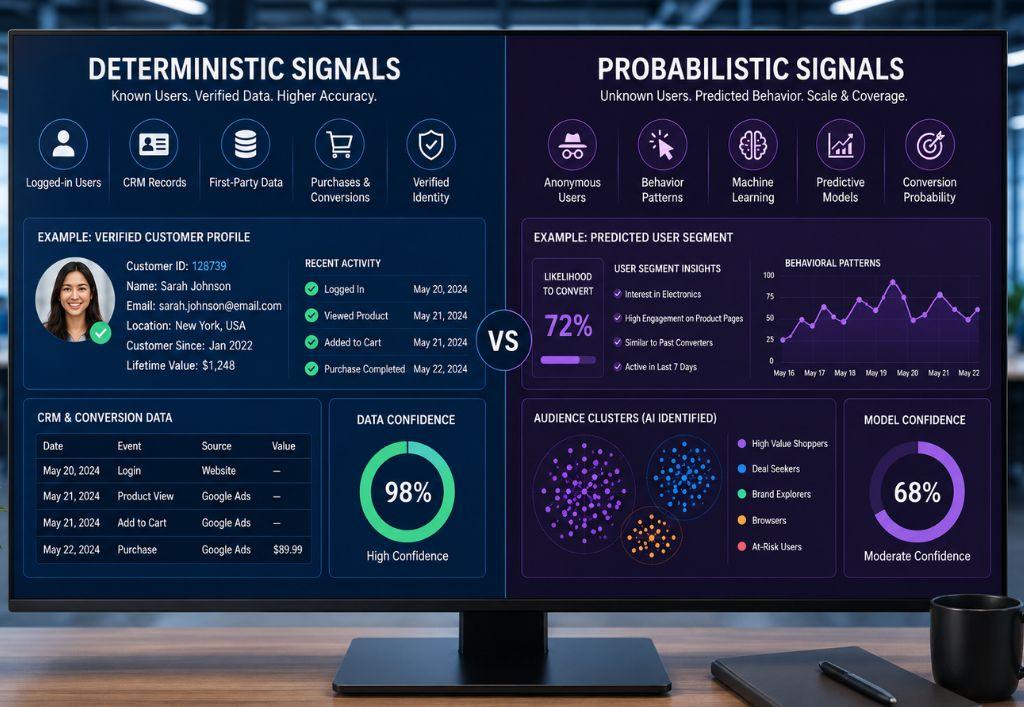
The table below highlights the major differences between the two approaches.
| Feature | Deterministic Signals | Probabilistic Signals |
| Definition | Based on verified user identities and confirmed actions | Based on statistical models and behavioral predictions |
| Data Source | CRM records, logins, purchase history, first-party cookies, hashed emails | Device type, browser, search behavior, location, contextual and aggregated data |
| Accuracy | Very high because the user is directly identified | High, but based on probability rather than certainty |
| Coverage | Limited to users with identifiable data | Broader coverage across anonymous users |
| Privacy Impact | Requires user consent and first-party data collection | Uses aggregated, privacy-safe modeling with minimal personal identifiers |
| Primary Use Cases | Customer Match, Enhanced Conversions, remarketing, attribution | Smart Bidding, audience expansion, conversion modeling, predictive targeting |
| Scalability | Limited by the amount of first-party data available | Highly scalable across large audiences |
| Role in Google Ads | Provides trusted signals for AI models | Fills data gaps and predicts user intent when direct identifiers are unavailable |
Accuracy vs. Scale
Deterministic signals are highly accurate because they are based on confirmed user interactions. For example, when a customer logs into your website, makes a purchase, or submits a lead form, Google Ads can directly associate those actions with a verified conversion. This precision makes deterministic data ideal for attribution, remarketing, and measuring campaign performance.
Probabilistic signals, however, prioritize scale. By analyzing millions of anonymized interactions, Google can estimate user intent even when direct identifiers are unavailable. Although individual predictions are not certain, the collective accuracy of these models enables effective optimization across much larger audiences.
Privacy and Compliance
Privacy regulations such as the GDPR, CCPA, and Google’s Privacy Sandbox have significantly reduced the availability of user-level tracking. As a result, advertisers cannot rely solely on deterministic data collected through cookies or authenticated sessions.
Probabilistic modeling addresses this challenge by using aggregated behavioral patterns instead of personally identifiable information. This allows Google Ads to optimize campaigns while respecting user privacy and complying with evolving data protection requirements.
Why Both Are Better Together
The real strength of Google Ads lies in combining both signal types. Deterministic signals provide reliable, high-quality data that trains Google’s machine learning models, while probabilistic signals extend those insights to users who cannot be directly identified.
For example, an ecommerce business may use Enhanced Conversions and Customer Match to provide verified customer data. Google then analyzes this information alongside probabilistic signals—such as search intent, device behavior, and contextual patterns—to identify new potential customers and optimize bids in real time.
This hybrid approach enables advertisers to achieve more accurate measurement, broader audience reach, improved bidding decisions, and stronger campaign performance, making it the foundation of modern AI-powered SEM.
Why Google Ads Uses Both Instead of Choosing One
A common misconception is that Google Ads must choose between deterministic and probabilistic signals. In reality, Google’s advertising ecosystem is designed to combine both because each addresses a different challenge. Deterministic signals provide verified, high-confidence data, while probabilistic signals fill the gaps when direct identifiers are unavailable. Together, they enable more accurate targeting, smarter bidding, and reliable conversion measurement in a privacy-first world.
Instead of replacing deterministic data, Google’s machine learning uses it as a trusted foundation and supplements it with probabilistic modeling to create a more complete picture of customer behavior. This hybrid approach powers many of Google Ads’ most advanced features, including Smart Bidding, Performance Max, Data-Driven Attribution, and conversion modeling.
Smart Bidding Relies on Both Signal Types
Google’s Smart Bidding system evaluates billions of signals during every ad auction to determine the optimal bid. Verified customer data—such as previous purchases, CRM records, and authenticated conversions—provides deterministic inputs that help Google’s algorithms understand what a valuable customer looks like.
However, not every potential customer can be directly identified. In these situations, Google supplements deterministic data with probabilistic signals, including search intent, device type, browser characteristics, location, language, time of day, and historical behavioral patterns. By combining both data sources, Smart Bidding predicts the likelihood of conversion and adjusts bids in real time, maximizing campaign performance while maintaining user privacy.
Data-Driven Attribution Creates a Complete Customer Journey
Modern customer journeys often span multiple devices, browsers, and sessions. A user might discover a product on mobile, research it later on a laptop, and finally complete the purchase on a tablet. Deterministic signals can connect these interactions when the user is logged in or has provided identifiable information.
When parts of the journey are missing due to cookie restrictions or consent limitations, Google uses probabilistic modeling to estimate how different touchpoints contributed to the conversion. This enables Data-Driven Attribution to assign credit more accurately, ensuring advertisers make better optimization decisions based on the complete customer journey rather than only observable interactions.
Audience Expansion and Campaign Growth
First-party customer data provides valuable insights into existing audiences, but it only represents people who have already interacted with a business. To help advertisers reach new customers, Google uses probabilistic modeling to identify users with similar behaviors, interests, and purchase intent.
For example, if an online retailer has a list of high-value customers through Customer Match, Google’s AI analyzes common behavioral characteristics and identifies new users who exhibit similar patterns. This allows advertisers to expand their reach without sacrificing relevance, making campaigns more scalable and cost-effective.
Performance Max Depends on Hybrid Intelligence
Performance Max campaigns demonstrate why combining deterministic and probabilistic signals is so effective. These AI-powered campaigns optimize ads across Search, Display, YouTube, Gmail, Discover, and Maps simultaneously.
Deterministic signals—such as conversion history, customer lists, and first-party data—help Google’s algorithms understand business goals and identify valuable customers. Probabilistic signals then predict which new users are most likely to convert based on contextual and behavioral patterns across Google’s ecosystem.
By blending both approaches, Performance Max continuously learns from new data, adapts to changing user behavior, and delivers better campaign performance even as privacy regulations reduce access to traditional tracking methods.
The Hybrid Approach Is the Future of SEM
The future of search advertising isn’t about choosing between deterministic and probabilistic signals—it’s about using both intelligently. Deterministic data provides accuracy and trust, while probabilistic modeling delivers scalability and resilience in an increasingly privacy-conscious digital landscape.
Businesses that invest in high-quality first-party data while embracing Google’s AI-powered modeling will be better positioned to improve audience targeting, maximize return on ad spend (ROAS), and maintain strong campaign performance as digital advertising continues to evolve.
How Google’s Machine Learning Combines Deterministic and Probabilistic Signals
At the core of Google Ads is a sophisticated machine learning system that continuously processes billions of signals to optimize campaign performance. Rather than treating deterministic and probabilistic signals as separate data sources, Google’s AI integrates them into a unified decision-making framework. Deterministic signals provide verified user information that establishes a reliable foundation, while probabilistic signals fill data gaps by predicting user behavior based on patterns and historical trends. This combination enables Google Ads to deliver accurate targeting, smarter bidding, and reliable attribution—even in a privacy-first advertising ecosystem.
Every ad auction happens in milliseconds. During this brief moment, Google’s algorithms evaluate hundreds of contextual factors to estimate the likelihood of a conversion and determine the optimal bid. The more high-quality signals available, the better the machine learning models can optimize campaign outcomes.
Identity Resolution
One of Google’s biggest challenges is understanding customer journeys across multiple devices and sessions. A user might discover a product on their smartphone, compare options on a laptop, and complete the purchase on a tablet. When users are logged into their Google accounts or interact through authenticated channels, deterministic signals help connect these touchpoints with confidence.
However, when direct identifiers are unavailable due to privacy settings or browser limitations, Google’s machine learning uses probabilistic techniques to infer relationships between interactions. Instead of identifying an individual user, the system analyzes behavioral and contextual similarities to estimate whether separate events are likely part of the same customer journey. This improves attribution while maintaining user privacy.
Conversion Modeling
Not every conversion can be directly observed. Users may decline tracking permissions, block cookies, or switch devices before completing a purchase. To address these gaps, Google Ads uses conversion modeling, which estimates conversions that cannot be measured directly.
The machine learning model analyzes historical conversion data, campaign performance, audience behavior, device types, and other aggregated signals to predict the number of likely conversions. These modeled conversions provide advertisers with a more complete view of campaign performance, allowing bidding strategies to remain effective despite incomplete measurement data.
Rather than guessing individual actions, Google’s models estimate trends across large groups of users, improving reporting accuracy while respecting privacy requirements.
Behavioral Prediction
Google’s AI continuously learns from billions of searches, clicks, impressions, and conversions to recognize behavioral patterns that indicate purchase intent. Instead of relying solely on who a user is, the algorithms focus on what users are likely to do next.
For example, if users searching for “best running shoes for beginners” frequently purchase within a few days, the system recognizes this behavioral pattern. When a new user demonstrates similar search intent and contextual signals, Google’s machine learning predicts a higher probability of conversion and adjusts campaign optimization accordingly.
This predictive capability allows advertisers to reach potential customers even when deterministic identifiers are unavailable.
Real-Time Auction Optimization
Every Google Ads auction is unique. Before deciding which ad to show, Google’s machine learning evaluates hundreds of auction-time signals, including:
- Search query intent
- Device type
- Browser
- Geographic location
- Language
- Time of day
- Previous campaign performance
- Landing page relevance
- Audience characteristics
- Historical conversion patterns
Deterministic signals improve confidence whenever verified user information exists, while probabilistic signals provide additional context when direct identification isn’t possible. Together, these signals help Google’s Smart Bidding algorithms determine the optimal bid for each auction in real time, maximizing the likelihood of achieving campaign goals.
Continuous Learning Improves Performance
Google’s machine learning models are not static—they continuously improve as new data becomes available. Every impression, click, and conversion helps refine prediction models, enabling campaigns to adapt to changing user behavior, market trends, and seasonal demand.
Advertisers also play a crucial role in this learning process. By implementing Enhanced Conversions, maintaining accurate GA4 tracking, using Customer Match, and collecting high-quality first-party data, businesses provide stronger deterministic signals that improve the accuracy of Google’s predictive models. The result is a feedback loop where verified data enhances machine learning, and machine learning extends the value of verified data.
Ultimately, Google’s ability to combine deterministic and probabilistic signals is what makes modern SEM so effective. Instead of depending on a single source of truth, its AI creates a comprehensive understanding of customer behavior—delivering more accurate targeting, better attribution, and stronger campaign performance in an increasingly privacy-focused digital landscape.
Privacy Changes That Increased the Importance of Probabilistic Signals
The digital advertising landscape has changed dramatically over the past few years. Growing concerns about consumer privacy, stricter data protection regulations, and browser restrictions have reduced advertisers’ ability to track users across websites. As a result, Google Ads can no longer depend solely on deterministic signals collected through cookies or user identifiers. Instead, it increasingly relies on probabilistic signals and AI-powered modeling to maintain campaign performance while respecting user privacy.
Rather than viewing privacy changes as obstacles, Google has redesigned its advertising ecosystem around a hybrid measurement approach. Deterministic signals remain valuable whenever first-party data is available, while probabilistic modeling fills the gaps created by limited tracking and consent restrictions.
The End of Third-Party Cookies
For years, third-party cookies enabled advertisers to track users across multiple websites, build detailed audience profiles, and measure conversions with high precision. However, growing privacy concerns have led major browsers to restrict or eliminate third-party cookies, fundamentally changing how digital advertising operates.
Without these cookies, advertisers lose visibility into many customer journeys, making traditional tracking less reliable. To overcome this challenge, Google Ads increasingly uses probabilistic modeling to estimate user behavior and attribute conversions based on aggregated patterns rather than individual tracking.
This shift encourages businesses to prioritize first-party data while allowing Google’s AI to bridge measurement gaps through privacy-safe predictions.
Privacy Regulations Reshaped Digital Advertising
Global privacy laws such as the General Data Protection Regulation (GDPR) in Europe and the California Consumer Privacy Act (CCPA) have introduced stricter rules governing how businesses collect, store, and process personal data.
These regulations require organizations to obtain user consent before collecting identifiable information, limiting the amount of deterministic data available for advertising platforms. As fewer users opt into tracking, Google Ads increasingly depends on probabilistic signals to maintain campaign optimization without compromising user privacy.
For advertisers, compliance is no longer optional—it is an essential part of building a sustainable and trustworthy marketing strategy.
Consent Mode and Conversion Modeling
One of Google’s most important responses to privacy changes is Consent Mode. Instead of stopping measurement entirely when users decline tracking consent, Consent Mode adjusts how data is collected and allows Google Ads to use machine learning to estimate conversions that cannot be directly observed.
For example, if some visitors reject analytics or advertising cookies, Google’s conversion modeling analyzes aggregated campaign data and historical performance to estimate the number of likely conversions. This helps advertisers maintain more accurate reporting while honoring users’ privacy preferences.
Consent Mode demonstrates how deterministic and probabilistic signals work together: verified data improves model accuracy, while AI fills the remaining gaps.
Privacy Sandbox and the Future of Measurement
Google’s Privacy Sandbox represents the next generation of privacy-preserving advertising technologies. Instead of relying on cross-site tracking through third-party cookies, Privacy Sandbox introduces APIs that support interest-based advertising, attribution reporting, and audience measurement while keeping personal information on users’ devices whenever possible.
This approach significantly reduces dependence on individual identifiers and increases the importance of probabilistic analysis. Google’s machine learning can use aggregated and anonymized signals to optimize campaigns without exposing personally identifiable information.
For advertisers, this means future success will depend less on tracking every individual user and more on providing high-quality first-party data that helps Google’s AI make better predictions.
Adapting to a Privacy-First Future
Privacy changes are not reducing the effectiveness of Google Ads—they are changing how campaign optimization works. Businesses that continue relying on outdated cookie-based tracking risk losing valuable measurement insights as browser restrictions and privacy regulations evolve.
Advertisers who invest in first-party data collection, Enhanced Conversions, Google Analytics 4, Consent Mode, and server-side tagging will provide stronger deterministic signals for Google’s machine learning. Combined with advanced probabilistic modeling, this hybrid strategy enables accurate attribution, smarter bidding, and sustainable campaign performance in an increasingly privacy-focused digital ecosystem.
Ultimately, privacy-first advertising is not about collecting less data—it’s about using better data and smarter AI to deliver relevant experiences while respecting user trust.
Real-World Examples of Deterministic and Probabilistic Signals in Action
Understanding the theory behind deterministic vs. probabilistic signals in SEM is important, but seeing how they work in real campaigns makes the concept much clearer. Every day, Google Ads combines verified first-party data with AI-driven predictions to optimize bidding, targeting, attribution, and audience discovery. Whether you’re running an ecommerce store, generating B2B leads, or promoting a local business, both signal types work together behind the scenes to improve campaign performance.
The following examples demonstrate how Google’s machine learning uses deterministic and probabilistic signals across different marketing scenarios.
Example 1: Ecommerce Purchase Tracking
Imagine an online fashion retailer running Google Shopping and Performance Max campaigns.
A customer logs into their account, browses several products, adds shoes to the cart, and completes a purchase using the same email address. Because the user is authenticated, Google receives strong deterministic signals, including:
- Logged-in account information
- Purchase confirmation
- CRM data
- Enhanced Conversions
- First-party customer records
These verified interactions help Google understand exactly which keywords, ads, and audiences generated the sale.
Now consider another shopper who researches products across multiple devices but declines advertising cookies. Google cannot directly observe every interaction. Instead, it analyzes contextual and behavioral patterns—such as product searches, browsing behavior, device characteristics, and historical conversion trends—to estimate the likelihood of conversion using probabilistic signals.
Together, both signal types provide a more complete picture of campaign performance than either could alone.
Example 2: B2B Lead Generation
A software company advertises its CRM platform through Google Search Ads.
A visitor clicks an ad, downloads a whitepaper, and later returns to request a product demonstration after logging into the company’s website.
Because the final conversion includes verified customer information, deterministic signals connect the lead submission to the original advertising campaign. Google can confidently attribute the conversion and use this data to improve future bidding strategies.
However, many visitors may research pricing pages, comparison articles, and product reviews before ever identifying themselves. During these early stages, Google relies on probabilistic modeling to evaluate search intent, engagement patterns, session behavior, and contextual signals to determine which users are most likely to become qualified leads.
This allows Smart Bidding to optimize for high-value prospects—even before deterministic data becomes available.
Example 3: Cross-Device Customer Journey
Modern consumers rarely complete purchases using a single device.
Consider this journey:
- A user searches for “best wireless headphones” on a smartphone.
- Later, they compare reviews on a laptop.
- That evening, they purchase using a tablet.
If the customer remains signed into their Google account across devices, deterministic signals connect every interaction into a single customer journey.
If direct identifiers are unavailable, Google’s AI evaluates behavioral similarities, search intent, timing, and contextual patterns to probabilistically estimate that these interactions belong to the same purchasing journey.
This improves attribution accuracy and helps advertisers understand which marketing touchpoints contributed to the conversion.
Example 4: Smart Bidding in Action
Suppose an advertiser uses Target CPA bidding for an online education platform.
During every auction, Google evaluates hundreds of signals, including:
- Search intent
- Device type
- Geographic location
- Time of day
- Browser
- Previous engagement
- Historical conversion rates
- Audience behavior
- Landing page relevance
Verified customer information strengthens the model whenever deterministic signals exist. When those identifiers are missing, Google’s machine learning supplements them with probabilistic predictions based on similar user behavior.
As a result, Smart Bidding can increase bids for users who appear highly likely to enroll in a course while reducing bids for lower-intent traffic, improving return on ad spend without requiring complete user identification.
Key Takeaways from These Examples
These real-world scenarios demonstrate that Google Ads doesn’t treat deterministic and probabilistic signals as competing technologies—they are complementary components of the same AI-driven system.
- Deterministic signals deliver precision through verified customer interactions.
- Probabilistic signals provide scalability by predicting user behavior when direct identifiers are unavailable.
- Machine learning combines both data sources to improve audience targeting, Smart Bidding, attribution, and conversion measurement.
- As privacy regulations continue to evolve, businesses with strong first-party data strategies will give Google’s AI higher-quality deterministic inputs, while probabilistic modeling ensures campaigns continue performing effectively across broader audiences.
Ultimately, advertisers who understand how these signals work together can make better decisions about data collection, campaign optimization, and measurement—leading to stronger long-term SEM performance in an AI-powered, privacy-first world.
Common Misconceptions About Deterministic and Probabilistic Signals
As Google’s advertising ecosystem becomes increasingly AI-driven, many advertisers misunderstand how deterministic and probabilistic signals actually work. Some believe probabilistic data is simply “guesswork,” while others assume deterministic data alone is enough to optimize campaigns. In reality, both misconceptions can lead to ineffective measurement strategies and missed optimization opportunities.
Understanding these myths helps marketers make better decisions about campaign tracking, audience targeting, and data collection in today’s privacy-first environment.
Myth 1: Probabilistic Signals Are Just Random Guesses
One of the biggest misconceptions is that probabilistic signals are unreliable because they are based on predictions rather than confirmed identities.
In reality, Google’s probabilistic models are built using advanced machine learning trained on billions of searches, clicks, impressions, and conversions. Instead of randomly estimating user behavior, these algorithms analyze consistent behavioral patterns, contextual information, historical performance, and aggregated data to predict the likelihood of future actions.
While no individual prediction is guaranteed, the models become highly accurate when evaluated across millions of users. This is why Smart Bidding, Performance Max, and conversion modeling continue delivering strong results even when direct identifiers are unavailable.
Myth 2: Deterministic Data Is Always Better
Deterministic data is incredibly valuable because it comes from verified customer interactions such as CRM records, logged-in users, purchases, and first-party conversions.
However, deterministic data has one major limitation—it only represents users who have already identified themselves.
Many potential customers remain anonymous during the research phase. They compare products, read reviews, and perform multiple searches before ever submitting a lead form or making a purchase. If advertisers rely exclusively on deterministic data, they lose visibility into a large portion of the customer journey.
Probabilistic signals complement deterministic data by helping Google’s AI understand anonymous behavior and optimize campaigns before customers become identifiable.
Myth 3: AI Replaces First-Party Data
Some marketers believe Google’s artificial intelligence eliminates the need to collect customer data.
The opposite is true.
Machine learning performs best when trained with high-quality deterministic signals. Accurate CRM data, Enhanced Conversions, Customer Match, Google Analytics 4 events, and first-party customer interactions help Google’s AI understand what successful conversions look like.
Probabilistic models then extend those insights to broader audiences.
In other words:
- Better first-party data leads to better AI predictions.
- Better AI predictions lead to stronger campaign performance.
AI doesn’t replace first-party data—it amplifies its value.
Myth 4: Privacy Means Campaign Performance Will Decline
Many advertisers feared that privacy regulations and third-party cookie restrictions would dramatically reduce advertising effectiveness.
While measurement has certainly changed, Google has introduced technologies such as:
- Consent Mode
- Enhanced Conversions
- Conversion Modeling
- Data-Driven Attribution
- Privacy Sandbox APIs
These innovations allow campaigns to remain highly effective without relying entirely on traditional user tracking.
Rather than reducing campaign performance, privacy-first technologies encourage advertisers to build stronger first-party data strategies while allowing Google’s machine learning to fill unavoidable measurement gaps.
Myth 5: Small Businesses Don’t Benefit from Probabilistic Signals
Another common misconception is that only enterprise advertisers benefit from AI-driven modeling.
In reality, every Google Ads account uses Google’s machine learning to some extent.
Whether you’re spending $500 or $500,000 per month, features like Smart Bidding, responsive search ads, Performance Max, and automated audience optimization all rely on probabilistic modeling behind the scenes.
Even businesses with limited first-party data benefit because Google’s AI learns from aggregated platform-wide behavioral patterns while still prioritizing each advertiser’s own conversion history.
The Reality: Google Ads Performs Best with Both Signal Types
The most successful advertisers don’t choose between deterministic and probabilistic signals—they intentionally strengthen both.
A balanced strategy includes:
- Collecting high-quality first-party customer data.
- Implementing Enhanced Conversions and Google Analytics 4.
- Using Consent Mode to improve privacy-compliant measurement.
- Allowing Google’s machine learning to optimize campaigns using probabilistic predictions.
- Continuously monitoring campaign performance and feeding accurate conversion data back into Google’s AI.
As digital advertising continues to evolve, marketers who embrace this hybrid approach will gain a significant competitive advantage. Instead of viewing deterministic and probabilistic signals as competing methodologies, they should be seen as complementary components of a modern, AI-powered SEM strategy that delivers both accuracy and scalability.
Best Practices for Advertisers: Maximizing Both Deterministic and Probabilistic Signals
As Google Ads becomes increasingly powered by artificial intelligence, successful advertisers are no longer focused solely on collecting more data—they focus on collecting better data. The most effective SEM strategies combine strong deterministic signals with Google’s probabilistic modeling to create campaigns that are accurate, scalable, and privacy-compliant.
Whether you’re managing ecommerce campaigns, generating B2B leads, or running local advertising, following a hybrid data strategy helps Google’s machine learning make smarter optimization decisions while future-proofing your marketing efforts.
Prioritize First-Party Data Collection
First-party data is the foundation of deterministic signals. Every verified customer interaction provides Google Ads with reliable information that improves audience targeting, attribution, and bidding accuracy.
Businesses should focus on collecting customer data directly through their own digital properties instead of relying on third-party tracking methods.
Examples include:
- Customer account registrations
- Newsletter subscriptions
- Lead generation forms
- CRM records
- Purchase history
- Loyalty programs
- Email sign-ups
The richer your first-party dataset becomes, the more effectively Google can understand which users generate the highest business value.
Implement Enhanced Conversions
One of Google’s most valuable features for improving deterministic measurement is Enhanced Conversions.
Enhanced Conversions securely use hashed first-party customer information—such as email addresses collected during purchases or lead submissions—to improve conversion tracking accuracy.
Benefits include:
- Better attribution across devices
- Improved Smart Bidding performance
- More complete conversion reporting
- Higher-quality signals for machine learning
- Increased measurement accuracy despite browser restrictions
For businesses experiencing conversion tracking gaps, Enhanced Conversions is often one of the highest-impact improvements they can implement.
Configure Google Analytics 4 Correctly
Google Analytics 4 (GA4) has become the central measurement platform for modern digital marketing.
Unlike Universal Analytics, GA4 uses an event-based data model that provides richer behavioral insights and integrates directly with Google Ads.
Best practices include:
- Track all meaningful conversion events.
- Import GA4 conversions into Google Ads.
- Enable cross-platform measurement where appropriate.
- Use recommended ecommerce events.
- Monitor engagement metrics alongside conversions.
High-quality GA4 implementation strengthens both deterministic data collection and Google’s predictive modeling capabilities.
Enable Consent Mode
Privacy regulations require businesses to respect user consent choices, but declining cookies doesn’t have to eliminate valuable campaign insights.
Google’s Consent Mode allows advertisers to continue measuring campaign effectiveness using conversion modeling when direct tracking isn’t possible.
When implemented correctly, Consent Mode helps:
- Preserve user privacy.
- Improve modeled conversion reporting.
- Support Smart Bidding optimization.
- Maintain campaign performance despite consent limitations.
Rather than viewing consent as lost data, advertisers can use Consent Mode to help Google’s AI estimate missing conversions in a privacy-safe way.
Feed Accurate Conversion Data into Machine Learning
Google’s AI learns from every conversion it observes. The more accurate your conversion tracking, the better the platform can optimize future campaigns.
Advertisers should regularly audit:
- Conversion actions
- Duplicate conversions
- Attribution settings
- Offline conversion imports
- Lead quality
- Revenue tracking
- Ecommerce values
Poor-quality conversion data leads to poor optimization decisions. High-quality conversion data improves both deterministic accuracy and probabilistic predictions.
Avoid Over-Reliance on Automation
Google Ads automation is extremely powerful, but it still depends on human guidance.
Advertisers should continue to:
- Define clear campaign objectives.
- Segment audiences strategically.
- Create high-quality ad copy.
- Optimize landing pages.
- Review search term reports.
- Monitor bidding performance.
- Test creatives regularly.
Machine learning performs best when marketers provide clean data, strong creative assets, and meaningful business goals.
Continuously Improve Your First-Party Data Strategy
Privacy regulations will continue evolving, making first-party data increasingly valuable.
Businesses should invest in:
- CRM integration
- Customer Match
- Server-side tagging
- Email marketing databases
- Loyalty programs
- Lead nurturing systems
- Customer lifecycle analytics
These investments create stronger deterministic signals that improve every AI-powered optimization feature inside Google Ads.
Build for the Future of AI-Powered Advertising
The advertisers that will outperform competitors over the next decade won’t necessarily have the largest budgets—they’ll have the highest-quality data.
A future-ready SEM strategy should:
- Combine deterministic and probabilistic signals.
- Embrace AI-powered automation while maintaining human oversight.
- Prioritize privacy-compliant data collection.
- Continuously refine conversion tracking.
- Use first-party data to strengthen machine learning models.
By following these best practices, businesses can create campaigns that are more resilient to privacy changes, more efficient in their use of advertising budgets, and better equipped to capitalize on Google’s increasingly intelligent advertising ecosystem. In the evolving world of search marketing, success comes from balancing trusted customer data with predictive AI—not choosing one over the other.
The Future of SEM Measurement: AI, Privacy, and the Evolution of Signals
Search engine marketing is entering a new era where success depends less on tracking every individual user and more on understanding customer intent through intelligent, privacy-preserving technologies. As third-party cookies disappear, privacy regulations tighten, and artificial intelligence becomes more sophisticated, Google Ads is shifting toward a measurement framework that blends deterministic and probabilistic signals more seamlessly than ever before.
For advertisers, this evolution represents an opportunity rather than a challenge. Businesses that invest in high-quality first-party data while embracing AI-powered campaign optimization will be better positioned to achieve sustainable growth in an increasingly privacy-first digital landscape.
Artificial Intelligence Will Drive Every Advertising Decision
Google has already integrated artificial intelligence into nearly every aspect of its advertising platform—from Smart Bidding and Performance Max to Responsive Search Ads and Data-Driven Attribution.
In the coming years, AI will continue to make increasingly sophisticated decisions by analyzing billions of signals in real time. Rather than depending solely on manually created audience segments or keyword strategies, machine learning will evaluate user intent, historical behavior, contextual relevance, and business objectives simultaneously.
Advertisers who provide accurate deterministic data through first-party sources will give these AI systems stronger learning signals, resulting in more precise predictions and improved campaign outcomes.
First-Party Data Will Become the Most Valuable Marketing Asset
As third-party tracking continues to decline, businesses will rely more heavily on data collected directly from their own customers.
This includes:
- CRM databases
- Customer Match lists
- Newsletter subscribers
- Purchase history
- Loyalty programs
- Website registrations
- Mobile app interactions
Unlike third-party data, first-party information is consent-driven, more accurate, and directly aligned with customer relationships. These deterministic signals will increasingly serve as the foundation for Google’s AI-powered optimization models.
Organizations that begin strengthening their first-party data strategies today will gain a significant competitive advantage as privacy standards continue to evolve.
Privacy-Preserving Measurement Will Become the Industry Standard
Consumers expect greater transparency regarding how their information is collected and used.
To meet these expectations, Google is investing heavily in technologies such as:
- Privacy Sandbox
- Consent Mode
- Enhanced Conversions
- Aggregated reporting
- Conversion modeling
- Server-side measurement
These solutions enable advertisers to continue optimizing campaigns while minimizing reliance on personally identifiable information.
Future SEM strategies will focus less on tracking individuals and more on measuring overall campaign effectiveness through aggregated insights and predictive analytics.
Automation Will Increase—Human Strategy Will Remain Essential
Although Google Ads automation continues to improve, successful campaigns will still require strategic human oversight.
Marketing professionals will remain responsible for:
- Defining business objectives.
- Creating compelling ad creatives.
- Developing landing pages that convert.
- Building high-quality first-party data systems.
- Interpreting campaign insights.
- Aligning advertising strategies with broader business goals.
AI excels at processing enormous volumes of data and optimizing repetitive decisions, but it cannot replace human creativity, brand positioning, or strategic planning.
The future belongs to advertisers who combine machine intelligence with human expertise.
Preparing Your Business for the Next Generation of SEM
Businesses can future-proof their advertising strategy by taking several practical steps today:
- Invest in first-party data collection.
- Enable Enhanced Conversions and Consent Mode.
- Implement accurate Google Analytics 4 tracking.
- Use Smart Bidding with reliable conversion data.
- Regularly audit attribution and measurement settings.
- Focus on customer lifetime value rather than short-term conversions.
- Stay informed about Google’s evolving privacy initiatives.
These actions create stronger deterministic signals while allowing Google’s probabilistic models to optimize campaigns more effectively.
The Future Is Hybrid, Intelligent, and Privacy-First
The debate over deterministic vs. probabilistic signals in SEM is no longer about choosing one approach over the other. Google’s advertising platform has demonstrated that the greatest results come from combining verified customer data with AI-driven predictive modeling.
Deterministic signals deliver confidence, accuracy, and trust. Probabilistic signals provide scalability, adaptability, and resilience when direct identifiers are unavailable. Together, they form the foundation of modern search advertising.
As artificial intelligence continues to evolve and privacy expectations reshape digital marketing, advertisers who embrace this hybrid strategy will achieve more accurate measurement, smarter campaign optimization, stronger customer relationships, and a lasting competitive advantage. The future of SEM belongs to businesses that recognize data quality, machine learning, and user privacy as complementary pillars of successful digital advertising.
FAQ
1. What is the difference between deterministic and probabilistic signals in SEM?
Deterministic signals are based on verified user information such as logged-in accounts, CRM records, purchase history, and first-party data. They provide highly accurate insights because the user’s identity is confirmed. Probabilistic signals, on the other hand, use machine learning and statistical models to predict user behavior based on contextual and behavioral patterns when direct identifiers are unavailable. Google Ads combines both to improve targeting, bidding, and attribution.
2. Why does Google Ads use probabilistic signals?
Google uses probabilistic signals to compensate for gaps in measurement caused by privacy regulations, cookie restrictions, and users declining tracking consent. These signals allow Google’s AI to estimate conversion likelihood, optimize Smart Bidding, and improve attribution while maintaining user privacy.
3. Are probabilistic signals accurate?
Yes—although they are predictive rather than deterministic, Google’s probabilistic models are trained on billions of anonymized interactions. Across large datasets, these models achieve high levels of accuracy and significantly improve campaign optimization. They are especially effective when combined with strong first-party deterministic data.
4. Can small businesses benefit from deterministic and probabilistic signals?
Absolutely. Even businesses with modest advertising budgets benefit from Google’s AI-powered optimization features, including Smart Bidding, Performance Max, Responsive Search Ads, and conversion modeling. By implementing GA4, Enhanced Conversions, and Customer Match, small businesses can provide better deterministic signals that strengthen Google’s predictive models.
5. What is the future of deterministic vs. probabilistic signals in Google Ads?
The future is a hybrid approach. As privacy regulations evolve and AI becomes more advanced, deterministic signals will continue to provide trusted first-party data, while probabilistic signals will fill measurement gaps through privacy-safe machine learning. Advertisers who invest in high-quality data collection and AI-driven optimization will be best positioned for long-term SEM success.
Conclusion
The evolution of search engine marketing has fundamentally changed how advertisers measure, target, and optimize campaigns. While deterministic signals remain the gold standard for accuracy by leveraging verified first-party customer data, probabilistic signals have become equally essential for filling the gaps created by privacy regulations, cookie deprecation, and fragmented customer journeys. Together, they enable Google Ads to deliver more intelligent, scalable, and privacy-conscious advertising experiences.
Rather than viewing deterministic and probabilistic signals as competing methodologies, marketers should recognize them as complementary components of Google’s AI-powered ecosystem. Businesses that prioritize first-party data, implement tools such as Google Analytics 4, Enhanced Conversions, and Consent Mode, and embrace machine learning-driven optimization will be better equipped to improve attribution, maximize return on ad spend, and adapt to the future of digital advertising.
Ultimately, success in modern SEM is no longer determined by how much data you collect—it depends on the quality of your data, your commitment to privacy-first practices, and your ability to leverage Google’s artificial intelligence effectively. By combining trusted deterministic insights with advanced probabilistic modeling, advertisers can build resilient, future-ready campaigns that continue delivering measurable business growth in an ever-evolving digital landscape.