
LLMs vs Search Engines: How AI Answers Differ From Google Results
Search is no longer only a list of links. For more than two decades, finding information online meant typing a few keywords into Google, scanning ten blue links and clicking through to a website. Today, a growing number of people simply ask a question in plain language and receive a finished answer, often with a follow-up prompt ready for the next question. That shift, from retrieving pages to generating responses, is one of the biggest changes in how people discover information, products and services.
To understand it, two definitions help. A traditional search engine, such as Google Search or Bing, is a system that crawls the web, stores what it finds in an index, and ranks pages in response to a query so users can choose which source to read. A Large Language Model (LLM) is an AI system trained on very large amounts of text to understand and produce natural language. It can answer questions, summarize ideas, draft content and hold a conversation, usually in a single synthesized response rather than a list of options.
The difference matters for everyone who relies on online discovery. Users need to know when an answer is a ranked page and when it is a generated summary, because each carries different strengths and risks. Marketers need to understand that visibility now includes being mentioned or cited inside an AI response, not just ranking on a results page. Businesses need to know that the way customers research a purchase is changing, and that a brand can be absent from one experience while thriving in the other.
The landscape is also blurring. Google Search now offers AI Overviews and AI Mode alongside its classic results. ChatGPT and Gemini can browse the web and cite sources. Other assistants and answer engines combine search and generation in their own ways. Each approaches information discovery differently, yet all of them are competing to answer the same human need: getting from a question to a trustworthy answer as quickly as possible.
This guide explains how search engines and LLMs work, where their answers differ, what each does well, and what businesses should do about it in 2026.
A search engine retrieves and ranks existing web pages so users can choose which source to read, while a Large Language Model (LLM) generates a synthesized, conversational answer to a natural-language prompt. Google Search returns links and search features; ChatGPT and Gemini return composed responses, sometimes with citations. The two are converging through Google AI Overviews and AI Mode, so businesses now need SEO, AEO and GEO working together.
What Are Search Engines?
A search engine is a retrieval system: it finds existing web pages and ranks them by how well they appear to match a query. Google, Bing and similar platforms do not write answers from scratch in their classic form. They organize the web so users can reach the source that best serves them.
How Google and Traditional Search Engines Work
The process has three broad stages. First comes crawling, where automated programs called crawlers follow links across the web to discover new and updated pages. Second is indexing, where the search engine analyzes each page, including its text, images, structure and links, and stores that information in a vast database. Third is ranking and retrieval: when a user searches, the engine consults its index and orders matching pages using hundreds of signals, such as relevance to the query, content quality, page experience, the authority of the site and the user’s context, including location and language.
Keywords and Search Intent
Traditional search is built around queries. People type keywords such as “running shoes” or “SEO services Dubai pricing,” and the engine tries to infer what they really want. This is known as search intent, and it usually falls into informational, commercial, transactional or navigational categories. Modern engines are much better than early ones at interpreting intent rather than simply matching words, but the interaction still starts from a short query.
What a Results Page Contains
A results page is far more than a list of websites. It can include organic listings, paid ads, Featured Snippets that extract a direct answer from a page, People Also Ask boxes that suggest related questions, local results with maps and business profiles, image and video carousels, shopping listings and reviews. Together, these are often called SERP features.
How Users Interact With Results
The typical behavior is search, scan, click and read. Users compare titles and descriptions, open a few promising results, judge the sources themselves and often return to the results page to refine the query. This puts the user in control of evaluation, which is a major strength, but it also means finding a complete answer can take several clicks and some effort.
What Are Large Language Models (LLMs)?
An LLM is a generative system: instead of pointing to existing pages, it composes a new response in natural language. That single distinction explains most of the differences between AI answers and Google results.
What an LLM Is
A Large Language Model is a type of AI model trained on enormous collections of text, so it learns patterns in how language, facts and reasoning are expressed. It does not store the web as a searchable list of pages. Instead, it encodes statistical relationships between words and concepts, which lets it predict and produce coherent text that fits a given prompt.
How LLMs Process and Generate Responses
When a user submits a prompt, the model breaks the text into small units called tokens, interprets the request in context, and generates a reply one token at a time, each choice informed by everything that came before. Because the output is assembled rather than copied, the same question can produce differently worded answers, and the response can be tailored to tone, length, audience and format.
Examples of LLM-Powered Experiences
LLMs now power chat assistants such as ChatGPT, Gemini and Claude, AI features inside search engines such as Google’s AI Overviews and AI Mode, writing and coding tools, customer service bots and research assistants. Some work purely from what the model learned in training. Others connect to live web search or private documents so they can draw on fresher or more specific information.
Generating an Answer vs Retrieving a List
A search engine answers the question “which pages are most relevant?” An LLM answers the question “what is a good response to this request?” The first returns options for the user to evaluate. The second returns a synthesized result that may blend ideas from many places, which is faster to read but harder to trace back to a single origin unless citations are provided.
Why Context and Conversational Prompts Matter
LLMs respond to the whole conversation, not just one query. A user can say “I run a small e-commerce store in Dubai selling skincare, and my budget is limited,” then ask for advice, and every later answer reflects that context. Detailed, conversational prompts therefore tend to produce more useful results than short keyword strings, and follow-up questions let users refine the answer without starting over.
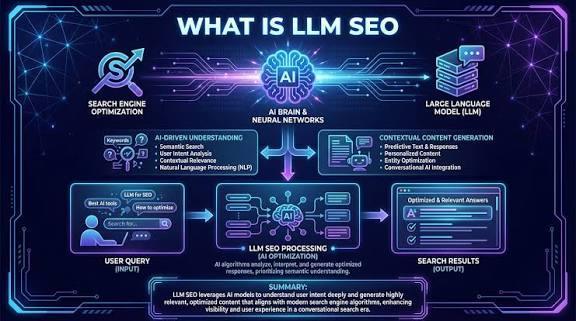
LLMs vs Search Engines: Key Differences
Search engines find and rank existing information, while LLMs generate a synthesized response. The table below compares them across the factors that matter most to users and businesses.
| Factor | Search Engines | LLMs |
| Primary function | Find and rank information | Generate a synthesized response |
| User input | Keywords and queries | Natural-language prompts |
| Output | Links and search features | Conversational answers |
| Main interaction | Search, click, read | Ask, receive, follow up |
| Information discovery | Multiple sources | Synthesized information |
| Context | Primarily query-based | Can maintain conversational context |
| Commercial discovery | Rankings, ads, local results | Recommendations and generated responses |
| Measurement | Rankings, clicks, impressions | Mentions, citations, visibility and referrals |
The most important row for businesses is the last one. Search success has long been measured through rankings, impressions and clicks, all of which are reported in familiar tools. AI-driven discovery is harder to measure, because a brand may be mentioned in an answer without any click occurring. That is why visibility, citations and brand mentions are becoming part of the conversation alongside traditional SEO metrics.
How Google Results Differ From AI Answers
Google traditionally hands users a set of sources to evaluate, while an AI system hands them a conclusion. Both are useful, but they ask the user to do different work.
With a classic Google results page, the user sees multiple sources side by side. Each result links directly to an original webpage, so the user can read the full context, check who published it and compare competing views. The engine organizes the choices, but the judgment about which source to trust remains with the user.
An AI system can summarize information into a single response. That response may combine information from several sources, resolve differences between them and present the result in clear language. This saves time, especially for complex or multi-part questions, and it can explain technical subjects in simpler terms. The tradeoff is that the underlying sources are less visible, and the synthesis may smooth over nuance, disagreement or uncertainty.
Neither format is automatically better. Search results give direct access to original webpages and make source comparison easy. AI answers give speed, structure and conversation. Many people now use both, starting with an AI summary and then turning to search results to confirm details.
That last step matters. AI-generated answers can contain mistakes, outdated information or confident-sounding claims that are not well supported. For anything important, such as health, legal, financial or major purchasing decisions, users should verify key points against authoritative sources, such as official websites, regulators, peer-reviewed research or established publications.
How LLMs Generate Answers
An LLM answer is the product of several steps, and understanding them explains why answers can vary so much. The exact pipeline differs between systems, but most follow a similar pattern.
- Prompt interpretation. The model reads the user’s message, along with any earlier conversation and system instructions, and works out what is being asked.
- Context and intent understanding. It identifies the goal behind the words: whether the user wants a definition, a comparison, a recommendation, a plan or a piece of writing, and what constraints, such as location or budget, apply.
- Retrieval or access to external information, where applicable. Some systems answer only from their training. Others search the web, query a knowledge base or read uploaded files before responding, which helps with recent or specialized topics.
- Information synthesis. The model combines what it knows and what it retrieved, weighing relevance and organizing the points into a coherent structure.
- Natural-language generation. It writes the response in fluent prose, adapting tone, length and format to the request.
- Citations and source references, where provided. Some systems attach links or footnotes showing where information came from. Others do not, and even when sources are shown, users should check that the cited page actually supports the claim.
Why Answers Vary
Two users asking what looks like the same question can receive different answers. The wording of the prompt matters, because small changes can shift emphasis. The model matters, because different systems are trained and tuned differently. The underlying data matters, because a model without web access cannot know recent events, while one with live search depends on what it finds. And the available sources matter, because the pages a system can reach, and chooses to trust, shape the result.
For businesses, this variability is the key lesson. There is no single fixed ranking to climb, as there is on a results page. Visibility in AI answers depends on being a clear, credible and relevant source across many possible prompts and systems.
Search Intent in Traditional Search vs AI Search
Intent is the reason behind a query, and both search engines and AI assistants try to serve it. What changes is how that intent is expressed and what comes back.
Informational Intent
Example: “What is Generative Engine Optimization?” In Google, this query typically returns definitions, guides and articles, sometimes with a Featured Snippet at the top. In an AI assistant, the user usually receives a short explanation in a few paragraphs, possibly with sources, and can immediately ask for examples or a comparison with SEO.
Commercial Investigation
Example: “Best digital marketing agencies in Dubai.” Google shows ranked listings, local business results, review sites and ads, and the user opens several to compare. An AI assistant may name a handful of agencies, explain what each is known for and describe how to choose, though the names it surfaces depend on the model, the sources it can reach and how well each agency is represented online.
Transactional Intent
Example: “SEO services Dubai pricing.” This searcher is close to a decision. Google is strong here, with paid ads, service pages and local listings that lead straight to a quote request or purchase. AI assistants may offer typical price ranges and factors that affect cost, but the actual transaction usually still happens on a business’s own website.
Conversational Intent
Example: “Which SEO strategy should a Dubai e-commerce business use?” This kind of question is awkward for a keyword search, because it contains a business type, a location and a decision to be made. An LLM can take the question as written, ask clarifying questions and build a tailored recommendation.
This shows why conversational queries matter. A short keyword search gives an engine very little context, so it must guess. A conversational prompt supplies the context directly, such as the industry, the market, the goal and the constraints, which allows a more specific answer. As more users get used to asking full questions, businesses will need content that answers detailed, situation-specific questions rather than only broad keywords.
Why AI Answers Can Look Different From Google Results
AI answers and Google results can differ even for the same question, because the two systems are built to do different jobs. Understanding the reasons helps avoid wrong conclusions about visibility.
First, they use different ranking and response-generation mechanisms. Google ranks pages using signals refined over decades, from links to content quality to page experience. An LLM does not rank pages in that way. It builds a response from learned patterns and, where available, from retrieved sources, and the factors that decide which brands or pages appear are less transparent.
Second, AI can synthesize multiple pieces of information. A single paragraph may draw on several pages, and the brand or page that contributed the most valuable fact may not be the one that tops a results page.
Third, search engines may return several competing sources. A results page can show ten organic listings plus ads, local results and other features, giving many brands a chance to appear. An AI answer is shorter and may mention only a few names or sources, so competition for each slot is tighter.
Fourth, AI responses can prioritize context and relevance to the specific question. A page that ranks well for a broad keyword might not be the best fit for a detailed, situational question, while a smaller site with a precise, well-explained answer might be used.
For these reasons, an AI answer should not automatically be treated as equivalent to a search ranking. Appearing first on Google does not guarantee a mention in an AI response, and being cited by an AI system does not mean a page ranks highly in classic search. The two are related, since both reward strong, credible content, but they are separate measures of visibility and should be tracked separately.
SEO vs LLM Optimization: What Changes for Businesses?
Traditional SEO remains important, and AI discovery adds new considerations on top of it. Businesses do not need to abandon what works, but they do need to widen their view of visibility.
Search engines are still a primary route to websites, and many AI experiences rely on web content that search systems have already crawled and indexed. Strong technical foundations, relevant content and good user experience continue to support visibility in both worlds.
What AI discovery adds is a stronger emphasis on whether content can be understood, trusted and reused in an answer. Several qualities help:
- Clear and authoritative content. Pages that state facts plainly and back them up are easier for both people and AI systems to rely on.
- Strong topical coverage. Covering a subject in depth, including related questions and subtopics, signals real expertise rather than a thin one-off page.
- Structured information. Clear headings, summaries, lists, tables and appropriate schema markup help systems identify what a page is about and extract the right details.
- Consistent brand and entity information. The same business name, services, location and descriptions across the website, profiles and directories help systems recognize a brand as a distinct entity.
- First-hand expertise and trustworthy sources. Original insight, real experience, named authors, data and references show why a page deserves trust.
- Content that directly answers user questions. Pages that address the specific questions customers ask, in plain language, are more likely to be useful as the basis of an answer.
None of these ideas is new to good SEO. The difference is the weight placed on clarity, credibility and consistency across the whole web, not only on a single page.
Where GEO Fits Into the LLM vs Search Engine Landscape
Generative Engine Optimization (GEO) is the practice of making content and brand information easier for AI systems to find, understand, trust and use when they generate answers. Where SEO focuses on earning a place in search results, GEO focuses on earning a place inside the response itself, as a cited source, a recommended option or a named brand.
How GEO Differs From Traditional SEO
The goals overlap, but the targets differ. SEO aims at rankings, organic traffic and clicks from results pages. GEO aims at mentions, citations and accurate representation in AI-generated answers, where users may never visit a website at all. SEO is judged largely by position and click-through. GEO is judged by whether, how often and in what context a brand appears across relevant prompts.
GEO also leans more heavily on signals that help an AI system be confident about a source: clear explanations, original information, consistent facts, credible mentions elsewhere and content structured so key points are easy to extract.
How SEO and GEO Work Together
They are best seen as complementary. Many AI experiences draw on content that search engines already index, so strong SEO foundations, including crawlability, helpful content and authority, feed AI visibility. In turn, the discipline GEO encourages, such as direct answers, clear structure and consistent entity information, tends to improve the experience for human readers and for search engines as well.
Citations, Mentions and Entity Recognition
Three ideas sit at the center of GEO. Citations are the links or references an AI system shows when it uses a source. Mentions are the times a brand is named in an answer, with or without a link. Entity recognition is the system’s understanding of a brand as a distinct, well-defined organization with specific services, locations and credentials. A brand that is described consistently and credibly across the web is easier to recognize and more likely to be represented accurately.
Why Consider Both
Customers move between traditional and AI-powered discovery, sometimes within the same research session. A business that invests only in rankings may be invisible in AI answers, while one that chases AI mentions without a sound website and search presence may lack the foundation those answers depend on. Considering both gives the most complete coverage.
Example: One Query, Two Different Experiences
The same question can lead to two very different discovery journeys. Consider this query: “Best digital marketing agency in Dubai for an e-commerce brand.”
The Traditional Google Experience
The user sees a results page with several layers. Paid advertisements from agencies appear first. Below them may be a local pack with map listings and ratings, followed by organic results, which are often agency websites, “best of” roundups and directories. Reviews, People Also Ask boxes and related searches add further paths.
To decide, the user opens several websites, compares services, reads case studies, checks reviews and builds a shortlist. The process is thorough and transparent, and the user sees many competing brands. It is also time-consuming, and the user does the synthesis alone.
The AI-Powered Experience
The user asks the question conversationally, perhaps adding details such as budget, platform or goals. The AI may summarize what matters when choosing an e-commerce agency, such as experience with online stores, platform expertise, regional market knowledge, reporting transparency and proven results. It may mention several agencies by name or explain how to evaluate candidates, and, depending on the system, it may show sources or citations.
The user can then ask follow-ups, such as “Which of these suits a small skincare brand?” or “What questions should I ask in a first call?” The research happens inside the conversation, and fewer websites may be opened along the way.
What This Means
The discovery journey can differ even when the underlying search intent is similar. In the first, an agency wins by ranking, advertising and presenting a compelling page. In the second, an agency wins by being a clear, credible and well-documented option that the AI system can recognize and describe accurately. Agencies that want to be found need to prepare for both.
Advantages and Limitations of Search Engines
Search engines remain the most reliable way to reach original sources, but they ask more effort from the user. Their strengths and weaknesses follow directly from the way they work.
Advantages
- Direct access to original sources. Users go straight to the publisher and see the full context, not a summary of it.
- Broad web coverage. Search indexes an enormous range of sites, from major publishers to small local businesses.
- Multiple perspectives. A results page shows different viewpoints, so users can compare rather than rely on one voice.
- Strong local and transactional capabilities. Maps, business profiles, opening hours, shopping listings and ads make search very effective for finding nearby services and making purchases.
- Easy source comparison. Placing results side by side helps users judge credibility and consistency.
Limitations
- Users may need to open several pages. Pulling together a complete answer can mean visiting and reading multiple sites.
- Results can require additional research. Users often have to refine queries, filter out low-quality pages and connect the dots themselves.
- Ranking is not the same as completeness. A top-ranking page is the best match for the query as a whole, but it does not necessarily address every part of a complex, multi-layered question.
These limitations explain why search engines have been adding summaries and direct answers: they are trying to reduce the effort between question and answer without losing the benefits of open access to the web.
Advantages and Limitations of LLMs
LLMs offer speed, convenience and conversation, but their answers need careful handling. Knowing both sides helps people use them well.
Advantages
- Conversational interaction. Users can ask in their own words, without learning how to phrase keywords.
- Fast synthesis of information. An LLM can condense several ideas into one organized answer in seconds.
- Ability to handle complex questions. Multi-part, situational or comparative questions that would take several searches can often be addressed in one response.
- Follow-up questions and contextual conversations. The assistant remembers what has been discussed, so users can refine, challenge or extend an answer.
- Can simplify technical subjects. LLMs can explain a difficult topic at the level the user asks for, from beginner to expert.
Limitations
- AI-generated answers can contain errors. Models sometimes produce statements that sound confident but are inaccurate, outdated or unsupported.
- Information can depend on the model and available sources. A system with no live web access may miss recent developments, and one with web access is limited by what it finds and trusts.
- Responses may omit relevant perspectives. A summary is shorter than the original material, so some viewpoints, caveats or details can be left out.
- Verification is still the user’s job. For important decisions, claims should be checked against authoritative sources.
LLMs are therefore best treated as a fast, capable starting point for understanding a topic, not as a final authority on matters where accuracy carries real consequences.
How Search and LLMs Are Converging
The line between search and AI assistants is getting thinner, because each is adopting the other’s strengths. The question is no longer “search or AI?” but “which blend of both is the user experiencing right now?”
Search engines are moving toward generated answers. Google’s AI Overviews place a synthesized summary at the top of some results pages, and AI Mode offers a more conversational, multi-step search experience. Other search platforms are introducing similar AI-powered features. The common pattern is that the engine now answers directly in many cases, with links to sources alongside.
At the same time, LLMs are moving toward search. Assistants such as ChatGPT and Gemini can search the web for current information and show citations, which narrows the freshness gap that once separated them from search engines. Their answers are increasingly grounded in live sources instead of training data alone.
The result is a hybrid landscape. Search results contain generated summaries, and AI answers contain links. The distinction between “search” and “answer” is becoming less rigid, and users move fluidly between typing a query, asking a question and following up in conversation.
For businesses, convergence has a practical meaning. The same content may be crawled by a search engine, ranked on a results page, quoted in a Featured Snippet, summarized in an AI Overview and cited in an assistant’s reply. That makes it more valuable to produce content that works at every layer: easy for a person to read, easy for a search engine to index and easy for an AI system to extract and attribute.
What This Means for SEO in 2026
In 2026, SEO is expanding beyond rankings into a wider practice of earning visibility wherever people look for answers. It is not being replaced, but its scope is growing.
Brands now need visibility across multiple discovery environments: traditional results, AI summaries in search, conversational assistants, maps and local listings, video platforms and social search. A strategy built around a single ranking position on a single engine leaves gaps.
Several principles help teams adapt.
- Optimize for humans first. Content that genuinely helps readers is the most durable foundation for both search engines and AI systems. Writing for algorithms alone is a short-term bet.
- Build topical authority and trustworthy sources. Deep, accurate coverage of a subject, supported by credible references and respected mentions, makes a site a safer source to rank and to cite.
- Make important information easy to understand. Clear structure, descriptive headings, concise definitions, helpful summaries and appropriate structured data make it simpler for search engines and AI systems to interpret and reuse a page.
- Combine SEO, AEO and GEO where appropriate. SEO builds search visibility. Answer Engine Optimization (AEO) focuses on being the direct answer to a question, as in snippets, voice results and AI summaries. GEO focuses on being cited and mentioned in generative responses. In practice, the three overlap heavily, and one well-made piece of content can serve all of them.
Measurement also needs to evolve. Rankings and traffic still matter, but teams will increasingly want to understand how and where their brand appears in AI answers, and how that connects to enquiries, leads and sales.
How Businesses Can Prepare for AI-Powered Search
Preparing for AI-powered search means strengthening the fundamentals and adding a few new habits. The steps below apply to most businesses, from a local service provider to an international e-commerce brand.
- Build authoritative, original content. Publish material that reflects real experience, such as case studies, original data, expert commentary and practical guidance, instead of rewording what already exists.
- Answer specific customer questions. List the questions customers ask during sales calls, in reviews and in support requests, then answer each one clearly on your site, ideally near the top of the relevant page.
- Strengthen brand and entity signals. Use the same business name, descriptions, services and key facts across your website, social profiles, directories and press. Consistency helps systems recognize who you are and what you do.
- Use appropriate structured data. Schema markup for organizations, products, articles, FAQs, reviews and local businesses gives machines a clearer map of your content. Only mark up what is actually on the page.
- Maintain accurate business information. Keep addresses, opening hours, contact details, pricing and product data current everywhere they appear, because outdated details can be repeated in generated answers.
- Earn credible mentions and links. Coverage from reputable publications, industry bodies, partners and satisfied customers helps establish authority and gives AI systems more places to find you.
- Monitor AI visibility and traditional search performance. Track rankings, impressions and clicks, and also test relevant prompts in major AI assistants to see whether, and how, your brand is mentioned or cited.
- Keep measuring business outcomes. Organic traffic, leads, conversions and revenue remain the real test. Visibility only matters if it supports growth.
A useful starting exercise is to take ten questions your ideal customers might ask, search them in Google and ask them in two or three AI assistants, then note which brands appear and why. The gaps this reveals usually point directly to what needs improving.
LLMs vs Search Engines: Which Should Businesses Optimize For?
Businesses should not treat this as an either/or decision. Traditional search and AI-powered discovery serve overlapping but different experiences, and customers use both.
Search engines remain essential for navigational, local and transactional behavior: finding a specific company, locating a nearby service or comparing prices before buying. AI assistants are growing in research-heavy and advisory moments, where a person wants help understanding options, narrowing a shortlist or planning a decision. A single customer journey can include both, starting with an AI conversation to understand the market and finishing with a Google search to find the brand’s website and read reviews.
The good news is that the work is largely shared. SEO supports visibility in conventional search. At the same time, strong content, genuine expertise, clear structure and a recognized brand contribute to visibility in AI answers. Investing in these qualities pays off in both environments, so businesses are not forced to split their efforts in half.
The better question is not “which platform should we optimize for?” but “how do our customers discover and evaluate us, and are we present and credible at each step?” Mapping the customer’s discovery journey, from first question to final purchase, shows where search matters most, where AI matters most and where both do. Optimizing around that journey, instead of around one platform, is the more resilient strategy.
Conclusion
The fundamental difference is that search engines retrieve information, while LLMs generate and synthesize an answer. A search engine points users to sources and lets them decide. An LLM gives users a composed response and lets them dig deeper through conversation. Each approach has real strengths and real limits, and neither is a perfect substitute for the other.
In practice, the two are converging. Google now presents AI-generated summaries and conversational modes, and AI assistants now search the web and cite sources. Users will keep moving between the two, and the line between searching and asking will keep fading.
What does not change is the value of authoritative, useful content. Pages that are accurate, clear, original and trusted are more likely to rank, to be cited and to be recommended, whichever system the customer happens to use.
For businesses, the sensible path is a combined one: SEO to earn visibility in search, AEO to provide clear answers to real questions, and GEO to be recognized and represented well in generative responses. Build for people first, make your information easy for machines to understand, keep measuring what matters, and your brand will be ready wherever the next question is asked.
Frequently Asked Questions
1. What is the difference between an LLM and a search engine?
A search engine finds and ranks existing web pages so users can choose what to read. An LLM generates a new, synthesized response in natural language. Search gives you sources to evaluate, while an LLM gives you an answer and lets you refine it through conversation.
2. Does Google use LLMs?
Yes. Google uses language models in several parts of its products, including AI Overviews, AI Mode and its Gemini assistant, and in systems that help interpret queries and content. Classic ranking and the web index remain central to Google Search, and AI features sit alongside them.
3. Are AI answers better than Google search results?
Neither is better in every case. AI answers are faster and easier to digest for complex or exploratory questions. Google results are stronger for direct access to original sources, local searches, shopping and comparing perspectives. For important decisions, using both and verifying key facts is the safest approach.
4. How does Google Search generate results?
Google crawls the web to discover pages, indexes their content and, when a user searches, ranks relevant pages using many signals, such as relevance, quality, authority, page experience and context like location. It then assembles a results page that can include organic listings, ads, snippets, local results and other features.
5. How do LLMs generate answers?
An LLM interprets the prompt and its context, may retrieve external information such as web results, synthesizes what it knows with what it found, and writes a response in natural language one token at a time. Some systems add citations. Answers can vary based on the prompt, the model, its data and the sources available.
6. Can AI replace search engines?
Not entirely, at least not soon. AI assistants are taking over many research and advisory tasks, but people still rely on search to find specific websites, local businesses, products and original sources. The more likely outcome is continued convergence, with search engines becoming more AI-driven and AI assistants becoming more search-driven.
7. What is the difference between SEO and GEO?
SEO aims to improve a website’s visibility and rankings in search results, driving organic traffic. GEO aims to improve how a brand and its content are found, cited and described in AI-generated answers. They share many foundations, such as quality content and authority, and work best together.
8. How does AI search affect SEO?
AI search widens what SEO has to cover. Some answers are given directly, which can reduce clicks on certain queries, and visibility now includes being mentioned or cited in AI summaries. Fundamentals still matter, but brands should also pay attention to clarity, structure, entity consistency and credible mentions.
9. How can businesses optimize for LLMs?
Publish original, authoritative content that directly answers customer questions. Cover topics in depth, use clear structure and structured data, keep brand and business information consistent and accurate, earn credible mentions, and monitor how your brand appears in AI assistants. No tactic guarantees inclusion, so focus on being genuinely useful and trustworthy.
10. Will SEO still matter as AI search grows?
Yes. Search engines remain a major route to websites, and many AI experiences rely on content that search systems have crawled and indexed. SEO is evolving rather than disappearing, and the foundations of helpful content, technical quality and authority support both search rankings and AI visibility.