Brand vs Non-Brand Keywords: Why You Should Report Them Separately
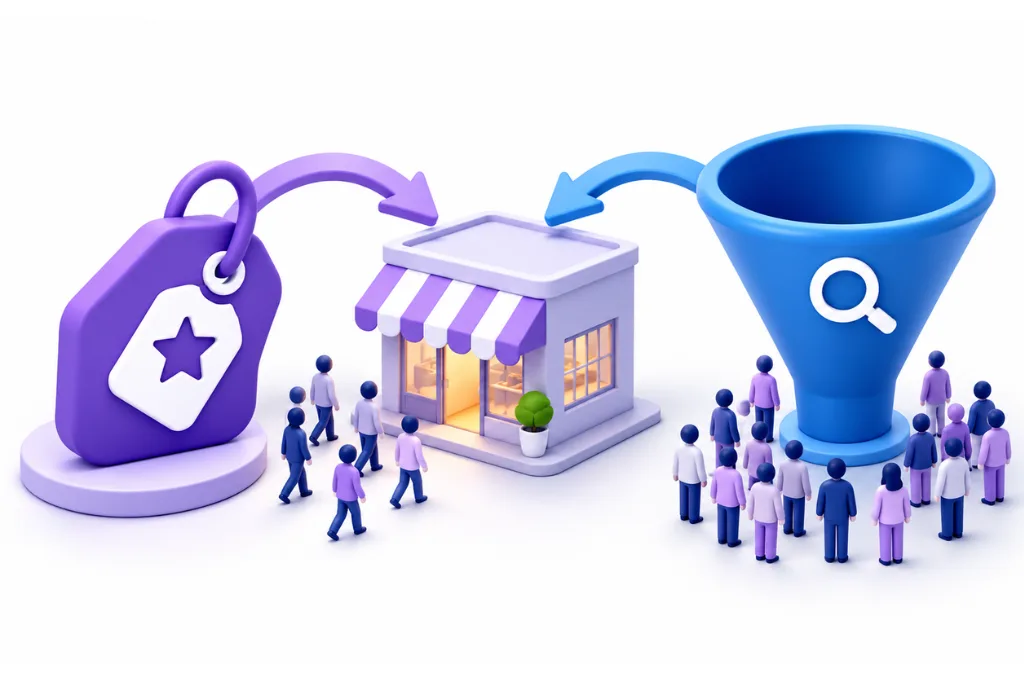
Branded keywords are searches that include your business name, its spelling variants or your unique products, such as “Octopus Marketing Dubai”. Non-branded keywords describe a need without naming you, such as “seo agency dubai”. Report them separately: branded clicks show existing demand, while non-branded growth shows whether SEO is bringing new customers.
Branded vs non-branded keywords: the short answer
A branded keyword names you. A non-branded keyword names a problem, a product type or a service. The first group comes from people who already know you, and the second from people who are still choosing.
That difference matters most in reporting. If you add both groups into one “organic traffic” number, you cannot tell whether SEO found new customers or whether old ones simply searched for you again.
|
Branded keywords |
Non-branded keywords | |
|
Example |
octopus marketing dubai |
seo agency dubai |
|
Who searches |
People who already know you |
People who are still looking |
|
Typical intent |
Navigational |
Informational, commercial or transactional |
|
Funnel stage |
Bottom, or returning customers |
Top and middle |
|
What growth proves |
Brand demand is rising |
SEO is finding new customers |
Most branded searches are navigational: the person wants to reach your site. Our guide to informational, navigational and transactional queries explains how Google reads each type. The wider picture of how Google interprets any query sits in our pillar on how search engines understand search queries.
What counts as a branded query for a UAE business
A branded query is any search that only makes sense because of your business. That includes your name, but also typos, Arabic spellings, product names and your name next to a place.
UAE brands need a wider net. Customers search in English, in Arabic script and in Arabizi, which is Arabic written with Latin letters. One family name can appear in three spellings. If your list only holds the English name, part of your brand demand will look like SEO growth.
Here is how to classify common query types. The brand “Saqr Optics” is a made-up example.
|
Query |
Branded? |
Why |
|
saqr optics |
Yes |
The brand name |
|
saqer optics |
Yes |
Transliteration variant |
|
sakr optic dubai |
Yes |
Spelling variant plus location |
|
صقر للبصريات |
Yes |
Brand name in Arabic script |
|
saqr optics dubai mall |
Yes |
Brand plus branch location |
|
saqr optcs |
Yes |
Typo of the brand |
|
saqr blue light lenses |
Yes |
Brand plus product |
|
ahmed saqr optician |
Yes |
The founder name is part of the brand |
|
optician dubai mall |
No |
Need plus location, no brand |
|
best sunglasses dubai |
No |
Product category |
|
eye test near me |
No |
Service need |
|
saqr |
Borderline |
Also a common word and name |
The last row is the hard one. If your brand is also a common word, a single-word match will catch unrelated searches. Pair the word with your category or product names instead.
Why one blended “organic traffic” number misleads
A blended number mixes two things that move for different reasons: branded demand rises when people hear about you, and non-branded traffic rises when your pages win new rankings. Only the second one is a direct result of SEO work.
So when the total goes up, you need to know which part moved. Otherwise a good month for your brand can hide a weak month for your SEO.
Seasons and campaigns lift branded demand
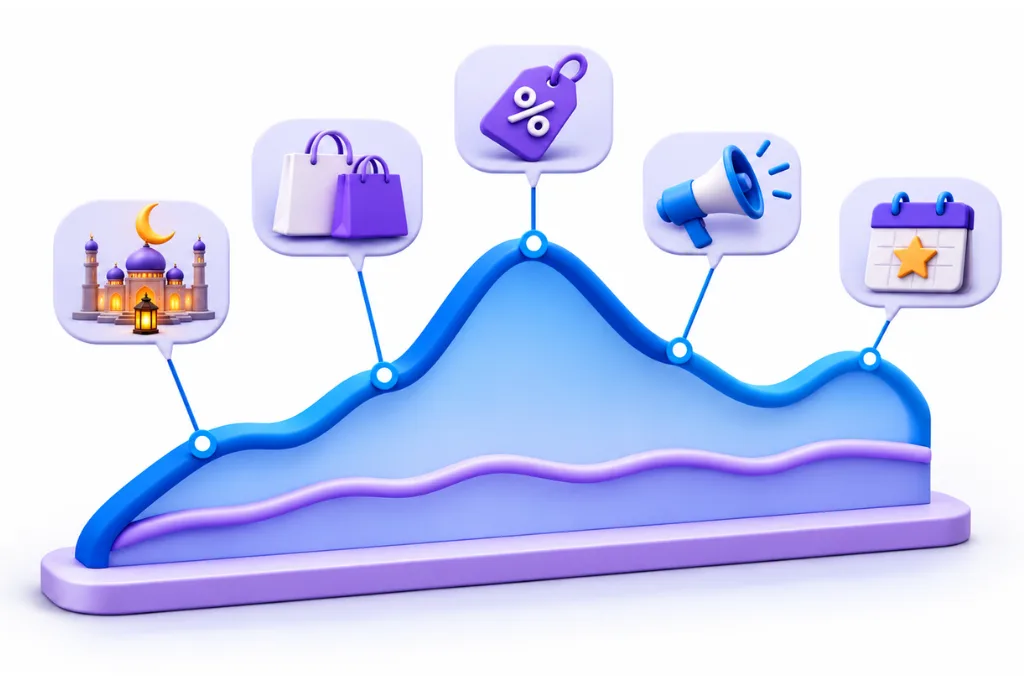
In the UAE, branded searches often jump around Ramadan, Dubai Shopping Festival (DSF) and White Friday. They also jump after PR, radio, outdoor ads or a busy event. None of that comes from SEO.
Say your total organic clicks rise 30% in December. If almost all of that rise came from branded searches during DSF, your SEO did not grow. The brand spike simply hid a flat line underneath.
What our own split looks like
Our own Search Console Insights showed 3% branded clicks and 97% non-branded (default period, viewed 14 Nov 2026). Most of our clicks come from guides, not from people typing our name. A local shop with a strong name might see the reverse. Neither number is good or bad on its own.
You only learn what SEO is doing once you look at the two groups apart. Our guide on how to measure SEO performance shows where this split fits among your other SEO numbers.
How branded and non-branded queries behave differently
Branded queries usually rank higher and earn a higher click-through rate. Non-branded queries spread across many positions but have far more room to grow. Mixing them blends very different averages into one misleading figure.
Google says branded queries typically lead to higher-ranking pages and a higher click-through rate. When someone types your name, your site is usually the first result, and they click it.
|
Metric |
Branded |
Non-branded |
|
Average position |
Usually near the top |
Spread across many positions |
|
Click-through rate |
Usually higher |
Usually lower |
|
Conversion rate |
Often higher, but check your own leads |
Often lower, as people are still comparing |
|
Volume you can win |
Capped by how many people know you |
Grows as you cover more topics |
|
Best pages |
Homepage, contact, branch pages |
Service pages, guides, comparisons |
So a rising average CTR can simply mean a larger share of branded searches. And a falling average position can mean you started ranking for many new non-branded terms. Split the data first, then judge the trend.
How to split them in Search Console with the branded queries filter
Google added a branded queries filter to Search Console on 20 Nov 2025 and made it available to all eligible sites from 11 Mar 2026. It sorts your queries into branded and non-branded for you, with no setup.
Step by step
- Open the Performance report for your property in Search Console.
- Add a filter and choose the branded queries option.
- Pick Branded or Non-branded, and compare the same date range year on year.
- Check the Insights report, which now shows a branded vs non-branded clicks card.
How Google classifies queries
Google says the classification is AI-assisted, not regex based. It covers your brand name in all languages, common typos and your unique products. That helps UAE brands with Arabic and English names.
The limits
The filter only works for top-level properties with enough query volume. Smaller sites may not see it yet. Google also says it may misclassify some queries, so check the borderline ones by hand. Using the filter has no effect on your rankings. Branded views and searches on your Google Business Profile also sit outside Search Console, so the branded trend there is only part of the picture.
No filter yet? The regex method for smaller and bilingual sites
If the filter is missing, you can split queries yourself with a regular expression (regex). Search Console has supported regex filters in the Performance report since April 2021. Google added a “doesn’t match regex” option in June 2021.
Build your brand pattern
A regex here is just a list of spellings separated by a vertical bar, which means “or”. Search Console regex uses RE2 syntax. For the made-up Saqr Optics example, the pattern would be:
(?i)saqr|saqer|sakr|9aqr|صقر
The (?i) at the start makes the match ignore capital letters. Each word after it is one spelling. The 9aqr variant is Arabizi, where the digit 9 stands for the Arabic letter ص. Also add Arabic spelling variants, such as names written with ا or أ and with ة or ه, plus common typos, product names and the founder name.
Apply it in two passes
- Add a Query filter, choose “Custom (regex)”, select “Matches regex” and paste your pattern. This shows branded queries.
- Change the setting to “Doesn’t match regex” with the same pattern. This shows non-branded queries.
Note the clicks, impressions, CTR and position for each pass. Then scan the non-branded list for any brand spellings you missed, and add them to the pattern.
Two cautions
Search Console hides some rare queries to protect privacy, so your two passes may not add up to the total. Also, a short pattern can catch unrelated words. In our example, صقر also means falcon, so you may need to pair it with your category words.
Getting the split into GA4 and Looker Studio
Search Console is where the query data lives. GA4 can show some of it, but not all.
What GA4 can and cannot do
GA4 does not report the search query for organic visits. If you link Search Console to GA4, you can see Search Console query reports inside GA4, but they are still Search Console data. They do not join each query to a GA4 conversion.
Use landing pages as a proxy
A practical workaround is to group landing pages. Visits to your homepage and contact pages lean branded. Visits to guides and service pages lean non-branded. Compare leads from each group in GA4 as a rough guide.
Build one view in Looker Studio
Looker Studio can connect to Search Console and GA4. You can add your brand regex as a filter on the Search Console data and show branded and non-branded clicks side by side. Add your landing page groups from GA4 next to them. For dashboards of this kind, see our performance reports service.
Branded vs non-branded in Google Ads
The same split matters in paid search. Run brand terms and non-brand terms in separate campaigns, so their cost and conversion data never mix.
Brand exclusions and brand lists
Performance Max can serve ads on brand searches unless you tell it not to. A brand list is the set of brand names you save in Google Ads, and you apply it to a campaign as an exclusion. Google Ads lets you apply brand exclusions to Performance Max and Search campaigns. For Performance Max, the exclusions cover Search, Shopping and YouTube search. Since 27 May 2025, Search campaign brand settings sit inside the AI Max panel. Without these settings, a non-brand campaign can quietly spend on your name and look better than it is.
Should you bid on your own brand?
The published evidence points both ways. In 2011, Google reported that across more than 400 Search Ads Pause Studies, 89% of paid clicks were incremental. Those studies covered search ads in general, not brand ads only. Those clicks did not come back as organic clicks when ads were paused.
A 2014 NBER working paper by Blake, Nosko and Tadelis found no measurable short-term value in eBay’s brand ads. When eBay stopped them, organic search recaptured about 99.5% of the lost clicks.
So test it for your own brand. eBay is a very well-known brand, and Google sells the ads. Competitors bidding on your name, a weak organic listing or a crowded results page can also change the result.
Run a simple holdout test
- Pick a period of 2 to 4 weeks with no major season or campaign.
- Pause brand ads in one region, such as Abu Dhabi, and keep them running in a similar region, such as Dubai.
- Compare total brand clicks, paid plus organic, and leads in both regions against the weeks before the test.
- Weigh the ad cost you saved against any leads you lost. If leads barely drop, brand ads add little. If they drop, keep them.
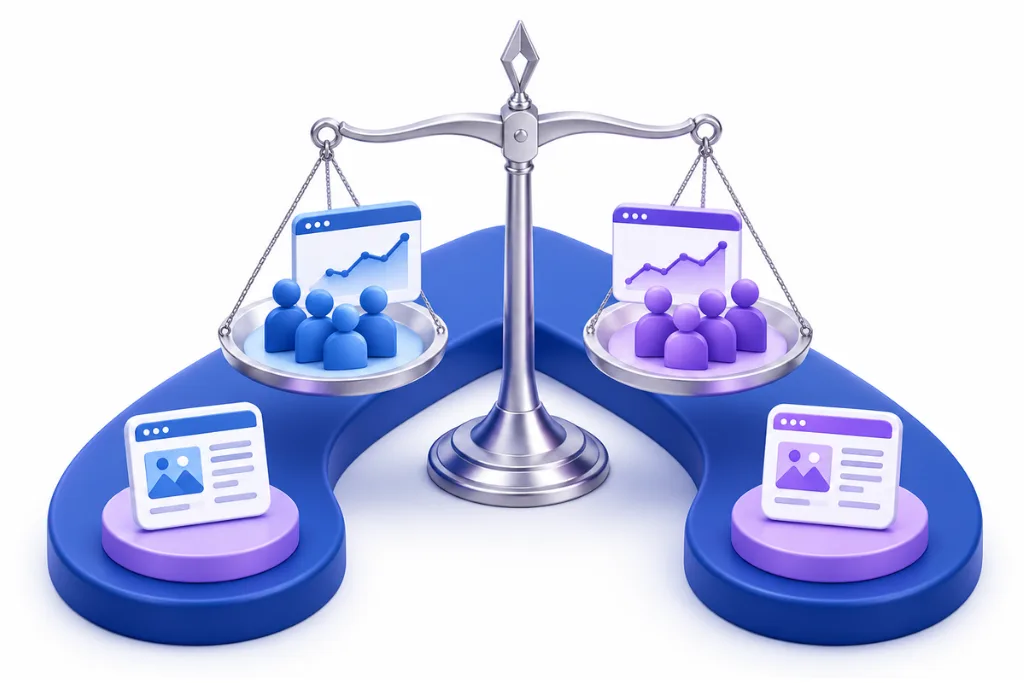
For help with campaign setup, see our Google Ads services.
What a healthy split looks like
There is no universal ratio. A new site may get most clicks from its name, while an established brand with a large blog may get most from guides. What matters is the direction of non-branded growth over time.
New site vs established brand
A new business often has few rankings, so branded clicks dominate at first. As content and authority grow, the non-branded share should rise. Our guide on how websites earn authority and trust in Google covers why brand and links help each other.
Watch the trend, not the percentage
A falling branded share can be good news, if non-branded clicks are rising. It can also be bad news, if branded clicks are falling. So track both counts, not only the share. Compare year on year to remove seasonal swings.
To grow the non-branded side, start with keyword research tied to revenue. Then balance reach and effort with head and long-tail keywords, a realistic view of keyword difficulty and a clear method for keyword prioritization.
The monthly report: six numbers leadership should see
A good SEO report puts non-branded growth first and keeps branded demand in its own line. These six numbers cover both.
|
Number |
Where it comes from |
What it tells leadership |
|
Non-branded clicks |
Search Console, filtered |
Whether SEO brings new visitors |
|
Non-branded impressions |
Search Console, filtered |
Whether visibility is growing |
|
Top non-branded queries and pages |
Search Console, filtered |
Which topics and pages drive growth |
|
Branded impressions trend |
Search Console, filtered |
Whether brand demand is rising |
|
Branded CTR |
Search Console, filtered |
Whether people who search your name find you |
|
Leads by segment |
GA4, landing page groups |
Which group turns into business |
Compare each number with the same month last year. Add a short note when a season, campaign or PR moment lifted branded demand. This stops leadership from reading a brand spike as SEO success. Our guide on how to measure SEO performance shows the wider set of numbers around this split.
For reporting support, see our SEO services.
Branded demand and AI search
AI answers can create brand demand that shows up later in Search Console. When ChatGPT, Gemini or a Google AI Overview mentions your business, a reader may not click. They may search your name later instead.
So AI visibility can appear in your reports as branded demand, not as referral traffic. Treat this as a pattern to watch, not a measured effect. If branded impressions rise with no campaign, season or PR moment behind them, AI mentions are one possible cause.
Non-branded growth shows how well you rank. Branded growth shows how often people meet your name, in search or in AI answers.
The verdict: report them separately
Branded and non-branded keywords answer different questions, so they belong in different lines of your report. Branded clicks measure demand for your name. Non-branded clicks measure whether SEO is bringing in people who did not know you yet.
Judge SEO mainly on non-branded growth, compared year on year. Keep branded demand in view, and note the seasons and campaigns that move it. For the full set of numbers around this split, start with our guide on how to measure SEO performance.
FAQ
Branded keywords include your business name, its spelling variants or your unique products. Non-branded keywords describe a need, product or service without naming you. Branded searches come from people who already know you, while non-branded searches bring new prospects.
Both are correct and mean the same thing in SEO. Google Search Console labels the segment non-branded, which is why many reports use that term. Pick one and use it consistently in your reports.
Branded traffic is the visits that come from searches including your brand name or its variants. It shows existing demand for your business. It does not prove that SEO is reaching new customers.
Not on its own. A strong brand with few content pages will naturally get most clicks from its name. It becomes a concern when non-branded clicks stay flat for months while you invest in SEO.
It depends on your market. Google’s 2011 studies found 89% of paid clicks were incremental, while eBay’s experiment found organic results recaptured about 99.5% of lost clicks. Run a 2 to 4 week holdout test to find the answer for your own brand.
No. Google says the branded queries filter is a reporting feature only and has no effect on how your pages rank. It only changes how you view your own data.
Semrush flags a keyword as branded when its results page shows your sitelinks or a Knowledge Graph link to your site. It also counts a keyword holding your brand term when you rank first. The term must also be unique to your domain. These are estimates, so use Search Console for your real numbers.
Sources
- Google Search Central: Search Console branded queries filter
- Google Search Central: Performance report data filtering with regex
- Google Search Central: Regex negative match in Search Console
- Google Ads Help: Apply brand exclusions to Performance Max or Search campaigns
- Google Ads Help: About brand settings
- Google Research: Studies show search ads drive 89% incremental traffic
- Blake, Nosko and Tadelis: Consumer Heterogeneity and Paid Search Effectiveness, NBER Working Paper 20171
- Semrush Knowledge Base: Branded vs non-branded keywords