SEO vs SEM vs PPC in Dubai: What Each Does and Which Your Business Needs First
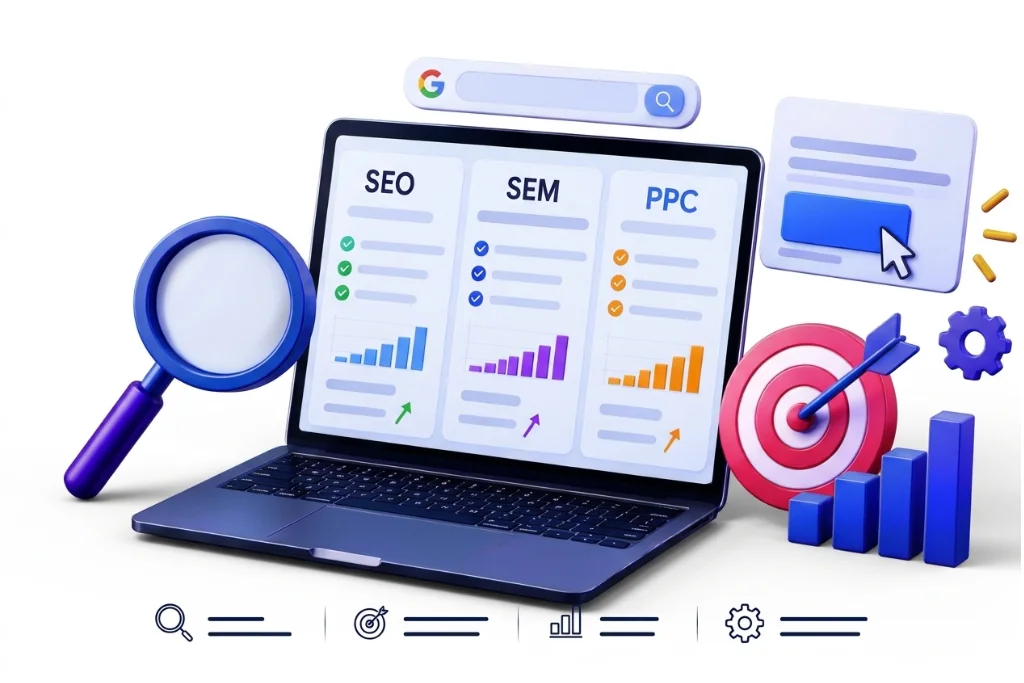
SEO earns your website a free place in Google’s organic results. PPC buys a place in the sponsored results, and you pay for each click, so leads start fast and stop when you stop paying. SEM is the umbrella term for search marketing. Many Dubai businesses need PPC for speed and SEO for lower costs over time.
If you run a business in the UAE, you have probably been pitched both. This guide clears up the terms, shows how each channel is ranked and charged using Google’s own documentation, and gives you a simple way to decide where your first dirham should go.
What SEO, SEM and PPC mean, and why people mix them up
SEO improves your pages so they rank in Google’s unpaid results. PPC is any advertising where you pay per click, and Google Ads is the biggest example. SEM means search engine marketing: some people use it for paid search only, others for paid and organic search together.
SEO (search engine optimisation) is the work that helps your pages rank in the organic results. That covers technical fixes, useful content, internal links, and signals from other sites such as links and reviews. You do not pay Google for the clicks. You pay in time, skills and content. If you want the full picture, start with our guide to what SEO is and how it works in Dubai and Abu Dhabi.
PPC (pay per click) is a payment model, not a platform. You pay when someone clicks your ad. Google Ads search campaigns use it, and so do Microsoft Advertising, Meta, LinkedIn and TikTok in many setups.
SEM (search engine marketing) is where most of the confusion starts. In much of the industry today, SEM means paid search: ads on Google or Bing. Older textbooks and some agencies still use SEM as an umbrella for everything you do to win search traffic, paid and organic. Neither use is wrong. Just ask which one the person in front of you means. Our complete guide to search engine marketing goes deeper on the paid side.
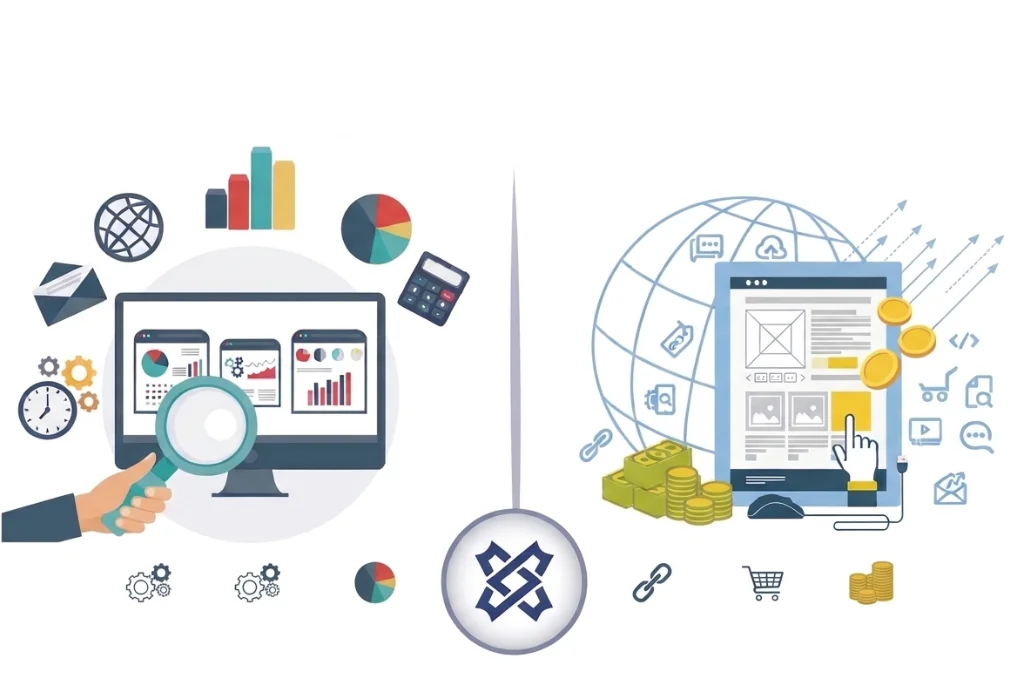
So where does Google Ads fit? A Google search ad is SEM because it appears on a search engine, and PPC because you pay per click. The same campaign can fairly be called SEM, PPC or paid search. A Meta or TikTok ad paid per click is PPC but not SEM.
SEO vs SEM vs PPC side by side
The real differences are cost model, speed and how long results last. Paid search buys fast, precise visibility that stops when the budget stops. SEO is slower to start but keeps working after the effort is done.
| SEO | SEM (paid search) | PPC (all platforms) | |
| Where you appear | Organic results, map pack, AI answers | Sponsored results on Google or Bing | Search, social, video and display placements |
| How you pay | Time, content and expertise | Per click, set by an auction | Per click (some platforms also charge per view or impression) |
| Speed to first results | Usually months | Often within days of launch | Often within days of launch |
| When you stop | Traffic usually fades slowly | Ads stop showing straight away | Ads stop showing straight away |
| Control | Low: Google decides rankings | High: keywords, locations, times, budget | High: audiences, placements, budget |
| Best for | Long-term, lower-cost demand | Urgent leads and high-intent searches | Social and display ads that reach people not yet searching |
| Choose it when | You can wait and want lower costs later | You need leads now | You want reach beyond search |
That is why “use both” is such a common answer. But order matters, and we cover it further down.
How each one wins a place on Google
Ads win their position through an auction called Ad Rank, where your bid and your ad quality both count. Organic results are ranked by Google’s search systems. Google says it does not take payment to rank pages higher, and ads have no effect on organic rankings.
Paid results: the Ad Rank auction
Every time someone searches, Google runs an auction for the ad slots. According to Google Ads Help, Ad Rank looks at six things:
- Your bid
- The quality of your ad and landing page
- Ad Rank thresholds, the minimum an ad must reach to show at all
- How competitive the auction is
- The context of the search, such as location, device and time
- The expected impact of your ad assets, such as call or sitelink assets
Google says Ad Rank is calculated each time someone searches. That means a higher bid alone does not guarantee the top spot. A clear ad that leads to a relevant page can beat a bigger budget. We explain the mechanics in detail in our post on how Google Ads determines Ad Rank.
Organic results: earned, not bought
Organic rankings depend on whether Google can crawl and index your pages, how well a page matches the intent behind a search, and how much your site is trusted on the topic. Google is clear on two points. Its How Search Works guide says: “Google doesn’t accept payment to crawl a site more frequently, or rank it higher.” And its guidance on hiring an SEO says advertising with Google won’t have any effect on your site’s presence in organic results.
So running ads will not lift your SEO. If rankings rise during a campaign, something else caused it.
What each one costs
With Google Ads you pay per click, and you often pay less than your maximum bid. Your daily spend can swing, but Google caps the month. SEO has no click cost. You pay for the work, so its cost per lead tends to fall as rankings grow.
How Google Ads charges you
Three rules from Google’s own help pages are worth knowing before you set a budget:
- You set a maximum, then usually pay less. Your maximum cost per click is the most you will typically be charged. Google says you are often charged less, sometimes much less. That final figure is your actual CPC.
- Daily spend can double. On a busy day, Google can spend up to two times your average daily budget for most campaigns.
- The month is capped. Over a month, you will not be charged more than 30.4 times your average daily budget for most campaigns. Google explains both limits in its page on average daily budgets.
A worked example
The numbers below are made up to show the method. They are not a Dubai benchmark. Prices change by sector, keyword and season, so pull your own figures from Keyword Planner, which forecasts clicks, cost and average CPC from one week of recent data.
- Monthly budget: AED 6,000
- Average daily budget: AED 6,000 divided by 30.4, which is about AED 197
- Forecast average CPC for your keywords: AED 10
- Expected clicks: 6,000 divided by 10, which is 600 a month
- Your own landing page conversion rate: 5%
- Expected leads: 600 times 5%, which is 30
- Cost per lead: AED 6,000 divided by 30, which is AED 200
Now do the same sum for a customer. If one new client is worth AED 5,000 in profit, a AED 200 lead can pay off quickly. If a sale is worth AED 300, it will not, and SEO or a cheaper channel should come first.
What SEO costs
SEO costs are mostly people and content: audits, technical fixes, writing, and local work such as your Google Business Profile. The cost does not rise with every visitor. That is why a page that ranks well for a long time can cost far less per visit than paying for the same clicks. For typical scopes and prices, see our breakdowns of local SEO costs in the UAE and PPC management fees in Dubai.
How long each takes, and what happens when you stop
Paid search can bring clicks within days, while SEO usually takes months to build. When you stop, the difference flips. Ads disappear as soon as spend ends. Organic traffic tends to fade slowly, because the pages are still there.
Once a Google Ads campaign is live, clicks can start the same week. The first few weeks are mostly learning which search terms convert and what a lead really costs.
SEO has no fixed timeline. Google does not publish one, and it depends on your site’s starting point, the competition and how much work goes in. New sites in busy Dubai categories should plan in months, not weeks. A site that already has some authority can move faster on less competitive terms.
The part most comparisons skip is what happens when the money stops:
- PPC: the ads switch off, so the paid traffic falls to zero that day. You keep the data and the lessons, not the traffic.
- SEO: rankings do not vanish overnight. They tend to slip gradually as competitors publish and Google updates its systems. A strong page can keep bringing visits for a long time.
For a longer look at this trade-off, read our piece on short-term ads vs long-term SEO.
Which one first? A decision framework
Start with paid search if you need leads within a month, your customer value is high and you can test landing pages. Start with SEO if you can wait, clicks in your category are expensive, or your customers research for weeks before they buy.
Three questions to answer first
- How soon do you need leads? If the answer is “this month”, SEO cannot carry you alone. Paid search can.
- What is a customer worth compared with a click? Use the worked example above. If a lead costs more than a sale earns, fix the offer or lean on SEO.
- Will this topic still matter next year? Evergreen services suit SEO. A one-off launch or event suits ads.
By business situation
- A new brand or new website: run a small, tightly targeted search campaign for leads and data. Start SEO foundations at the same time, because they take longest to pay back.
- A local service, such as a clinic, salon or contractor: begin with your Google Business Profile and local SEO, then add ads on your highest-intent terms. Our local SEO guide for Dubai covers the map pack.
- An ecommerce store: Shopping ads or Performance Max can bring sales quickly. SEO on category and product pages lowers your cost per sale over time.
- High-value B2B: buyers research for a long time, so SEO content that answers their questions matters most. Keep ads on a short list of high-intent terms and track deals back to the click.
- Regulated sectors, such as real estate and healthcare: check your sector’s advertising rules before you plan a paid launch.
- Seasonal offers: use ads for the window, such as Ramadan or the Q4 shopping peak. Build the SEO pages a few months ahead so they can rank in time.
How SEO and PPC help each other
The two channels share data. Your ads show which search terms turn into leads, and that tells your SEO team which pages to build. Strong organic pages, in turn, can make good landing pages for ads.
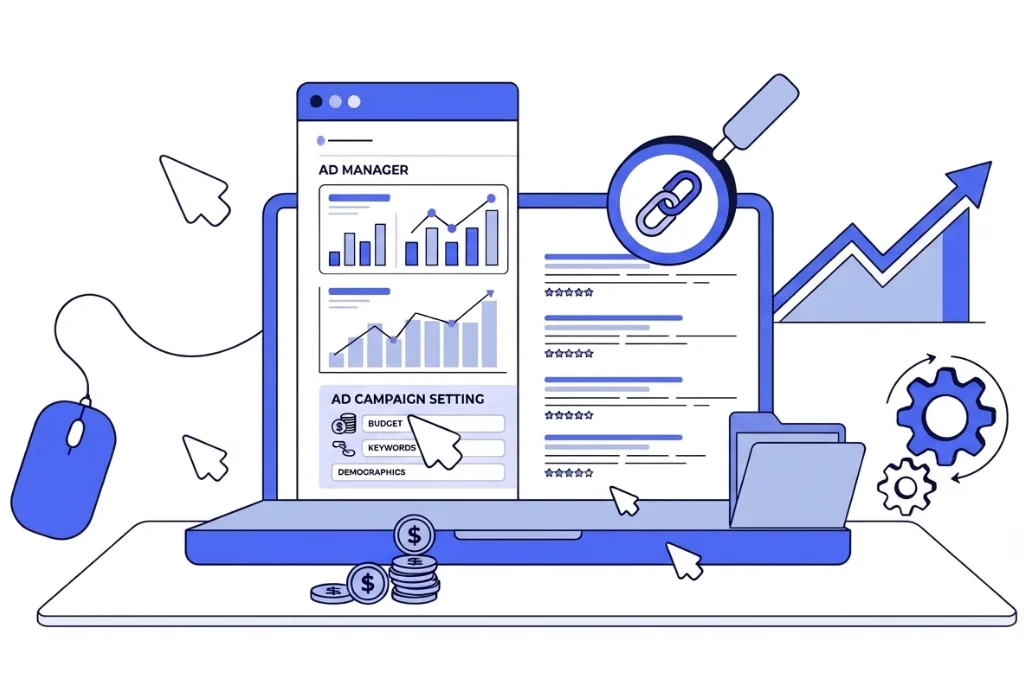
A few ways to make them work together:
- Mine the search terms report. It shows the real phrases people typed before they clicked your ad. The ones that convert are proven SEO targets.
- Test messages with ads first. Ad headlines with a higher click-through rate are a good guide for page titles and meta descriptions.
- Cover the gaps. Run ads on valuable terms where your organic pages do not rank yet. Pull back once organic results are strong.
- Watch branded searches. If you already rank first for your brand name, test whether brand ads add extra leads or only take clicks you would get anyway.
What is different in Dubai and the UAE
The UAE is almost fully online, mostly on mobile, and searches happen in English and Arabic. That shapes both channels: you may need Arabic keywords and pages, location targeting by emirate, and tracking for calls and WhatsApp leads.
DataReportal’s Digital 2026 report for the UAE counts 11.3 million internet users at the end of 2025, or 99.0% of the population. Your customers are online. The challenge is reaching them in the right language and place.
Things worth planning for:
- English and Arabic searches. Many people search in both. Arabic keywords often have their own demand and competition, and they deserve their own landing pages. Those pages usually need more than a direct translation.
- Emirate targeting. Google Ads lets you target Dubai, Abu Dhabi or Sharjah separately. For SEO, mention the areas you really serve and keep your business details consistent.
- Calls and WhatsApp. Many UAE leads never fill in a form. If you do not track calls and WhatsApp clicks, both channels will look worse than they are.
- How people search. Over the past 12 months, Google Trends shows people in the UAE searching for “google ads” nearly three times as often as “ppc”. People search for the platform name, not the jargon, so use their words on your pages too.
- Seasonality. Demand and click prices can move around Ramadan, Eid and the Q4 shopping period. Budget for those peaks early.
How to measure SEO and PPC fairly
Track every lead source, including calls and WhatsApp, and compare channels on cost per lead and revenue, not clicks. Know which attribution model your reports use, because it decides which channel gets the credit.
Attribution is how a sale gets credited to the clicks before it. The models on offer have changed. Google Analytics 4 now offers three: data-driven, paid and organic last click, and Google paid channels last click. First click, linear, time decay and position-based models were removed in November 2023. Google Ads offers two, last click and data-driven, with data-driven as the default for most conversion actions.
Google Ads reports conversions from its own clicks, while GA4 compares all your channels. The same lead can appear in both, so never add the two reports together.
A fair set-up looks like this:
- Mark form submissions, calls and WhatsApp clicks as key events in GA4.
- Import offline results, such as signed deals from your CRM, into Google Ads where possible.
- Work out a blended cost per lead: everything you spend on SEO and ads, divided by all the leads from search.
- Review the split each quarter, not each week. SEO needs time to show up in the numbers.
Our marketing measurement framework shows how to turn this into a report your leadership team will read.
What AI Overviews change for SEO and PPC
AI Overviews answer many questions on the results page itself, so fewer searches end in a click for anyone. For SEO, the new goal is to be cited in the answer as well as ranked below it. For ads, the slots sit above or below the overview in the UAE.
Zero-click search is not new, but AI makes it more common. In a 2024 study by SparkToro and Datos, 58.5% of US Google searches ended without a click, and only 360 of every 1,000 searches led to a click on the open web. That data runs to May 2024, before AI Overviews rolled out widely.
What this means for each channel:
- SEO: clear, well-structured answers and trusted sources are more likely to be quoted in the overview. Our guide on how Google AI Overviews choose their sources covers this, and our comparison of generative engine optimisation vs SEO explains what changes and what does not.
- PPC: according to Google Ads Help, ads can show above or below AI Overviews in every market where overviews appear. Ads inside the overview are limited to a short list of English-language markets, and the UAE was not on that list when we checked in October 2026.
Neither channel is dead. Both now compete for fewer, better-qualified clicks, so tracking and landing page quality decide who wins them.
The bottom line
For many Dubai businesses, the answer is not SEO or PPC. It depends on the three questions above: how soon you need leads, what a customer is worth, and how long the topic will matter. If you need leads this month, start with paid search and begin SEO alongside it. If you can wait or clicks are very expensive, lead with SEO. Either way, measure both fairly.
If you want a second opinion on your own numbers, our SEO team and Google Ads team can review where your first budget should go.
Frequently asked questions
Which is better, SEO or SEM?
It depends on your timeline and budget. Paid search (SEM) is better when you need leads now. SEO is better for lower-cost traffic over the long term. Many businesses start with one and add the other.
Is SEO the same as SEM?
No. SEO is unpaid search work. SEM usually means paid search ads, though some people use it as an umbrella that includes SEO. Ask which meaning someone has in mind.
Is SEM the same as PPC?
Not quite. PPC is a way of paying for ads: you pay per click. SEM is marketing on search engines. Google search ads are both SEM and PPC. Social media ads paid per click are PPC but not SEM.
Is Google Ads SEO or SEM?
Google Ads is SEM. It is paid search, so it is also PPC. SEO is the unpaid work that helps your pages rank in organic results.
Is SEO paid or free?
Google does not charge for organic clicks or rankings. But SEO is not free to do well. You pay in time, content and expertise, whether that is your own team or an agency.
Is PPC better than SEO?
Neither is better in every case. PPC is better when you need leads fast and a customer is worth much more than a click. SEO is better for steady, lower-cost traffic over the long term. Most businesses end up using both.
Is SEO dead now with AI?
No. AI Overviews mean fewer clicks per search, but the overviews still draw on web pages. Well-structured, trusted content is more likely to be cited, and organic results still sit on the same page.
What is replacing SEO?
Nothing is replacing it, but it is growing. Getting cited in AI answers, often called generative engine optimisation, builds on the same basics: useful content, a site Google can crawl, and trust in your brand.
Sources
- Google Search Central, “In-depth guide to how Google Search works”:
- Google Search Central, “Do you need an SEO?”:
- Google Ads Help, “About Ad Rank”
- Google Ads Help, “Cost-per-click (CPC): Definition”
- Google Ads Help, “About average daily budgets”
- Google Ads Help, “About Keyword Planner forecasts”
- Google Ads Help, “About attribution models”
- Google Analytics Help, “Get started with attribution”
- Google Ads Help, “About ads and AI Overviews”
- SparkToro, “2024 Zero-Click Search Study” (Rand Fishkin, July 2024)
- DataReportal, “Digital 2026: The United Arab Emirates” (Simon Kemp)
- Google Trends, “google ads” vs “ppc”, United Arab Emirates, past 12 months: