
How Google Ranks and Displays Results: Systems, Signals and SERP Features
Google ranks websites with automated ranking systems. They work out what a search means, then compare indexed pages on relevance, quality, usability and context. A separate step decides how the results page looks. AI Overviews, featured snippets, People Also Ask and local results can all appear above the first organic link.
That second step is the part most guides skip. Yet it explains a question many business owners ask: “We rank first, so why are clicks falling?” This guide covers both decisions. It is built on Google’s own documentation, and it links to deeper posts where a topic needs more room.
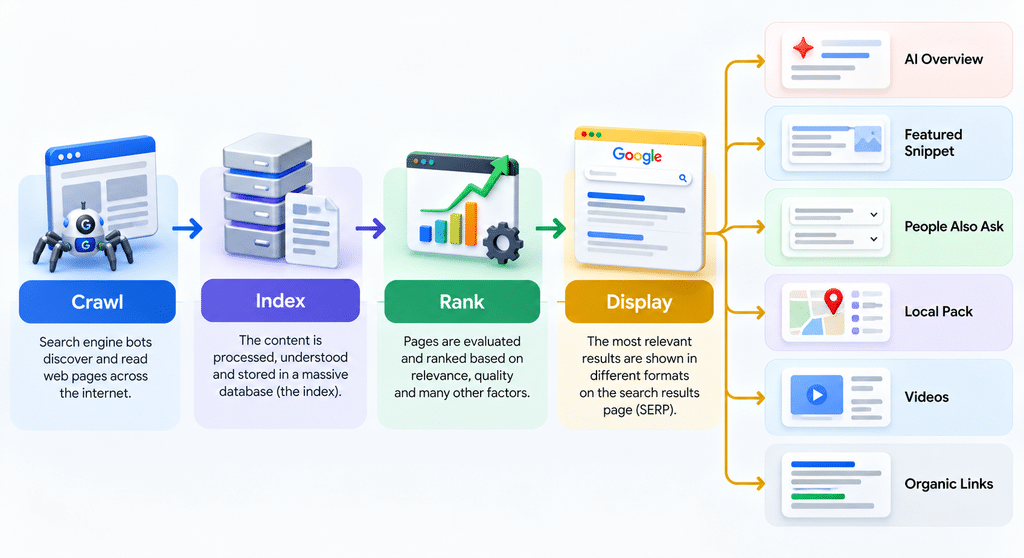
Crawl, index, rank, display: the four steps in one picture
Before Google can rank a page, it has to find it and store it. Google describes three stages: crawling, indexing and serving results. We add a fourth label, display, because what Google shows on the page is now a choice in its own right.
Here is the short version:
-
- Crawl. Googlebot finds pages by following links and reading sitemaps.
-
- Index. Google reads each page, works out what it is about and stores it in its index.
-
- Rank. When someone searches, Google’s systems pick the most useful indexed pages and put them in order.
-
- Display. Google decides which features to show, such as an AI Overview, a map pack or a set of videos, and where the organic links sit.
Google is clear that money cannot buy better crawling or ranking. Its developer guide says it “doesn’t accept payment to crawl a site more frequently, or rank it higher.” Ads are shown separately and labelled as sponsored.
If crawling and indexing are new to you, our guide to the search engine lifecycle covers them in depth. The rest of this post focuses on steps three and four.
Ranking systems, signals and factors: what Google actually confirms
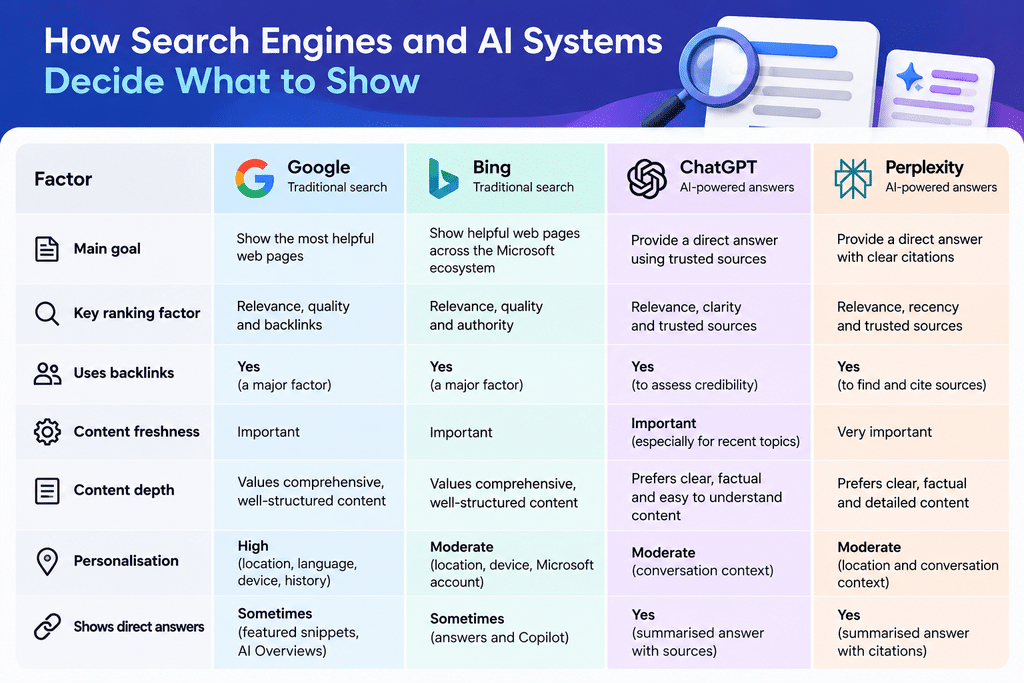
Google ranks pages with a set of named ranking systems. Each system looks at many signals, and Google does not publish a weighted list of factors. When you see “200 ranking factors” or factor percentages, you are reading someone’s estimate, not Google’s.
It helps to separate three words that often get mixed up:
-
- Ranking systems are the programs that do the work, such as BERT or the reviews system. Google names and describes them.
-
- Signals are the pieces of information those systems use, such as the words on a page, links from other sites or how fast a page loads.
-
- Ranking factors is the industry’s word for signals. It is a useful shorthand, but most published lists mix confirmed signals with guesses.
Google’s ranking systems guide opens by saying its automated systems “look at many factors and signals”. They search hundreds of billions of pages to show the most relevant results almost instantly. Its How Search Works site adds an important detail: the weight given to each signal changes with the query. For example, freshness counts for more on a news search than on a search for a dictionary definition.
So a single fixed list can never be right for every search.
Google’s named ranking systems and what each one rewards
Google publicly names more than a dozen ranking systems. Most of them help Google understand language, judge quality or keep results varied and free of spam. Knowing what each one rewards tells you where to spend effort.
The table below summarises the main systems from Google’s guide to Search ranking systems, last updated 10 December 2025.
| System | What it does | What it means for you |
|---|---|---|
| BERT | Understands how word order and combinations change meaning | Write naturally for the question people ask |
| RankBrain | Links words to concepts, so pages can rank without the exact query words | Cover the topic fully, not just one keyword |
| Neural matching | Matches ideas in a query to ideas on a page | Explain things clearly, in your customers’ words |
| MUM | An AI model used for specific tasks, not general ranking | No direct action needed |
| Passage ranking | Judges individual sections of a page | Give each section a clear heading and a direct answer |
| Link analysis and PageRank | Uses links between pages to judge what they are about and how useful they are | Earn links from relevant, respected sites |
| Freshness systems | Show newer content when the query expects it | Update time-sensitive pages |
| Reviews system | Rewards reviews with original analysis and research | Show first-hand testing and real evidence |
| Reliable information systems | Raise authoritative sources and demote low-quality content | Cite sources and show who wrote the page |
| Original content systems | Favour original reporting over copies | Publish your own data and views |
| Site diversity system | Usually limits a site to two listings in the top results | One strong page beats several thin ones |
| Deduplication systems | Hide near-identical results | Avoid duplicate pages |
| Exact match domain system | Limits the credit given to domain names built to match a query | A keyword domain will not rank on its own |
| Spam detection (SpamBrain) | Finds spam content and behaviour | Avoid shortcuts such as bought links |
Google also lists retired systems for history. The helpful content system became part of the core ranking systems in March 2024. Panda joined core ranking in 2015 and Penguin in 2016. Their goals live on, but they no longer run as separate updates.
The five things Google looks at: meaning, relevance, quality, usability and context
Google groups its signals into five areas: meaning, relevance, quality, usability and context. Meaning is about the query, and context is about the searcher. The other three are about the page.
Meaning. Google first works out what the searcher wants. Its language models deal with spelling mistakes, synonyms and short queries. A search for “best shawarma near me” is a request for places to eat, not a recipe.
Relevance. Next, Google checks whether a page matches the query. The most basic signal is that the page uses the same words as the search. Google also looks for related content, such as pictures or videos, rather than the same keyword repeated.
Quality. Google tries to rank content that shows expertise, authoritativeness and trustworthiness. One signal it names is whether other prominent websites link to or mention the content. Its helpful content guide says the ranking systems are built to “prioritize helpful, reliable information” made to benefit people. The same guide notes that E-E-A-T itself is not a specific ranking factor. It is a way of thinking about quality. Our guide to search quality evaluation principles explains E-E-A-T and the rater guidelines in detail.
Usability. When other signals are roughly equal, the page that is easier to use may rank higher. Mobile friendliness and loading speed are the usual examples. Usability will not lift a page that does not answer the query. It helps when the options are otherwise close.
Context. Google uses information such as your location, past searches and Search settings. This is why two people in Dubai can see slightly different results for the same query.
How Google decides what the results page looks like
After ranking, Google decides which features to show and where. This is why being the first organic result does not always mean being the first thing people see. An AI Overview, ads, a map pack or a People Also Ask box can sit above you.
Google calls these parts of the page “visual elements.” Its Visual Elements Gallery names each one. The main ones you will see are:
-
- Text results. The classic blue link, made of a title link, a snippet, the site name and sometimes sitelinks.
-
- Rich results. Text results with extra details, such as star ratings, prices or event dates, usually powered by structured data.
-
- Featured snippets. A highlighted answer pulled from one page and shown near the top.
-
- People Also Ask. Google calls this the related questions group. Each question expands into a short answer with a link.
-
- Local pack. A map with three or so businesses, shown for searches with local intent.
-
- Image and video results. Thumbnails shown inline when pictures or video suit the query.
-
- Related searches. Suggested searches, usually at the bottom of the page.
-
- AI Overviews. An AI-written summary with links to supporting pages, covered in the next section.
Two points surprise many site owners. First, you cannot ask for a featured snippet. Google’s documentation on featured snippets says plainly that its systems decide whether a page would make a good one. You can opt out with the nosnippet or max-snippet rules, but you cannot opt in. Second, Google’s deduplication systems do not usually repeat a featured snippet page as a normal listing further down the first page. A snippet can replace your blue link rather than add to it.
You can see this on a live results page. When our team checked Google UAE for “how google ranks websites” on 16 October 2026, an AI Overview filled the top of the page. There was no featured snippet. People Also Ask sat below the first results, and a “People also search for” box suggested related queries. The first organic result, Google’s own How Search Works page, was not the first thing a visitor saw.
AI Overviews and AI Mode: how pages get cited, and what it does to clicks
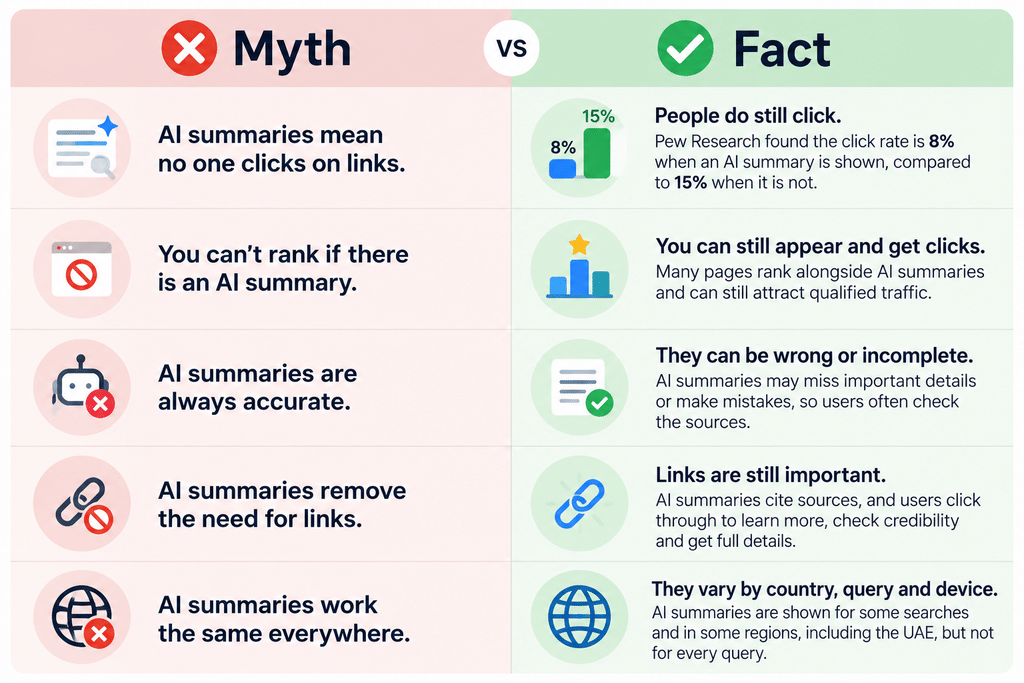
AI Overviews and AI Mode draw on pages in Google’s normal Search index. Google says there are no extra requirements to appear in them: a page must be indexed and eligible to show with a snippet. Studies show fewer clicks to organic results when an AI Overview appears.
Google’s page on AI features and your website says: “There are no additional requirements to appear in AI Overviews or AI Mode.” It also explains a technique called query fan-out. The AI runs several related searches across subtopics, then builds an answer from what it finds. AI Mode, the more conversational search experience, can use the same approach. So a page may be cited even if it does not rank first for the main query, if it answers one part of the topic well.
The effect on clicks is real, and it is now measured:
-
- Pew Research Center tracked the browsing of 900 US adults in March 2025. Users clicked a traditional search result on 8% of visits that showed an AI summary, compared with 15% when no summary appeared. They clicked a link inside the summary itself on about 1% of those visits. (Pew Research Center)
-
- Ahrefs compared 300,000 keywords using desktop Search Console data. In its February 2026 update, an AI Overview was linked to a 58% lower average click-through rate for the top-ranking page. That compares December 2023 with December 2025. Its first study, comparing March 2024 with March 2025, found a 34.5% drop. Ahrefs describes this as a correlation, and it found that click-through rates also fell for keywords without an AI Overview. (Ahrefs)
Pew’s study covers US adults, and Ahrefs does not say which market its keywords come from. Neither is a UAE measurement, so treat the exact figures as a guide. The direction is clear, though. For informational searches, ranking first is no longer the same as getting the click. Being cited inside the AI Overview at least keeps your brand in view, even when few people click.
Our guide on how Google AI Overviews work explains where the sources come from and who gets cited.
Why rankings move: core updates, constant testing, location, device and personalisation
Rankings move for three reasons. Google changes its systems, competitors change their pages, and results depend on who is searching, where and on what device. A small daily shift is normal. A sudden, lasting drop usually has a cause you can find.
Google tests and launches constantly. According to Google’s page on rigorous testing, in 2023 it ran 719,326 search quality tests, 124,942 side-by-side experiments and 16,871 live traffic experiments. Those led to 4,781 launches. That is about 13 changes to Search every day, on average.
Core updates are bigger. A few times a year, Google makes broad changes to its core systems. Some pages rise and others fall, often without anything being “wrong” with the pages that drop. Google announces these on its Search Status Dashboard.
Location changes results. A search for “dentist” in Dubai Marina returns different businesses than the same search in Al Ain. Even informational results can differ by country.
Device matters. Google uses mobile-first indexing, so it mainly looks at the mobile version of your site. Results pages on phones and desktops are also laid out differently, so the same position can be more or less visible.
Personalisation plays a smaller role. Past searches and settings can affect some results, but most differences come from location, language and the query itself.
Competitors move too. If another site publishes a better answer or earns strong links, it can pass you without you doing anything wrong.
A core update drop is not a penalty, but it still deserves a careful look. If a sharp drop follows a spam update or a manual action notice in Search Console, our Google penalty recovery team can help.
Ranking myths that waste budget
Google has never published factor weightings. Domain Authority is not a Google metric. Search quality raters do not change rankings directly. And domain age is not one of Google’s named systems.
| Myth | What Google’s documentation says |
|---|---|
| “There are exactly 200 ranking factors.” | Google uses many systems and signals and does not publish a fixed list or a count. |
| “Content is worth 30% and links 20%.” | No factor percentages exist. Google says the weight of each signal depends on the query. |
| “You need a high Domain Authority score.” | Domain Authority is a score made by an SEO software company, not by Google. Links matter, but Google does not use third-party scores like this. |
| “Older domains always win.” | Domain age is not among Google’s named ranking systems. Older sites often rank well because they have had years to earn links and build content. |
| “Search quality raters can push my site down.” | Google’s rater guidelines say: “No single rating can directly impact how a particular webpage, website, or result appears in Google Search.” Ratings are used to test changes. |
| “I can pay Google to rank higher.” | Google does not accept payment to rank pages higher in organic results. Ads are separate and labelled. |
| “Adding structured data guarantees a rich result.” | Google says structured data makes a page eligible for rich results. Its systems still decide whether to show one. |
The pattern is the same each time. Tools and blog posts give you a neat number, but Google’s systems are judging usefulness for each query. Spend budget on better pages, real evidence and earned links, not on moving a third-party score.
What changes for businesses in Dubai and Abu Dhabi
The same ranking systems apply in the UAE, but three things matter more here: location, language and the local pack. A business in Dubai competes for nearby searchers, often in both English and Arabic, and local results often appear before the organic links.
The local pack follows its own rules. For searches like “physiotherapy clinic in JLT”, Google usually shows a map with a few businesses. Google’s Business Profile help page says local results are based mainly on three things:
-
- Relevance: how well your Business Profile matches the search.
-
- Distance: how far you are from the searcher, or from the location in the query.
-
- Prominence: how well known your business is, based on things like links to your website and the number of reviews and ratings.
The same page adds: “There’s no way to request or pay for a better local ranking on Google.” A complete profile, accurate details and a steady flow of genuine reviews are what improve local rankings. Our guide to local SEO in Dubai walks through each step.
Location shapes every result. Distance is a direct signal in the local pack, and context affects organic results too. A searcher in Abu Dhabi and one in Dubai can see different businesses for the same query. Check your rankings from the city your customers search from.
Language splits the market. Many UAE customers search in both English and Arabic, and the results for each language can be quite different. An English page will not usually rank for an Arabic query. If Arabic speakers are a key audience, give them a proper Arabic page and tell Google how the language versions relate with hreflang tags.
Competition is dense. Dubai has many businesses chasing the same high-value searches in a small area. That makes reviews, a strong Business Profile and well-built location pages more important than in less crowded markets.
If the map pack is where your customers find you, our local SEO services can help.
How to see how Google ranks your own pages: a 5-step check
You do not need paid tools to understand how Google treats your pages. A live search and the free Google Search Console show where you rank, what the results page looks like and whether people click. Run this check once a month for your most important pages.
Step 1: Pick the queries that matter. List five to ten searches your customers actually type, including at least one in Arabic if that suits your audience.
Step 2: Look at the live results page. Search each query in a private browser window, which removes most personalisation. Google will still use your location, so check from the city your customers search from, or ask a colleague there. Note every feature above your listing: ads, an AI Overview, a map pack, People Also Ask or videos. This tells you how visible your position really is.
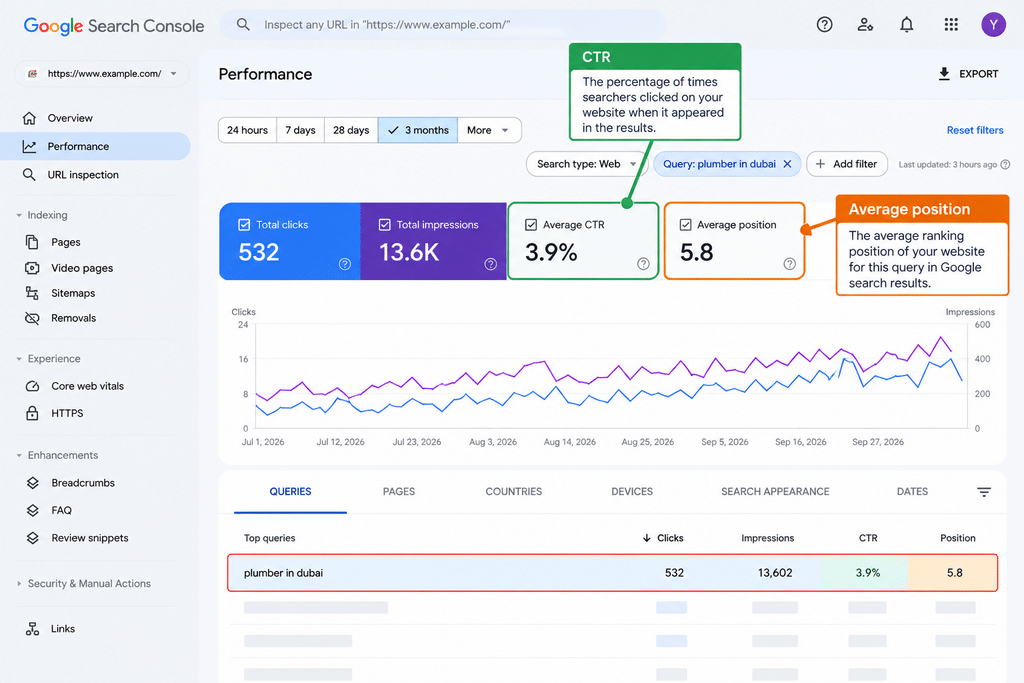
Step 3: Open the Performance report in Search Console. Filter by query and by page. Look at impressions, clicks, average position and click-through rate together. A steady position with falling clicks usually points to a new feature on the results page, not a ranking problem.
Step 4: Check that Google can index the page. Use the URL Inspection tool on your key pages. If a page is not indexed, it cannot rank or be cited in an AI Overview. Fix indexing before anything else.
Step 5: Compare yourself with the pages above you. Open the top three results. Ask whether they answer the question faster, show more evidence or cover parts of the topic you skip. Then improve your page where it falls short.
If this check shows problems you cannot explain, an SEO audit is the fastest way to find the cause. And if you are new to the subject, start with our guide to what SEO is and how it works.
Frequently asked questions
How does Google rank a website?
Google ranks a website one page at a time, not as a whole. For each search, its ranking systems compare indexed pages on the meaning of the query, relevance, quality, usability and the searcher’s context. The most useful pages appear first. Site-wide signals, such as links and reputation, support the pages on that site.
How are Google searches ranked?
Searches are ranked almost instantly. Google interprets the query, pulls matching pages from its index and orders them with its ranking systems. It then decides which features, such as an AI Overview or map pack, to show alongside the organic results.
What determines Google rankings?
Many signals determine rankings, grouped into meaning, relevance, quality, usability and context. The weight of each one depends on the query. Google does not publish a ranked list or percentages, so treat any list that claims exact weightings with caution.
What are the top 5 SEO ranking factors?
Google does not publish a top five. Its documentation keeps returning to the same areas: matching search intent, helpful and original content, and links and mentions from respected sites. A fast, mobile-friendly page helps too. For local searches, add a strong Google Business Profile.
How does Google PageRank work?
PageRank is one of Google’s link analysis systems. It uses the links between pages to help judge what each page is about and how useful it is. It is one signal among many, not a score you can buy or check in Search Console.
How do I boost my Google ranking in 2026?
Match the intent of the search and answer it better than the pages above you. Show real evidence and who wrote the page, make it fast on mobile and earn links from relevant sites. Then check the results page, because a higher position does not always bring more clicks.
Does Google rank AI-generated content?
Google’s guidance focuses on whether content is helpful and reliable for people, not on how it was produced. Pages mass-produced mainly to rank, by any method, risk breaking Google’s spam policies on scaled content. Edit and fact-check AI drafts like any other copy.
How do I check my Google ranking?
Search your target query in a private browser window, or use the Performance report in Google Search Console. Search Console shows your average position, impressions and clicks for each query and page, straight from Google’s data.
Why does my Google ranking keep changing?
Google makes thousands of changes to Search each year, competitors update their pages, and results vary by location and device. Small daily moves are normal. A big, lasting drop that lines up with a core update or a site change is worth investigating.
Why do I rank first but get no clicks?
Often an AI Overview, featured snippet, ads or a map pack sits above your listing and answers the question first. Check the live results page and your Search Console click-through rate. A clearer title and a page that answers the question better than the summary can help.
How long does it take to rank on Google?
There is no fixed timeline. New pages can be indexed within days, but ranking well for competitive searches often takes months of steady work. Pages on sites that already rank for related topics often move faster.
How do I get ranked #1 on Google?
No one can promise a first place, and Google does not sell one. The reliable path is to answer the search better than anyone else. Make the page easy to use on mobile, earn links from relevant sites and keep important pages up to date.