
Training Data vs Live Retrieval: Where AI Gets Its Answers About Your Business
For years, businesses have asked one question above all others: how do we get search engines to find our website? That question still matters. But the way people discover information is shifting underneath it. Instead of typing a keyword, opening ten results and comparing pages themselves, more and more users simply ask an AI system a direct question and receive a synthesized answer.
They ask ChatGPT which software provider suits a company their size. They ask Gemini to compare hotels for a family holiday. They use Perplexity to research a product before buying, or rely on an AI search experience to recommend a local service. In each of these moments, a business’s visibility depends on more than whether its website ranks. It depends on whether AI systems can understand, retrieve and confidently use information about that business.
This raises a question every marketer should be able to answer: where does AI actually get its answers about your business?
The honest answer is more nuanced than “the AI learned your website.” Modern AI systems can draw on three different layers of information: knowledge absorbed during training, content retrieved from external sources at the moment a question is asked, and, in some applications, information pulled from private company databases. Each layer works differently, and, crucially, you have very different levels of control over each one.
Understanding these layers is quickly becoming a core part of AI SEO, Generative Engine Optimization (GEO) and modern search visibility. This guide explains the difference between training data and live retrieval, why it matters commercially, what you can and cannot influence, and how to build a digital presence that performs well in both worlds.
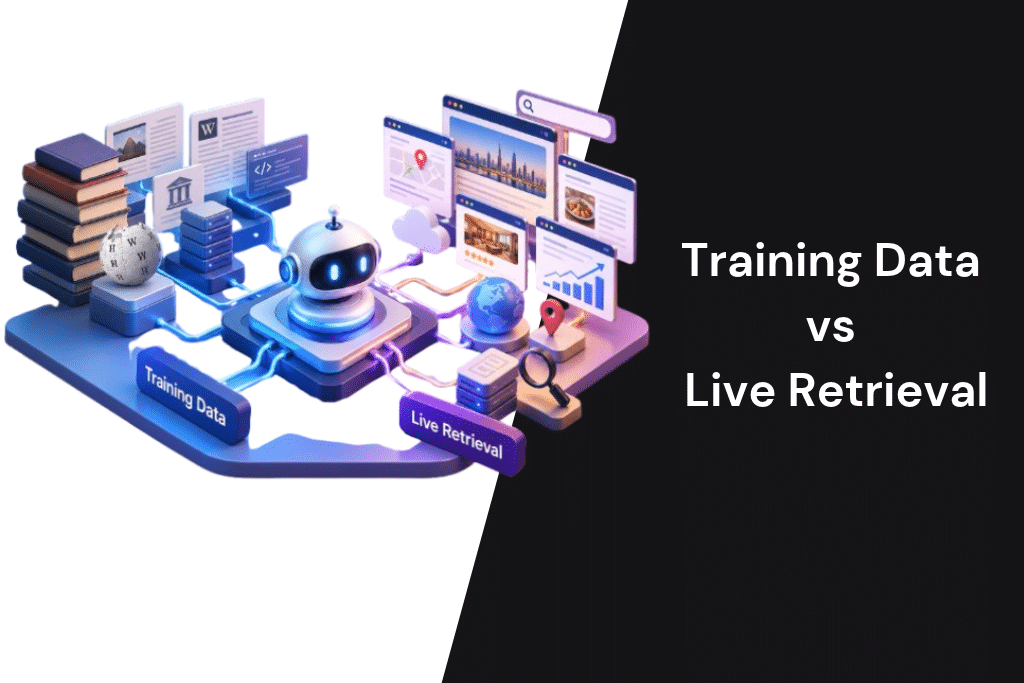
AI gets information about your business from two primary layers: training data and live retrieval. Training data represents information an AI model learned during its training process, such as websites, articles, documents and other publicly available content. This knowledge can help AI understand your business, but it may become outdated as your services, pricing, locations or products change. Live retrieval, on the other hand, allows AI systems to search and retrieve current information from websites and other external sources when answering a query. For businesses, this means you cannot directly control what an AI model has already learned, but you can improve the information available for retrieval by maintaining accurate website content, clear business information, structured data, authoritative third-party mentions and regularly updated resources. Training data shapes what AI remembers; live retrieval influences what AI can discover and use today.
What Is Training Data in AI?
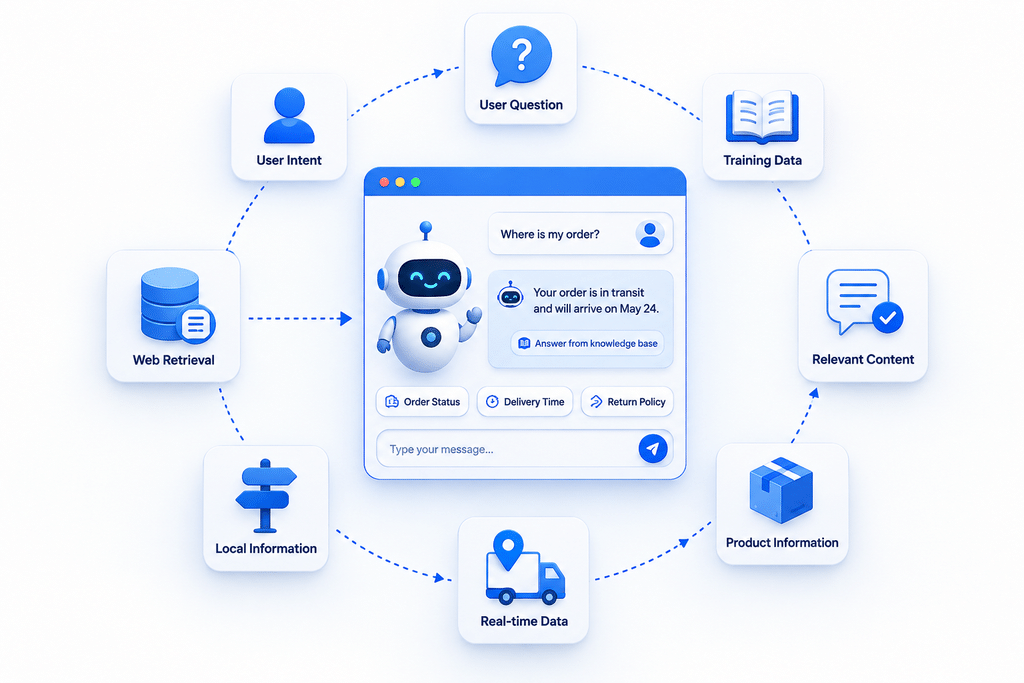
Training data is the enormous body of material used to develop an AI model. Depending on the system, it can include books, websites, articles, technical documentation, code and many other kinds of text and data. During training, the model studies this material and learns statistical patterns and relationships: how words connect, how concepts relate, how topics are typically discussed.
It is important to understand what this is not. A language model is not a filing cabinet in which every web page is stored and can be pulled out word for word. Training reshapes the model’s internal parameters so that it can generate useful, plausible responses based on the patterns it absorbed. The knowledge is woven into the model rather than stored as retrievable records.
What this means for your brand
If your company appeared in material the model was trained on, that exposure may shape what the model “knows” about you. It might understand that you operate in a particular industry, offer certain services, serve a specific market, or have been covered by certain publications.
But that knowledge has a built-in weakness: it is frozen in time. A model trained before your latest product launch cannot know about that product, no matter how thoroughly you described it on your website yesterday.
Imagine a company that has recently changed its name, launched three new services, opened a new office in Dubai and revised its pricing. Its website reflects every change. Yet an AI answering purely from older training knowledge may still describe the business as it used to be. The model may know the brand, but knowing a brand and knowing its current state are two very different things.
Training data is not the enemy
None of this makes training data unreliable or unimportant. It is the foundation of everything a large language model does. Training gives the model its command of language, its ability to reason about topics and its capacity to interpret what a user actually means. Without it, there would be nothing to build on.
The problem is a common misconception: that everything a model says is current, or that a business can reach into a trained model and correct what it believes. In most cases, no control panel exists where a company can log in and replace an outdated fact inside a model’s parameters. Once a model is trained, its internal knowledge stays put until the next version is released.
What Is Live Retrieval?
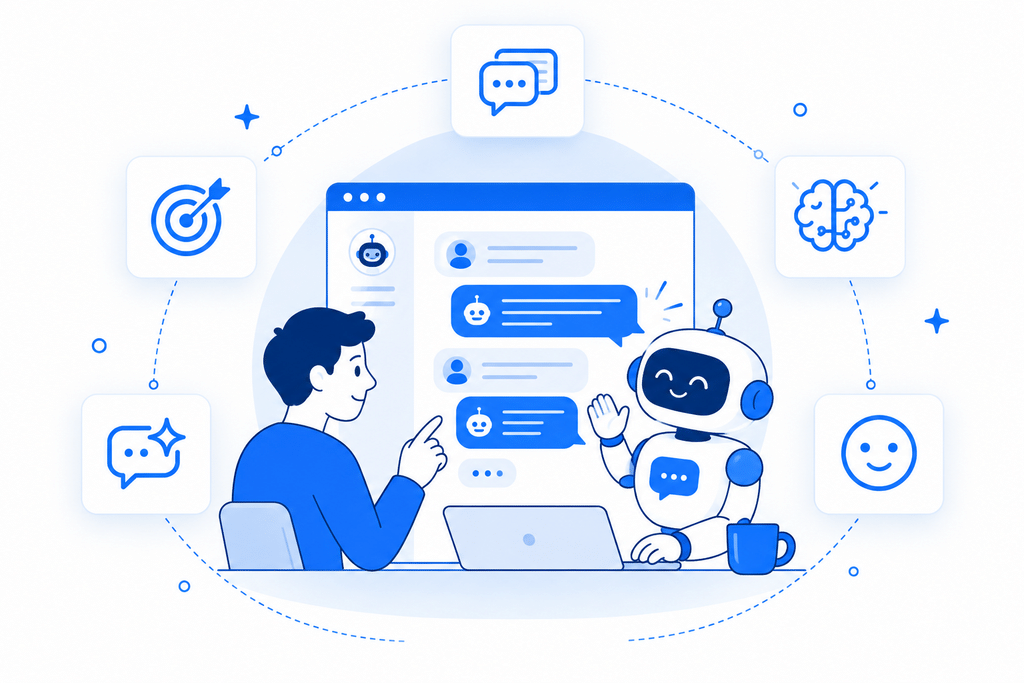
Live retrieval adds a second layer between the user’s question and the AI’s answer. Instead of relying only on what it learned during training, the system can go out and look things up. It searches external sources, pulls back relevant content and uses that material as context while writing its response.
This approach is closely associated with Retrieval-Augmented Generation, usually shortened to RAG. In a retrieval-augmented workflow, the system first works out what information is relevant to the query, then retrieves documents or web pages, and finally hands that material to the language model as extra context. The model then composes an answer that blends its built-in capabilities with the freshly retrieved information.
The practical difference is enormous. Training data is what the model learned previously. Retrieval is what the system has found right now.
A simple illustration
Suppose someone asks, “What does this software cost today?”
If the AI relies only on training knowledge, it may quote a price that was accurate months or years ago, or it may describe the product without giving a price at all. If the AI has live web retrieval, it can locate the company’s current pricing page and base its answer on that.
The same logic applies to your business. Imagine you publish a new service page today. If an AI system retrieves that page while answering a relevant question, the page can shape the response even though the underlying model was never retrained on it. This is exactly why retrieval has become such a central concept in AI search visibility: it is the mechanism through which new and updated content can reach AI answers quickly.
The Core Difference: Memory vs Research
The simplest way to hold this distinction in your mind is to compare memory with research.
Training data is memory. The model learned something in the past and draws on those learned patterns when it responds. Memory is excellent for stable concepts, general knowledge, language understanding and facts that rarely change.
Live retrieval is research. The system actively searches sources, reads what it finds and builds an answer from it. Research is most valuable when a question depends on current information, specific sources or recent changes.
A human analogy helps. If a colleague asks you what a mortgage is, you answer from memory. If they ask what your bank’s mortgage rate is this week, you check. A well-designed AI system does the same, relying on memory for the first kind of question and on research for the second.
Adding a third layer: private retrieval
The picture becomes even more useful once you add a third category. Not every retrieval system searches the public internet. A company might build an internal AI assistant that pulls answers from its product documentation, customer-support knowledge base, HR policies, CRM or other private databases. In that case the AI isn’t consulting Google at all; it is searching a controlled, internal body of knowledge.
This gives us three layers that production AI systems commonly combine:
- Training data: broad knowledge, reasoning ability and language understanding, fixed until the model is updated.
- Private or indexed retrieval: controlled information from internal documents, databases and knowledge bases.
- Live web retrieval: current information fetched from the public internet at the time of the question.
Each layer solves a different problem, and each offers a different opportunity to a business trying to be represented well.
RAG vs Live Web Retrieval: Not Quite the Same Thing
People often use “RAG” and “live retrieval” interchangeably, but they are not identical, and the distinction is worth making.
Retrieval-Augmented Generation is the broader architecture: information is retrieved and supplied to a language model before the answer is generated. The source of that information can be a company’s internal database, a vector index, a document repository or any other controlled knowledge source.
Live web retrieval is a specific use of the idea: fetching current information from the public internet at query time.
Consider two scenarios. An employee at a company asks an internal support assistant, “What is our refund policy?” The assistant looks it up in the company’s internal documentation. That is a retrieval-augmented workflow, but it never touches the public web.
Now a different user asks an AI agent, “What is this competitor charging right now?” The agent has to visit the competitor’s public website, because that information is external and changes frequently. That is live web retrieval.
For AI SEO, the public-web layer matters most, because it is the part of AI visibility that businesses can directly influence through their websites, content, digital PR and wider online presence. Private retrieval systems are controlled by the organizations that build them; the public web is the shared space where your brand competes for attention.
Why This Difference Matters for Your Business
When an AI system mentions your business, you naturally want to know why. Did it learn about you during training? Did it find your website through a search? Did it read a news article about you, retrieve a review page or consult a private database? The answer determines what you should do next.
If the information came from training data, your ability to change it quickly is limited. You can strengthen how your business is represented across the web, and over time that may contribute to future model updates, but it is a slow, indirect, long-term process. You cannot simply edit what the model believes.
If the information came from live retrieval, the opportunity is far more immediate. The pages and sources available to the retrieval system influence what it finds, and therefore can influence what it says. That does not mean publishing a single page guarantees a citation. Retrieval systems still have to judge which sources are relevant and useful. But it does mean businesses can actively improve the quality and accessibility of the information AI systems may retrieve.
This changes the questions marketers should be asking. Traditional SEO asks, “How do I rank this page?” AI-era SEO adds a second question: “What information would an AI system need in order to confidently understand and recommend my business?”
That second question pushes you to think about clarity, completeness, consistency and credibility, rather than only keywords and backlinks.
How AI Learns About Your Business
Your website is only one part of your online identity. An AI system may encounter information about your business across many different sources. Your service pages can explain what you do. Your About page can explain who you are. Location pages can explain where you operate. Product pages can provide specifications and pricing. Case studies can demonstrate expertise. Reviews can reveal customer experiences. Industry publications can provide independent coverage. Business directories can reinforce contact and location information. Social platforms can show how customers and creators discuss your brand.
This wider ecosystem matters because AI systems do not necessarily treat your own website as the only source of truth. A business might claim that it is “the leading provider” of a service, but an AI system may look for independent evidence before presenting that claim as fact. It may compare multiple sources, evaluate relevance and use the information it considers most useful for the question.
This is why AI SEO should not be reduced to adding an “AI keyword” to a webpage. The underlying challenge is much broader: build a clear, consistent and credible digital representation of the business.
For example, if your website says your company operates in Dubai, your Google Business Profile lists the same location, industry publications describe the company consistently, and reputable directories contain matching information, an AI system has multiple signals describing the same entity. If those sources contain contradictory information, the system has a more difficult task.
Consistency therefore becomes increasingly important in an AI-driven search environment.
Consistency is a signal
Suppose your website says you operate in Dubai. Your Google Business Profile lists the same location. Industry publications describe your company in the same terms, and reputable directories carry matching details. An AI system now has several independent signals describing the same entity in the same way, which makes its job easy and its answer more confident.
Now imagine those sources disagree: different addresses, different service descriptions, different company names. The system has to guess which is right, and it may guess wrong or simply leave you out. In an AI-driven search environment, consistency stops being housekeeping and becomes a competitive advantage.
How Does AI Know Whether Information Is Current?
One of retrieval’s greatest strengths is that it can reach information published or updated after a model’s training period. A live retrieval system can find a page published last week. A model relying only on training data cannot have learned that page, because it didn’t exist at the time of training.
This matters most for information that changes often: product pricing, software versions, event schedules, company announcements, stock and availability, regulations and breaking news. In these areas, stale information can quickly become misleading or even harmful.
For businesses, this elevates content freshness from a nice-to-have traditional SEO tactic to a genuine strategic concern. Keeping your important information accurate gives retrieval systems a better chance of finding the truth when users ask time-sensitive questions.
Still, it’s important not to overstate what freshness can do. A recently published page is not automatically chosen by an AI system. Relevance, source quality, accessibility, structure and the particulars of each platform’s retrieval process all play a part. The goal is not to publish constantly or to tweak dates for the sake of it. The goal is to make important information accurate, useful and easy to retrieve.
How Can You Tell Whether AI Used Training Data or Retrieval?
The easiest clue is usually a citation.
When an AI answer includes a clickable source attached to a claim, that typically signals the system retrieved external content and used it to ground its response. When an AI talks about your business with no visible source, it is more likely drawing on learned knowledge or on context that isn’t displayed to the user.
There is an important caveat, though: a citation does not guarantee accuracy. An AI system can cite a page that doesn’t truly support the claim it is attached to. The responsible habit is to open the cited page and check that it really says what the AI says it does.
A simple diagnostic routine
Ask an AI system a question about your company, then examine the answer closely:
- Does it mention your brand at all?
- Does it provide a citation?
- Is the cited source your own website or a third party?
- Does the cited page actually contain the information the AI used?
- Is that information current?
Then repeat the exercise with a prompt that explicitly demands current information. Instead of “What does Company X do?”, try “What services does Company X currently offer?” or “What is Company X’s latest product?” The more time-sensitive the question, the more informative your retrieval test becomes.
Be aware too that platforms differ. ChatGPT, Gemini, Perplexity, Copilot and Google’s AI search experiences don’t all behave the same way, and they don’t always make the boundary between model knowledge and web retrieval equally visible. Never assume that what you observe on one platform applies to all of them.
Why Citations Matter in AI Search
Traditional search gave businesses rankings and clicks. AI search gives them something different: mentions, recommendations and citations.
Picture a user asking, “What are the best digital marketing agencies in Dubai for e-commerce?” An AI system may respond with a short list rather than ten pages of results. If it cites five websites, those five sources have effectively become the evidence layer behind the answer. Being cited can therefore be valuable even when your page doesn’t rank first for the exact query in traditional search.
But citation should not be confused with recommendation. A page can be cited as background material without the business being recommended. Likewise, a business can be mentioned without its website being cited at all. AI visibility has several distinct dimensions:
- Brand mention: does the AI name you?
- Position: where in the answer do you appear?
- Recommendation: does it actively suggest you?
- Citation: is your content used as a source?
- Sentiment and description: how does it characterize you?
Measuring visibility therefore takes more than typing your brand name into a chatbot once. You need to test the questions your potential customers actually ask and observe which sources appear again and again.
Why Traditional SEO Still Matters
The rise of AI search does not mean traditional SEO is dead. In most cases, AI retrieval depends on the same fundamental web infrastructure that supports conventional search.
Search engines and AI systems both need to discover your pages. They need to interpret your content, understand entities, topics and relationships, and access a technically healthy site containing useful information. Technical SEO, internal linking, structured content, authoritative references and strong user-focused pages all remain important.
What changes is the final destination of the information. Traditional SEO asks whether a page can rank for a query. AI SEO asks whether the information on that page can be understood and used inside a generated answer.
A well-optimized service page can serve both purposes at once: it can rank in conventional results and supply clear, structured information that an AI system can retrieve when answering a related question. AI SEO is best seen as an extension of a strong search strategy, not a replacement for it.
Making Content Easy for AI to Retrieve
AI systems have to process information efficiently. A page full of vague marketing language can be hard to interpret, even if it looks impressive to a human visitor.
Write clearly and explicitly
Compare these two statements.
“At our company, we deliver innovative, world-class solutions designed to transform businesses and create exceptional outcomes.”
And:
“We provide SEO services for e-commerce businesses, including technical SEO, content optimization, product-page optimization and link-building.”
The second tells a retrieval system exactly what the company does and who it serves. The first could describe almost any business in any industry.
This doesn’t mean every page should read like a database entry. Human readability still comes first. But your important business facts should be stated plainly enough that both people and machines can understand them.
Build content around real questions
One of the most practical approaches is to organize content around the questions customers genuinely ask. Rather than publishing an article titled “Our Innovative Approach to Digital Transformation,” a business might publish “What Does Digital Transformation Cost in 2026?” if that reflects what customers want to know.
Rather than simply declaring “We are a leading Dubai SEO agency,” the company can publish genuinely useful material: what SEO services involve, how long SEO typically takes, what to evaluate when choosing an agency and which metrics matter. Question-driven content creates explicit connections between user intent and your expertise.
There is no formula that forces an AI system to select a particular page, and anyone promising one is overselling. But clear, relevant content gives retrieval systems better material to work with. The same principle applies to product pages, service pages, location pages and comparison content: don’t hide important facts behind vague language.
Use structured data
Structured data helps machines interpret key facts about your business. Schema markup can describe organizations, local businesses, products, services and other entities in a machine-readable way.
Schema is not a magic switch for AI visibility, and adding it doesn’t guarantee citations. But it contributes to a clearer representation of what your site contains. It is particularly valuable when a business has multiple locations, product variants, services or organizational relationships. A local business can reinforce its name, address, phone number, opening hours and location. A product page can communicate specific properties. An organization can establish its identity and its relationships to other entities.
The principle is simple: make important facts explicit instead of forcing systems to infer them from marketing copy. Q&A-style headings, semantic page structure, canonical metadata and concise factual snippets all support the same goal.
Freshness as a Strategic SEO Asset
Traditional SEO has always valued updated content, but AI retrieval makes freshness especially relevant wherever information changes quickly.
Think of a hotel that has changed its facilities, a restaurant with new opening hours, a SaaS company that has released a major feature, or an agency that has added a new service. If old pages remain online with outdated details, AI systems may retrieve conflicting information from different sources and present a muddled or inaccurate picture.
A reliable content maintenance process therefore becomes part of AI visibility. Review your key pages regularly and ask whether the information is still true. Pay particular attention to:
- Services and service descriptions
- Pricing and packages
- Locations and opening hours
- Product specifications and availability
- Contact details
- Leadership and team information
- Case studies and results
- Frequently asked questions
The objective is not to change a publication date to make a page look fresh. It is to keep the information itself accurate.
Third-Party Sources Shape How AI Understands Your Brand
Your website tells AI what you say about yourself. Third-party sources tell it what the wider web says about you. That second voice carries a lot of weight.
This is where digital PR, authoritative backlinks, industry publications, customer reviews, interviews, partnerships and independent mentions become relevant to AI visibility. Suppose a company describes itself as a specialist in luxury e-commerce. If several credible industry publications independently discuss it in that context, the business has a far stronger external representation than if the claim lives only on its own About page.
This isn’t unique to AI search. Traditional SEO has long rewarded authority and external references. But because AI systems synthesize information across multiple sources, your digital reputation becomes more visible than ever.
The aim should never be to manufacture mentions or scatter low-quality content across hundreds of websites. Instead, develop genuine, useful expertise and earn references from sources that are relevant to your field.
What Businesses Can and Cannot Control
One of the most useful ways to think about AI SEO is to separate what you can control from what you can’t.
What you generally cannot control:
Businesses generally cannot control the internal parameters of a commercial language model, when a future model will be trained or released, whether an AI system selects their webpage for a particular answer, or whether a generated response ultimately recommends their business.
What you can control:
Businesses can control the quality and accuracy of the information they publish, their website architecture and the clarity of their services, the consistency of their business details across profiles, directories and listings, the use of appropriate structured data, the creation of original research and genuinely useful educational content, relevant media coverage and legitimate authority, and ongoing monitoring of how AI systems describe their brand.
This distinction is liberating. It moves your strategy away from trying to manipulate something you can’t touch and toward improving things you can. Training knowledge is largely fixed until a future model update, while retrieved information can be influenced by the quality and retrievability of content published today.
A Practical AI Retrieval Strategy for Businesses
Understanding the theory is useful, but most teams want to know what to do on Monday morning. Here is a practical process.
Step 1: Identify the questions that matter commercially
Think beyond keywords and consider the real questions customers might put to an AI assistant. Examples include:
- “What are the best SEO agencies in Dubai?”
- “Which accounting firms specialize in startups?”
- “What are the best alternatives to this software?”
- “Which hotel is best for a family holiday?”
- “Which dental clinics offer cosmetic dentistry in this area?”
Step 2: Test those questions across AI platforms
Run your list through the AI platforms your customers are likely to use. Record which businesses are mentioned, which sources are cited, how your company is described and which competitors keep appearing.
Step 3: Analyze the sources
If competitors are repeatedly cited, study the pages AI systems reference. What information do those pages contain? Are they comprehensive? Are they independently referenced elsewhere? Are they kept up to date? Do they answer specific questions? Are they backed by reviews, publications or other credible sources?
Step 4: Compare those sources with your own website
This is where the insights appear. You may discover that your website has beautiful pages but lacks basic factual information. You may find your services described differently across several pages. Competitors may have detailed comparison guides while your site offers only promotional blurbs. Or AI systems may be citing third-party articles about your competitors because those articles explain the market more clearly than the competitors’ own sites do.
Step 5: Turn the gaps into a roadmap
Each gap you uncover becomes an item on your AI SEO roadmap: a page to create, a fact to clarify, a listing to correct, a publication to approach or a comparison guide to write.
Building an AI-Ready Website
An AI-ready website should first be a genuinely useful website for humans. The aim is not to fill pages with robotic text or write exclusively for language models.
- Your homepage should clearly communicate who you are, what you offer and where you operate.
- Your service pages should explain each service in real detail.
- Your location pages should provide useful local information rather than repeating one paragraph with the city name swapped.
- Your product pages should contain accurate specifications.
- Your About page should establish identity, expertise and relevant credentials.
Supporting content should then answer questions around those core topics. A strong internal linking structure ties it all together: a service page links to relevant guides, a guide links to supporting case studies, and a location page links to the services offered there. This creates a clearer information architecture for both users and search systems.
The result is a website that works as a coherent knowledge source rather than a pile of disconnected marketing pages.
AI Visibility Is Not Only About Your Website
One of the biggest mistakes in AI SEO is assuming that publishing more content on your own domain is enough. AI systems retrieve information from the wider web, so your reputation exists well beyond your own pages.
- For a local business, that means business profiles, review platforms, local directories and local publications.
- For a B2B company, it means industry publications, software directories, analyst coverage, partner websites and expert interviews.
- For an e-commerce brand, it means product reviews, comparison sites, creators, editorial coverage and community discussions.
This means AI SEO increasingly overlaps with digital PR, reputation management, content marketing, local SEO and traditional SEO. The goal is to make your business consistently understandable wherever relevant information about it appears.
Common AI SEO Mistakes
Treating any mention as success. A model might mention your company based on outdated training information. If the description is wrong, the mention can actually damage your reputation rather than help it.
Focusing on a single platform. AI search is an ecosystem. ChatGPT, Gemini, Perplexity, Copilot and Google’s AI experiences can use different retrieval systems and present information differently. Build your strategy around the questions customers ask, not around one platform.
Treating AI SEO as keyword density. Repeating “best SEO agency” throughout a page does not make a business more likely to be cited. AI retrieval rewards context, relevance and useful information.
Mass-producing low-quality AI content. More pages do not automatically mean more visibility. If content offers little original information, lacks evidence and simply rehashes what already exists, it gives an AI system no good reason to select it.
Neglecting traditional search. Some businesses become so focused on AI visibility that they let technical SEO, strong content, authority, user experience and local signals slip. That is unnecessary and risky; these remain the foundation.
How AI Retrieval Changes Content Strategy
AI retrieval nudges content strategy away from publishing because a keyword has search volume and toward publishing because a piece answers a meaningful question.
Instead of writing ten generic articles about one service, a company might build a comprehensive knowledge cluster covering costs, processes, comparisons, alternatives, common mistakes, timelines, use cases, industry examples and frequently asked questions. That creates multiple entry points for potential retrieval.
An SEO agency, for instance, could publish content explaining:
- What technical SEO is
- How technical SEO audits work
- What an SEO audit costs
- How long SEO takes to deliver results
- How local SEO differs from e-commerce SEO
- What to look for when choosing an agency
- How AI search is changing SEO
Each article addresses a distinct information need. Together, they establish topical depth, which signals genuine expertise to both readers and retrieval systems.
The Future Is Hybrid: Training and Retrieval Together
It would be a mistake to assume retrieval will replace training data. AI systems need their trained models: training supplies the language, reasoning and broad knowledge that make them useful at all. Retrieval adds current and specific information when it’s needed.
The future is therefore hybrid. Production AI systems increasingly combine model knowledge, private retrieval and live web access, with each source serving a different purpose.
For marketers, that means there will be no single optimization trick that solves AI visibility. A business needs long-term brand authority, so it’s represented accurately across the web and potentially within future model training. It also needs strong current content, so retrieval systems can find accurate information today. The two strategies reinforce each other.
Measuring AI Search Visibility
Traditional SEO offers familiar metrics: rankings, impressions, clicks and organic traffic. AI search introduces new questions:
- How often is your brand mentioned?
- How often do you appear when customers ask category-level questions?
- Which competitors are mentioned alongside you?
- Which websites are cited, and are any of them yours?
- Where does your brand sit within generated recommendations?
- How accurately does the AI describe your business?
Metrics such as Share of Answer (how often you appear across a set of relevant prompts), Share of Mention and position, together with analysis of the prompts and sources influencing answers, help show where visibility is being won or lost.
The key point is to measure with realistic customer questions rather than random brand-name prompts. If you only search your company name, you learn whether AI knows your brand. If you ask, “What are the best companies for [service] in [market]?”, you learn whether your brand competes in the category. That is much closer to the real commercial value of AI search.
A Simple Example: Studio A
Consider a fictional Dubai-based interior design company called Studio A.
An AI model may already know that Studio A is an interior design business, because articles, directories or other sources about the company existed before the model’s training cutoff. That is the training-data layer.
Studio A then launches a new luxury villa design service. It publishes a detailed service page covering the service, the process, the locations and project examples. A few weeks later, someone asks an AI search system, “Which Dubai interior design companies specialize in luxury villas?”
If the system retrieves Studio A’s new page, or an authoritative article discussing the new service, the answer may include information that was never part of the model’s original training. That is the retrieval layer.
Notice what happened: Studio A did not change the model’s old memory. It created better information for the retrieval system to find.
Now imagine Studio A also publishes a research report that several reputable architecture publications cite. Those external mentions strengthen the company’s broader digital representation. The business is now working on both sides of the equation: improving its long-term web presence while creating useful, current information that retrieval systems can use.
What This Means for Dubai Businesses
For businesses competing in Dubai, AI retrieval is especially relevant. The market is crowded across real estate, hospitality, healthcare, finance, professional services, retail, restaurants and e-commerce, and customers often want recommendations rather than simple facts.
They may ask which clinic is best for a particular treatment, which agency specializes in a certain property type, which restaurant suits a special occasion or which marketing agency understands their industry. These are exactly the kinds of questions where AI-generated recommendations can influence consideration.
A Dubai business should therefore think beyond “ranking for Dubai SEO.” Consider the complete set of questions customers might ask about your category, your location, your services and your competitors. Make sure your business information is consistent across your website, business profiles, directories, reviews and relevant third-party sources.
For multilingual markets, clarity matters even more. Businesses serving audiences in English, Arabic and other languages should make sure important information is represented consistently and accurately in each language their customers use.
The New Search Visibility Equation
Traditional SEO can be summarized as improving crawlability, relevance, authority, rankings and user experience.
AI SEO adds another layer: retrievability, contextual relevance, entity clarity, source authority, freshness and citation potential.
The goal is no longer simply to produce a page that ranks. The goal is to create information that can survive the journey from webpage to answer.
A user may never visit ten websites. They may see one AI-generated response with a few recommendations and several citations. In that environment, the business that provides clear, authoritative and retrievable information has the best chance of becoming part of the conversation.
Conclusion:
The difference between training data and live retrieval is one of the most important ideas for any business entering the AI search era.
Training data is what an AI model learned. Live retrieval is what an AI system can find and use right now.
Training knowledge can influence how an AI understands your brand, but it is largely outside your immediate control. You cannot rewrite the parameters of a model that has already been trained. Strengthening your online presence can improve your representation over time, but that process is slow and depends on future model updates.
Live retrieval offers a more immediate opportunity. When AI systems search the web, the pages and sources they find contribute to the answers they generate. That makes your website content, third-party mentions, structured information, authority, relevance and freshness more important than ever.
None of this makes traditional SEO obsolete. Strong technical SEO, useful content, internal linking, authoritative references and a healthy website remain fundamental. AI search builds another layer on top of those foundations. The smartest strategy is not to choose between SEO and AI SEO, but to build a digital presence that works for both.
So, in practice:
- Create clear pages and explain your services directly.
- Answer the real questions your customers ask.
- Keep important information current.
- Use appropriate structured data.
- Strengthen your authority through credible third-party sources.
- Maintain consistent business information everywhere.
- Monitor the questions customers ask AI systems.
- Study which sources your competitors are earning.
- Test whether your own pages are being cited, then close the gaps.
The central lesson is simple: you cannot control everything an AI model remembers, but you can influence the quality of the information it finds.
As search continues to move from lists of links toward generated answers, that distinction will only grow in importance. Businesses that optimize only for what search engines ranked yesterday may miss the opportunities created by what AI systems retrieve today. The future of visibility isn’t just about being indexed. It’s about being understood, retrieved, trusted, cited and recommended.
Training data is the history of what AI has learned. Live retrieval is the information AI can discover now. For your business, the opportunity is to make the current web tell the clearest, most accurate and most authoritative story about who you are.
Frequently Asked Questions
Can I edit what ChatGPT or another AI model “knows” about my business?
Not directly. Knowledge stored in a trained model’s parameters can’t be edited by individual businesses. You can, however, improve the information available on the web, which affects what retrieval-enabled systems find and may influence future model updates.
Does a citation mean the AI is recommending my business?
No. A citation shows that a source was used as evidence in an answer. Your page could be cited as background without your business being recommended, and your business could be recommended without your site being cited.
Does schema markup guarantee AI citations?
No. Structured data helps machines interpret your content more clearly, but it doesn’t force any AI system to select your page.
Is traditional SEO still worth investing in?
Yes. AI retrieval relies on much of the same infrastructure as conventional search: crawlable pages, clear content, internal linking and authority. AI SEO extends these foundations rather than replacing them.
How often should I update my content?
Whenever the underlying facts change, and on a regular review schedule for key pages such as services, pricing, locations and contact details. Accuracy matters more than frequency.
