
Google Business Profile Optimization for Multi-Location Businesses: A Complete 2026 Guide
Managing a Google Business Profile for one location is relatively simple. Managing profiles for 20, 50, 100, or 500 locations is an entirely different challenge.
Every branch has its own address, phone number, opening hours, services, customers, reviews, competitors, and local reputation. A profile that performs well in one city may be incomplete or outdated in another. That creates a problem that goes beyond SEO. It becomes a question of data accuracy, customer experience, reputation management, and operational control.
This is why Google Business Profile optimization for multi-location businesses needs to be approached as a system rather than a collection of individual profile updates.
The central idea is straightforward: one company may operate under one brand, but every physical location needs to be represented accurately as its own local business entity. Customers searching for a nearby branch are not evaluating the entire organization. They are deciding whether that particular location is relevant, convenient, trustworthy, and worth contacting or visiting.
Here’s a natural way to include “LinkedIn Profile Optimization” without making the paragraph feel keyword-stuffed:
A successful multi-location strategy connects centralized brand standards with location-specific information. Corporate teams can establish governance and consistency, while local teams provide accurate information about individual branches. SEO teams can monitor visibility, reputation, and customer actions, while LinkedIn Profile Optimization can strengthen the professional presence of the brand and its local teams across LinkedIn.
The result is not hundreds of identical profiles. It is a connected network of accurate, useful, locally relevant profiles.
Google Business Profile Optimization for Multi-Location Businesses
Google Business Profile optimization for multi-location businesses is the process of managing and improving individual Google Business Profiles for multiple physical locations. A successful strategy combines centralized location-data management with location-level optimization. Key activities include auditing existing profiles, preventing duplicate listings, maintaining accurate business names, addresses and phone numbers, selecting relevant categories, keeping opening hours current, creating useful location pages, managing customer reviews, adding genuine photographs, monitoring local search performance, and maintaining profiles through a repeatable operating process. Each location should accurately represent the real-world business while following consistent brand standards. The goal is to make every branch easy for customers to find, understand, trust, and contact through Google Search and Google Maps.
Why Google Business Profile Optimization Matters for Multi-Location Businesses
Local search is often much closer to a purchasing decision than a traditional informational search. When someone searches for a restaurant, clinic, retailer, hotel, repair company, salon, bank branch, or other local business, there is usually a practical reason behind the search.
The customer may be looking for somewhere to visit today. They may need a phone number, directions, opening hours, a particular service, or reassurance from recent reviews.
Google Business Profile places much of that information directly within the local search experience. Customers can discover a business, look at photographs, read reviews, check hours, visit the website, call the business, or request directions without necessarily starting on the company’s homepage.
For a multi-location business, this creates both an opportunity and a challenge.
The opportunity is that every branch can become a valuable local discovery point. The challenge is that every branch has to provide accurate information.
A company with 50 locations does not really have one local SEO presence. It has 50 local presences connected by one brand.
Local search happens at the location level
Consider a customer searching for a coffee shop near work. The customer is not simply interested in which coffee chain has the strongest national reputation. The customer wants to know which nearby location is open, where it is, what it looks like, whether it has seating, and what other customers have experienced.
The same principle applies to almost every local industry.
Someone searching for a dentist wants to know which clinic is nearby and what services it provides. A person searching for a hotel wants to know which property is available in the destination they are visiting. Someone looking for a car repair shop wants to know where the workshop is located and whether it provides the required service.
This is why a brand-wide reputation cannot completely compensate for a weak individual profile.
A national retailer may have an excellent reputation, but if one branch has the wrong opening hours and another has an outdated phone number, customers at those locations still experience the problem.
The local profile is often the final piece of information standing between discovery and action.
One strong location cannot compensate for weak locations
A common mistake is to look at overall GBP performance and assume that a healthy average means every branch is performing well.
Imagine a company with 40 locations. Thirty-five locations have strong reviews, accurate information, and healthy engagement. Five locations have poor review activity, incomplete profiles, outdated photographs, or incorrect contact details.
An overall report might still look positive.
But the customers visiting those five locations are having a different experience.
This is why reporting should always include location-level data. Averages are useful for understanding the health of the brand, but they can hide the problems that matter most.
Multi-location SEO works best when the business can answer questions such as:
Which locations have the strongest visibility?
Which locations are losing reviews?
Which branches have inaccurate information?
Which locations have duplicate or ownership issues?
Which branches have weak location pages?
Which locations generate the most calls or website visits?
Which locations need immediate attention?
That level of visibility turns GBP management into a practical business process rather than a generic SEO activity.
The real goal is customer confidence
The strongest Google Business Profile is not necessarily the one containing the most keywords.
It is the profile that answers the customer’s important questions clearly.
Is this the right business?
Is this the correct location?
Is it open?
Does it provide the service I need?
Can I contact it?
Can I find it?
What do other customers say?
Does the location look like what I expected?
When the profile answers those questions accurately, the customer has fewer reasons to hesitate.
That is the real value of local search.
A multi-location business should therefore think beyond rankings. Search visibility matters, but visibility only becomes commercially valuable when the information customers encounter is accurate enough to support a decision.
Create a Centralized Multi-Location GBP Management System
The first major step in managing multiple profiles is creating a system that can support them.
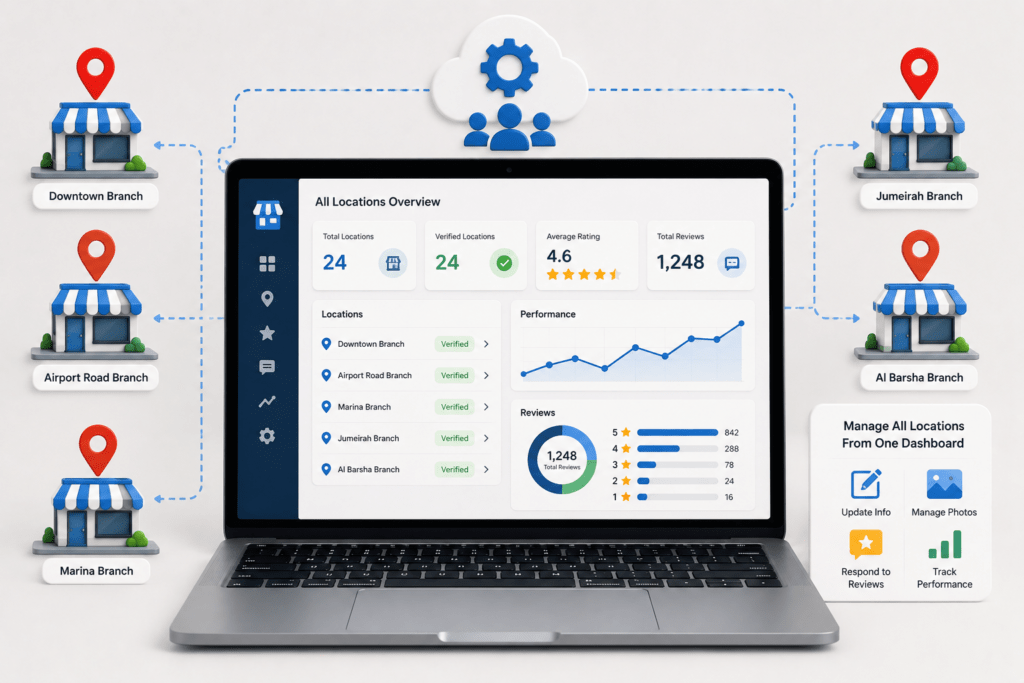
Two or three locations can often be managed manually. Once the business reaches dozens of locations, manual management starts creating unnecessary risks. Different teams update different information, employees leave, locations change their hours, new branches open, old branches close, and outdated information remains on external websites.
A centralized management system creates structure around all of those changes.
Build a master location database
Every multi-location business should maintain a reliable record of every active location.
The database should contain the information needed to manage each branch, including its official business name, physical address, phone number, website location page, categories, services, opening hours, special hours, ownership status, verification status, and operational status.
The exact fields will depend on the industry.
A healthcare organization may need information about departments, appointment links, practitioners, and accessibility. A retail chain may need store formats, pickup options, departments, and temporary closures. A restaurant group may need dining options, delivery availability, parking, and location-specific facilities.
The important point is that the database should reflect reality.
If a marketing manager needs to know the current phone number for Location 37, the answer should be available immediately. Nobody should need to search through old emails or contact a former employee.
Establish one source of truth
The database becomes much more useful when everyone treats it as the authoritative source.
Suppose a branch changes its phone number. The change should begin with the central location record. The website team, SEO team, directory-management team, and local manager can then work from the same approved information.
Without a central source of truth, several teams may independently update different platforms.
The website may contain one phone number.
Google may contain another.
A directory may contain an older number.
A social profile may contain something different again.
Customers are left to figure out which information is correct.
Centralization reduces this problem by creating a clear information flow:
Business change → central record → approved digital channels → verification → monitoring.
This process becomes increasingly important as the number of locations grows.
Standardize what should be standardized
A centralized system does not mean every location should have exactly the same information.
Some information should be standardized at the brand level. Business naming conventions, photography guidelines, category policies, review-response standards, access rules, and reporting procedures can all be controlled centrally.
Other information should remain location-specific.
One branch may open at 7 a.m. while another opens at 9 a.m. One location may provide delivery while another does not. One store may have parking while another relies on nearby public parking.
Those differences are not inconsistencies.
They are facts.
Good multi-location GBP management creates consistency where consistency is appropriate while preserving legitimate local differences.
Define ownership and responsibilities
As the business grows, profile access can become a serious operational issue.
Corporate teams may manage the overall profile structure. Regional managers may oversee groups of locations. Local managers may provide branch information. SEO teams may monitor optimization and performance.
Everyone does not need identical access.
The business should know who owns the profiles, who manages them, who approves major changes, who handles verification issues, who monitors profile problems, and who is responsible for updating information when something changes.
This becomes especially important when employees leave or agencies change.
A profile should never depend entirely on one former employee’s account or an agency’s private system.
Clear governance makes the entire operation more resilient.
Create a change-management process
Location information changes constantly.
A branch may move. Opening hours may change. A service may be introduced or discontinued. A location may temporarily close for renovation. A new branch may open.
These changes should have a defined process.
The local team identifies the change. The responsible person verifies it. The central location record is updated. Relevant digital properties are changed. Someone checks the customer-facing result.
That simple process prevents a surprisingly large number of errors.
The goal is not to create unnecessary bureaucracy. The goal is to ensure that a real-world change does not remain trapped inside one department while customers continue seeing outdated information elsewhere.
Audit Existing Google Business Profiles Before Adding Locations
Before creating a new profile, find out whether one already exists.
This is one of the most important rules for businesses expanding into new markets or acquiring existing businesses.
A location may already have a profile created years ago. It may have accumulated reviews, photographs, local visibility, and customer history. Creating another listing without understanding the existing one can lead to duplication and unnecessary complications.
Build a complete profile inventory
Search for each location using the brand name, city, neighborhood, address, phone number, and relevant services.
Compare what appears in Google Search and Maps with the internal location database.
The purpose is to discover the current local search footprint.
A complete inventory should identify legitimate profiles, duplicate listings, unclaimed profiles, suspended profiles, outdated listings, and locations that are missing a profile altogether.
The audit should also record important information about each profile so that the team can prioritize its work.
Check for duplicate listings
Duplicates can appear for many reasons.
An employee may have created a new listing because they could not find the original. A location may have moved and someone may have created a new profile instead of updating the existing one. Two departments may have independently created profiles.
The solution is not to automatically delete whichever profile looks less complete.
First determine which profile represents the legitimate location and understand the relationship between the listings.
The same principle applies after acquisitions and rebranding. A newly acquired business may already have valuable local profiles that should be properly managed rather than replaced without investigation.
Check ownership and verification
A profile can be visible to customers while still being poorly controlled by the current business.
This is particularly common when profiles were created by former employees, franchise operators, or external agencies.
Ownership should therefore be part of the audit.
The company should know whether it can manage the profile, who currently has access, and whether verification or ownership issues need to be resolved.
Compare GBP information with reality
A profile that is technically complete may still contain incorrect information.
Check the business name, address, phone number, category, website, hours, services, photographs, and other important information.
Then compare that information with what customers actually encounter.
If the store has moved, the old address is a serious issue.
If the phone number no longer works, the profile is failing a basic customer need.
If the profile says the branch is open on a day when it is closed, the information is misleading.
If photographs show a storefront from five years ago, the customer may struggle to recognize the location.
Accuracy should therefore be treated as the first level of optimization.
Check the location page
The profile should connect customers to the correct location page on the business website.
A location-specific search should not necessarily send the customer to the corporate homepage and force them to search again.
The location page should reinforce the information in the GBP. The name, address, phone number, hours, services, and other important details should make sense together.
When different teams manage the website and GBP independently, inconsistencies can easily appear.
A profile may be updated while the website remains outdated, or the website may be corrected while Google continues displaying the old information.
A proper audit catches these gaps.
Optimize the Most Important GBP Information
Once the audit is complete, optimization can begin.
The goal is not to fill every available field just because it exists. The goal is to provide accurate information that helps customers understand the business.
Choose the right primary category
The primary category should accurately describe the main business represented by the location.
This is particularly important for organizations with different types of branches.
A healthcare company might operate general clinics, specialist centers, and diagnostic locations. A retail group might operate full-size stores, express stores, and specialty outlets.
The category should reflect what customers actually encounter at that location.
Do not choose categories simply because they contain a desirable keyword.
Relevance should come first.
Use secondary categories carefully
Secondary categories can add useful context, but they should represent legitimate business activities.
If a customer visited the location, would the selected category make sense?
If the answer is no, the category probably does not belong.
Different branches can legitimately have different secondary categories when their services differ.
Write useful business descriptions
Business descriptions should sound like they were written for customers, not search engines.
A common shortcut is to create one corporate description and copy it into every profile while changing the city name.
That saves time, but it wastes an opportunity.
A better approach is to establish consistent brand messaging and then adapt it to the individual location.
If one branch has extended hours, a special service, unique facilities, or a particular customer focus, that information may be worth mentioning.
The writing should remain natural.
Keyword stuffing does not make a profile more useful.
Keep hours accurate
Opening hours are one of the simplest pieces of information and one of the easiest to get wrong.
Customers often check hours immediately before visiting.
Regular hours should be maintained, but special hours matter too. Holidays, temporary closures, renovations, seasonal schedules, and unusual operating periods should be handled carefully.
A central location-management process makes this easier because local teams can communicate changes through one established workflow.
Add useful services and attributes
Customers often search because they need a particular service.
A profile that clearly communicates what a location actually provides can reduce uncertainty.
The important word is actually.
Do not list services offered by another branch simply because they belong to the same company.
If a service is not available at that location, the profile should not imply otherwise.
Use real location photography
Photographs should help customers understand and recognize the location.
Exterior photographs can help someone identify the storefront. Interior photographs show the environment. Product and service images explain what the business offers.
For multi-location brands, real branch-specific photography is particularly valuable.
A generic corporate photograph may communicate the brand, but it does not necessarily help a customer recognize a particular branch.
Photography should also be reviewed periodically. A renovated location may look completely different from the photographs uploaded several years earlier.
Master NAP Consistency Across All Locations
NAP stands for Name, Address, and Phone number.
These details form the basic identity of a local business and should be managed carefully across the company’s digital presence.
The objective is not to force identical information everywhere regardless of context. The objective is to ensure that the information representing each location is accurate.
Keep the business name consistent
The business name should reflect the real-world name customers recognize.
Avoid adding unnecessary keywords, promotional language, or location terms purely for search purposes.
A multi-location brand should have a clear naming convention so that corporate and local teams are not creating different versions of the same business name.
Keep addresses accurate
Physical addresses need particular attention during relocations and expansions.
When a location moves, the change should be reflected in the central database and then propagated to the relevant digital properties.
An old address can do more than create an SEO inconsistency. It can send a customer to the wrong place.
Keep phone numbers current
A phone number is often one of the first actions a customer takes after discovering a local business.
If a number is disconnected, redirected incorrectly, or assigned to another location, the profile is failing a basic customer need.
Phone-number changes should therefore be part of the location change-management process.
Audit citations
Business directories and third-party websites can retain old information long after the company has updated its own website.
Periodic citation audits can identify outdated addresses, old phone numbers, incorrect names, and duplicate listings.
The larger the location network, the more useful systematic auditing becomes.
Build High-Quality Location Pages for Every Branch
A strong Google Business Profile should lead customers to a useful website destination.
For most multi-location businesses, that means creating dedicated location pages.
A location page should not simply be a corporate page with a city name substituted into the text.
It should answer the questions customers have about that specific branch.
Give every location a useful digital home
A good location page should clearly communicate the branch name, address, phone number, hours, services, directions, and relevant facilities.
Depending on the industry, it may also include photographs, local reviews, staff information, parking details, appointment options, or nearby landmarks.
The page should help someone who has never visited the location understand what to expect.
Avoid duplicate location pages
Creating 100 pages with essentially the same paragraph and changing only the city name does not create 100 useful local resources.
The page should have a genuine reason to exist.
That does not mean every sentence needs to be completely different. Basic business information will naturally repeat across locations.
What matters is whether the page provides useful location-specific information beyond the address.
Connect GBP and website content
The GBP and location page should tell the same basic story.
If Google shows one phone number and the website shows another, customers may hesitate.
If Google says the location is open until 9 p.m. but the website says 8 p.m., customers do not know which source to trust.
Maintaining consistency between the two is therefore part of good customer experience.
The supplied quality guidelines emphasize that pages should fulfill their purpose and provide satisfying Main Content. For a location page, that means giving visitors useful information about the location rather than creating a page primarily to capture search traffic.
Develop a Scalable Review Management Strategy
Reviews are local reputation signals, but more importantly, they are customer feedback.
A multi-location business should therefore manage reviews at the branch level.
Encourage genuine reviews
Businesses can create a consistent process for asking customers to share honest feedback after an interaction.
The objective should be genuine feedback, not manufactured ratings.
A branch with a healthy review process can build a stronger and more representative reputation over time.
Respond like a real business
Customers can tell when review responses are copied and pasted.
A response does not need to be long. It needs to acknowledge what the customer actually said.
Positive reviews can receive genuine appreciation. Negative reviews should be handled calmly and professionally, with the focus on resolving the issue where appropriate.
Look beyond the star rating
A location with a 4.7 rating and 2,000 reviews is different from a location with a 4.7 rating and 12 reviews.
Review volume, recency, recurring complaints, positive themes, and response patterns all provide useful context.
Reviews can also reveal operational issues.
If customers repeatedly mention parking problems, confusing directions, long waits, or a particular service issue, the business may need to address the underlying operational problem rather than simply trying to improve its online reputation.
Manage each location independently
A brand-wide rating can hide significant differences.
One branch may have an excellent customer experience. Another may have persistent complaints.
Local review management should therefore provide branch-level visibility.
The corporate team can establish standards, but local teams often need to understand and respond to the actual experiences customers are reporting.
Optimize Photos, Posts, Q&A, and Other GBP Features
A profile should remain useful after it is initially created.
That does not mean posting content every day simply to appear active. It means reviewing customer-facing information regularly and updating it when there is a genuine reason.
Use real photographs
Location-specific photographs can answer practical questions that text cannot.
What does the entrance look like?
Where is the business located?
What does the interior look like?
What products or facilities are available?
What can a customer expect when they arrive?
Real images make the profile more useful and can help customers feel familiar with a location before visiting.
Publish useful updates
Posts can communicate genuine local updates, seasonal information, events, announcements, and relevant offers.
The content should serve a customer purpose.
There is little value in publishing generic updates that do not help anyone.
Use customer questions as content signals
Customers often ask the same questions repeatedly.
Can I park here?
Do you offer this service?
Are appointments required?
Is the location accessible?
What time do you open on weekends?
Those questions can help identify missing information on the profile and website.
Keep information fresh
Profiles should be reviewed when locations change.
A renovation, new service, changed hours, relocation, or temporary closure can make old information misleading.
The goal is not constant activity.
The goal is current information.
Scale GBP Management From 10 to 500+ Locations
The process that works for five locations will not necessarily work for 500.
At scale, the business needs repeatable systems.
Create a multi-location GBP SOP
A standard operating procedure should explain how the organization handles profile creation, verification, ownership, NAP changes, categories, photographs, reviews, location pages, closures, relocations, and reporting.
This allows new employees and teams to follow the same process.
It also reduces dependency on individual knowledge.
Create different levels of responsibility
Corporate teams can establish brand standards and governance.
Regional teams can oversee groups of locations.
Local managers can report changes and provide branch-specific information.
SEO teams can monitor visibility, reviews, website performance, and optimization opportunities.
This division allows each group to focus on what it knows best.
Prioritize exceptions
Not every location needs the same amount of attention.
A healthy location with accurate information and strong reviews may need routine monitoring.
A location with a duplicate listing, incorrect phone number, poor reviews, or weak visibility may require immediate attention.
This exception-based model becomes essential when the location count grows.
Without prioritization, teams can spend too much time making small improvements to healthy profiles while serious problems remain unresolved.
Understand Local SEO: Relevance, Distance, and Prominence
Local search performance is not determined by profile completeness alone.
Three useful concepts for understanding local search are relevance, distance, and prominence.
Relevance
Relevance asks whether the business matches what the customer is looking for.
Accurate categories, services, business information, reviews, and useful location content all help communicate what the business actually does.
A profile should be specific enough that the relationship between the customer’s search and the business is clear.
Distance
Distance is geographic.
A business cannot simply add more keywords and expect to overcome physical distance.
A customer searching from one part of a city may see a different set of local businesses from someone searching from another part.
That is why location itself remains central to local SEO.
Prominence
Prominence relates to how established and recognized a business appears.
Reviews, local references, links, citations, reputation, and broader visibility can all contribute to how a business is understood in the local search ecosystem.
The exact balance will differ by market and query.
Diagnose before changing everything
When a location performs poorly, do not immediately rewrite its entire profile.
First ask what is actually wrong.
Is the business not relevant enough to the search?
Is the location geographically disadvantaged?
Does it lack reputation or local prominence?
Is the profile simply inaccurate?
Is the website page weak?
The answer determines the appropriate action.
Prepare Multi-Location Businesses for AI Search in 2026
Search is becoming increasingly conversational, which makes clear business information even more valuable.
The most useful approach is not to chase every new AI feature or create content specifically for an imagined algorithm.
Instead, make the business easy to understand.
Build a clear local business entity
The company name, location, services, contact information, website, and other important details should consistently describe the same real-world business.
This creates a clearer digital identity.
Make location information easy to understand
Important information should not be buried.
A customer should be able to understand where the location is, what it offers, and how to contact it.
The same principle applies to search systems.
Clear information is easier to interpret than inconsistent or ambiguous information.
Use real customer language
Reviews and customer questions can reveal how people naturally describe services.
Those phrases can inform useful website content, FAQs, and location information.
The goal is not to copy reviews into pages or stuff keywords into paragraphs.
It is to understand the language customers actually use.
Connect the local SEO ecosystem
GBP, location pages, reviews, structured business information, directories, and other references should reinforce one another.
The more consistently these sources describe the same location, the easier it is for customers—and search systems—to understand the business.
The Search Quality Evaluator Guidelines emphasize understanding user intent and judging whether content fulfills that intent. That principle remains useful regardless of how the search interface changes.
Service-Area Businesses: A Different Local SEO Challenge
Not every multi-location business operates traditional storefronts.
Some businesses travel to customers or serve defined geographic areas without maintaining a physical office in every city they target.
That creates a different local SEO challenge.
Distinguish physical locations from service areas
A genuine physical location should be represented as such.
A service area should represent where the business genuinely provides its service.
Businesses should not imply that they have physical offices in cities where they do not operate simply because those cities have valuable search demand.
Accuracy matters more than geographic expansion.
Build useful service-area content
If a business creates pages for different service areas, each page should help customers understand what service is available and how the company operates in that area.
Useful local context can make a page more meaningful.
The page should not simply say:
“We provide [service] in [city].”
It should explain the service, customer needs, relevant considerations, and how the business can help.
Avoid thin city pages
Creating dozens of pages with nearly identical content and changing only the city name is rarely a strong long-term strategy.
The Search Quality Evaluator Guidelines emphasize useful Main Content and satisfying the purpose of a page. A geographic landing page should therefore provide genuine value to someone interested in that area.
Measure GBP Performance at the Location Level
If the business does not measure individual locations, it cannot reliably identify where improvement is needed.
Brand-wide reporting can be useful, but it should not replace branch-level analysis.
Track visibility
Monitor how locations perform for relevant local searches and Maps visibility.
The goal is not to obsess over one ranking position.
Local results can vary by searcher location and context, so broader patterns are more useful.
Measure customer actions
Track meaningful actions such as calls, website visits, direction requests, appointments, and other relevant conversions.
These actions are often more useful to business leaders than ranking reports alone.
A location that ranks well but generates little customer engagement may need a different strategy from a location with moderate visibility but strong conversion activity.
Monitor reputation
Track review volume, ratings, recent activity, sentiment, and response patterns.
Look for changes over time rather than relying on one snapshot.
Connect GBP to website performance
A dedicated location page makes it easier to understand what happens after a customer clicks from Google.
Businesses can analyze location-specific traffic, engagement, leads, and conversions.
This creates a clearer connection between local search visibility and business outcomes.
Build a practical dashboard
A useful dashboard can combine profile health, visibility, customer actions, reviews, website activity, and unresolved problems.
The purpose is not to collect every available metric.
The purpose is to answer:
Which locations are healthy?
Which locations need attention?
What should we do next?
A 30-60-90 Day GBP Optimization Roadmap
A structured implementation plan makes a large optimization project easier to execute.
Days 1–30: Clean and standardize
The first month should focus on the foundation.
Audit every location and identify duplicates, ownership problems, inaccurate information, weak location pages, and inconsistent NAP details.
Establish the central location database and define who is responsible for managing profiles.
Review categories, hours, websites, and verification status.
The objective is not advanced optimization.
It is to make sure the business knows what it has and whether the basic information is correct.
Days 31–60: Improve local relevance
Once the foundation is stable, improve the customer-facing experience.
Review descriptions, services, photographs, location pages, reviews, and other useful information.
Make each location page genuinely useful.
Strengthen the review-management process.
Identify location-specific differences that should be reflected in the profiles.
At this stage, the business should be moving from cleanup to meaningful local optimization.
Days 61–90: Measure and improve
The final stage should focus on performance.
Review visibility, calls, website activity, direction requests, reviews, and conversions.
Identify locations that are still underperforming.
Do not assume that every weak location needs the same fix.
Use the relevance, distance, prominence framework to understand the situation and prioritize the most valuable improvements.
After 90 days, the process should continue.
A multi-location GBP strategy is not a campaign that ends after three months. It is an ongoing operating system.
Common Multi-Location GBP Mistakes to Avoid
Even experienced marketing teams can make basic mistakes when managing large location networks.
Creating duplicate profiles
Always investigate existing listings before creating a new one.
Adding keywords to business names
Business names should represent the real-world business, not become containers for search terms.
Copying identical location pages
Location pages should provide genuine local value instead of merely swapping city names.
Allowing NAP information to drift
Outdated phone numbers and addresses can create confusion across the customer journey.
Choosing irrelevant categories
Categories should accurately describe the business and its services.
Ignoring weaker branches
A strong overall brand average can hide individual locations that need help.
Letting opening hours become outdated
Customers depend on hours when deciding whether to visit.
Using generic photographs everywhere
Customers benefit from seeing the actual location they intend to visit.
Treating reviews as a numbers game
Review volume and star rating matter, but the content and recurring themes can reveal much more.
Treating GBP optimization as a one-time project
Locations change, customers leave reviews, businesses open and close, and services evolve.
The profile needs to evolve with the business.
Build a Repeatable Multi-Location GBP SOP
The final piece is creating a process that can be repeated.
A good SOP should explain what happens when a new location opens, an existing branch moves, a location closes, a phone number changes, services change, or a profile develops a problem.
New location launch
Before a new location opens, confirm its official information, website page, category, hours, ownership, verification status, services, photographs, and other customer-facing details.
GBP should be part of the location launch process rather than something handled after the branch is already operating.
Monthly maintenance
Review important profile information regularly.
Check hours, services, reviews, photographs, customer questions, and other location details.
The exact frequency can vary by business, but the process should be consistent.
Quarterly citation audit
Review important external business listings for outdated or inconsistent information.
This is particularly useful for organizations with frequent openings, closures, relocations, or acquisitions.
Review management
Create a clear workflow for monitoring reviews, responding appropriately, identifying recurring problems, and escalating serious customer issues.
Local teams can provide context while corporate teams maintain standards.
Closures and relocations
When a location closes or moves, the change should be handled systematically.
Update the central location record first, then coordinate the necessary changes across GBP, the website, directories, and other important channels.
Performance reporting
Maintain a simple performance record for each location.
Visibility, customer actions, reputation, website performance, profile health, and unresolved issues should all be considered.
A documented process makes the business less dependent on individual employees and easier to scale.
FAQ
1.How do I optimize Google Business Profile for multiple locations?
Start by creating a complete inventory of your locations and existing profiles. Audit each listing for accuracy, duplicates, ownership, categories, hours, reviews, photographs, and website connections. Then establish a central location database and a repeatable process for ongoing management.
After the foundation is clean, optimize each location individually. Use accurate categories and services, maintain useful location pages, manage reviews, update photographs, and monitor performance at the branch level.
2. Should every location have its own Google Business Profile?
Eligible physical locations should be represented accurately rather than combining unrelated branches into one profile. However, businesses should always check whether an existing legitimate profile already represents a location before creating another one.
This is particularly important for businesses that have acquired other companies, relocated branches, or changed management.
3. How do I keep NAP consistent across hundreds of locations?
Create a centralized location database containing the approved business name, address, and phone number for every branch. Treat that database as the source of truth.
When information changes, update the central record first and then coordinate the change across GBP, the website, directories, and other important digital properties.
Regular audits are also useful because third-party websites can retain outdated information.
4. Do multi-location businesses need separate location pages?
Dedicated location pages are generally useful when they provide genuine information about individual branches.
A strong page should help customers understand the location, services, hours, contact information, directions, facilities, and other relevant details.
Avoid creating hundreds of nearly identical pages that differ only by city name. A location page should exist because it provides value to customers interested in that particular branch.
5. Is Google Business Profile optimization still important in 2026?
For businesses that depend on local customers, Google Business Profile remains an important part of the local discovery journey.
Customers use local business information to find locations, compare options, check hours, read reviews, visit websites, request directions, and contact businesses.
The important point is to avoid treating GBP as an isolated SEO tactic. It works best when connected with accurate website information, location pages, customer reviews, local reputation, and reliable business data.
6. How often should Google Business Profiles be updated?
Core information should be updated whenever it changes.
Businesses should also regularly monitor reviews, hours, services, photographs, profile issues, and other customer-facing information.
The larger the organization, the more important it becomes to establish recurring maintenance rather than relying on occasional manual updates.
7.What is the biggest mistake multi-location businesses make?
The biggest mistake is treating every location as an identical copy of the corporate profile.
Centralized standards are valuable, but individual branches have legitimate differences. Hours, services, facilities, customer experiences, photographs, and local circumstances can vary.
The best strategy combines a consistent brand framework with accurate location-level information.
8.How can I manage GBP for 100 or more locations?
Start with centralized data and clear ownership.
Maintain a master location database, establish an SOP, define responsibilities for corporate, regional, local, and SEO teams, and create an exception-management system.
Healthy locations can receive routine monitoring while locations with duplicate profiles, incorrect information, reputation problems, verification issues, or weak performance receive priority attention.
This makes the process scalable without requiring every location to receive exactly the same amount of manual work.
Conclusion
Google Business Profile optimization for multi-location businesses is ultimately an exercise in balancing centralized governance with local relevance.
The brand should provide the framework. Individual locations should provide the reality.
That means maintaining accurate business information, managing profiles centrally, auditing existing listings, choosing appropriate categories, keeping hours current, using real photographs, creating useful location pages, maintaining NAP consistency, managing reviews, and measuring performance at the branch level.
The most important lesson is not to treat every location as a copy of the corporate profile.
Every branch has its own customers, competition, reputation, services, and circumstances.
A strong multi-location strategy recognizes those differences while maintaining consistent brand standards.
Start with the fundamentals. Know which profiles exist. Fix inaccurate information. Establish one source of truth. Create useful location pages. Build a repeatable review process. Monitor each branch instead of relying only on brand averages.
Then keep improving.
The best Google Business Profile optimization strategy is not the one that produces the most updates. It is the one that consistently makes every location easier to find, easier to understand, easier to trust, and easier for customers to act on.
One brand. Multiple local entities. One reliable system connecting them.