
How to Leverage Social Proof to Boost Brand Credibility

Introduction
In today’s hyper-transparent digital economy, where consumers in Dubai and across the GCC evaluate brands not only by their promises but by the collective experiences of others, social proof has become the new currency of trust. A glossy advertising campaign may capture attention, but what sustains credibility is the perception that other people, customers, influencers, employees, or peers endorse the brand.
Robert Cialdini, whose foundational work on persuasion theory introduced “social proof” as a principle of influence, noted that “we view a behavior as more correct in a given situation to the degree that we see others performing it.” This insight, once confined to academic theory, now defines brand survival in markets where reputational capital is more fragile than ever.
For brands in Dubai, a city that positions itself as the capital of credibility in finance, real estate, tourism, and retail, social proof is not optional. It is the invisible scaffolding upon which trust, preference, and loyalty are built. This article explores how social proof functions as a branding accelerant, unpacks frameworks for embedding it into communications, and provides regional case studies that demonstrate its impact.
The Strategic Role of Social Proof in Branding
From Awareness to Assurance
Traditional advertising raises awareness; social proof creates assurance. Customers no longer trust marketing messages in isolation. A NielsenIQ study found that 92% of consumers trust recommendations from peers, even strangers, more than brand-generated content. For Dubai’s competitive consumer market, this means brands must borrow trust from others to earn legitimacy.
Social proof operates across the brand funnel:
- At the awareness stage, testimonials and influencer content reduce skepticism.
- At the consideration stage, ratings and reviews validate decision-making.
- At the conversion stage, case studies and user-generated content mitigate risk.
- At the loyalty stage, advocacy reinforces community belonging.
In effect, social proof transforms branding from self-assertion (“we are trustworthy”) into externally validated reputation (“others prove we are trustworthy”).
The Psychology Behind Brand Social Proof
Cognitive Shortcuts in a Crowded Market
Antonio Damasio’s research on decision-making demonstrated that human choices are rarely rational; they are driven by emotional shortcuts. Social proof functions as a heuristic, reducing cognitive load in moments of uncertainty. In the GCC, where consumers are bombarded with competing offers during high-stakes retail events like White Friday or Ramadan campaigns, this shortcut becomes critical.
- Fear of Missing Out (FOMO): If “everyone” is buying from Noon or Ounass during a seasonal sale, individual consumers feel compelled to join.
- Authority Bias: Endorsements from trusted figures be it Sheikh Hamdan’s subtle nods to brands or a global celebrity at Dubai Mall carry outsized influence.
- Similarity Effect: When local consumers see “people like me” leaving positive reviews in Arabic, Hindi, or Tagalog, relatability drives adoption.
As behavioral scientist Gerald Zaltman observed, “95% of purchase decisions occur in the subconscious mind.” Social proof speaks directly to this subconscious arena, bypassing rational filters.
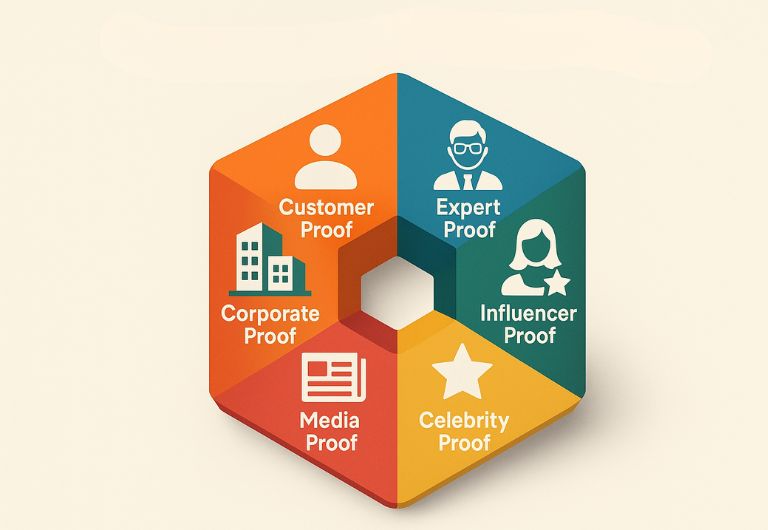
Framework: The Six Dimensions of Brand Social Proof
For agencies advising brands in Dubai, categorizing social proof into clear, strategic dimensions is crucial. Each dimension plays a distinct role in shaping credibility, and the right mix depends on the sector, target audience, and brand maturity. Below we expand the six dimensions with greater depth and contextual application:
1. Customer Proof
Perhaps the most accessible yet powerful form of validation, customer proof includes reviews, star ratings, testimonials, unboxing videos, and user-generated content on platforms such as Instagram or TikTok. In the GCC, consumers place disproportionate value on community validation, especially when reviews are localized in Arabic, Hindi, or Tagalog languages that resonate with the region’s multicultural population. For example, Noon prominently features star ratings and reviews to ease purchase anxiety during Yellow Friday, converting hesitant browsers into confident buyers. By surfacing “voices of the many,” customer proof provides scale-driven legitimacy.
2. Expert Proof
When credibility hinges on authority, expert proof becomes the gold standard. This dimension includes endorsements from industry professionals, certifications from recognized bodies, independent audits, and published whitepapers. For sectors like fintech, healthcare, and luxury real estate industries where reputational risk is high, expert validation is non-negotiable. A DIFC-based fintech start-up, for instance, gains trust not by flashy ads, but by publishing compliance certifications and showcasing backing from respected financial regulators. Expert proof anchors the brand in evidence, not opinion.
3. Influencer Proof
The GCC’s social media penetration rate is among the highest globally, making influencer proof especially potent. Collaborations with local and regional influencers whether mega influencers with millions of followers or micro-creators with niche communities can rapidly shift perceptions. Importantly, influencer proof is not just about reach but relatability. A beauty brand targeting Gen Z women in Dubai might rely on TikTok creators for authentic tutorials, while a B2B SaaS company could partner with respected LinkedIn voices to build executive credibility. The effectiveness lies in matching the influencer’s persona with the brand’s DNA.
4. Celebrity Proof
Dubai thrives on global attention, from Hollywood stars at film festivals to football icons endorsing luxury towers. Celebrity proof capitalizes on this visibility by associating brands with internationally recognized names. When a celebrity is seen shopping at Mall of the Emirates or posting about Emirates Airlines, the halo effect transfers credibility to the brand. For luxury, hospitality, and fashion sectors, celebrity proof not only signals popularity but also status alignment. In a region where aspirational consumption is deeply ingrained, celebrity endorsement reinforces the perception of exclusivity.
5. Media Proof
Coverage in respected media outlets Gulf News, Khaleej Times, Arabian Business, or regional TV platforms carries weight far beyond advertising. Unlike paid campaigns, earned media signals independent recognition. A start-up featured in Arabian Business is perceived as credible by investors and customers alike, while a multinational brand quoted in The National reinforces its leadership position in the region. Media proof is particularly effective in B2B contexts, where stakeholders often equate journalistic visibility with market legitimacy.
6. Corporate Proof
This dimension highlights the brand’s ecosystem: strategic partnerships, joint ventures, B2B case studies, and awards from recognized bodies such as Dubai Chamber, Dubai Lynx, or Effie MENA. Corporate proof demonstrates that a brand has been vetted and validated by other credible institutions. For example, when Etisalat collaborates with global tech giants or when a homegrown SME wins a Dubai Chamber award, the association elevates trust instantly. In sectors like construction, energy, or government services, corporate proof may outweigh all other dimensions because institutional validation carries long-term credibility.
Strategic Application
Each dimension is not equal in weight; the relevance shifts depending on category and audience. A start-up fintech in DIFC may prioritize expert proof (regulatory compliance) and corporate proof (partnerships with banks), while a lifestyle beauty brand in Dubai Mall might rely heavily on influencer and customer proof. The art of brand strategy lies in designing the right mix balancing immediacy (customer reviews) with authority (expert validation) and prestige (celebrity or corporate recognition).
Case Studies: Dubai and GCC in Action
Noon’s “Yellow Friday” Trust Play
Noon rebranded Black Friday into Yellow Friday, not just to localize but to own the trust narrative. By featuring real customer reviews on product pages, highlighting influencer unboxing videos, and running campaigns with Arabic-speaking micro-creators, Noon turned transactions into proof points. The result: it consistently dominates UAE e-commerce sales in November.
Emirates NBD and Peer Validation
In retail banking, where switching costs are high, Emirates NBD has consistently showcased client testimonials and SME success stories. By embedding customer narratives into their brand campaigns, the bank transforms intangible financial promises into visible proof of reliability.
Careem’s Community Credibility
When Careem launched its loyalty program, it leaned on social validation by showcasing the number of rides booked and positive ratings from drivers and customers. This “strength in numbers” approach reassured users in a category where trust in safety and reliability is paramount.
Integrating Social Proof into the Brand Ecosystem
1. Website and Digital Platforms
Social proof is most effective when embedded seamlessly into the customer journey. Brands must integrate ratings, reviews, and testimonials not as afterthoughts but as conversion tools. For instance, adding dynamic review counters on e-commerce checkout pages can reduce cart abandonment by up to 18% (Baymard Institute, 2023).
2. Paid Media Campaigns
Campaigns in Dubai’s outdoor spaces Sheikh Zayed Road billboards or The Dubai Mall LED screens gain credibility when backed by social proof. Rather than leading with slogans, brands can feature trust metrics (“Rated 4.9/5 by 20,000 GCC customers”). This reframes paid media from persuasion to validation.
3. Retail & Experiential Environments
Dubai malls thrive on footfall, but in-store credibility still matters. Sephora Middle East integrates customer ratings directly into product displays. This empowers hesitant shoppers with real-time proof of popularity.
4. PR and Thought Leadership
Articles in regional outlets are themselves social proof. When a Dubai-based brand is profiled in Arabian Business or quoted in Gulf Marketing Review, credibility is reinforced among stakeholders, investors, and regulators.
The Data Imperative: Quantifying Social Proof
In the GCC’s increasingly regulated environment, anecdotal proof is insufficient. Stakeholders demand measurable credibility.
- Trust Metrics: Net Promoter Score (NPS), review scores, referral rates.
- Engagement Metrics: Social shares, comment sentiment, influencer reach.
- Adoption Metrics: Customer growth validated by independent audit or government recognition.
For example, Dubai Tourism leverages data-driven social proof by showcasing annual visitor numbers and satisfaction indices as a trust anchor in its campaigns. Numbers, when credible, speak louder than narratives.
Challenges and Guardrails
The Risk of Over-Engineering Proof
While social proof is persuasive, artificial or manipulated proof backfires. Fake reviews, inflated influencer claims, or over-edited testimonials erode trust. In markets like Dubai, where regulators actively monitor misleading practices under consumer protection laws, authenticity is not negotiable.
Cultural Calibration
Not all proof resonates equally across demographics. Emirati audiences may be more influenced by family-oriented endorsements, while expatriate millennials may respond to global influencers. A one-size-fits-all proof strategy fails in a cosmopolitan city with 200+ nationalities.
Platform Dependence
Relying solely on Instagram or TikTok for proof is risky. Algorithm shifts can diminish reach overnight. Brands need omni-channel proof strategy websites, PR, retail, and community forums to hedge dependency.
Agency Framework: Embedding Social Proof in Brand Strategy
Agencies play a pivotal role in transforming social proof from scattered, tactical executions into a coherent brand architecture. Too often, organizations treat proof points reviews, awards, influencer shout-outs as campaign embellishments rather than strategic assets. A forward-thinking Dubai-based agency, however, must recognize that credibility cannot be improvised. It requires deliberate mapping, orchestration, and amplification.
To operationalize this, we propose The Social Proof Integration Model (SPIM) a structured blueprint that ensures proof is not reactive but embedded in the DNA of brand strategy.
The Social Proof Integration Model (SPIM)
1. Audit: Map the Trust Landscape
The first step is diagnostic. Brands must conduct a credibility audit that inventories all existing proof assets: customer reviews, influencer mentions, corporate partnerships, awards, certifications, case studies, and press coverage. This exercise surfaces both strengths (e.g., high ratings on e-commerce platforms) and gaps (e.g., lack of expert endorsements in regulated sectors). In Dubai, such audits must also factor in linguistic diversity: is proof available in Arabic for Emiratis, in Hindi for South Asian audiences, and in English for expatriates? Without localized proof, reach remains limited.
2. Curate: Align Proof with Brand Positioning
Not all proof is equally relevant. The key is curation. Agencies must prioritize proof types that reinforce the brand’s strategic positioning premium, accessible, innovative, sustainable, or luxury. For example, a luxury real estate developer at Dubai Creek Harbour gains more from celebrity and corporate proof (celebrity endorsements, government partnerships) than from sheer volume of customer reviews. Meanwhile, a start-up in DIFC may need expert proof (compliance certifications, fintech accelerator validation) to establish legitimacy in a conservative sector. Curating proof ensures consistency rather than noise.
3. Embed: Integrate Proof Across All Touchpoints
Proof loses power when siloed. Agencies must weave it seamlessly into the customer journey. On websites, trust badges and testimonials should be placed at conversion moments. In retail spaces, physical displays can highlight awards or ratings. In PR campaigns, customer success stories and independent media coverage should anchor the narrative. Embedding proof across touchpoints elevates it from a “supporting claim” to a central element of persuasion.
4. Amplify: Scale Proof Through Storytelling
Social proof must not remain static; it must be amplified. Agencies should design campaigns that scale proof across channels digital storytelling on TikTok, influencer collaborations on Instagram, outdoor campaigns on Sheikh Zayed Road, or earned media features in Arabian Business. The amplification phase ensures that proof reaches beyond the converted and into the attention economy. For example, Careem amplified its “safety proof” by running a campaign featuring both customer testimonials and driver advocacy stories, reinforcing a two-sided trust ecosystem.
5. Measure: Track and Iterate for Stronger Resonance
Proof without measurement risks complacency. Agencies must establish KPIs around credibility review sentiment scores, referral rates, influencer ROI, PR reach, and Net Promoter Score (NPS). In Dubai’s data-intensive business environment, proof should be continuously monitored and optimized. An influencer who once drove engagement may lose credibility over time; a testimonial may need refreshing to reflect current consumer needs. Measurement ensures proof evolves alongside market expectations.
Together, these five stages move social proof from improvisation to institutionalization, allowing agencies to position themselves not merely as campaign executors, but as architects of credibility.
The Dubai Edge: Why Social Proof Matters More Here
While social proof is a universal concept, its importance in Dubai and the wider GCC context is amplified by structural, cultural, and technological dynamics. Brands operating in this region must recognize the unique conditions that make proof not just valuable, but indispensable.
Hyper-Competition
Dubai’s marketplace is one of the most crowded in the world. From global giants like Apple, Nike, and Amazon, to regional powerhouses like Noon, Ounass, and Namshi, and a growing ecosystem of start-ups in DIFC and Dubai Internet City competition is fierce. In such a crowded field, credibility is the ultimate differentiator. Consumers overwhelmed with choice often default to brands with visible validation. Proof reduces decision friction and accelerates preference.
Cultural Collectivism
In many GCC societies, purchasing decisions are collective rather than purely individual. Family members, friends, or community networks play a decisive role in validating choices. For example, when an Emirati family selects a new car, the decision may involve extended relatives. In such contexts, social validation multiplies in influence. A brand that demonstrates strong proof across multiple audiences through testimonials, peer recommendations, and community engagement aligns with this collectivist orientation.
Regulatory Rigor
Dubai has enacted strict consumer protection regulations to prevent deceptive advertising, fake reviews, or manipulated influencer campaigns. The UAE’s Consumer Protection Law and Advertising Standards Authority impose penalties for false claims, reinforcing the need for authentic proof. Agencies that embed credibility as a compliance-aligned asset protect brands from reputational and legal risks. This regulatory rigor means proof must be verifiable, consistent, and auditable.
Digital-First Consumer Behavior
Dubai has one of the highest social media penetrations globally, with platforms like TikTok, Instagram, and Snapchat deeply embedded in daily life. This creates an environment where proof travels faster, wider, and with more permanence. A single viral testimonial or conversely, a negative review can reach millions within hours. High mobile adoption rates mean consumers are constantly cross-referencing proof during purchase journeys, whether in malls, online stores, or via WhatsApp recommendations. Proof, in this sense, is not just an influence mechanism, it is a real-time decision trigger.
Strategic Implication for Agencies
For Dubai-based branding agencies, these dynamics create both responsibility and opportunity. Agencies must design proof strategies that are culturally calibrated, legally compliant, digitally agile, and strategically aligned with brand positioning. The agency that masters this role moves from being a service provider to being a guardian of credibility, ensuring that proof is not fragmented but orchestrated to deliver enduring brand equity.
Conclusion: From Proof Points to Perception Capital
In 2025 and beyond, brand social proof must be treated not as campaign collateral, but as strategic capital. Its function extends well beyond boosting conversions; it shapes how stakeholders, customers, employees, regulators, investors form judgments about a brand’s trustworthiness. In Dubai’s hyper-competitive landscape, credibility cannot be manufactured through advertising alone. It must be earned, validated, and amplified by others.
At the core of this shift lies User & Market Branding Perception. Reputation is no longer defined solely by brand messaging; it is co-created through the experiences, voices, and validations of others. When customers leave authentic reviews, when respected institutions bestow awards, when influencers lend their voice, or when trusted media outlets provide coverage, these collective signals build a perception ecosystem that is more powerful than any one campaign.
For businesses, the imperative is clear: embedding social proof into governance, culture, and communication is now as important as financial performance. A strong foundation of proof lowers acquisition costs, accelerates market adoption, and insulates brands from reputational shocks.
For agencies, the opportunity is even more profound. No longer should they be seen merely as executors of marketing campaigns. The real value lies in positioning themselves as custodians of credibility architects who design frameworks where social proof is systematically curated, integrated, and amplified. Agencies that master this role are not just building visibility for their clients; they are engineering beliefs.
In a market as diverse, digital-first, and culturally interconnected as Dubai, the brands that win will be those that recognize social proof as the linchpin of trust and translate it into enduring brand equity. The ultimate outcome is not just visibility in crowded markets, but believability that converts awareness into advocacy.
FAQ
1. What is social proof and why is it important for brand credibility?
Social proof is evidence that real people trust and value your brand—such as reviews, testimonials, ratings, and user-generated content. It helps potential customers feel confident in their buying decisions and builds instant credibility for your business.
2. What types of social proof work best for businesses?
The most effective forms of social proof include customer reviews, case studies, influencer endorsements, client testimonials, media mentions, and social media engagement. A mix of these elements creates a strong and trustworthy brand image.
3. How can businesses collect social proof effectively?
Businesses can gather social proof by encouraging happy customers to leave reviews, requesting testimonials after successful projects, showcasing customer stories, and engaging users on social media. Offering incentives or simple feedback forms can also help increase participation.
4. Where should social proof be displayed for maximum impact?
Social proof should be placed on key touchpoints such as your website homepage, product pages, landing pages, email campaigns, and social media profiles. Displaying it where customers make decisions helps increase trust and conversions.
5. How does social proof influence purchasing decisions?
People naturally trust the experiences of others. When potential customers see positive feedback and real-life success stories, they are more likely to trust your brand, feel confident about your products, and ultimately choose you over competitors.