
Real Estate SEO in Dubai: Ranking Listings, Projects and Area Guides
Real estate SEO in Dubai means getting a brokerage or developer website to rank in Google for the searches portals like Bayut and Property Finder do not own: off-plan project names, community and area questions, and investor research. It relies on clean listing pages, honest handling of sold or expired stock, useful area guides and compliant, permit-numbered ads.
What is real estate SEO in Dubai?
Real estate SEO is the work of making a property website show up in Google when buyers, tenants and investors search. In Dubai, that means picking the searches you can win, not fighting portals for every query. You build pages that answer project, community and investor questions better than anyone else.
Dubai Media Office reported more than 270,000 property sales worth AED 917 billion in 2025, up 20% on the year before. Around 193,100 investors took part, and about 129,600 of them were new to the market.
Portals take the generic listing searches. Your goal is to win the searches that sit before and around the portal visit: “what is the payment plan for this project”, “is JVC good for families”, “when is handover”. Those are the people who are ready to talk to a broker or a developer.
Who this guide is for
This guide is for marketing heads, digital leads and founders at Dubai brokerages and developers. You likely pay portal fees already. You want to know if your own site can bring leads, and what to brief your team or agency on. We cover the page types, the technical rules and the Dubai rules that touch SEO, in the order you would build them.
Where Bayut and Property Finder win, and where your own site can
Portals win generic listing searches, and your site wins specific ones. A search like “apartments for sale in Dubai” goes to portals because they hold the most stock. A search for a project name, a community question or an investor topic is open to anyone with the best page.
Google Trends data for the UAE shows how strong the portal brands are. Between October 2025 and October 2026, searches for “property finder” averaged around 75 on the Trends scale, and “bayut” around 66. Over the same period, “apartments for sale dubai” fell from about 10 to about 3. Generic listing searches are moving to the portal brands themselves.
The useful question is which searches the portals do not answer well. This table is a planning guide, not a record of live results. Who wins each query type varies, so check the real results for your own targets.
|
Query type |
Example |
Who typically wins |
Page to build on your site |
|
Generic listing |
apartments for sale in Dubai Marina |
Portals |
Do not chase it; support with community pages |
|
Community or area |
living in JVC, Dubai Hills schools |
Open |
Area or community guide |
|
Project name |
a named off-plan launch |
Developer, then brokers |
Off-plan project page |
|
Developer |
Emaar or Sobha new launches |
Developer, brokers |
Developer hub page |
|
Investor question |
what is off plan property, rental yield in Business Bay |
Open |
Guide or explainer |
|
Brand |
your brokerage name |
You |
Home and about pages |
Why the open rows matter
The open rows are where buyers do their research. A portal page lists hundreds of flats in a community. It rarely explains service charges, school runs or which buildings suit a young family. That depth is where your site can add something a portal page does not.
Quora threads on property SEO say the same thing. Answers from SEOs point new brokers away from head terms and towards local depth, schools, rules and data around the listings.

Listing pages: duplicate portal copy, unique descriptions and what to index
Listing pages are the hardest pages to rank because the same flat appears on many sites. Quora answers from SEOs describe the UAE as having no MLS, with portals acting as the shared listing source, so several agents may list the same unit. If your listing copy matches the portal copy word for word, Google has little reason to show your version.
Write your own description
The fix is simple but takes effort. Write a fresh description for each listing you want to rank. Use your own photos where you can, not only the developer renders. Add facts a portal page often skips, such as the view from the balcony, the walk to the metro or the building’s service charge.
Keep the description useful and short. Lead with the price in AED, the size, the layout and the community. Then add what makes this unit different. A buyer should learn something on your page they could not learn on Bayut.
Decide what to index
Not every listing needs to be in Google. A thin page with one photo and a copied paragraph can drag the rest of the site down. Quora answers from SEOs suggest putting a noindex tag on thin listings and putting the effort into strong local pages instead.
A practical rule: index listings with unique copy, original photos and a clear price. Noindex the rest until they are improved. Your community and project pages then carry the search traffic, and the listings below them catch buyers who are ready to enquire.
Canonical tags for repeated listings
Sometimes the same listing lives at several URLs on your own site. This happens with print views, tracking links or a unit filed under two categories. Google’s canonical guidance lists three ways to show the main version, from strongest to weakest: redirects, the rel=canonical tag and sitemaps. Pick one main URL and point the copies to it.
A canonical tag only works inside your own control. It will not make Google prefer your listing over a portal’s copy of the same unit. Only unique content does that.
Sold, rented and expired listings: keep, redirect or remove
Every Dubai listing ends, so you need a rule for what happens next. Leaving dead listings live with a “sold” badge and no other content wastes crawl time. Deleting them without a plan can lose links and traffic you built.
Google’s guidance on HTTP status codes helps here. Google treats 404 and 410 the same way: both remove an indexed URL from search. A page that says “not found” but returns a 200 status becomes a soft 404. So an empty “this unit is gone” page served as 200 helps no one.
A simple decision path
Use these three outcomes for listings that end.
- Keep with a status. If the page still has value, keep it live and mark it sold or rented. This suits units in a building you sell often, where the page has photos, floor plans and price history.
- Redirect to the building or project. If a closely matching page exists, such as the building or project page, a 301 redirect can send buyers there. Redirect only to a page that truly matches. Redirecting everything to the home page is a poor fit.
- Return 404 or 410. If the page has no links, no traffic and no close match, let it go. Google will remove it.
Do not leave an empty page with a 200 status. It turns into a soft 404 and wastes crawling.
Write this rule down and agree it with whoever runs your CRM feed. Most listing problems on Dubai sites come from feeds that create and remove pages with no SEO rule at all.

Off-plan project pages: ranking before launch and keeping rankings through handover
Off-plan project pages are a major SEO asset for a Dubai developer or broker. People search for a project name soon after they hear it. If your page exists, is indexed and answers their questions, it has a chance to rank before portals list the units.
Google Trends shows steady interest in “off plan” across the UAE, with top related searches such as “off plan dubai”, “off plan projects in dubai” and “what is off plan property”. These are research searches. They suit a well built project page and a clear explainer better than a portal grid.
Build the page early
Create the project page as soon as you have approved details you are allowed to publish. Give it one stable URL that will survive launch, sales and handover. Do not build a new page at each stage. Every move resets links and history you have already earned.
On a pre-launch page, publish what buyers ask first:
- The project name, developer and master community
- Unit types and size ranges
- The payment plan, including any post-handover plan
- The expected handover date
- Location, nearby metro and road links
- An enquiry form and WhatsApp button
Keep it fresh through handover
A project page that stops changing after launch loses ground. Add construction progress updates with dated photos. Update the payment plan when it changes. Add floor plans as they are released. Each update gives buyers a reason to return and gives Google a reason to recrawl.
At handover, keep the same URL. Change the page from “off-plan” to “ready” and add resale and rental listings in the building. The page then serves the next wave of buyers and tenants, and it keeps the links it built during launch.
Show the permit number
Every project page that markets units is a real estate ad in Dubai. It should show the advertising permit number and, where it applies, the Madmoun QR code. We cover these rules in their own section below.
Area and community guides that beat generic content
Area guides win when they use facts a portal page does not show. A generic “living in Dubai Marina” page with stock photos is unlikely to rank. A guide with service charges, school options, metro times and original photos can.
Portals have area pages too, but they are often light on detail. Your advantage is local knowledge. Put that knowledge on the page.
What to put in a strong community guide
A useful guide answers the questions a buyer asks on a first viewing. Build each guide around the same blocks so they stay consistent:
- Who it suits: families, young professionals, investors or retirees
- Prices and rents: ranges from your own data or DLD transaction data, with a date
- Service charges: typical ranges per square foot for the main buildings
- Schools and nurseries: names and rough drive times
- Transport: nearest metro station, main roads and drive time to key hubs
- Amenities: parks, beach access, malls and clinics
- Original photos: taken by your team, not pulled from the developer brochure
Avoid duplicate area pages
The common mistake is to copy one template across 40 communities and only swap the name. Those pages look the same to Google, and to buyers. Each guide needs facts that only apply to that place. Start with your top five communities by enquiries, such as Downtown Dubai, Dubai Marina, Business Bay, JVC and Dubai Hills Estate, and do those well before adding more.
Area guides are a form of location page. Our local SEO in Dubai guide explains how location pages, maps and reviews work together.
Link guides, projects and listings together
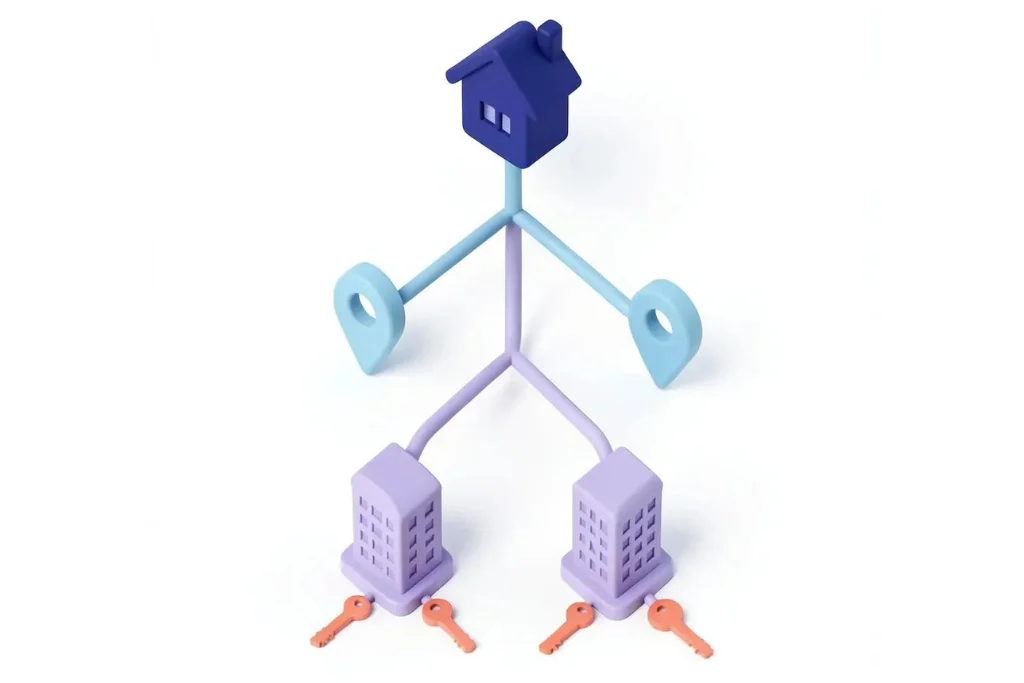
Your site structure should follow how buyers think: community, then building or project, then listing. Each community guide links down to its projects and buildings. Each project page links up to its community guide and down to available units. This keeps link value flowing to the pages that bring enquiries.
Search filters and crawl budget on property sites
Search filters can create millions of URLs that Google does not need. Every mix of price, bedrooms, community and sort order can make a new page. If Google crawls all of them, it may miss the pages that matter.
Google’s faceted navigation guidance, updated in December 2025, gives clear steps. Block filter URLs you do not need indexed with robots.txt. Keep URL parameters in a consistent order and format. Return a 404 status when a filter combination has no results, instead of an empty page.
What to keep and what to block
Decide which filtered pages deserve to rank. A page for “2 bedroom apartments in JVC” may match a real search, so it can become a proper landing page with its own copy. A page for “2 bed, JVC, AED 900,000 to 950,000, sorted by newest” does not match any search, so block it.
A short plan for most Dubai brokerage sites:
- List the filter pages that match real searches, usually community plus property type plus bedrooms.
- Turn those into clean, static URLs with unique intro copy.
- Block other filter mixes in robots.txt.
- Return 404 for empty results.
- Keep only the clean pages in your XML sitemap.
Our technical SEO for large inventories page covers crawl control, feeds and site structure for big catalogues.
Structured data for property sites: what helps and what does not
Structured data helps search engines read your pages, but it will not rank a weak page on its own. Use it to describe what is on the page clearly. Do not expect a special real estate result in Google.
Schema.org has a RealEstateListing type. It is a kind of web page with fields such as datePosted and leaseLength. It helps describe a listing, but Google’s own search gallery lists no real estate listing feature. The types Google does show in its gallery include Breadcrumb, Organization, Local business and Video.
A practical schema set
For most brokerage and developer sites, this set covers the basics:
- Organization on the home page, with your logo, contact details and social profiles
- Local business for each office, with address and opening hours
- Breadcrumb on every page, showing community, building and listing
- Video on project pages with walkthroughs or construction updates
- RealEstateListing on listing pages, to describe the unit to any system that reads it
Google also says there are no extra requirements or special schema needed to appear in AI Overviews or AI Mode. Good content and normal SEO basics are what count. Our page on schema for properties, hotels and reviews shows how we set this up for property sites.
Dubai rules that touch SEO: Trakheesi permits, Madmoun QR codes and licensed authors
Dubai’s advertising rules cover real estate marketing, and the safe approach is to treat your project and listing pages as ads. Check the current rules with DLD before you publish.
The Dubai Land Department said in 2020 that RERA requires a permit, issued through the Trakheesi system, before any real estate marketing campaign. The permit number must appear in every ad. DLD said fines start at AED 50,000. At that time, DLD fined 10 companies and warned another 30 for breaking the rules.
Madmoun QR codes
In April 2023, DLD launched the Madmoun service. It puts a QR code on each permitted ad from 24 April 2023. Buyers can scan it to check the ad is real and see whether the property has already been sold or rented.
This links neatly to SEO. A listing page that shows a valid permit number and a Madmoun code is easier for buyers to check. It also pushes you to keep listing status accurate, which supports the sold and expired rules above.
Licensed authors and expert review
This part is best practice for expertise and trust, not a Dubai legal requirement. Have a RERA-licensed broker write or review property guides, and add the author’s name, role and licence details to guides and project pages.
Our research for this guide looked at 12 pages from two Google UAE searches on 19 October 2026. None of them mentioned Trakheesi, Madmoun or RERA-licensed authors.
Local SEO, Arabic and AI answers for brokers and developers
Three more channels shape how Dubai buyers find you: Google Maps, Arabic search and AI answers. Here is the short version, with links to our deeper guides.
Google Business Profile
Your office profile shows in the map pack when people search “real estate agent near me” or “brokers in Business Bay”. Keep your name, address and phone the same everywhere. Ask happy clients for reviews. Post new projects and market updates. Our Google Business Profile setup guide for UAE businesses walks through each field.
Arabic pages
Many GCC buyers search in Arabic, using terms like عقارات دبي or شقق للبيع. A translated menu is not enough. Build Arabic pages with their own keyword research and set hreflang tags for en-ae and ar-ae. Our Arabic SEO guide and our guide to multilingual SEO for UAE and GCC websites cover the setup.
AI answers
Buyers now ask ChatGPT, Gemini and Google’s AI Overviews which areas suit families or which projects offer post-handover plans. Google says it needs no special markup for this. Clear answers near the top of each page, accurate facts and a named expert author give AI tools something they can quote.
For a wider view of how these channels fit together, read our guide to types of SEO for businesses in Dubai and Abu Dhabi.
Measuring SEO by lead quality: WhatsApp clicks, viewings and cost per lead vs portal spend
Measure real estate SEO by leads and viewings, not by traffic alone. For example, a page with 200 visits and 10 qualified WhatsApp chats beats a page with 5,000 visits and none. The aim is to compare the cost of an organic lead with the cost of a portal lead.
What to track
Set up these events in Google Analytics 4 and connect them to your CRM:
- WhatsApp clicks from each page
- Phone clicks and tracked call numbers
- Enquiry form submissions, with the page that sent them
- Viewings booked from organic leads, logged in the CRM
- Deals closed, tied back to the first page the lead visited
Google Search Console shows which searches bring people to each page. Track rankings by community and by project, not only by head terms. That tells you which guides and project pages pull their weight.
Compare against portal spend
Once you know your organic leads per month, divide your SEO cost by that number. Do the same for each portal using your fees and the leads it sends. The comparison shows which channel gives you a lower cost per lead.
Our work with a Jumeirah developer shows what this looks like in practice. In the high-net-worth lead pipeline case study, long-tail SEO content ranked for 18 luxury-specific search terms in the top 5, and the campaign scheduled 43 qualified showings in 60 days.
Getting started
Start with an audit of your current site. Find thin and duplicate listings, empty filter pages and dead URLs. Then build your first project page and your first three community guides. If you want help with the plan, our hospitality and real estate SEO team can run a real estate SEO audit and show you where your site can win.
FAQ
SEO in real estate is the work of getting a property website to rank in Google for searches by buyers, tenants and investors. It covers listing pages, project pages, area guides, technical setup and local search. In Dubai, it focuses on searches portals do not own, such as project names and community questions.
SEO in property means the same thing as real estate SEO. It is how a broker, developer or property manager makes their website show up when people search for homes, projects or areas. The main tools are useful pages, clean site structure and accurate listing data.
Our research found about 90 UAE searches a month for “real estate seo” in AnswerThePublic, with a high cost per click of US$18.25, so the term is modest in volume but commercially valuable. The property market itself is large, with more than 270,000 sales in Dubai in 2025, so brokers and developers have a reason to look for leads beyond portal fees.
We do not cite a public price range, because no reliable one exists. Cost depends on the size of your site, the number of listings and how much content you need. A small brokerage with a few community guides needs far less work than a developer with many projects and a large feed. Ask for a scoped audit first so you pay for the work your site needs.
You can handle the basics yourself, such as writing unique listing copy, keeping your Google Business Profile up to date and building community guides. Technical work on filters, feeds and redirects usually needs a developer or an SEO specialist. Many teams do content in-house and bring in help for the technical side.
ChatGPT can help draft outlines, suggest questions and speed up writing. It cannot check your site’s crawl data, see your CRM leads or know the latest payment plan for a project. Use it as a writing aid, then have a licensed broker review the facts.
SEO is evolving, not dead. AI Overviews and chat tools now answer many questions, but they still draw on web pages. Google says normal SEO basics are enough to appear in its AI features, so clear, accurate pages remain the way to be found.
No. AI tools change how answers are shown, but they still rely on well built, trusted websites for their facts. A property site with clear answers, real data and expert authors gives AI tools a source worth citing.
Good SEO takes skilled time across content, development and data. For property sites, that includes writing unique copy for many pages, fixing large feeds and keeping project details current. The cost is easier to judge when you compare cost per organic lead against cost per portal lead.
Do not compete for generic listing searches. Focus on project names, community questions, developer searches and investor topics, where portal pages are thin. Build detailed project pages and area guides with original facts to give your site a chance at those searches.
Sources
- Dubai Media Office: Dubai’s real estate market records new historic milestone
- Dubai Land Department: DLD fines 10 real estate companies and warns another 30 for not adhering to advertising requirements
- Gulf News: Dubai Land Department launches Madmoun service for real estate ad verification
- Google Search Central: Managing crawling of faceted navigation URLs
- Google Search Central: How HTTP status codes and network errors affect Google Search
- Google Search Central: How to specify a canonical URL
- Google Search Central: AI features and your website
- Google Search Central: Structured data markup that Google Search supports
- Schema.org: RealEstateListing
- Quora: How do I beat the national real estate portals at SEO?
- Quora: How do I rank the real estate listing pages on Google?
- Quora: Are Bayut and PropertyFinder an MLS?