
Why AI Hallucinates About Brands, and How to Reduce the Damage
AI search is changing how people discover businesses. Instead of typing a query into Google and scanning a list of blue links, users can now ask ChatGPT, Gemini, Perplexity, Copilot and other AI-powered systems questions such as, “Which agency is best for SEO in Dubai?” or “What services does this company offer?”
That creates a new visibility challenge for brands. It is no longer enough for your website to rank well. Your business also needs to be understood accurately by AI systems.
The problem is that AI does not always get brands right. It may invent a service a company does not provide, show an outdated address, confuse two businesses with similar names, attribute an award incorrectly, or recommend a competitor instead. These mistakes are commonly called AI hallucinations.
For businesses, the issue goes beyond technical accuracy. An incorrect AI answer can influence what a potential customer believes about a company before they ever visit its website.
The good news is that businesses do have ways to reduce the likelihood and impact of these errors. You cannot directly control every AI-generated answer, but you can make your brand’s information clearer, more consistent, authoritative and easier for AI systems to discover and interpret.
AI hallucinations about brands happen when AI systems generate inaccurate, outdated, conflicting or unsupported information about a business. AI may misunderstand a brand because of incomplete training data, inconsistent information across websites, weak or outdated third-party sources, ambiguous business entities, or unreliable retrieval. For businesses, improving AI retrieval means making accurate brand information easy for AI systems to discover, understand and connect across authoritative sources. Clear website content, consistent business details, structured data, relevant third-party mentions and regularly updated information can help strengthen these signals. You cannot control every AI-generated answer, but you can make the correct version of your brand easier for AI to retrieve and understand.
What Is an AI Hallucination About a Brand?
An AI hallucination occurs when an AI system generates information that is inaccurate, unsupported or fabricated but presents it as though it were factual.
When the subject is a business, an AI hallucination might involve almost any part of the brand’s identity. An AI assistant could claim that a company provides a service it has never offered, associate it with the wrong location, give an outdated price, invent a partnership, misstate its history or incorrectly describe one of its products.
The important point is that not every incorrect AI answer is necessarily a hallucination.
An answer can be wrong because the information is outdated, because the system retrieved an unreliable source, because several websites contain conflicting information, or because the model misunderstood an entity. A fabricated claim is different from an old claim that was once accurate.
This distinction matters because the solution depends on the cause. If AI is using an outdated address, updating the brand’s online information may help. If it is confusing two companies with similar names, stronger entity signals may be required. If it invents information without a supporting source, the issue is more fundamentally related to AI generation and uncertainty.
Why Does AI Hallucinate About Brands?
AI systems generate answers using complex combinations of learned information, retrieval systems, ranking mechanisms and generation processes. They are not simply databases that look up one definitive record for every company.
One reason hallucinations occur is that information about a business can be incomplete or inconsistent. A company website may describe its services one way, a directory may use an older description, a social profile may contain outdated information and an article from several years ago may describe the business differently.
Brand ambiguity can create another problem. Companies with similar names, subsidiaries, parent companies, product brands and regional branches can be difficult for an AI system to distinguish when the available information does not clearly establish the relationships between them.
Freshness also matters. Businesses change constantly. They launch products, discontinue services, move offices, change leadership, update prices and enter new markets. Information published several years ago can remain available even after it becomes inaccurate.
There is also the fundamental nature of generative AI. A language model is designed to generate useful language, not simply retrieve a verified database record. As a result, an answer can sound extremely confident even when the underlying claim is wrong.
That is why an AI response should not automatically be treated as proof that the information exists somewhere in an authoritative source.
Why Brand Hallucinations Are More Dangerous Than Ordinary AI Errors
An incorrect answer about a general topic may be inconvenient. An incorrect answer about a company can directly affect trust, reputation and customer decisions.
Imagine a potential customer asks an AI assistant whether your company provides a particular service. The system says yes, but you do not offer it. The customer may arrive expecting something your team cannot deliver.
The opposite can be even more damaging. If AI says that you do not provide a service that is central to your business, a potential customer may never consider you.
AI can also recommend competitors instead. If the system understands a competitor’s services more clearly than yours, it may repeatedly include that competitor in recommendation-based searches while leaving your business out.
The consequences can include customer confusion, incorrect expectations, lost leads, reputational problems and missed visibility opportunities.
The problem becomes more significant because AI responses are conversational. Users may perceive an answer from an AI assistant as a personalized recommendation rather than simply another webpage to investigate.
Where Does AI Get Information About Your Brand?
AI systems can draw on different information sources depending on the platform, model and search experience.
Training Data
Large language models are trained on extensive collections of information. This learned knowledge can help an AI system understand companies, industries, products and concepts.
However, training knowledge is not a live database of your business. It can become outdated, incomplete or inaccurate as your company changes.
Live Web Retrieval
Some AI search experiences retrieve information from the web when responding to a question. This allows the system to use more current information than its underlying model may contain.
But retrieval introduces another challenge: which sources are selected?
If authoritative information exists alongside outdated or contradictory information, the system may not always select the source a business would prefer.
Your Official Website
Your website is one of the most important places to establish what your business actually does.
Clear service pages, company information, product descriptions, location details, leadership information and regularly updated content give search and AI systems a stronger first-party source to interpret.
Business Directories and Profiles
Directories, business listings, review platforms and social profiles can also contribute to the information ecosystem surrounding your brand.
Conflicting details across these sources can create ambiguity. A business that has changed its address, for example, should ensure that important external profiles are updated rather than leaving multiple versions of its location online.
Reviews and Social Platforms
Customer-generated information can influence how a business is perceived online. Reviews can provide useful context, but they should not be treated as a substitute for authoritative company information.
News and Third-Party Publications
Independent publications, industry websites, interviews, digital PR and expert contributions can strengthen the broader understanding of a brand.
This is particularly valuable when third-party sources independently reinforce important facts about a company.
Common Examples of AI Hallucinations About Businesses
Brand hallucinations can appear in surprisingly ordinary questions.
An AI assistant might provide an incorrect business location, especially when a company has multiple branches or has moved.
It might describe products or services the business does not offer, particularly when the company operates in a broad category with many similar businesses.
It may provide outdated pricing, even when the current website clearly shows different prices.
Another possibility is a fabricated award, certification or partnership. An AI system can generate a plausible-sounding claim that has no supporting evidence.
It can also provide an incorrect founder or company history, confuse related businesses, invent testimonials or incorrectly compare the company with competitors.
These examples demonstrate why brand accuracy is not one single data point. A company’s digital identity consists of many connected facts.
How to Find Out What AI Is Saying About Your Brand
The first step in reducing AI hallucinations is to find them.
Do not test your brand with only one question. Ask several questions that represent the types of information customers might want to know.
For example:
- What does [Company] do?
- What services does [Company] offer?
- Where is [Company] located?
- Who are [Company]’s main competitors?
- Is [Company] a good choice for [specific service]?
- What makes [Company] different?
- What products does [Company] sell?
- Who founded [Company]?
- What industries does [Company] serve?
Run variations of these prompts across relevant AI platforms.
The goal is not to find one perfect answer. The goal is to identify patterns.
If multiple systems repeatedly describe the company incorrectly in the same way, investigate why that information might exist in the wider web ecosystem.
Keep a record of the question, response, incorrect claim, cited sources and date. This creates a baseline that can be compared during future monitoring.
How to Identify the Source of an AI Hallucination
Once you identify an incorrect claim, investigate its possible origin.
Start with any citations or links provided by the AI system. Does the cited page actually support the statement? Is it current? Is it the original source?
Then search for the incorrect statement yourself.
You may discover that an outdated directory contains the information, an old article describes the company differently, a third-party profile has not been updated, or another business with a similar name is being confused with yours.
You may also find that the information does not appear anywhere credible. That is an important distinction because it suggests the claim may have been generated rather than retrieved from a trustworthy source.
The key principle is:
Do not only correct the AI answer. Investigate the information environment that may be producing the answer.
Research from the Tow Center for Digital Journalism illustrates why this matters. In one study of AI search engines, researchers found that the systems could provide incorrect answers while maintaining a confident conversational style. The study reported incorrect answers across more than 60% of its test queries.
How to Correct Wrong Information About Your Brand
If an incorrect claim originates from your own website, fix the website first.
Review your core business information and make sure important facts are clearly stated. This includes your services, products, locations, company description, leadership, contact information and other facts that customers frequently ask about.
Next, review important third-party sources. Correct outdated business listings and profiles where possible. If an important publication or directory contains incorrect information, contact the publisher or platform and request an update.
You should also avoid creating multiple contradictory versions of your brand story across your own content.
For example, if your homepage says you specialize in three services but an older service page describes five services, an AI system may have difficulty determining which description represents the current business.
The objective is not to publish more information simply for the sake of publishing more information. The objective is to create a clear, consistent information ecosystem.
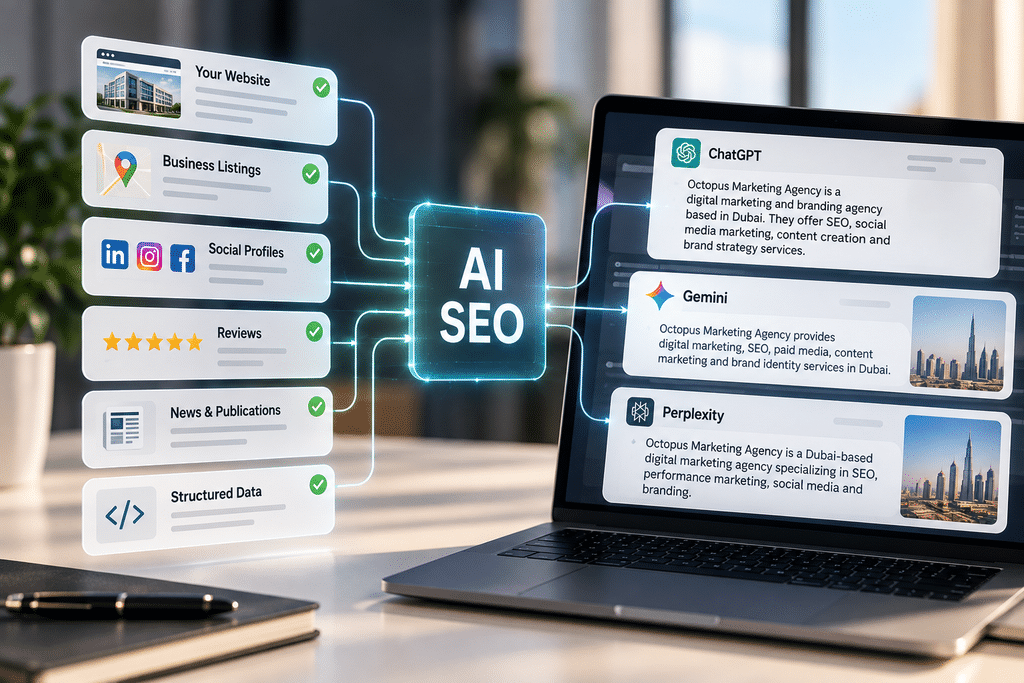
How AI SEO Can Reduce Brand Hallucinations
AI SEO is not a guarantee against hallucinations. However, it can improve the quality and accessibility of the information available to search and AI systems.
A strong AI SEO strategy begins with entity clarity.
Your company name, website, services, locations, products and relationships should be presented consistently. Search engines and AI systems should not have to guess whether two different names represent the same company.
Content should also be specific rather than vague. Instead of saying that your agency provides “innovative digital solutions,” clearly explain which services you provide, who they are for and what makes them different.
Your content should be supported by appropriate internal linking, structured information and credible external references.
This is where traditional SEO and AI SEO overlap. Technical accessibility, useful content, topical authority and strong information architecture remain important. AI search adds another layer: the information must also be easy to interpret and retrieve in the context of a question.
Why Consistent Brand Information Matters for AI Search
Consistency is one of the simplest areas businesses can improve.
Imagine that your website says your company has operated in Dubai for 12 years, a directory says 10 years, a press article says 8 years and an outdated profile lists a previous location.
A human can investigate these differences. An AI system may instead encounter several competing signals.
The same issue can occur with company names, addresses, phone numbers, service descriptions, founders, product names and business categories.
Consistency does not mean every website must use identical wording. It means important facts should not contradict one another.
The more important the information, the more carefully it should be maintained.
How Structured Data Helps AI Understand Your Business
Structured data gives search engines additional machine-readable context about entities and their attributes.
Depending on the business, relevant schema types may include Organization, LocalBusiness, Product and Service.
Structured data can help communicate relationships and attributes in a standardized format. For example, an organization can be associated with its official website and relevant profiles through appropriate properties.
However, structured data should not be treated as a magic solution for AI hallucinations.
It works best when it reflects information that is also clearly visible and accurate on the page. Adding schema that contradicts the visible content can create another inconsistency rather than solving one.
Think of structured data as part of your information architecture, not a shortcut to controlling AI answers.
How to Build Stronger Brand Signals Across the Web
Your website is important, but it is not the only representation of your company.
A strong brand information ecosystem can include relevant industry publications, authoritative directories, expert contributions, interviews, digital PR, reviews and credible third-party references.
The objective is not to manipulate AI systems by generating hundreds of mentions.
Instead, focus on earning legitimate references that independently reinforce important facts about your company.
If your agency specializes in a particular service, for example, relevant industry articles, expert commentary and authoritative profiles discussing that expertise can provide additional context around the entity.
This is where E-E-A-T principles, digital PR and brand authority can complement AI SEO.
The strongest signal is not simply “more mentions.” It is more credible and contextually relevant evidence.
How to Monitor AI Hallucinations Before They Damage Your Brand
Brand accuracy should not be treated as a one-time cleanup project.
AI systems, web content and business information all change. A response that is accurate today may be different later.
Create a recurring AI visibility check around the questions that matter most to your customers.
Track:
- How AI describes your company
- Which services it associates with your brand
- Whether your location is correct
- Which competitors it recommends
- Which sources it cites
- Whether important claims remain accurate
- Whether new incorrect information appears
You do not need hundreds of prompts to start. A focused set of high-value commercial and informational questions can provide a useful baseline.
Over time, this becomes an AI brand monitoring process rather than a one-off experiment.
What Businesses Can and Cannot Control About AI Answers
One of the most important things businesses need to understand is the difference between influence and control.
You can control the information you publish on your website. You can improve your structured data, update your business profiles, maintain accurate content and seek legitimate third-party coverage.
You cannot directly control a commercial AI model’s internal parameters, training schedule, individual response or the exact source it ultimately chooses for every query.
This distinction prevents unrealistic expectations.
The goal of AI SEO is not to guarantee that an AI assistant will always mention your company or always produce the answer you want.
The goal is to make your business clear, credible, discoverable and accurately represented across the information sources AI systems may use.
AI Hallucinations vs. Outdated Information: What’s the Difference?
This distinction deserves special attention because the solution changes depending on what went wrong.
An AI hallucination is generally an unsupported or fabricated claim generated by the system.
Outdated information may have once been correct but is no longer current.
Incorrect retrieval occurs when an AI system finds information that does not accurately answer the question.
Conflicting information occurs when multiple sources provide different versions of the same fact.
Misinterpretation occurs when the system has information but draws the wrong conclusion from it.
These problems can overlap. An outdated or conflicting information environment can make accurate AI responses more difficult.
That is why simply saying “AI hallucinated” is often not enough. Businesses should ask a more useful question:
What information caused the system to reach this conclusion?
A Practical AI Brand Accuracy Checklist
Use the following checklist to establish a basic brand accuracy program.
Audit your website. Make sure your most important company facts are current and clearly stated.
Review business profiles. Check major directories, social profiles and relevant industry listings for outdated information.
Check entity consistency. Make sure your company name, location, services and other core attributes are consistent.
Implement relevant structured data. Use appropriate schema to provide additional machine-readable context.
Strengthen authoritative sources. Build legitimate industry coverage, expert references and relevant third-party mentions.
Refresh important content. Remove or update pages that contain outdated business information.
Test AI platforms. Ask important customer questions across relevant AI search systems.
Track citations. Record which sources AI systems use when describing your business.
Document errors. Maintain a list of recurring inaccuracies and investigate their potential sources.
Repeat the process. AI visibility and the wider information ecosystem change over time.
What the Evidence Says About AI Accuracy
The problem is not theoretical.
A 2025 Tow Center study examined eight AI search tools, including ChatGPT Search, Perplexity, Gemini and Microsoft Copilot. The research found that the tools produced incorrect answers on more than 60% of queries in the researchers’ test dataset.
In another investigation, researchers gave ChatGPT 200 excerpts from 20 publications and asked it to identify their sources. The system produced partially or completely incorrect responses 153 times and acknowledged that it could not accurately answer only seven times.
The research also highlights an important lesson for businesses: simply making information accessible to AI crawlers does not guarantee that the information will subsequently be represented accurately.
The researchers also documented cases where AI attributed information to syndicated or republished versions instead of the original source.
That reinforces the importance of thinking about source quality, consistency and authority, rather than assuming that publishing information once is enough.
The Brand Information Signal Framework
A practical way to approach AI brand accuracy is to think in six stages.
1. Discover
Find out what AI systems currently say about your business.
2. Diagnose
Identify inaccurate claims and investigate where conflicting or outdated information exists.
3. Strengthen
Improve the accuracy and clarity of your official website and relevant external sources.
4. Structure
Use clear entity information, appropriate structured data and logical website architecture.
5. Reinforce
Build legitimate authority through relevant publications, expert contributions, reviews and third-party references.
6. Monitor
Continue testing important prompts and tracking changes in AI-generated brand information.
The framework changes the question from “How do I stop AI from hallucinating?” to something much more actionable:
“How can I make the correct version of my brand easier for AI to discover, understand and support?”
A Six-Step Framework to Reduce Brand Hallucinations
We use a simple loop: Discover, Diagnose, Strengthen, Structure, Reinforce, Monitor.
1. Discover: find out what AI is actually saying
Test branded prompts across ChatGPT, Gemini, Perplexity and Google’s AI features. Ask the same question several ways: “What does [brand] do?”, “Is [brand] good for [use case]?”, “[Brand] vs [competitor]”, “Where is [brand] based?”. Record every answer, every claim that is wrong, and every citation.
Visual note: add a screenshot of a real AI answer containing a brand error here, with an anonymised caption.
2. Diagnose: trace the error to its source
Check the URLs the AI cites. Look for outdated pages, old press releases, inconsistent directory listings and copied versions of your content. Then classify each error: fabricated, outdated, misinterpreted, wrongly retrieved, or caused by conflicting sources. Where the AI gives no citation, ask what information is missing or unclear on your own site.
3. Strengthen: make your own site the clearest source
State your core facts plainly and keep them current: what you do, who you serve, where you operate, key people, pricing approach, and policies. Update or remove pages that contradict them. A dedicated, well-maintained About page and clear service pages give AI systems something authoritative to retrieve.
4. Structure: make facts machine-readable
Use structured data to describe your business explicitly. Organization and LocalBusiness schema, plus Product or Service markup where relevant, help systems identify who you are and what you offer. Use sameAs links to connect your site with your official profiles, and keep names, addresses and descriptions identical everywhere.
5. Reinforce: build trustworthy signals beyond your site
Correct and standardise business listings, keep social profiles consistent, and earn mentions in credible industry publications through digital PR and expert contributions. Reviews and third-party references help confirm that your version of the facts is the accepted one. This is also where traditional E-E-A-T work pays off in AI search.
6. Monitor: make it a routine, not a one-off
Re-run your prompt set on a schedule, track recurring inaccuracies, watch which competitors appear in recommendations, and note changes in citations. Set up a clear correction process so someone owns the fix when an error appears.
Your AI Brand Accuracy Checklist
- Website accuracy: core facts are current, consistent and easy to find.
- Business listings: names, addresses, hours and descriptions match everywhere.
- Structured data: Organization, LocalBusiness and Service markup is in place and valid.
- Entity consistency: one brand name, one description, one version of your history.
- Third-party authority: credible mentions and reviews that confirm your facts.
- Content freshness: outdated or contradictory pages are updated or removed.
- Prompt testing: a standard set of branded prompts is checked on a regular schedule.
- Citation monitoring: you track which sources AI cites about you, and when they change.
Conclusion:
AI hallucinations are not simply a technical curiosity. For brands, they can become a problem of information accuracy, reputation and search visibility.
The most useful response is not to assume that every incorrect AI answer can be manually corrected. Instead, investigate why the system may be misunderstanding the business.
Look for outdated information. Find conflicting sources. Strengthen your first-party content. Improve entity clarity. Use appropriate structured data. Build credible third-party authority. Then monitor what AI systems actually say.
The central principle is simple:
You cannot control every AI answer, but you can build an information ecosystem that makes the correct answer easier for AI to find.
That is where AI SEO becomes more than another optimization tactic. It becomes an ongoing approach to ensuring that your business is not only visible across AI-powered search, but also understood accurately, represented consistently and supported by trustworthy information.
Frequently Asked Questions
Why does ChatGPT give incorrect information about my business?
AI can produce incorrect information because of outdated knowledge, conflicting sources, incorrect retrieval, ambiguous entities or generated information that is not supported by reliable evidence. An incorrect answer does not necessarily mean your website contains incorrect information.
Can I correct a hallucination about my brand?
You cannot directly edit every AI model’s internal knowledge or guarantee a particular response. However, you can investigate the incorrect claim, correct inaccurate first-party and third-party information, strengthen authoritative sources and monitor whether the problem persists.
How do I know where an AI got incorrect information about my company?
Start with the citations and links provided in the response. Compare them with your official information and search for the incorrect claim across the web. Look for outdated directories, old articles, conflicting profiles or similarly named businesses.
Can AI hallucinations hurt my brand reputation?
Yes. Incorrect information can create customer confusion, undermine trust, misrepresent your services or influence potential customers toward competitors. The severity depends on what information is incorrect and how customers use the AI-generated answer.
Does SEO help prevent AI hallucinations?
Traditional SEO does not guarantee hallucination prevention, but strong SEO fundamentals can help establish clear, authoritative and accessible information. AI SEO extends this approach by focusing on entity clarity, retrieval, citations, structured information and how AI systems interpret your brand.
How does structured data help AI understand my business?
Structured data provides machine-readable information about entities and their attributes. It can help clarify relationships and business details when implemented accurately, although it cannot guarantee that an AI system will always use or interpret the information correctly.
How often should I check what AI says about my brand?
There is no universal frequency. Businesses with high customer-search activity, frequent product changes or significant reputational exposure should monitor more regularly. Start with a focused set of important prompts and establish a repeatable review process.
Can businesses control what ChatGPT says about them?
Businesses cannot directly control every AI response. They can, however, influence the quality and consistency of information available across their website and broader digital ecosystem.