
Answer Engine Optimization: The Complete Guide to Getting Cited by ChatGPT, Gemini, and Google AI Overviews
Your website ranks well on Google. Your target keywords sit on page one. Your organic traffic looks healthy on paper.
But when a customer asks ChatGPT, Gemini, or Google AI Overviews for a recommendation in your space, your brand may not show up at all. A competitor gets mentioned instead sometimes a competitor that ranks below you in traditional search.
This is the new reality of search behavior. People are increasingly asking questions and receiving synthesized, ready-made answers instead of clicking through a list of blue links. The click is disappearing. The answer is becoming the destination.
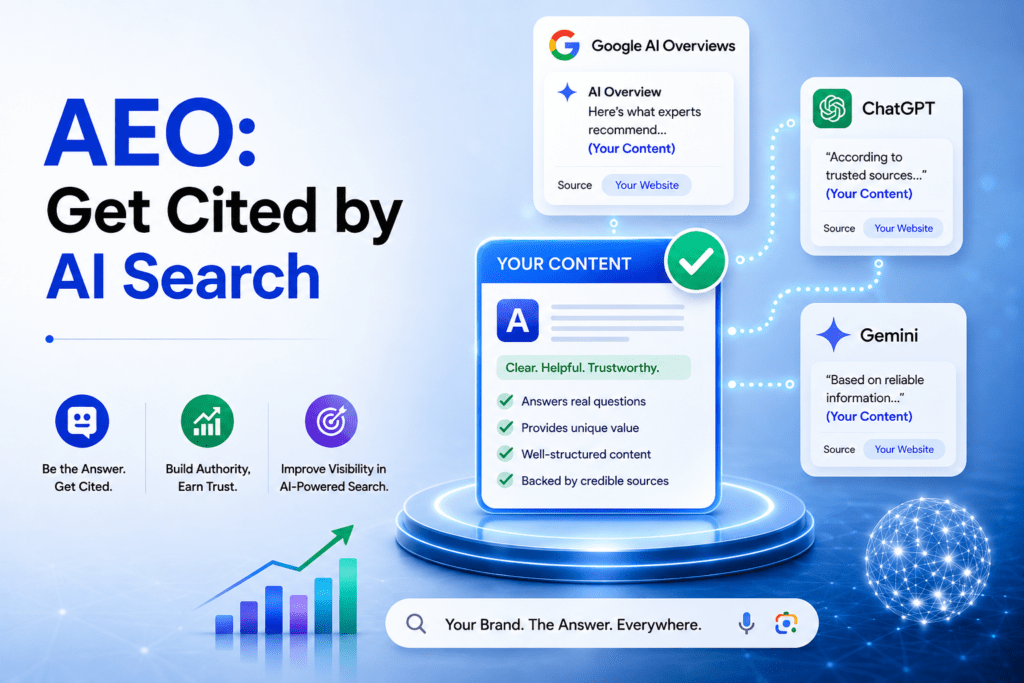
This shift is why Answer Engine Optimization (AEO) matters. AEO is not simply about optimizing pages for AI. It’s about engineering information the actual claims, evidence, and context inside your content so that AI systems can understand it, verify it, reuse it, and potentially cite it as a trustworthy source.
This guide walks through a complete AI Citation-Ready Framework: what makes content citable, how to apply that framework to your existing pages, and how to measure whether it’s working.
Answer Engine Optimization (AEO) is the process of making website information easier for AI-powered systems such as ChatGPT, Gemini, Perplexity, and Google AI Overviews to understand, verify, retrieve, and potentially cite. AI-retrievable content normally provides a direct answer immediately below the relevant heading, uses clear definitions that can stand alone, supports important claims with credible sources, identifies relevant brands, authors, products and locations, and provides sufficient context around statistics. Descriptive headings, logical structure and regularly reviewed information also make important passages easier to extract accurately.
SEO and AEO perform different but connected roles. SEO helps a page become crawlable, discoverable and competitive in traditional search results, while AEO helps the information within that page become clear, extractable and reusable in AI-generated answers. Neither AEO, schema markup nor a particular content format can guarantee an AI citation. These practices can only improve citation eligibility by making information easier to understand and verify.
AEO performance should be measured by testing a consistent set of realistic customer prompts across relevant AI platforms. Businesses can monitor brand mentions, website citations, cited pages, prompt-level visibility, competitor mentions and competitor citation share. Repeating these tests after content updates helps determine whether stronger answers, evidence, sourcing and entity clarity are improving AI search visibility.
What Is Answer Engine Optimization (AEO)?
AEO in Simple Terms
Answer Engine Optimization is the practice of structuring information so that answer engines and AI-powered search experiences like ChatGPT, Gemini, Perplexity, and Google AI Overviews can identify a clear, trustworthy answer inside your content and use it in their responses.
Where SEO is concerned with getting a page to rank, AEO is concerned with getting a specific answer understood, trusted, and reused.
AEO vs. SEO: What’s Actually Different
It helps to lay this out plainly, because a lot of the confusion around AEO comes from treating it as a replacement for SEO rather than a layer on top of it.
| Traditional SEO | Answer Engine Optimization |
| Optimizes whole pages | Optimizes specific passages within pages |
| Success = ranking position | Success = being cited or mentioned in an AI answer |
| Built around keywords and backlinks | Built around answers, evidence, and named entities |
| Measured by traffic and rankings | Measured by AI mentions, citations, and prompt visibility |
| The click is the goal | The correct, trusted answer is the goal |
Neither one replaces the other. A page still needs to be crawlable, fast, well-linked, and relevant to rank in the first place that’s SEO’s job, and it isn’t going away. AEO is about what happens after a page gets read by a model: does it contain something worth quoting?
A page can rank on page one of Google and still contain zero passages an AI system would feel confident citing. That’s the uncomfortable part for a lot of marketing teams years of SEO investment doesn’t automatically transfer into AI visibility.
Why This Is Becoming Urgent Right Now
Search behavior has genuinely split into two distinct paths, and most businesses are still only optimized for one of them.
The traditional path looks like this: someone has a question, searches Google, sees a list of results, clicks one, and reads the page to find their answer.
The AI-assisted path looks different: someone has a question, asks an AI system, and gets a synthesized answer immediately often with a short list of sources, sometimes with none at all. The click is optional, and increasingly, skipped.
On that second path, a customer can gather enough information to make a decision before ever visiting a website. If your brand isn’t part of that generated answer, you’re simply not in the running for that customer’s attention no matter how well you rank in traditional search.
Ranking Well Doesn’t Guarantee Inclusion
This is the part that catches a lot of experienced SEOs off guard. AI systems aren’t reranking search results and picking the top few. They’re evaluating individual passages for clarity, credibility, and relevance and they’ll often pull from sources that don’t rank particularly high in traditional search at all.
A competitor with a clearer definition, one cited statistic, or a more specific, self-contained answer can get selected over you even if your domain authority is stronger and your page outranks theirs by ten positions. Authority still matters, but it’s no longer the deciding factor on its own.
Your Competitors Might Already Be the Default Answer
There’s a specific, uncomfortable version of this problem worth naming directly: it’s not just that you might be absent from an AI-generated answer. It’s that a competitor might already be sitting in the spot where your brand should be.
If you’ve never actually tested this asked ChatGPT or Gemini the questions your prospects are asking, and watched who gets named it’s worth doing before reading any further. Most teams are surprised by the result, one way or the other.
The Customer Journey Has Quietly Changed
Traditional search followed a predictable path: question → search results → website click → information → decision. AI-assisted search compresses that: question → AI-generated answer → maybe a source click → decision.
Brand consideration can now happen before a website visit, sometimes replacing it entirely. That means your marketing has to earn trust and visibility at a stage that didn’t used to exist as a separate step inside someone else’s generated answer, not on your own page.
The Measurement Gap Nobody’s Solved Yet
Most analytics setups were built for the first journey, not the second. Standard SEO reporting tracks:
- Keyword rankings
- Organic impressions and clicks
- Backlinks
- Conversion rate from organic traffic
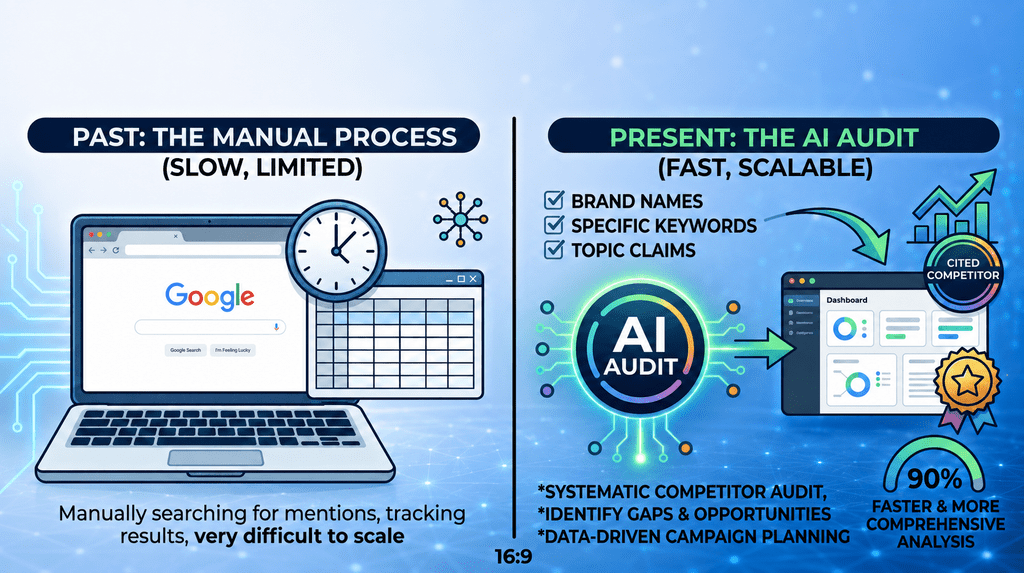
None of that tells you whether your brand showed up in a ChatGPT answer last week, or whether a competitor did instead. That’s a separate, newer layer of visibility, and frankly, most teams aren’t tracking it at all yet which means most teams also don’t know how exposed or well-positioned they actually are.
How AI Search Actually Decides What to Cite
There’s no published algorithm here, and there’s no reliable formula that guarantees a citation on any platform. Anyone selling you a “guaranteed AI citation” package is overselling it. But the patterns across ChatGPT, Gemini, Perplexity, and Google AI Overviews are consistent enough to build a real strategy around.
AI systems tend to favor content that is relevant, understandable, verifiable, current, and easy to extract. Let’s go through what each of those actually looks like in practice.
Relevance: Answer the Question That Was Actually Asked
If someone asks “What is Answer Engine Optimization?”, they shouldn’t have to read three paragraphs of industry context before finding a definition. The strongest opening states the answer immediately:
Answer Engine Optimization (AEO) is the practice of structuring content so AI-powered search systems can understand information and potentially use it in generated answers.
Direct, specific, aligned with the actual question. Everything after that can expand, qualify, or add nuance but the answer itself shouldn’t be a scavenger hunt.
Clarity: One Idea Per Passage, Stated Plainly
Compare these two versions of the same idea:
Less effective: “Businesses operating in an increasingly AI-driven search environment need to consider the various ways users may discover information and how these changes could influence online visibility.”
More direct: “AEO helps businesses make important information easier for AI systems to understand and potentially cite.”
The second version says one clear thing. This doesn’t mean every article needs to be short long-form content is still valuable for genuinely complex topics. The important part is that the key answer inside a longer page should be easy to isolate, even if the surrounding explanation runs for several paragraphs.
Evidence: Claims Need Something Behind Them
A clearly written claim isn’t automatically a credible one. Strong AEO content backs important statements with something checkable:
- Original research or first-party data
- Industry reports or academic studies
- Government or regulatory sources
- Expert analysis or named commentary
- Documented case studies
Think of every important claim as needing a visible trail: claim → evidence → source. A sentence like “AI search visibility is becoming more important” is an opinion. A sentence like “a 2025 survey of 400 marketing leads found 61% had changed their content strategy because of AI search” is evidence and it’s the kind of sentence a model can actually use with confidence.
Context: Don’t Let a Statistic Stand Alone
A number without context is easy to misread or misuse. If you’re citing a statistic, include:
- Where it came from
- The methodology, roughly
- The time period and geography
- What “visibility” or whatever metric actually means in that source
- Any real limitations
This isn’t about padding every paragraph with caveats. It’s about giving a claim enough surrounding information that it still makes sense if it gets quoted out of context somewhere else because that’s exactly what happens when an AI system extracts it.
Entities: Make It Obvious Who and What You’re Talking About
AEO isn’t only about keywords AI systems also need to correctly interpret entities: companies, products, people, locations, and concepts. For a business, that means consistently making clear:
- Who your company is
- What services or products you actually provide
- What industry you operate in
- Where you operate
- Who your experts or authors are
- What subjects you’re genuinely qualified to speak on
Vague phrasing like “this tool” or “the company” is much harder for a model to attribute confidently than a named entity. This consistency also needs to extend beyond your own website if your business name, location, or services are described inconsistently across your site, directories, and other mentions, it makes it harder for any system to build a confident picture of who you are.
Freshness: Old Information Is a Liability
Information becomes less useful the moment it goes stale and this matters more in categories where things change quickly: AI technology itself, software features, pricing, regulations, statistics, and market trends.
Treat AEO as an ongoing cycle rather than a one-time project: publish → monitor → review → update. And when updating, actually change the information don’t just bump the publish date and hope nobody checks.
Structure: Make the Passage Extractable
Good structure serves both human readers and machines pulling information out of a page. That means:
- Descriptive, specific headings (not clever ones)
- Short paragraphs
- Bulleted or numbered lists where they genuinely help
- Tables for comparative information
- Clear, stated definitions
- A logical hierarchy from general to specific
But structure alone doesn’t rescue weak content. A perfectly formatted page built on vague claims and no evidence still won’t get cited formatting is the delivery mechanism, not the substance.
A Practical Audit: Five Questions for Any Page
Rather than trying to hold seven abstract principles in your head while editing, it helps to reduce this to a short, repeatable checklist you can run against any important page:
- Answer Does the page state the actual answer clearly, near the top of the relevant section?
- Evidence Is there a stat, study, or concrete example backing the central claim?
- Entity Is it obvious who the company, author, or expert behind this content actually is?
- Context Would this claim still make sense if it were quoted completely out of context, with no surrounding paragraphs?
- Source If a statistic or claim is cited, is the actual source named not just implied?
Run your ten or fifteen most important pages through these five questions. You’ll usually find the same one or two weaknesses repeating across most of them often it’s evidence or entity clarity, since those are the two elements most content teams skip by default.
Before and After: Turning Generic Copy Into a Citation-Ready Passage
The clearest way to understand AEO is to see the same idea written two different ways.
Example 1: A Definition
Before (typical SEO copy):
Answer Engine Optimization is an emerging digital marketing strategy that businesses can use to improve their visibility in AI search. As artificial intelligence continues to change search behavior, companies need to focus on high-quality content that follows SEO best practices.
This isn’t incorrect. It’s just empty it could describe almost any marketing tactic, and it gives an AI system nothing specific to cite.
After:
Answer Engine Optimization (AEO) means structuring content so an AI system can pull a specific answer from it and cite your site as the source not just so the page ranks. In practice, that means leading with a direct answer, backing claims with real data, and making it obvious who’s behind the content.
Same topic, but now there’s an actual definition, a clear distinction from SEO, and a concrete description of what to do differently.
Example 2: A Product Recommendation
Before:
There are many factors that go into choosing the best project management software for your team. Companies today need tools that are flexible, affordable, and easy to use. Our platform offers a variety of features designed to help teams of all sizes work more efficiently.
Nothing here is wrong, but nothing is usable either. No direct answer, no evidence, no named entities, nothing specific enough for an AI system to extract with confidence.
After:
For teams of 10 to 50 people, the best project management software typically combines task tracking, time tracking, and reporting in one platform. A 2026 survey of 1,200 small businesses by [Research Firm] found that 68% cited “too many disconnected tools” as their top productivity complaint. [Product Name] addresses this by combining these three functions natively, which matters most for teams currently juggling three or more separate apps. This recommendation applies to small and mid-sized teams specifically larger enterprises with complex approval workflows will likely need additional governance features.
Notice that the rewritten version isn’t shorter. It’s more specific. AEO isn’t primarily about trimming word count it’s about precision, evidence, and making sure a passage holds up on its own.
Getting Cited by ChatGPT
There’s no trick that guarantees inclusion in a ChatGPT response, but a handful of practices consistently move the needle.
Answer the real question first. If a section heading is “What is local SEO?”, the very next sentence should be the definition not a lead-in about how search behavior has evolved.
Write for the actual questions people type into a chat window, not just the keyword version. “How do I get my business mentioned by ChatGPT?” is a real, natural-language question people ask. Most keyword research tools won’t surface phrasing like that, but it’s worth writing directly for it anyway, because it reflects how people actually interact with these systems.
Make every important passage stand alone. If a sentence only makes sense after reading three paragraphs of setup, it’s not citation-ready. Rewrite it so it holds up if it were the only sentence someone ever saw.
Publish something genuinely original. A generic explainer is easy to pass over in favor of ten other generic explainers covering the same ground. An original statistic, a real survey, or a documented case study is much harder to substitute.
Build your brand as a recognizable entity, not just a domain. Make sure your company name, what you do, your area of expertise, and your locations are described consistently on your site and in outside mentions.
Actually test your prompts. Build a list of 15 to 20 realistic questions your customers might type into ChatGPT. Run them monthly. Record whether your brand shows up, whether competitors do instead, and which of your pages (if any) get referenced. This is tedious, unglamorous work, and it’s also the only reliable way to know whether any of this is working.
Getting Cited in Google AI Overviews
Google AI Overviews sits directly inside a search results page, which makes intent-matching even more important than usual Google already has a strong sense of what kind of answer the searcher wants before your content is ever considered.
Match search intent precisely. Is the person looking for a definition, a comparison, a recommendation, a process, or current information? Build the answer around that specific need rather than a generic overview of the topic.
Put the core answer immediately under the relevant heading. Overviews frequently pull the first clear sentence following an H2 or H3, so if the definition or answer is buried two paragraphs down, it’s less likely to get used.
Build genuinely comprehensive coverage without padding. A strong resource on a topic covers what the searcher actually needs to know: what something means, how it differs from a related concept, how it works, and what to do about it. That’s different from adding paragraphs purely to hit a word count.
Show real authorship. Named authors with relevant experience or credentials are a small detail that meaningfully affects how both Google and human readers judge trustworthiness.
Use structured data where it’s genuinely appropriate Article, Organization, FAQ schema, and similar markup can help machines parse a page’s structure. But schema is infrastructure, not a shortcut. Perfect markup wrapped around weak, vague content still won’t get cited.
Keep the page current. Overviews tend to favor fresh, accurate information over pages with the strongest backlink profile but stale facts.
Gemini, Perplexity, and the Rest: One Strategy, Not Four
It’s tempting to think you need a separate content plan for every AI platform. You don’t. The overlap in what these systems value clarity, evidence, currency, and clear sourcing is far larger than the differences between them.
Instead of chasing platform-specific tricks, focus on three things that transfer across all of them:
Build content around the actual language people use to ask questions, including the slightly awkward, conversational phrasing people use when typing into a chatbot rather than a search bar. “How do I get my business mentioned by AI” and “AI SEO services” reflect the same underlying need, expressed very differently.
Go deep on a smaller set of topics you’re genuinely qualified to discuss, rather than spinning up dozens of thin pages to catch every possible keyword variation. Depth and consistency build a stronger topical footprint than volume does.
Keep brand details consistent everywhere company name, services, locations, and leadership should read the same across your website, directory listings, and any other place your business is mentioned. Inconsistency makes it harder for any system, not just one platform, to build a confident, coherent picture of who you are.
| Platform | What users typically want | Where to focus |
| ChatGPT | Explanations, comparisons, recommendations | Clear definitions, evidence, original data |
| Gemini | Research-style questions and explanations | Topic depth, consistent entity information |
| Google AI Overviews | Fast answers embedded in search | Intent match, concise, well-placed lead answers |
| Perplexity | Research-oriented answers with visible sources | Strong sourcing, verifiable facts |
AEO Is More Than Formatting Common Myths Worth Retiring
A lot of the advice circulating about AEO reduces it to a formatting exercise: add question-based headings, shorten your answers, bolt on some schema, break paragraphs into bullet points. These tactics can help readability, but none of them substitute for the underlying substance.
Myth: Short answers automatically get cited. A concise definition can work well for a simple question, but there’s no universal word count that guarantees a citation. A complex business question may genuinely need several paragraphs to answer properly the goal is completeness, not brevity for its own sake.
Myth: More AI-related keywords improve visibility. Repeating “AEO,” “ChatGPT,” or “AI search” throughout a page doesn’t make it more authoritative it just reads as keyword stuffing to a human, and it doesn’t fool a model either. The real objective is semantic completeness: covering the related concepts a reader would actually need, not hitting a keyword quota.
Myth: FAQ sections are the secret to AEO. FAQs are genuinely useful when they answer real customer questions. Adding dozens of artificial questions purely to capture keyword variations just adds repetitive noise.
Myth: Schema guarantees a citation. It doesn’t. Schema helps machines parse a page’s structure, but it does nothing for content that lacks evidence or authority in the first place. Treat it as supporting infrastructure, not a shortcut.
Myth: You need to rewrite your entire website. You don’t. Prioritize your highest-value pages first the ones already generating traffic, leads, or rankings and apply the framework there before touching lower-priority content.
Myth: AEO replaces SEO. It doesn’t. Your site still needs to be crawlable, indexable, fast, and well-structured for AEO to matter at all you can’t optimize a passage an AI system never sees because the page itself is technically broken.
Building Brand and Entity Authority
AEO operates on two layers, and it’s worth being explicit about the difference between them.
Content authority asks a narrow question: is this specific answer useful and credible on its own? This is built through evidence, clear explanations, and reliable sourcing at the page or passage level.
Brand and entity authority asks a much broader question: does the wider web establish this company as a credible entity on this subject, independent of any single page? This is built through things like:
- Expert authorship with real, verifiable credentials
- Original research, surveys, or proprietary data
- Legitimate digital PR and coverage in relevant industry publications
- Professional profiles and consistent third-party mentions
- Consistent business information across every place your company appears online
The goal here isn’t manufacturing artificial mentions or gaming a signal. It’s building a legitimate footprint around the topics your business is genuinely qualified to speak on the kind of footprint that would exist naturally if your company were doing credible work in its space.
Where to Start Without Rewriting Your Entire Website
You don’t need to touch every page on your site, and trying to would be a waste of effort. A focused, prioritized approach works far better.
Step 1 Identify your most valuable pages. Start with pages that already receive organic traffic, generate leads, support conversions, rank for important queries, or demonstrate real expertise.
Step 2 Find the buried answers. Most pages already contain the right information somewhere; it’s often three paragraphs down, wrapped in unnecessary setup. Look specifically for strong answers hidden inside long introductions or vague explanations.
Step 3 Rewrite the key passages. Apply the framework directly: lead with the answer, then evidence, entity clarity, context, sourcing, and freshness, in roughly that order of priority.
Step 4 Add evidence where it’s missing. Attach a real statistic, study, or documented example to claims that currently stand unsupported. Even one solid piece of evidence per page changes how the whole passage reads.
Step 5 Improve entity clarity. Replace vague references like “this tool” or “the company” with named brands, products, people, and organizations.
Step 6 Set a recurring review schedule. Revisit statistics, links, examples, and time-sensitive claims on a fixed cadence rather than letting them go stale indefinitely.
This turns AEO into an ongoing content improvement process rather than a one-time overhaul which is realistically the only way most teams will actually sustain it.
How to Measure Whether Any of This Is Working
This is the part most teams skip entirely, and it’s the only way to know if the effort is paying off. At minimum, track:
- AI mentions whether your brand name shows up at all in AI-generated answers to relevant prompts
- AI citations whether your specific website is referenced or linked as a source
- Citation share your visibility relative to named competitors on the same prompts
- Prompt visibility which customer questions actually trigger your brand appearing
- Source visibility which of your pages, specifically, are being referenced
- Competitor visibility who shows up instead of you, and for which questions
There’s no fully automated dashboard for most of this yet. Most teams are doing it manually a running spreadsheet of test prompts, checked on a recurring schedule, with notes on what changed after a page gets updated. It’s unglamorous work, but it’s the difference between guessing whether AEO is working and actually knowing.
The Real Shift Behind All of This
SEO’s core question has always been: “how do I get this page to rank?”
AEO’s question is different: “which part of this page could an AI system actually use as an answer, and would it trust that answer enough to attribute it to us?”
Ranking well is still worth doing it remains the foundation everything else sits on. But it’s no longer the finish line. The businesses that show up consistently inside AI-generated answers over the next few years won’t be the ones who found a clever formatting trick or gamed a schema tag. They’ll be the ones whose content was simply clear, evidenced, current, and easy to trust which, honestly, was always the standard for good content. It just matters in a more visible, measurable way now.
Conclusion
Start with your highest-value pages. Identify the actual questions your customers are asking, in the language they’d use to ask an AI system, not just a search bar. Turn the important passages inside those pages into genuinely citation-ready answers. Strengthen the evidence and sourcing behind your key claims. Keep the information current. Then set up a simple, recurring way to monitor how your brand actually shows up across AI-powered search.
Don’t optimize for AI as an abstract target. Optimize the information AI systems need in order to trust you because that’s also, not coincidentally, the same information a real customer needs in order to trust you too.
Frequently Asked Questions
AEO is the practice of structuring website content so AI-powered search and answer engines can understand relevant information and potentially use or cite it in generated answers.
SEO focuses on getting a page to rank for search queries. AEO focuses on making the specific information inside that page clear, evidenced, and self-contained enough for an AI system to trust and reuse.
There’s no guaranteed method. Focus on direct answers, credible evidence, clear entity information, useful context, traceable sources, current information, and strong structure then test regularly to see what’s actually working.
Match search intent precisely, lead with a clear answer under the relevant heading, support claims with credible sources, build topical and entity authority, and keep the content current.
Apply the same fundamentals used for other platforms clear answers, strong evidence, entity clarity, context, and freshness. A separate content strategy per platform generally isn’t necessary.
It can help AI systems parse a page’s structure, but it doesn’t replace the need for genuine evidence, authority, and clear answers. Treat it as supporting infrastructure, not a shortcut.
Track AI brand mentions, citations, citation share against competitors, which prompts trigger your brand, and which specific pages get referenced ideally on a recurring monthly cadence.
No. Start with your highest-value pages the ones already driving traffic, leads, or rankings and apply the framework there first.