
Search Quality Evaluation Principles: The Complete Guide to Ranking Better in Google

Introduction
Search quality evaluation principles define how Google assesses whether webpages genuinely help users achieve their goals. Instead of relying only on keywords or backlinks, modern search systems evaluate Content Quality, Search Intent, Trustworthiness, User Experience, and E-E-A-T (Experience, Expertise, Authoritativeness, and Trustworthiness). According to Google’s Search Quality Evaluator Guidelines (January 2025), the primary objective is to deliver helpful, reliable, and relevant search results that best satisfy user needs.
These principles are especially important for topics that can impact people’s health, finances, or safety, known as Your Money or Your Life (YMYL) content. Google’s evaluation framework emphasizes high-quality main content, website reputation, factual accuracy, and transparency to ensure users receive trustworthy information. Human Search Quality Raters assess webpages using Page Quality (PQ) and Needs Met (NM) ratings, helping Google refine its search algorithms rather than directly influencing rankings.
As search evolves with AI Search, semantic understanding, and the Helpful Content System, creating people-first content has become more important than ever. Websites that demonstrate genuine expertise, satisfy user intent, and provide an excellent page experience are better positioned to meet modern search quality standards. This guide explores the core principles behind Google’s search quality evaluation framework and explains how businesses and content creators can build websites that users—and search engines—can trust.
What Are Search Quality Evaluation Principles?
Search quality evaluation principles are the standards Google uses to assess whether search results provide helpful, relevant, and trustworthy information that satisfies users’ needs. According to the Search Quality Evaluator Guidelines, the goal of search is not simply to match keywords but to deliver results that effectively achieve their purpose while offering a positive user experience. These principles help Google determine what high-quality content looks like and guide improvements to its search algorithms.
At the core of these principles is the idea that every webpage should have a beneficial purpose. Whether a page is designed to educate, entertain, sell products, answer questions, or provide tools, it should genuinely help users accomplish their goals. Pages created primarily to deceive users, spread misinformation, manipulate rankings, or provide little value are considered low quality. Google also recognizes that different types of content require different quality standards—for example, a medical article demands far greater accuracy and trust than a movie review or humorous blog post.
Another important principle is understanding search intent. Google evaluates whether a webpage satisfies what users are actually looking for rather than simply containing the search terms they entered. Someone searching for “best DSLR camera for beginners” expects detailed buying advice, comparisons, and recommendations—not just a product listing. Similarly, a user searching for “how to tie a tie” expects a clear tutorial with step-by-step instructions. The better a page matches user intent, the higher its perceived quality.

Google’s evaluation framework also emphasizes E-E-A-T (Experience, Expertise, Authoritativeness, and Trustworthiness). These signals help determine whether users can rely on the information presented. For sensitive topics such as healthcare, finance, legal advice, or public safety, demonstrating expertise and trustworthiness becomes especially important. High-quality content often includes accurate information, credible authors, transparent sourcing, and evidence of real-world experience.
Beyond content itself, search quality considers the overall user experience. A page should be easy to navigate, load quickly, function properly on mobile devices, and avoid excessive advertisements or distracting elements. Google’s guidelines distinguish between Main Content (MC), which directly fulfills the page’s purpose, Supplementary Content (SC), which enhances usability, and advertisements. While advertising is acceptable, it should never interfere with users’ ability to access or understand the main content.
Search quality evaluation principles are also closely connected to Google’s broader efforts to reward Helpful Content, improve Content Quality, and deliver better search experiences. Rather than focusing solely on technical SEO or keyword density, successful websites prioritize originality, accuracy, user satisfaction, and genuine value. As AI-powered search continues to evolve, these principles remain essential for creating content that earns both user trust and long-term search visibility.
By understanding these principles, website owners, SEO professionals, and content creators can move beyond outdated optimization tactics and focus on building authoritative resources that meet user expectations. Throughout this guide, you’ll see how concepts like Page Quality, Needs Met, Helpful Content, Core Web Vitals, and Search Intent work together to define what Google considers a high-quality webpage.
Why Google Uses Search Quality Evaluation
Google’s mission is to organize the world’s information and make it universally accessible and useful. To achieve this, it must consistently deliver search results that are relevant, reliable, and helpful for users. Search quality evaluation helps Google measure how effectively its search systems meet these goals by identifying whether webpages satisfy user intent and provide a positive search experience. According to the Search Quality Evaluator Guidelines, search quality ratings are used to evaluate and improve Google’s algorithms—they do not directly influence the ranking of individual webpages.
One of the primary reasons Google uses search quality evaluation is to ensure that users receive information they can trust. Every day, people search for answers related to health, finance, education, shopping, travel, and countless other topics. For sensitive Your Money or Your Life (YMYL) queries, inaccurate or misleading information can have serious consequences. By evaluating Page Quality, Trustworthiness, and E-E-A-T, Google aims to surface content that is accurate, authoritative, and genuinely helpful.
Search quality evaluation also helps Google better understand search intent. A single query can have different meanings depending on the user’s goal. For example, someone searching for “Apple” might be looking for the company, the fruit, or investment information. Google’s evaluation process measures whether search results match these different intents and provide users with the most appropriate information for their specific needs.
Another key objective is improving the overall user experience. High-quality search results should not only contain useful information but also be easy to access, navigate, and understand. Google’s evaluation considers factors such as clear page purpose, high-quality main content, transparency, and a satisfying browsing experience. This aligns closely with modern SEO practices that emphasize Helpful Content, Content Quality, and Page Experience.
The evaluation process also helps Google identify low-quality or harmful content. Pages created with deceptive intent, misleading information, spam, or little original value can negatively impact users. Through continuous quality assessments, Google improves its ability to detect and reduce the visibility of such content while rewarding websites that demonstrate expertise, originality, and trustworthiness.
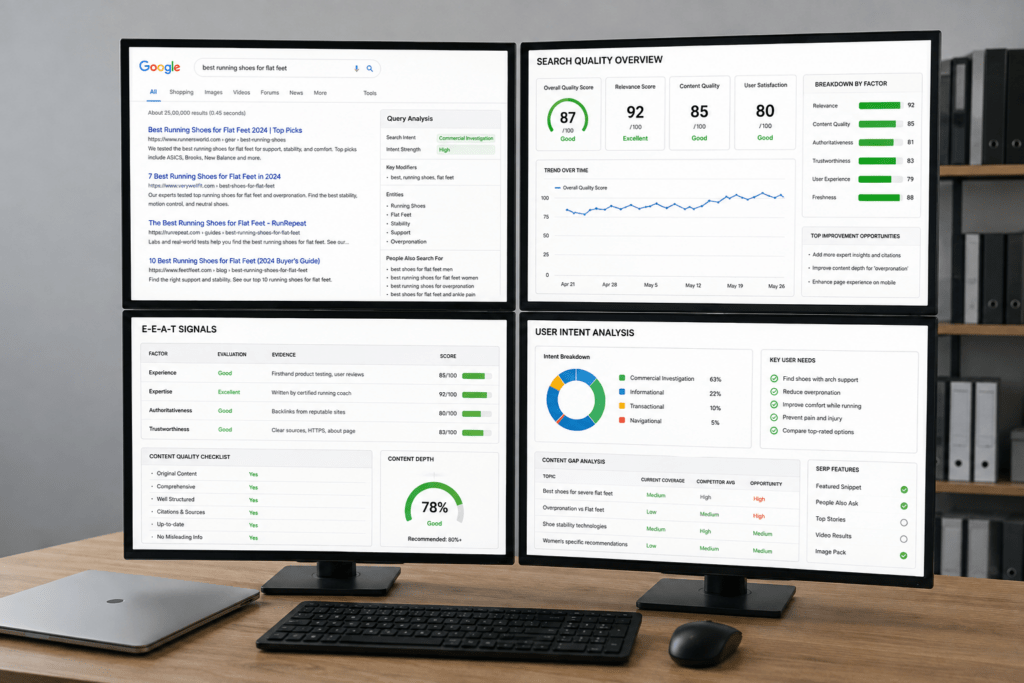
As search continues to evolve with AI Search, Google’s focus remains the same: delivering the most helpful results for every query. By using search quality evaluation principles, Google continually refines its algorithms to prioritize people-first content, improve user satisfaction, and ensure that search remains a trusted source of information across every industry and topic.
Understanding Search Quality Rater Guidelines
The Search Quality Rater Guidelines (SQRG) are Google’s official instructions used by human Search Quality Raters to evaluate the quality and usefulness of search results. These guidelines provide a consistent framework for assessing whether webpages are helpful, trustworthy, and capable of satisfying user intent. While Search Quality Raters do not directly influence the ranking of individual websites, their evaluations help Google measure the effectiveness of its search algorithms and improve future updates.
The guidelines emphasize that search quality is evaluated based on two primary frameworks: Page Quality (PQ) and Needs Met (NM). Page Quality measures how well a webpage achieves its purpose by examining factors such as the quality of the main content, website reputation, transparency, and E-E-A-T (Experience, Expertise, Authoritativeness, and Trustworthiness). Needs Met, on the other hand, evaluates how effectively a search result satisfies the user’s query and intent. Together, these frameworks help Google understand whether its search results provide a positive and reliable experience.
Another key principle within the guidelines is identifying the purpose of a webpage. Every webpage should exist to help users achieve a specific goal, whether it is providing information, selling a product, answering a question, or entertaining visitors. Pages created primarily to mislead users, spread harmful information, or manipulate search rankings are considered low quality. The guidelines also highlight that the quality expectations vary depending on the topic, with Your Money or Your Life (YMYL) pages requiring much higher levels of trust and accuracy because they can directly impact a person’s health, finances, or safety.
Google’s evaluators are also instructed to examine the overall user experience. They assess the Main Content (MC), Supplementary Content (SC), and advertisements to determine whether the page delivers value without distracting or confusing users. A high-quality page typically provides original, well-organized content, demonstrates expertise, and offers a smooth browsing experience, while excessive ads, poor navigation, or thin content can negatively affect its quality assessment.
Understanding the Search Quality Rater Guidelines helps SEO professionals, content creators, and website owners align their content with Google’s quality expectations. Instead of focusing only on rankings, these guidelines encourage creating helpful, trustworthy, and user-focused content that delivers genuine value—an approach that remains essential as Google’s search systems continue to evolve.
Purpose of Page Quality Rating
Page Quality (PQ) is one of the two core evaluation frameworks in Google’s Search Quality Rater Guidelines. Its purpose is to determine how well a webpage achieves its intended purpose while providing a trustworthy, satisfying, and helpful experience for users. Rather than evaluating a page based on keyword usage or SEO tactics alone, Page Quality focuses on the overall value the page delivers to its audience. According to the guidelines, the first step in assigning a Page Quality rating is understanding why the page exists and whether its purpose is beneficial to users.
A webpage can serve many legitimate purposes, such as sharing information, selling products, providing entertainment, answering questions, or offering online tools. Google does not consider one type of page inherently better than another. Instead, the quality rating depends on how effectively the page fulfills its purpose. For example, a medical article should provide accurate, evidence-based information, while a product page should offer clear descriptions, pricing, and purchasing details. If a page is created primarily to deceive users, spread misinformation, or manipulate search rankings, it may receive the Lowest Page Quality rating regardless of its design or technical optimization.
To evaluate Page Quality, Search Quality Raters examine several key factors. The most important is the Main Content (MC)—the part of the page that directly helps users accomplish their goal. Raters assess whether the content demonstrates sufficient effort, originality, talent or skill, and accuracy, especially for informational and YMYL (Your Money or Your Life) topics. They also evaluate the website’s reputation, the credibility of the content creator, and the presence of E-E-A-T (Experience, Expertise, Authoritativeness, and Trustworthiness) signals. These factors help determine whether users can confidently rely on the information provided.
In addition to content quality, the guidelines consider the overall user experience. A high-quality webpage should have a clear title, logical navigation, useful supplementary content, and advertisements that do not interfere with the main content. While ads are acceptable, they should never distract users from accomplishing their intended task. The guidelines also encourage raters to research a website’s reputation using independent sources rather than relying solely on claims made by the website itself.
Ultimately, the purpose of Page Quality rating is to help Google identify webpages that genuinely benefit users while filtering out content that is misleading, low effort, or untrustworthy. Although these ratings do not directly affect rankings, they provide valuable feedback that helps Google improve its search algorithms and deliver more helpful search results over time.
Understanding Needs Met Ratings
While Page Quality (PQ) evaluates the overall quality of a webpage, Needs Met (NM) measures something different—how well a search result satisfies the user’s query and intent. According to Google’s Search Quality Rater Guidelines, the Needs Met rating helps determine whether users can accomplish their goal after clicking a search result. A page with excellent content may still receive a lower Needs Met rating if it does not answer the user’s specific query. Conversely, a simple webpage can earn a high Needs Met rating if it perfectly fulfills the user’s intent.
Google instructs Search Quality Raters to first understand the user’s intent before assigning a Needs Met rating. Search queries can have different purposes, such as finding information, visiting a specific website, completing a task, or locating a nearby business. The more effectively a webpage matches that intent, the higher its Needs Met score. For example, someone searching for “weather today” expects an immediate weather forecast, while a user searching for “how to bake sourdough bread” expects a detailed tutorial with clear instructions. The evaluation focuses on whether the search result successfully helps the user achieve that goal.
The guidelines use a scale that ranges from Fails to Meet (FailsM) to Fully Meets (FullyM). Results rated Fully Meets completely satisfy the user’s need, often eliminating the need to visit additional webpages. Highly Meets results are extremely helpful for most users, while Moderately Meets results satisfy many users but may require additional information. Slightly Meets indicates
Needs Met Rating Scale
Google’s Needs Met (NM) scale ranges from Fails to Meet to Fully Meets, helping Search Quality Raters determine how effectively a search result satisfies the user’s query. The rating depends on how well the result matches the user’s intent—not simply the quality of the webpage itself.
Needs Met Comparison Table
| Page Quality | Needs Met |
| Evaluates webpage | Evaluates search result |
| E-E-A-T | Search Intent |
| Website quality | User satisfaction |
| Independent evaluation | Query-specific |
Fully Meets (FullyM)
A Fully Meets rating is given when a search result completely satisfies the user’s need, leaving little or no reason to view additional results. This rating is reserved for very specific queries where one result is clearly the best answer, such as navigating to an official website or finding a precise piece of information. According to the guidelines, not all queries are eligible for a Fully Meets rating because many searches have multiple valid answers or user intents.
Highly Meets (HM)
A Highly Meets result is extremely useful for most users and satisfies the query very well, although some users may still want to explore other results. These pages provide comprehensive, relevant, and trustworthy information that closely aligns with the user’s intent.
Moderately Meets (MM)
A Moderately Meets rating indicates that the result is helpful for many users but may not fully address every aspect of the query. Users often need to compare additional search results or gather more information before completing their task.
Slightly Meets (SM)
A Slightly Meets result provides limited value. It may only answer part of the user’s question, be only somewhat relevant, or require significant effort from users to find the information they need. While not entirely unhelpful, these results do not effectively satisfy the majority of users.
Fails to Meet (FailsM)
A Fails to Meet rating is assigned when a search result does not satisfy the user’s intent or is misleading, irrelevant, outdated, or harmful. Pages that contain inaccurate information, deceptive content, spam, or fail to answer the query appropriately typically fall into this category. Such results provide little or no benefit to users and create a poor search experience.
Why Needs Met Matters
The Needs Met framework helps Google understand whether its search results successfully solve users’ problems. Combined with Page Quality, it ensures that search results are not only trustworthy but also relevant to the user’s specific intent. For website owners and SEO professionals, this means that ranking well is no longer just about optimizing keywords—it requires creating content that directly answers users’ questions, fulfills their goals, and delivers a satisfying experience from the moment they click on the page.
Understanding YMYL (Your Money or Your Life) Topics
One of the most important concepts in Google’s Search Quality Rater Guidelines is Your Money or Your Life (YMYL). These are topics that can significantly impact a person’s health, financial stability, safety, or the welfare of society. Because inaccurate or misleading information in these areas can cause real-world harm, Google applies much higher quality standards when evaluating YMYL content. Pages covering these subjects are expected to demonstrate strong E-E-A-T (Experience, Expertise, Authoritativeness, and Trustworthiness) and provide accurate, reliable, and well-supported information.
YMYL Comparison Table
| YMYL | Non-YMYL |
| Health | Movies |
| Finance | Games |
| Legal | Recipes |
| Elections | Sports |
According to the guidelines, a topic may be considered YMYL if poor-quality information could negatively affect an individual or society. Examples include medical advice, financial planning, legal guidance, emergency preparedness, elections, public safety, and other topics where users depend on trustworthy information to make important decisions. In contrast, subjects such as movie reviews, hobbies, recipes, or entertainment generally carry much lower risk and therefore require less stringent evaluation standards.
The guidelines classify YMYL topics into several broad categories:
- Health and Safety: Medical conditions, treatments, medications, mental health, nutrition, emergency response, and public safety.
- Financial Security: Banking, investments, taxes, insurance, loans, retirement planning, and financial advice.
- Society and Civic Information: Elections, government services, public policies, legal rights, and information that can influence public trust or societal well-being.
- Other High-Impact Topics: Content that could significantly affect a person’s welfare, education, employment, housing, or other critical life decisions.
When evaluating YMYL pages, Search Quality Raters pay close attention to the accuracy of the main content, the credibility of the author, the reputation of the website, and the overall level of trustworthiness. For example, a medical article written or reviewed by qualified healthcare professionals, supported by reputable sources, is more likely to be considered high quality than an anonymous article without evidence or citations. Similarly, financial advice published by recognized experts carries greater credibility than unsupported personal opinions.
The guidelines also explain that not every topic is clearly YMYL. Some subjects fall somewhere in between and require evaluators to consider the potential consequences of inaccurate information. A useful question suggested by the guidelines is: Could even minor inaccuracies cause significant harm? If the answer is yes, the topic is likely YMYL and should be evaluated with greater scrutiny.
For website owners and content creators, understanding YMYL is essential. If your website publishes information related to health, finance, legal matters, or public safety, demonstrating expertise, maintaining factual accuracy, citing authoritative sources, and building user trust are critical. By meeting these higher quality expectations, websites can better align with Google’s search quality standards and provide users with information they can confidently rely on.
E-E-A-T and Search Quality
One of the most important concepts in Google’s Search Quality Evaluator Guidelines is E-E-A-T, which stands for Experience, Expertise, Authoritativeness, and Trustworthiness. These factors help Search Quality Raters determine whether users can rely on the content they are viewing. While E-E-A-T is not a direct ranking factor, it represents the qualities Google’s systems aim to reward when identifying helpful, high-quality content. Among these four elements, Trustworthiness is considered the most important because even experienced or authoritative content has little value if users cannot trust it.
Experience
Experience refers to the first-hand knowledge or practical involvement a content creator has with a topic. For many subjects, users benefit from insights based on real-world experience rather than purely theoretical knowledge. For example, a traveler sharing personal experiences from visiting Japan or a software developer documenting lessons learned from using a programming framework demonstrates valuable first-hand experience. This type of content often provides practical insights that generic articles cannot offer.
Expertise
Expertise measures the knowledge and skills of the content creator. The level of expertise required depends on the topic. For YMYL (Your Money or Your Life) content, such as medical, financial, or legal advice, expertise is especially important because inaccurate information can cause serious harm. On less critical topics, such as hobbies or personal experiences, practical knowledge and demonstrated competence may be sufficient.
Authoritativeness
Authoritativeness reflects the reputation and recognition of both the content creator and the website within their field. Websites that are widely recognized as reliable sources, receive recommendations from industry experts, or consistently publish high-quality content tend to demonstrate stronger authority. Google encourages evaluators to research a website’s reputation using independent sources rather than relying solely on claims made by the website itself.
Trustworthiness
Trustworthiness is the foundation of E-E-A-T. According to the guidelines, every webpage should provide users with information they can confidently rely on. Trust is built through factual accuracy, transparent authorship, secure website practices, clear contact information, editorial accountability, and a positive reputation. For websites handling sensitive information or financial transactions, demonstrating trust becomes even more important. Pages that appear deceptive, misleading, or lack sufficient transparency are likely to receive lower quality evaluations.
How E-E-A-T Improves Content Quality
Strong E-E-A-T is achieved by consistently publishing original, accurate, and user-focused content. Website owners can strengthen their E-E-A-T by including detailed author biographies, citing authoritative sources, maintaining editorial standards, updating outdated information, and clearly explaining who is responsible for the content. Building a positive online reputation through quality content and user trust also contributes to long-term authority.
As Google’s search systems continue to evolve with Helpful Content, AI Search, and semantic understanding, E-E-A-T remains central to evaluating search quality. Websites that demonstrate real experience, subject-matter expertise, recognized authority, and strong trust signals are better positioned to create content that satisfies both users and Google’s quality expectations.
Page Quality Factors
Page Quality (PQ) is one of the most important components of Google’s Search Quality Evaluator Guidelines. It measures how effectively a webpage fulfills its purpose while providing a satisfying and trustworthy experience for users. Rather than focusing on a single metric, Google instructs Search Quality Raters to evaluate multiple factors, including the quality of the Main Content (MC), the website’s reputation, E-E-A-T, user experience, and the page’s potential to cause harm. Together, these factors determine whether a webpage deserves a Lowest, Low, Medium, High, or Highest Page Quality rating.
Main Content Quality
The Main Content (MC) is the primary reason a webpage exists. It should directly help users accomplish the page’s purpose, whether that is providing information, answering a question, selling a product, or offering a useful tool. According to the guidelines, high-quality main content demonstrates effort, originality, talent or skill, and accuracy. For informational and YMYL topics, factual correctness and alignment with expert consensus are especially important. Low-effort, copied, or automatically generated content with little added value is considered poor quality.
Website Reputation
Google also evaluates the reputation of both the website and the content creator. Search Quality Raters are instructed to research independent sources such as news articles, expert recommendations, and credible reviews instead of relying solely on information published on the website itself. A strong reputation demonstrates reliability and authority, while evidence of scams, misinformation, or deceptive practices can significantly reduce a page’s quality rating. For websites covering YMYL topics, expert recognition and professional credibility carry even greater importance.
E-E-A-T Signals
Experience, Expertise, Authoritativeness, and Trustworthiness (E-E-A-T) play a critical role in evaluating Page Quality. Raters assess whether the content creator has relevant first-hand experience or subject-matter expertise, whether the website is recognized as an authority, and whether users can trust the information presented. Transparent author information, citations from reliable sources, editorial accountability, and secure website practices all contribute to stronger E-E-A-T signals. Among these, Trustworthiness is considered the most important factor because it underpins every other aspect of content quality.
User Experience and Page Design
A high-quality webpage should provide an excellent user experience. The guidelines encourage evaluators to examine page layout, navigation, readability, and the balance between Main Content (MC), Supplementary Content (SC), and advertisements. While advertisements are acceptable, they should never distract users or interfere with accessing the main content. Clear page titles, logical navigation, mobile-friendly design, and fast-loading pages all contribute to a more satisfying experience. Although metrics such as Core Web Vitals are not part of the Search Quality Rater Guidelines, they complement these user experience principles by improving website performance.
Purpose and Potential Harm
One of the first steps in evaluating Page Quality is identifying the purpose of the webpage. Pages created to educate, entertain, inform, or provide useful services generally have a beneficial purpose. However, webpages designed to deceive users, spread harmful misinformation, manipulate rankings, or facilitate malicious activities are considered the lowest quality regardless of their design or technical optimization. Google places particular emphasis on preventing harm in YMYL topics, where inaccurate information can directly affect people’s health, finances, or safety.
High vs Low Page Quality Table
| High Quality | Low Quality |
| Original | Copied |
| Expert Author | Anonymous |
| Sources | No citations |
| Updated | Outdated |
By understanding these Page Quality factors, website owners can create content that aligns with Google’s quality expectations. Prioritizing original and helpful Main Content, building a trustworthy reputation, demonstrating strong E-E-A-T, and delivering an exceptional user experience not only improves perceived page quality but also creates lasting value for users.
Helpful Content and Search Quality
Google’s Helpful Content System complements the principles outlined in the Search Quality Evaluator Guidelines by rewarding content created primarily for people rather than search engines. While the Search Quality Rater Guidelines focus on evaluating Page Quality, Needs Met, and E-E-A-T, both emphasize the same goal: helping users find original, trustworthy, and satisfying information. Websites that consistently publish people-first content are more likely to meet Google’s quality expectations and provide a better search experience.
A key characteristic of helpful content is that it fully satisfies user intent. Instead of simply targeting keywords, high-quality content answers users’ questions comprehensively, provides practical solutions, and demonstrates real expertise or first-hand experience. Whether someone is looking for a product review, a how-to guide, or expert advice, the content should deliver meaningful value without forcing users to search elsewhere for essential information.
The Search Quality Evaluator Guidelines also highlight the importance of effort, originality, and added value. Content created with little human effort, copied from other sources, or generated at scale without providing unique insights is considered low quality. Helpful content, on the other hand, demonstrates thoughtful research, clear organization, factual accuracy, and a genuine understanding of the topic. It should contribute something useful that users cannot easily find elsewhere.
Another important aspect of helpful content is trustworthiness. Users should know who created the content, why they are qualified to discuss the topic, and where the information comes from. Including author biographies, citing reputable sources, maintaining transparent editorial policies, and regularly updating outdated information all help strengthen credibility. For YMYL (Your Money or Your Life) topics, these trust signals become even more critical because inaccurate information can significantly affect people’s health, finances, or safety.
As AI Search continues to evolve, originality and human expertise have become increasingly valuable. AI tools can assist with research, drafting, and editing, but they should not replace human judgment or create low-value content solely for ranking purposes. Successful websites combine AI efficiency with expert review, real-world experience, and editorial oversight to produce content that is both accurate and genuinely helpful.
Ultimately, helpful content is not defined by word count or keyword density—it is measured by how effectively it solves users’ problems. By focusing on Content Quality, Search Intent, E-E-A-T, and user satisfaction, website owners can create resources that align with Google’s search quality principles while building long-term trust and authority.
Case Study 1 (Best Option – Based on Google’s Helpful Content)
Case Study: How Helpful, Expert-Led Content Improves Search Visibility
After Google’s Helpful Content System was introduced, many websites that relied on thin, keyword-focused articles experienced declines in organic visibility. In contrast, websites that invested in original research, demonstrated E-E-A-T, and regularly updated their content were more likely to maintain or improve search performance.
For example, a health website that publishes articles reviewed by licensed medical professionals, cites peer-reviewed research, and updates content regularly is generally better positioned to meet Google’s search quality expectations than an anonymous blog with no author information or references. While rankings always depend on multiple factors, this example illustrates how Page Quality, Trustworthiness, and Helpful Content work together to improve user experience.
Key Takeaway
Original, experience-driven content supported by trustworthy sources aligns more closely with Google’s Search Quality Evaluation Principles than content created solely to target keywords.
Case Study 2 (SEO Agency Style)
Case Study: Improving Page Quality Through E-E-A-T
An educational website noticed that many of its articles lacked author information, publication dates, and credible references. Instead of rewriting every page, the editorial team focused on strengthening trust signals by:
- Adding detailed author biographies
- Including expert-reviewed references
- Updating outdated statistics
- Improving page structure with clear headings
- Publishing transparent editorial guidelines
Within the following months, the website provided a more trustworthy experience for visitors and better aligned with Google’s Search Quality Evaluator Guidelines. Although rankings depend on many factors, these improvements strengthened the site’s overall content quality and credibility.
How to Optimize Your Website for Better Search Quality
Improving your website’s search quality goes beyond traditional SEO techniques like keyword optimization and link building. According to Google’s Search Quality Evaluator Guidelines, high-quality websites are those that consistently provide helpful, trustworthy, and satisfying experiences for users. By focusing on E-E-A-T, Content Quality, User Experience, and technical best practices, website owners can create pages that better align with Google’s quality expectations.
Improve E-E-A-T
Building strong Experience, Expertise, Authoritativeness, and Trustworthiness (E-E-A-T) should be a priority for every website. Clearly identify your content creators by including detailed author biographies, relevant qualifications, and first-hand experience where applicable. Publish accurate, well-researched content supported by credible references, and maintain transparent pages such as About Us, Contact Us, and editorial policies. These trust signals help both users and search engines recognize your website as a reliable source of information.
Create Helpful, People-First Content
Google rewards content that is written primarily for users rather than search engines. Focus on answering real questions, solving problems, and satisfying search intent instead of simply targeting keywords. Publish original insights, practical examples, and comprehensive explanations that provide genuine value. Avoid thin, repetitive, or automatically generated content with little human oversight, as it may offer limited benefit to users.
Enhance User Experience
A positive user experience plays a significant role in perceived page quality. Ensure your website is easy to navigate, mobile-friendly, and accessible across devices. Organize content with clear headings, readable formatting, and logical page structures. Minimize intrusive advertisements and ensure that Main Content (MC) remains the primary focus of each page. Although the Search Quality Evaluator Guidelines do not directly evaluate Core Web Vitals, improving page speed, responsiveness, and visual stability contributes to a better overall experience.
Strengthen Technical SEO
Technical optimization supports both usability and search performance. Improve Core Web Vitals, optimize page loading speed, implement HTTPS for secure browsing, fix broken links, and ensure your website is easily crawlable by search engines. Use structured data where appropriate to help search engines better understand your content. These improvements complement Google’s broader emphasis on delivering high-quality user experiences.
Build a Strong Website Reputation
Google encourages evaluators to consider a website’s reputation using independent sources. Maintain a positive online presence by consistently publishing trustworthy content, responding professionally to customer feedback, and earning recognition from reputable organizations or industry experts. Positive reviews, authoritative mentions, and quality backlinks can strengthen your website’s credibility over time.
Keep Your Content Fresh and Accurate
Search quality is not a one-time achievement. Regularly review and update your content to ensure it remains accurate, relevant, and aligned with current information. Refresh outdated statistics, verify external references, improve readability, and expand sections that no longer fully satisfy user intent. Continuous content maintenance demonstrates ongoing commitment to quality and helps maintain user trust.
Optimizing for search quality ultimately means optimizing for your audience. By combining helpful content, strong E-E-A-T, excellent user experience, sound technical SEO, and continuous improvement, you create a website that not only aligns with Google’s Search Quality Evaluation Principles but also earns lasting trust from users.
Common Search Quality Mistakes
Even well-designed websites can struggle to achieve high search quality if they overlook Google’s core evaluation principles. The Search Quality Evaluator Guidelines emphasize that low-quality pages often fail because they provide little value to users, demonstrate weak E-E-A-T, or have a misleading or harmful purpose. Avoiding these common mistakes helps improve both user satisfaction and overall content quality.
Publishing Thin or Low-Value Content
One of the most common mistakes is creating pages with minimal information or little original value. Thin content often repeats what is already available elsewhere without offering new insights, practical guidance, or meaningful expertise. Google’s guidelines state that pages created with little effort, low originality, and no added value may receive lower Page Quality ratings because they fail to adequately serve users.
Ignoring E-E-A-T
Many websites focus heavily on keywords while overlooking Experience, Expertise, Authoritativeness, and Trustworthiness (E-E-A-T). Missing author information, unclear credentials, lack of transparency, or unsupported claims can reduce user confidence—especially for YMYL topics. Demonstrating real expertise and maintaining a trustworthy online presence are essential for building credibility.
Creating Content for Search Engines Instead of People
Content written primarily to manipulate rankings rather than help users often performs poorly over time. Excessive keyword repetition, unnatural writing, and pages created solely to target search terms rarely provide a satisfying experience. Instead, focus on answering users’ questions clearly and comprehensively while naturally incorporating relevant keywords.
Misunderstanding Search Intent
A page can contain accurate information yet still fail if it does not satisfy the user’s intent. For example, someone searching for “best project management software” expects comparisons, pricing, and recommendations—not just a definition of project management. Understanding whether users are looking for information, products, tutorials, or specific websites is critical for creating content that truly meets their needs.
Poor Website Transparency
Users expect to know who is responsible for the content they read. Websites that lack About Us, Contact, author biographies, editorial policies, or customer support information may appear less trustworthy. The Search Quality Evaluator Guidelines encourage evaluators to examine website transparency and independently research a website’s reputation when assessing Page Quality.
Excessive Ads and Poor User Experience
While advertisements are acceptable, they should never interfere with the Main Content (MC). Intrusive pop-ups, distracting layouts, autoplay media, and excessive advertising can create a poor browsing experience. Similarly, slow-loading pages, confusing navigation, and poor mobile usability reduce overall user satisfaction and can negatively impact perceived page quality.
Publishing Outdated or Inaccurate Information
Content should be regularly reviewed to ensure that facts, statistics, references, and recommendations remain current. This is especially important for YMYL topics, where outdated information may mislead users or create unnecessary risks. Regular updates demonstrate an ongoing commitment to quality and accuracy.
Using AI Without Human Oversight
AI can accelerate content creation, but publishing AI-generated articles without fact-checking, editing, or adding original insights often results in generic or inaccurate information. Google’s quality principles prioritize helpful, original, and people-first content. AI should enhance the writing process—not replace human expertise and editorial judgment.
Avoiding these common mistakes is just as important as implementing SEO best practices. Websites that prioritize originality, transparency, E-E-A-T, user intent, and a positive user experience are far more likely to meet Google’s search quality expectations and build long-term trust with their audience.
Future of Search Quality in AI Search
The future of search quality is being shaped by rapid advancements in AI Search, semantic understanding, and user-focused ranking systems. While Google’s search technology continues to evolve, the core principles outlined in the Search Quality Evaluator Guidelines remain unchanged: search results should be helpful, trustworthy, and capable of satisfying users’ needs. The guidelines continue to emphasize evaluating webpages based on their purpose, Page Quality (PQ), Needs Met (NM), and E-E-A-T, regardless of how search technology evolves.
As AI-powered search experiences become more sophisticated, search engines are better able to understand search intent, context, and the relationships between entities instead of relying solely on keyword matching. This means that websites must focus on creating comprehensive, people-first content that answers users’ questions naturally and demonstrates genuine expertise. Simply optimizing for keywords is no longer enough; content must provide meaningful value, clear explanations, and trustworthy information.
The rise of generative AI has also increased the importance of originality and human oversight. The Search Quality Evaluator Guidelines recognize that generative AI can be a useful tool for content creation, but they also caution against content created with little effort, originality, or added value. As AI-generated content becomes more common, websites that combine AI-assisted workflows with expert review, first-hand experience, and factual accuracy are more likely to earn user trust and maintain high content quality.
Another emerging trend is the growing importance of E-E-A-T. Users increasingly expect transparency about who created content, why they are qualified, and whether the information can be trusted. Strong author profiles, credible citations, editorial standards, and regular content updates will continue to differentiate authoritative websites from low-quality sources. For YMYL (Your Money or Your Life) topics, these trust signals are likely to become even more critical as search engines prioritize accuracy and user safety.
Technical excellence will also remain an important part of search quality. Fast-loading pages, mobile-friendly experiences, secure browsing, accessibility, and a seamless user interface contribute to better user satisfaction. Although the Search Quality Evaluator Guidelines primarily focus on content quality rather than technical ranking signals, delivering an excellent overall experience supports Google’s broader goal of providing helpful search results.
Ultimately, the future of search quality will continue to center on people-first content. Regardless of advances in AI, websites that publish original, accurate, and trustworthy information while prioritizing user needs over search engine manipulation will remain best positioned for long-term success. By aligning with the principles of the Search Quality Evaluator Guidelines, businesses and content creators can build sustainable visibility, stronger credibility, and lasting user trust in an increasingly AI-driven search landscape.
Frequently Asked Questions
1.What are search quality evaluation principles?
Search quality evaluation principles are the standards outlined in Google’s Search Quality Evaluator Guidelines to assess how well search results help users. They focus on determining whether a webpage fulfills its purpose, demonstrates E-E-A-T (Experience, Expertise, Authoritativeness, and Trustworthiness), provides high-quality Main Content (MC), and satisfies user intent. These evaluations help Google improve its search algorithms rather than directly ranking individual webpages.
2. How does Google evaluate search quality?
Google evaluates search quality using two primary frameworks: Page Quality (PQ) and Needs Met (NM). Page Quality measures how effectively a webpage achieves its intended purpose by considering factors such as content quality, website reputation, E-E-A-T, and user experience. Needs Met assesses how well a search result satisfies the user’s query and intent. Human Search Quality Raters use these frameworks to provide feedback that helps Google refine its ranking systems.
3.What are Search Quality Rater Guidelines?
The Search Quality Rater Guidelines (SQRG) are Google’s official evaluation manual used by human Search Quality Raters. The document explains how to assess webpage quality, understand user intent, identify YMYL (Your Money or Your Life) topics, evaluate E-E-A-T, and assign Page Quality and Needs Met ratings. The ratings do not directly affect search rankings but are used to measure and improve the effectiveness of Google’s search algorithms.
4. Does E-E-A-T improve rankings?
The Search Quality Evaluator Guidelines describe E-E-A-T as an important framework for evaluating the trustworthiness and quality of webpages. The guidelines themselves do not state that E-E-A-T is a direct ranking factor. Instead, they explain that Experience, Expertise, Authoritativeness, and especially Trustworthiness are qualities that characterize high-quality content and help evaluators assess whether users can rely on the information presented.
5. How can I improve page quality?
According to the Search Quality Evaluator Guidelines, improving Page Quality starts with creating original, helpful content that fulfills a beneficial purpose. Website owners should focus on publishing accurate information, demonstrating strong E-E-A-T, maintaining transparency through author and contact information, building a positive reputation, and providing a satisfying user experience. Regularly reviewing and updating content also helps ensure it remains accurate and useful over time.
Conclusion
Search quality evaluation principles provide the foundation for understanding what Google considers helpful, trustworthy, and high-quality content. The Search Quality Evaluator Guidelines emphasize that successful webpages are those that clearly fulfill their purpose, demonstrate strong E-E-A-T, provide valuable Main Content, and effectively satisfy user intent through the Page Quality and Needs Met frameworks. Rather than focusing solely on keywords or technical optimization, Google’s evaluation process prioritizes content that genuinely benefits users.
For website owners, marketers, and SEO professionals, these principles offer a clear roadmap for long-term success. By creating original, people-first content, building trust through transparency and expertise, maintaining an excellent user experience, and continuously improving content quality, websites can align with Google’s quality expectations while delivering meaningful value to their audience. As search continues to evolve with AI-powered experiences, the core objective remains unchanged: help users find accurate, reliable, and satisfying answers to their questions.