
Full-Funnel Digital Marketing That Converts at Every Stage

Introduction: Why Funnels No Longer Behave Like Funnels
In Dubai’s hyper-competitive, digitally mature economy, growth is no longer constrained by reach—it is constrained by relevance, timing, and orchestration. Audiences move fluidly across channels, devices, and intent states. They research anonymously, compare relentlessly, and decide asynchronously. In this environment, full-funnel digital marketing is not a framework—it is an operating system.
According to Google research, modern buyers interact with 7–10 touchpoints before conversion, often looping back and skipping stages altogether. McKinsey has observed that the most effective growth companies outperform peers not by optimizing a single channel, but by aligning the entire customer journey end to end. For Dubai-based brands—particularly in real estate, luxury retail, fintech, healthcare, and B2B services—this alignment is the difference between fragmented spend and compounding returns.
This article unpacks how a full-funnel digital marketing strategy works in practice, why it converts at every stage, and how leading brands apply it—from awareness through retention—using data, systems, and precision rather than guesswork.
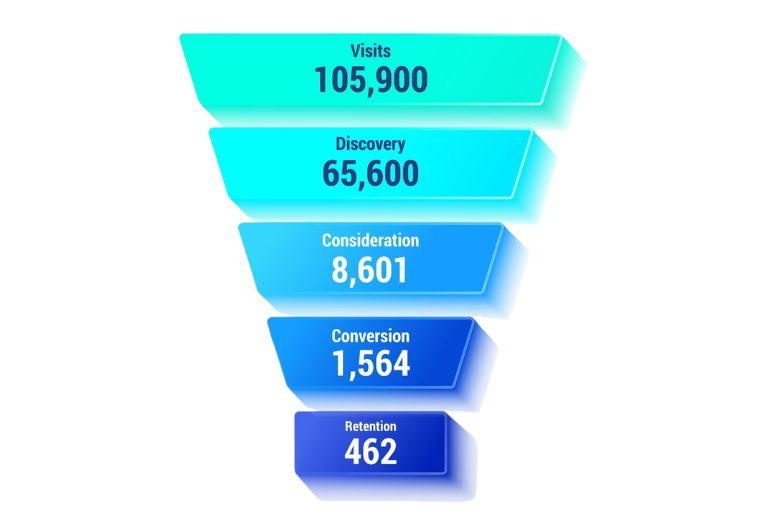
Rethinking the Funnel: From Linear Model to Dynamic System
Traditional funnels assumed a neat progression: awareness, consideration, conversion. Reality is messier. Buyers jump stages, stall, disappear, reappear, and demand relevance at every interaction. The modern funnel behaves more like a networked system than a pipeline.
A funnel-based marketing approach today must therefore be adaptive. It requires customer journey mapping that reflects real behavior, not theoretical stages. Each touchpoint—search, social, content, email, retargeting, landing pages—must work independently and collectively. When done correctly, the funnel compounds performance: insights from conversion optimization inform awareness creative; retention data sharpens acquisition targeting.
This is where end-to-end digital marketing becomes a growth lever rather than a cost center.
The Strategic Core of Full-Funnel Digital Marketing
At its core, full-funnel digital marketing aligns strategy, channels, data, and messaging around buyer intent. Rather than optimizing campaigns in isolation, it designs a digital marketing funnel strategy that treats every stage as both an entry point and a conversion opportunity.
The most effective frameworks share three principles.
First, they are intent-led. Rather than pushing products, they respond to what buyers are trying to solve at each moment. Second, they are data-driven. Decisions are informed by funnel analytics and attribution, not vanity metrics. Third, they are conversion-focused. Every asset—whether a thought-leadership article or a retargeting ad—has a defined role in moving the buyer forward.
As Peter Drucker famously noted, “The best way to predict the future is to create it.” In marketing terms, that creation happens through disciplined funnel design.
Awareness: Engineering Demand, Not Just Visibility
In high-growth markets like Dubai, awareness is not about shouting louder—it is about entering the buyer’s mental shortlist early and credibly. Top-of-funnel marketing must balance reach with resonance.
Effective brand awareness campaigns begin with insight. What questions are buyers asking before they know your brand exists? What narratives dominate their category? High-performing agencies invest heavily in content marketing strategy rooted in search intent, social listening, and competitive gap analysis. This is where thought leadership, SEO-driven content, and paid media awareness converge, supported by a facebook ads agency dubai to reach relevant audiences and remarketing services dubai to re-engage users who have already interacted with the brand.
Crucially, awareness content must be designed with downstream impact in mind. A well-ranked article or video is not an endpoint; it is a data signal. Which messages attract high-quality traffic? Which audiences engage deeply? These insights inform mid-funnel personalization and future acquisition efficiency.
In performance-driven digital marketing, awareness is measured not just by impressions, but by qualified attention.
Consideration: Designing Momentum Through Relevance
The consideration stage is where most funnels fail—not due to lack of traffic, but due to lack of momentum. Prospects are interested, informed, and undecided. The role of full-funnel digital marketing here is to reduce cognitive friction.
This is achieved through lead nurturing campaigns that deliver the right depth of information at the right time. Email marketing funnels, retargeting campaigns, webinars, case studies, and comparison content work together to answer unspoken objections.
Data matters deeply at this stage. Behavioral signals—page depth, return visits, content consumed—enable mid-funnel optimization that personalizes messaging without being intrusive. Marketing automation funnels ensure consistency, while human insight ensures relevance.
Harvard Business Review has consistently shown that companies excelling at lead nurturing generate 50% more sales-ready leads at 33% lower cost. The implication is clear: consideration is not a waiting room; it is an acceleration lane.
Conversion: Where Strategy Meets Proof
Conversion is often misunderstood as a moment. In reality, it is a process of confidence-building. Buyers convert when perceived value outweighs perceived risk.
A conversion-focused digital marketing approach integrates messaging, UX, and trust signals. Landing pages are optimized not just for clicks, but for clarity. Conversion rate optimization (CRO) is informed by qualitative insights—session recordings, heatmaps, user testing—not just A/B tests.
In Dubai’s premium markets, social proof plays an outsized role. Testimonials, certifications, case studies, and localized credibility markers reduce friction. Pricing transparency, clear next steps, and fast response times further reinforce trust.
This is where performance-driven digital marketing earns its name. Conversion is measured not merely by volume, but by quality—lifetime value, deal size, retention probability. A full-funnel strategy ensures that what converts is also what sustains growth.
Retention: The Most Undervalued Stage of the Funnel
The most sophisticated brands recognize that the funnel does not end at conversion. Retention and loyalty marketing are where profitability compounds.
Full-funnel digital marketing from awareness to retention treats customers as long-term assets. Post-conversion onboarding, lifecycle marketing, and personalized communication deepen relationships. Data from existing customers informs future acquisition, closing the loop.
According to Bain & Company, increasing customer retention rates by just 5% can increase profits by 25% to 95%. Yet many organizations underinvest here. A disciplined full-funnel growth marketing approach embeds retention into the strategy from day one.
In Dubai’s relationship-driven business culture, retention is not optional—it is reputational capital.
Where Conversion Really Begins
When agencies say “converts at every stage,” they are not suggesting that every interaction leads to an immediate sale. In a full-funnel digital marketing context, conversion is defined more precisely—and more strategically—as progression. Each stage of the funnel has its own form of conversion, its own success metric, and its own economic value.
This distinction is critical, especially for Dubai-based brands operating in high-consideration categories where buying decisions unfold over weeks or months.
Conversion Is Not a Single Event — It Is a Series of Commitments
Traditional thinking treats conversion as the final transaction. Full-funnel marketing reframes conversion as a series of micro-commitments that reduce uncertainty and increase intent over time.
McKinsey describes this as “progressive disclosure of value,” where trust is earned incrementally. Each stage answers a different buyer question:
- Do I know you?
- Do I trust you?
- Do I prefer you?
- Do I stay with you?
A funnel that converts at every stage is engineered to move the buyer from one question to the next—deliberately and measurably.
Awareness Conversion: Turning Attention into Qualified Interest
At the awareness stage, conversion does not mean sales. It means earning attention that signals relevance.
A successful awareness conversion could be:
- A high-intent search click
- A long-form content read
- A video viewed past a critical threshold
- A brand search after initial exposure
These actions indicate that the brand has moved from noise to consideration. In full-funnel digital marketing, awareness campaigns are optimized not for reach alone, but for engaged reach—attention that statistically correlates with downstream conversions.
In markets like Dubai, where audiences are saturated with messaging, this distinction is decisive.
Consideration Conversion: Turning Interest into Intent
The consideration stage is where most revenue is decided, even though no transaction has occurred yet. Conversion here means intent formation.
Examples include:
- Downloading a guide or whitepaper
- Registering for a webinar
- Returning to the website multiple times
- Engaging with retargeting content
- Opening and clicking through nurture emails
These behaviors indicate that the buyer is mentally allocating time and cognitive bandwidth to the brand. A conversion-focused digital marketing strategy at this stage reduces friction by anticipating objections and answering them before they are voiced.
Harvard Business Review research shows that brands that simplify decision-making during consideration dramatically increase close rates later. In other words, consideration-stage conversion is about making the eventual “yes” easier.
Conversion Stage: Turning Intent into Revenue with Confidence
At the bottom of the funnel, conversion aligns with the traditional definition—purchase, signup, inquiry, or contract. However, a funnel that converts at every stage ensures that this moment feels inevitable rather than risky.
By the time a buyer reaches this stage:
- The value proposition is already understood
- The brand’s credibility is established
- The perceived risk is minimized
This is why effective full-funnel digital marketing places heavy emphasis on conversion rate optimization (CRO), trust signals, clarity of offer, and frictionless user experience. The final conversion is less about persuasion and more about confirmation.
Retention Conversion: Turning Customers into Long-Term Value
The most overlooked conversion happens after the sale. Retention-stage conversion means transforming a one-time buyer into a repeat customer, advocate, or partner.
Examples include:
- Onboarding completion
- Repeat purchase
- Upsell or cross-sell acceptance
- Subscription renewal
- Referral or testimonial submission
From a full-funnel growth marketing perspective, retention conversions have the highest ROI. Bain & Company’s research consistently shows that small improvements in retention produce outsized profit gains.
A funnel that converts at every stage does not stop at revenue—it continues until loyalty is established.
Why “Converts at Every Stage” Is a Strategic Advantage
When each stage has a defined conversion goal, three things happen:
- Marketing spend becomes more efficient because every interaction has measurable value.
- Sales cycles shorten because buyers are progressively educated and de-risked.
- Growth compounds because retention fuels acquisition insights.
This is the essence of a performance-driven, end-to-end digital marketing strategy. Conversion is no longer a bottleneck at the bottom—it is a continuous force throughout the buyer journey.
Case Study: B2B Growth Through Full-Funnel Alignment
A Dubai-based B2B services firm operating in a competitive professional services category faced a familiar challenge: strong traffic, inconsistent lead quality, and long sales cycles. Rather than increasing spend, the company partnered with a full-funnel digital marketing agency to redesign its funnel.
The strategy began with customer journey mapping to identify drop-off points. Awareness content was restructured around problem-led narratives rather than service descriptions. Mid-funnel assets—whitepapers, webinars, and email sequences—were aligned to specific buyer roles. Conversion pages were simplified, emphasizing proof over persuasion.
Within six months, the firm saw a 38% increase in qualified leads, a 22% reduction in cost per acquisition, and a measurable shortening of the sales cycle. The key was not a single tactic, but orchestration.
As one senior executive noted, “For the first time, marketing felt like a system, not a series of campaigns.”
Case Study: eCommerce Scale Through Funnel Optimization
An eCommerce brand targeting the GCC market struggled with high acquisition costs despite strong brand recognition. The issue lay in fragmentation: awareness campaigns operated independently from retention efforts.
A full-funnel digital marketing strategy for eCommerce brands was implemented. Paid media was restructured to prioritize high-intent audiences informed by retention data. Email marketing funnels were redesigned around lifecycle stages. Retargeting campaigns focused on value reinforcement rather than discounts.
The result was a 31% increase in repeat purchases and a significant improvement in ROAS. By viewing the funnel as a continuous loop rather than a linear path, the brand unlocked sustainable scale.
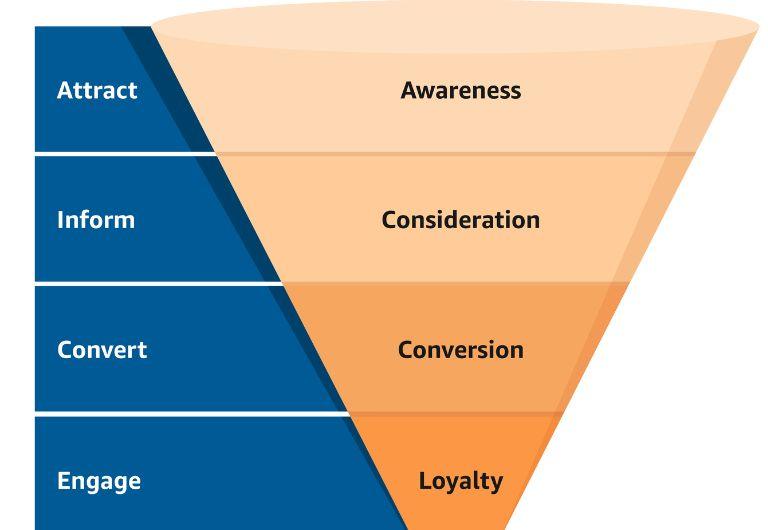
Measurement, Attribution, and the Role of Data
No full-funnel strategy succeeds without rigorous measurement. Funnel analytics and attribution provide visibility into what drives growth and what drains budget.
Modern attribution models move beyond last-click thinking. They account for assisted conversions, cross-channel influence, and time-to-convert. Dashboards integrate acquisition, engagement, and retention metrics to inform decision-making.
A data-driven digital marketing strategy is not about more data, but better questions. Which awareness channels produce the highest lifetime value? Which mid-funnel assets accelerate conversion? Which retention initiatives reduce churn? These insights turn marketing into a strategic growth function.
Why Dubai-Based Brands Require a Full-Funnel Mindset
Dubai is a global marketplace with local nuances. Buyers are digitally sophisticated, brand-conscious, and value-driven. Competition is intense, and switching costs are low. In such an environment, isolated tactics underperform.
A full-funnel digital marketing agency brings not just execution, but perspective. It understands how global best practices intersect with regional behavior. It aligns paid, owned, and earned media around a single growth narrative.
For businesses seeking scale—not spikes—full-funnel digital marketing services provide the structure required to compete and win.
Conclusion: Building Funnels That Compound
Full-funnel digital marketing is not a trend; it is a structural response to how modern buyers behave. It reflects the reality that decision-making is no longer linear, predictable, or confined to a single channel. By replacing fragmentation with flow, isolated tactics with integrated systems, and short-term wins with sustainable growth models, full-funnel strategies align marketing with how value is actually created in today’s economy.
For Dubai-based organizations navigating complex, high-stakes markets, the question is no longer whether to adopt a full-funnel approach, but how rigorously and intelligently to implement it. In environments defined by intense competition, sophisticated buyers, and rising acquisition costs, incremental optimization is not enough. Brands that succeed are those that design their funnels with discipline—grounded in data, informed by buyer intent, and executed with consistency across every touchpoint.
When implemented correctly, full-funnel digital marketing does more than increase lead volume. It improves lead quality, shortens sales cycles, strengthens retention, and compounds lifetime value. It ensures that every interaction—whether an awareness touchpoint, a nurturing sequence, or a post-conversion experience—contributes measurably to growth.
In a world where attention is scarce and trust is earned incrementally, competitive advantage belongs to brands that treat every interaction as a deliberate step in the buyer journey. Designing with intent, measuring with precision, and optimizing with a long-term lens is what separates scalable brands from stagnant ones. That is the true power of full-funnel digital marketing—and why it has become the foundation of sustainable growth in modern markets.
FAQ
1. What is full-funnel digital marketing, and how is it different from traditional digital marketing?
Full-funnel digital marketing focuses on the entire customer journey, from first awareness to post-purchase retention, rather than isolated tactics like ads or SEO alone. Traditional digital marketing often optimizes individual channels in silos, while full-funnel marketing connects awareness, consideration, conversion, and loyalty into a single, data-driven system. The difference lies in orchestration and continuity, not just execution.
2. Is full-funnel digital marketing worth it for small or mid-sized businesses?
Yes—provided it is implemented proportionally. Many Reddit and Quora users assume full-funnel strategies are only for large enterprises, but in reality, smaller businesses often benefit more because they cannot afford wasted spend. A lean full-funnel digital marketing strategy helps prioritize high-impact touchpoints, improve lead quality, and shorten decision cycles instead of chasing volume.
3. How long does it take to see results from a full-funnel digital marketing strategy?
Results are staggered by stage. Awareness improvements may appear within weeks, mid-funnel engagement within 1–3 months, and revenue impact typically within 3–6 months. However, the real value compounds over time as data improves targeting, messaging, and retention. Full-funnel digital marketing is designed for sustained performance, not overnight spikes.
4. How do you measure success in full-funnel digital marketing?
Success is measured using stage-specific metrics, not a single KPI. This includes engagement quality at the top of the funnel, intent signals and lead velocity in the middle, conversion rate and deal quality at the bottom, and retention or lifetime value post-conversion. Most experienced practitioners emphasize attribution modeling and funnel analytics over vanity metrics like clicks or impressions.
5. Should I hire a full-funnel digital marketing agency or build it in-house?
This depends on complexity and scale. Many Quora discussions highlight that building full-funnel capability in-house requires strategy, analytics, creative, automation, and CRO expertise—often difficult to assemble quickly. A specialized full-funnel digital marketing agency can accelerate results by providing systems, experience, and cross-channel integration, while internal teams focus on domain knowledge and execution alignment.