
Exploring Market Fit: Ensuring Brand Relevance & Demand

Introduction
In an era of accelerating market changes, brand market fit has emerged as one of the most critical determinants of long-term business success. While the concept of product-market fit has dominated startup literature for over a decade, the reality is that many brands fail even after finding it. Why? Because the brand — the perception, story, and promise wrapped around the product — no longer resonates with evolving consumer expectations.
A 2024 Nielsen Global Brand Relevance Study found that 73% of consumers have switched to a different brand in the last 12 months due to perceived misalignment with their personal values and needs. This isn’t just a marketing problem; it’s a brand strategy and execution problem that directly impacts business survival.
From Product to Perception
Brand market fit refers to the degree to which a brand’s identity, values, and messaging align with the evolving needs and beliefs of its target audience. It’s the emotional and cultural connection that sustains loyalty even when competitors offer similar or better functional benefits.
“A brand without relevance is like a conversation without context — it doesn’t matter how polished your delivery is if you’re not saying something your audience cares about,” says marketing strategist David Aaker, often called the “Father of Modern Branding.”
Strong brand strategy execution — as outlined in resources like Brand Strategy and execution — ensures that this alignment isn’t left to chance. Instead, it becomes a deliberate, ongoing process of market listening, testing, and refinement.
The High Stakes of Misalignment
Failing to maintain brand market fit is costly. McKinsey & Company research shows that brands suffering from relevance decline experience a 50% faster erosion of market share compared to those maintaining strong alignment. Once brand trust breaks, rebuilding it is exponentially harder than preserving it.
Real-world example: In the mid-2010s, Gap attempted a rapid rebranding that ignored the emotional attachment customers had to its original identity. The backlash was immediate, sales slumped, and the company reverted to its old logo within a week. This illustrates how ignoring cultural and emotional cues in the pursuit of change can sever the connection between brand and audience.
Brand Market Fit as a Competitive Moat
In markets saturated with interchangeable products, brand differentiation through relevance becomes a moat competitors struggle to breach. Tech giants like Apple and Nike continuously invest in understanding the cultural currents shaping their audiences — from sustainability to inclusivity — ensuring that their brand identity evolves alongside their customers’ values.
Research from Forrester confirms this, stating: “Brands that track and optimize relevance on a quarterly basis grow revenue 23% faster than their peers.”
The Role of Speed in a Shifting Landscape
Today’s challenge is speed. Markets shift quickly due to technological innovation, cultural movements, and global events. A brand that feels relevant today can feel outdated tomorrow. The global pandemic alone compressed years of consumer behavior changes into a few months, forcing brands from Zoom to Peloton to redefine their positioning almost overnight.
In such conditions, brand market fit is not a one-time achievement but a continuous exploration. Businesses must treat it as a core operational process, integrating brand strategy execution, real-time consumer feedback, competitive intelligence, and cultural trend analysis into their decision-making.
Understanding Brand Market Fit
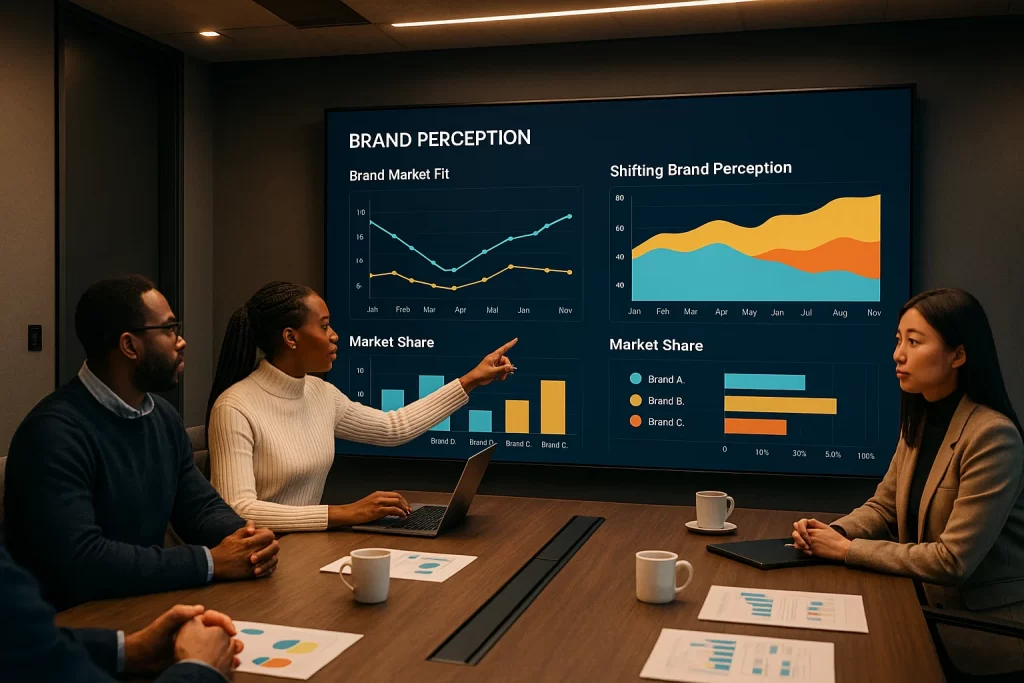
Most businesses are familiar with product-market fit — the stage when a product’s features, pricing, and positioning meet a defined market demand. But brand market fit is a different, and arguably more enduring, challenge. It measures how effectively a brand’s identity, promise, and emotional resonance align with the evolving beliefs, lifestyles, and aspirations of its target audience.
While product-market fit answers the question “Do people want what we’re selling?”, brand market fit asks, “Do people want us — and do they see us as relevant to their world?”. This distinction is crucial because in crowded markets, it is often the brand that becomes the ultimate differentiator.
Brand Market Fit vs. Product-Market Fit
Both concepts share the goal of alignment, but they operate on different planes:
- Product-Market Fit: Driven by functionality, performance, and value delivery.
- Brand Market Fit: Anchored in perception, values, storytelling, and cultural alignment.
When a brand achieves both, it not only wins customers but creates advocates. However, a strong product without brand alignment can be vulnerable — think of technically superior products that never gain traction because they fail to connect emotionally.
The Role of Brand Strategy and Execution
To maintain brand market fit over time, businesses need a deliberate brand strategy paired with disciplined execution.
- Brand Strategy: Defines the brand’s purpose, values, market positioning, and unique voice.
- Execution: Brings the strategy to life through consistent messaging, customer experiences, and touchpoints that reinforce relevance.
As outlined in Executing Winning Brand Strategies: From Planning to Performance, strategy without execution is little more than a blueprint, while execution without strategy is a series of disconnected actions. True brand market fit requires both in constant dialogue — adapting to market signals without losing core identity.
Why This Matters in a Shifting Landscape
Cultural values, generational attitudes, and competitive narratives shift faster than ever. What feels resonant today can feel outdated tomorrow. For example:
- Sustainability, once a niche talking point, is now a baseline expectation in many industries.
- Social and political stances can dramatically alter brand perception, especially among younger demographics.
Without proactive market listening and iterative execution, brands risk drifting into irrelevance despite strong historical performance.
E-E-A-T and Trust as Core to Brand Market Fit
From a Search Quality Evaluator perspective, brand market fit also intersects with Experience, Expertise, Authoritativeness, and Trust (E-E-A-T). A brand can’t be relevant if its claims aren’t credible or if it’s absent from authoritative conversations in its category. Execution here means not just running campaigns but ensuring every public action reinforces credibility.
Signs Your Brand Is Losing Market Fit
Losing brand market fit rarely happens overnight. It’s a gradual drift, often hidden beneath surface-level sales data or masked by legacy customer loyalty. By the time the decline becomes visible in financial metrics, the damage to perception and positioning can be severe. Recognizing early warning signs allows brands to adjust strategy and execution before the market fully moves on.
1. Declining Engagement Across Channels
One of the earliest indicators of relevance erosion is a measurable drop in customer interaction — fewer clicks on campaigns, declining social media engagement, or reduced email open rates.
- This doesn’t always mean the product has lost appeal; it often reflects a brand message that no longer resonates.
- For example, a fashion retailer may still sell well during seasonal promotions, but its day-to-day organic engagement steadily falls because its brand storytelling feels outdated.
Execution Insight: Constant A/B testing of creative and messaging can flag declining relevance before it shows up in revenue.
2. Shift in Customer Demographics
When the demographic composition of your active customer base changes — often skewing older or toward less desirable acquisition segments — it can be a signal that your brand’s cultural resonance is slipping.
- For instance, legacy soda brands have watched younger generations migrate toward flavored water and energy drinks because the brand image failed to evolve with lifestyle shifts.
Strategy Note: Regular market segmentation updates, informed by audience listening tools, are critical to avoid demographic drift.
3. Brand Sentiment Decline
Tracking brand sentiment through social listening, reviews, and NPS scores can reveal perception shifts long before sales decline.
- Negative or neutral sentiment replacing positive feedback may indicate the brand is perceived as out-of-touch.
- A McKinsey study found that brands experiencing a 10-point drop in sentiment faced, on average, a 15% sales decline within 12 months.
Execution Tip: Integrating real-time sentiment dashboards into marketing workflows ensures that brand strategy adjustments are data-driven, not reactive guesses.
4. Competitors Outflanking Your Narrative
Competitors launching campaigns that feel fresher, more relevant, or culturally attuned can push your brand into the background.
- This often happens when brand strategy execution becomes static — reusing old positioning while rivals adapt their voice, tone, and visuals to current trends.
- Example: Athletic brands that failed to adopt inclusive imagery and messaging lost share to newcomers actively showcasing diversity.
5. Internal Misalignment Between Strategy and Execution
Sometimes the warning signs come from within. If your creative, product, and sales teams interpret your brand strategy differently, execution becomes inconsistent — confusing customers and weakening the brand’s market position.
- Consistent brand execution across all touchpoints is vital to maintaining market fit.
Why Early Detection Matters
The cost of repairing lost brand market fit is significantly higher than the cost of maintaining it.
- Forrester research shows that brands actively tracking fit indicators can recover relevance 2.5x faster than those that only respond after major market share loss.
Recognizing these signs early is the first step toward strategic intervention — whether that means refreshing brand messaging, realigning target audiences, or pivoting execution to better reflect consumer realities.
Market Landscape Analysis
Understanding your market landscape is essential to maintaining brand market fit. Without a clear view of where your brand sits in relation to competitors, emerging trends, and shifting consumer behaviors, even the best brand strategy risks becoming disconnected from reality. The brands that stay relevant are those that treat market analysis not as a quarterly exercise, but as a continuous, embedded part of execution.
1. Mapping the Competitive Field
The first step in market landscape analysis is identifying direct competitors (brands targeting the same audience with similar offerings) and indirect competitors (brands meeting the same needs in different ways).
- Example: For a premium coffee brand, a direct competitor might be another artisanal roaster, while an indirect competitor could be a high-end home espresso machine brand.
- Brands that excel here don’t just monitor product features — they track narrative positioning, visual identity changes, and campaign themes.
Execution Tip: Maintain a shared competitive intelligence dashboard accessible to all marketing and product teams to ensure strategy alignment.
2. Identifying Emerging Threats and Opportunities
Market relevance can erode quickly if a new entrant captures the cultural zeitgeist.
- For example, a legacy sportswear brand may lose ground to a startup that positions itself around sustainability and inclusivity — narratives with strong appeal to younger demographics.
- Early detection allows for strategy pivots that address these shifts before they become existential threats.
3. Tracking Cultural and Industry Trends
Market analysis is not just about competitors; it’s also about the broader cultural context in which your brand operates.
Trend Categories to Watch
Cultural Movements: Shifts in social values, activism, and representation.
Technological Advances: AI integration, digital personalization, or new platforms.
Economic Conditions: Inflation, disposable income shifts, or supply chain changes.
Strategy Insight: By mapping how these trends intersect with brand values, you can prioritize which narratives to own and which to avoid.
4. Audience Evolution Analysis
Your audience is not static. Tracking changes in their motivations, challenges, and aspirations is critical.
- A brand that positioned itself for aspirational luxury in 2015 may now find success in offering accessible premium experiences in response to economic constraints.
- Tools like social listening platforms, panel surveys, and ethnographic studies help maintain this alignment.
Execution Example: Integrating quarterly audience insight reports into your brand strategy execution meetings ensures these changes directly inform creative, product, and channel decisions.
5. Positioning Through Strategic Differentiation
The ultimate goal of market landscape analysis is to sharpen your competitive differentiation.
- This involves more than claiming a unique value proposition — it requires delivering consistent proof of that proposition through brand actions, not just advertising.
- As brand strategist Marty Neumeier puts it: “A brand is not what you say it is. It’s what they say it is.”
Why Continuous Analysis Matters
Brands that monitor the market landscape continuously — and act on insights — maintain agility and relevance. Those that don’t risk relying on outdated assumptions, leading to strategy-execution gaps and lost market fit.
Measuring Brand Market Fit
You can’t improve what you don’t measure. For many brands, the challenge isn’t knowing that brand market fit matters — it’s having a reliable, repeatable system to track it over time. Without metrics, brand strategy execution becomes guesswork, and relevance decisions risk being driven by intuition rather than evidence.
1. Core Metrics for Brand Market Fit
To evaluate brand alignment with your target market, track both quantitative and qualitative measures:
- Net Promoter Score (NPS)
Gauges customer loyalty by asking how likely they are to recommend your brand. A rising NPS often correlates with stronger market fit. - Brand Relevance Index (BRI)
Measures how essential your brand feels to your audience compared to alternatives. - Share of Voice (SOV)
Tracks your brand’s visibility in the market compared to competitors. A declining SOV in key conversations can signal a fit problem. - Brand Sentiment Analysis
Social listening and review monitoring reveal whether your audience views your brand positively, neutrally, or negatively. - Engagement-to-Acquisition Ratio
Measures whether your marketing is not only reaching people but moving them toward conversion — a key execution health check.
2. Tools to Implement Measurement
Several tools can systematize these measurements:
- Survey Platforms (Qualtrics, Typeform) for NPS and BRI data.
- Social Listening Tools (Brandwatch, Sprinklr) for sentiment and trend detection.
- Analytics Dashboards (Google Analytics, Looker Studio) to connect engagement metrics to conversion performance.
- Competitive Intelligence Tools (SEMrush, SimilarWeb) for SOV benchmarking.
Execution Tip: Integrate these tools into a single reporting dashboard so leadership, marketing, and product teams see the same truth.
3. Establishing a Measurement Cadence
- Quarterly Deep Dives: Assess long-term shifts in sentiment, relevance, and audience perception.
- Monthly Snapshots: Spot short-term fluctuations caused by campaigns, competitor moves, or cultural events.
- Real-Time Alerts: Use automated monitoring to flag sentiment drops or engagement anomalies.
As Octopus Marketing notes, measurement must be embedded in brand strategy execution — not bolted on after campaigns run.
4. Linking Measurement to Action
Data is only as valuable as the strategic action it informs:
- If NPS is low but engagement is high, you may have a messaging–experience mismatch.
- If SOV is shrinking, you may need a competitive push or refreshed creative execution.
- If sentiment declines after a brand move, it’s time for rapid audience feedback loops and corrective communication.
Example: A global beverage brand noticed declining relevance scores in younger demographics. Sentiment analysis revealed environmental concerns. By pivoting packaging strategy to 100% recycled materials and communicating the change aggressively, they reversed the trend within two quarters.
5. The Role of E-E-A-T in Measurement
High Experience, Expertise, Authoritativeness, and Trust scores contribute directly to brand market fit. This means measuring fit isn’t just about market metrics — it’s about ensuring your content and actions continuously reinforce credibility.
Why This Matters
Without a measurement framework, brands risk making strategy-execution decisions based on assumptions. With it, they can adapt with precision, staying relevant even in turbulent markets.

Strategies to Improve Brand Market Fit
Achieving brand market fit is not the finish line — it’s the starting point for continuous adaptation. Markets evolve, cultural values shift, and competitors refine their narratives. A winning brand strategy anticipates these changes, while strong execution ensures the brand’s relevance is maintained and reinforced across every touchpoint.
1. Repositioning Your Brand
When metrics indicate a decline in relevance, brand repositioning may be necessary.
- Approach: Adjust your brand’s promise, voice, and value proposition to align with current audience priorities without alienating core customers.
- Example: A fitness apparel company pivoted from performance-first messaging to body inclusivity, expanding its market without losing credibility with athletes.
Execution Tip: Roll out repositioning in phases — starting with test campaigns to measure response before committing to a full identity shift.
2. Audience Re-Segmentation
If demographic analysis shows your audience is aging or shrinking, it’s time to refresh targeting.
- Use data-driven personas that reflect current values, buying triggers, and content preferences.
- Identify secondary audience segments that share your brand’s values but haven’t yet engaged deeply.
Strategy-Execution Link: Audience re-segmentation should be paired with creative refreshes, new product lines, or partnerships that speak directly to these new groups.
3. Product and Service Adaptation
A powerful way to restore market fit is to adjust the offer itself.
- This could mean adding features, refining design, or creating limited-edition products tied to cultural moments.
- Example: Food brands that reformulated recipes to meet health-conscious trends (reduced sugar, plant-based ingredients) regained relevance quickly.
Execution Reminder: Communicate these changes as part of your brand story — transparency builds trust and strengthens alignment.
4. Cultural and Value Alignment
Aligning with cultural shifts can rapidly boost brand relevance — but it must be authentic.
- If sustainability is rising in importance, adopt measurable environmental goals and publish progress updates.
- If inclusivity is a priority, ensure representation is present in both marketing campaigns and internal policies.
Outbound Link Insight: Adweek case studies show that brands making authentic, sustained commitments see longer-lasting engagement lifts compared to one-off campaigns.
5. Strategic Partnerships and Collaborations
Collaborations can introduce your brand to new audiences without a complete repositioning.
- Partner with brands, influencers, or causes that share your values but reach different demographics.
- Example: A luxury skincare brand partnering with a sustainable packaging startup to appeal to eco-conscious consumers.
Execution Precision: Choose partners with reputations that enhance — not dilute — your brand equity.
6. Enhancing Customer Experience
Improving brand fit often comes down to removing friction and adding delight.
- Streamline the buying process, personalize recommendations, and offer post-purchase engagement that reinforces brand values.
- Consistent experience execution ensures that the brand promise feels real at every interaction.
Why Integrated Strategy + Execution Wins
The best strategies fail without flawless execution, and execution without strategy risks short-term wins that erode long-term equity. Continuous measurement, audience listening, and adaptive action form the closed loop that keeps brands in alignment with their markets.
Case Studies: Brands That Nailed the Shift
Theoretical strategies are valuable, but nothing builds confidence like seeing them succeed in the real world. These case studies illustrate how brands that were losing relevance restored brand market fit through a combination of smart strategy and disciplined execution.
1. Nike – Doubling Down on Cultural Alignment
Challenge
By the mid-2010s, Nike faced growing competition from younger, digitally native sportswear brands. Its relevance among Gen Z was slipping, especially as emerging brands owned conversations around inclusivity and social causes.
Strategy
Nike repositioned itself as a brand that stands for social activism, not just athletic performance. It embraced cultural moments, most famously through its Colin Kaepernick campaign, aligning with social justice issues that resonated with younger demographics.
Execution
- Integrated storytelling across TV, social media, and influencer partnerships.
- Updated visual identity and ad creative to reflect diverse representation.
- Expanded product collaborations with athletes known for activism.
Outcome
Despite short-term backlash in certain segments, Nike’s sales surged 31% in the month following the Kaepernick ad launch. The campaign deepened loyalty among younger, values-driven consumers, re-establishing market fit.
2. Lego – From Decline to Cultural Icon
Challenge
In the early 2000s, Lego faced financial trouble as children shifted toward digital entertainment and the brand’s product lines had drifted from its core identity.
Strategy
Refocus on Lego’s core brand promise — creativity and imagination — while embracing digital culture instead of fighting it.
Execution
- Partnered with entertainment franchises (Star Wars, Marvel, Harry Potter) to merge play with storytelling.
- Launched digital experiences, apps, and a Lego movie franchise to engage tech-savvy kids.
- Reinforced brand values in all channels, from packaging to social media content.
Outcome
By 2015, Lego became the world’s most powerful brand according to Brand Finance, with revenue doubling over the previous decade.
3. Old Spice – Rebranding a Legacy
Challenge
Old Spice was losing market share to younger, “cooler” men’s grooming brands. Its audience skewed older, and its brand image was outdated.
Strategy
Transform Old Spice into a quirky, self-aware brand appealing to a younger demographic without alienating loyal older customers.
Execution
- Introduced humorous, over-the-top ads like “The Man Your Man Could Smell Like.”
- Leveraged social media to engage directly with fans and generate viral content.
- Updated packaging and product design to reflect a modern, energetic aesthetic.
Outcome:
Sales of Old Spice body wash jumped 125% year-over-year, and the brand became a pop culture phenomenon.
Key Lessons from These Shifts
- Cultural Listening Drives Strategy: Nike and Lego succeeded by deeply understanding emerging cultural and consumer narratives.
- Execution Consistency is Critical: Every touchpoint reflected the new positioning — from ad campaigns to packaging.
- Risk is Often Required: Each brand took bold moves that carried potential backlash but aligned authentically with their values.
These examples prove that brand market fit isn’t about chasing trends blindly — it’s about making strategic choices and executing them with precision, authenticity, and cultural awareness.
Common Pitfalls in Market Fit Exploration
Exploring and maintaining brand market fit is not without risks. Many brands begin with strong intentions but fall into predictable traps that undermine both strategy and execution. These missteps can cause more harm than inaction, as they erode trust, dilute identity, and make recovery more difficult.
1. Ignoring the Feedback Loop
One of the most damaging mistakes is failing to build real-time feedback into brand strategy execution.
- Brands that launch repositioning efforts without testing messaging or tracking sentiment risk misreading their audience.
- Example: A beverage brand introduced a bold sustainability campaign without confirming whether its audience valued eco-packaging over taste. Sales dipped when customers perceived quality had declined.
Avoidance Tip: Implement iterative testing — small-scale rollouts, focus groups, and pilot campaigns — before committing to large-scale changes.
2. Over-Reliance on Past Brand Equity
Heritage and history are valuable, but nostalgia alone does not guarantee relevance.
- Brands sometimes assume that because they were once market leaders, they can “reclaim” fit by returning to old messaging or identity.
- This can lead to strategic stagnation, where the execution feels dated compared to competitors.
Execution Insight: Balance core identity preservation with modern cultural alignment. The most successful legacy brands keep their essence but evolve their tone and presentation.
3. Chasing Every Trend
Jumping on every cultural wave or meme may bring short-term attention, but it often dilutes brand identity.
- When brands lack a clear strategic filter, execution becomes inconsistent, leaving audiences unsure of what the brand stands for.
- Example: Several fast-food chains tried mimicking streetwear drops without a logical connection to their product, confusing customers and cluttering brand perception.
Strategy Tip: Use trends as tools, not direction-setters. Only participate when a trend aligns with your core values and audience expectations.
4. Inconsistent Cross-Channel Execution
Even the strongest strategy fails if it’s executed inconsistently across platforms and touchpoints.
- Misaligned tone, visuals, or messaging can fracture the brand experience.
- Example: A tech brand presented itself as innovative on social media but used outdated design templates for its email marketing, creating a jarring disconnect.
Execution Best Practice: Develop a brand execution playbook with approved visuals, messaging guidelines, and tone-of-voice principles that all teams follow.
5. Overlooking Internal Alignment
If leadership, marketing, and product teams interpret the brand strategy differently, execution suffers.
- Mixed internal understanding leads to conflicting campaigns, product decisions, and customer experiences.
- Example: A retailer’s marketing promoted luxury positioning while its product line shifted toward budget offerings, undermining credibility.
Solution: Align internal stakeholders through regular brand strategy workshops, unified KPIs, and shared performance dashboards.
6. Treating Market Fit as a One-Time Project
Perhaps the most common pitfall is viewing market fit exploration as a project with a start and finish.
- In today’s environment, relevance requires ongoing monitoring and adaptation.
- Without continuous input, even well-executed strategies lose effectiveness as the market shifts.
Why Avoiding These Pitfalls Matters
By steering clear of these traps, brands preserve both strategic integrity and executional consistency, making it far easier to sustain relevance and trust over time.
Future-Proofing Your Brand Market Fit
In an unpredictable business landscape, future-proofing brand market fit is about building the ability to adapt without losing core identity. This requires an intentional combination of brand strategy foresight and execution discipline, ensuring that when cultural, economic, or technological shifts occur, your brand can respond faster — and more authentically — than competitors.
1. Anticipatory Branding
The most resilient brands are not merely reactive; they anticipate change.
Example: Tesla didn’t wait for electric vehicles to become mainstream — it shaped the narrative years in advance.
Anticipatory branding involves tracking weak signals in consumer behavior, culture, and technology, then preparing strategies that position your brand ahead of the curve.
Execution Tip: Dedicate part of your marketing budget to experimental projects that explore emerging platforms, formats, and narratives.
2. Continuous Consumer Listening
Consumer expectations evolve quickly, especially as generational attitudes shift.
Strategy: Build a permanent “listening infrastructure” — social listening, quarterly sentiment reports, and direct community feedback channels.
Execution: Make this data a standing agenda item in brand strategy meetings, ensuring creative and product decisions reflect current audience realities.
3. Embedding Agility into Execution
Agility means having processes that allow for rapid pivoting without bureaucratic delays.
Example: During the early pandemic, brands with pre-approved creative templates and decentralized decision-making were able to launch relevant campaigns in days rather than weeks.
This agility stems from preparing flexible brand guidelines, scenario-based content plans, and empowered teams.
4. Investing in Cultural Relevance
Cultural alignment doesn’t mean chasing trends — it means staying part of the conversations your audience cares about.
Outbound Link Insight: As noted in TrendWatching’s foresight reports, brands that consistently appear in relevant cultural contexts are perceived as 28% more innovative.
Execution: Identify 3–4 long-term cultural territories your brand can authentically own, and commit to them in campaigns, partnerships, and product development.
5. Cross-Functional Brand Ownership
Future-proofing requires that brand relevance isn’t just marketing’s job — it’s everyone’s responsibility.
Strategy: Embed brand KPIs into product, service, and HR performance metrics.
Execution: Train all departments on brand voice, promise, and positioning so that every decision supports market fit.
6. Measuring and Iterating in Short Cycles
Long annual planning cycles are too slow for modern markets.
- Shift to quarterly or even monthly measurement of brand market fit metrics (NPS, sentiment, share of voice) and adjust execution accordingly.
- This creates a loop where insight leads directly to immediate action, reducing the lag between trend recognition and brand response.
Why Future-Proofing Matters
In an era where disruption is constant, brand market fit is less about “getting it right” once and more about “staying right” continually. Brands that embed anticipation, agility, and cultural alignment into their strategy and execution will not only survive — they’ll thrive.
FAQ
1.What’s the difference between product-market fit and brand market fit?
Product-market fit is about whether your product meets a demand. Brand market fit goes deeper — it measures whether your brand identity, values, and messaging align with your audience’s cultural expectations and emotions.
Without brand market fit, even a great product risks being ignored in favor of competitors with stronger emotional and cultural resonance.
As one Reddit user bluntly put it: “I’ll buy from the brand that ‘gets me,’ even if the product’s not the absolute best.”
2. How do I know if my brand is losing market fit?
Watch for these red flags:
- Declining engagement across marketing channels.
- Audience demographics shifting away from your target.
- Negative sentiment trends in social listening tools.
- Competitors dominating the narrative in your space.
Execution note: Set up automated alerts for sentiment and share-of-voice changes to detect relevance issues early.
3.Can small brands compete with big players on market fit?
Absolutely. Smaller brands often have an agility advantage — they can adjust brand strategy execution faster without layers of approval.
Example from Reddit: “I switched to a small coffee roaster because they told me exactly where my beans came from. Starbucks can’t match that level of connection.”
For small brands, authenticity and responsiveness can outperform big-budget campaigns.
4. How often should I re-evaluate brand market fit?
Quarterly reviews are ideal.
- Monthly sentiment and engagement checks keep your execution responsive to short-term changes.
- Quarterly deep dives allow for strategic pivots without overreacting to temporary fluctuations.
Outbound link insight: According to Octopus Marketing, continuous measurement is the backbone of market fit maintenance.
5. Is chasing trends a good way to stay relevant?
Not unless the trend aligns with your brand’s core values and positioning.
- Jumping on irrelevant trends can dilute brand identity.
- As one Reddit user wrote: “Nothing screams desperate like a brand using TikTok slang three months late.”
Execution best practice: Maintain a “trend fit checklist” to ensure every cultural moment you engage with strengthens your brand’s narrative.
Conclusion
In today’s volatile markets, brand market fit is the bridge between what your business offers and what your audience values — both emotionally and culturally. Achieving it requires more than intuition; it demands a deliberate brand strategy reinforced by consistent execution across every channel and touchpoint.
From identifying early warning signs of misalignment to adapting through repositioning, audience re-segmentation, and cultural alignment, the brands that thrive are those that embed agility, authenticity, and foresight into their DNA. They don’t just react to change — they anticipate and shape it.
The key takeaway is simple: market fit is not a milestone, it’s a muscle. The more consistently you measure, refine, and adapt, the stronger your brand becomes in navigating shifts without losing its core identity. In doing so, you build a brand that not only survives the next disruption but uses it as a launchpad for deeper relevance and competitive advantage.