
The Brand Agility Playbook: Adapting to Rapid Market Changes
Introduction
In a marketplace defined by volatility, brand agility has become a decisive competitive advantage. Research from McKinsey (link) shows that companies with adaptable brand systems outperform less flexible competitors by up to 63% in revenue growth during market disruptions. Yet, agility is not simply about speed — it’s about adaptive resilience: the ability to pivot in response to market signals while preserving the core identity that makes a brand recognizable and trusted.
This is the paradox at the heart of brand governance today. Too rigid, and a brand becomes outdated before the quarter ends. Too reactive, and the brand loses its strategic anchor, confusing both internal teams and external audiences. The Brand Agility Playbook offers a roadmap to resolve this tension — balancing the freedom to evolve with the discipline to protect equity.
At its core, agility must be grounded in a robust brand strategy and execution framework. Without a clear strategic direction and an execution plan to match, rapid changes risk becoming random acts of marketing rather than intentional steps toward long-term positioning. This playbook is built to ensure that adaptation is guided by data, anchored in purpose, and executed flawlessly across every channel.
From adaptive branding strategies and modular brand systems to real-time market insights, this guide draws on lessons from innovation leaders who’ve mastered the art of change without eroding their brand’s DNA.
Understanding Brand Agility in the Modern Marketplace
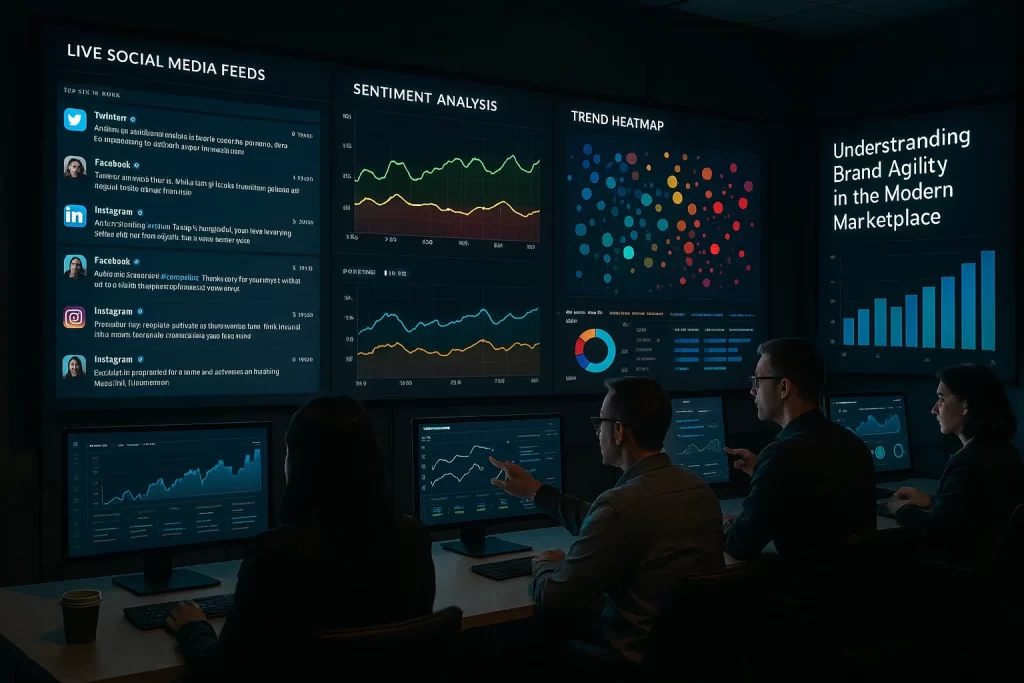
In 2025, brand agility is no longer a differentiator; it’s a survival requirement. The accelerated pace of technological disruption, the unpredictability of consumer sentiment, and the rise of global crises have shortened the strategic planning cycle from years to months — in some industries, to mere weeks. Brands that thrive are those that adapt rapidly without losing their strategic core.
According to Harvard Business Review , agile brands are 2.5 times more likely to achieve above-average market share growth in volatile markets. This isn’t about chasing every trend — it’s about creating a responsive brand strategy that reacts to the right signals, not just the loudest ones.
“In a volatile market, agility is not just an advantage — it’s survival,” notes Harvard Business Review, emphasizing the need for adaptable yet consistent brand positioning.
Why Brand Agility Matters Now
- Consumer Expectations Have Shifted – Customers expect brands to respond to cultural moments, industry changes, and even geopolitical events in near real-time.
- Markets Are Less Predictable – Predictive models have been disrupted by unprecedented events, from supply chain shocks to AI-driven competition.
- The Digital Noise Factor – A rigid brand message risks irrelevance when competitors update narratives weekly.
Will Adapting Dilute My Brand Identity?
One of the most common fears among CMOs and brand managers is that frequent adaptation will lead to brand fragmentation. This fear is valid — without governance, brand agility can devolve into chaos. The answer lies in building a flexible brand framework: a modular brand playbook that allows for rapid creative iteration without altering foundational elements like brand purpose, tone, or visual identity.
Core Principles of an Agile Brand Playbook
An agile brand playbook is more than a document — it’s a dynamic operating system for brand management. While traditional brand guidelines focus on preserving identity, an agile playbook emphasizes adaptability without fragmentation. It’s built to flex in response to market signals while maintaining the brand’s strategic DNA.
According to Forrester (link), organizations with adaptive brand frameworks outperform competitors by up to 25% in brand equity retention during high-volatility periods. The reason: agility is embedded into both brand strategy and execution, ensuring that every adjustment aligns with core positioning.
Principle 1: Flexibility Without Fragmentation
A common mistake brands make when pivoting quickly is allowing inconsistencies to creep in — from tone of voice to visual identity. The solution is modular brand systems: design and messaging frameworks where core elements remain fixed, while secondary elements are adaptable by context.
Example: Spotify keeps its logo, color palette, and typographic style consistent, but adapts imagery and copy to local markets within hours.
Principle 2: Data-Informed Creative Direction
In an agile framework, creative decision-making isn’t based on intuition alone. It’s guided by real-time insights from:
- Social listening platforms.
- Brand sentiment analysis.
- Cultural trend monitoring.
- A/B testing results for creative assets.
“Data should be the compass, not the cage,” says Sarah Robb O’Hagan, CEO of EXOS, emphasizing that data informs creativity but doesn’t replace it.
Principle 3: Clear Governance & Approval Pathways
Agility doesn’t mean anarchy. A truly agile playbook defines who can authorize brand changes, how fast-track approvals work, and which updates require full stakeholder review. This ensures speed without sacrificing quality.
Solving Key Challenges
“We don’t have the resources for constant brand updates.”
The agile playbook streamlines decision-making, so teams aren’t reinventing processes every time they need to adapt.

Step-by-Step Brand Agility Playbook for Innovation Leaders
A brand agility playbook should be actionable — not just inspirational. The following step-by-step process integrates brand strategy and execution so that innovation leaders can move fast without losing strategic focus. This is where agility moves from theory into repeatable operational practice.
Step 1 – Diagnose Market Signals Early
The earlier you spot a trend or disruption, the more strategic options you have. Leading agile brands invest in real-time market intelligence systems that pull from:
- Social listening (e.g., Brandwatch, Sprout Social).
- Search trend monitoring (e.g., Google Trends).
- Competitor watchlists tracking product launches, ad campaigns, and positioning changes.
“Brand leaders must treat market signals like vital signs — measured daily and interpreted in context,” says David Aaker, Professor Emeritus at UC Berkeley’s Haas School of Business.
Step 2 – Rapid Prototyping of Brand Assets
Once a potential pivot is identified, the brand should test new creative directions quickly. Agile brands adopt a design sprint methodology, producing minimum viable campaigns within 3–5 days.
- Example: Airbnb’s response to global travel restrictions with a “Live Anywhere” campaign — conceptualized, tested, and launched in under two weeks.
- Use brand asset iteration cycles: test visuals, headlines, and formats in low-risk channels before scaling.
Step 3 – Controlled Pilot Launches
Instead of a full-scale rollout, run localized or segmented launches to test message resonance and operational feasibility.
Metrics to watch: Engagement rates, sentiment shifts, conversion data, cost per acquisition.
Risk control: Limit spend and exposure until KPIs confirm the approach is viable.
Step 4 – Cross-Functional Debriefs & Iteration
After pilots, gather insights from marketing, sales, customer service, and product teams. Adjust creative, copy, or positioning based on multi-department feedback.
Solving Key Challenges
“Our marketing team moves fast, but the rest of the company lags.”
Solution: Embed agility into cross-functional operations so everyone adapts together.
Step 5 – Institutionalize Learnings into the Playbook
The final — and most often neglected — step is updating your agile brand playbook with new best practices, templates, and success benchmarks. This ensures the next pivot is even faster and smoother.
Measuring the Impact of Brand Agility
Agility without measurement is just motion. For brand agility to be a sustainable business advantage, it needs to prove its impact — not only in creative relevance but also in bottom-line performance. This requires a metrics framework that balances speed of adaptation with brand equity preservation.
A 2024 Forrester report (link) found that companies measuring brand adaptability KPIs were 31% more likely to increase market share year-over-year compared to those with only creative performance metrics. The key is to track both short-term tactical wins and long-term strategic health.
Core Agility KPIs
- Time-to-Market (TTM) – Measures the number of days between identifying a market signal and launching an aligned campaign. Goal: Decrease without sacrificing quality.
- Brand Sentiment Shift – Tracks how public perception evolves following brand adjustments Tools: Net Promoter Score (NPS), sentiment analysis via AI listening tools.
- Engagement Lift – Compares campaign performance pre- and post-adjustment. Channels: Social, email, paid ads. Focus on metrics like CTR, video completion rate, and organic share of voice.
- Revenue Attribution to Agile Initiatives – Links specific agile campaigns to sales conversions. Often tracked in CRM and marketing automation systems.
- Brand Equity Index – Measures long-term strength through awareness, preference, and trust surveys. Ensures agility isn’t eroding foundational positioning.
How Do We Prove ROI to Leadership?
Executives often hesitate to invest in agility because its benefits seem intangible. The solution: connect agility KPIs to core business outcomes like sales, market share, and customer lifetime value (CLV).
Example: A retail brand that reduced its TTM by 40% during a trend-driven campaign also saw a 15% boost in same-month revenue.
Data Storytelling for Internal Buy-In
Numbers alone won’t win over decision-makers — the story matters. Use before-and-after comparisons, customer quotes, and competitor benchmarks to show the real-world value of agile adjustments.
“Agility without measurement is just improvisation,” says Rita McGrath, Columbia Business School professor and author of The End of Competitive Advantage.

Case Studies – Brands That Mastered Agility Without Losing Identity
Studying brands that have successfully navigated rapid market changes without diluting their core identity offers a blueprint for execution. These companies balance creative responsiveness with brand governance, demonstrating that agility doesn’t mean abandoning what makes a brand distinct.
Nike: Responding to Cultural Moments in Real-Time
Nike’s agility is rooted in its brand purpose: championing athletes and inspiring movement.
- Agility in Action: During the early months of the pandemic, Nike flipped its messaging from “Just Do It” to “Play Inside, Play for the World”, leveraging social distancing as a call for collective responsibility.
- Execution Framework: Nike uses real-time social listening and a modular content library so global teams can adapt campaigns to local cultural contexts in days, not months.
Airbnb: Pivoting During Global Travel Disruptions
When global travel restrictions hit in 2020, Airbnb shifted its entire value proposition almost overnight.
- Agility in Action: Launched Online Experiences in just two weeks — from cooking classes with Michelin-star chefs to virtual walking tours.
- Execution Framework: Airbnb empowered its global host network with creative autonomy while maintaining visual and tone consistency through a refreshed agile playbook.
Spotify: Data-Driven Personalization at Scale
Spotify’s agility is powered by data-informed creative execution.
- Agility in Action: The annual Wrapped campaign adapts instantly to user listening trends, creating personalized experiences for millions — all within a consistent visual identity.
- Execution Framework: Continuous A/B testing of design, copy, and interactive elements ensures campaigns evolve alongside user behavior without breaking brand coherence.
Lessons Across All Three
- Clear Brand Purpose: All three brands have a guiding purpose that anchors every adaptation.
- Data-Informed Decisions: Agility is never guesswork; it’s rooted in analytics.
- Modular Playbooks: Core brand assets are fixed; secondary elements are contextually flexible.
Solving Key Challenges
“We want to move faster, but we fear losing what makes our brand recognizable.”
These brands show that speed and consistency can coexist when agility is embedded in governance.
Common Pitfalls in Implementing Brand Agility
While brand agility offers tremendous competitive advantages, rushing into it without the right structures can backfire. Many brands mistake speed for strategy, leading to inconsistency, wasted resources, and brand dilution. Understanding the most frequent missteps is key to avoiding them.
Pitfall 1: Overreacting to Every Trend
Jumping on every viral moment can make a brand seem desperate or inauthentic.
- Why It’s a Problem: Overexposure to irrelevant trends can alienate core audiences.
- Example: Brands tweeting memes unrelated to their industry often see minimal engagement but risk eroding credibility.
- Solution: Apply a trend relevance filter — only respond if the moment aligns with brand values and target audience interests.
Pitfall 2: Inconsistent Messaging Across Markets
When multiple teams adapt campaigns independently, messaging and tone can drift.
- Why It’s a Problem: Customers lose trust when brand voice varies drastically between regions or channels.
- Solution: Maintain a modular brand system with core assets fixed, but allow controlled flexibility for local adaptation.
- Expert Quote: “The best agile brands give teams the tools to adapt without rewriting the brand’s DNA,” — Deloitte Digital (link).
Pitfall 3: No Governance or Approval Workflow
In the rush to move fast, some brands bypass the approval process entirely.
- Why It’s a Problem: Mistakes go live — from factual errors to cultural insensitivity.
- Solution: Use tiered approval systems where urgent updates get fast-tracked but still reviewed by at least one brand steward.
Pitfall 4: Measuring the Wrong Metrics
Focusing only on short-term engagement spikes ignores long-term brand health.
- Why It’s a Problem: A campaign may generate clicks but harm brand perception.
- Solution: Pair agility KPIs (e.g., time-to-market) with brand equity metrics (awareness, trust, preference).
Solving Key Challenges
“Our campaigns look different every time we adapt — are we losing brand equity?”
By avoiding these pitfalls, brands can act quickly without compromising cohesion.
Tools and Frameworks for Scaling Brand Agility
A truly agile brand doesn’t just adapt once in a crisis — it develops the infrastructure to adapt continuously. Scaling agility means building a toolkit and workflow that empowers teams to respond quickly, consistently, and intelligently across all channels.
According to Gartner (link), organizations that invest in brand agility platforms see a 37% faster campaign deployment rate and a 22% increase in cross-channel consistency compared to those managing brand updates manually.
Tool Category 1: Brand Asset Management (BAM) Systems
Centralized platforms where teams can instantly access approved brand assets, templates, and guidelines.
Examples: Bynder, Frontify, Brandfolder.
Benefits: Reduces time wasted hunting for assets; ensures all adaptations are on-brand.
Tool Category 2: Real-Time Listening & Analytics
Agile brands rely on live market intelligence to guide pivots.
Examples: Brandwatch, Sprout Social, Talkwalker.
Key Features: Sentiment analysis, competitor monitoring, trending topic alerts.
Tool Category 3: Collaborative Project Management
To execute quickly, teams need shared workspaces with visibility across departments.
Examples: Asana, Trello, Monday.com.
Best Practice: Set up agility-specific workflows with fast-track approval routes for high-priority updates.
Framework 1: Modular Brand Systems
A core brand DNA layer (logo, values, tone of voice) remains fixed, while a flexible adaptation layer changes by market or campaign.
Outcome: Allows local teams to tailor messaging without creating inconsistencies.
Framework 2: The “Three-Sprint” Model
- Insight Gathering: Monitor trends, analyze relevance, and draft adaptation concepts.
- Rapid Prototyping: Create minimum viable assets for testing.
- Scaling: Roll out across channels once KPIs validate performance.
Solving Key Challenges
“We adapt well in one market, but struggle to scale changes globally.”
Solution: Standardize tools, approval flows, and brand governance before a pivot is needed, so agility can be deployed at scale without chaos.
FAQ
1. How often should a brand update its playbook?
There’s no universal timeline — it depends on your industry volatility and market pace. However, in fast-moving sectors like tech or fashion, reviewing your playbook every 6–12 months ensures it reflects the latest trends, consumer behaviors, and platform changes.
Community Insight: A Reddit brand strategist shared, “Every 6 months feels right — we stay fresh but don’t exhaust our team.”
2. Can small startups benefit from brand agility?
Absolutely. In fact, small teams often have a natural agility advantage because they have fewer decision layers. By creating a lightweight brand playbook that’s easy to adjust, startups can pivot quickly without losing consistency.
Example: A DTC skincare startup used a two-page modular brand guide to pivot messaging during a supply chain shortage while staying on-brand.
3. How to maintain brand consistency across multiple markets?
Consistency comes from clear non-negotiables in your brand system — like logo usage, tone of voice, and color palette — paired with localized flexibility in imagery, examples, and copy.
Reference: Deloitte Digital recommends modular brand frameworks to balance control and local relevance.
4. What’s the difference between brand agility and rebranding?
Brand agility is about adjusting tactics and messaging while keeping your core identity intact.
Rebranding is a fundamental change to the brand’s identity, values, and often visual presentation.
Agile brands evolve without wiping the slate clean.
5. Which KPIs best measure brand agility?
The most useful KPIs balance speed, relevance, and equity:
- Time-to-Market – how fast you adapt.
- Brand Sentiment Shift – perception change after a pivot.
- Engagement Lift – interaction increase post-adjustment.
- Revenue Attribution to Agile Campaigns – direct financial impact.
- Brand Equity Index – long-term trust and preference metrics.
Conclusion
The most resilient brands of the next decade will be those that adapt without losing themselves. Agility is no longer a “nice-to-have” but a core competency — one that must be supported by a clear brand strategy and execution framework.
By combining modular brand systems, data-informed decision-making, and fast yet controlled adaptation processes, organizations can respond to market shifts in hours or days rather than weeks or months. The Brand Agility Playbook isn’t just a reactive toolkit — it’s a proactive operating model for building brands that can survive disruption and thrive in uncertainty.
Whether you’re a global enterprise or a fast-moving startup, the principles remain the same:
- Stay anchored in purpose.
- Build systems for speed.
- Measure impact relentlessly.
In an era where consumer expectations evolve overnight, the brands that win will be the ones that change fast — and change smart.