
Ensuring Brand Voice Consistency Across All Touchpoints
Introduction
Brand voice consistency is the ability to maintain a unified tone, style, and messaging across every customer-facing interaction. In an era where users encounter brands through dozens of fragmented platforms—email, social media, websites, product interfaces—this consistency becomes not just an aesthetic goal but a business imperative. A study by Lucidpress revealed that consistent brand presentation across all platforms can increase revenue by up to 33%, while research from Demand Metric shows that 71% of consumers expect coherent and personalized interactions.
This isn’t just a marketing concern. Psychologically, humans crave coherence. When a brand sounds cheerful on Instagram but robotic in customer support, it introduces cognitive dissonance. That gap diminishes trust and chips away at loyalty. In contrast, brands that master consistency build emotional resonance—think of the approachable wit of Mailchimp or the luxury precision of Apple. These voices are carefully engineered and relentlessly maintained as part of a holistic Brand Strategy and Execution approach.
From a semantic SEO perspective, consistent voice contributes to entity recognition. The more uniform your tone, the stronger your association with your brand’s identity, communication style, and trust signals. This guide offers not theory but practical systems: documented tone principles, workflow embeds, training modules, and governance models. It’s about making consistency not just achievable but automatic.
Why Brand Voice Consistency Matters
Imagine opening an email from a skincare brand that’s witty and playful—only to later visit its website and find language that’s dry, technical, and impersonal. That’s not just poor copywriting; it’s brand damage. Every mismatch in tone disrupts the emotional contract a brand forms with its audience. These inconsistencies fracture trust and, over time, decrease brand equity.
Brand voice consistency ensures that a customer engaging with your brand on Instagram, then reading your blog, and finally reaching out to support, encounters a coherent, recognizable identity. This is crucial because, as McKinsey reports, brand consistency is one of the strongest predictors of customer trust and preference. It reinforces familiarity, which leads to preference and, eventually, loyalty.
There’s also a cognitive relief that comes with consistent messaging. Consumers don’t need to re-learn how to “read” a brand each time. Instead, they flow through content intuitively, recognizing tone cues and emotional intent. This seamlessness turns passive audiences into brand evangelists.
Expert Insight:
“Brands that master voice consistency across media perform 23% better in customer retention,” says Jennifer Aaker, Professor of Marketing at Stanford Graduate School of Business.
Common Challenges in Maintaining Brand Tone
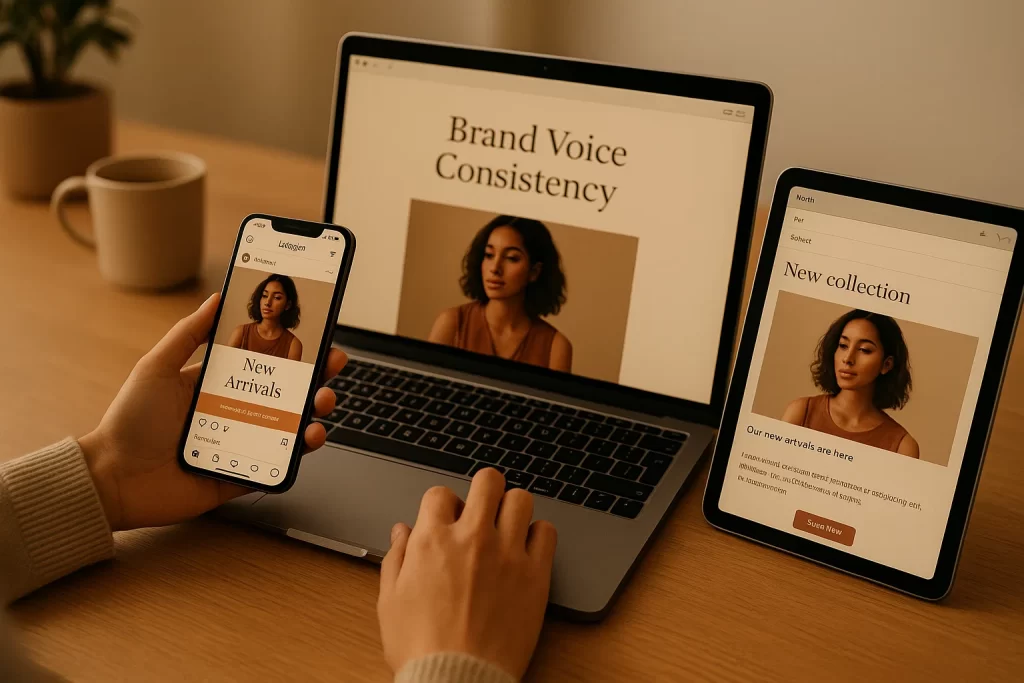
Despite good intentions, maintaining consistent tone across a brand’s digital footprint is incredibly difficult. Why? Because modern organizations operate in silos. Marketing, customer support, sales, and product teams often use different tools, follow different schedules, and—even worse—work with different understandings of the brand’s personality.
Siloed communication is the first culprit. Marketing may write playful Instagram captions while the support team responds to queries with cold, transactional messages. There’s also the issue of incomplete documentation. Many brands have visual style guides but lack well-defined tone principles. This leads to improvisation, where each team “feels out” the voice—resulting in tone drift.
Training is another gap. New hires, freelancers, and even seasoned marketers often write based on past brand experiences rather than codified voice rules. Finally, different platforms demand different energies. A quirky tweet might feel jarring in a formal press release, but brands without channel-specific tone adaptations find themselves either sounding generic or inconsistent.
“Our newsletters sound like one brand, but our Instagram captions feel like a different person entirely.”
Inconsistent voice not only affects how customers perceive your professionalism, it also creates internal friction—rewrites, miscommunications, and alignment meetings that waste time and morale.
Creating Voice Guidelines That Work
A brand voice guide isn’t just a checklist or a document—it’s the operating manual for your brand’s personality. Yet many organizations either lack one entirely or maintain a version so vague that it’s practically useless. Statements like “Our tone is friendly yet professional” don’t provide any concrete direction. To achieve brand voice consistency, your voice guide must translate abstract values into actionable writing behaviors.
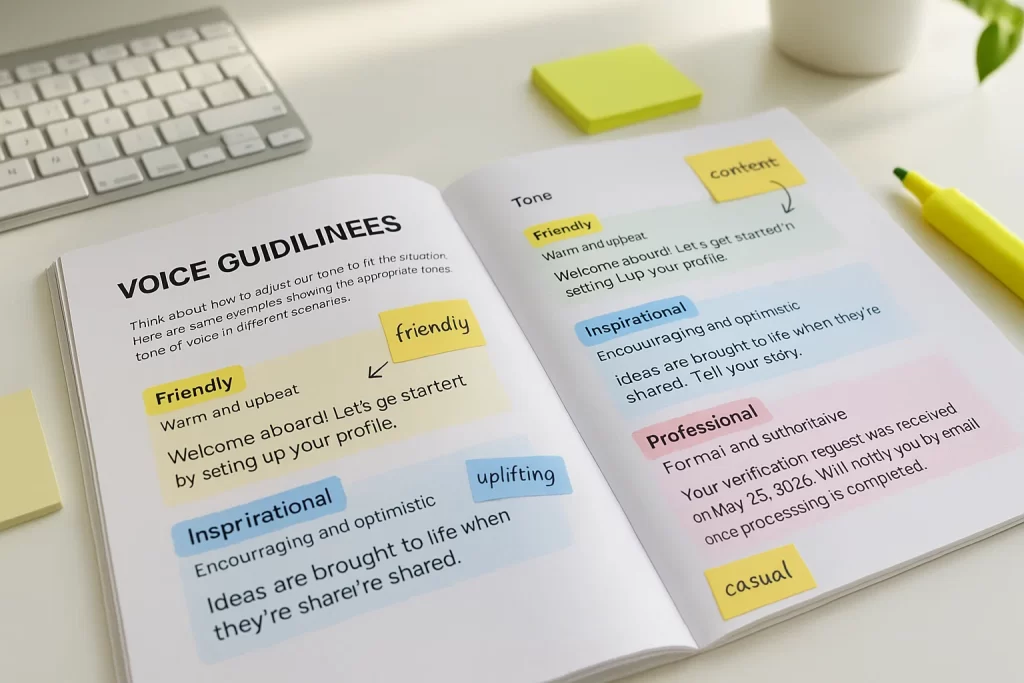
At minimum, a robust voice guide should include tone descriptors—adjectives like “playful,” “direct,” “empathetic”—paired with sample sentences. But it should go further: real-life examples, “on-tone” vs. “off-tone” comparisons, platform-specific usage tips, and direction for different scenarios (e.g., how to sound empathetic in a refund denial).
Audience expectations should also guide voice strategy. A B2B SaaS product for developers will require a radically different tone than a DTC wellness brand. Your guide should define who you’re speaking to and what emotional response you aim to trigger in them.
Use case matrices are highly effective. For instance, document how to phrase apology emails, thank-you notes, or feature announcements. Each scenario has tonal nuances. Include a Voice Dos and Don’ts section—especially vital for remote teams or freelancers—covering everything from jargon to emoji usage.
Expert Quote:
“Without example-led tone documentation, everyone creates their own version of voice—and chaos ensues,” says Ann Handley, author of Everybody Writes.
Embedding Brand Voice in Systems and Workflow
Creating a voice guide is a powerful first step—but if it lives in a Google Drive folder no one opens, it’s practically useless. To truly achieve brand voice consistency, your tone must be embedded directly into the systems and workflows where content is created. This ensures that consistency isn’t dependent on memory—it’s baked into the process.
Start with your Content Management System (CMS). Use CMS plugins or tags to label pieces with tone attributes. For instance, label an article as “playful” or “analytical,” and ensure preview tools show how that tone will be reflected. Email marketing platforms like HubSpot or Klaviyo can store tone-tagged templates—each designed for a specific emotional goal.
AI tools and writing assistants can be pre-trained with brand voice parameters. Tools like Writer.com, Grammarly Business, or Jasper now allow you to feed voice samples so AI-generated drafts match your tone from the start. This minimizes rewrites and preserves consistency even across large-scale content generation.
Incorporate tone into briefing documents. Rather than sending a writer a topic alone, include instructions like: “Use our confident, slightly irreverent tone. Similar to our [X blog post]. Avoid jargon.” This turns abstract tone advice into operational instruction.
At one fintech startup, the support team embedded brand tone tips inside their Zendesk macros. Every canned response included a mini checklist—“Start empathetic, include first-name, soften the call-to-action.” Over three months, their customer satisfaction score rose by 30%—with fewer escalations.
Voice alignment can also be supported by collaborative review tools. In tools like Figma, Notion, or Google Docs, use inline comments to tag sections as “off-tone” or “needs warmth.” The faster tone feedback becomes part of the revision loop, the stronger the final output will be.
Cross-Functional Ownership and Voice Governance
One of the most overlooked elements in brand voice strategy is governance. Brands often assume that once a tone is defined and documented, it will naturally trickle down through the organization. In reality, brand voice consistency erodes rapidly without clear accountability. The question every organization must answer is: who owns the voice?
The answer isn’t one person—it’s a cross-functional model. Typically, a Brand or Content Lead serves as the primary voice custodian. But true enforcement and alignment come from a voice governance committee, including stakeholders from marketing, product, support, HR, and sometimes even legal. Each department must feel a sense of ownership over how voice is maintained in their workflows.
This committee should meet quarterly to perform content audits, discuss edge cases, review feedback, and update tone applications based on new business goals or product changes. These reviews are also perfect opportunities to showcase best-in-class content examples that align with tone.
Governance should also include a feedback mechanism. For example, teams might use Voice Scorecards during quarterly reviews—rating their recent content on voice alignment, tone quality, and emotional clarity. This creates not just accountability but a shared language for improvement.
Another powerful tactic is the appointment of voice champions in each department. These individuals act as liaisons who ensure that their team’s work aligns with voice standards. They can also gather tone-specific concerns and escalate them to the committee.
According to Content Design London, brands with distributed voice ownership—where each department feels responsible—achieve higher consistency than those relying on a centralized content team.

Training Your Team to Stay On‑Voice
Even the most detailed voice guide won’t deliver results unless people are trained to use it. That’s where many brands fall short. They assume that once the documentation exists, team members—especially freelancers or new hires—will intuitively apply it. But brand voice consistency isn’t about knowing the rules; it’s about developing tonal instincts through guided practice.
One of the most effective ways to internalize tone is through voice workshops. These sessions can include activities like tone rewriting, where participants transform “off-brand” sentences into aligned content. Role-playing exercises also help—especially in customer service—by simulating tough communication scenarios, such as apologizing for delays or delivering policy news in-brand.
Voice rewriting drills are especially powerful. Take real content (support replies, tweets, website copy) and walk through multiple rewrites using your tone principles. Let team members vote or comment on which version feels “most on-voice” and explain why.
For remote or fast-scaling teams, create voice onboarding modules in your LMS. These should include short quizzes, interactive rewriting examples, and voice application checklists. Embedding tone training directly into the hiring pipeline sets expectations from day one.
Monthly live brand clinics are another excellent tool. These are informal sessions where anyone can bring a piece of content—social post, product page, email—and get real-time tone feedback from the content team. They turn brand voice into a team sport.
Personal Anecdote:
At an HR-tech company, the recruiting team rewrote all their LinkedIn InMail templates to match their voice guide’s “human, warm, and clear” tone. Within six weeks, they saw a 25% increase in candidate reply rates and a 15% boost in Net Promoter Score.
Training transforms voice from theory into instinct. It empowers employees to act as tone ambassadors in every customer touchpoint.
Auditing and Measuring Brand Voice Consistency
Once your tone is documented and deployed, the next question becomes: is it working? Without an ongoing mechanism to evaluate performance, even the most thoughtful brand voice strategy will fade into inconsistency. That’s where auditing and measurement come in. These tools are essential for maintaining brand voice consistency over time—and for proving the ROI of your voice efforts.
Start with content sampling. Choose representative content across touchpoints—email campaigns, landing pages, blog posts, social media captions, help center articles. Look at this content from both a semantic and emotional perspective. Does it feel like the same person is speaking? Are tone traits—like empathy, authority, humor—consistent across formats?
Next, implement a Voice Scorecard. This is a simple 1-to-5 rating rubric that evaluates content across dimensions like tone alignment, emotional clarity, language simplicity, and empathy. You can have team members score their own work—or, better yet, review each other’s. Peer feedback often surfaces blind spots the creator might miss.
AI-powered tone analysis tools like Writer.com, Grammarly Business, or ChatGPT plug-ins can help scale your audit. These tools can scan large volumes of content, flag tonal inconsistencies, and suggest rewrites. Some even benchmark against pre-set tone traits, making it easier to quantify alignment.
Qualitative feedback is just as important. Use surveys to ask content creators if they feel confident applying the brand voice. Do they find the guide helpful? Are there gray areas where tone decisions feel ambiguous? Also, gather feedback from customers: Do your emails sound personable? Is your support language clear?
Expert Quote:
“Voice consistency is not a one-and-done task. You need to tune it like an instrument—frequently and collaboratively,” says Margot Bloomstein, author of Trustworthy.
Regular auditing ensures your tone stays aligned with evolving brand goals and audience expectations. It also builds a feedback-rich culture where content quality and emotional resonance are continuously improving.
FAQ
1.How do I keep brand tone consistent across Facebook, email, and blog?
Start by documenting platform-specific tone adaptations in your brand voice guide. While the core tone—say, “friendly and expert”—should remain constant, each platform requires a different execution. On Facebook, you might be more conversational; in emails, you’ll lean toward empathy and clarity; on the blog, you’ll aim for depth and authority. To implement this, create content templates for each channel and embed brand voice checklists into your publishing workflow.
Also consider appointing tone owners per channel—individuals responsible for maintaining tone integrity on each platform. Bi-weekly content reviews can catch drift early and realign language to your guide.
2. What are best practices for documenting brand voice and messaging?
Your documentation should do more than state your tone traits—it should show, not tell. Include:
- Voice traits with clear definitions (e.g., “Empathetic: We acknowledge pain before we offer solutions”).
- On-tone vs. off-tone examples.
- Use case grids (e.g., how we write for refunds vs. upgrades).
- Platform-specific adaptations.
- A section on how tone flexes depending on context—like during a PR crisis or customer escalation.
Embed this guide into your team’s daily tools—like Notion, Figma, or CMS. A static PDF no one reads won’t change habits.
3.How often should I perform a brand voice audit?
At minimum, every 6 months—especially after major shifts like a product launch, rebrand, or team restructure. For fast-paced or content-heavy teams, quarterly reviews are ideal.
Use a mix of scorecards, AI tone tools, and qualitative peer review. Include people from multiple teams—marketing, support, product—to ensure you’re auditing broadly, not just in marketing silos.
4.My freelancers write off‑voice—how can I train them consistently?
Freelancers are often your highest-risk group for inconsistency. To mitigate this:
- Share your brand voice guide upfront.
- Provide annotated examples of what “good” looks like.
- Include voice notes in each brief: “This should feel like this article from our site.”
- Offer a quick 15-minute onboarding session or loom video.
- Use feedback loops early—don’t wait until the draft is final.
Voice isn’t just about the words; it’s a mindset. Freelancers who understand the “why” behind your tone will execute it more naturally.
5.What tools can help automate voice consistency?
Several tools now support voice consistency at scale:
- Writer.com : Custom voice templates and tone checks in Google Docs.
- Grammarly Business : Brand tone style guides and live editing suggestions.
- Jasper : AI that can be trained on your brand’s tone of voice.
- Frontify or Zeroheight : Living brand guidelines with embeddable voice examples.
Choose tools that integrate with your team’s actual writing environments—email, docs, CMS—so that voice checks happen where content is created.
Conclusion
Consistency is not a constraint—it’s a multiplier. In a digital world where audiences are overwhelmed by noise, brand voice consistency becomes your brand’s most powerful signal. It tells your customers: “We know who we are. You can trust what we say.” This trust, once earned, compounds—turning first-time readers into loyal followers, and customers into advocates.
But consistency doesn’t happen by accident. It requires intention. Through robust documentation, seamless workflow integration, cross-functional ownership, and ongoing training, brands can make voice consistency not just achievable, but sustainable. And by auditing tone performance regularly, they ensure that their voice evolves with the business while staying emotionally grounded.
Your voice isn’t just what you say—it’s how people remember you. And in every blog post, tweet, support ticket, and onboarding email, you’re either reinforcing your identity or diluting it.
The most trusted brands don’t just communicate. They resonate—with clarity, confidence, and above all, consistency.