
The Power of Brand Collateral Storytelling: Reinforcing Identity at Every Touchpoint

Introduction
“Brand Collateral Storytelling” isn’t just another marketing buzzword—it’s a game‑changer in how brands connect, convert, and truly resonate. In an age flooded with noise, storytelling in collateral transforms brochures, packaging, and even digital one‑sheets into emotional experiences that linger. Consider this: research consistently shows that brands employing emotionally charged narratives see up to a 31% increase in engagement compared to those using plain facts—proof that story-driven collateral isn’t decoration; it’s strategic propulsion.
Contrary to the belief that collateral is merely “visual stuff,” storytelling collateral fuses visual narrative, brand identity, and strategic messaging into a cohesive experience. It’s where narrative marketing meets design thinking, and where brand voice dances locally with the reader’s psyche. This article will break down the essential key features of effective brand collateral storytelling, trace its real-world impact through tangible examples, and equip you with frameworks to craft your own—from the ground up. By the end, you’ll see how storytelling transcends pretty visuals; it fosters brand resonance and delivers measurable ROI.
What Is Brand Collateral Storytelling? (and How It Differs from Traditional Advertising)
In traditional advertising, the goal is often direct: persuade quickly, sell fast, and drive immediate action. Ads scream for attention—loud taglines, limited-time offers, and bold CTAs dominate the landscape. But brand collateral storytelling takes a different route. Instead of shouting, it invites. Instead of demanding, it engages. Instead of selling a product, it narrates a journey.
Brand collateral storytelling is the strategic use of design and narrative within your marketing assets—such as brochures, packaging, presentations, and leave-behinds—to tell a story that reflects your brand’s values, personality, and mission. It isn’t just about looking good; it’s about connecting emotionally. These collateral pieces act like chapters of a larger brand book, consistently reinforcing your message across touchpoints.
How It Works
Where traditional ads might ask, “What’s in it for me?”—storytelling collateral asks, “What role do you, the customer, play in our brand’s narrative?” This is a powerful psychological shift. It moves the customer from a passive buyer to an active participant in the brand’s ecosystem.
For instance, rather than a real estate firm handing out a plain folder with property specs, a storytelling-driven collateral piece might include homeowner journeys, stories of transformation, neighborhood narratives, and even embedded visuals that reflect future aspirations. It builds brand resonance that goes beyond a transaction.
Addressing the Misconception
A common pain point among marketers is: “Isn’t brand collateral just visual stuff?”—a sentiment echoed across Reddit threads and forums. One Redditor commented:
“Collateral always felt like fluff to me—just branded color schemes on paper. I never saw how it actually sold.”
This is a widespread misconception. Visuals are part of the equation, yes—but without a cohesive narrative, they’re just aesthetics. Storytelling provides the emotional scaffolding that gives visual design its purpose.
Differentiating from Content Marketing
It’s also crucial to differentiate brand collateral storytelling from content marketing. While both use storytelling, content marketing typically lives online—blogs, videos, social media. Brand collateral, on the other hand, is often tangible, curated, and designed for more intimate, high-stakes settings like pitch meetings, trade shows, or retail touchpoints.
As Brand Master Academy notes“Collateral storytelling builds credibility in settings where attention spans are longer, and brand trust is earned, not clicked.”
The Key Principles of Effective Collateral Storytelling
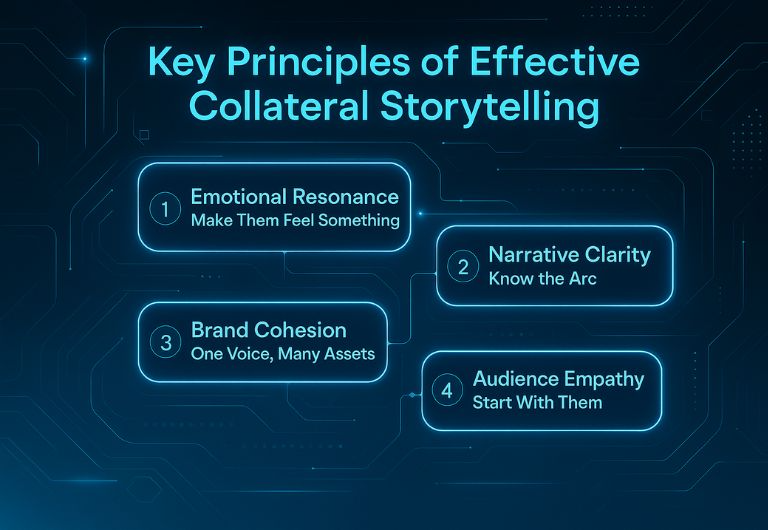
Great brand collateral doesn’t just happen—it’s crafted with intention, guided by principles that shape how a story connects emotionally and strategically. Whether you’re creating a physical brochure or a downloadable lookbook, the most impactful pieces follow four key principles: emotional resonance, narrative clarity, brand cohesion, and audience empathy.
1. Emotional Resonance: Make Them Feel Something
Stories that stick are stories that stir emotions. In collateral, this means moving beyond features and benefits into moments that matter—frustration, aspiration, triumph. According to Harvard Business Review emotionally connected customers are 52% more valuable than those who are just satisfied.
A tech brand, for example, could show a timeline of a founder’s journey—from dorm room to IPO—in its investor pitch deck. That story becomes part of the investor’s experience, not just data on a slide.
2. Narrative Clarity: Know the Arc
Every great story has a beginning, middle, and end. So should your collateral. The story arc in marketing assets typically follows:
- Challenge (what problem the customer faces)
- Solution (how your brand/product helps)
- Outcome (what success looks like)
This structure makes your messaging intuitive and easy to follow. A cluttered, disjointed brochure with facts scattered randomly leaves people guessing. A clear narrative gives them a path—and a reason to keep reading.
3. Brand Cohesion: One Voice, Many Assets
Strong storytelling collateral feels unmistakably “you”—from a tradeshow pull-up banner to your packaging inserts. That’s brand cohesion in action. Use consistent tone, visual identity, and core messaging so that every piece aligns with the overarching brand story.
As Content Marketing Institute explains, “Collateral should not just echo the brand—it should extend it, telling new parts of the same story.”
This principle also addresses a common user fear: “How do I keep all my materials from feeling disconnected?”
4. Audience Empathy: Start With Them
The most powerful stories are not about the brand—they’re about the audience’s transformation. Who is the hero in your narrative? Spoiler: It’s not you—it’s them. Use data, personas, and research to understand what your audience wants to feel, overcome, or become.
Imagine a sustainability-focused skincare brand. Instead of listing ingredients, its product sheet tells the story of a consumer who chooses clean beauty, avoids toxins, and protects the environment—all by choosing this one serum. Suddenly, the audience sees themselves in the story. “Great brand storytelling doesn’t start with what the brand does—it starts with what the customer wants to become.” – Ann Handley, MarketingProfs
Real‑World Examples
While principles give structure, it’s real‑world examples that breathe life into the concept of brand collateral storytelling. Let’s explore how some standout brands have used storytelling in their collateral to connect emotionally, differentiate themselves, and ultimately drive results.
1. Apple: The Minimalist Manifesto
Apple’s product brochures and packaging inserts are storytelling masterpieces. A MacBook insert doesn’t list all specs—it tells a story of effortless creativity and power. The clean layout, thoughtful typography, and minimal copy reflect the product’s design philosophy.
What’s at play here is narrative consistency: the product, packaging, and collateral all reinforce the same message—“this just works.” It’s emotional, aspirational, and meticulously aligned with Apple’s brand identity.
“With Apple, every printed page tells the same story: simplicity that empowers.” – Brand Strategist, Fast Company
2. Nike: Packaging with a Purpose
Nike doesn’t just ship shoes—it sends experiences. Their limited-edition sneaker drops often come with printed collateral narrating the story behind the design: the athlete who inspired it, the cultural movement it’s tied to, or the city that shaped it.
In one release, Nike included a fold-out poster featuring street photography, quotes from community athletes, and hand-drawn maps of iconic running routes. It wasn’t just marketing—it was a cultural artifact.
This approach turns physical collateral into emotional currency. Consumers don’t throw it away—they keep it. That’s ROI you can’t always measure in clicks.
3. Indian Brand: Paperboat’s Storytelling Pouches
Closer to home, the Indian beverage brand Paperboat has redefined storytelling through packaging. Their pouches include short stories, childhood memories, and Indian folklore tied to each flavor—like Aamras or Jaljeera. Their printed cartons are filled with nostalgic visuals and hand-lettered fonts, evoking warmth and familiarity.
It’s collateral that whispers, not shouts. And it works. Paperboat grew to a ₹200 crore brand within a few years—partly because every piece of its branding feels like a memory, not a message.
4. Airbnb: Host Onboarding Collateral
Airbnb’s printed host onboarding kits tell a story of empowerment and belonging. From illustrated city maps to welcome letters that frame the host as a hospitality ambassador, each piece makes the recipient feel part of a global narrative. Airbnb doesn’t just hand out documents—it builds identity.
A Redditor who received the kit shared:
“I expected a packet of rules. What I got felt like a badge of honor. It made me feel like I belong.”
That’s the heart of storytelling collateral—it doesn’t inform. It initiates.
Why These Examples Work
Across Apple, Nike, Paperboat, and Airbnb, common threads emerge:
- They all embed emotion within utility.
- They tell micro-stories that align with macro brand narratives.
- Their collateral isn’t designed just to show—but to evoke.
Measuring the ROI of Brand Collateral Storytelling
One of the biggest objections marketers face when pitching storytelling-based collateral is:
“How do we measure its impact?”
Unlike PPC campaigns or email funnels, storytelling collateral often lacks immediate, linear metrics. But that doesn’t mean ROI isn’t measurable—it just requires a shift in perspective and the use of layered metrics.
The Core ROI Challenge
Let’s start with the elephant in the room. Many stakeholders, especially in B2B settings, want hard data—clicks, conversions, lead volumes. But storytelling collateral is often physical or experiential. It’s handed out at events, used in pitches, or left behind after client meetings. It doesn’t generate clicks—it generates connections.
And yet, those connections can be tracked. Here’s how:
1. Engagement & Retention Metrics
Instead of “open rate,” track:
- Time spent with the collateral (observed or surveyed)
- Recollection rate (what users remember from it)
- Retention lift after receiving storytelling pieces (e.g., how long customers stay subscribed or loyal)
“We noticed a 40% increase in second-meeting rates after switching to narrative-based pitch decks.” — VP of Sales, SaaS startup (internal case study)
2. Lead Conversion Attribution
While your CRM might not log “story made client cry,” it can track:
- Collateral distribution date vs. lead conversion timelines
- Feedback from reps: Did the storybook make them smile? Did they bring it up later?
Many companies use coded print collateral (e.g., QR codes, URLs, or custom phone numbers) to track:
- Downloads
- Follow-ups
- Page visits from specific printed campaigns
This turns a traditionally untraceable asset into a trackable conversion touchpoint.
3. Net Promoter Score (NPS) Changes
Did your storytelling kit increase customer sentiment?
Ask:
“After receiving our welcome pack, how likely are you to recommend our brand?”
Track this against previous cycles with non-story-based collateral.
Airbnb, for example, has seen statistically significant NPS lifts after distributing humanized, print-based host kits. It isn’t the only variable—but it’s a clear contributor.
4. Social & User-Generated Content (UGC)
Storytelling collateral often generates organic social shares—especially when it feels thoughtful or beautiful.
Think of:
- Customers posting your packaging with the quote they loved
- Hosts uploading their Airbnb welcome guide with pride
- Students sharing the school brand book with nostalgic captions
These are hard-to-buy signals of brand equity. You can track:
- Branded hashtag usage
- Share rates
- Visual mentions on Instagram, LinkedIn, etc.
5. Sales Rep Feedback Loops
Sometimes, the best data is qualitative. Sales reps often report:
“They opened the booklet and just nodded all the way through.”
“The founder called me back to say that story really hit home.”
These anecdotes build internal buy-in and can be tracked in CRMs as call notes or win stories. Over time, patterns emerge—and they almost always point back to emotional impact.
Don’t Ignore the Intangibles
Not every ROI touchpoint is trackable—and that’s okay. Brands like Apple and Paperboat never ask, “How many pouches did we sell because someone loved our packaging story?” They know the story is what builds the brand, which builds trust, which builds preference—which leads to revenue.
As Content Marketing Institute puts it:
“Storytelling isn’t the icing—it’s the strategy.”
“Our investor deck had every metric. But it wasn’t until we told our story through our customer’s eyes that we got funded.” — /r/startups
Crafting Your Own Brand Storytelling Collateral—A Step‑by‑Step Framework
You’ve seen what brand collateral storytelling is and why it works. But how do you create it? What if you don’t have Nike’s budget or Apple’s in-house design team? Fortunately, powerful storytelling doesn’t start with money—it starts with meaning.
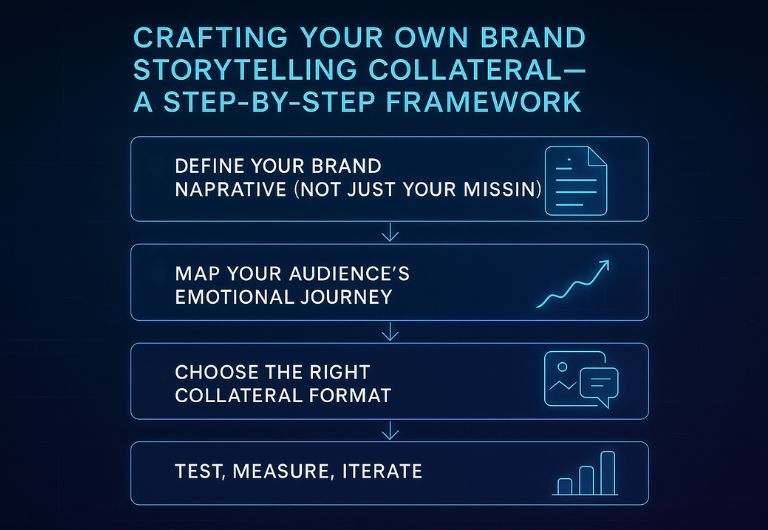
Here’s a step-by-step framework for crafting storytelling collateral that connects and converts, no matter your industry or size.
Step 1: Define Your Brand Narrative (Not Just Your Mission)
Most brands have a mission. Few have a story.
Start with a simple arc:
- Who are you?
- What pain did you notice in the world?
- What transformation do you promise?
- Who are your customers in that story?
This foundational narrative isn’t fluff—it’s the emotional blueprint for your collateral. Every printed page, visual asset, or branded piece should point back to this origin.
Step 2: Map Your Audience’s Emotional Journey
Before you put pen to paper, put yourself in your audience’s shoes.
Ask:
- What fears or desires are they carrying into this touchpoint?
- Are they overwhelmed, skeptical, hopeful?
- What emotional shift do you want them to experience?
For example, a financial planning firm might shift users from fearful and uncertain to informed and confident. That’s the emotional story your collateral should tell.
Include quotes, stories, or testimonials that mirror those feelings—people love seeing their journey reflected.
Step 3: Choose the Right Collateral Format
Not every story fits every format. Match the message to the medium:
- Brochures: great for product stories or step-by-step transformation
- Welcome kits: ideal for onboarding and setting emotional tone
- Postcards: good for single, resonant quotes or micro-stories
- Pitch decks: perfect for founder narratives and customer journeys
Tip: Let function inform form. If your message is complex, use a fold-out or multi-panel format that visually supports the journey.
Step 4: Integrate Narrative Elements Visually and Verbally
Now the magic happens. Blend design and copy to show and tell:
- Imagery should reflect the emotions you mapped (e.g., fear > joy)
- Typography should reflect your tone (e.g., playful, premium, bold)
- Copy should read like a story, not a spec sheet
- Use micro-stories—mini case studies, customer quotes, founder flashbacks
A compelling storytelling brochure might begin with:
“Asha had $14 in her bank account when she found us…”
Not:
“We offer financial planning for women entrepreneurs.”
Step 5: Test, Measure, Iterate
Great storytelling isn’t static—it evolves. After distributing your first round of storytelling collateral:
- Collect qualitative feedback (“What stood out to you most?”)
- Track engagement metrics (page dwell time, QR scans)
- Use A/B testing: story-driven collateral vs. standard informational handouts
And yes—use your sales reps and customers as feedback loops. Their insights will refine the story better than any software.
A Quick Anecdote
An Indian edtech startup switched from a features-only brochure to a storytelling booklet that walked users through a 3-act student success narrative. Within three months, demo signups tripled—not because the product changed, but because the story landed.
“The best marketing doesn’t feel like marketing. It feels like someone understands you.” – Bernadette Jiwa, Brand Storytelling Expert
Conclusion
Brand collateral storytelling isn’t just a design trend or creative indulgence—it’s a strategic tool for building emotional resonance, brand trust, and ultimately, stronger results. When brands move beyond specs and slogans to tell stories—through brochures, onboarding kits, packaging, or pitch decks—they move closer to the hearts of their audience.
At the intersection of Visual Branding & Design and narrative marketing lies the true power of storytelling collateral. It’s where layout, typography, imagery, and messaging converge to create memorable, emotionally rich experiences that represent more than just a brand—they reflect a belief.
You’ve seen how global giants like Apple and Nike, as well as homegrown brands like Paperboat, use storytelling in their collateral to connect deeply and stand apart. You’ve also explored how to build your own storytelling assets—even with limited resources—by focusing on emotion, structure, and audience transformation.
In a world where content is everywhere but connection is rare, your brand’s story may be its most valuable asset. Tell it clearly. Tell it meaningfully. And tell it through the collateral that your audience holds, reads, and remembers.
FAQ
1. What makes brand collateral storytelling effective?
Brand collateral storytelling works because it emotionally anchors your brand in the audience’s mind. Instead of just showing what you do, it demonstrates why you exist and who you help, all through relatable, memorable narratives. Storytelling transforms functional material into identity-driven experiences. When people see themselves in your story, they trust you more. And in marketing, trust is the strongest currency.
2. How do brands actually tell stories through collateral?
Brands tell stories by weaving customer journeys, founder missions, product origins, and emotional outcomes into every touchpoint. A simple brochure can become a chapter in the customer’s future, not just a flyer. This happens when visuals, copy, layout, and structure mirror a narrative arc. For example, starting with a problem, leading to a solution, and ending in transformation. It’s about inviting the audience into a role—not just presenting facts.
3. Is collateral storytelling really worth the investment (ROI)?
Yes—if done right. While it may not give instant click-through rates, it builds longer-term brand equity, deeper engagement, and conversion lift in high-consideration settings. A Redditor once said:
“We swapped our slide deck for a brand storybook—and got 4 follow-up calls in one day.”
The ROI may be slower to measure, but it’s often more lasting and more human.
4. Can small businesses use storytelling collateral effectively?
Absolutely. In fact, small businesses often have the best stories—real struggles, personal wins, tight-knit communities. You don’t need flashy design—just an honest narrative and thoughtful structure. A simple customer testimonial on a flyer or a printed founder letter in your packaging can do more than an expensive ad. Storytelling levels the playing field by making your brand unforgettable, not just visible.
5. How is storytelling collateral different from content marketing?
Content marketing lives online—blogs, videos, SEO-focused articles. Storytelling collateral is tactile, curated, and often delivered during key offline or high-touch moments: onboarding, events, pitches. It’s built to be felt, kept, or remembered—not scrolled past. While both aim to connect, collateral has the power of presence and permanence, making it ideal for deeper emotional narratives.