
Multichannel vs Omnichannel Marketing: What Every Brand Needs to Know
Introduction
In theory, the distinction between multi-channel vs omnichannel marketing seems academic. In practice—especially in a market like Dubai—it is one of the most commercially consequential decisions a brand can make.
Dubai is a hyper-competitive, digitally mature, and culturally diverse marketplace. Consumers here move seamlessly between Google search, Instagram, WhatsApp, marketplaces, physical retail, and word-of-mouth—often within the same buying journey. Media costs are high, attention is scarce, and switching barriers are low. In this environment, marketing inefficiency is not just wasteful; it is existential.
Many brands operating in the UAE believe they are “doing omnichannel” simply because they appear on multiple platforms. In reality, they are executing multichannel marketing—often well-funded, sometimes creative, but fundamentally fragmented. The result is a familiar pattern: rising acquisition costs, inconsistent messaging, poor attribution clarity, and diminishing returns.
This article explores multichannel vs omnichannel marketing not as a surface-level comparison, but as a strategic lens. We will examine how the two approaches differ structurally, how they shape customer behavior, where each model succeeds or fails, and why omnichannel systems increasingly outperform in high-cost, high-expectation markets like Dubai. Throughout, the focus is on frameworks, real-world applications, and decision-making—not slogans.
Understanding Multichannel Marketing: Presence Without Integration
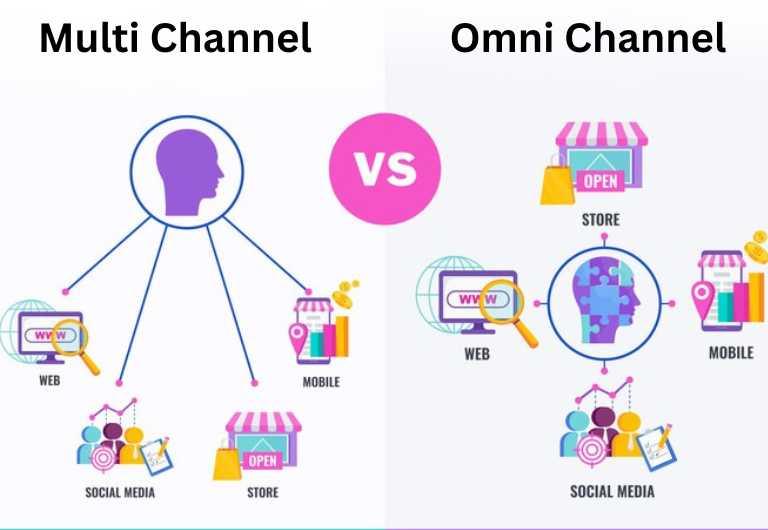
Multichannel marketing refers to a strategy where a brand operates across multiple channels—search, social, email, marketplaces, retail, apps—each designed to reach customers independently. The underlying assumption is reach: if consumers are everywhere, brands should be too.
From a tactical perspective, multichannel marketing strategy is often the natural first stage of growth. As brands expand, they add platforms. A paid search team optimizes Google Ads. A social team runs Meta and TikTok. Email campaigns operate through a CRM. Offline activations are handled separately. Each channel has its own goals, budgets, KPIs, and sometimes even agencies.
The limitation is structural. Channels coexist, but they do not meaningfully communicate.
Customer data is siloed. Messaging varies by platform. Attribution models favor last-click or channel-specific metrics. Success is measured locally rather than holistically. This creates internal optimization that feels productive but often undermines overall performance.
In Dubai, this problem is amplified. Consumers are highly exposed to advertising and quickly recognize inconsistency. A luxury hospitality brand may present premium storytelling on Instagram, transactional urgency on Google Search, and generic promotions via email. Each channel performs “well” in isolation, but the combined experience feels disjointed—and trust erodes quietly.
Multichannel marketing is not inherently flawed. It works when buying cycles are short, products are low-consideration, or channels are used opportunistically. But its limitations become visible as competition intensifies and customer journeys become nonlinear.
Omnichannel Marketing: Designing the Journey, Not the Channel
Omnichannel marketing begins from a fundamentally different premise. Instead of asking, “How do we perform better on each channel?” it asks, “How do people actually move toward a decision—and how do our channels support that movement together?”
An omnichannel marketing strategy treats channels as interconnected touchpoints within a single system. Data flows across platforms. Messaging evolves based on prior interactions. Measurement focuses on journeys rather than clicks. The goal is not channel dominance, but touchpoint consistency and momentum.
In omnichannel systems, a user who discovers a brand through social media does not start from zero when they search on Google. Their intent, context, and prior exposure inform the next interaction. Email does not repeat what ads already said; it deepens understanding. Offline experiences reinforce digital signals, and vice versa.
This is where the omnichannel customer experience becomes materially different. It feels coherent. The brand “remembers.” The narrative builds. Friction is reduced.
In Dubai’s service-heavy economy—real estate, healthcare, education, financial services—this coherence directly affects conversion velocity. Buyers arrive more informed, less skeptical, and more confident. Sales cycles shorten not because pressure increases, but because clarity improves.
Multi-Channel vs Omnichannel Marketing: A Strategic Comparison
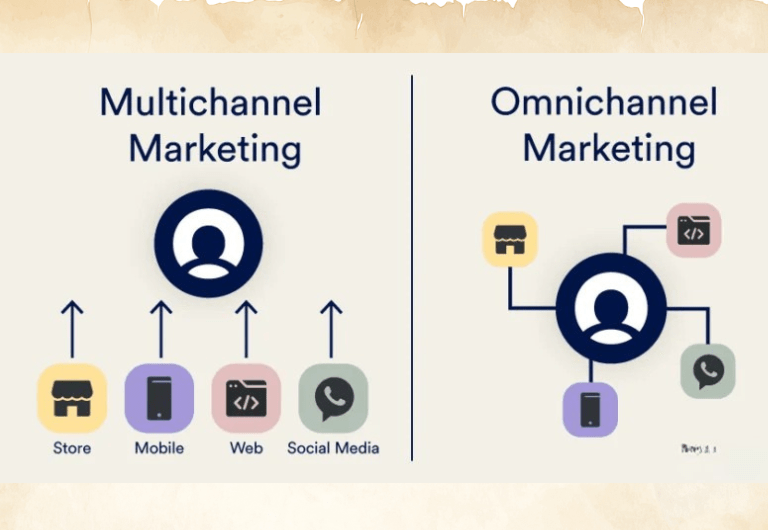
Below is a clear, side-by-side comparison with focused headings, designed for decision-makers, not beginners. This goes beyond definitions and highlights how each model behaves in real business environments, especially in competitive markets like Dubai.
1. Strategic Focus
Multi-Channel Marketing
The primary objective is reach. Brands aim to be present wherever customers are—search, social, email, marketplaces, offline—treating each channel as an independent opportunity to acquire or convert users.
Omnichannel Marketing
The objective is journey optimization. Channels exist to support one another, guiding customers smoothly from awareness to conversion to retention within a single, connected system.
2. Channel Structure
Multi-Channel Marketing
Channels operate in parallel. Each has its own campaigns, budgets, KPIs, and often separate teams or agencies. Performance is optimized locally, not holistically.
Omnichannel Marketing
Channels are interdependent. Campaigns are designed together, data flows across platforms, and performance is evaluated based on how channels reinforce each other.
3. Customer Experience
Multi-Channel Marketing
The experience is fragmented. Customers may encounter different messages, offers, and tones depending on the channel they interact with. Context is frequently lost between touchpoints.
Omnichannel Marketing
The experience is consistent and cumulative. Messaging evolves based on prior interactions, creating continuity and reducing friction across the customer journey.
4. Data & Insights
Multi-Channel Marketing
Customer data is siloed by platform. Insights are channel-specific, making it difficult to understand full customer behavior or intent.
Omnichannel Marketing
Data is unified through CRM/CDP systems. Brands gain a single customer view, enabling better personalization, forecasting, and decision-making.
5. Measurement & Attribution
Multi-Channel Marketing
Relies heavily on last-click or channel-level attribution. This often overvalues bottom-of-funnel activity and undervalues awareness and consideration stages.
Omnichannel Marketing
Uses journey-based and multi-touch attribution models. Success is measured by overall impact on conversion efficiency, lifetime value, and retention.
6. Personalization Capability
Multi-Channel Marketing
Personalization is limited and channel-specific. A user may be personalized in email but treated as anonymous in paid media or search.
Omnichannel Marketing
Personalization is contextual and cross-channel. Behavior in one channel informs messaging in another, enabling meaningful relevance at scale.
7. Operational Complexity
Multi-Channel Marketing
Easier to launch and manage initially. Suitable for early-stage brands or short-term campaigns but becomes inefficient as scale increases.
Omnichannel Marketing
More complex to implement, requiring alignment across teams, technology, and leadership. However, it becomes more efficient over time.
8. Cost Efficiency
Multi-Channel Marketing
Often leads to higher acquisition costs due to duplication of effort, repeated messaging, and poor demand nurturing.
Omnichannel Marketing
Improves efficiency by warming demand, shortening sales cycles, and increasing conversion rates without proportional spend increases.
9. Scalability
Multi-Channel Marketing
Scales in volume but not intelligence. More spend is required to maintain growth, and diminishing returns are common.
Omnichannel Marketing
Scales as a system. Performance improves as data accumulates and feedback loops strengthen across channels.
10. Best Use Cases
Multi-Channel Marketing
- Early-stage brands
- Low-consideration products
- Short-term promotions
- Platform-specific experimentation
Omnichannel Marketing
- Mature or scaling brands
- High-consideration purchases
- Competitive markets (like Dubai)
- Long-term growth and retention strategies
The Structural Difference: Channels vs Systems
To truly understand the difference between multichannel and omnichannel marketing, it helps to view marketing as either a collection of activities or a unified system.
Multichannel marketing optimizes channels as independent profit centers. Omnichannel marketing optimizes the flow between them.
This distinction shapes everything from budgeting to measurement. In multichannel models, budgets are often allocated based on historical channel ROI. In omnichannel models, budgets follow stages of the customer journey. Early-stage demand creation may justify spend even if it does not convert directly. Mid-funnel education is valued for its role in downstream efficiency. Retention channels are measured by lifetime value, not campaign response rates.
This systems perspective aligns with channel interdependencies—the reality that performance in one channel is rarely independent of others. Strong organic search often reduces paid media costs. Brand familiarity improves conversion rates across platforms. Email engagement increases when content reflects prior browsing or ad exposure.
Harvard Business Review has consistently highlighted that customers engaging across multiple, connected touchpoints tend to spend more and remain more loyal than those acquired through single-channel interactions. The value is not in multiplicity, but in integration.
Why Multichannel Marketing Often Underperforms in High-Cost Markets
In lower-cost or emerging markets, inefficiencies can hide behind growth. In Dubai, they cannot.
Media inflation across search and social means that every wasted impression compounds. When channels operate in silos, brands frequently overpay to re-educate the same user repeatedly. Messaging resets at each touchpoint. Context is lost. Fatigue builds.
Another critical limitation is attribution. Multichannel marketing relies heavily on simplified attribution models that over-credit bottom-of-funnel interactions. This leads to underinvestment in upper-funnel and mid-funnel activities that actually create demand. Over time, brands become trapped in performance channels, competing aggressively for shrinking pools of high-intent traffic.
The result is a paradox: marketing teams appear busy and data-rich, yet strategic clarity diminishes. Decision-making becomes reactive. Channels are blamed rather than redesigned.
These multichannel marketing limitations are not theoretical. They are visible in rising cost per acquisition, plateauing growth, and declining brand distinctiveness—patterns common among digitally mature but structurally fragmented organizations.
Omnichannel as a Competitive Advantage, Not a Trend
Omnichannel marketing is often discussed as a “best practice.” In reality, it functions as a structural moat.
When channels are integrated, brands accumulate first-party data that improves targeting, personalization, and forecasting. Customer insights deepen over time rather than resetting with each campaign. Marketing automation becomes smarter. CRM and CDP integration allows teams to respond to behavior, not assumptions.
This is particularly powerful in ecommerce and high-consideration categories. In multichannel vs omnichannel marketing for ecommerce, omnichannel brands consistently outperform by aligning product discovery, remarketing, email flows, and post-purchase communication into a single narrative.
McKinsey research has shown that companies with strong omnichannel engagement strategies retain customers at significantly higher rates and achieve materially higher lifetime value. The reason is simple: friction compounds in fragmented systems, while trust compounds in connected ones.
The Customer Journey Lens: Where Omnichannel Wins
The most practical way to evaluate multichannel vs omnichannel customer journey performance is to map how decisions are actually made.
Modern journeys are not linear. A consumer may discover a brand through social, research via search, seek validation through reviews, abandon, return via retargeting, and finally convert after an email reminder or WhatsApp interaction. Multichannel strategies treat these as separate events. Omnichannel strategies treat them as chapters in a single story.
This is where customer journey mapping becomes more than an academic exercise. It becomes an operational blueprint. Content is sequenced. Offers are timed. Frequency is managed. Each interaction is aware of what came before.
In Dubai’s multilingual, multicultural market, this sequencing is critical. Messaging that resonates with an expat professional may differ from that aimed at a local family business owner. Omnichannel systems allow personalization across channels without fragmentation—an increasingly important differentiator.
Case Insight: How Integration Changes Outcomes
Consider a regional real estate developer marketing off-plan properties. In a multichannel setup, search ads target “buy apartment in Dubai,” social campaigns showcase lifestyle visuals, and email pushes generic launch offers. Each channel performs adequately, but lead quality fluctuates and sales cycles remain long.
When redesigned through an omnichannel lens, the strategy changes. Social content introduces the vision and lifestyle narrative. Search campaigns are retargeted with context-aware messaging. Email sequences adapt based on property interest and engagement depth. Sales teams receive enriched lead profiles reflecting the full interaction history.
The result is not just higher conversion rates, but better conversations. Prospects arrive informed. Objections decrease. Sales velocity improves. This is the benefit of omnichannel marketing over multichannel in its most tangible form: alignment replaces repetition.
Measurement and Attribution: From Fragmented Metrics to Strategic Insight
One of the least discussed—but most critical—differences between multichannel and omnichannel marketing lies in measurement.
Multichannel environments depend on channel-level KPIs: click-through rates, cost per lead, ROAS. These metrics are useful but incomplete. They reward immediacy and undervalue influence.
Omnichannel environments require marketing attribution models that account for assist value and sequence effects. While perfect attribution remains elusive, even directional improvements—such as time-decay or data-driven models—shift decision-making toward reality.
In Dubai, where senior stakeholders often demand clear ROI justification, this shift is essential. Omnichannel measurement reframes marketing from a cost center into a growth system, where investments are evaluated by their contribution to the whole, not their isolated output.
Organizational Implications: Why Omnichannel Is a Leadership Decision
A common misconception is that omnichannel marketing is primarily a technology challenge. In truth, it is an organizational one.
Omnichannel success requires shared objectives across teams, integrated planning cycles, and governance structures that discourage channel-level competition. Incentives must align with journey outcomes, not platform performance. Data ownership must be centralized. Collaboration must be rewarded.
This is why omnichannel adoption often stalls—not due to lack of tools, but due to lack of leadership alignment. Brands that succeed treat omnichannel transformation as a strategic initiative, not a campaign optimization exercise.
For Dubai-based agencies advising regional clients, this is a critical advisory role. Technology enables omnichannel execution, but culture determines whether it works.
Multichannel or Omnichannel: Which Is Right for Your Brand?
The question “which is better: multichannel or omnichannel marketing?” has no universal answer. The right approach depends on maturity, category, and ambition.
Multichannel marketing may suffice for early-stage brands testing demand or operating in low-consideration categories. It offers speed and flexibility. But as brands scale, complexity increases, and margins tighten, the cracks become visible.
Omnichannel marketing is not about doing more. It is about doing things in the right order, with shared context. It rewards patience, discipline, and systems thinking. For brands seeking durable growth in competitive environments like Dubai, it is increasingly not optional.
Conclusion: From Channel Presence to Strategic Coherence
The debate around multi-channel vs omnichannel marketing is ultimately a debate about how brands grow.
Multichannel strategies emphasize presence. Omnichannel strategies emphasize coherence. One adds channels; the other connects them. One optimizes activity; the other optimizes outcomes.
In Dubai’s fast-moving, high-stakes market, coherence is no longer a luxury. It is a competitive requirement. Brands that invest in integrated marketing channels, unified data, and journey-based thinking build trust faster, convert more efficiently, and scale more sustainably.
For marketing leaders, the challenge is not choosing platforms, but designing systems. For agencies, the opportunity lies in guiding that transition with clarity and rigor. And for brands willing to move beyond fragmentation, omnichannel marketing offers not just better metrics—but better business.
FAQ
1. What is multi-channel marketing?
Multi-channel marketing refers to using multiple marketing channels—such as websites, social media, email, mobile apps, and offline media—to reach customers. Each channel operates independently, and messaging may vary across platforms without full integration.
2. What is omnichannel marketing?
Omnichannel marketing is a customer-centric approach where all channels are fully integrated to deliver a seamless and consistent experience. Customer interactions are connected across platforms, allowing users to move smoothly between channels without disruption.
3. What is the key difference between multi-channel and omnichannel marketing?
The main difference is integration. Multi-channel marketing focuses on presence across channels, while omnichannel marketing focuses on experience across channels. Omnichannel strategies unify data, messaging, and touchpoints to create a cohesive customer journey.
4. Which approach is more effective for modern businesses?
Omnichannel marketing is generally more effective because it aligns with modern customer behavior. Consumers expect consistent experiences across devices and platforms. However, multi-channel marketing can be a starting point for businesses with limited resources.
5. How can businesses transition from multi-channel to omnichannel marketing?
Businesses can transition by integrating customer data, aligning messaging across channels, using CRM and marketing automation tools, mapping customer journeys, and ensuring teams collaborate across platforms. Gradual integration helps maintain consistency and improve engagement.