
Market & Audience Research: The Foundation of High-Performance Marketing

Introduction: Why Marketing Performance Fails Before Campaigns Begin
Most marketing underperforms long before the first ad is launched, the first keyword is bid on, or the first creative is approved. The failure rarely lies in execution alone. It lies upstream—in weak or superficial market & audience research.
In fast-moving, competitive markets like Dubai, where consumer expectations are global and switching costs are low, intuition-based marketing is no longer a survivable strategy. Organizations that rely on assumptions, legacy personas, or surface-level analytics often experience inconsistent ROI, rising acquisition costs, and campaigns that generate activity but not impact.
High-performance marketing begins with clarity. And clarity is the outcome of disciplined market & audience research—research that goes beyond demographics to uncover motivations, constraints, decision triggers, and contextual behavior.
As Peter Drucker famously noted, “The aim of marketing is to know and understand the customer so well the product or service fits them and sells itself.” While the statement is decades old, its relevance has intensified in a data-saturated but insight-poor marketing landscape.
This article explores how market & audience research functions as the strategic foundation of modern marketing, how it informs decision-making across channels, and how Dubai-based organizations can apply research rigor to drive sustainable growth.
Market & Audience Research as a Strategic Discipline
Market & audience research is often misunderstood as a preliminary task—something conducted at the start of a project and quickly archived. In high-performing organizations, it is treated as a strategic discipline, not a one-time deliverable.
At its core, market & audience research integrates three interdependent perspectives:
the market environment, the competitive landscape, and customer behavior. When executed properly, it informs what to say, who to say it to, where to say it, and why it will matter.
Market research and audience analysis are not about accumulating data. They are about reducing uncertainty in decision-making. Research creates leverage by helping leaders allocate budgets, select channels, design offers, and prioritize segments with confidence rather than conjecture.
In Dubai’s fragmented, multicultural marketplace—where expatriate populations, regional preferences, and global brand exposure intersect—this discipline becomes even more critical. A strategy that resonates with Western expatriates may underperform with GCC nationals. A value proposition that works in Europe may fail to translate in the Middle East due to cultural or behavioral differences.
Without rigorous target audience research, marketing teams optimize tactics in isolation, unaware that the underlying assumptions guiding those tactics are flawed.
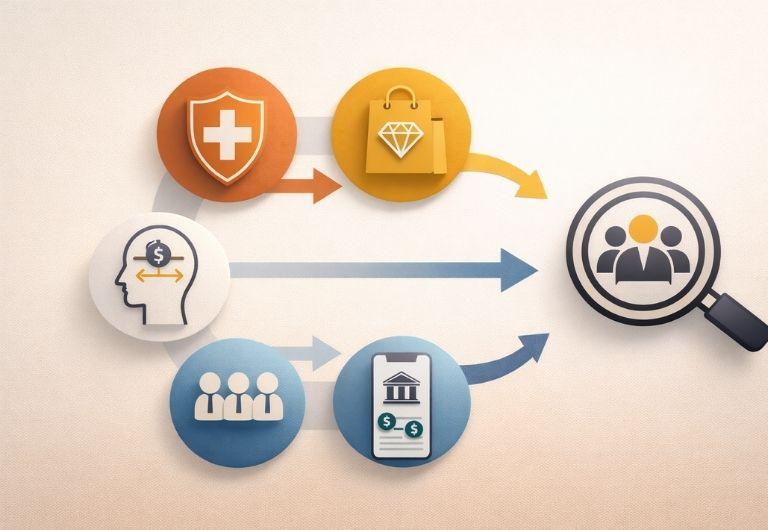
From Demographics to Decision Drivers: Evolving Audience Understanding
Traditional audience definitions often rely on age, income, gender, and location. While these factors provide descriptive context, they rarely explain why customers act.
Modern audience behavior analysis focuses on decision drivers rather than descriptors. It asks deeper questions:
What problem is the customer actively trying to solve?
What risks do they perceive in making a decision?
What alternatives are they comparing—and why?
This shift is particularly important in B2B, real estate, healthcare, financial services, and premium consumer categories common in Dubai’s economy. Purchasing decisions in these sectors are rarely impulsive. They are shaped by trust signals, perceived authority, social proof, and long-term value.
Effective customer research and insights integrate both qualitative and quantitative research. Quantitative data reveals patterns at scale—traffic sources, conversion rates, funnel drop-offs. Qualitative research explains those patterns—why customers hesitate, what objections remain unresolved, and which moments build or erode confidence.
As McKinsey has observed, organizations that combine behavioral data with qualitative insight are significantly more likely to outperform peers in revenue growth and customer retention. Insight emerges not from data volume, but from synthesis.
The Market & Audience Research Process: From Signals to Strategy
A robust market & audience research process is structured, iterative, and closely tied to strategic decisions. It does not exist in isolation from marketing strategy—it shapes it.
The process typically begins with demand analysis and competitive market analysis, establishing the external constraints and opportunities shaping customer behavior. Market size, growth rates, category maturity, and competitor positioning provide essential context for realistic strategy development.
Next comes audience segmentation research, which moves beyond surface-level personas to identify meaningful segments based on needs, motivations, and readiness to buy. In high-performing organizations, segmentation is dynamic rather than static—updated as markets evolve and new behavioral data emerges.
This is followed by customer journey analysis, mapping how awareness, consideration, and conversion actually unfold—not how teams assume they should. Journey mapping often reveals friction points that are invisible in dashboards but highly influential in decision-making.
Finally, insights are translated into market research strategy—guiding positioning, messaging, channel selection, and performance benchmarks. Research without translation creates reports. Research with translation creates competitive advantage.
Foundation of High-Performance Marketing
High-performance marketing is not defined by scale, speed, or sophistication of tools. It is defined by decision quality. Campaigns perform consistently only when the decisions behind them—who to target, what to say, where to invest, and when to act—are grounded in evidence rather than assumption. This is why market & audience research functions as the structural foundation of high-performance marketing systems.
At its core, marketing performance is a compounding system. Early decisions influence downstream efficiency. Weak assumptions at the research stage propagate into misaligned positioning, inefficient media spend, and rising acquisition costs. Strong research, by contrast, creates strategic leverage. It clarifies demand, sharpens focus, and aligns execution across channels.
In high-performing organizations, market & audience research does not sit upstream as a disconnected activity. It operates as a continuous intelligence layer that informs planning, execution, and optimization. This integration is what separates performance-driven marketing from campaign-led marketing.
Research establishes strategic constraints—what not to pursue as much as what to pursue. By identifying which segments are commercially viable, which audiences are price-sensitive versus value-driven, and which behaviors signal readiness to convert, research prevents overextension. Focus, not visibility, becomes the driver of results.
A useful way to understand this foundation is through three interlocking pillars that research enables:
- Strategic Precision: Clear definition of priority markets, audience segments, and demand drivers reduces dilution and improves relevance.
- Executional Alignment: Messaging, channels, creative, and timing align with how customers actually evaluate and decide—not how organizations hope they do.
- Performance Resilience: Insight-led strategies adapt more effectively to market volatility, competitive pressure, and platform changes.
This is particularly critical in Dubai’s hyper-competitive environment, where brands compete not only on price or promotion, but on trust, credibility, and experience. Audiences are exposed to global benchmarks. Tolerance for irrelevant messaging is low. Marketing that is not grounded in audience reality is quickly filtered out.
McKinsey research consistently shows that companies leading in customer insight integration outperform peers on revenue growth, margin expansion, and customer retention. The implication is not that insight guarantees success—but that absence of insight guarantees inefficiency.
High-performance marketing, therefore, is not an outcome of better campaigns. It is the outcome of better thinking enabled by better research. When market & audience research informs strategy at every stage—from positioning to channel selection to measurement marketing shifts from experimentation to execution with intent. This is the foundation on which sustainable performance is built.
Consumer Research Methods That Actually Drive Performance
The effectiveness of consumer research methods lies not in novelty, but in relevance. Surveys, focus groups, interviews, social listening, and behavioral analytics each serve distinct purposes—and none are sufficient alone.
Surveys are valuable for validating hypotheses at scale but are limited by self-reporting bias. Focus groups reveal group dynamics and language patterns but can distort individual truth. One-on-one interviews uncover emotional drivers but lack statistical significance. Behavioral data captures what people do but not why they do it.
High-performance marketing teams triangulate across methods, using each to compensate for the others’ limitations. This triangulation is essential for accurate customer insights research.
In Dubai, where consumer behavior is influenced by global exposure, cultural norms, and digital maturity, relying on a single method often leads to misleading conclusions. For example, stated brand preference may diverge significantly from observed purchase behavior due to social desirability bias.
The most valuable insights often emerge at the intersection of methods—where qualitative narratives explain quantitative anomalies.
Market & Audience Research for Marketing Strategy Development
Marketing strategy without research is storytelling. Research without strategy is documentation. High performance emerges when the two are inseparable.
Market & audience research for marketing strategy ensures that positioning is not aspirational but defensible, and that messaging aligns with real customer priorities rather than internal assumptions.
In practice, this means research informs:
- Value proposition design
- Audience targeting and positioning
- Channel prioritization
- Content strategy and messaging hierarchy
For example, a Dubai-based real estate developer may assume price sensitivity is the primary driver for mid-market buyers. Research may reveal that buyers are more concerned with developer credibility, project delivery history, and resale liquidity—reshaping both messaging and channel strategy.
According to Bain & Company, companies that anchor strategy in customer insights grow revenues 4–8% faster than competitors. The implication is clear: insight-led strategy compounds over time.
Applying Market & Audience Research to Digital Marketing Performance
Digital marketing has amplified the consequences of weak research. With algorithmic optimization and real-time bidding, platforms reward relevance and penalize misalignment at scale.
Market and audience research for digital marketing improves performance by ensuring that creative, targeting, and landing experiences align with user intent. SEO, paid media, and content marketing all depend on accurate understanding of audience behavior.
In SEO, SEO audience research identifies not just keywords, but search intent—informational, navigational, or transactional. In paid media, audience research for paid media prevents wasted spend by aligning offers with readiness signals. In content strategy, research informs depth, tone, and sequencing.
Organizations that rely solely on platform data often optimize within artificial constraints. Those that integrate external research gain a systemic advantage.
Case Study: Research-Driven Growth in a Competitive Dubai Market
A Dubai-based professional services firm faced stagnant lead quality despite increased media spend. Campaign metrics suggested healthy traffic and engagement, yet conversions remained inconsistent.
A comprehensive market & audience research initiative revealed a critical insight: decision-makers were not seeking providers—they were seeking validation. Trust, credibility, and risk mitigation dominated early-stage consideration.
By restructuring messaging around proof points, authority signals, and educational content—and aligning channels with research-driven journey stages—the firm reduced cost per qualified lead by over 35% within six months.
The transformation was not tactical. It was strategic. Research reframed the problem, enabling more precise execution.
Reducing Marketing Risk Through Evidence-Based Decisions
Marketing risk is rarely binary. It accumulates incrementally through misaligned assumptions, fragmented targeting, and poorly prioritized spend.
Market & audience research for business growth functions as a risk-reduction mechanism. It identifies where uncertainty is highest, where investment is most likely to pay off, and where assumptions require validation before scaling.
In volatile or competitive markets like Dubai, where cost of error is high, research discipline protects both budget and brand equity. It shifts marketing from reactive optimization to proactive design.
As Clayton Christensen observed, “Understanding the job customers are trying to get done is the key to innovation.” The same principle applies to marketing performance.
The Role of Voice of Customer (VoC) in Continuous Improvement
High-performing organizations treat voice of customer (VoC) as an ongoing input, not a periodic exercise. Feedback loops—reviews, support interactions, post-purchase surveys—provide real-time signals that complement formal research.
When integrated with behavioral data analysis, VoC highlights emerging needs, unmet expectations, and language patterns that can be leveraged in messaging and product development.
In Dubai’s service-driven economy, where experience is often as influential as price, VoC insights play a critical role in sustaining differentiation.

Market & Audience Research Examples Across Sectors
While the underlying principles of market & audience research remain consistent, their application varies meaningfully by sector because customer decision-making contexts differ. In luxury retail, research often centers on emotional drivers, symbolic value, and identity signaling. Purchase decisions are influenced less by functional comparison and more by brand narrative, social validation, and the meanings customers attach to ownership. Understanding aspiration, status cues, and moments of emotional resonance becomes critical to effective positioning.
In healthcare, by contrast, trust, credibility, and risk mitigation dominate the decision process. Patients and caregivers seek reassurance, authority, and clarity under conditions of uncertainty. Research in this context prioritizes credibility signals, information transparency, and the emotional dynamics of vulnerability. Seemingly minor friction points—such as unclear credentials, inconsistent communication, or delayed follow-up—can disproportionately erode confidence and suppress conversion.
Fintech introduces a different set of dynamics. Here, adoption is shaped by perceived risk, usability, and control. Customers evaluate not only potential upside but also downside exposure, data security, and ease of use. Effective research surfaces the psychological barriers that slow adoption—fear of loss, complexity anxiety, or distrust of digital intermediaries—and informs design and messaging choices that reduce cognitive load and increase perceived safety.
Despite these sector-specific differences, what unites successful examples is not industry familiarity but methodological rigor and strategic translation. High-performing organizations resist the temptation to treat research as an isolated phase or a one-time deliverable. Instead, they embed research into ongoing decision-making processes, allowing insights to evolve as markets, technologies, and customer expectations change.
Organizations that treat research as a living system—continuously refreshed through behavioral data, voice-of-customer feedback, and competitive intelligence—develop a structural advantage. They detect shifts in demand earlier, adapt messaging with greater precision, and reallocate resources with confidence. Over time, this discipline compounds, enabling sustained performance rather than episodic success.
In contrast, organizations that rely on static reports or legacy assumptions often find themselves optimizing tactics against outdated realities. The performance gap that emerges is not driven by creativity or budget, but by the quality and freshness of insight guiding strategic choices.
Conclusion: From Insight to Advantage
High-performance marketing does not begin with creativity, channels, or technology. It begins with understanding. Market & audience research provides the clarity that transforms marketing from activity into advantage by grounding every decision in evidence rather than assumption. Without this foundation, even the most sophisticated tools and compelling creative executions operate in isolation—optimized for efficiency but disconnected from real impact.
In complex, highly competitive environments like Dubai—where audiences are culturally diverse, digitally sophisticated, and exposed to global benchmarks—research is not a discretionary investment. It is foundational infrastructure. Organizations that embed research deeply into strategy development, execution, and optimization reduce uncertainty at every stage. They prioritize more accurately, target more precisely, and communicate more coherently, lowering strategic risk while improving ROI.
Over time, this discipline compounds. Insight-led organizations build durable growth engines that adapt to market volatility rather than react to it. Those that neglect this discipline often blame budget constraints or platform shifts, but the gap is rarely financial. The difference is not the budget. It is discipline. When insight guides action—and action continuously reinforces insight—marketing stops guessing and starts performing.
FAQ
1. What is market and audience research?
Market and audience research is the process of collecting and analyzing data to understand industry trends, competitive landscapes, and customer behaviors, needs, and preferences. It helps businesses identify opportunities, reduce risk, and create more effective marketing strategies.
2. Why is market and audience research important in digital marketing?
Research ensures marketing decisions are data-driven rather than assumption-based. Understanding who your audience is, what they care about, and how they behave online allows brands to create relevant messaging, choose the right channels, and improve engagement and conversions.
3. What methods are used for market and audience research?
Common methods include surveys, interviews, focus groups, website analytics, social listening, keyword research, competitor analysis, and customer feedback reviews. Combining qualitative and quantitative methods provides a more complete view of the market.
4. How does audience research influence digital marketing strategy?
Audience insights shape content creation, messaging tone, channel selection, and personalization strategies. When brands understand audience motivations and pain points, they can design campaigns that resonate and guide customers more effectively through the journey.
5. How often should businesses conduct market and audience research?
Research should be an ongoing process. While in-depth studies may be conducted quarterly or annually, continuous monitoring of analytics, trends, and customer feedback helps businesses stay aligned with changing market dynamics and audience expectations.