
How Large Language Models Work: A Plain-English Guide for Marketers
Large language models (LLMs) are changing how businesses approach content creation, search engine optimisation, advertising, customer engagement, and marketing automation. From writing blog posts to analysing customer feedback, these AI systems can help marketing teams process information and complete language-based tasks more efficiently.
However, using AI effectively involves more than entering a prompt and copying the response. Marketers need to understand how large language models work, how they learn from training data, how they generate answers, and why their outputs sometimes contain errors.
Understanding these fundamentals helps businesses identify suitable use cases, improve the quality of AI-generated content, and establish workflows that balance automation with human expertise.
In this guide, we explain how large language models work in plain English, explore their applications in digital marketing, and examine the benefits, limitations, and practical techniques marketers should understand before adopting them.
What Is a Large Language Model (LLM)?
A large language model is an artificial intelligence system trained on extensive datasets to recognise patterns in language and generate responses based on those patterns. LLMs can answer questions, summarise documents, translate text, analyse feedback, draft content, and assist with research.
Unlike traditional software that follows a fixed set of rules, an LLM can respond to many different instructions using capabilities learned during training. This flexibility allows a single model to support a wide range of language-related tasks.
Most modern text-generating LLMs work by predicting the next token based on the preceding context. A token may represent a complete word, part of a word, punctuation, or another unit of text. The model repeatedly predicts tokens to build a response.
For example, a marketer could ask an LLM to create three advertising concepts for a skincare product. One concept might focus on convenience, another on approved product benefits, and a third on value. The model uses the supplied instructions and its learned patterns to generate different drafts.
Popular model families include GPT, Claude, Gemini, Llama, and DeepSeek. Their capabilities, interfaces, costs, integrations, and data-handling options vary.
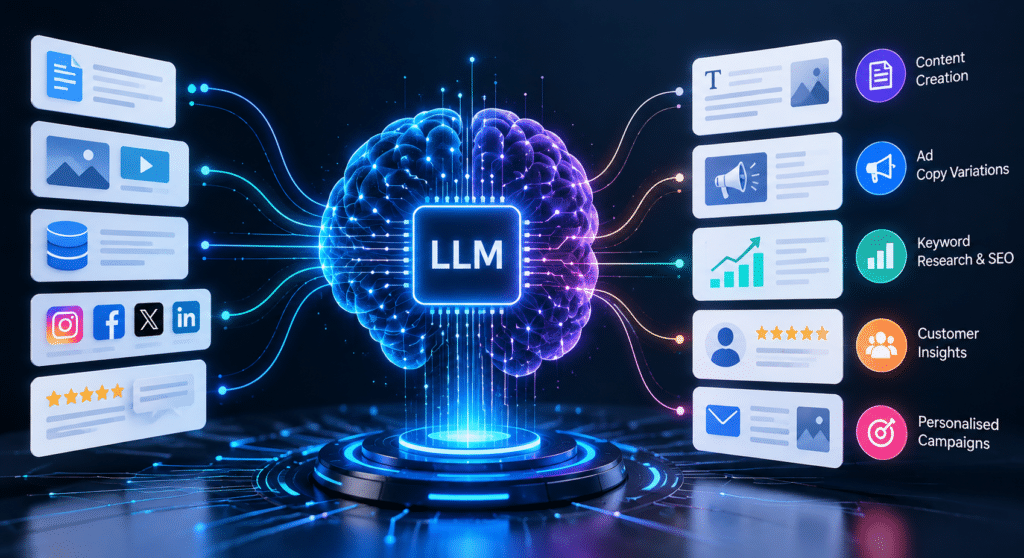
For marketers, LLMs can support content production, SEO research, advertising, personalisation, customer support, and campaign analysis. Their usefulness depends on the task, the quality of the information supplied, and the process used to review the output.
What Does LLM Stand For?
LLM stands for Large Language Model. Each word describes an important characteristic of the technology.
- Large: These models are trained using extensive datasets and may contain millions or billions of parameters, depending on their architecture. Parameters are numerical values learned during training.
- Language: LLMs are designed primarily to process and generate language, supporting tasks such as writing, summarisation, translation, and question answering.
- Model: A model is a computational system that learns patterns from data and uses those patterns to generate predictions or outputs.
Together, these characteristics allow an LLM to respond to a wide range of instructions without requiring a developer to manually program a separate rule for every possible request.
For example, a marketing team could provide a product description and ask an LLM to create a headline, a social media caption, and an email introduction. The model can adapt the same source information to different formats.
The resulting content still needs to be checked against the original product details, brand guidelines, and campaign objectives.
Examples of Popular Large Language Models
Several model families support modern AI writing, research, analysis, and business applications.
- GPT models: Used in ChatGPT and other applications for writing, analysis, summarisation, and problem-solving.
- Claude: Developed by Anthropic and used for writing, document analysis, coding, and other language-intensive tasks.
- Gemini: Google’s model family supports text and multimodal tasks, with features varying by model and product.
- Llama: Meta’s model family includes models that developers can use and adapt under the applicable licences.
- DeepSeek: Includes models used for general-purpose text generation, coding, and reasoning tasks.
For marketers, selecting a model should involve more than comparing brand names. Consider output quality, context requirements, privacy controls, integration options, cost, and performance on the tasks your team actually performs.
A small agency may prioritise affordable content generation and reliable brand alignment. An enterprise marketing department may place greater emphasis on data governance, access controls, and integration with existing business systems.
LLMs vs Traditional AI: What Is the Difference?
Traditional AI is a broad category that includes systems designed for specific tasks, such as predicting customer churn, detecting fraud, classifying images, and recommending products.
Large language models are a specialised form of AI focused primarily on language and related tasks. They can interpret varied instructions and generate flexible responses, while specialised AI systems may be better suited to numerical predictions or narrowly defined decisions.
Consider how both approaches could support a marketing campaign:
| Marketing task | Specialised AI | Large language model |
| Customer segmentation | Identifies groups using data and statistical patterns | Helps interpret customer descriptions and develop messaging for segments |
| Campaign performance | Predicts outcomes or identifies patterns | Summarises reports and suggests questions to investigate |
| Content creation | May select or optimise predefined content | Generates drafts of emails, advertisements, and social posts |
| Customer support | Classifies or routes enquiries | Drafts conversational responses using available context |
| Sentiment analysis | Classifies feedback into categories | Helps identify themes and explain customer comments |
These technologies can work together. For example, a predictive model might identify customers at risk of stopping purchases, while an LLM helps draft a suitable retention email.
The predictive model estimates risk; the language model assists with communication. This combination allows businesses to use each technology for the task it handles best.
How Do Large Language Models Work?
Large language models process input through neural networks that identify patterns and relationships between tokens. Most modern text-generation LLMs use transformer-based architectures to process context and generate responses.
The process can be understood through five stages: tokenisation, embeddings, transformer processing, next-token prediction, and response generation.
Understanding these stages helps marketers recognise why prompt quality matters, why context influences output, and why generated content requires verification.
How LLMs Break Text Into Tokens
Before a model processes a prompt, the text is converted into smaller units called tokens. Depending on the tokenizer, a token may represent a complete word, part of a word, punctuation, or another text unit.
Consider this prompt:
“Create a marketing campaign for a premium skincare brand.”
The tokenizer converts the sentence into a sequence of tokens represented numerically. The exact divisions depend on the model’s tokenisation method.
Tokens matter because many AI services measure usage through input and output tokens. These counts can affect pricing, processing limits, and how much text a model can accept or generate in one request.
For example, a short campaign brief may contain only the target audience and objective. A longer brief may include competitor research, customer interviews, product specifications, and brand guidelines.
The longer brief may provide useful context, but it can also increase processing requirements. Marketers should prioritise relevant information rather than adding documents simply to make a prompt longer.
How Embeddings Help Models Represent Meaning
After tokenisation, the model converts token identifiers into numerical representations called embeddings. These vectors help the model process relationships between words, phrases, and other elements of the input.
Consider the word “Apple” in two sentences:
- “The company launched a new Apple product.”
- “The chef sliced an apple for dessert.”
The surrounding context helps distinguish the technology company from the fruit. Embeddings provide numerical representations that contribute to the model’s subsequent processing.
Embeddings are also widely used in semantic search and retrieval systems. These systems identify information based on meaning rather than depending exclusively on exact keyword matches.

For example, a search system may connect a query about “affordable skincare for dry skin” with product descriptions containing phrases such as “budget-friendly moisturiser” or “hydrating skincare.”
For marketers, this is useful when organising product information, building searchable knowledge bases, or connecting customer questions with relevant content.
How Transformer Architecture and Self-Attention Work
The transformer architecture is a major reason modern LLMs can process complex text and generate context-sensitive responses.
One of its central mechanisms is called self-attention. In simple terms, self-attention helps a model calculate which other tokens are relevant when processing a particular token.
Consider this sentence:
“The marketing team reviewed the campaign because it was underperforming.”
The model uses the surrounding words to assess what “it” refers to. Self-attention helps it evaluate relationships between different parts of the sentence rather than treating every word as an isolated unit.
A transformer processes information through multiple layers of numerical operations. Attention mechanisms help combine relevant contextual information, while other components transform the resulting representations.
For marketers, imagine providing a detailed brand brief containing the target audience, tone of voice, product benefits, and campaign objective. Transformer-based processing helps the model use relationships between these details when generating a response.
However, self-attention does not guarantee that a model will always interpret instructions correctly. Its output still depends on the available context, training, and model design.
How LLMs Predict the Next Token
Next-token prediction is central to many language models. The model calculates probabilities for possible next tokens based on the preceding sequence.
Suppose you enter the phrase:
“Five ways to improve customer…”
Possible continuations might include “retention,” “loyalty,” or “engagement.” These are illustrative possibilities, not fixed predictions.
The model selects or samples a token according to its generation settings. It adds that token to the sequence and repeats the process until it reaches an appropriate stopping condition or output limit.
This allows an LLM to generate a complete paragraph one token at a time.
For marketers, this explains why a model can produce several headline variations from the same campaign brief. It also explains why its response can differ across attempts, particularly when generation settings allow variation.
Importantly, likely text is not necessarily true text. A model can generate a natural-sounding statement that contains incorrect information. Current market statistics, product specifications, and regulatory claims should therefore be verified before publication.
Why Context Matters When Generating Answers
Context helps an LLM determine which information is relevant to a request. It can include the current prompt, previous messages, supplied documents, and information retrieved through connected tools.
Compare these two prompts:
Basic prompt: “Write a marketing email.”
Context-rich prompt: “Write a concise marketing email for a premium skincare brand targeting adults aged 25–40 in the UAE. Introduce the new hydrating serum, use a sophisticated but approachable tone, include only benefits from the approved product brief, and finish with a clear call to action.”
The second prompt provides more direction about the audience, product, tone, and expected output. This makes the response easier to evaluate against the campaign requirements.
Useful context includes:
- Target audience and customer needs.
- Brand positioning and tone of voice.
- Campaign objective and desired action.
- Approved product information and supporting evidence.
- Required length, format, channel, and language.
More context is not always better. Irrelevant details can make prompts inefficient, and models have finite context windows. For larger projects, organise supporting information into concise briefs and provide the material most relevant to the task.
How Are Large Language Models Trained?
Training allows a language model to learn patterns from data and improve its ability to predict or generate language. Although the exact process varies, many modern LLMs undergo pretraining, additional training, and evaluation.
Pretraining on Large Datasets
During pretraining, a model learns from extensive datasets that may include text, code, and other sources selected and processed by its developers.
For autoregressive language models, the training process commonly involves predicting the next token in a sequence. The model compares its predictions with the training objective and adjusts its parameters to improve future performance.
Across many examples, it learns statistical patterns involving grammar, vocabulary, writing styles, and relationships between concepts.
Pretraining is not simply memorising a complete library of documents. The model’s parameters are adjusted to capture patterns in the training data, although some models can memorise and reproduce portions of their examples.
This stage provides the foundation for tasks such as writing, summarisation, translation, and question answering. However, a pretrained model may require additional training to follow instructions consistently or behave like a polished conversational assistant.
Fine-Tuning Models for Specific Tasks
Fine-tuning adapts an existing model using a more specialised dataset. It can help a model perform selected tasks or follow consistent output formats.
A simplified fine-tuning workflow includes:
- Define the task and expected behaviour.
- Prepare high-quality examples demonstrating the desired outputs.
- Train the model using the prepared data.
- Evaluate results on separate examples.
- Refine the approach if quality or consistency is insufficient.
For example, an e-commerce business may need thousands of product descriptions to follow a consistent structure and use approved terminology. Fine-tuning a suitable model may help it reproduce these patterns more reliably.
However, fine-tuning does not automatically give a model access to updated prices, product availability, or changing company policies. Those details may still need to be supplied through prompts or retrieval systems.
Reinforcement Learning From Human Feedback
Some LLMs use reinforcement learning from human feedback (RLHF) or alternative preference-optimisation techniques to improve the way they respond to users.
In a simplified RLHF workflow, human reviewers assess model responses or demonstrate desirable answers. A learning process uses these preferences to guide further optimisation.
For example, reviewers may prefer an email that explains a product’s approved benefits clearly over one that makes exaggerated promises.
This process can improve instruction-following and response quality, but human preferences can vary. A response that sounds helpful is not automatically factually correct.
Training vs Inference: What Is the Difference?
Training and inference are distinct stages in the lifecycle of an LLM.
| Feature | Training | Inference |
| Purpose | Learn or adapt model behaviour | Generate an output from an input |
| Parameters | Adjusted during training | Used to calculate predictions |
| Typical example | Adapting a model for a specialised task | Generating a campaign email from a prompt |
| Main considerations | Data quality, computing resources, evaluation | Accuracy, context, response time, and usage cost |
When a marketer asks an AI writing assistant to draft a social media caption, the model is typically performing inference. It is using its trained parameters and the available context to generate a response.
This distinction matters because supplying a brand guide in a prompt does not necessarily retrain the model. Whether submitted information is retained or used for future model training depends on the product and its data-handling settings.
What Are Tokens, Parameters and Context Windows?
Tokens, parameters, and context windows describe different parts of how an LLM operates.
Tokens are the units of text a model processes. They affect usage costs and processing limits in many AI services.
Parameters are numerical values learned during training that influence how the model processes information and generates predictions.
Context windows determine how much information a model can consider during a particular request. They may include the prompt, conversation history, and supplied documents.
For marketers, these concepts help with model selection, prompt design, and workflow planning.
Imagine preparing an SEO content strategy using a brand voice guide, keyword list, competitor articles, and audience research. A suitable context window may allow the model to consider these materials together.
However, a larger context window does not guarantee that every detail will be used correctly. Clear organisation and relevant source material remain important.
How Model Size Influences Performance and Cost
Model size can affect computing requirements, but parameter count alone does not determine performance or operating cost. Architecture, hardware, optimisation, and serving methods also influence efficiency.
Marketing teams should match the model to the task.
| Marketing use case | What to prioritise |
| Product descriptions at scale | Consistency, speed, and cost |
| SEO metadata | Relevance, accuracy, and length |
| Customer feedback analysis | Classification quality and data handling |
| Campaign strategy | Context handling, reasoning, and reliability |
| Customer-facing assistants | Accuracy, privacy, response time, and escalation |
A cost-efficient model may be sufficient for generating structured metadata. A more capable model may be preferable for complex campaign planning involving several audiences and markets.
The best approach is to evaluate models using representative tasks and measure output quality, editing time, error rates, and total cost.
How Do Large Language Models Generate Marketing Content?
LLMs generate marketing content by interpreting instructions, processing available context, and predicting a sequence of tokens. They can produce blog drafts, social media captions, advertising copy, product descriptions, email campaigns, and other marketing assets.
However, effective marketing content must do more than sound natural. It should reflect the brand’s positioning, address audience needs, support the campaign objective, and communicate accurate information.
From a Marketing Prompt to a Finished Output
The process begins with a prompt that defines the task. It may include the target audience, brand guidelines, product information, desired format, and campaign objective.
Consider an agency preparing a social media campaign for a premium skincare brand in the UAE.
A basic prompt might say:
“Write a social media caption for a hydrating serum.”
A stronger prompt could specify the audience, tone, approved benefits, word limit, and desired call to action.
The model generates a draft based on the supplied information. The marketing team then reviews it, corrects unsupported claims, and adapts the wording to the brand and platform.
A practical workflow includes five stages:
- Define the objective: Decide whether the content should build awareness, encourage engagement, generate leads, or support sales.
- Provide context: Include audience details, product information, and brand guidelines.
- Generate drafts: Ask for alternatives that follow the brief.
- Review and refine: Check accuracy, tone, originality, and relevance.
- Publish and measure: Evaluate performance using appropriate marketing metrics.
This approach treats the LLM as part of a controlled production process rather than assuming its first response is ready to publish.
How LLMs Generate Blog Posts, Social Media Content and Ad Copy
For blog posts, LLMs can help develop outlines, organise research, draft sections, and improve readability. Editors should add original insights and verify claims to ensure the article delivers value beyond a generic summary.
For social media, LLMs can suggest caption variations, campaign themes, and content calendar ideas. A core message can be adapted for LinkedIn, Instagram, or a short-form video script, with changes for each channel.
For paid advertising, LLMs can suggest headlines, value propositions, and calls to action. These variations can form the basis of structured experiments, but actual performance must be established through campaign data.
For email marketing, LLMs can assist with subject lines, welcome sequences, promotional messages, and retention campaigns.
An e-commerce business launching a product could use an approved product brief to create a blog outline, social captions, paid advertising variations, and a launch email. Each asset should be reviewed and adapted for its purpose.
The objective is not to produce the greatest volume of AI content. It is to create useful, accurate, and relevant content more efficiently.
How Brand Voice Influences AI-Generated Content
Brand voice is the consistent personality and communication style a business uses across its marketing channels. It helps communicate values, differentiate the business, and build recognition.
An LLM does not automatically know a brand’s identity simply because it knows the brand name. Without relevant information, it may generate generic language based on common patterns associated with the industry.
To improve brand alignment, provide:
- Brand personality and positioning.
- Preferred terminology and words to avoid.
- Sentence style and tone guidelines.
- Audience expectations and customer needs.
- Examples of approved content.
- Restrictions on product claims and promotional language.
For example, a luxury brand may favour restrained language and an emphasis on craftsmanship, while a technology startup may prefer concise explanations of practical benefits.
A reusable brand voice brief gives the model clearer direction and helps human editors evaluate the output consistently.
Why the Same Prompt Can Produce Different Answers
An LLM may produce different responses to the same prompt because generation can involve sampling or other decoding choices. Results may also vary when context, model versions, or external information changes.
This variation can be useful during brainstorming because it provides alternative headlines, messaging angles, and campaign ideas. However, it can create problems when content must follow a strict structure.
Marketers can improve consistency by using reusable prompts, approved source material, defined output formats, and review criteria. Automated checks can also identify content that fails requirements such as length, required fields, or prohibited claims.
How Do Marketers Use Large Language Models?
LLMs can support several marketing activities, but their value depends on how well they fit into existing workflows.
Content Creation and Repurposing
Marketers can use LLMs to brainstorm topics, draft content, refine headlines, and adapt existing material into different formats.
For example, a webinar could become a blog article, a newsletter, several social posts, and short-form video scripts. The team should adapt each asset to the intended audience and channel rather than simply copying the same text.
Original research, expert commentary, and editorial review help ensure that the resulting content remains distinctive and useful.
SEO Research and Content Optimisation
LLMs can help organise keyword lists, develop content briefs, suggest title tags and meta descriptions, and identify possible internal links.
An SEO specialist could supply competitor articles and ask the model to identify topics that appear to be covered, questions readers may have, and areas requiring further research.
These suggestions need validation. Search demand, ranking difficulty, technical SEO, and business value should be evaluated using reliable data. AI-generated content alone does not guarantee higher rankings.
Paid Advertising and Email Marketing
LLMs can produce headline variations, calls to action, email subject lines, and campaign messages for different audiences.
A retailer could test convenience-focused, benefit-focused, and value-focused messaging, provided every claim reflects approved product information.
Marketers should compare the results using metrics such as click-through rate, conversion rate, and acquisition cost rather than assuming that the most persuasive-sounding message will perform best.
Customer Personalisation and Audience Segmentation
LLMs can help adapt messages for different audience groups, customer journeys, and product interests.
For example, a retailer might prepare different email drafts for first-time buyers and returning customers. The model can help adjust the wording, but the business must supply appropriate audience information and verify that the messages reflect the actual customer journey.
Personalisation should respect privacy requirements and avoid unsupported or discriminatory assumptions about individuals.
Customer Support and Sentiment Analysis
LLMs can help draft responses, summarise conversations, and organise customer feedback into recurring themes.
A support assistant connected to an approved knowledge base could retrieve information about delivery, returns, or product specifications. Such capabilities depend on suitable integrations, permissions, and safeguards.
Sentiment analysis can help identify recurring concerns, but sarcasm and ambiguous language may lead to incorrect classifications. Important findings should be validated, and sensitive issues should be escalated to human representatives.
Marketing Research and Campaign Analysis
LLMs can summarise customer surveys, organise competitor messaging, and explain campaign reports in plain language.
For example, if a campaign receives more clicks but fewer conversions, an LLM may suggest investigating audience quality, landing-page relevance, the offer, or tracking issues.
These are potential explanations, not proven causes. Marketers should use reliable analytics tools to verify calculations and investigate the data before deciding what happened.
How Do LLMs Get Information Beyond Their Training Data?
A model’s learned knowledge does not automatically update whenever new information becomes available. Questions about recent market developments, current product prices, or updated company policies may require additional sources.
AI applications can supply this information through web searches, internal documents, product databases, or connected systems.
Training Data vs Live Information
Training data influences the patterns learned during model development. Live or externally supplied information is made available at the time of a request or through an updated information system.
For example, an LLM may explain established SEO principles, but a marketer researching recent platform changes should consult current documentation and reliable sources.
External access does not automatically guarantee accuracy. Sources can be outdated, irrelevant, or incorrect, so important claims should still be verified.
What Is Retrieval-Augmented Generation (RAG)?
Retrieval-augmented generation combines information retrieval with language generation. An application retrieves relevant passages from an external collection and supplies them to the LLM as context.
A typical workflow involves preparing documents, retrieving relevant information, providing that information to the model, and generating a response.
For example, an e-commerce business could connect an AI assistant to its product catalogue. When a customer asks whether a travel bag fits a particular laptop, the system can retrieve the relevant dimensions and use them to help answer the question.
RAG is useful for company-specific information, updated documentation, and large knowledge collections. However, its reliability depends on retrieving the correct information and generating an answer that represents it accurately.
Prompting vs Retrieval vs Fine-Tuning
Prompting provides instructions and context directly. Retrieval supplies relevant information from external sources. Fine-tuning changes model behaviour through additional training.
A marketing agency could use prompting to define a client’s brand voice, retrieval to access approved service information, and fine-tuning to improve consistency in a specialised workflow.
For most teams, clear prompts and reliable source material are the most practical starting points before investing in model customisation.
What Are the Benefits of Large Language Models in Digital Marketing?
LLMs can support marketing teams by reducing repetitive language-based work, making information easier to process, and helping generate content variations.
Faster Content Production and Research
LLMs can accelerate brainstorming, outlining, drafting, and summarisation. They can help teams move from a blank page to an initial draft more quickly.
However, productivity should be measured across the entire process. If AI-generated drafts require extensive fact-checking and editing, the overall time savings may be smaller than expected.
Scalable Personalisation
LLMs can help adapt messaging to different audiences, markets, and channels. A common campaign framework can be used to create variations for different customer needs while maintaining consistent objectives.
Businesses should test these variations to determine whether they improve engagement or conversions.
More Efficient Marketing Workflows
AI can assist with several stages of a marketing workflow, including brief preparation, content drafting, metadata creation, and reporting.
When connected to other applications, LLMs can support repeatable processes. Appropriate approval controls should remain in place before publishing content or sending customer communications.
Better Access to Customer Insights
LLMs can help summarise qualitative research and organise customer feedback into themes. These summaries can make large collections of comments easier to review and help teams identify questions for further investigation.
They should not replace validated data analysis or direct examination of important evidence.
What Are the Limitations and Risks of LLMs?
LLMs introduce risks that businesses should understand before integrating them into marketing workflows. Common challenges include hallucinations, bias, outdated information, privacy concerns, and inconsistent brand voice.
Why LLMs Hallucinate and Produce Incorrect Information
An AI hallucination occurs when a model generates information that appears plausible but is incorrect or unsupported.
For example, an LLM may produce an unverified market statistic, invent a citation, or include a product feature that does not exist.
Businesses can reduce these risks by supplying approved source material, using retrieval systems where appropriate, and checking important claims against reliable references.
Every statistic should have a traceable source, and product descriptions should be compared with approved specifications.
Bias, Outdated Information and Missing Context
Models can reflect limitations in their training data and may make unsupported assumptions about audiences. They may also provide outdated information when current sources are unavailable.
Marketing teams should review outputs for stereotypes, verify time-sensitive claims, and provide clear audience research and business context.
Data Privacy and Marketing Compliance
AI workflows may involve customer information, campaign reports, or confidential business documents. Organisations should assess the selected service’s data-handling practices, security measures, access controls, and applicable legal requirements.
Use only the information necessary for the task, protect sensitive details, and ensure that processing is appropriately authorised.
Maintaining Brand Voice and Content Quality
AI-generated copy can sound generic, repetitive, or inconsistent with a brand’s positioning.
Provide explicit voice guidelines, approved terminology, and examples of preferred content. Review the final output for accuracy, originality, readability, audience relevance, and strategic fit.
Why Human Review and Fact-Checking Matter
Human reviewers can evaluate whether content supports the brand’s strategy, addresses real audience needs, and uses evidence correctly.
A practical review should check:
- Factual accuracy: Verify statistics, dates, product details, and quotations.
- Source quality: Confirm that references are genuine and support the claims.
- Brand alignment: Check tone, terminology, and positioning.
- Audience relevance: Ensure the content answers a genuine question.
- Compliance: Review privacy, advertising claims, and other applicable requirements.
The level of review should match the task’s risk. A brainstorming exercise may require a light review, while a public report containing important market statistics needs more rigorous verification.
How Can Marketers Get Better Results From LLMs?
Effective LLM use requires clear instructions, relevant context, and a repeatable process for evaluating outputs.
Write Clear, Context-Rich Prompts
A strong prompt explains the objective, audience, task, supporting information, constraints, and required format.
For example:
“Create an SEO article outline for a digital marketing agency targeting businesses in the UAE. Explain how local SEO helps businesses attract relevant customers. Include clear H2 and H3 headings, practical examples, common mistakes, and FAQs. Use a professional, accessible tone and avoid unsupported statistics.”
This provides more direction than a broad request such as “Write about SEO.”
Provide Brand Guidelines and Examples
Include the brand’s positioning, tone of voice, preferred terminology, and examples of approved content. This gives the model a clearer standard to follow and helps reviewers assess the result.
Use Reliable Sources for Factual Content
When a task depends on current statistics, market information, or company-specific facts, provide reliable source material or use an appropriate retrieval or search tool.
Verify that the sources support the final claims rather than assuming the model has interpreted them correctly.
Review, Refine and Measure
Treat AI output as a draft that may require refinement. Check facts, remove generic wording, improve clarity, and ensure that the content supports the campaign objective.
Measure editing time, error rates, output quality, and relevant marketing outcomes. This reveals whether the workflow is delivering genuine improvements.
LLMs vs Generative AI vs AI Agents: What’s the Difference?
These terms are related but describe different concepts.
Large language models are models primarily designed to process and generate language. Some modern models also accept or generate other types of information.
Generative AI is a broader category of AI systems that create new content, including text, images, audio, video, and code.
AI agents are systems that use a model and other components to pursue a goal through a sequence of steps. Depending on their configuration, they may use tools, retrieve information, or interact with connected applications.
For example, an LLM can draft an email, a generative AI system can create marketing visuals, and an AI-enabled agent may prepare a campaign report by retrieving data from connected systems and organising the results for review.
These systems are not interchangeable. Marketers should select the approach based on the task, required integrations, risk level, and degree of human oversight needed.
Frequently Asked Questions About Large Language Models
1.How Do Large Language Models Help Marketers?
LLMs help marketers draft content, organise keyword research, generate advertising variations, summarise customer feedback, and personalise communications. Their usefulness depends on reliable information, clear instructions, and appropriate review.
2.How Do LLMs Generate Marketing Content?
They process a prompt, use available context, and predict a sequence of tokens to generate text. Marketers can guide the output using audience details, brand guidelines, product information, and campaign objectives.
3.Can LLMs Improve SEO Rankings?
LLMs can support keyword organisation, content briefs, metadata, and readability improvements. They do not guarantee higher rankings. Search performance also depends on content quality, search intent, technical factors, competition, and other relevant signals.
4.What Is the Difference Between Training and Inference?
Training adjusts model parameters using data. Inference occurs when the trained model processes an input and generates a response.
5.What Is Retrieval-Augmented Generation?
RAG retrieves relevant information from external documents or databases and supplies it to an LLM as context. It can help applications answer questions using current or business-specific information.
6.Can LLMs Access Real-Time Information?
A model does not automatically have real-time access to information. Depending on the application, it may use search tools, connected databases, or supplied documents to obtain updated information.
7.Can LLMs Replace Digital Marketers?
LLMs can assist with repetitive tasks and content production, but marketers remain responsible for strategy, audience understanding, creativity, factual verification, and business outcomes.
8.How Can Businesses Use LLMs Safely?
Businesses should select appropriate tools, protect sensitive information, provide reliable sources, establish review procedures, and assess outputs for accuracy, bias, privacy, and brand consistency.
Conclusion
Large language models are transforming how businesses approach content creation, SEO, customer engagement, research, and marketing operations. By learning patterns from training data and generating responses based on prompts and available context, they can support a broad range of language-intensive tasks.
For marketers, the opportunity lies in combining these capabilities with clear instructions, trustworthy information, brand guidelines, and human expertise. Start with a defined use case, test the results, and expand AI-assisted workflows when they demonstrate meaningful improvements in efficiency and quality.
The most effective marketing teams will not simply produce more content with AI. They will use large language models to make their work more relevant, informed, consistent, and useful to the audiences they serve.