
Environmental Signage for Brands: Design Strategy, Wayfinding & Identity

Introduction
In a world where brand presence extends beyond screens and packaging, brand environmental signage has emerged as a silent yet powerful storyteller. It’s not just about names on doors or directories—it’s about translating your identity into a physical experience. This is where brand environment design and environmental graphics come into play, sculpting spaces that do more than guide; they resonate.
Whether in hospitals, coworking spaces, corporate towers, or boutique stores, signage is no longer a passive backdrop. It’s an interactive asset woven into the visual branding & design strategy of an organization. It breathes life into spaces, directing visitors while communicating a company’s ethos, mission, and values—without saying a word. A font choice, a material texture, or a directional icon can define the way people emotionally experience a brand.
From office lobbies to retail spaces, environmental signage creates a sense of place, injects identity into walls, and subtly influences behavior. A carefully designed sign isn’t just a message—it’s a handshake, a voice, a memory. And in this guide, we’ll explore exactly what makes environmental signage successful, how it supports both wayfinding and brand consistency, and why the smartest brands treat their walls and windows as part of their messaging ecosystem.
We’ll also uncover how integrating visual branding & design principles across physical environments transforms mundane pathways into meaningful journeys—and turns passive navigation into immersive storytelling.
What Is Environmental Graphic Design & Branding?
Defining the Field
Let’s break down the terminology: environmental graphic design (EGD) blends architecture, interior design, and branding into one tangible experience. Think signage, wall graphics, digital kiosks, and even floor markers—all contributing to a cohesive spatial narrative. These elements help people navigate physical spaces while reinforcing brand values in subtle, artful ways.
Unlike traditional marketing, EGD doesn’t demand attention. It guides, informs, and immerses. For instance, you’ll often see branded environments in coworking spaces, tech headquarters, or university campuses, where logos, values, and mission statements subtly play across walls or through textures and colors.
Why It Matters: Experience & Identity
Here’s the kicker—people remember 80% of what they see and experience. When a space feels intuitive and expressive, visitors associate that fluidity with your brand. Confused wayfinding, on the other hand, frustrates users and fractures trust.
Imagine walking into a corporate building, unsure of where to go, surrounded by bland hallways. Now picture that same journey—but every turn reveals a visual cue that makes sense, matches the brand, and reinforces purpose. That’s the magic of environmental signage when it’s done right.
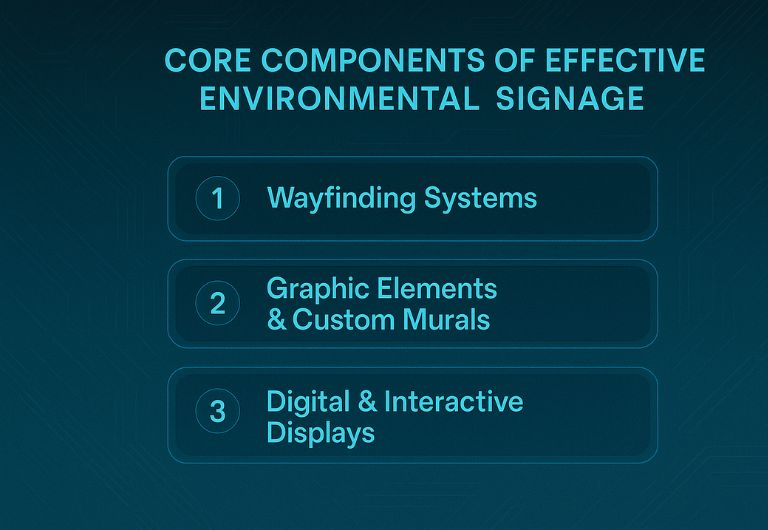
Core Components of Effective Environmental Signage
Wayfinding Systems
Wayfinding signage does more than point people in the right direction. It reduces friction, lowers stress, and enhances accessibility. Great wayfinding systems anticipate needs—”Where’s reception?” “How do I find the restroom?”—and answer them before the question is even asked. In today’s fast-paced world, intuitive navigation isn’t just a convenience—it’s a necessity.
These include
- Directional signs: Arrows, routes, paths
- Identification signs: Room names, numbers, departments
- Informational signs: Timetables, directories, rules
Designing them isn’t about making signs pretty. It’s about strategic placement, high-contrast readability, inclusive language, and, when possible, brand cohesion. The font size, pictograms, lighting, and mounting height must all be considered for universal accessibility. Companies often fear that investing in wayfinding means overhauling entire systems. But modular, digital, or magnetic options offer longevity and flexibility.
Moreover, a great wayfinding system does more than prevent people from getting lost—it sets a tone of care and clarity. It reflects how much the brand values the visitor experience. In healthcare or corporate environments, especially, a well-thought-out wayfinding experience can influence perception and efficiency.
Graphic Elements & Custom Murals
This is where brand meets art. Wall graphics, murals, vinyl wraps, and even supergraphics make a space feel alive. They extend beyond signage to create mood, provoke emotion, and communicate ethos. These elements can reinforce the brand’s mission visually—without relying on a single word.
A mural that depicts a company’s history or values can inspire both clients and employees. Supergraphics that stretch across architectural elements add scale, impact, and energy to what might otherwise be dead space. When placed strategically, these visuals can guide movement, define zones, or even boost morale. They’re not just decorative—they’re deeply functional.
Think of a tech startup’s hallway turned into a timeline mural showing product evolution. Or a hospital calming anxious visitors with soothing nature-inspired wall art paired with clear directionals. The value here lies not just in function, but in storytelling. Every graphic is a chance to reinforce brand identity and user orientation simultaneously.
Digital & Interactive Displays
In high-traffic or dynamic environments, digital signage wins. Touchscreen kiosks, rotating displays, and even mobile-integrated QR codes can guide users while showcasing branding in real-time. They offer an agile approach to content delivery, enabling instant updates for events, promotions, or directions.
The benefit? Instant updates, rotating campaigns, and enhanced accessibility for visually impaired users with features like audio guides and screen contrast modes. For example, in a corporate lobby, a touchscreen may show the company’s mission, event calendar, and visitor instructions—all wrapped in branded visuals that adapt to time-of-day or audience.
Digital signage also allows for engaging storytelling through motion and interactivity. It can display welcome messages, live news feeds, or even employee spotlights. These tools also combat a major fear: signage becoming outdated. With centralized control, multiple screens across different locations can be updated simultaneously, ensuring consistency.
Most importantly, digital signage scales and evolves—without physical reprinting costs—making it a favorite among future-forward brands looking for dynamic and data-driven branding tools.
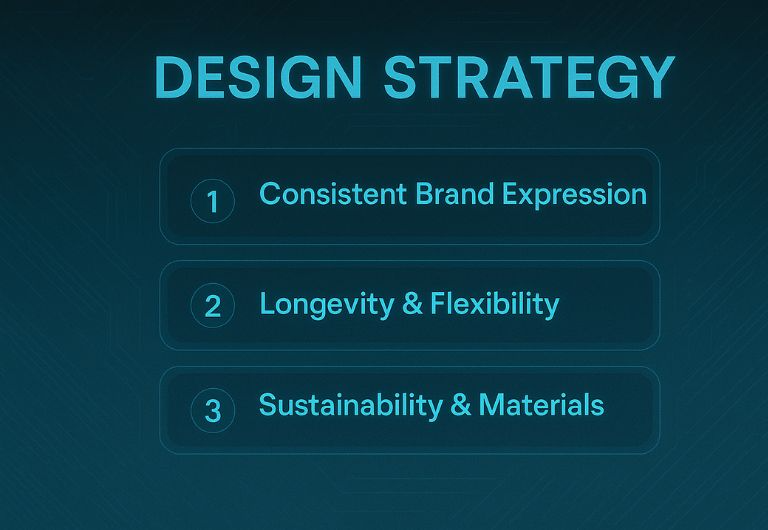
Design Strategy & Best Practices
Consistent Brand Expression
Consistency builds trust. If your signage uses colors and fonts that differ from your website or brochures, users feel a subconscious disconnect. That’s why your brand guidelines should be front and center during signage planning—ensuring every visual touchpoint is cohesive and intentional.
In branded environments, this includes:
- Color palettes matching online presence
- Typography aligned with digital assets
- Iconography and visual language that’s uniform across platforms
This isn’t just aesthetic. It’s a strategy. A space that feels off-brand feels off-message. It also impacts how employees internalize the brand and how visitors perceive legitimacy. Aligning physical space with digital and print elements makes your brand more memorable, professional, and emotionally resonant. Over time, consistent environmental signage becomes part of the brand’s identity toolkit, just like a logo or tagline.
Longevity & Flexibility
Designers often face the concern: “What if the office layout changes in 2 years?” Good signage design anticipates that. It’s not about permanence—it’s about planned adaptability. Future-proofing signage is a practical way to ensure ongoing relevance without incurring unnecessary costs.
Use:
- Magnetic panels for interchangeable content
- Modular sign systems that clip on/off
- Digital elements that update remotely
These flexible systems allow businesses to adapt to relocations, departmental shifts, or rebranding efforts without discarding or reprinting everything. They also empower brands to respond to seasonal campaigns, new hires, or structural updates with minimal downtime. Longevity in signage isn’t just about the physical materials—it’s also about strategic foresight.
Sustainability & Materials
The best signage isn’t just beautiful—it’s responsible. Sustainable signage uses recycled metals, bamboo, low-VOC paints, and LED lighting to reduce environmental impact. Ethical sourcing and energy-efficient technology have become major considerations for brand-conscious organizations.
Sustainability also means durability. Weather-resistant coatings, UV protection, and tamper-proof fasteners extend the life of outdoor signs. Materials should be evaluated not just for their look and cost, but for their lifecycle, recyclability, and environmental footprint.
Incorporating these details addresses client concerns about waste, ethics, and long-term ROI. More than ever, customers and stakeholders want to know that the brands they engage with care about the planet. Responsible signage becomes a subtle but powerful declaration of corporate values, woven directly into the built environment.
Practical Examples & Competitor Case Learnings
Real-World Cases
Brands like Google, Lululemon, and Saint Elizabeth have built immersive branded environments using a mix of wayfinding, murals, and interactive touchpoints. These spaces aren’t just functional—they’re Instagrammable, memorable, and on-message.
One standout example: A healthcare provider created a color-coded floor plan for its hospital wings, pairing it with wall graphics of calming imagery, reducing stress and increasing patient satisfaction scores.
Takeaways from Industry Guides & Agencies
Organizations like SEGD (Society for Experiential Graphic Design) and university design systems (like Johns Hopkins) emphasize:
- Purposeful placement
- Material sustainability
- Emotional resonance
Their guides aren’t fluff—they’re blueprints. And more importantly, they show what works (and what doesn’t) across industries.
Integrating Strategy: A Framework for Brands
Let’s wrap strategy into action. Here’s a framework to help any brand build their environmental signage system—one that’s not only effective and aesthetic but also scalable and sustainable across environments and evolving needs.
- Audit the environment – What’s currently working? Where are the pain points? Walk through the space as a first-time visitor might. Is the flow intuitive? Are signs visible, legible, and positioned logically? This phase should include talking to staff and users, identifying high-confusion zones, and documenting all existing signage with photographs and annotations.
- Define goals – Are you solving for wayfinding clarity, brand elevation, improved visitor flow, or all of the above? Clear objectives anchor design decisions. For example, if your priority is brand immersion, focus on bold visuals and storytelling. If wayfinding is key, clarity, simplicity, and universal icons become vital.
- Choose signage types – Digital or analog? Permanent plaques or modular inserts? This is where practicality meets creativity. Digital signage may suit dynamic lobbies with changing schedules, while classic etched signs work better for consistency in professional settings. Consider user demographics, update frequency, and technical support capabilities.
- Select materials – Choose with longevity and the planet in mind. Recycled aluminum, FSC-certified wood, low-VOC paints, and durable finishes all contribute to lower maintenance and higher ethical value. Think also about lighting—will LED strips or backlit panels improve visibility and mood?
- Integrate brand – Apply approved fonts, colors, icons, and visual motifs across all elements. The goal is brand consistency without visual clutter. Use hierarchy to distinguish primary from secondary information, and maintain contrast standards for accessibility. Every piece of signage should feel like a seamless extension of your brand.
- Test & iterate – Don’t install and walk away. Observe users interacting with your signs. Are people still asking for directions? Are certain elements being ignored? Use feedback to refine placements, language, and formats. Even slight adjustments in alignment or lighting can significantly improve clarity.
Conclusion
Environmental signage is more than functional—it’s transformative. It merges strategy, storytelling, and space into one branded experience. Whether you’re enhancing wayfinding, elevating aesthetics, or embedding values into architecture, smart signage design pays dividends. It aligns form and function in ways that traditional advertising simply cannot.
Through visual branding & design, signage becomes a multi-sensory experience that anchors memory, guides behavior, and deepens emotional connection. From the moment someone walks into your space, every sign becomes a silent ambassador of your brand values. The material textures, the lighting choices, the typography, and even the negative space between letters—all of it tells a story.
Environmental graphics also serve as navigational tools and culture cues, empowering both visitors and employees to understand and internalize a brand’s environment and ethos. The right combination of iconography and design principles can turn a sterile hallway into a curated experience that evokes trust, energy, or calm.
From materials to message, modularity to murals, it’s about making your brand felt in every corner. Don’t just hang a sign—create a moment. Let that moment reflect your brand’s promise and personality, expressed through strategic and purposeful visual branding & design.
FAQ
1. What are examples of branded environments that effectively use environmental signage?
Branded environments like Google’s headquarters or Lululemon stores are designed with immersive environmental graphics, combining murals, typography, and digital signage to reinforce identity. These aren’t just spaces—they’re brand experiences. Signage in these settings does more than direct; it inspires, connects, and communicates a clear message. By aligning physical space with visual storytelling, they elevate brand engagement to new levels.
2. How can I develop a brand environmental signage strategy for corporate offices?
Start with an audit: What spaces need identification, direction, or engagement? Define brand visuals. Then select materials, test placements, and gather feedback. Use modular signage systems to future-proof the investment. Combine consistent design elements with adaptable technologies for longevity and brand integrity.
3. What role does brand environmental signage play in customer perception?
Signage sets the tone before a word is spoken. It influences how customers feel about your professionalism, accessibility, and attention to detail. A well-executed brand environmental signage system signals credibility and care, often making the difference between a forgettable space and one that inspires loyalty. It visually conveys a company’s culture and intention.
4. How does environmental signage improve employee experience in workspaces?
Employees thrive in spaces that feel purposeful and branded. Environmental signage aids navigation, reinforces values, and even boosts morale through thoughtful visual branding & design. Custom murals, branded quotes, and clear directional signs create a sense of identity and pride. When staff understand and see the brand, they become more connected to its mission.
5. Can small businesses benefit from environmental signage just like large corporations?
Absolutely. Small businesses can use brand environmental signage to build authenticity and local trust. Strategic use of color, typography, and custom signage in small spaces—like cafes or boutique offices—can turn any location into a brand destination. With budget-friendly modular systems and digital tools, even modest setups can deliver major brand impact