
Driving Brand Success through Internal Activation Programs
Introduction
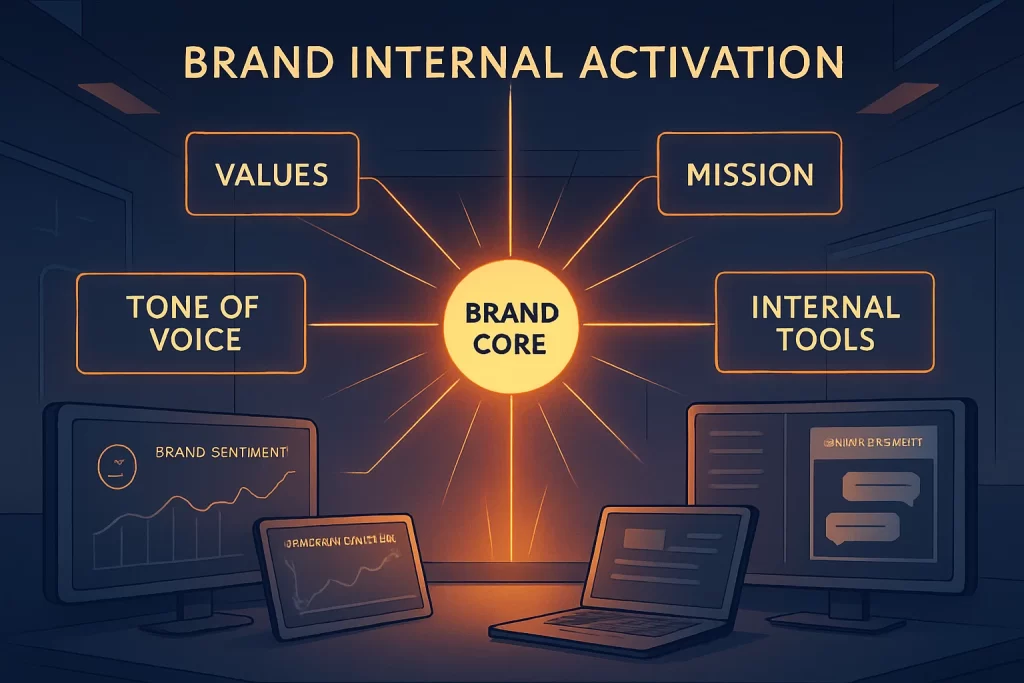
Brand internal activation has emerged as a vital strategic function for organizations aiming to embed their brand purpose, values, and mission into the behaviors and mindsets of employees. Unlike external branding—where logos, taglines, and campaigns dominate—internal activation is an employee-first strategy that transforms static brand assets into a living, breathing culture. This process empowers teams to act, speak, and make decisions in ways that are deeply aligned with the brand promise, bridging the gap between brand strategy and execution.
Scientific and business literature alike emphasize the organizational value of brand internalization. A study by Harvard Business Review found that companies with high internal brand alignment see a 20% increase in customer loyalty and 23% improvement in brand awareness, driven primarily by employees acting as brand advocates. In the B2B space, employee brand alignment has been linked to higher client retention rates, more consistent service experiences, and stronger sales cycles.
The most successful brand internal activation programs work not as standalone events, but as structured frameworks. These frameworks span leadership modeling, culture integration, strategic communications, immersive training, and employee advocacy. Together, these form a brand operating system that governs how internal stakeholders live out the brand daily—an internal infrastructure that aligns behavior to brand strategy.
Yet, despite the growing body of research and real-world case studies, many companies still struggle to activate their brand internally. Why? Because most initiatives are fragmented, overly abstract, or disconnected from business goals. Internal brand workshops are treated as one-off events. Values live on posters rather than in meeting rooms. Leaders talk about vision, but fail to model it.
“When brand becomes real inside, it’s seen as credible outside.” – Motto Agency
From Reddit threads and branding forums, the confusion is palpable. One user on r/marketing writes:
“My company rolled out a rebrand and nobody knows what it means internally. They gave us new mugs and t-shirts, but no one feels anything’s changed.”
This signals a critical pain point: internal branding is often reduced to swag and slogans, not embedded behaviors or mindsets. The result? Cynicism, disengagement, and brand dilution.
That’s where this article comes in.
We’ll unpack a repeatable, strategy-first model for internal activation—one rooted in measurable systems, human behavior, and brand psychology. We’ll explore why brand internal activation is the missing link between external success and internal culture, and how companies can operationalize it through leadership, storytelling, communication, and recognition.
You’ll learn:
- What internal activation really means (and doesn’t mean)
- A five-pillar framework for executing it at scale
- How to avoid the most common pitfalls and fluff
- Ways to measure and sustain activation over time
Semantic focus will center around key themes like internal branding process, brand values training, internal brand communications, employee brand engagement, and brand purpose alignment. By the end of this article, you’ll be equipped to not just launch an internal brand campaign—but to embed a culture that truly lives the brand.
What Is Brand Internal Activation?
Brand internal activation is the deliberate process of aligning every employee—across functions, levels, and geographies—with the organization’s brand purpose, values, and voice. It’s not just a communication strategy. It’s a behavioral transformation that makes the brand tangible in the actions, decisions, language, and rituals of the people who work there.
To understand its importance, we need to contrast it with external brand activation. External activation focuses on how the brand is presented to the public—through campaigns, messaging, visual identity, and customer experience. But internal activation determines how authentically that brand promise is lived out behind the scenes.
“Your brand is not what you say it is. It’s what your employees do when no one is looking.”
– Simon Manchipp, SomeOne Agency
Brand Activation Begins Inside
True brand differentiation begins inside the organization. No matter how stunning your website is or how catchy your advertising, if the internal teams aren’t aligned, the external message will fall apart. This misalignment often shows up in poor customer service, inconsistent tone across channels, and leadership contradictions.
Brand internal activation solves this by creating a common language and behavioral standard. It’s not about posters in hallways that say “Integrity” or “Innovation.” It’s about ensuring your engineering team, customer success, finance, and HR all interpret and embody those values in the same way.
For example:
- If “Boldness” is a brand value, does your product team feel empowered to take creative risks?
- If “Customer-first” is your ethos, do internal processes make it easy for employees to act in the customer’s interest—even when it’s not the most efficient?This is internal activation: making sure that brand values guide action, not just aspiration.
Internal Activation ≠ Internal Marketing
A common misconception is equating internal brand activation with internal marketing or HR-led engagement initiatives. While there’s overlap, internal activation is broader. It’s a cross-functional strategy owned by leadership, not just HR or marketing. It informs everything from hiring and onboarding to performance reviews, meeting structure, decision-making protocols, and recognition systems.
“Internal brand activation is not about cheerleading. It’s about operationalizing the brand.” – We Are Motto
In fact, one of the biggest user pain points—surfaced frequently in marketing communities—is the vagueness of internal brand efforts. Teams often roll their eyes at “brand values” because they’re never given tools or context to live them out. That’s why structured activation programs must be specific, contextual, and actionable.
“We had this whole rebrand project and I still don’t know what to do differently. No one explained how our jobs were supposed to change.”
Internal Activation Is Ongoing, Not One-Off
Activation is not a one-day launch event or brand refresh workshop. It’s a long-term transformation. The most successful companies treat it like an operating system—one that’s embedded in daily decisions, team rituals, leadership modeling, internal communications, and even physical/digital environments.
This process includes:
- Internal storytelling : Narratives about how real employees exemplify brand values.
- Behavioral training : Teaching managers how to give feedback using brand-aligned language.
- Cross-functional collaboration : Breaking silos to ensure a consistent internal voice.
When internal activation is done well, employees don’t just “know” the brand—they live it. They become aligned in their work, inspired by the brand’s purpose, and clear on how their role contributes to a larger mission. That’s what turns ordinary teams into brand ambassadors.
Why It Matters: Benefits of Internal Activation
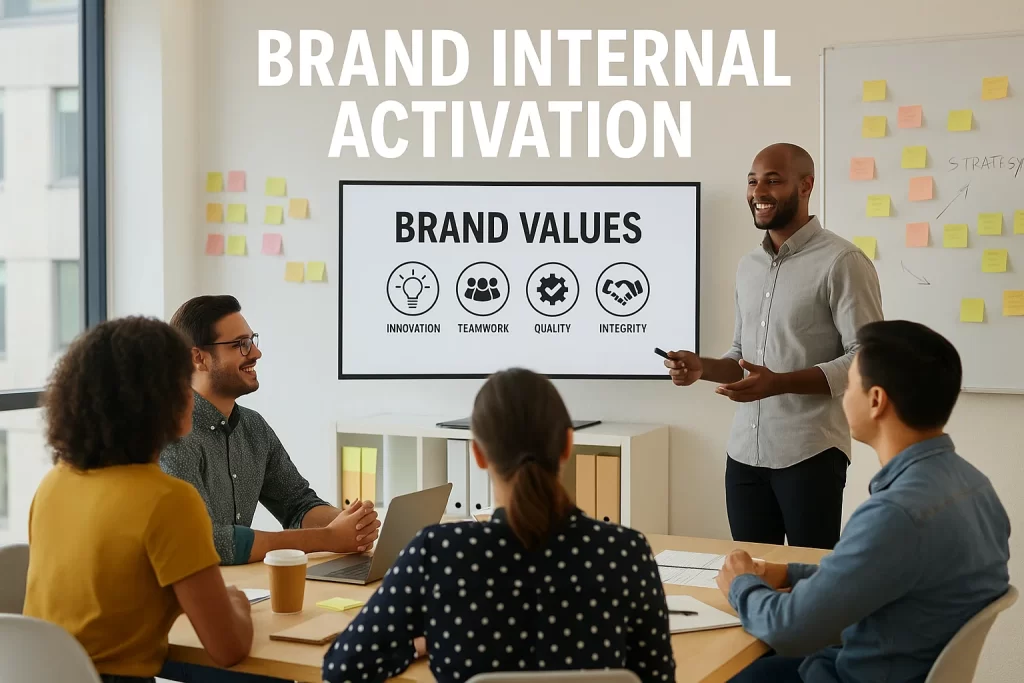
In today’s hyper-transparent world, brand perception is no longer controlled solely by marketing. Employees have become the new frontline of brand experience, shaping it with every customer interaction, internal email, LinkedIn post, and strategic decision. This is why brand internal activation is no longer a “nice-to-have” initiative—it’s a core growth strategy with direct impact on reputation, retention, and revenue.
Employees Are Your Most Trusted Brand Messengers
According to Edelman’s Trust Barometer, employees are trusted more than CEOs, journalists, and government officials when it comes to communicating information about a company. In a world where authenticity trumps polish, your employees’ behavior, language, and tone set the tone for how the brand is experienced—internally and externally.
That trust, however, only translates to brand equity if your team is aligned and activated. Research by Gallup found that only 27% of employees strongly believe in their company’s values. This gap represents not just a cultural problem—but a branding crisis.
“You can’t activate your brand externally until it’s activated internally. You’re only as strong as your alignment.”
– Marty Neumeier, author of The Brand Gap
Quantifiable Business Outcomes
Brand internal activation isn’t just philosophical—it’s measurable. Organizations that prioritize internal activation see statistically significant gains across multiple business metrics:
- 23% increase in brand awareness
- 20% boost in customer loyalty
- 25% uplift in productivity
- 15% improvement in employee retention
- 18% higher revenue per employee (source: HBR, Gallup, Forbes)
These results aren’t driven by flashy slogans or onboarding videos. They’re driven by a systemic approach to aligning employee behavior with brand promise.
Preventing Brand Disconnection
One of the most common pain points voiced on platforms like Quora and Reddit is the feeling of disconnection between a company’s stated brand and its internal reality. One Redditor shared:
“Our company talks about being ‘bold and innovative,’ but every new idea dies in middle management. Feels like the brand values are just PR.”
That disconnect leads to brand dilution, internal cynicism, and even employee attrition. When teams don’t understand how their role connects to the brand, engagement plummets. Customers notice the inconsistency. And competitors gain ground.
Internal brand activation solves this by:
- Clarifying expectations
- Reinforcing behaviors
- Enabling storytelling
- Creating emotional buy-in
It’s not enough for people to know the values. They need to feel ownership of them.
Building Cultural Consistency at Scale
As organizations grow, especially across geographies, maintaining cultural consistency becomes a challenge. Internal activation frameworks offer a scalable way to ensure alignment without enforcing rigidity.
This includes:
- Branded rituals that adapt locally
- Shared onboarding experiences
- Brand-aligned communication playbooks
- Internal channels where value-aligned stories are shared
As seen in companies like Airbnb and Atlassian, when internal brand behaviors are codified and reinforced, they naturally shape external perception—creating a magnetic, consistent brand experience.
Core Pillars of a Framework-Driven Internal Activation Strategy
Internal brand activation succeeds not through isolated events, but through interconnected systems. These systems operate like a brand OS (operating system)—embedded into the daily functions of leadership, communication, culture, and employee development.
Below are the five core pillars of a scalable, sustainable brand activation framework.
1. Leadership Alignment & Modeling
“If leaders don’t live the brand, no one else will.” This simple truth is the foundation of any internal brand strategy.
Leadership alignment means more than endorsing the brand—it’s about embodying the values consistently in language, decisions, and behavior. A study from Gallup shows that 85% of employees are more likely to be engaged when senior leadership regularly communicates the brand’s purpose.
Key activation strategies
- Brand immersion sessions for executives to explore their personal connection to brand purpose
- Leadership storytelling training to help model the brand narrative in speeches, town halls, and one-on-ones
- Decision-making frameworks aligned with core values (e.g., “What would boldness look like here?”)
A weak link at the top creates skepticism at the bottom. Authentic activation starts with modeling from the C-suite down to middle managers.
“You can’t outsource culture. It starts in the boardroom.” – Brandingmag
2. Culture & Experience Integration
Internal brand activation lives or dies by employee experience. This includes the systems, environments, and rituals employees engage with daily.
If values like “Innovation” or “Empathy” are promoted but unsupported by internal processes (e.g., innovation ideas are dismissed, empathy is punished in favor of urgency), your activation will backfire.
Embed the brand into
- Hiring : Align job descriptions and interview questions with brand behaviors
- Onboarding : Use storytelling and immersive sessions to anchor values early
- Daily rituals : Begin meetings with brand shout-outs or “value in action” stories
- Performance systems: Evaluate not just what people do—but how they do it
As internal brand consultant Denise Lee Yohn writes:
“Great brands don’t just communicate their values—they operationalize them.”
3. Internal Communication & Messaging
Inconsistent communication is one of the fastest ways to erode internal trust and confuse brand expectations. That’s why companies with strong internal activation develop clear messaging frameworks—tailored for employees.
This involves:
- A unified brand voice guide for internal use
- Branded messaging templates for town halls, newsletters, intranet posts
- Encouragement of bottom-up storytelling—employee-generated stories that illustrate values in action
- Use of communication channels (Slack, internal blogs, screensavers, office signage) to reinforce brand language
Example: Atlassian runs an internal campaign where employees share “Brand in Action” stories weekly—micro-experiences that reflect values like “Open company, no bullshit.”
When communication is multi-directional and branded, culture becomes stronger, not just louder.
4. Learning, Training & Brand Immersion
Many companies fail at internal activation because they overcommunicate values but undertrain behavior. Training is the bridge between knowing and doing.
A high-functioning internal brand system includes:
- Brand storytelling workshops to teach teams how to tell value-aligned stories
- Manager training on how to coach, give feedback, and evaluate through a brand lens
- Simulated case studies : Real-world dilemmas where employees choose actions aligned with core values
- Immersive onboarding journeys : Not just welcome emails, but cultural immersion through video, live sessions, and peer stories
“Employees who undergo immersive brand training are 47% more likely to act as brand advocates.”
– Gallup Workplace Study
This pillar solves a major user fear: “Our brand values are too abstract—what do they look like in action?”
5. Employee Advocacy & Recognition
True internal activation culminates in employee-led advocacy. When employees genuinely believe in the brand and are equipped with the language, stories, and permission to share, they amplify the brand more powerfully than any external ad campaign.
Systems for activation
- Employee ambassador programs with storytelling support, social sharing assets, and peer coaching
- Internal awards for behaviors aligned with brand values
- Feedback loops that reward not just output but how outcomes were achieved
Example: Salesforce’s “Ohana Culture” includes recognition platforms that reward team members for embodying their shared values. Their employee Net Promoter Score (eNPS) is among the highest in tech.
“My team actually gets excited to ‘win the week’ by sharing brand moments in our Slack channel. Feels like we finally have language to describe the good stuff.”
This peer-to-peer validation reinforces culture and helps make abstract values visible and shareable.
Brand Activation Framework in Action: Step‑by‑Step Rollout Plan
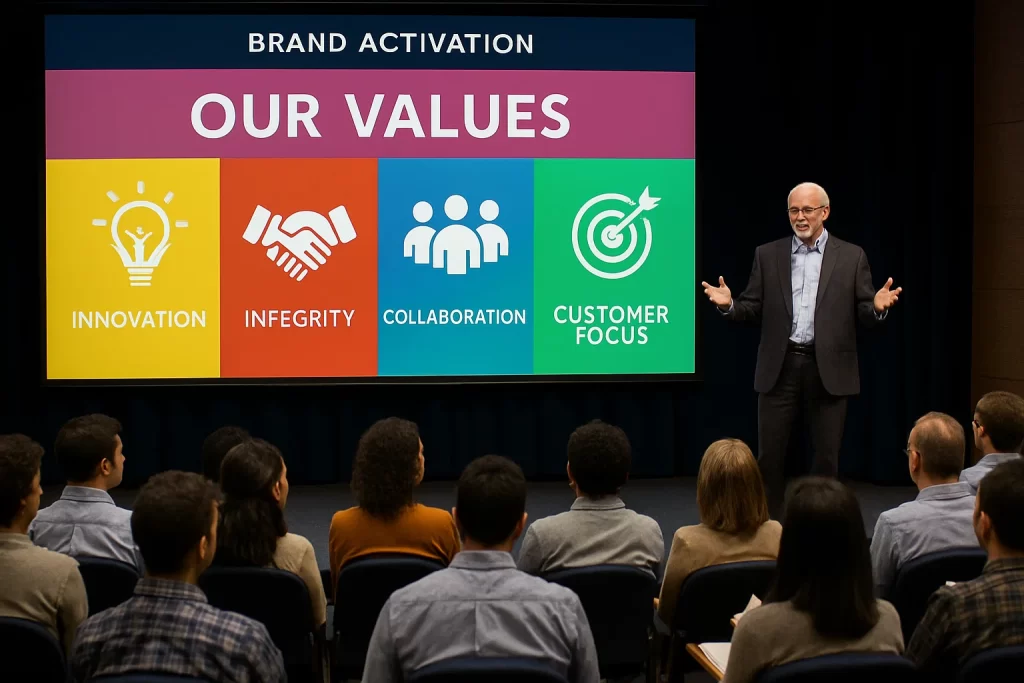
Successful internal activation requires more than intent—it demands a clear, sequenced, and feedback-driven framework that aligns all stakeholders. Here’s a proven 6-step rollout plan that integrates strategy, psychology, and operational excellence.
Step 1: Define Your Core Identity
Activation starts with clarity. Before you can activate anything internally, you must define the non-negotiable core of your brand:
- Purpose – Why does the brand exist?
- Mission – What does the brand aim to achieve?
- Vision – Where is the brand going?
- Values – How does the brand behave?
But definition isn’t just about words—it’s about agreement. According to research from Lucidpress, 64% of employees feel their company’s messaging is inconsistent. Internal confusion leads to disconnection.
Tactical move: Run brand alignment workshops with senior leaders, department heads, and key influencers to stress-test core identity through real scenarios.
“If your purpose can’t survive a budget meeting or product crisis, it’s not a purpose—it’s a slogan.”
– Emily Heyward, Red Antler
Step 2: Listen Deeply to Employees
Activation cannot be done to employees; it must be done with them.
Internal brand alignment fails when leadership imposes a vision disconnected from ground realities. To fix this, build in structured employee feedback loops:
- Focus groups across functions
- Anonymous surveys on brand clarity and relevance
- Ethnographic research: observe how values show up (or don’t) in daily work
- 1:1 conversations with high-trust team members
Real-world insight: A mid-sized SaaS company discovered during listening sessions that “customer-first” was seen as lip service because backend teams never interacted with customers or saw feedback loops.
You can’t activate what you don’t understand.
Step 3: Co-Create the Internal Brand Narrative
Use what you heard to craft a brand narrative that feels emotionally relevant and operationally realistic. This isn’t just about logos or phrases—it’s about:
- Crafting an internal “why” story
- Mapping values to behaviors
- Co-authoring rituals, slogans, and mantras that feel owned
- Building bridges between external campaigns and internal culture
“Culture is not created by leadership alone—it’s co-authored by the people who live it daily.”
– WeAreMotto.com
Give employees a stake in the story. When they help write it, they’re more likely to live it.
Step 4: Launch with Intention
Resist the urge to “go big” without structure. A rebrand party is great—but it’s sustained activation that matters.
Design your launch sequence to create curiosity, clarity, and connection:
- Teaser campaigns: hint at values through posters, slack emojis, digital wallpapers
- Leadership alignment video: execs explaining the “why” behind brand moves
- Kickoff workshops: multi-functional sessions where teams engage with new values through challenges, role-play, and reflection
- Brand playbooks: printed or digital guides with language, visuals, tone, rituals, and behavioral prompts
Important: ensure leaders show up consistently across these moments—not just once.
Step 5: Embed the Brand into Daily Experience
This is where most activation programs fail—post-launch energy fades because there’s no system to embed behaviors.
Embed brand into:
- Meetings – open with values in action
- Slack/Teams – dedicated “brand moments” channel
- Performance reviews – 10% of scoring tied to values-aligned behavior
- Rituals – like “Fridays for the Brand” where teams reflect on wins through brand lens
- Visuals – refresh internal dashboards, signage, intranet to reflect brand codes
Case study: A logistics company integrated value prompts into project retros—asking, “Which value did we live today?” This simple change increased clarity and internal advocacy.
Step 6: Measure, Adjust, and Sustain
Internal brand activation is not a campaign—it’s a capability.
You must track:
- Employee engagement scores
- Brand values comprehension (via quizzes or nudges)
- Advocacy rates (e.g., employee-generated content or eNPS)
- Retention and culture-fit hires
- Operational KPIs like decision turnaround speed or customer satisfaction, mapped against brand behaviors
Use these metrics not to judge but to evolve. Create quarterly brand council check-ins. Update rituals. Highlight success stories. Make activation a living system.
“The best cultures iterate—not just scale.” – Brandingmag

Visual Asset Ideas
Visuals aren’t just decorative—they’re activation tools. When thoughtfully deployed, they help anchor abstract brand values into tangible experiences, foster recognition, and embed the brand into the daily digital and physical environment. Great internal brand activation relies on a visual language system that is consistent, story-driven, and contextually placed.
Here are several categories of visual assets to reinforce internal brand messaging and drive engagement.
1. Brand Activation Flowchart
What it shows: A linear or cyclical diagram visualizing the activation journey—from leadership alignment to employee advocacy.
Use case: Kickoff presentations, onboarding decks, internal playbooks.
Design tips:
- Use the company’s brand palette and iconography
- Include key action words: “Listen,” “Co-create,” “Train,” “Celebrate”
- Reinforce touchpoints like workshops, feedback loops, and rituals
Impact: Provides employees with a mental model for how brand lives in their daily workflow.
2. Employee Journey Map
What it shows: A timeline of the employee’s experience at the company, overlayed with brand activation touchpoints—starting with hiring and ending with advocacy or exit.
Use case: HR onboarding, internal brand strategy workshops.
Sections might include:
- Recruitment message
- Onboarding immersion
- First brand-aligned milestone
- Manager feedback loop
- Recognition moments
- Offboarding rituals
Impact: Makes clear where activation is lived or lost along the employee lifecycle.
3. Pillar Icons or Value Glyphs
What it shows: Unique symbols, illustrations, or icons that represent each of the brand values or core pillars (e.g., “Empowerment,” “Curiosity,” “Integrity”).
Use case: Branded merchandise, slide decks, mural walls, email signatures.
Design idea: If “Boldness” is a value, use a lightning bolt. If “Curiosity,” an open eye or question mark with flair.
Impact: Helps teams remember and emotionally connect to abstract values.
“Visual cues are memory anchors. When we see a symbol daily, it starts to shape our thinking.”
– Branding psychologist Maria Kiefer
4. Brand-Behavior Matrix Table
What it shows: A matrix mapping each core brand value to specific employee behaviors and rituals across departments.
| Value | Behavior | Ritual/Trigger | Channel |
| Empathy | Listen before responding | “Pulse Check” at team huddles | Slack reaction or survey |
| Boldness | Share a risky idea | Monthly “Moonshot Pitch” | Innovation channel |
Use case: Internal training, team alignment workshops, brand handbooks.
Impact: Translates vague values into actionable, observable behaviors.
5. Real Employee Portraits with Brand Stories
What it shows: Photographs of employees with personal stories of how they’ve embodied the brand. These are not stock photos—they are candid, human, and contextual.
Use case: Intranet homepage banners, digital signage, screen savers.
Copy example:
“Mia in CX went above and beyond to solve a client’s issue—living our value of ‘Obsess over experience.’”
Impact: Builds emotional resonance and peer modeling of what the brand looks like in real life.
6. Immersive Environment Visuals
What it shows: Environmental branding in the physical or digital workspace—values printed on meeting room glass, floor-to-ceiling quote walls, intranet hero banners that rotate weekly brand stories.
Use case: Office interiors, remote culture hubs, Slack channels.
Impact: Creates a saturated, immersive experience where the brand is constantly seen, felt, and reinforced.
FAQ
1. What are some effective internal brand activation ideas?
Internal brand activation doesn’t need to be flashy—it needs to be strategic and behavioral. Here are a few ideas that consistently deliver impact:
- “Brand Story of the Week” shared company-wide to highlight employees living values
- Branded internal Slack channels (e.g.,
#boldmoves,#valuewins) where staff share moments tied to values - Immersive onboarding experiences with storytelling sessions from leadership
- Employee Brand Champion program to amplify voices from across the org
- Gamified feedback systems where peers reward brand-aligned behaviors with digital badges or shout-outs
- Micro-videos from different departments showing “How We Live the Brand Here”
As one Redditor posted on r/marketing:
“We started a Monday ritual where one team shares a 2-minute story of ‘brand lived in action’—weirdly more effective than our entire rebrand campaign.”
2. How do you activate a brand internally across departments and teams?
Cross-functional alignment is one of the biggest challenges. Activation must be tailored and co-created, not imposed uniformly.
Strategies include:
- Department-specific value translations: Sales might interpret “Integrity” differently than Product—both valid, both must be codified.
- Role-based playbooks that show how each job contributes to the brand
- Cross-functional workshops where Marketing, Ops, and HR design shared rituals
- “Brand Moment Libraries” that showcase how different teams live out values differently—but authentically
The key is flexibility within consistency. The brand should feel coherent, not cloned.
3. What metrics show brand internal activation is working?
Measuring activation is critical to sustaining it. Metrics fall into four major categories:
- Behavioral: Are employees exhibiting values-aligned actions? (e.g., 360° reviews, peer shout-outs)
- Engagement: Employee NPS, pulse survey scores, internal campaign participation
- Advocacy: LinkedIn posts, Glassdoor reviews, internal storytelling volume
- Business outcomes : Retention, cultural fit of new hires, customer experience alignment
Example: After formalizing brand-aligned behavior KPIs, a fintech company saw a 22% increase in customer satisfaction and 18% drop in internal friction scores.
4. How do I ensure the internal brand resonates with employees?
If your brand feels like a marketing echo chamber, no one will live it.
Instead:
- Listen first: Run internal research, town halls, shadowing
- Co-create language and rituals—even mantras or taglines
- Test activation materials with a Brand Pilot Group
- Make values show up in how people are recognized, promoted, and held accountable
“Our leadership asked us to memorize the mission statement. I’d rather they helped us connect it to our actual work.”
Resonance comes from relatability, not memorability.
5. Can you give examples of internal brand rollouts that worked?
Yes—here are a few standout examples:
- Salesforce’s “Ohana Culture”: Every team member is immersed in a culture that connects personal and professional values. Their internal language reinforces belonging.
- Airbnb’s “Belong Anywhere” activation: Employees went through a global listening campaign, created internal rituals like “Host Stories,” and integrated values into product decision-making.
- Atlassian’s “Open Company, No Bullshit”: They operationalized transparency through internal town halls, decision documentation, and public performance data.
Common thread? Each company embedded brand into the operating system, not just the onboarding slideshow.
Conclusion
Brand internal activation is no longer optional in a world where trust is distributed, transparency is expected, and culture is king. It is the linchpin that binds external promises to internal behaviors. When done well, it turns brand strategy into brand experience—at every level of the organization.
What we’ve explored is more than just a communications exercise. It’s a multi-pillar framework that empowers leaders, aligns teams, and embeds values into the very rhythm of work. From leadership modeling and culture rituals to immersive training and employee advocacy, activation isn’t a one-time event—it’s a capability. A system. A mindset.
Organizations that embrace this approach will find that their teams are not only more aligned but also more engaged, productive, and brand-loyal. When employees live the brand, customers believe in it. When internal systems echo external messages, authenticity follows.
Remember:
- Leadership must go first
- Employees must co-create
- Stories must be told often
- Values must show up in behavior
- Activation must be measured and evolved
Because at the end of the day, the most powerful brand strategy is the one your people actually believe in—and live.