
Digital Marketing Strategy & Planning: From Goals to Execution
Introduction
In digital marketing, failure rarely comes from poor execution. It comes from poor planning. Organizations invest heavily in channels, tools, and campaigns, yet struggle to generate consistent growth because strategy and execution are treated as separate disciplines. The result is fragmented activity—SEO without intent alignment, paid media without lifecycle logic, content without conversion purpose.
Digital marketing strategy & planning is the discipline that closes this gap. It transforms ambition into action by connecting business goals, customer behavior, channel economics, and execution capability into a single operating system. For Dubai-based businesses navigating intense competition, rising acquisition costs, and increasingly sophisticated consumers, this discipline is no longer optional—it is a prerequisite for sustainable growth.
As Peter Drucker observed, “Plans are only good intentions unless they immediately degenerate into hard work.” In digital marketing, that hard work begins with planning that is both strategic and executable.
This article explores how organizations can move from goals to execution through a rigorous digital marketing strategy and planning process—one that prioritizes outcomes over activity and builds a repeatable system for growth.
Why Digital Marketing Strategy & Planning Determines Growth Outcomes
The proliferation of digital channels has not simplified marketing; it has made it more complex. Businesses today operate across search, social, paid media, content, marketplaces, email, and automation platforms—each with its own metrics, algorithms, and costs. Without a unifying strategy, these channels compete for budget rather than compound value.
A well-structured digital marketing strategy framework solves this by establishing clarity at three levels: intent, investment, and impact.
First, it clarifies who the marketing is for and why. Strategy forces organizations to define priority customer segments, decision triggers, and moments that matter. Second, it governs where resources should be allocated by aligning budget with channel effectiveness across the funnel. Third, it ensures execution is measurable, tying every activity to business outcomes rather than vanity metrics.
According to McKinsey, companies that align marketing strategy with business objectives are 1.5 times more likely to outperform peers in revenue growth. The implication is clear: performance is not driven by tactics alone, but by disciplined planning that guides execution.
From Business Goals to Marketing Objectives: The Strategic Starting Point
Every effective digital marketing planning process begins outside marketing. It starts with the business.
Growth targets, revenue mix, market expansion plans, and customer lifetime value expectations define the strategic constraints within which marketing must operate. Without this alignment, marketing teams often optimize for engagement while leadership expects revenue impact.
The most effective organizations translate business goals into explicit marketing objectives. For example, a company seeking regional expansion in the GCC may prioritize awareness and trust-building, while a mature Dubai-based enterprise may focus on improving conversion rates and retention. These distinctions matter because they determine channel strategy, messaging depth, and measurement models.
This is where many digital marketing strategies fail: they skip the translation layer between business intent and marketing execution. Strategic planning fills this gap by articulating how marketing will contribute—not just what marketing will do.
Understanding the Customer Journey as a Strategic Asset
Digital marketing strategy & planning must be grounded in how customers actually behave, not how organizations wish they behaved. This requires customer journey mapping that goes beyond funnel diagrams and into decision psychology.
Modern journeys are non-linear. Customers discover brands through content, validate through search and reviews, engage through social proof, and convert across multiple touchpoints. Strategy must therefore account for intent progression, not just channel presence.
High-performing organizations analyze where customers hesitate, where trust is formed, and where momentum is lost. Often, the most significant growth opportunities lie not in acquisition, but in reducing friction—unclear messaging, delayed follow-ups, or misaligned landing experiences.
In Dubai’s highly competitive digital landscape, where consumers are digitally sophisticated and choice-rich, these moments disproportionately influence outcomes. Strategic planning ensures execution focuses on the moments that matter most.
Designing the Digital Marketing Strategy Framework
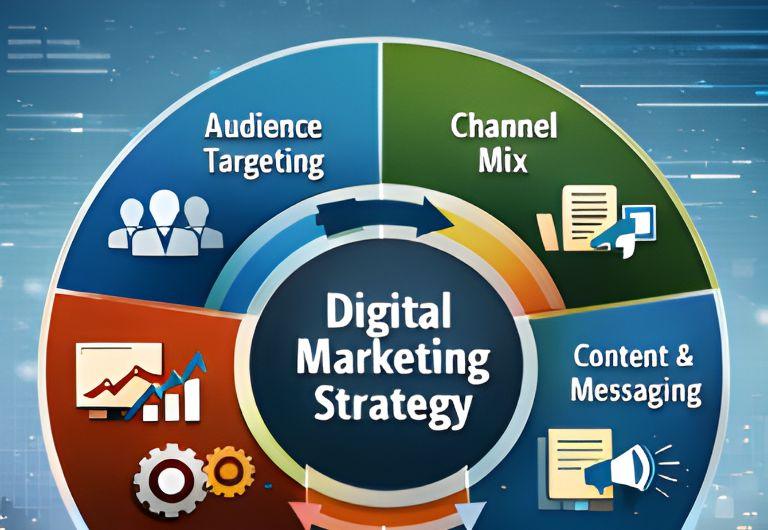
A robust digital marketing strategy framework connects insight to action. While execution tactics vary by industry, effective frameworks share common principles.
At the core is segmentation and intent modeling. Not all audiences require the same message or channel mix. Strategy defines priority segments, their pain points, and the signals that indicate readiness to engage.
Surrounding this is the channel mix strategy. SEO, PPC, social media, content, and email are not independent levers; they are interconnected systems. Strategy determines how each channel supports awareness, consideration, conversion, and retention—ensuring integration rather than duplication.
Finally, the framework establishes measurement discipline. Marketing KPIs are selected based on strategic objectives, not convenience. Leading indicators such as engagement quality and pipeline velocity are balanced with lagging indicators like revenue and lifetime value.
This integrated approach distinguishes strategic planning from campaign planning. The former builds systems; the latter executes activities.
Digital Marketing Planning in the Dubai Market Context
Dubai presents a unique strategic environment. High digital penetration, multicultural audiences, and premium brand expectations require planning that is both data-driven and culturally aware.
Dubai-based organizations often operate across multiple languages, platforms, and customer segments simultaneously. This complexity amplifies the need for structured digital marketing planning. Without it, execution becomes reactive—driven by trends rather than strategy.
Moreover, acquisition costs in competitive sectors such as real estate, healthcare, education, and professional services continue to rise. Strategic planning helps organizations reduce wasted marketing spend by focusing investment on high-impact channels and audiences.
In this context, digital marketing strategy is not about experimentation for its own sake. It is about disciplined learning—testing within strategic guardrails and scaling what works.
From Strategy to Execution: Bridging the Most Critical Gap
The most common failure point in digital marketing is not strategy or execution individually, but the handoff between the two. Strategies remain theoretical; execution becomes tactical.
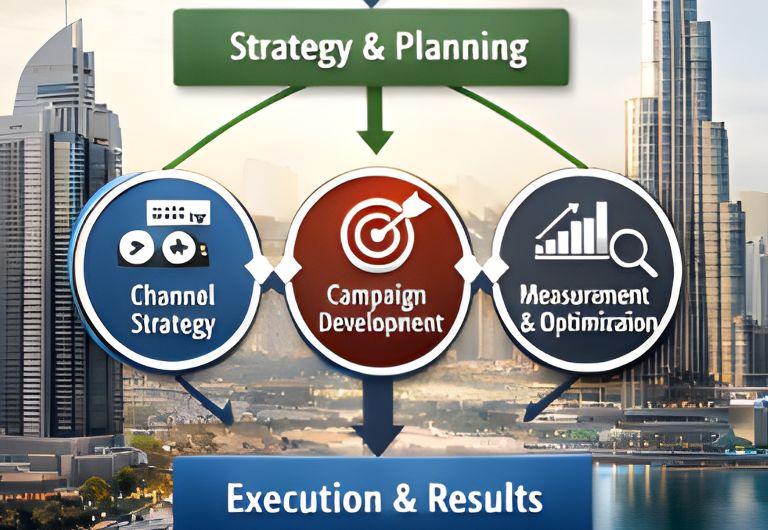
Effective digital marketing planning addresses this by translating strategy into clear executional roadmaps. These roadmaps define priorities, sequencing, responsibilities, and performance benchmarks. They ensure teams understand not only what to do, but why it matters.
This is particularly important in performance marketing strategy, where optimization without context can undermine long-term goals. For example, chasing short-term conversions through aggressive paid media may erode brand trust or inflate costs over time.
Execution guided by strategy balances immediacy with sustainability—aligning daily decisions with long-term outcomes.
From Goals to Execution: Turning Strategic Intent into Measurable Impact
Why Most Digital Marketing Strategies Break Down
The gap between ambition and results in digital marketing is rarely caused by a lack of ideas. More often, it emerges from a failure to translate goals into executable decisions. Organizations set growth targets—revenue increases, market expansion, lead generation—but struggle to make those targets meaningful at the level where daily marketing decisions are made.
Strategy lives in boardrooms and slide decks. Execution lives in channels, platforms, and workflows. When the two are disconnected, even well-funded marketing efforts become fragmented. Teams move quickly, but not always in the same direction.
Digital marketing strategy & planning exists to close this gap. It connects business intent with how marketing behaves in practice—across channels, campaigns, and customer touchpoints—so execution reflects strategy rather than improvisation.
Turning Ambition into Constraints That Guide Action
Effective execution begins with a subtle but critical shift in thinking: goals must be treated as constraints, not aspirations.
A revenue growth target is not simply a number to be achieved; it defines acceptable acquisition costs, required conversion efficiency, and retention expectations. Without making these implications explicit, execution teams optimize in isolation. Media teams chase lower-cost traffic, content teams focus on engagement, and CRM teams automate journeys—each successful in their own metrics, yet misaligned with overall business outcomes.
Strategic planning forces clarity. It translates ambition into boundaries that guide trade-offs, ensuring that execution choices reinforce one another rather than compete for attention or budget.
When Strategy Shapes Execution Priorities
Not all growth objectives demand the same execution logic. Profitable growth, for example, requires fundamentally different decisions than volume-driven expansion. Channel selection, bidding models, content depth, and funnel architecture must all align with the type of growth the business is pursuing.
This is where digital marketing strategic planning proves its value. It ensures that execution is intentional rather than reactive. Teams are not simply responding to short-term performance signals; they are operating within a shared understanding of what success actually looks like.
When strategy is clear, execution accelerates—not because teams work harder, but because fewer decisions need to be debated or reversed.
The Importance of Sequencing, Not Just Speed
Execution discipline is not only about what to do, but when to do it. Many organizations attempt to scale before foundational elements are in place—driving traffic before fixing conversion friction, increasing spend before establishing credibility, or automating journeys before data quality is reliable.
Strategic planning introduces sequencing. It determines what must be built before scale: trust before performance, experience before traffic, infrastructure before automation. This sequencing is what separates scalable execution from short-lived wins that collapse under their own weight.
In fast-moving markets like Dubai, where speed is often celebrated, this discipline becomes even more critical. Moving quickly in the wrong order magnifies inefficiency just as easily as it magnifies results.
Executing With Purpose, Not Just Optimization
A common execution failure occurs when organizations optimize without a strategic baseline. Teams iterate on creatives, landing pages, and campaigns without a clear hypothesis tied to business outcomes. Activity increases, but learning remains shallow.
Strategy-led execution defines success in advance. It establishes what should improve, why it should improve, and how that improvement will be measured. This allows teams to test with intent rather than experiment blindly.
Optimization becomes a tool for learning, not a substitute for direction.
Measurement as a Strategic Discipline
Goals that cannot be measured meaningfully cannot be executed effectively. Strategic planning establishes a hierarchy of metrics—leading indicators that signal progress, and lagging indicators that confirm impact.
This structure protects execution from being driven by vanity metrics. Engagement, impressions, and clicks are evaluated in context, not in isolation. Teams remain focused on outcomes that matter to the business, not just signals that look good in dashboards.
Measurement, in this sense, is not about control; it is about alignment.
Coordinated Autonomy: How High-Performing Teams Execute
In high-performing organizations, execution is neither centralized rigidity nor decentralized chaos. It is coordinated autonomy.
Teams are empowered to optimize, but within clearly defined strategic guardrails. They understand which levers matter most, which trade-offs are acceptable, and which metrics define success. This shared clarity reduces friction, speeds decision-making, and allows learning to compound across channels.
Execution becomes a system, not a series of disconnected efforts.
From Linear Plans to Continuous Learning
The journey from goals to execution is not linear. Strategy informs execution, execution generates data, and data refines strategy. Organizations that institutionalize this loop move beyond campaign-based marketing toward repeatable growth systems.
As Michael Porter observed, “The essence of strategy is choosing what not to do.” Execution excellence depends on those choices being visible, understood, and consistently applied across every marketing action.
When goals are translated into execution with discipline and clarity, digital marketing stops being a collection of activities—and becomes a system that reliably converts intent into impact.
Performance Marketing Strategy Within a Strategic Framework
Performance marketing is often misunderstood as purely tactical. In reality, its effectiveness depends on strategic context.
A mature performance marketing strategy operates within clearly defined objectives, audience segments, and attribution models. It recognizes that not all conversions are equal and that channel performance must be evaluated holistically.
Strategic planning determines how performance marketing supports broader goals such as market penetration, customer lifetime value, or cross-sell. It also governs budget allocation and experimentation cadence—ensuring learning compounds over time.
According to Google research, organizations that adopt data-driven marketing decisions are 23 times more likely to acquire customers. The key is not data availability, but strategic interpretation.
Measurement, Attribution, and ROI Discipline
Measurement is where strategy is either validated or exposed.
Too many organizations rely on surface-level metrics—clicks, impressions, or isolated conversions. Strategic digital marketing planning emphasizes attribution modeling and ROI measurement that reflect real business impact.
This includes understanding how upper-funnel activities influence downstream conversions, how channels interact, and where diminishing returns occur. Advanced teams use multi-touch attribution and cohort analysis to inform investment decisions.
In Dubai’s competitive environment, this discipline separates high-performing marketing organizations from those that merely stay busy.
Case Insight: From Fragmented Activity to Integrated Growth
Consider a Dubai-based B2B services firm struggling with inconsistent lead quality despite significant marketing spend. SEO, paid search, and social campaigns operated independently, each optimized for channel-specific metrics.
Through strategic digital marketing planning, the firm redefined its objectives around pipeline quality rather than lead volume. Customer journey analysis revealed that trust-building content played a critical role before conversion.
The resulting strategy integrated content marketing with performance channels, aligned messaging across touchpoints, and introduced CRM-driven attribution. Within twelve months, cost per qualified lead decreased by 35%, while conversion rates improved significantly.
The lesson is not tactical—it is strategic. Growth followed alignment.
Building a Repeatable Digital Marketing System
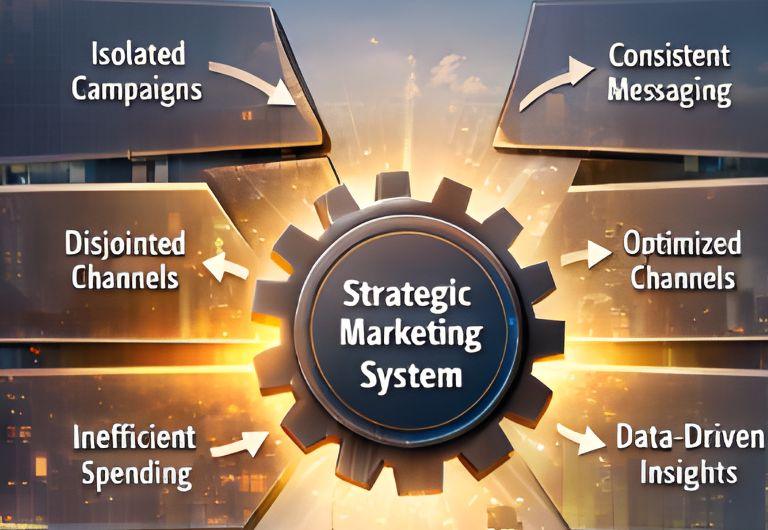
Sustainable growth requires repeatability. Digital marketing strategy & planning is not a one-time exercise; it is an operating model.
Leading organizations revisit strategy regularly, using performance data to refine assumptions and adjust execution. They invest in marketing automation and CRM integration to ensure insights flow across teams. They treat planning as a living process rather than a static document.
As Michael Porter famously stated, “Strategy is about making choices, trade-offs; it’s about deliberately choosing to be different.” In digital marketing, those choices are operationalized through planning that guides execution at scale.
Conclusion: From Intent to Impact
Digital marketing success is not driven by activity, tools, or trends. It is driven by clarity of intent, alignment across teams, and disciplined execution over time. In an environment where platforms evolve quickly and customer expectations rise even faster, organizations that rely on isolated tactics inevitably struggle to sustain performance.
For Dubai-based organizations operating in complex and highly competitive markets, digital marketing strategy & planning provides the structure required to move from ambition to impact. It replaces fragmented efforts with integrated systems, aligns channel execution with business priorities, and brings rigor to decision-making. Rather than reacting to short-term signals, organizations gain the ability to allocate resources with confidence, reduce inefficiency, and compound results over time.
Most importantly, strategic planning transforms marketing from a collection of campaigns into a repeatable growth engine. When strategy consistently guides execution, every action—across content, media, technology, and experience—serves a defined purpose. Measurement becomes meaningful, learning accelerates, and performance becomes predictable rather than episodic.
In this model, marketing is no longer viewed as a cost to be managed, but as a strategic capability to be developed. It becomes an engine for sustainable growth, capable of adapting to market shifts while remaining anchored to long-term business value.
FAQ
1. What is a digital marketing strategy?
A digital marketing strategy is a structured plan that outlines how a business will use online and digital channels to achieve specific marketing and business goals. It defines target audiences, value propositions, channels, budgets, timelines, and performance metrics to guide consistent and measurable execution.
2. Why is planning important in digital marketing?
Planning ensures that digital marketing efforts are goal-driven rather than reactive. A well-defined plan helps allocate resources efficiently, maintain consistent messaging, reduce wasted spend, and adapt quickly based on performance data and market changes.
3. What are the key components of a digital marketing plan?
A strong digital marketing plan typically includes:
- Clear business and marketing objectives
- Target audience personas
- Channel selection and role definition
- Content and campaign strategy
- Budget allocation and timelines
- KPIs, tracking, and optimization framework
These components ensure alignment between strategy and execution.
4. How do digital marketing strategies align with business goals?
Digital marketing strategies translate business goals—such as growth, profitability, or market expansion—into actionable digital initiatives. For example, a revenue growth goal may align with lead generation, conversion optimization, or retention-focused campaigns.
5. How often should digital marketing strategies be reviewed and updated?
Digital marketing strategies should be reviewed regularly—typically quarterly or biannually—and adjusted based on performance data, customer behavior, competitive trends, and platform updates. Continuous optimization keeps strategies relevant and effective.