
Digital Marketing Funnels & Journeys for Lead Generation & Sales
Introduction: Why Funnels Alone No Longer Drive Growth
In mature digital economies such as Dubai, growth failure is rarely caused by lack of traffic or advertising spend. Most organizations already operate multiple paid channels, produce high-quality content, and generate consistent leads. Yet conversion efficiency stagnates, sales cycles lengthen, and customer acquisition costs rise year over year.
The underlying issue is structural. Digital marketing funnels are often optimized in isolation, while customer journeys unfold independently of internal assumptions. Funnels are treated as execution tools. Journeys are treated as UX artifacts. Revenue emerges only when these two are engineered as a single system.
This article explores how digital marketing funnels & journeys should be designed together to drive sustainable lead generation and sales, using modern marketing funnel models, TOFU / MOFU / BOFU frameworks, lead nurturing journeys, and lifecycle marketing concepts—applied strategically, not tactically.
Understanding Digital Marketing Funnels & Customer Journeys
Funnels as Internal Control Systems
A digital marketing funnel is an internal construct. It reflects how an organization intends to guide prospects through marketing funnel stages toward conversion. Funnels prioritize structure, predictability, and measurement. They are indispensable for forecasting, performance marketing, and sales alignment.
However, funnels assume progression. Customers do not.
Customer Journeys as External Decision Reality
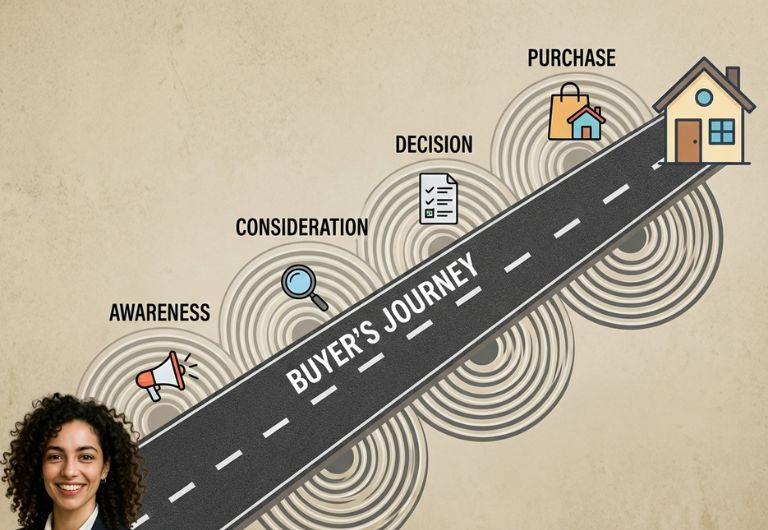
A digital customer journey reflects how real people make decisions—across devices, channels, timeframes, and emotional states. Journeys are nonlinear, interruption-prone, and heavily influenced by trust, risk, and third-party validation.
The difference between marketing funnel and customer journey is therefore not semantic. It is strategic. Funnels describe intent from the business perspective. Journeys describe behavior from the buyer’s perspective.
Why Alignment Determines Revenue Efficiency
When funnels ignore journeys, organizations experience leakage—leads that exist in CRMs but never convert. When journeys ignore funnel logic, marketing becomes unfocused and difficult to scale. Alignment turns both into a revenue system.
Marketing Funnel Models in the Modern Buying Environment
From Linear Funnels to Adaptive Architectures
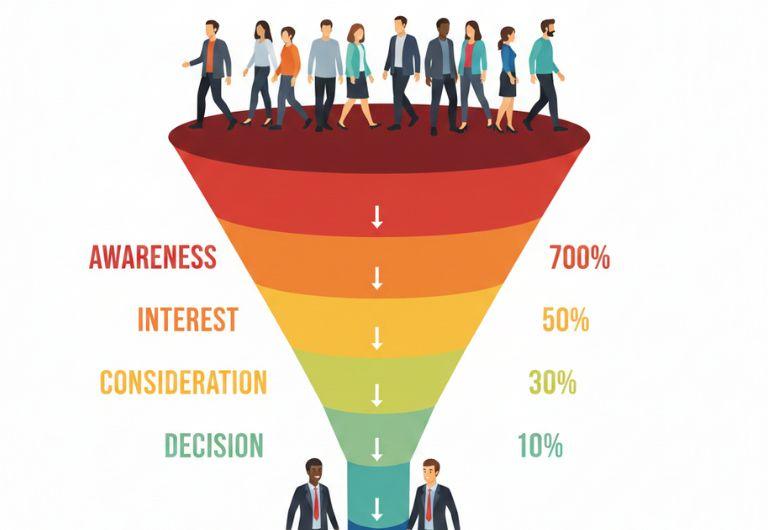
Classic marketing funnel models were built for a simpler buying environment—one in which attention was scarce, channels were limited, and customer behavior was relatively predictable. These models assumed that buyers progressed sequentially from awareness to consideration and finally to purchase, guided primarily by exposure and repetition.
That assumption no longer holds.
Modern buyers operate in information-dense ecosystems. They encounter brands across multiple channels, compare alternatives asynchronously, consult peer reviews, and pause decisions until perceived risk is resolved. As a result, movement through the funnel is rarely linear. Prospects may enter at different stages, regress to earlier points for validation, or remain in prolonged states of consideration while internal or emotional barriers are addressed.
High-performing organizations respond to this reality by abandoning rigid funnel mechanics in favor of adaptive architectures. In these systems, funnels are designed to respond dynamically to behavioral signals—content consumption patterns, engagement depth, intent indicators, and contextual triggers—rather than forcing prospects through predefined steps. The funnel becomes less about control and more about alignment, adjusting its pace and messaging based on how the buyer is actually progressing.
This adaptive approach is particularly critical in high-consideration markets, where decisions are shaped as much by confidence and timing as by product features. Funnels that adapt to buyer readiness consistently outperform those optimized purely for speed.
Funnels as Decision-Support Systems
The role of the funnel has fundamentally changed. It is no longer a mechanism for acceleration; it is a decision-support system.
In traditional models, funnel optimization focused on removing friction to push prospects forward as quickly as possible. Today, that mindset often backfires. Buyers who feel rushed respond by disengaging, delaying, or seeking reassurance elsewhere. Conversion stalls not because of insufficient persuasion, but because of unresolved uncertainty.
Effective funnels now prioritize uncertainty reduction over urgency creation. Each stage is designed to answer a specific class of buyer questions—credibility, relevance, differentiation, risk, and return. Content, messaging, and experience are sequenced to support cognitive and emotional resolution, not just action.
This reframing is foundational to effective full-funnel digital marketing. When funnels function as decision-support systems, they work in harmony with customer journeys rather than against them. Prospects move forward because they feel informed and confident, not pressured.
The commercial impact is significant. Funnels built to support decisions produce higher-quality leads, shorter sales cycles, and stronger post-conversion retention—because the choice was made with clarity, not coercion.
TOFU / MOFU / BOFU Frameworks Reimagined
TOFU: Creating Contextual Awareness, Not Noise
Top-of-funnel activity is frequently misinterpreted as a scale problem—reach more people, publish more content, increase frequency. In reality, TOFU effectiveness is a relevance problem, not a volume problem. Modern buyers are not short on information; they are short on attention that feels worthwhile.
TOFU succeeds only when it aligns with a problem the buyer already senses, even if they have not yet articulated it clearly. Contextual awareness means entering the buyer’s mental frame at the moment friction appears—when inefficiency, risk, or missed opportunity becomes noticeable. Content that merely announces a brand’s existence generates impressions, but content that mirrors an unspoken challenge generates recognition.
This is why awareness without relevance produces activity, not intent. High-performing TOFU strategies focus on insight-led messaging, category education, and problem reframing rather than product visibility. In competitive markets, TOFU is less about being seen and more about being recognized as relevant.
MOFU: Where Lead Nurturing Journeys Create Value
Middle-of-funnel activity is where most revenue is either enabled or quietly lost. At this stage, buyers are no longer asking what is available—they are asking what is credible, appropriate, and safe to choose. This is why lead nurturing journeys play a decisive role in commercial outcomes.
MOFU is not a persuasion phase. Buyers are actively comparing alternatives, validating claims, and seeking reassurance that they will not regret their decision. Content that anticipates hesitation—around implementation, differentiation, cost justification, or internal alignment—outperforms content that simply promotes features or benefits.
Effective MOFU strategy recognizes that uncertainty is natural, not resistance. The goal is not to overcome objections, but to remove the need for them. When nurturing journeys deliver the right proof at the right moment, readiness increases organically. When they do not, buyers stall—not because of lack of interest, but because confidence has not yet formed.
BOFU: Risk Reduction, Not Closing Pressure
Bottom-of-funnel activity is often mischaracterized as the “closing stage.” In reality, it is the final risk-resolution stage. By the time buyers reach BOFU, intent already exists. What remains is the reconciliation of price, risk, timing, and justification.
Effective BOFU strategy does not rely on urgency tactics or aggressive calls to action. Instead, it answers one critical question: Why this solution, for my situation, right now? This requires specificity, not pressure. Buyers want to see themselves reflected in the solution—through tailored use cases, relevant case studies, transparent pricing logic, and clear next steps.
When BOFU focuses on risk reduction rather than acceleration, conversions increase while post-sale friction decreases. Buyers who convert with clarity require less reassurance after purchase and demonstrate higher long-term value. In this sense, BOFU is not the end of the journey—it is the point at which confidence becomes commitment.
Full-Funnel Digital Marketing as a Growth System
Why Channel-Based Thinking Fails
Many organizations continue to manage paid media, content, email, CRM, and sales as separate operational units, each optimized for its own metrics and short-term outcomes. While this structure simplifies internal reporting, it creates fragmentation from the customer’s perspective.
Buyers do not experience channels independently. They experience a single, continuous interaction with the brand, moving fluidly between ads, websites, content, emails, and sales conversations. When these touchpoints are disconnected—repeating messages, contradicting value propositions, or resetting context—confidence erodes. Momentum is lost not because of poor execution within channels, but because of poor coordination across them.
Channel-based thinking also encourages local optimization at the expense of global performance. A paid campaign may generate low-cost leads that overwhelm sales. An email sequence may optimize open rates while ignoring readiness. Content may perform well in isolation but fail to move buyers forward in the journey. Full-funnel digital marketing addresses this failure by shifting the focus from channels to transitions—ensuring that each interaction meaningfully prepares the buyer for the next decision.
When continuity replaces channel silos, conversion efficiency improves without increasing spend. The funnel stops feeling like a series of handoffs and begins to operate as a unified experience.
Integrating Funnels with Lifecycle Marketing Concepts
Sustainable growth does not come from optimizing isolated funnel stages. It comes from designing end-to-end lifecycles in which acquisition, conversion, retention, and loyalty reinforce one another.
Without lifecycle marketing concepts, funnels reset after every sale. Customers are treated as finished transactions rather than evolving relationships. This forces organizations to repeatedly reacquire demand they could have retained, driving up acquisition costs and flattening lifetime value.
Integrating lifecycle thinking transforms the funnel into a compounding system. Early-stage messaging sets expectations for long-term value. Post-conversion experiences reinforce the original promise. Retention efforts generate advocacy, referrals, and repeat purchases that strengthen upstream performance.
In this model, customers become growth multipliers rather than endpoints. Each stage of the lifecycle informs the next, creating a feedback loop in which marketing efficiency increases over time rather than deteriorates. This integration is what separates brands that scale sustainably from those that rely on constant reinvestment to maintain momentum.
Micro-Conversions vs Macro-Conversions
Measuring Momentum vs Measuring Commitment
One of the most persistent measurement errors in digital marketing is treating all conversions as equal. The distinction between micro-conversions vs macro-conversions is not a reporting nuance—it is a strategic lens for understanding funnel health.
Micro-conversions signal momentum. They indicate that a buyer is progressing cognitively and emotionally through the decision process—consuming content, engaging with tools, returning to key pages, or interacting with educational assets. These actions do not represent commitment, but they do represent increasing readiness.
Macro-conversions, by contrast, signal commitment. They represent a decision point—purchase, contract, subscription, or qualified opportunity creation. When organizations collapse these two into a single conversion metric, they lose visibility into how decisions are forming. The funnel may appear healthy on the surface while silently failing to build sufficient readiness upstream.
By separating momentum from commitment, leaders gain a clearer picture of where friction actually exists and which stages require intervention.
How Micro-Conversions Power Lead Generation Funnels
In advanced lead generation funnels, micro-conversions function as predictive signals, not vanity metrics. They inform how the funnel should respond to each prospect in real time—adjusting message depth, content sequencing, and engagement intensity based on demonstrated intent.
Rather than treating all leads uniformly, high-performing organizations use micro-conversion patterns to determine when to nurture, how to personalize, and when to involve sales. A prospect who repeatedly engages with comparison content and pricing pages requires a different response than one who passively downloads a single asset.
This intelligence improves efficiency without increasing spend. Nurturing resources are concentrated where readiness is forming, sales outreach occurs at the moment of highest confidence, and low-intent leads are allowed to mature naturally. The result is higher-quality pipeline, shorter sales cycles, and improved conversion rates—not through pressure, but through timing.
When micro-conversions are aligned with customer journey stages, the funnel stops reacting and starts anticipating. That shift is what transforms lead generation from volume production into revenue architecture.
Lead Nurturing Journeys as the Core Revenue Engine
Why Most Leads Are Not Sales-Ready
A common misconception in digital marketing is that lead generation failure stems from lead quality. In reality, the issue is often lead timing. In both B2B and high-consideration B2C markets, the majority of leads enter the funnel with interest but without readiness. They are exploring, learning, and calibrating—not committing.
This is not resistance; it is rational behavior. Buyers face uncertainty around fit, risk, cost, and internal alignment. In B2B environments, additional layers of approval, budget cycles, and competing priorities further delay decision-making. In B2C categories involving higher spend or perceived risk, buyers require reassurance and validation before moving forward.
Lead nurturing journeys exist to bridge this gap. They provide continuity during the decision window, ensuring that interest does not decay while readiness forms. Without structured nurturing, leads either go cold or are pushed prematurely to sales, creating friction on both sides. The result is lower conversion rates, longer sales cycles, and misaligned expectations between marketing and sales teams.
Recognizing that most leads are not sales-ready shifts strategy from pressure to preparation—and dramatically improves funnel efficiency.
Sequencing Information to Match Buyer Psychology
Effective nurturing is not about volume or frequency; it is about sequencing. Buyers do not absorb information randomly. They seek different types of reassurance at different psychological moments in the journey.
Early-stage prospects require clarity—what the problem is, why it matters, and whether it applies to them. Mid-stage prospects seek validation—proof, comparisons, and evidence of credibility. Late-stage prospects require risk reduction—pricing transparency, implementation clarity, and outcome certainty.
Delivering the wrong information at the wrong time creates cognitive friction. Providing pricing too early may intimidate. Offering high-level education too late may frustrate. This is why customer journey mapping for lead generation is essential: it aligns content, messaging, and experience with the buyer’s evolving mindset.
When information sequencing mirrors buyer psychology, nurturing feels helpful rather than intrusive. Readiness increases naturally, trust compounds, and conversion becomes a logical conclusion rather than a forced outcome.
B2B vs B2C Funnel & Journey Design
Digital Funnels for B2B Lead Generation
B2B buying decisions are rarely individual or immediate. They are collective, deliberate, and risk-sensitive. Digital funnels for B2B lead generation must therefore support group decision-making, extended timelines, and heightened scrutiny—conditions that fundamentally change how funnels should be designed.
In B2B environments, authority outweighs speed. Buyers are less concerned with rapid action and more focused on validation—of expertise, credibility, and long-term impact. Content must enable internal justification, equipping champions with the materials they need to persuade stakeholders who may never interact directly with marketing channels. This is why educational depth, industry-specific insights, and evidence-based messaging outperform promotional tactics.
B2B funnels also require patience. Prospects may remain in the middle of the funnel for weeks or months, revisiting content as priorities shift and internal alignment forms. Funnels that attempt to accelerate this process prematurely often create resistance rather than momentum. Effective B2B funnel strategy respects decision latency, using structured nurturing and contextual follow-ups to maintain relevance without pressure.
Ultimately, B2B funnels succeed when they function as decision enablement systems—helping organizations say “yes” with confidence, not urgency.
Digital Funnels for B2C Sales Growth
B2C buying behavior operates under a different set of psychological rules. While consideration still exists, decisions are more individual, emotionally driven, and time-compressed. Digital funnels for B2C sales growth therefore prioritize reassurance, clarity, and immediacy over depth.
In consumer contexts, trust signals matter more than technical detail. Social proof, reviews, guarantees, and transparent policies reduce perceived risk quickly. Simplicity is equally critical. Every additional step, form field, or moment of ambiguity introduces friction that can derail conversion.
Unlike B2B, where buyers expect to invest time in evaluation, B2C funnels must remove obstacles rapidly. This does not mean sacrificing credibility, but rather delivering it efficiently—surfacing reassurance at the exact moment doubt appears.
The most effective B2C funnels balance emotional confidence with operational ease. When trust is established and friction is minimized, conversion becomes a natural response rather than a considered commitment.
Retention & Loyalty Loops in Funnel Strategy
Why Conversion Is Not the End of the Funnel
Many organizations still design funnels as if conversion is the finish line. From a revenue perspective, this is a structural mistake. Funnels that stop at conversion ignore their most profitable phase—the period after the first sale, when trust is highest and future value is easiest to unlock.
Acquisition and conversion are cost centers. Retention is where profitability emerges. Without intentional post-conversion design, organizations are forced to repeatedly replace churned customers, driving acquisition costs upward and flattening growth. This is why retention & loyalty loops are not an add-on to the funnel; they are an extension of it.
When retention is engineered into the funnel, early-stage messaging sets accurate expectations, onboarding reinforces value quickly, and post-sale engagement maintains momentum. Each of these moments reduces churn risk and increases customer lifetime value. In this model, conversion becomes a midpoint rather than an endpoint—marking the transition from persuasion to value delivery.
Funnels that extend beyond conversion do not merely generate sales; they generate durable revenue.
Turning Customers into Growth Assets
The true commercial payoff of funnel maturity appears when customers stop being treated as transactions and start functioning as growth assets.
When retention strategies feed advocacy, referrals, and repeat purchases, the funnel becomes self-reinforcing. Satisfied customers lower acquisition costs by generating word-of-mouth demand, strengthening trust signals, and accelerating decision-making for new prospects. Every retained customer improves the performance of the funnel upstream.
This is the practical application of lifecycle thinking. Marketing does not end when a deal closes; it evolves. Messaging shifts from justification to enablement. Content moves from persuasion to expansion. Engagement becomes personalized based on usage, tenure, and value potential.
Organizations that achieve this shift experience compounding returns. Growth becomes less dependent on constant spend increases and more driven by accumulated trust. In competitive markets, this is the difference between brands that chase demand and brands that generate it.
Funnel Analytics, CRO, and Experience Optimization
Beyond Surface-Level Metrics
Most funnels appear healthy when viewed through traditional metrics—traffic volume, cost per lead, conversion rate, and return on ad spend. These indicators are useful, but incomplete. They describe what is happening, not why it is happening.
Advanced organizations move beyond surface-level metrics and instead track friction, velocity, and hesitation using sophisticated funnel analytics and tracking. Friction reveals where cognitive or operational barriers interrupt progress. Velocity measures how quickly prospects move between stages. Hesitation signals where confidence is forming—or failing to form—within the journey.
This shift changes how performance is diagnosed. A declining conversion rate may not indicate poor messaging, but unresolved risk. A long sales cycle may reflect missing validation rather than weak demand. By instrumenting funnels to capture behavioral signals—time between interactions, content sequencing patterns, repeat visits, and abandonment contexts—teams gain visibility into decision health, not just outcomes.
When analytics illuminate decision friction, optimization efforts become targeted rather than reactive. Spend increases are no longer the default response to underperformance; structural refinement is.
CRO as Decision Optimization
Traditional conversion rate optimization (CRO) has often focused on interface-level adjustments—button colors, headline variations, form length reductions. While these changes can produce incremental gains, they rarely address the underlying reasons buyers hesitate.
Modern CRO reframes optimization as decision optimization. The objective is not simply to increase clicks, but to increase confidence. Experience-led optimization prioritizes clarity of value, credibility of claims, and transparency of outcomes—elements that reduce uncertainty and support commitment.
This approach recognizes that buyers abandon funnels not because interfaces are imperfect, but because questions remain unanswered. Effective CRO therefore integrates journey insight, behavioral data, and qualitative feedback to identify where reassurance is missing. It aligns content, design, and messaging around trust-building rather than aesthetic preference.
Experience-led CRO consistently outperforms interface-led testing because it addresses root causes, not symptoms. It transforms the funnel from a conversion mechanism into a confidence-building system—one that converts not by persuasion, but by resolution.
The Role of a Digital Marketing Funnel Agency
From Execution Partner to Growth Architect
As digital channels have matured, the role of agencies has evolved. Tactical execution—running ads, producing content, managing campaigns—remains necessary, but it is no longer sufficient. In complex, high-competition markets, value is created not by activity, but by architecture.
A mature digital marketing funnel agency operates as a growth architect, not merely an execution partner. It integrates customer journey consulting, performance marketing, conversion rate optimization (CRO), and lifecycle strategy into a single, cohesive system. Rather than optimizing channels in isolation, it designs how demand is created, matured, converted, and retained across the entire customer lifecycle.
This architectural role requires a different mindset. The focus shifts from short-term metrics to long-term revenue mechanics—from campaign performance to decision dynamics. The agency becomes a strategic extension of leadership, helping organizations align marketing structure with business outcomes rather than tactical outputs.
Why Integration Outperforms Optimization
Isolated optimization delivers incremental gains. Integrated architecture delivers compounding returns. This distinction defines scalable growth.
When teams optimize channels independently, improvements often cancel each other out. A paid campaign may increase lead volume while sales capacity remains fixed. CRO may improve form fills while nurturing remains misaligned. Retention efforts may succeed without feeding insight back into acquisition strategy. Metrics improve locally, but revenue impact remains constrained.
Integrated systems behave differently. Funnel stages reinforce one another. Insights from retention inform acquisition. Journey analytics guide CRO. Performance marketing adapts to lifecycle signals. Instead of chasing efficiency at individual points, the organization improves flow across the entire system.
This is why integration consistently outperforms optimization. It transforms marketing from a collection of tactics into a growth engine—one that scales not by adding more activity, but by aligning structure with how customers actually decide and stay.
Conclusion: Designing for How People Decide
Digital marketing funnels & journeys are not competing frameworks; they are complementary perspectives on the same decision process. Funnels provide structure—the logic that allows organizations to scale, forecast, and allocate resources with discipline. Journeys provide truth—the reality of how buyers discover, evaluate, hesitate, and commit across time and touchpoints. When one exists without the other, growth becomes fragile: efficiency improves without effectiveness, or empathy increases without scale.
The organizations that outperform design for real decision behavior across acquisition, nurturing, conversion, retention, and loyalty. They understand that growth is not driven by pressure, urgency, or louder messaging, but by reducing uncertainty at every stage of the experience. Sustainable performance emerges from alignment—between strategy and behavior, structure and experience—where each interaction builds confidence and each decision feels inevitable rather than forced.
FAQ
1. What are digital marketing funnels and journeys?
Digital marketing funnels and journeys describe how customers move from initial awareness to conversion and beyond. Funnels focus on stages (such as awareness, consideration, and conversion), while journeys emphasize the full, non-linear experience customers have across multiple touchpoints and channels.
2. How does a digital marketing funnel work?
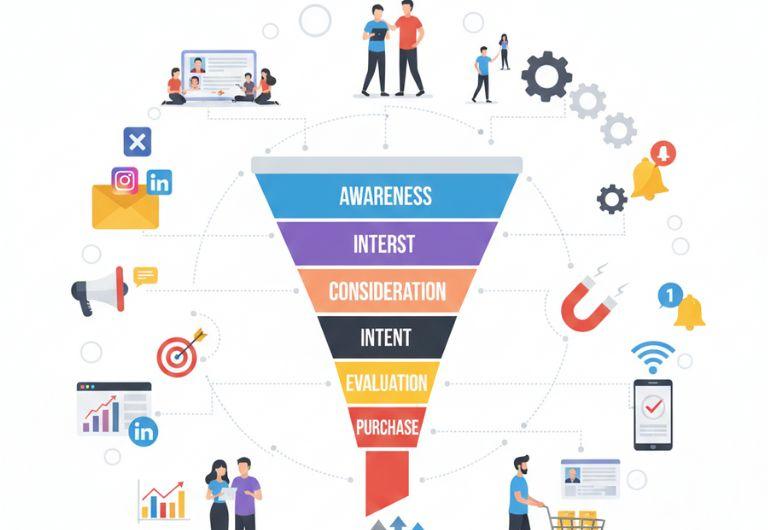
A digital marketing funnel guides prospects through defined stages—awareness, interest, consideration, conversion, and retention. Each stage uses targeted content, messaging, and channels to move users closer to taking action while reducing friction and uncertainty.
3. What is the difference between a funnel and a customer journey?
Funnels are structured and goal-oriented, showing how users progress toward conversion. Customer journeys are more holistic and dynamic, reflecting real user behavior across devices, platforms, and repeated interactions. Modern marketing combines both for better accuracy and personalization.
4. Why are funnels and journeys important for marketing performance?
They help businesses understand user intent at each stage, align content and channels effectively, and identify drop-off points. Well-designed funnels and journeys improve conversions, customer experience, and long-term retention.
5. How can businesses optimize digital marketing funnels and journeys?
Optimization involves analyzing data, improving messaging relevance, personalizing experiences, aligning channels, strengthening trust signals, and continuously testing touchpoints. Metrics like conversion rates, engagement, and retention guide ongoing improvements.