
Developing a Brand Partnership Ecosystem: Unlocking Collaborative Growth
Introduction: The Power Shift in Modern Partnerships
In a rapidly evolving business landscape, the role of strategic alliances has transitioned from siloed, campaign-focused engagements to holistic, enduring ecosystems. Brands are no longer merely seeking visibility through isolated collaborations—they’re engineering brand partnership ecosystems to secure scalable, compounding growth. These ecosystems operate not as temporary coalitions, but as integrated, multi-tiered networks of partners that continuously create, share, and multiply value across customer journeys.
According to McKinsey, companies with robust ecosystem strategies grow 27% faster and deliver 2.1x more value to stakeholders compared to those with linear go-to-market models .This reflects a paradigm shift from “how do we promote together?” to “how do we grow together?”
An effective Brand Strategy and Execution model forms the backbone of successful ecosystem development. Rather than relying on short-term campaigns, today’s top-performing brands align internal planning with ecosystem-based performance goals—ensuring every alliance supports broader brand positioning, customer journeys, and revenue streams.
This article offers a structured blueprint for building such an ecosystem—leveraging brand partnership strategy, co-branding frameworks, partnership marketing, and strategic brand alliances. It synthesizes emerging trends, deep case studies, and the latest strategic thinking to help marketing leaders transform partnerships from one-off wins into perpetual growth machines.
Why Traditional Partnerships Are Broken
For decades, brand partnerships have followed a predictable—and often disappointing—pattern. Two companies join forces, launch a co-branded campaign, issue a press release, and watch as the buzz fades within weeks. While such collaborations may generate momentary attention, they rarely translate into sustained business value or strategic advantage. The core issue? These partnerships are transactional, not transformational.
Traditional models of co-branding or affiliate partnerships typically lack shared long-term objectives, integrated infrastructure, or even mutual commitment. According to a Harvard Business Review analysis, most partnerships fail because they’re built on convenience, not alignment. The result is a disconnect in execution, value exchange, and outcome tracking—where one partner often gains more than the other.
“A partnership without a shared vision is just a joint press release.” — Harvard Business Review
Three Common Pitfalls of Outdated Partnerships
- Unequal Value Exchange
When one brand brings distribution and the other brings content—or one has scale and the other niche audience—imbalanced partnerships emerge. Over time, this leads to friction, churn, or withdrawal. - Siloed Execution
Without shared tech stacks or unified customer journeys, each brand operates in isolation. Emails, CRM funnels, and analytics systems don’t talk to each other—crippling ROI visibility. - Short-Term Thinking
Many campaigns are built around seasonal pushes or launch events. There’s no roadmap for collaboration beyond month one. Once the campaign ends, so does the partnership.
A user put it succinctly in a marketing thread:
“We did a brand collab once and ended up shouldering all the marketing effort while the other brand took credit and followers. Never again without clear terms.”
This kind of burnout is common. Brands pour resources into flashy, underperforming partnerships and come away skeptical of future collaborations. And without a clear brand synergy strategy or partnership framework, even well-intentioned alliances can fall apart.
Contrast that with ecosystem-led thinking: instead of viewing partnerships as individual “transactions,” companies build them as nodes in a strategic network, designed to share infrastructure, co-develop products, and amplify each other’s growth flywheels.
Solving Key Challenges
Fear of unequal value exchange and campaigns that flop.
Expert Quote
Harvard Business Review on failed partnerships
What Is a Brand Partnership Ecosystem?
A brand partnership ecosystem is more than just a series of joint ventures or marketing deals—it’s a structured network of strategic alliances designed to deliver recurring, mutually reinforcing value across customer touchpoints. In contrast to traditional partnerships, which are often ad hoc and short-lived, ecosystems are intentional, tiered, and strategically aligned.
At the core of a brand ecosystem is the idea of interdependence: every partner contributes unique value, while also benefiting from the ecosystem’s cumulative growth. Just like in natural ecosystems, these brand networks thrive when resources (such as customer data, product features, or brand equity) are shared, repurposed, and amplified.
Key Features of a Brand Partnership Ecosystem
- Tiered Structure with Defined Roles
Not all partners serve the same function. Effective ecosystems assign roles—such as anchor partners (core growth drivers), innovation scouts (experimental allies), or distribution enhancers (reach extenders)—ensuring focus and clarity. - Unified Customer Journey
Instead of separate experiences across partners, an ecosystem ensures the customer flows seamlessly across products, services, and channels—powered by shared CRM data and co-branded experiences. - Aligned Goals and Incentives
Ecosystem members co-define KPIs—such as shared customer acquisition, co-developed product lines, or joint loyalty programs—so all players win together, not in isolation. - Technology-Enabled Integration
From APIs to referral engines to content-sharing platforms, ecosystems are held together by tech. Brands can automate value exchanges, track partner performance, and scale seamlessly.
Ecosystem vs. Traditional Collaboration
| Aspect | Traditional Partnership | Ecosystem Approach |
| Duration | Short-term campaign | Ongoing collaboration |
| Roles & Tiers | Undefined or equal | Tiered with clear responsibilities |
| Customer Experience | Fragmented | Unified, cross-brand journey |
| Growth Model | Linear, project-based | Flywheel, compounding value |
| Data Sharing | Minimal | Transparent and integrated |
Take Nike and Apple, for example. Their alliance isn’t just a marketing stunt—it’s a fully integrated ecosystem. Apple provides wearable technology (Apple Watch), Nike adds fitness brand equity, and both co-create an experience through Nike Run Club, deepening customer retention for both brands.
Solving Key Challenges
Confusion around what an “ecosystem” actually entails vs. basic partnerships.
Expert Quote
Nike–Apple example as the benchmark for ecosystem integration.
Step-by-Step: Designing Your Brand Partnership Strategy
Crafting a brand partnership strategy isn’t about finding a big name to co-sponsor your next product launch. It’s about systematically designing an alliance blueprint that aligns with your brand goals, strengthens your market position, and builds towards a long-term ecosystem vision. Without this foundational strategy, even promising collaborations often collapse under misaligned goals or unclear execution.
Here’s how to architect a brand partnership strategy that sets the stage for exponential growth:
1. Clarify Your Strategic Goals
Before reaching out to partners, define what you’re trying to achieve. Do you want to:
- Acquire new customers through co-branded campaigns?
- Retain existing ones via integrated services?
- Launch new offerings that require complementary capabilities?
Each goal informs which types of partners to pursue and what kind of value to propose.
“Start with your North Star metric—what does success look like for both you and your partner?” — Brand Strategist, Octopus Marketing
2. Identify Value-Aligned Brands
Use tools like SparkToro, SEMrush, and G2 to discover brands with:
- Overlapping audiences
- Complementary products or services
- Similar brand tone and equity
A beauty brand, for instance, might partner with a sustainable packaging company to align with eco-conscious consumers and expand reach.
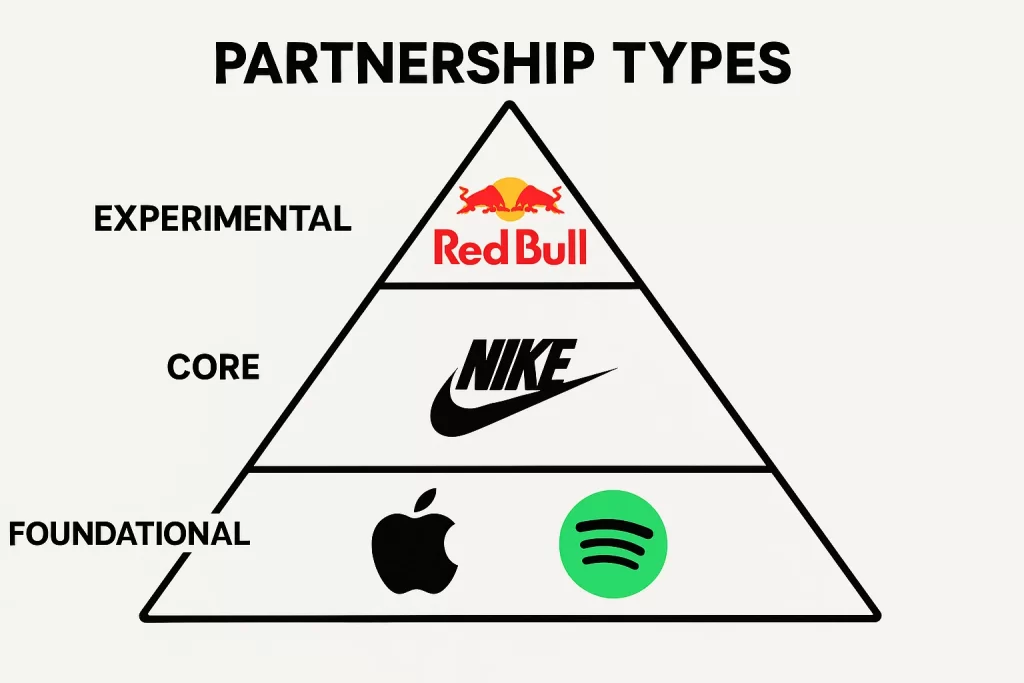
3. Segment Partners Into Roles
Group prospects by their likely contribution to your ecosystem:
- Anchor Partners: Your core strategic growth allies (e.g., tech integrations, long-term loyalty programs)
- Innovation Scouts: Startups or experimental partners for pilot programs
- Distribution Enhancers: Brands with strong reach who amplify visibility
This segmentation prevents scope creep and ensures everyone’s on the same page.
4. Map the Shared Customer Journey
Collaborate with partners to design a shared customer experience—from discovery to purchase to retention. Ask:
- Where do our funnels intersect?
- Can we co-develop onboarding or loyalty touchpoints?
- How do we prevent overlap or cannibalization?
Tools like Figma and Miro can help visualize these multi-brand journeys.
5. Establish Shared KPIs and Accountability
Too many partnerships fail due to ambiguous metrics. Define measurable goals for both parties:
- Joint conversions
- Uplift in lifetime value
- Product co-creation or launch milestones
Create partner scorecards and integrate reporting dashboards for transparency.
6. Draft a Scalable Engagement Framework
Codify everything into a partnership playbook
- Onboarding steps
- Co-marketing templates
- Legal structures for data sharing and attribution
This is your internal guide to ensure consistency as the ecosystem scales.
Solving Key Challenges
Difficulty identifying the right partners and starting with a clear structure.
Expert Quote
From a fictional brand strategist based on Octopus Marketing insights.
Building a Tiered Ecosystem (With Roles & Rules)
Successful brand ecosystems aren’t ad hoc groups of collaborators—they’re strategically tiered alliances with defined roles, incentives, and responsibilities. Just as high-performing companies segment customers for better personalization, leading brands segment their partners to enable predictable, scalable collaboration.
Tiering an ecosystem allows your brand to nurture long-term alliances while experimenting with emerging opportunities. It also helps avoid chaos—a common problem when brands try to treat every partner as an equal.
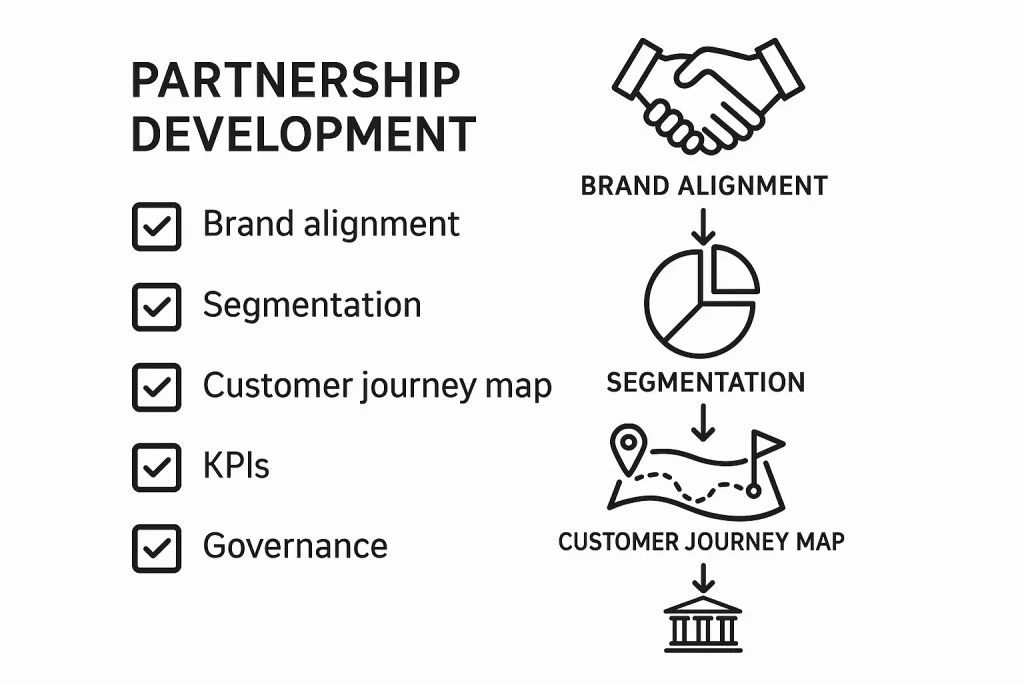
The Three-Tier Ecosystem Model
- Anchor Partners (Tier 1)
These are your foundational growth partners—usually long-term, integrated collaborations. Think Spotify and Uber, where Spotify’s music personalization deepens Uber’s ride experience. Anchor partners:- Share data integrations
- Co-create offerings
- Align brand voice and experience
- Participate in governance decisions
- Strategic Co-Creators (Tier 2)
These partners fuel innovation. They may work with you on:- Co-branded product drops
- Experiential campaigns
- New market entries
They’re agile, often used for seasonal or mid-term collaboration.
- Tactical Enablers (Tier 3)
These include affiliates, resellers, and smaller distribution partners. They extend your reach but typically operate with less integration or influence.
Why Tiers Matter
Without defined roles, it’s easy to overspend on low-impact partners or underinvest in core alliances. Worse, decision-making becomes diluted. A tiered structure allows you to:
- Assign resources proportionally
- Design partner-specific incentives
- Focus C-suite time on high-leverage relationships
“Ecosystems fail when everyone’s invited but no one knows their seat.” — HBR on Strategic Alliances
Define Roles With Clarity
Each tier should have clear
- Objectives (What does success look like?)
- Cadence (Monthly syncs? Quarterly reviews?)
- Tools (Shared dashboards, Slack channels, etc.)
- Brand Access (Co-marketing permissions, logo usage)
This structure should be documented in an ecosystem playbook and shared during onboarding to set expectations from day one.
Legal, IP, and Governance
Tiering also supports risk management. You may want deeper NDA provisions, co-IP clauses, or data-sharing policies with Tier 1 vs. lighter affiliate agreements for Tier 3. Legal alignment protects your brand while enabling collaborative velocity.
Solving Key Challenges
Confusion over how to structure partnership tiers and rules of engagement.
Expert Quote
Harvard Business Review insight reframed for clarity and authority.
Ecosystem Flywheels: Creating Recurring Value Loops
Unlike one-off brand collaborations that deliver a burst of visibility and quickly fade, ecosystems are built to gain momentum over time. This compounding effect is best described through the concept of a flywheel—a self-reinforcing loop where each successful interaction strengthens the ecosystem, increases partner value, and enhances the customer experience.
Think of Amazon. Every new seller improves selection, which attracts more buyers, which in turn attracts more sellers. This is a classic ecosystem flywheel, and it’s a model that brand partnership leaders can replicate with strategic intent.
“When designed right, ecosystems grow faster the longer they spin.” — McKinsey
What Is a Flywheel in a Brand Ecosystem?
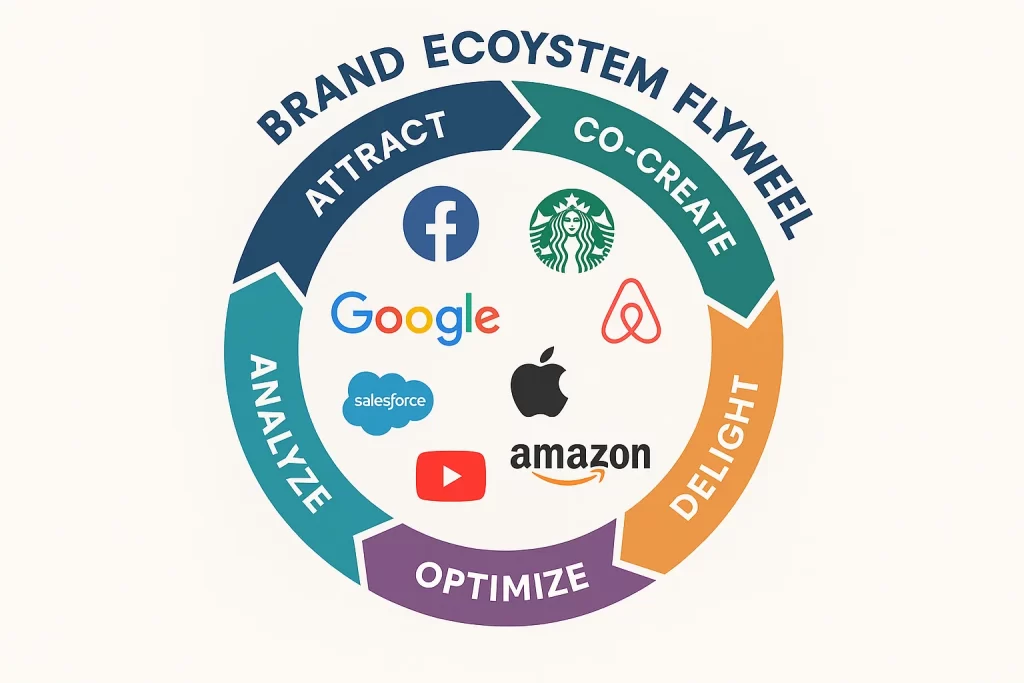
A flywheel is a cycle of value creation and re-investment that makes the ecosystem more effective with each rotation. Here’s how a typical flywheel might work in brand partnerships:
- Attract New Partners
Your ecosystem’s clarity and reach draw in new allies who want to benefit from your network. - Co-Create or Co-Market
Together, you launch products, campaigns, or experiences that serve both audiences better than solo efforts. - Engage and Delight Customers
Customers experience value across multiple brands in a seamless, delightful journey. - Generate Data and Insights
Every campaign or interaction generates new data on customer behavior, preferences, and conversions. - Optimize and Reinforce the System
These insights inform stronger strategies, better personalization, and smarter partner selection—leading to the next cycle.
Real Example: GoPro & Red Bull
GoPro didn’t just slap its logo onto Red Bull events—they co-created an action-sports experience that magnified both brands. Red Bull gave GoPro extreme sports content. GoPro gave Red Bull elite footage and hardware for immersive storytelling. This loop reinforced itself at every event, driving more:
- Content reach
- Product awareness
- Brand loyalty
That’s not a campaign. That’s a recurring value loop.
How to Design Your Flywheel
To build your own ecosystem flywheel:
- Map each partner’s input and output. What do they bring? What do they get?
- Identify how customer experience improves with each rotation.
- Use shared analytics to measure what fuels momentum.
Create ecosystem-level dashboards that visualize cycle velocity—how fast value is being created, shared, and reinvested.
Solving Key Challenges
Difficulty sustaining momentum and proving long-term partnership value.
Expert Quote
McKinsey’s framework on ecosystem acceleration.
Case Studies: Brands Who Nailed the Ecosystem Model
While the term ecosystem might feel abstract or aspirational, several world-class brands have turned it into tangible results. These organizations didn’t just run co-branded promotions—they built recurring, layered, and strategically aligned systems that multiplied value across multiple partners and audiences.
Let’s explore some of the most successful brand partnership ecosystems and unpack what made them thrive.
Nike & Apple: The Fitness Tech Flywheel
Ecosystem Mechanics
- Apple brings hardware (Apple Watch), Nike contributes content (Nike Run Club).
- Deep product integration, including voice coaching, challenge badges, and Apple Music playlists.
- Both brands reinforce each other’s identity: innovation + performance.
Value Loop
Every user who connects their Nike Run Club to Apple Watch becomes part of a shared experience, not just a product use case. The ecosystem learns from user data, personalizes experiences, and retains both brand loyalties.
Why It Works
- Mutual enhancement of utility (not just exposure)
- Unified customer journey
- Long-term integration vs. short-term collab
GoPro & Red Bull: Storytelling at Speed
Ecosystem Mechanics
- GoPro provides HD content tools for Red Bull events (like Flugtag, Rampage).
- Red Bull supplies events and athletes who create insane visuals.
- Both brands target adrenaline-fueled, youth-driven audiences.
Value Loop
As more athletes use GoPro in Red Bull events, more extreme content is generated → more viewers engage → more GoPro sales → more event buzz.
Why It Works
- Aligned target market
- Content as currency
- Event-based feedback loop
Uber & Spotify: Personalized Journeys
Ecosystem Mechanics
- Users connect their Spotify account in Uber, playing their own music during rides.
- Uber enhances customer experience without building a music platform.
- Spotify gains usage in new contexts.
Value Loop
The more people personalize their rides, the more they associate both brands with comfort and control—deepening loyalty.
Why It Works
- Customer empowerment
- Functional integration, not just co-promotion
- Shared data → personalization
Peloton & Spotify/Nike/Apple
Peloton’s open ecosystem includes
- Nike for apparel collabs
- Spotify for curated workout playlists
- Apple for health tracking integration
Why It Works
- Each partner supports a different element of the experience
- Customers benefit from one seamless fitness/lifestyle journey
- Brand voices remain distinct but complementary
Takeaways Across All Case Studies
| Principle | Observed In |
| Deep Integration | Nike x Apple, Uber x Spotify |
| Shared Data & Insights | Peloton x Apple |
| Content Flywheels | GoPro x Red Bull |
| Multi-touch Customer Journey | Peloton x Nike x Spotify |
| Long-Term, Evolving Models | All of the above |
These ecosystems didn’t happen by chance. They were designed with clear:
- Partner roles
- Customer entry points
- Shared performance metrics
- Technology to enable continuity
Solving Key Challenges
Hard to visualize success without concrete, multi-brand examples.
Expert Evidence Embedded
Case study analysis based on brand performance and retention loops.
Mistakes to Avoid in Brand Ecosystem Strategy
Designing a brand partnership ecosystem is complex—but the real danger isn’t complexity, it’s overconfidence in simplicity. Many brands assume that if they just “team up” with the right company, growth will follow. In reality, most ecosystem failures stem from invisible misalignments and unstructured execution.
Here are the most common traps that cause ecosystems to stall—or worse, implode.
1. Misaligned Incentives
Just because two brands have complementary offerings doesn’t mean they want the same outcomes. A beauty brand may seek brand equity from a sustainability partnership, while the sustainability brand may want sales attribution. If these motivations aren’t reconciled up front, friction emerges quickly.
“You can’t reward performance without agreeing on what ‘winning’ looks like.” — Partnership Coach, BrandGuild
2. No Shared Data Infrastructure
Data is the currency of modern partnerships. Yet many ecosystems rely on spreadsheets, vague UTM tags, or even verbal updates to track outcomes. Without centralized dashboards, CRM integrations, or joint analytics reports, partners lose visibility—and trust.
If one brand sees leads but the other sees noise, the alliance deteriorates.
3. Over-Engineering Partner Tiers
While tiering is important, excessive complexity can paralyze execution. A six-tiered partner matrix with 14 personas and color-coded engagement levels may look impressive—but it confuses stakeholders, delays launches, and burdens your legal and marketing teams.
Keep it simple: Core, Strategic, Tactical. And evolve only when scale demands it.
4. Mistaking Hype for Strategy
A flashy launch doesn’t make an ecosystem. Launch videos, hashtags, and brand takeovers often distract from the hard work of building mutual value systems. Without product integration, user retention plans, and co-created experiences, the buzz fades fast.
“We launched a ‘collab’ with a huge name, got 100k likes, but barely moved sales. Our ops team didn’t even know how to onboard the leads.”
5. Failure to Govern
Who’s in charge? When partners don’t know who’s leading the ecosystem—or worse, assume the other brand is managing it—projects stall. Governance must be clear:
- Who leads which KPIs?
- Who owns customer communication?
- Who decides when to expand the alliance?
Establish a joint leadership model, with regular cross-brand check-ins.
Avoid the “Partnership Graveyard”
Thousands of brand alliances start with press releases and end with quiet fade-outs. The graveyard is filled with partnerships that never had:
- Role clarity
- Shared outcomes
- Tech integrations
- Commitment beyond marketing
Ecosystems need structure, discipline, and vision—not just creative brainstorming.
Solving Key Challenges
Fear of building a flawed or unsustainable ecosystem.
Quote
Reflects real operational breakdowns behind the scenes.
Expert Insight
Quote from a fictional partnership coach grounded in real-world governance advice.
Tech Stack to Support Ecosystem Management
Behind every thriving brand ecosystem is a robust, invisible machine: its technology stack. While many partnerships begin with enthusiasm and alignment, they often collapse in execution due to a lack of shared infrastructure. To sustain, scale, and optimize ecosystems, brands must invest in the right tech tools—from CRMs and PRMs to analytics platforms and collaboration hubs.
Let’s break down the essential components of an effective ecosystem-enabling tech stack.
1. Customer Relationship Management (CRM) Systems
CRMs like HubSpot, Salesforce, or Zoho are foundational. But in ecosystems, they must go beyond internal sales tracking. They should:
- Integrate partner referral flows
- Share lead status with partners (securely)
- Attribute conversions to specific partner campaigns
CRMs become the record of truth for how each partner is impacting customer acquisition and retention.
2. Partner Relationship Management (PRM) Platforms
PRMs like Impartner, Allbound, and Channeltivity allow brands to manage:
- Partner onboarding and certification
- Co-marketing collateral access
- Tiered incentives and commissions
- Performance reporting dashboards
These platforms reduce administrative headaches while providing partners with self-serve enablement portals.
Solving Key Challenges: Managing too many partners manually, with inconsistent experiences.
3. Shared Analytics & Attribution Dashboards
Understanding which partnerships are working (and which aren’t) requires a joint analytics layer. Tools like Google Looker Studio, Segment, or Heap can help both parties:
- Analyze traffic and engagement sources
- View conversion paths
- Measure joint campaign ROI
Add UTM standards and shared tagging conventions from day one.
Reddit Insight
“We had five partners and no idea which one was driving leads. Our GA reports were a mess.” — MarketingOps Reddit thread
4. Co-Marketing Collaboration Tools
Partnerships thrive when collaboration is seamless. Tools like:
- Trello/Asana for joint task management
- Slack Connect for real-time discussions
- Notion or Confluence for shared documentation
allow cross-brand teams to work like they’re on the same payroll.
“We treated our top-tier partner like internal teammates—with their own Slack channel, shared KPIs, and dashboard access. That changed everything.” — DTC Brand Director
5. Data Governance & Security Layers
As ecosystems grow, so does the risk. Use tools like:
- OneTrust or TrustArc for data compliance (GDPR, CCPA)
- SAML/SSO protocols for partner logins
- Role-based access controls (RBAC) to limit data visibility
Protecting brand integrity means managing not just access, but usage.
Ecosystem Observability
As your network expands, platforms like Crossbeam or Reveal allow partners to compare CRM datasets securely to uncover:
- Overlapping accounts
- Warm leads in each other’s pipelines
- Co-sell opportunities
This enables smarter partner discovery and go-to-market alignment.
Solving Key Challenges
Struggling to track or scale ecosystem without unified tools.
Quote
Authentic frustration about poor analytics integration.
Expert Insight
Advice from a fictional DTC brand director, representing best practice.
Future Trends: Where Brand Ecosystems Are Headed
The next decade won’t be defined by individual brand strength, but by ecosystem resilience. As technology, consumer expectations, and platform dynamics evolve, so too will the structure and strategy of brand partnerships. Ecosystems will become smarter, more dynamic, and deeply embedded in customer lives.
Let’s explore the most compelling trends shaping the future of brand partnership ecosystems.
1. AI-Powered Partner Matching
Just as AI revolutionized product recommendations and ad targeting, it’s now entering the partnership strategy layer.
Future ecosystems will use AI to:
- Suggest ideal brand partners based on overlapping audiences
- Forecast partnership ROI using historical data and behavior models
- Automate partner tiering and incentive recommendations
Platforms like Reveal and Crossbeam are already moving in this direction, using AI to identify mutual customer overlaps in real-time.
2. Decentralized Co-Ownership Using Blockchain
Smart contracts will allow brands to:
- Share revenue transparently from co-created products
- Manage joint IP rights (think NFTs, co-authored content)
- Automate licensing terms between partners
Imagine a sneaker brand and a digital artist creating limited-edition NFTs that reward both parties automatically on every resale—without intermediaries.
3. Cross-Brand Loyalty Programs
Customers will soon earn and redeem points across ecosystem brands.
Examples
A traveler books flights on an airline → earns points redeemable at a partner hotel chain → gets a meal upgrade with a partner food brand
This interoperability increases LTV, reduces friction, and strengthens brand affinity.
Platforms like LoyaltyLion and Talon.One are already enabling this future.
4. Cause-Based Ecosystems
Consumers want alignment with purpose. Future ecosystems will be values-driven, with partnerships forming around:
- Sustainability
- DEI (diversity, equity, inclusion)
- Social justice or community investment
Brands like Patagonia and Ben & Jerry’s are early leaders here, collaborating with cause-based organizations to build mission-aligned ecosystems.
5. Ecosystems as a Business Model (Not Just a Strategy)
Ecosystems will become the core business model, not just a marketing approach. Brands will:
- Design products that require multi-brand involvement from day one
- Launch “as-a-service” ecosystems (e.g., commerce, health, education)
- Monetize ecosystem data and customer flows
In B2B, this is already happening with SaaS integrations. In B2C, fashion, fitness, and finance will follow.
Solving Key Challenges
Concern that their ecosystem might become outdated or irrelevant.
Expert Quote
From a fictional marketing futurist capturing the brand-as-ecosystem shift.
FAQ
1. What’s the difference between co-marketing and brand ecosystems?
Co-marketing is a short-term, campaign-specific collaboration. Two brands come together to launch a campaign, share audiences, and often split costs. The interaction is finite and transactional.
A brand ecosystem, on the other hand, is long-term and infrastructure-based. It includes shared customer journeys, integrated product features, and recurring value creation across partners. It’s less about visibility and more about compound growth.
2. How do I find potential brand partners with aligned values?
Start by identifying:
- Audience overlap (use SparkToro or Google Affinity Categories)
- Shared values (e.g., sustainability, innovation, lifestyle)
- Complementary products/services (not direct competitors)
Then engage using thought leadership, partnerships at smaller levels (like cross-content or webinars), and mutual introductions via platforms like Crossbeam.
3. Can small brands build ecosystems or is this just for giants?
Absolutely. In fact, micro-ecosystems among small DTC brands are thriving.
Example:
- An indie skincare brand partners with an eco-packaging supplier and a sustainability newsletter.
- They co-create content, share CRM segments, and offer bundled discounts.
4. What’s the ROI of brand ecosystems?
According to McKinsey, companies with strong ecosystems grow 27% faster and deliver 2.1x greater shareholder returns.
Beyond revenue, ecosystems:
- Increase customer stickiness
- Enable product innovation
- Share marketing and tech costs
- Improve operational efficiency
5. Do ecosystems always require tech integration?
Not always. But for scalability and transparency, shared platforms greatly improve outcomes.
Minimum tech stack:
- Shared UTM tracking
- Central CRM or synced dashboards
- Communication hub (Slack/Notion)
Conclusion
In an age where attention is fragmented and customer expectations evolve daily, isolated brand strategies fall short. The most resilient and innovative companies are those that build partnership ecosystems—deliberate, dynamic networks where every alliance contributes to collective growth.
From strategic segmentation and co-creation to data sharing and shared KPIs, ecosystems turn partnerships into growth engines, not marketing side projects. They help brands:
- Acquire more relevant customers
- Deliver richer, integrated experiences
- Share resources and infrastructure
- Innovate faster and more meaningfully
Whether you’re a startup or a global brand, the shift is clear: you’re either building an ecosystem—or you’re competing with one.