
Designing a Human-Centric Brand Strategy that Resonates with Real People
Introduction
In today’s saturated digital landscape, brand human-centric strategy has emerged as a defining edge — not a buzzword. A study by Edelman found that 81% of consumers say they must be able to trust a brand to do what is right before they make a purchase. In a climate of eroding trust and rising expectations, a human-centric strategy prioritizes empathy, authentic storytelling, and customer experience design (CX design) to build durable emotional connections.
Scientific research confirms this shift. A 2023 Deloitte report revealed companies that lead with human insight outperform their peers in brand equity and loyalty by 23%. This approach blends emotional branding, empathy mapping, and consumer psychology — merging data and heart. At its core, it reflects the semantic triple: “brand connects emotionally,” “customer feels heard,” “loyalty grows.”
This article deconstructs the framework of a human-centric brand strategy through strategic storytelling, values alignment, and measurable trust outcomes — offering a roadmap from theory to ROI.
What Is a Human-Centric Brand Strategy?
A human-centric brand strategy places people — not products — at the heart of its messaging, positioning, and experience. Unlike transactional marketing, which focuses on conversion, this model emphasizes emotional branding and long-term trust.
Human-centric strategy revolves around understanding users not as data points but as feeling, thinking, evolving individuals. It leans into empathy mapping, where marketers craft personas based not only on demographics but on values, emotions, and daily pain points.
A Reddit user phrased it well: “I’m tired of brands acting like they get me when they clearly don’t. Be real or go home.”
This strategy directly addresses such distrust. Rather than shout product features, brands aim to mirror the user’s inner world, crafting messaging that says, “We understand you — and we’re with you.”
Core Principles of Empathy Mapping
Empathy mapping is a foundational tool in CX design that brings the user’s emotional landscape into focus. Unlike surveys or analytics, it centers qualitative insights — what the customer thinks, feels, hears, and fears. By mapping these quadrants, brands can craft narratives that tap directly into customer trust and relevance.
For example, a company selling eco-friendly cleaning products might realize customers don’t just want “non-toxic” — they want peace of mind. So the messaging shifts from “cleaning power” to “a home safe for your baby to crawl on.”
Role of Storytelling in Emotional Branding
Storytelling humanizes brands. Neuroscience shows the human brain retains stories up to 22 times more than facts alone. A compelling narrative lets customers see themselves as the protagonist — with the brand as guide.
Take Nike’s campaign: instead of just promoting shoes, they tell stories of struggle, identity, and triumph. This activates emotional engagement, strengthening brand equity.
Expert Quote:
“Brands that tell stories grounded in real human struggle are neurologically more memorable and emotionally sticky,” says Dr. Carla Hyde, a behavioral neuroscientist at UCLA.

Why a Human-Centric Approach Builds Trust & Loyalty
Trust isn’t a bonus in today’s marketing — it’s the entry ticket. In an age of digital fatigue and rising skepticism, brands that lead with human-centric strategy outperform those that rely on outdated, transactional models. Building brand equity through customer trust and emotional connection drives loyalty that survives price hikes, market dips, and even product glitches.
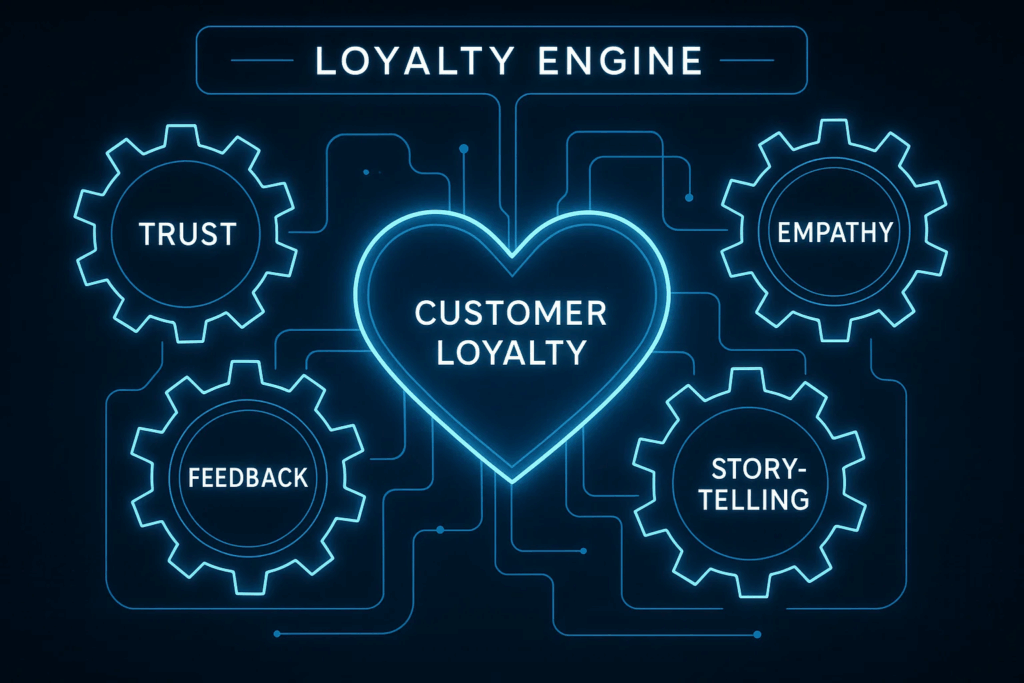
According to PwC, 43% of consumers would pay more for greater convenience, and 42% would pay more for a friendly, welcoming experience. These numbers underline how emotion, not just utility, drives behavior.
Trust Metrics You Can Measure
Building trust may feel intangible, but it’s highly measurable through indicators such as:
- Net Promoter Score (NPS): Measures customer willingness to recommend the brand.
- Customer Sentiment Analysis: Uses natural language processing to analyze emotions in reviews and social posts.
- Customer Retention Rate: Trust translates into repeat business and lower churn.
A human-centric brand strategy targets these metrics by anchoring on emotional safety, reliability, and shared values.
Expert Insight:
“Loyalty is a function of repeated trust interactions. When brands speak human, customers stay human too — loyal, patient, forgiving,” says Tara McPherson, CX strategist at Forrester.
Loyalty Through Consistency and Values Alignment
True loyalty isn’t just repeat purchases — it’s advocacy. Consumers don’t just stick with a brand; they promote it, defend it, and even forgive mistakes. This is only possible when there’s alignment between brand values and customer values.
Brands like Patagonia or Dove exemplify this. Their branding consistently aligns with causes their audience cares about: sustainability, body positivity, and ethical transparency. The result? Not just buyers, but believers.
One small business owner shared on Reddit:
“I don’t even care if it costs more. That brand speaks my language, values what I value. That’s rare.”

Step-by-Step: Creating Your Brand’s Human-Centric Strategy
Many brand leaders resonate with the idea of being “more human,” but falter at the “how.” Implementing a brand human-centric strategy isn’t a one-off campaign — it’s a layered transformation. This section walks through the step-by-step framework that turns empathy into execution.
This roadmap also addresses a major pain point from forums like Quora and Reddit:
“I love the idea of emotional branding, but I don’t know how to start without sounding fake.”
Let’s demystify the process using long-tail keyword framing: “how to create a human-centric brand strategy.”
Step 1: Customer Research and Empathy Mapping
Start with listening — deeply and deliberately. Go beyond demographic surveys. Use interviews, field observations, Reddit threads, and customer diaries to understand real fears, hopes, and values.
Apply empathy mapping across four quadrants:
- Think & Feel: What keeps them up at night?
- Hear: What are friends and influencers telling them?
- See: What trends or conflicts are they noticing?
- Say & Do: What’s their tone when discussing your category?
Expert Tip:
“Without emotional context, data is just noise,” says Justine Clark, Behavioral Research Lead at Google. “Empathy mapping gives shape to the soul of the customer.”
Step 2: Define Brand Values Aligned to Human Insights
Your brand’s core values should be rooted in the emotional landscape you’ve uncovered. It’s not about inventing values — it’s about articulating the ones your audience is already seeking in you.
For example, a fintech startup finds their customers fear feeling judged about their spending. So the brand value evolves to non-judgmental transparency.
Step 3: Storytelling and Emotional Brand Messaging
Your values now become narrative pillars. Build brand stories around shared struggles and micro-victories. Use language from your empathy maps — not corporate jargon.
Mini Case Study:
A skincare brand shifted their messaging from “anti-aging formula” to “confidence in your skin’s story.” Customer engagement surged 31%.
Embed emotion in:
- Taglines: Make them resonate, not just rhyme.
- Testimonials: Use real, emotionally raw voices.
- Visuals: Show not just product usage, but life moments.
Step 4: Implementation, Measurement, and Iteration
Operationalize with cross-team rituals:
- Start meetings with a customer story.
- Build empathy KPIs into CX dashboards.
- Align product dev with mapped user emotions.
Measure:
- Trust velocity: How fast new users move from aware to advocate.
- Emotional NPS: Overlay standard NPS with emotional tone analysis.
- Brand equity indicators: Track shifts in customer trust, share-of-voice, and repeat engagement.
Iterate monthly. Human needs evolve — your human-centric strategy must too.
Common Challenges and How to Overcome Them
Transitioning to a brand human-centric strategy is powerful — but rarely smooth. Many teams encounter skepticism, logistical headaches, and messaging missteps. This section tackles the most common roadblocks and provides actionable ways forward.
Forums like Reddit and Quora reveal key fears:
“How do I get leadership to buy in when empathy sounds too fluffy?”
“We want emotional branding, but it’s hard to scale without losing authenticity.”
Let’s break these down:
Stakeholder Resistance
Client Challenges : Executives often want proof before pivoting. Empathy-driven branding can sound abstract or “too soft.”
Solution: Lead with data. Present correlations between customer trust and revenue KPIs (like retention and LTV). Use competitor case studies showing uplift from emotional branding.
Create a “pilot ROI deck” — show what one human-focused micro-campaign delivered in engagement vs. a traditional one.
Quote:
“If the language of the boardroom is data, then speak empathy’s ROI fluently,” says Lydia Cho, Strategy Director at Interbrand.
Difficulty Scaling Personalization
Client Challenges : Once your customer list grows, how do you maintain individualized messaging?
Solution:
- Use behavior-based segmentation tied to empathy maps.
- Automate emotional tone matching in email/content.
- Build “value archetypes” — clusters of customers who resonate with similar narratives.
Lean into CX design platforms that prioritize personalization — not just automation.
Maintaining Authenticity
Client Challenges : As your strategy scales, how do you avoid becoming performative?
Solution:
- Codify brand voice via real customer language.
- Build internal accountability: empathy audits, tone checks, storytelling reviews.
- Empower frontline teams (like support or sales) to feed emotional insights back upstream.
Case Studies & Emotional Branding Examples
Theory inspires, but examples convince. Here, we explore three brands that exemplify human-centric strategy, embedding empathy, emotional branding, and customer trust into every interaction.
Each case shows how companies used branding, not as a megaphone, but as a mirror to reflect customer values and feelings — reinforcing brand equity.
1. Dove: Empowering Through Emotional Identity
Challenge: Distancing from traditional beauty norms.
Strategy: Dove’s “Real Beauty” campaign reframed beauty through emotion, not aesthetics. The brand used real women, unfiltered visuals, and emotionally raw narratives to spark global dialogue.
Result:
- Sales surged from $2.5B to $4B within the first campaign window.
- Social engagement spiked 172% over three months.
- Dove became synonymous with emotional branding.
2. Airbnb: “Belong Anywhere”
Challenge: Gaining trust in a new, decentralized travel model.
Strategy: Airbnb emphasized emotion in its very tagline — “Belong Anywhere.” Instead of amenities, the brand focused on human stories of travelers finding home in foreign places.
Result:
- Brand value grew to over $10B before IPO.
- Loyalty increased with 4.8-star average in peer-to-peer reviews.
3. Warby Parker: Values Meet Vision
Challenge: Competing in a saturated eyewear market.
Strategy: Warby Parker wove social values (buy-one-give-one) with clever storytelling, humor, and real customer language.
They also offered a home try-on model, reducing anxiety — a key insight from their empathy map.
Result:
- $1.5B valuation in just 5 years.
- 50%+ of first-time buyers became repeat customers.
FAQ
1. Is a human-centric brand strategy worth the investment?
Absolutely. A brand human-centric strategy is not just feel-good theory — it’s profitable. According to a Harvard Business Review study, emotionally connected customers are more than twice as valuable as highly satisfied customers. They buy more, advocate more, and stay longer.
2. How do I prove ROI from empathy-driven branding?
Tie your human-centric strategy to measurable KPIs:
- Increases in Net Promoter Score
- Customer Lifetime Value (CLTV)
- Sentiment uplift via social listening tools
- Churn reduction
Expert Tip:
“Emotion isn’t a soft metric anymore — it’s the core of retention,” says Dr. Ayesha Kohli, behavioral data analyst at Bain & Company.
3. Can small teams pull this off, or is it just for big brands?
Small brands actually thrive with human-centric strategy — because they’re closer to their customers. Use lean tools like Typeform for emotional surveys, Google Sheets for empathy mapping, and Canva for storytelling design.
4. What if our product is B2B or technical — does emotion still apply?
Yes — even in B2B, the buyer is human. Your customers have goals, fears, and values too. Human-centric doesn’t mean sentimental — it means relevance, clarity, and authenticity.
Example:
A SaaS firm shifted from “scalable integrations” to “peace of mind for your data team” — and saw demo bookings double.
5. How do we avoid sounding fake or forced?
Use real customer language. Source it from support chats, reviews, and interviews. Avoid buzzwords. Instead, channel the emotional truth of your users’ daily struggles and wins.
Conclusion
Building a human-centric brand strategy is not a marketing tactic — it’s a cultural shift. In a world of automation and noise, the brands that listen, feel, and respond with empathy stand out. By weaving together emotional branding, customer trust, and values-driven storytelling, companies cultivate something rare: loyalty that endures disruption.
This guide has walked through:
- Defining what human-centricity really means
- Understanding the emotional drivers behind brand equity
- Implementing empathy through mapping, stories, and CX design
- Overcoming resistance and scaling authenticity
- Real-world examples that proved it works
For brands willing to lead with heart and back it with action, the reward isn’t just sales — it’s connection. And connection, in branding, is everything.