
Demand Generation vs Demand Capture in B2B Marketing: What’s the Difference?
Introduction
In B2B marketing, growth is rarely constrained by execution alone. More often, it is constrained by strategic misalignment—specifically, confusion between creating demand and capturing existing demand. Many organizations invest heavily in campaigns, platforms, and performance metrics without clearly understanding whether they are building future market demand or merely harvesting demand that already exists.
This distinction sits at the heart of the debate around demand generation vs demand capture.
In markets such as Dubai—where B2B competition is intense, decision cycles are long, and buyers are increasingly self-directed—this difference is not academic. It directly determines pipeline quality, cost of acquisition, and long-term brand equity. According to Gartner, B2B buyers spend only 17% of their buying journey meeting with potential suppliers, preferring independent research, peer validation, and content consumption for the remainder. This behavioral shift fundamentally changes how demand should be approached.
This article explores the difference between demand generation and demand capture in B2B marketing, how each operates across the funnel, where organizations go wrong, and how modern B2B brands integrate both to drive sustainable growth.
Understanding the Modern B2B Demand Problem
Before defining demand generation vs demand capture, it is important to understand why the distinction matters more today than ever before.
Traditional B2B marketing assumed that awareness naturally preceded consideration, and that lead generation was a linear process. Marketing created awareness, sales followed up, and revenue emerged. That model no longer reflects reality.
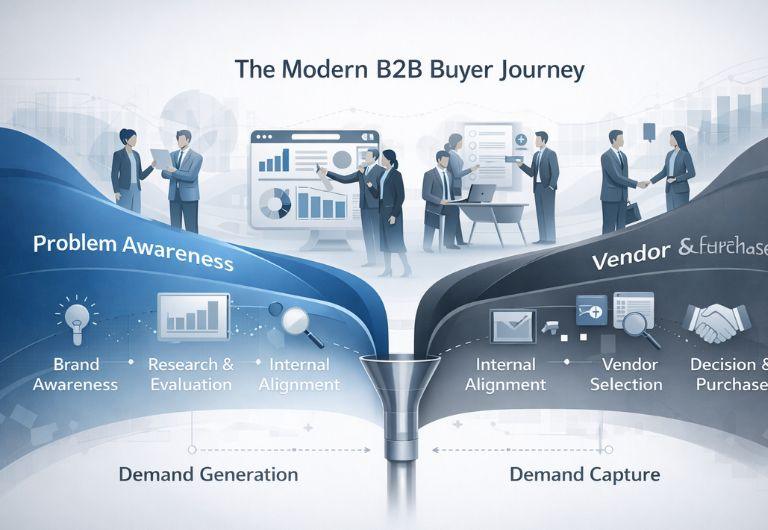
Today’s B2B buyer journey is non-linear, anonymous, and fragmented. Buyers move back and forth between problem exploration, solution comparison, internal consensus building, and budget justification—often without ever filling out a form. By the time they engage a vendor, they may already be 60–70% through their decision process.
In this environment, organizations that focus exclusively on demand capture compete aggressively for the same limited pool of high-intent buyers. Those that invest only in demand generation often struggle to translate attention into revenue. The most effective B2B strategies recognize that demand generation and demand capture serve fundamentally different roles within a unified revenue system.
What Is Demand Generation in B2B Marketing?
Demand generation refers to the strategic discipline of creating demand where none previously existed. It focuses on shaping market perception, educating potential buyers, and framing problems before buyers actively search for solutions.
Unlike lead generation, demand generation does not begin with a form or a call-to-action. It begins with insight.
In B2B contexts, demand generation targets problem-aware or problem-unaware buyers—individuals who may not yet recognize a need, or who have not connected that need to a specific category of solution. The goal is not immediate conversion, but cognitive positioning.
Effective demand generation operates primarily at the top of the B2B sales funnel, but its impact extends throughout the buying journey. Thought leadership marketing, content-led growth, and inbound marketing strategies are common expressions of demand creation, but the underlying objective is deeper: to influence how buyers think before they buy.
As Peter Drucker famously noted, “The aim of marketing is to know and understand the customer so well the product or service fits him and sells itself.” Demand generation is the strategic application of that principle.
The Strategic Role of Demand Creation
In B2B marketing, demand creation is not about visibility alone. It is about narrative control.
When a company successfully generates demand, it defines:
- What problems matter
- Why existing approaches are insufficient
- What outcomes buyers should expect
- How success should be measured
This narrative influence dramatically reduces friction later in the funnel. Research by Bain & Company shows that B2B buyers who perceive a vendor as an early “thought leader” are three times more likely to shortlist that vendor during vendor evaluation.
For Dubai-based B2B brands competing regionally and globally, demand generation becomes a strategic moat. It reduces dependency on price competition, lowers cost per acquisition over time, and builds long-term brand authority across complex buying committees.
What Is Demand Capture in B2B Marketing?
If demand generation creates interest, demand capture converts it.
Demand capture focuses on identifying, attracting, and converting buyers who already have intent. These buyers are solution-aware, actively researching vendors, or ready to engage sales. The role of demand capture is not to educate broadly, but to win decisively.
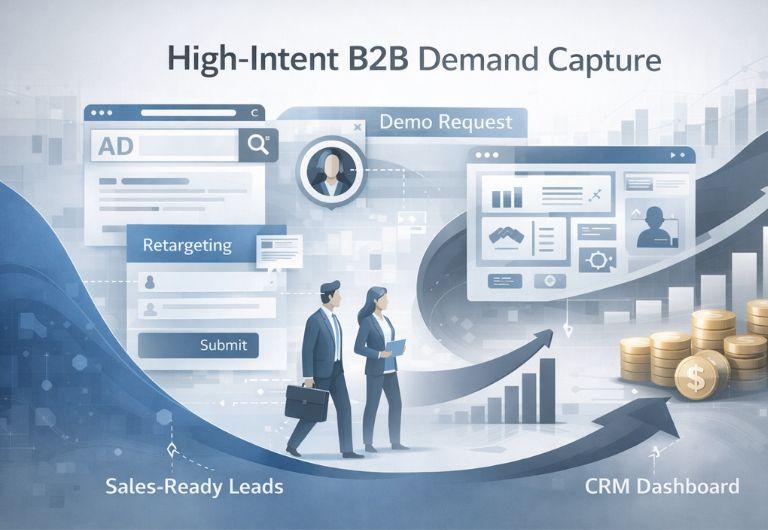
Demand capture strategies operate primarily at the bottom of the funnel, where speed, relevance, and precision matter more than storytelling. Paid search, retargeting and remarketing, comparison pages, demo requests, and sales-ready lead capture forms all fall within demand capture marketing.
In B2B environments, demand capture is closely aligned with revenue operations. It is measured through metrics such as MQLs, SQLs, pipeline velocity, and close rates. Unlike demand generation, its impact is visible in shorter timeframes.
However, demand capture is inherently finite. It does not expand the market; it competes within it.
Demand Conversion and Intent Economics
One of the most common misconceptions in B2B marketing is assuming that increasing spend on demand capture will indefinitely scale growth. In reality, demand capture efficiency declines as competition increases.
High-intent keywords become saturated. Cost-per-click rises. Retargeting audiences overlap. Conversion rates plateau. This is particularly visible in competitive B2B verticals such as SaaS, professional services, and enterprise technology in Dubai’s mature market.
Demand capture excels at harvesting existing intent, but it cannot manufacture new intent. Without parallel investment in demand generation, organizations risk entering a zero-sum competition for the same prospects.
As McKinsey has observed, “Companies that outperform peers do not capture more demand—they create more demand.”
Demand Generation vs Demand Capture: Core Differences
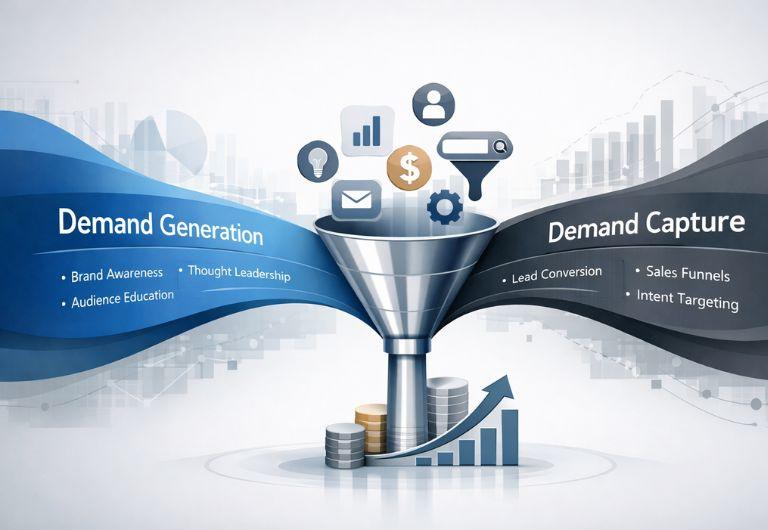
The difference between demand generation and demand capture is not tactical; it is philosophical.
Demand generation is proactive, while demand capture is reactive. One shapes buyer perception over time, the other responds to buyer signals in the moment. One invests in long-term demand building, the other optimizes short-term conversion efficiency.
In the B2B sales funnel, demand generation expands the top by increasing the number of problem-aware buyers entering the market. Demand capture optimizes the bottom by converting those who are already prepared to buy.
Understanding this distinction allows B2B organizations to design strategies that align with business maturity, market conditions, and revenue objectives.
Demand Generation vs Demand Capture: A Strategic Comparison for B2B Marketing
At a strategic level, the difference between demand generation vs demand capture lies in how organizations approach market growth over time. Demand generation is designed to expand the universe of potential buyers by shaping awareness, reframing problems, and influencing how decision-makers define success. Demand capture, by contrast, operates within an already defined universe, focusing on identifying and converting buyers who are actively seeking solutions.
From a temporal perspective, demand generation works on a longer horizon. Its impact compounds gradually as brand authority, mental availability, and category understanding grow. Demand capture, on the other hand, delivers immediate but finite returns, constrained by existing search demand, intent signals, and competitive bidding dynamics.
The two approaches also differ fundamentally in how value is created. Demand generation creates strategic leverage by lowering future acquisition costs and increasing win rates before competitive evaluation begins. Demand capture creates operational efficiency, ensuring that high-intent demand does not leak from the funnel due to poor timing, messaging, or sales alignment.
In high-consideration B2B markets—particularly in SaaS, professional services, and enterprise solutions—organizations that over-index on demand capture often experience diminishing returns, while those that over-invest in demand generation without capture infrastructure struggle to monetize attention. The most effective B2B marketing systems recognize that demand generation shapes the battlefield, while demand capture wins the battles.
This strategic distinction explains why leading B2B organizations do not debate demand generation versus demand capture as alternatives, but instead design integrated revenue engines where each discipline reinforces the other across the buyer journey.
How Demand Generation and Demand Capture Work Across the B2B Funnel
In modern B2B marketing, the funnel is less a linear path and more a dynamic system of influence.
Demand generation dominates the early and middle stages of the funnel, where buyers are exploring problems, validating assumptions, and aligning internally. Content-led growth, audience education, and thought leadership marketing play a critical role here, particularly in long sales cycles.
Demand capture becomes dominant once buyers cross an intent threshold. At this stage, they seek proof, differentiation, and reassurance. Bottom-of-funnel marketing tactics—case studies, demos, pricing clarity, and sales enablement—become decisive.
High-performing B2B organizations design intent-responsive systems, where demand generation nurtures interest until intent is detectable, and demand capture activates immediately once it is.
When to Use Demand Generation vs Demand Capture
The question is not whether to use demand generation or demand capture, but when and how to emphasize each.
Early-stage B2B companies, particularly startups entering crowded markets, often rely excessively on demand capture. This creates a short-term pipeline but fails to establish category relevance. Over time, acquisition costs rise faster than revenue.
Conversely, enterprise organizations sometimes over-invest in demand generation without adequate capture infrastructure, resulting in strong brand visibility but weak revenue attribution.
The optimal balance depends on:
- Market maturity
- Brand awareness
- Sales cycle length
- Average contract value
- Competitive density
In Dubai’s B2B ecosystem—characterized by fast-growing startups, regional headquarters, and global competitors—the most effective strategies dynamically adjust emphasis based on intent signals and pipeline health.
Demand Generation vs Demand Capture in SaaS and High-Consideration B2B
In SaaS marketing, the demand generation vs demand capture debate becomes especially pronounced.
SaaS buyers often self-educate extensively before engaging in sales. This makes demand generation critical for influencing early perceptions. Companies like HubSpot and Salesforce have demonstrated that sustained investment in content, education, and community dramatically lowers reliance on paid acquisition over time.
However, SaaS businesses also depend on precise demand capture to convert trial users, retarget evaluators, and accelerate decision-making. Here, demand capture marketing acts as a conversion accelerator, not a growth engine in isolation.
Successful SaaS brands integrate both into a unified revenue marketing system, aligning marketing automation platforms, CRM integration, and sales teams around shared intent data.
The Role of ABM in Bridging Demand Generation and Demand Capture
Account-based marketing (ABM) occupies a unique position in the demand generation vs demand capture landscape.
ABM blends demand creation and demand conversion by targeting specific high-value accounts with tailored messaging across the buyer journey. In B2B enterprise environments, ABM allows organizations to generate demand within known accounts while simultaneously capturing emerging intent signals.
For Dubai-based B2B firms selling into regional enterprises, ABM offers a practical framework for balancing long-term relationship building with short-term pipeline objectives.
Common Mistakes B2B Companies Make
One of the most damaging mistakes in B2B marketing is equating lead volume with demand generation. Lead generation is often a byproduct of demand capture, not demand creation. Filling the CRM with low-intent leads does not expand the market.
Another common error is isolating demand generation and demand capture into separate teams with misaligned incentives. When marketing is measured only on MQLs and sales on closed deals, strategic coherence breaks down.
High-performing organizations adopt revenue marketing models, where demand generation and demand capture are evaluated based on pipeline contribution, not isolated metrics.
Case Study: Demand Strategy in a Competitive B2B Market
Consider a mid-market B2B technology firm operating in the GCC region. Initially reliant on paid search and outbound sales, the company experienced rising acquisition costs and stagnant growth.
By investing in demand generation—publishing industry insights, hosting executive roundtables, and reframing customer problems—the company increased inbound branded search by over 60% within 12 months. Demand capture efficiency improved simultaneously, with higher conversion rates and shorter sales cycles.
The lesson was clear: demand capture performs better when demand generation does its job first.
Can Demand Generation and Demand Capture Work Together?
Not only can demand generation and demand capture work together—they must. Treating them as separate or sequential initiatives creates structural inefficiencies that undermine growth. The most effective B2B strategies recognize that demand generation and demand capture are interdependent components of a single, continuously operating system, not isolated campaigns owned by different teams.
Demand generation feeds the future pipeline by shaping buyer understanding, increasing category relevance, and building trust long before purchase intent becomes explicit. Demand capture monetizes present intent by ensuring that when buyers are ready to act, the brand is visible, credible, and easy to engage. When these functions operate in isolation, organizations either generate attention they cannot convert or attempt to convert demand they never helped create.
High-performing B2B organizations integrate both disciplines through shared data, unified messaging, and aligned incentives across marketing, sales, and revenue operations. Intent signals from demand capture efforts inform content strategy and audience development, while insights from demand generation improve conversion effectiveness by warming the market in advance. This feedback loop allows companies to allocate budget more intelligently, prioritize accounts more accurately, and forecast pipeline with greater confidence.
The result is not merely higher lead volume, but higher-quality pipeline, improved win rates, and more resilient long-term growth. In increasingly competitive B2B markets, this integrated approach is no longer a best practice—it is a prerequisite for sustainable performance.
Measuring Success: Beyond Vanity Metrics
Measuring demand generation vs demand capture requires discipline, patience, and a clear understanding of what each function is designed to achieve. One of the most common mistakes B2B organizations make is applying the same performance metrics to both, which often leads to short-term optimization at the expense of long-term growth.
Demand generation success is best reflected in leading indicators—signals that precede revenue rather than immediately produce it. These include growth in branded search volume, depth and quality of content engagement, increases in direct and returning traffic, and measurable influence on pipeline creation across extended buying cycles. While these indicators do not always translate into immediate revenue, they provide early evidence that the market is being shaped and that buyer perceptions are shifting in the brand’s favor.
Demand capture, by contrast, is evaluated through lagging indicators that reflect commercial outcomes. Conversion rates, cost per acquisition, sales-qualified lead velocity, pipeline progression, and revenue contribution offer clear insight into how effectively existing demand is being converted into tangible business results. These metrics are inherently transactional and time-bound, making them essential for operational decision-making but insufficient on their own to guide long-term strategy.
Advanced B2B teams bridge this measurement gap through multi-touch attribution models, intent modeling, and revenue analytics that connect early-stage engagement to downstream conversions. By analyzing how demand creation activities influence later buying behavior, organizations gain a more accurate view of marketing’s true contribution to growth. This integrated measurement approach enables better budget allocation, stronger alignment between marketing and sales, and more reliable forecasting—transforming demand generation and demand capture from isolated functions into a cohesive, accountable growth system.
Conclusion: Rethinking Demand for Sustainable B2B Growth
The debate around demand generation vs demand capture is not about choosing one over the other, nor is it a tactical disagreement about channels or budgets. At its core, it is a strategic recognition that sustainable B2B growth depends on both market creation and market conversion working in concert. Organizations that focus solely on capturing existing demand confine themselves to competing within a fixed pool of buyers, while those that invest only in demand generation risk building visibility without monetization.
In competitive environments like Dubai—where B2B buyers are increasingly sophisticated, procurement processes are structured, and choice is abundant—this balance becomes even more critical. Buyers are not only well-informed but also risk-averse, often engaging multiple stakeholders before committing to a decision. Brands that succeed in this landscape are those that shape demand early by influencing how problems are defined, and then capture that demand later by meeting buyers precisely when intent crystallizes.
Demand generation builds relevance, trust, and mental availability long before a buying decision is made. It positions the brand as a credible authority rather than a late-stage vendor. Demand capture, in contrast, translates that relevance into pipeline velocity, deal conversion, and revenue realization by removing friction at the moment of action.
Together, demand generation and demand capture form the foundation of modern B2B marketing strategy—not as separate functions, but as interdependent pillars of a unified revenue system. When aligned, they allow organizations to reduce acquisition costs, improve win rates, and sustain growth even as markets mature and competition intensifies.
FAQ
1. What is demand generation?
Demand generation focuses on creating awareness and interest in a product or service before customers are ready to buy. It includes activities like content marketing, social media engagement, brand storytelling, thought leadership, webinars, and community building. The goal is to educate and nurture potential buyers.
2. What is demand capture?
Demand capture targets customers who already have intent and are actively looking for a solution. It includes channels such as search engine marketing (SEO and PPC), product landing pages, retargeting ads, and marketplace listings. The goal is to convert existing demand into sales.
3. What is the main difference between demand generation and demand capture?
The key difference is timing and intent. Demand generation creates future demand by building awareness and trust, while demand capture converts existing demand by intercepting high-intent prospects ready to take action.
4. Which approach is more important for business growth?
Both are essential. Demand capture drives immediate revenue, while demand generation ensures long-term pipeline growth. Businesses that rely only on demand capture may struggle as competition increases, while those investing only in demand generation may face delayed ROI.
5. How can businesses balance demand generation and demand capture?
Businesses should allocate resources based on growth stage and goals. Early-stage brands often invest more in demand generation, while mature brands balance both. Aligning content, paid media, SEO, and analytics helps ensure awareness-building efforts feed conversion-focused channels.