
Creating a Brand Personalization Framework: Strategies for Individualized Engagement
Introduction
In today’s competitive brand ecosystem, consumer expectations have shifted dramatically. Customers now demand hyper-relevant experiences tailored to their behaviors, preferences, and purchase intentions. To meet this demand, brands must move beyond one-size-fits-all messaging toward a systemized brand personalization framework—a scalable, structured approach that weaves personalization into every layer of brand strategy and execution.
Brand personalization frameworks are not merely trends—they are performance drivers. According to a 2025 McKinsey report, “Companies that excel at personalization generate 40% more revenue from those activities than average players.” More than 71% of consumers now expect personalized interactions, and a lack thereof can push 38% of customers toward a competitor.
A personalization framework integrates three essential concepts:
- Segmentation architecture – grouping users by behavior, intent, and traits.
- Content orchestration – delivering messages dynamically at the right touchpoint.
- Measurement loop – continuously optimizing performance through data feedback.
These semantic structures—personalization architecture, segmentation granularity, and trigger-based communication—anchor the personalization strategy. They answer core brand challenges such as:
“Why aren’t our customers engaging?” or
“How do we speak to different user needs without confusing our brand message?”
For brands looking to connect the dots from planning to execution, frameworks such as this one act as operational blueprints. For deeper insights on how to translate strategy into performance, explore this detailed guide on executing winning brand strategies.
This article outlines a practical path to creating a brand personalization framework that is ethical, scalable, and human-centric. With expert-backed principles, long-tail SEO use cases, and real user fears addressed along the way, you’ll gain a playbook for embedding strategic empathy into your brand.
Why Personalization Frameworks Matter in Today’s Brand Strategy
The marketing landscape has undergone a radical shift. What once worked as mass communication now risks being ignored, or worse, driving customers away. Modern consumers no longer tolerate irrelevant messaging. They expect—and reward—personalized brand experiences.
The Performance Imperative
According to a McKinsey report (2025), brands that lead in personalization generate up to 40% more revenue from their activities than laggards. But the real story lies deeper:
- 71% of consumers now expect brands to personalize interactions.
- 76% are frustrated when this doesn’t happen.
- And a staggering 38% will switch to a competitor if they feel a brand doesn’t understand them.
In this context, brand personalization frameworks aren’t optional—they’re foundational to a winning brand strategy and execution model. A personalization framework bridges the gap between high-level marketing strategy and operational delivery, ensuring that every touchpoint is relevant, resonant, and measurable.
Aligning with User Intent
Today’s search queries, content interactions, and buying patterns all reflect one thing: users want to be understood. Long-tail keyword phrases such as “how to build a personalization framework for brand engagement” or “why brand personalization matters” indicate deeper user intent—not just for tools, but for transformation.
A framework ensures you’re not just reacting, but proactively designing these experiences based on intent. This isn’t just semantic SEO—it’s semantic strategy.
From Fragmentation to Cohesion
Many brands struggle with fragmentation: multiple channels, inconsistent messages, and siloed data. A personalization framework provides coherence across:
- Touchpoints – ensuring the website, email, social media, and ads speak the same language.
- Customer journeys – aligning messaging to each stage of the funnel.
- Technology stacks – harmonizing CRM, CDP, and CMS systems into one unified operation.
According to OptiMonk, “Mapping the customer journey reveals critical moments for tailored messaging.” Without a framework, brands often miss these key conversion opportunities.
Why Should We Even Care?
Many marketers or business owners ask this quietly:
“We already have a content calendar and ad strategy—do we really need another layer of complexity?”
The answer lies in efficiency and efficacy. Personalization done right doesn’t complicate—it clarifies. A well-structured framework improves ROI by focusing your efforts on what truly matters to your audience.
“Honestly, the biggest unlock I’ve seen is getting super clear on your users and their pain points.”
That clarity is exactly what a personalization framework delivers.
Key Components of a Brand Personalization Framework
At its core, a brand personalization framework is not just a marketing plan—it’s a structural system that allows brands to deliver the right message, to the right user, at the right time. To make personalization operationally viable and scalable, several essential components must be integrated cohesively.
1. Customer Segmentation Architecture
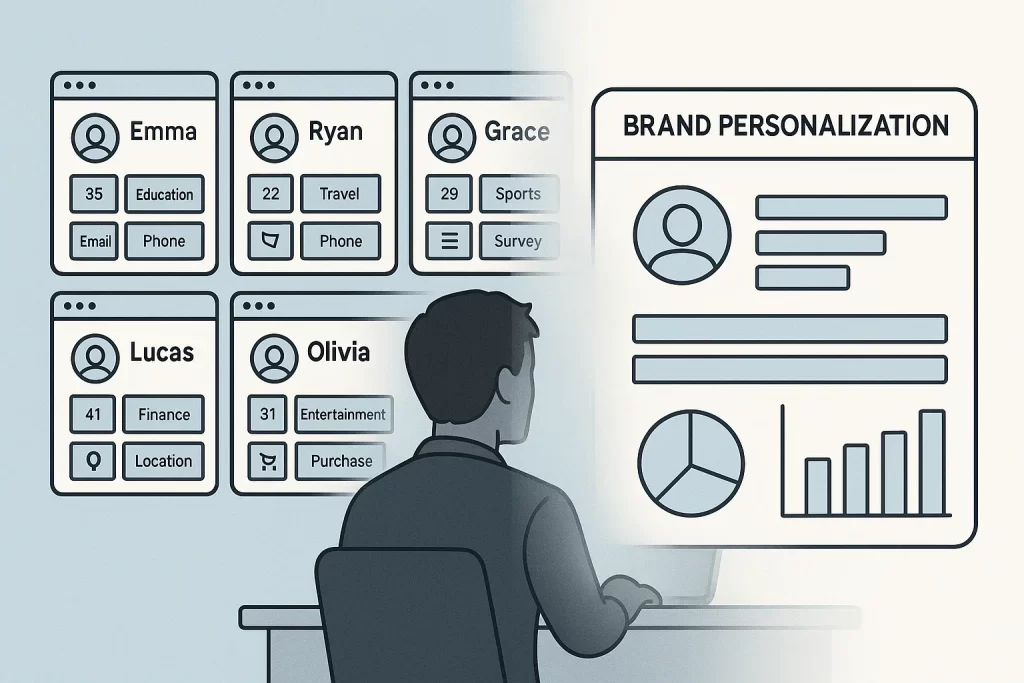
This is where it begins. To personalize anything, you must first know who you’re talking to. That means segmenting your users based on:
- Demographics
- Behavior (clicks, purchases, time spent)
- Psychographics (values, goals, motivations)
- Contextual triggers (location, device, real-time actions)
“Even small, incremental improvements to personalization can drive significant results at scale.” — Dynamic Yield
Solving Key Challenges : “We have traffic but no conversions.”
Segmentation lets you identify micro-audiences and tailor your messaging accordingly.
2. Personalization Rules & Triggers
Once you’ve segmented your audience, define rules that dictate what they see and when. Examples include:
- If user abandons cart → Then show exit-intent pop-up with incentive.
- If user visits “pricing” page 3 times → Then email pricing guide with case study.
AI tools and platforms like OptiMonk and Salesforce Interaction Studio use these logic layers to enable dynamic content delivery.
3. Content Orchestration Engine
This component controls what content is shown to whom. Think:
- Dynamic hero images
- Custom CTAs based on user persona
- Product recommendations
- Personalized landing pages
Many CMS platforms (like Webflow or HubSpot) now allow dynamic content swapping based on behavioral tags.
Solving Key Challenges
“Our content isn’t converting—it feels generic.”
Quote
“We do a mix of deep dives—looking at industry trends, company pain points, and even their tone of voice—and then weave that into everything from emails to landing pages.”
4. Tech Infrastructure & Data Stack
Terms: customer data platform (CDP), first-party data, CRM integration
Behind every seamless personalization system is a reliable data architecture. You need:
- Data Collection: via forms, tracking pixels, behavioral analytics
- Data Storage: ideally in a unified CDP
- Data Activation: synced with ad platforms, CMS, CRM
Expert Insight
“Use advanced AI and machine learning to scale personalization. Structure teams and capabilities to embed personalization in all customer interactions.” — McKinsey (2025)
5. Measurement Loop & Optimization
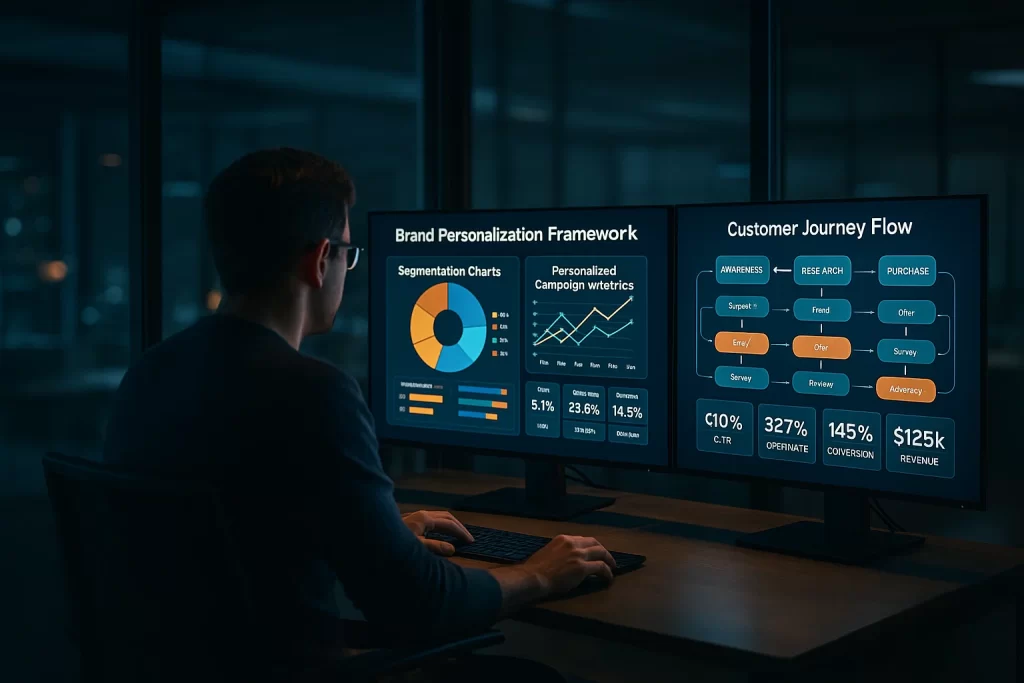
A personalization framework isn’t static—it evolves. Key metrics to track:
- CTR and conversion rates
- Segment-level engagement
- Campaign-specific ROI
- Churn rates and retention
Use A/B testing to validate assumptions, then iterate. Personalization without testing is just guesswork at scale.
Step‑by‑Step Building Blocks of a Brand Personalization Framework
Creating a brand personalization framework can seem overwhelming—but it doesn’t have to be. With a clear roadmap, even teams with modest resources can build a scalable and adaptive strategy. Here’s a step-by-step guide to building one from the ground up.
Step 1: Audit Your Current Ecosystem
Before building anything new, understand what you already have. Map all existing user touchpoints:
- Website content
- Email flows
- Social campaigns
- Ad copy
- Customer service scripts
Ask: Where are users dropping off? What messages perform best? What data are you collecting (or missing)?
Solving Key Challenges : “We don’t know what’s working or failing.”
Step 2: Map Customer Journeys
Now visualize your user’s experience from first touch to conversion (and beyond):
- Awareness
- Consideration
- Decision
- Loyalty
Plot the questions, emotions, and goals users have at each stage. Then map potential personalization layers to each.
Quote
“Mapping the customer journey reveals critical moments for tailored messaging.” — OptiMonk
Solving Key Challenges : “We don’t know when or where to personalize.”
Step 3: Segment and Define Personas
Create audience segments not just based on demographics, but:
- Behavioral signals (e.g., frequency of visits)
- Purchase intent
- Engagement stage
Use clusters like:
“Budget-conscious researchers,”
“Ready-to-buy professionals,”
“Repeat loyalists.”
Assign tailored content paths for each.
Step 4: Set Personalization Triggers and Rules
Based on journey and segments, define conditional logic:
- If a user downloads a whitepaper → Then show them a comparison guide
- If a visitor scrolls 75% on the product page → Then offer demo scheduling
Use tools like HubSpot, Salesforce, MoEngage, or custom scripts.
Expert Quote
“AI and generative AI allow marketers to orchestrate at scale, delivering millions of individually tailored messages.” — McKinsey, 2025
Step 5: Choose the Right Tools
Don’t get caught up in buzzwords—select tools based on needs:
- For behavioral tracking: Hotjar, Mixpanel
- For email personalization: Customer.io, Klaviyo
- For content delivery: Webflow CMS, Dynamic Yield
- For data unification: Segment, Bloomreach
Solving Key Challenges : “We can’t afford enterprise-level tools.”
Tip: Use low-code tools like Google Sheets + ChatGPT extension to start.
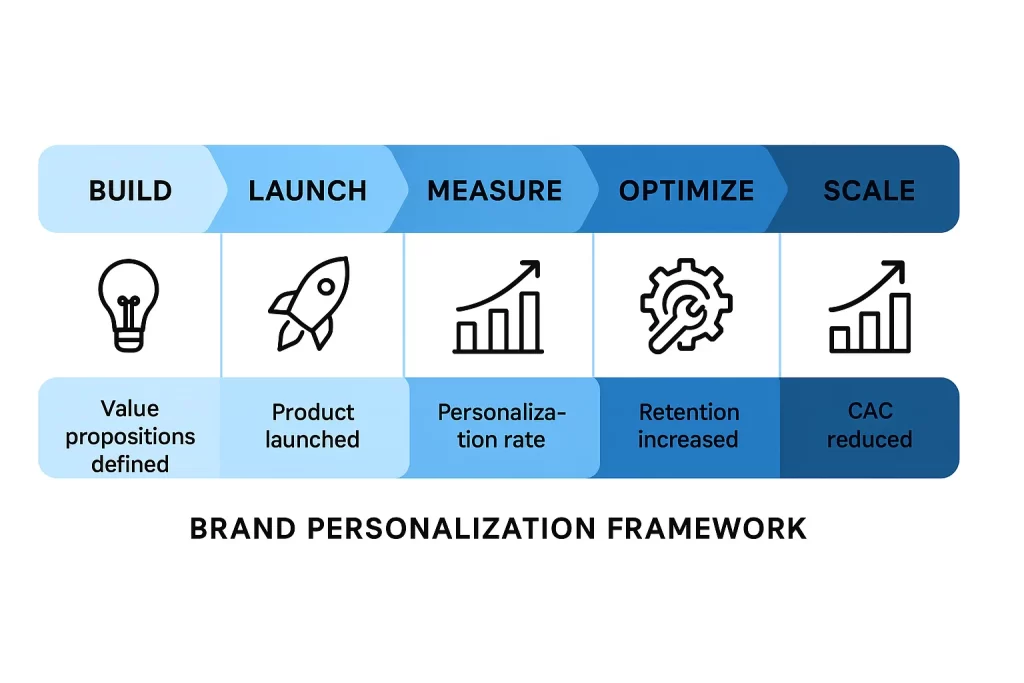
Step 6: Launch, Measure, Optimize
Start small: one journey, one segment, one channel. Then iterate based on:
- Engagement lift
- Time on page
- Conversion rate
- Retention
Document what works, expand gradually, and re-test.
Overcoming Common Challenges in Brand Personalization
Building a brand personalization framework is not just about tools and tactics—it’s about navigating real operational, ethical, and strategic barriers. Even experienced marketers encounter friction. Let’s explore the most common challenges and how to overcome them without compromising your brand or sanity.
1. Fragmented or Siloed Data
Problem: Your customer data is everywhere—email tools, CRM, web analytics—but nowhere unified.
Solution
- Start with a Customer Data Platform (CDP) like Segment or Bloomreach to centralize first-party data.
- Implement tracking consistency across all platforms with UTM structures and tag managers.
- Use tools that offer native integrations with each other or a common API.
Quote
“Collect, organize, and activate your data to form a single source of truth.” — Dynamic Yield, 2025
2. Privacy Concerns and Regulatory Risk
Problem: Consumers and regulators alike are watching. Over-personalization can feel creepy. Mishandling consent can lead to penalties.
Solution
- Use explicit opt-ins and layered consent mechanisms (GDPR/CCPA compliant).
- Personalize based on behavior, not identity, when in doubt.
- Provide transparency: explain what data you collect and why.
Expert Insight
“Consumer trust in AI-driven personalization hinges on transparent data practices.” — WJARR, 2023
3. Lack of Tech Expertise or Budget
Problem: Many assume personalization requires enterprise tools and engineers.
Solution
- Start with scrappy solutions like chatbots, Google Sheets, and manual segmenting in email tools.
- Use low-code/no-code platforms like Unbounce or MoEngage.
- Leverage AI integrations (e.g., OpenAI, Zapier) to scale personalization logic.
Quote
“Even small, incremental improvements to personalization can drive significant results at scale.” — Dynamic Yield
4. Difficulty Scaling Across Channels
Problem: Your email is tailored. Your website is not. Your ads say something else. This inconsistency erodes trust.
Solution
- Use journey-based orchestration tools (like Iterable or Customer.io) to manage messaging flows.
- Develop channel-agnostic personas and tone guides.
- Use centralized creative templates with dynamic fields for different channels.
Expert Quote
“Coordinate across functions, ensuring real-time adaptation to consumer responses.” — McKinsey, 2025
5. Fear of Getting It Wrong
Problem: Teams fear that incorrect personalization might alienate users or dilute the brand.
Solution
- Start with low-risk segments or non-critical journeys (e.g., onboarding emails).
- Always run A/B tests before full rollouts.
- Focus on value-first personalization: solve a user problem rather than show off tech.
Measuring Success and Scaling Your Brand Personalization Framework
The only way to evolve your personalization efforts is to measure what matters. Without feedback loops, even the most intelligent personalization strategies become stagnant. This section outlines how to evaluate performance, iterate intelligently, and eventually scale across the organization.
Defining the Right Metrics
Start by tracking the metrics that align directly with your brand and campaign goals. Common KPIs include:
- Conversion Rate (CR) – The ultimate measure of engagement effectiveness.
- Click-Through Rate (CTR) – Indicates how well your personalized message captures attention.
- Time on Page / Session Duration – Shows content relevance.
- Customer Lifetime Value (CLV) – Helps assess long-term impact.
- Return on Personalization Spend (RoPS) – Emerging metric: revenue increase attributable to personalized strategies.
- Churn Rate / Retention Rate – Reveals whether personalization builds loyalty.
Quote
“Companies with comprehensive personalization strategies see a 20% lift in conversion rates.” — Dynamic Yield, 2025
Tools for Tracking and Attribution
You can’t manage what you don’t measure. Use a combination of these tools:
- Google Analytics 4 (custom events and user cohorts)
- HubSpot or Salesforce (CRM-level tracking of segment responses)
- Hotjar / Microsoft Clarity (behavioral heatmaps)
- Amplitude or Mixpanel (for product personalization insights)
- Dynamic Yield / Optimizely (built-in A/B testing for personalized experiences)
Use UTMs and tags to distinguish between personalized vs. non-personalized campaigns.
Establishing a Feedback Loop
Your framework should be iterative. Here’s a simple loop:
- Launch a personalized message to a small audience.
- Measure results with segmented metrics.
- Analyze behavioral feedback (scrolls, exits, hovers).
- Optimize messaging, visuals, or targeting.
- Scale to more users or more channels.
When to Scale (and How)
You’re ready to scale when:
- You have 3–5 high-performing segments with reliable data.
- You’ve validated conversion lifts through testing.
- Your team can maintain personalization without burning out.
Scaling Tips
- Move from channel-specific to omnichannel orchestration.
- Assign a personalization owner inside your marketing org.
- Repurpose successful messages across similar audience clusters.
McKinsey reports that companies scaling personalization across journeys see “5 to 15% increases in revenue and 10 to 30% improvements in marketing-spend efficiency.”
Solving Key Challenges : “How Can We Justify More Investment?”
Without proof, it’s hard to ask for more budget or tools.
Here’s how to build the case:
- Start with a pilot project (e.g., abandoned cart email flow).
- Measure baseline vs. post-personalization metrics.
- Present attributable ROI to leadership with visuals and clear dollar-value impact.
- Tie it back to customer-centric strategy, not just “cool tech.”
FAQ
1. How do I start creating a personalization framework if I have limited data?
Customer Challenges: “We don’t have enough user data to segment or personalize yet.”
Start with behavioral signals already available in Google Analytics or your email platform:
- Pages visited
- Time on site
- Downloads or clicks
- Referrer source
You can also use zero-party data: ask users directly via onboarding surveys or lead gen quizzes.
“We started with just a single dropdown in our signup form asking what they wanted. That alone changed everything.”
Even limited data becomes powerful when used intentionally.
2. What tools are essential for brand personalization—do I need expensive software?
Customer Challenges : “We can’t afford Adobe or Salesforce.”
You don’t need an enterprise stack to start. Consider:
- Klaviyo for email-based personalization
- Unbounce or Webflow for dynamic landing pages
- Google Tag Manager for basic triggers
- Zapier to connect data across platforms
Use free tiers or trials. Build manual processes first and automate later.
3. How do I ensure personalization doesn’t feel creepy to customers?
Customer Challenges : “Where’s the line between personalized and invasive?”
Follow this rule: personalize by behavior, not identity.
Instead of saying:
“Hey Sarah, we saw you looked at Product X on Tuesday at 10:47AM…”
Say:
“Others exploring [Product X] also found this useful.”
Be transparent about data collection. Let users opt out or customize preferences.
According to Octopus Marketing, “Brand personalization works best when it feels like helpful intuition, not surveillance.”
4. How long does it take to see results from a personalization framework?
If executed thoughtfully:
- You can see micro-conversions improve (CTR, time on site) within 1–2 weeks.
- Revenue impact often becomes visible in 4–6 weeks.
- Full lifecycle ROI may take 3–6 months, depending on your funnel.
Start with high-intent segments (e.g., cart abandoners, product page viewers) for quick wins.
5. Can smaller brands really benefit from personalization frameworks?
Absolutely. In fact, smaller brands have an edge:
- Fewer bureaucratic layers
- More agility in testing
- Tighter feedback loops
Personalization doesn’t have to be massive—it just has to be meaningful.
Conclusion
A brand personalization framework isn’t just a marketing upgrade—it’s a transformational lens for how your brand communicates, sells, and grows.
In this article, we’ve explored:
- Why personalization is no longer optional in modern brand strategy and execution
- The foundational components of a scalable framework
- A step-by-step process to build, test, and optimize your strategy
- Common pitfalls—and how to avoid them
- How to measure impact and scale with confidence
But most importantly, we’ve grounded this in empathy: personalization is about respecting your audience’s time, needs, and context.
In a world flooded with generic messaging, personalized experiences feel like rare, human conversations. Whether you’re a solo founder or a global marketing team, building this framework is your pathway to brand relevance, resilience, and revenue.