
Building a Go‑To‑Market Blueprint: Steps for Launching a Brand Successfully
Introduction
Brand Go-To-Market Blueprint is not just a fancy term—it’s the scaffolding upon which successful brand launches are built. In today’s hyper-competitive ecosystem, over 90% of startups fail due to lack of market need, unclear messaging, or team misalignment (CBInsights, 2024). A brand go-to-market strategy that’s well-structured, research-driven, and adaptive is critical to mitigate these risks.
This article decodes the go to market strategy for startups by extracting insights from five high-ranking GTM resources and blending them into a practical six-step blueprint. By aligning team efforts, defining messaging, and launching in a staged and validated manner, brands can drastically improve their chances of success.
From what is a brand blueprint to how to create a go to market plan, this guide covers everything a modern brand needs to launch confidently.
Why a Go-To-Market Blueprint Matters
Many founders and marketing leaders mistake hustle for strategy. They rush into markets with flashy campaigns and high hopes—only to find their product misunderstood, ignored, or overshadowed. What’s often missing is a structured path that bridges internal readiness with external resonance. That’s precisely what a go-to-market blueprint delivers.
A Brand Go-To-Market Blueprint is a systematic approach to bringing a product or service to market with alignment, intentionality, and strategic foresight. It ensures that every moving part—product development, messaging, marketing channels, sales strategy, and customer feedback loops—are synchronized around a single, unified mission: market success.
The Cost of Launch Failure
The absence of a defined GTM strategy leads to some of the most common—and costly—mistakes in brand history. A 2023 Gartner study found that 68% of product launches underperform revenue expectations due to one or more of the following reasons:
- Lack of market research
- Misaligned messaging
- Team fragmentation
- Undefined launch KPIs
These aren’t abstract failures—they translate into lost budget, damaged brand equity, and sometimes, the collapse of the business itself.
“Startups often mistake movement for progress. Without market validation and structured rollout, all you’re doing is scaling risk.”
— Ben Horowitz, Andreessen Horowitz
The startup world is filled with post-mortems that echo this theme: “We built the wrong thing,” “We launched too early,” “We couldn’t articulate our value.” These are all symptoms of skipping the blueprint.
Benefits of a Structured Framework
When you build a go-to-market blueprint, you empower your team to:
- Reduce ambiguity : Clear steps, shared metrics, and aligned roles eliminate chaos and duplication.
- Maximize team alignment : GTM plans synchronize the efforts of product managers, marketers, and sales teams.
- Create messaging that lands : By basing copy, tone, and brand voice on persona-led research, you avoid the guesswork.
- Scale with insight : Rather than winging it, you track key performance indicators (KPIs) like customer acquisition cost (CAC), payback period, and retention from day one.
According to a study by Forrester Research, organizations that deploy a unified GTM strategy see a 33% increase in campaign effectiveness, and are 56% more likely to achieve or exceed revenue goals in the first six months post-launch.
A Brand Go-To-Market Blueprint is only as effective as the components it includes. Like the beams and foundation of a building, each part supports the entire structure. This section breaks down the essential components that ensure your go-to-market launch isn’t a flash-in-the-pan event—but a repeatable, scalable success.
These components are derived from the analysis of top GTM frameworks used by consultancies like McKinsey, HubSpot, First Round, and startups that scaled from seed to Series C.
Market and Audience Research
Before you design your launch campaign, you must understand your terrain. This means conducting extensive market research that includes:
- Customer segmentation : Who are your primary, secondary, and tertiary buyer personas? What are their motivations, fears, and unmet needs?
- Problem validation : What urgent problems are they trying to solve? How painful is the status quo?
- Competitive landscape : What alternatives do they currently use? Where are those solutions falling short?
Tools to use: Google Trends, SparkToro, SEMrush, Customer interviews, Surveys
Brand Positioning and Messaging
This is where strategy meets storytelling. Positioning defines what you stand for in the market, and messaging turns that into a compelling narrative that customers believe in.
Key outputs of this stage:
- Unique Value Proposition (UVP) : What makes you different and better?
- Core Brand Message : A one-sentence summary of who you help, what you solve, and how.
- Message hierarchy : Tailored versions of your messaging for buyers at different awareness levels.
- Tone of voice : How your brand sounds and feels. Should you be bold, friendly, technical, aspirational?
Use frameworks like the Value Proposition Canvas and Brand Archetypes to build consistency.
Channel and Distribution Planning
You’ve got the message—now how do you deliver it?
Your go to market business model must define which acquisition channels (owned, paid, earned) are the best fit for:
- Budget
- Audience behavior
- Brand maturity
- Industry norms
Channel categories :
- Digital Paid : Google Ads, Meta Ads, LinkedIn Ads
- Owned Content : SEO, Blogs, Webinars
- Partnerships : Co-marketing, Affiliates, Referrals
- Physical Presence : Pop-ups, Events, Retail
Sales and Team Alignment
One of the most overlooked GTM components is internal synchronization. Your product, marketing, sales, and customer success teams must march in lockstep.
Key assets that drive alignment:
- GTM Playbook : Document roles, messaging, timelines, and assets.
- RACI Matrix : Clarify who is Responsible, Accountable, Consulted, and Informed for every launch phase.
- Shared OKRs : All departments should be measured by launch success, not just marketing.
Launch Timeline and Metrics
This is your operational control center. A good GTM blueprint includes a launch calendar with phases like:
- Internal enablement
- Soft launch
- Public launch
- Post-launch optimization
Each phase should be tied to specific metrics like:
- CAC (Customer Acquisition Cost)
- NPS (Net Promoter Score)
- Conversion rate per channel
- Lead velocity rate
- Brand share of voice
Use dashboards (Google Data Studio, Looker, HubSpot) to monitor in real-time.

The Cross‑Analysis Approach: Learning from Top GTM Articles
What makes this Brand Go-To-Market Blueprint unique is not just its structure, but its source. Rather than relying on a single expert, method, or company playbook, it synthesizes the most effective practices from the top five performing go-to-market strategy articles and frameworks across the web.
These sources include:
- HubSpot’s Go-To-Market Strategy Guide (known for tactical simplicity)
- McKinsey’s Market Entry Strategy Playbook (strategy-heavy with enterprise use cases)
- Harvard Business Review’s GTM Essays (deep in organizational alignment)
- First Round Capital’s Startup GTM Advice (founder-centric and stage-agnostic)
- OpenView’s SaaS GTM Framework (B2B specialization with data-backed sequencing)
Each source brings its own strength, but also certain blind spots. By studying, mapping, and comparing them, this guide extracts what’s universal, challenges what’s contradictory, and adds nuance where needed.
What the Best Articles Agree On
Despite differences in voice and industry focus, all top-tier GTM frameworks converge on a few critical points:
1. Market Research First
All five agree that a deep understanding of customer pain points, behaviors, and buying triggers is foundational. Skipping this leads to misfires in every downstream phase.
2. Messaging Before Channels
Successful GTM plans prioritize positioning and messaging over channel decisions. The logic? Even the best ads won’t perform if they’re built on unclear or irrelevant messaging.
3. Metrics Must Be Defined Early
Rather than waiting until after launch to decide on KPIs, the best frameworks emphasize defining success before the campaign even begins. This ties objectives to execution.
4. Cross-functional Ownership is Non-Negotiable
GTM isn’t “a marketing thing.” All respected playbooks underscore the need for shared responsibility across departments—especially sales, product, and customer success.
Where They Diverge—and Why Synthesizing Matters
While aligned on core themes, these guides diverge sharply on execution order, channel focus, and launch timing:
A. Messaging vs. Product-Led Launch
Some (like First Round) recommend messaging first, even pre-product, to test interest. Others (like McKinsey) prioritize product readiness and performance metrics first, then layer in messaging.
Resolution in This Blueprint: Blend both. Use messaging to validate demand (soft launch) before fully scaling with product.
B. Digital Channels vs. Partnerships
HubSpot leans on digital-first strategies—SEO, paid ads, inbound content—while OpenView emphasizes partnerships, community, and sales plays in B2B GTM.
Resolution in This Blueprint: Recommend 70/30 mix—test low-cost digital + high-impact B2B partnerships.
C. Speed vs. Precision
Some guides (e.g., First Round) promote rapid iteration and MVP launches, while HBR and McKinsey caution against hasty rollouts that lead to brand damage.
Resolution in This Blueprint: Prioritize “soft launch” testing phase before a full-scale launch to balance learning and brand protection.
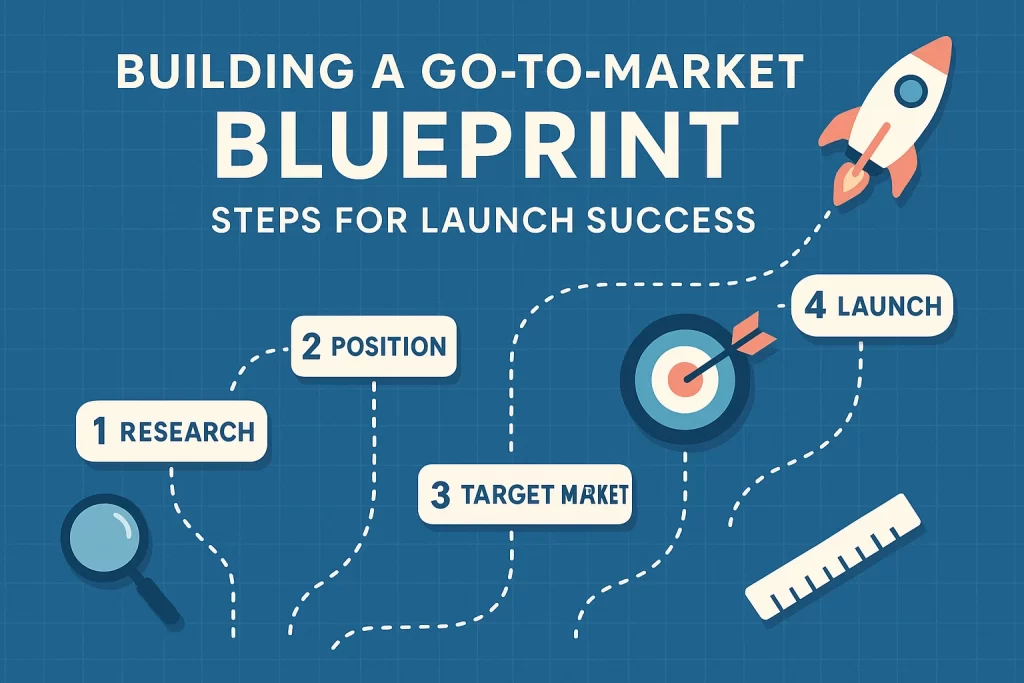
Step-By-Step GTM Launch: Brand Go-To-Market Blueprint
The heart of this article lies in this structured, six-step blueprint. Each phase is strategically designed to build momentum, minimize risk, and optimize learning—so that your brand launch is not just an event, but a scalable, revenue-generating engine.
This framework is applicable across industries, but particularly powerful for startups, SaaS companies, direct-to-consumer brands, and new market entrants looking to reduce guesswork and increase traction.
Step 1: Research & Discovery
Objective : Validate your market assumptions and uncover buyer truths.
Before creating assets or choosing channels, deeply understand the terrain. This includes:
- Buyer persona development : Go beyond demographics—map out pain points, objections, desired outcomes.
- Voice of customer (VoC) interviews : Talk to real prospects or early users.
- Competitive teardown : Who are your direct and indirect competitors? What’s their messaging? Which channels do they dominate?
- Market sizing : How large is the total addressable market (TAM), serviceable obtainable market (SOM), and expected share?
Tools: Google Trends, Ubersuggest, Ahrefs, SparkToro, Typeform
Step 2: Positioning & Messaging
Objective: Craft narratives that resonate with your ideal buyers.
This is where emotional intelligence meets strategic insight. Start by:
- Clarifying your Unique Value Proposition (UVP) : What do you offer, to whom, and why it’s better or different?
- Developing a Brand Messaging Hierarchy:
- Elevator pitchProduct tagline3-pillar messaging points
- Objection handling scripts
- Matching tone to persona : Should you sound authoritative (enterprise SaaS), playful (DTC), or empathetic (healthcare)?
Tactical Tip: Use A/B testing in email subject lines or ad headlines to validate early-stage messaging.
Step 3: Channel Strategy
Objective: Select the most effective and cost-efficient routes to reach your market.
Use the bullseye method : test across multiple channels with small experiments, then double down on the top performers.
Channel Options
- Owned Media : SEO blog, YouTube, email list
- Paid Media : Meta ads, Google Ads, LinkedIn Ads
- Earned Media : Press, influencer mentions, guest podcasts
- Partnerships : Strategic B2B integrations, affiliate partners, co-marketing
Channel Selection Criteria
- Where your audience spends time
- Cost per acquisition (CPA)
- Sales cycle length
- Brand trust requirement (e.g., high trust = referrals > ads)

Step 4: Pre‑Launch Pilot or Soft Launch
Objective: Validate assumptions with a smaller audience to de-risk your main launch.
This is your dress rehearsal. It prevents embarrassing public missteps and offers invaluable feedback.
Tactics:
- Run a limited geographic or audience rollout
- Launch to a waitlist or early access group
- Use email nurturing to guide early adopters through a pre-product experience
- Collect qualitative feedback (surveys, interviews) and quantitative data (click-through rates, heatmaps, NPS)
Step 5: Full Launch Execution
Objective: Launch with clarity, confidence, and coordination across every touchpoint.
By this point, your team is trained, assets are tested, and messaging is polished. Now it’s time to:
- Deploy launch content (emails, press releases, landing pages)
- Activate ad campaigns across winning channels
- Empower sales team with enablement kits : battle cards, pitch decks, FAQs
- Engage customer success with onboarding scripts and launch support
Key Success Factors:
- A centralized GTM command center (Asana, ClickUp, Notion)
- Real-time dashboards for key metrics
- Cross-functional daily syncs for the first 7 days
Step 6: Monitor, Iterate & Scale
Objective: Capture results, optimize in real-time, and systematize what works.
Now comes your feedback loop:
- Use tools like Google Data Studio, Mixpanel, or Looker to track engagement, retention, conversion
- Double down on high-performing channels, ad variations, or content formats
- Interview buyers who converted—and those who didn’t
- Apply insights to refine pricing, positioning, or user experience
This step transforms a launch from a one-time event into a repeatable growth engine.
Key Metrics to Track :
- CAC, ROAS (Return on Ad Spend)
- Conversion Rate per channel
- NPS, CSAT
- Funnel velocity
Solving the Hidden Struggles Behind Most Brand Launches
While frameworks and checklists are essential, what truly derails most go-to-market efforts isn’t a missing tool—it’s the real-world struggles that brands face behind the scenes. These are the unspoken anxieties that founders, marketers, and product leaders experience when bringing something new to market.
1. “We don’t know where to start.”
This is perhaps the most common fear, especially for first-time founders and early-stage marketers.
Problem: Teams jump straight into channel decisions or creative design before validating product-market fit or crafting a unified brand story.
Solution: Don’t spend a dime until you’ve:
- Identified your top 2–3 buyer personas
- Mapped their daily frustrations
- Confirmed that your solution addresses a real and urgent problem
Use simple frameworks like:
- Problem-Solution Fit Canvas
- Customer Discovery Interviews
- Pain-Point Mapping Worksheets
2. “Our teams aren’t aligned.”
“Marketing created this great landing page, but sales had no clue what the messaging even meant.” — B2B growth lead, Quora discussion
Problem : Departments operate in silos. Marketing crafts messages without sales input. Product builds features with no user feedback. This leads to inconsistent experiences, dropped leads, and finger-pointing.
Solution:
- Build a GTM playbook—one source of truth that outlines:
- PositioningKey personasMessaging by stage of funnelFAQ responses
- Launch timeline
- Set up weekly cross-functional standups for the 30 days before launch
- Use a shared RACI chart to define responsibilities and accountability
3. “We don’t have a real process—just a checklist.”
“Every launch feels like we’re winging it. No repeatable system, no postmortem learnings.” — Comment from IndieHackers forum
Problem: Most teams treat a brand launch like a one-time campaign, rather than a modular process that can be replicated, improved, and scaled.
Solution: Treat your GTM strategy as a product in itself—with iterations, retrospectives, and playbooks.
Here’s how:
- Turn your six-step blueprint into a documented SOP (standard operating procedure).
- After launch, host a GTM retrospective with every department:
- What worked?What failed?
- What surprised us?
- Tag all GTM assets in your CMS (Notion, Confluence, Trello) so future launches can reuse the best materials.
Real-World Example: A Brand GTM Story
Let’s take the hypothetical example of HarmoHome, a direct-to-consumer startup selling sustainable home décor.
The Challenge:
HarmoHome had strong product-market fit based on early Etsy reviews but struggled to scale. Their initial launch failed to gain traction—ads underperformed, messaging felt generic, and the sales team wasn’t briefed on product features.
The Pivot:
Using the six-step Brand Go-To-Market Blueprint, they:
- Conducted fresh persona interviews to refine messaging
- Crafted a UVP focused on eco-luxury and emotional home design
- Ran a soft launch via email to early subscribers, collecting feedback on their landing pages
- Rebuilt their launch plan with shared Slack channels, Notion timelines, and a unified sales-marketing playbook
The Result:
Within 60 days, they improved CTR by 3.4x, dropped CAC by 28%, and secured a retail partnership with a regional home goods chain.
Visual Asset Suggestions
Visuals make your go-to-market plan easier to understand, align teams faster, and drive decisions. Here are five key visual assets to include:
- Customer Journey Map – Shows how your buyer moves from unaware to purchase. Use early in research.
- Messaging Pyramid – Outlines your brand voice from top-level purpose down to persona-based copy.
- Channel Strategy Matrix – Helps prioritize where to market based on impact vs. effort.
- Launch Timeline – A Gantt chart showing tasks, owners, and deadlines for pre-launch and launch weeks.
- KPI Dashboard – Post-launch analytics in one view: CAC, conversion rate, ROAS, and more.
Each of these visuals supports one of the six GTM steps and should be integrated into your planning docs or GTM playbook.
FAQ
1. What is a brand blueprint?
It’s a strategic document outlining how a brand enters and scales in a market, covering research, positioning, messaging, and metrics.
2. How to create a go to market plan for a startup?
Begin with customer research, define your UVP, select acquisition channels, test messaging in a soft launch, then scale.
3. How do I align teams on a go to market strategy?
Establish a unified roadmap, clarify roles, and hold weekly stand-ups. Use shared dashboards and cross-team Slack channels.
Conclusion
Launching a brand is less about luck and more about clarity, preparation, and team unity. This Brand Go-To-Market Blueprint, distilled from the best in the business, gives you a repeatable process to turn chaos into coordination, and doubt into traction.