
Brand Purpose Activation: From Definition to Impact-Driven Strategies
Introduction
In today’s business environment, brand purpose has transcended trend status to become a fundamental strategic imperative. As consumers, employees, and investors demand more authenticity, responsibility, and clarity from brands, companies are being compelled to define not just what they do, but why they do it.
Brand purpose activation refers to the process of transforming a brand’s aspirational mission into tangible, measurable experiences across every touchpoint—from product design to internal culture to customer service. It means ensuring the company’s deeper reason for existing isn’t confined to the About page but lives and breathes in every business decision, message, and interaction.
“A clear and compelling brand purpose is crucial in today’s hyper-competitive market.” — Branding Strategy Insider
This is not mere theory. Research supports the tangible power of purpose:
- According to Deloitte’s 2022 “Global Marketing Trends” report, brands with strong purpose outperform competitors by 10x.
- Edelman reports that 64% of consumers choose brands based on shared values.
- A Gallup study shows that purpose-driven companies have higher employee engagement and retention.
Such numbers aren’t just impressive—they point to a paradigm shift. Brand purpose is no longer optional; it’s foundational.
This guide tackles these questions with clarity and strategy. Drawing on insights from Deloitte, Capgemini, Branding Strategy Insider, and purpose-driven brand case studies, we’ll map the journey from defining brand purpose to embedding it in culture, communication, and the marketplace.
What Is Brand Purpose vs Mission vs Vision?
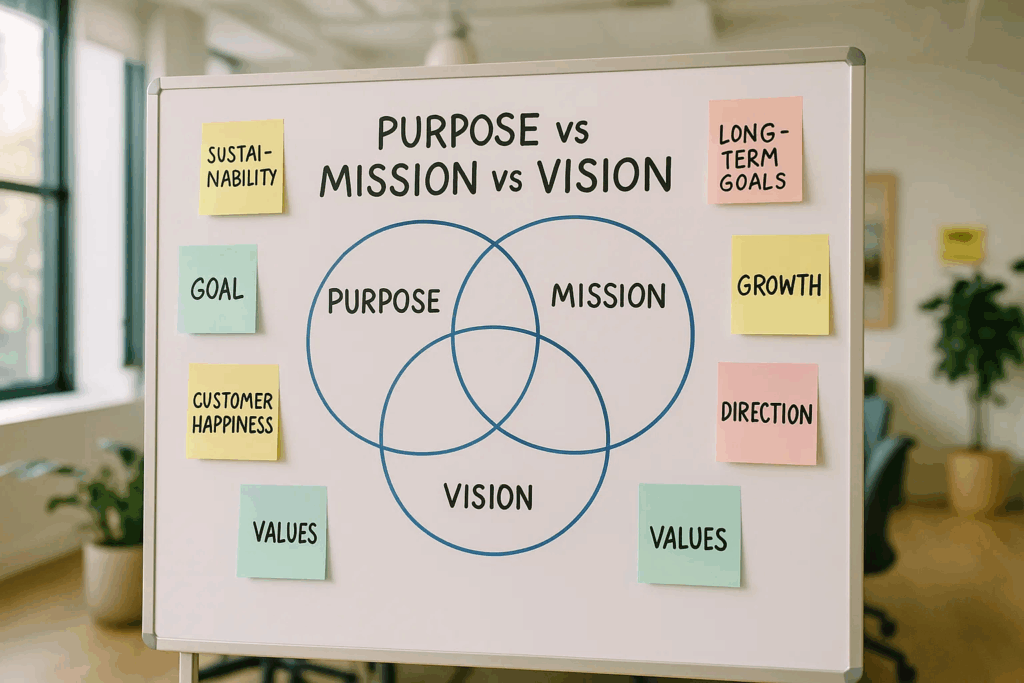
Despite their frequent interchangeability in business conversations, brand purpose, mission, and vision represent distinctly different elements of a company’s identity. Conflating them leads to confusion, diluted messaging, and missed opportunities for differentiation.
Clarifying Definitions
Let’s break down each concept to its core:
- Brand Purpose is the foundational “why”—the emotional and moral reason your company exists. It answers, “Why does our brand matter in people’s lives?”
Example: Patagonia’s purpose is “We’re in business to save our home planet.” - Mission reflects the “what” and “how”. It outlines what the company does daily to fulfill its purpose.
Example: Patagonia’s mission is “Build the best product, cause no unnecessary harm…” - Vision describes the aspirational “where”. It’s a future-focused narrative of the world the brand wants to help create.
Example: “A world where nature thrives, and human impact is regenerative.”
This simple semantic distinction helps companies frame their brand identity with clarity. When brands confuse mission with purpose, they risk sounding like every other brand—functional, but forgettable.
To clarify even further:
| Element | Question Answered | Time Orientation | Example (Patagonia) |
| Purpose | Why do we exist? | Eternal/Timeless | To save our home planet |
| Mission | What do we do and how? | Present/Active | Build best products, cause no harm |
| Vision | What future do we desire? | Future/Aspirational | A sustainable and thriving world |
Why It Matters
Understanding and clearly differentiating these elements is not just semantic hair-splitting—it’s strategic necessity.
A brand purpose connects with audiences at an emotional level. It builds trust, loyalty, and advocacy in an age when customers increasingly base purchase decisions on values, not price.
A mission guides operational focus and decision-making, while a vision sets a long-term horizon for strategy and innovation.
- According to Accenture, 62% of consumers prefer to purchase from brands that stand for a purpose.
- Gallup found that employees in purpose-aligned organizations are 3x more engaged.
Brands like Dove (Real Beauty), Warby Parker (Buy a Pair, Give a Pair), and even Nike (Equality campaigns) have leveraged strong purpose narratives to deepen customer relationships and outperform competitors.
“If you don’t define your purpose, someone else will — likely your customer or competitor.” — Capgemini Purpose Strategy Report
Strategic Steps to Define Your Brand Purpose
Activating a brand purpose begins with defining it. But this isn’t just a brainstorming session—it’s a structured, stakeholder-driven strategy process that taps into internal values, external needs, and long-term impact.
1. Anchoring in Core Values
Your brand’s core values are the raw material of your purpose. Before you define why you exist, you must know what you stand for.
Workshop Methodology:
- Gather a cross-functional team (leadership, customer service, marketing).
- Use sticky-note ideation around the prompt: “What behaviors do we reward?”
- Cluster and prioritize recurring themes like sustainability, empathy, excellence, etc.
Tool:
Use the “Golden Circle” framework by Simon Sinek:
- Why – your cause
- How – your unique process
- What – your products or services
“People don’t buy what you do. They buy why you do it.” — Simon Sinek
Many companies discover their purpose when they step back from product features and consider their human impact.
2. Mapping Customer Needs and Pain Points
Your brand exists not in a vacuum but in the lives of real people. Defining purpose means asking: What human tension do we relieve? What cultural or emotional role do we play?
Methods:
- Conduct empathy interviews with top customers.
- Analyze support tickets and FAQs.
- Use AI tools to mine Reddit threads and Quora queries for your category.
Framework: Pain Point → Emotional Need → Purpose Alignment
- If you relieve “overwhelm” → your purpose might be about “simplifying complexity.”
- If you serve “eco-conscious families” → your purpose could revolve around “sustaining generations.”
3. Co-Creation with Stakeholders
The most resonant brand purposes are not dictated—they are discovered through collaboration. Involve key stakeholders at every level: leadership, employees, customers, and even community partners.
Tactics:
- Host “Brand Narrative Co-Creation” workshops with diverse voices.
- Use anonymous digital surveys to source emotional language from team members.
- Analyze social listening tools to see how your audience describes you.
Imaginary Anecdote:
“At one fintech startup, a 23-year-old intern questioned their entire mission during a workshop. Her perspective on financial literacy for immigrants reframed the company’s entire purpose narrative.”
Together, these three steps—anchoring in values, mapping customer needs, and co-creating with stakeholders—form the strategic foundation of any lasting and actionable brand purpose.
Examples of Purpose-Driven Brands
Nothing clarifies theory like example. The following brands have not only defined their brand purpose but activated it successfully across products, marketing, and operations. Their stories serve as roadmaps for inspiration and application.
1. Iconic Global Examples
Patagonia
- Brand Purpose: “We’re in business to save our home planet.”
- How It’s Activated: From donating 1% of sales to environmental causes, to suing the U.S. government over protected land, Patagonia consistently puts purpose before profit.
- Result: A fiercely loyal customer base and sustained growth despite minimal advertising.
Dove
- Brand Purpose: “To help women everywhere develop a positive relationship with the way they look.”
- Activation Strategy: The “Real Beauty” campaign featured non-model women, sparking a global conversation about beauty standards.
- Result: Brand sales soared by $1.5 billion over a decade, proving the ROI of purpose-led campaigns.
TOMS Shoes
- Brand Purpose: “To improve lives through business.”
- Action: Launched the “One for One” model—donating a pair of shoes for every one sold.
- Impact: 100 million pairs donated globally, and a category-defining model for purpose activation.
2. Mid-Size and Regional Illustrations
Bare Necessities (India)
- Brand Purpose: To make sustainable living easy and accessible in India.
- Actions: Plastic-free packaging, zero-waste product lines, community education programs.
- Impact: Built a cult following among eco-conscious millennials and Gen Z shoppers.
Benevolent Health (UK)
- Purpose: To reduce health inequalities through culturally sensitive mental health services.
- Activation: Launched multilingual telehealth therapy in underserved communities.
- Result: Recognized by NHS partnerships and UN Women.
Oorvi Sustainable (India)
- Purpose: Destigmatizing menstruation through reusable sanitary products and awareness.
- Activation: Purpose is integrated in workshops for rural women and government partnerships.
- Impact: 50,000+ reusable pads distributed and 500+ workshops conducted.
These brands prove that purpose is not just for Fortune 500 companies—small and mid-size businesses can embed purpose and win customer trust at scale.
“When you have purpose, you don’t need a massive marketing budget. Your users become your evangelists.” — Founder, Bare Necessities
This section bridges inspiration with strategy—showing what’s possible and how brands of any size can model success.
Activating Brand Purpose in the Marketplace
Defining your brand purpose is only half the journey. The real impact begins when that purpose is made visible and tangible across every customer, employee, and stakeholder interaction. This is the true meaning of brand purpose activation: taking values off the wall and weaving them into your brand’s everyday presence.
Embedding Into Brand Touchpoints
Your brand is only as purposeful as your touchpoints communicate. This includes:
- Website: Is your purpose front-and-center or buried in your About page?
- Packaging: Are you using recyclable materials that reflect a sustainability message?
- Customer Support: Do your scripts reflect empathy and brand values?
- Retail & Physical Spaces: Does your store layout, music, signage reinforce your emotional intent?
Example:
- A skincare brand committed to anti-aging without toxins embeds its purpose by:
- Listing all ingredients transparently
- Including “purpose icons” on packaging
- Training sales reps on sustainability science
Client Challenges: Many businesses say, “We’ve defined our purpose, but it doesn’t show up in our day-to-day.”
Solution: Conduct a Purpose Audit across every customer-facing channel.
Internal Alignment and Culture
Before customers believe your purpose, your team must live it. Internal activation is often the missing link in failed purpose strategies.
Activation Methods:
- Onboarding: Include a “Purpose Orientation” module.
- Employee Stories: Feature real staff living the values.
- Recognition Programs: Reward purpose-aligned actions, not just KPIs.
“Employees must believe the purpose to deliver it authentically.” — Capgemini Purpose Culture Study
Example: A global logistics firm created a “Purpose Champions Circle”—a cross-department group that shared weekly stories of customer impact.
Tools:
- Internal brand toolkit
- Slack “Purpose Moments” channel
- Quarterly purpose-check-ins with leadership
Measuring Impact
What gets measured, gets managed—and believed. The only way to prove purpose is working is to track it like performance.
Impact Metrics to Consider:
- Brand Sentiment: Track NPS and customer emotions in feedback.
- Behavioral KPIs: Social shares, campaign click-throughs on cause-related content.
- Cultural Adoption: Employee survey scores around belief in the brand.
“64% of employees feel more motivated when they believe in the company’s purpose.” — Edelman Trust Barometer
Tools to Use:
- CultureAmp: Internal culture pulse surveys
- Brandwatch: External brand sentiment tracking
- Qualtrics XM: Real-time customer experience analysis
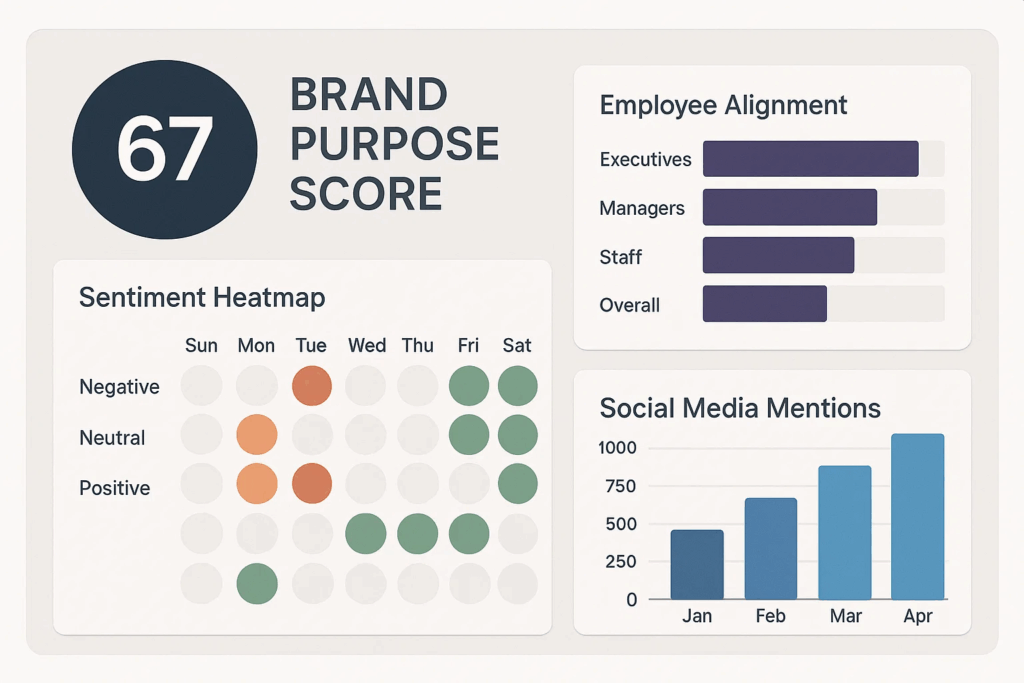
This section transforms the concept of purpose from abstract values into measurable, market-facing proof. Without this, purpose remains a feel-good poster instead of a competitive advantage.
Common Pitfalls & How to Avoid Them
Even well-intentioned brands often stumble when activating purpose. Whether it’s due to misalignment, miscommunication, or poor measurement, these pitfalls can dilute authenticity and breed consumer skepticism. This section outlines the most frequent mistakes—and how to prevent them.
1. Purpose-Washing and Inauthenticity
Definition:
Purpose-washing occurs when a brand makes bold claims about its values but fails to back them up with real action. It’s the CSR equivalent of greenwashing.
Examples:
- A soda brand launching a vague “unity” campaign without organizational diversity.
- A fashion brand celebrating International Women’s Day while underpaying female garment workers.
“Consumers don’t just reject inauthentic brands—they punish them.” — Edelman Trust Barometer
Pain Point: Customers feel betrayed when purpose isn’t lived consistently.
Fix:
- Only champion causes that tie to your brand DNA.
- Apply the 5C Filter: Is your purpose Clear, Consistent, Credible, Cultural, and Cared-for?
2. Lack of Executive Buy-In
Without leadership endorsement, purpose initiatives rarely last.
Signs of Resistance:
- C-Suite sees purpose as “marketing’s job.”
- Leaders avoid talking about values in shareholder meetings.
- No one at the top models behavior aligned with the purpose.
Solution:
- Align purpose with business KPIs (growth, retention, profit).
- Make purpose part of the CEO dashboard.
- Embed in performance reviews.
“Purpose-led transformation only works when the top models the values they expect to see.” — McKinsey Culture Report
Tool:
Leadership Alignment Workshop Toolkit
3. Poor Integration Across Channels
Even strong brand purposes can get lost in translation when different departments interpret them inconsistently.
Symptoms:
- Marketing pushes purpose messaging, but Sales uses price-only pitches.
- HR hires on skills, not values.
- Social media says one thing; customer service does another.
Fixes:
- Develop a Purpose Playbook for each team.
- Hold monthly cross-functional syncs to align on messaging.
- Audit your touchpoints for tone, language, values adherence.
Example:
One retail brand discovered that its “inclusive beauty” tagline clashed with website images showing only light-skinned models. They launched a visual overhaul after conducting a brand consistency audit.
Each of these pitfalls is avoidable—with intentional strategy, honest reflection, and operational alignment. The brands that succeed treat brand purpose as a system, not a slogan.
Tools, Frameworks & Templates
Activating brand purpose isn’t just about inspiration—it’s also about infrastructure. This section provides the frameworks, templates, and technologies that make purpose measurable, repeatable, and scalable across teams.
Brand Purpose Frameworks
1. Simon Sinek’s Golden Circle
- Why → How → What
- Helps teams start with purpose (“why”) instead of features (“what”).
- Best used during leadership and branding workshops.
2. Purpose Ladder (Harvard Business Review)
- Connects tactical activities to abstract goals.
- Useful for aligning employee behavior to purpose.
3. Edelman Trust Model
- Highlights how trust is built through action, not just messaging.
- Especially relevant in industries recovering from consumer cynicism (finance, pharma, tech).
Templates & Workshop Guides
Templates ensure consistency and allow scalable implementation of purpose across teams and departments.
Recommended Templates:
- Brand Purpose Statement Template
(Includes: What we stand for, Who we serve, The change we want to make) - Purpose Audit Checklist
(Touchpoints scored for alignment with core values) - Employee Onboarding Slide Deck
(One slide per value, use-case stories, team behaviors) - Internal Workshop Agenda
(90-minute sprint with stakeholder mapping, emotional storytelling, value clustering)
Software & Platforms
In the age of data, tracking purpose activation across digital and internal channels is essential.
Recommended Tools:
- Brandwatch – Tracks sentiment and brand purpose alignment in customer conversations.
- Qualtrics XM – Measures emotional resonance of branding and customer experience.
- CultureAmp – Monitors employee alignment, motivation, and purpose buy-in.
- Notion or Miro – Use for collaborative co-creation of mission/value maps.
Bonus Tool:
- Purpose Scorecard: A weighted rubric scoring every customer and internal touchpoint against brand values (can be custom-built in Airtable or Excel).
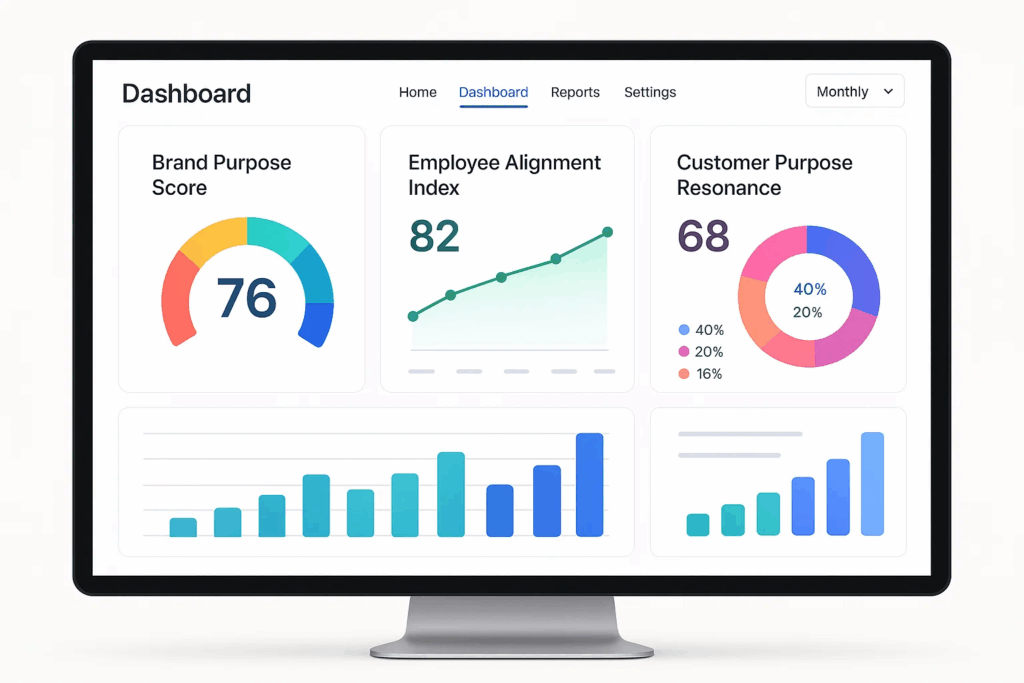
This toolbox enables brands to turn purpose into performance—with structure, data, and shared language. Activation doesn’t happen in strategy decks—it happens in systems.
FAQ
1. How do I define brand purpose for a small business?
Even small businesses have the power to shape the world around them—often more intimately than large corporations. The process is similar but scaled to fit smaller teams:
Steps:
- Identify your most passionate customer segment.
- Ask: What problem do we solve that others don’t?
- Draft a “why” statement that speaks to human emotion, not just product utility.
2. Brand purpose vs vision—what’s the difference?
This question confuses even seasoned marketers. Here’s a quick rule:
| Brand Purpose | Vision Statement |
| Why we exist | Where we’re going |
| Emotional, eternal | Aspirational, future |
| Focuses on meaning | Focuses on outcome |
Example:
- Purpose: “To democratize access to financial literacy.”
- Vision: “To be the leading app for financial wellness in underbanked regions by 2030.”
3. What are examples of brand purpose done well?
Some of the most frequently cited examples include:
- Patagonia – Protecting the environment
- Dove – Promoting self-esteem
- Warby Parker – Access to vision care
- FabIndia – Preserving artisanal heritage
What they share is consistency, courage, and customer alignment.
4. Can brand purpose improve revenue?
Yes—and significantly.
- A Zeno Group study showed that consumers are 4x more likely to buy from purpose-driven brands.
- Unilever’s purpose-led brands grew 69% faster than the rest of their portfolio.
- Employees in purpose-aligned companies are 3x more likely to stay long term.
“Purpose pays. But only when it’s practiced, not just posted.” — Brand Strategist
5. How do I test if my brand purpose is working?
Use this checklist:
- Are customers repeating your purpose in reviews or social media?
- Do employees reference it during meetings or in their work?
- Can you tie campaigns or product decisions back to it?
Tool:
- Run a Brand Purpose Resonance Survey for internal and external audiences.
Conclusion
Brand purpose is not a tagline. It’s not a CSR campaign. And it’s definitely not a once-a-year initiative trotted out in a glossy sustainability report. At its core, brand purpose is the reason your company deserves to exist in people’s lives—a guiding light that shapes strategy, inspires teams, and earns customer loyalty.
In this guide, we’ve journeyed from defining your brand purpose to activating it across internal culture and external experiences. We explored:
- How purpose differs from mission and vision
- Real examples from global giants and regional trailblazers
- Strategies for embedding purpose into marketing, UX, and leadership
- Frameworks, tools, and platforms that scale purpose with data and structure
- Pitfalls to avoid like purpose-washing and fragmentation
But perhaps the most important insight is this:
Purpose is not just something your brand says. It’s what your brand does—consistently, visibly, and courageously.
As the marketplace becomes noisier and more transactional, brands that stand for something will be the ones that stand out. Your brand purpose is your competitive edge—and your ethical compass.