
Brand Influence Mapping: Identifying Key Stakeholders & Partners
Introduction
Brand influence mapping is rapidly becoming a core competency for competitive strategy in both consumer and B2B markets. At its essence, it is the systematic identification, visualization, and measurement of the stakeholders who shape a brand’s reputation, trust score, and market momentum. This approach is more than a sophisticated version of influencer marketing — it’s a strategic intelligence discipline that combines stakeholder mapping, sentiment analytics, and competitive network modeling to reveal the hidden architecture of brand perception.
The shift toward influence mapping has been driven by two undeniable market realities:
- Information asymmetry has collapsed — brands no longer control the narrative; instead, influence is distributed across a complex network of journalists, analysts, regulators, partners, customers, and even critics.
- Decision-making power has fragmented — a single negative LinkedIn post from a respected industry analyst can now erode trust faster than a million-dollar ad campaign can build it.
According to a Harvard Business Review study, brands with robust stakeholder intelligence frameworks outperform their competitors by 25% in brand equity growth and are 3x more likely to recover quickly from reputational crises. These are not marginal gains — they are decisive advantages in markets where trust and credibility act as currency.
Why It Matters Now
In a post-algorithm era where social media feeds, search engine results, and even news coverage are algorithmically curated, influence mapping is the compass that prevents brands from drifting into irrelevance. It is grounded in the principle that perception is reality, and that perception is shaped by networks, not just audiences.
Traditional brand tracking systems — such as Net Promoter Score (NPS) or quarterly sentiment surveys — offer lagging indicators. Influence mapping, by contrast, delivers leading indicators by identifying who will shape the conversation next, what narratives are emerging, and how influence flows across channels.
Customer Challenges Solved
Many brands face recurring frustrations:
- “We’re surprised by negative press because we didn’t see it coming.”
- “We have 200 brand mentions this month, but they’re not driving trust.”
- “Our influencer campaigns get likes, but no measurable sentiment shift.”
Influence mapping addresses these by creating a living, dynamic intelligence map that is continuously updated to reflect the true power structure behind market perception — and, critically, integrates with a holistic Brand Strategy and Execution approach to ensure insights translate into measurable performance outcomes.
Scientific Foundation
From a methodological standpoint, influence mapping integrates:
- Graph theory (identifying nodes and edges in influence networks)
- Natural Language Processing (NLP) (analyzing tone, sentiment, and narrative frames)
- Authority score metrics (borrowed from SEO trust algorithms)
- Stakeholder salience models (evaluating power, legitimacy, and urgency)
This blend of computational and qualitative insight produces a multi-layered brand influence model that is both predictive and actionable.
Expert Perspective:
“Influence mapping is not about counting likes or retweets; it’s about mapping the invisible hands that can accelerate or derail your brand’s trajectory.” — Prof. Karen S., London School of Economics
Understanding Brand Influence Mapping
Brand influence mapping is not a buzzword — it is a structured discipline grounded in strategic communication science, network theory, and market intelligence. At its core, it answers a deceptively simple question:
Who really shapes how the world sees our brand?
Unlike traditional brand positioning exercises, which focus on how a company wishes to be perceived, brand influence mapping investigates the ecosystem of power that actively drives that perception. It’s a forensic approach to uncovering the influence pathways that determine market narratives, consumer trust, and even investor sentiment.
From PR Roots to Data-Driven Intelligence
The concept has its roots in public relations and political campaign strategy, where stakeholder mapping was used to chart relationships between key decision-makers and media outlets. Today, this method has evolved into a data-driven brand intelligence platform that blends:
- Influence analysis (ranking stakeholders by reach, authority, and network centrality)
- Sentiment mapping (identifying whether their narratives support, oppose, or remain neutral toward your brand)
- Stakeholder engagement scoring (measuring the depth and frequency of interactions)
This transformation is largely due to the rise of real-time analytics tools, social listening platforms, and advanced graph analytics that can process millions of data points across earned media, owned content, and third-party reviews.
The Difference Between Influence Mapping and Social Listening
One of the most common pain points among marketing teams is the confusion between influence mapping and social listening.
- Social listening: Monitors brand mentions, hashtags, and conversations.
- Influence mapping: Goes deeper to reveal who is moving those conversations and how they are interconnected.
Without this deeper layer, brands often chase vanity metrics like follower counts, overlooking silent but decisive stakeholders who can trigger industry-wide sentiment shifts.
A Multi-Stakeholder Perspective
Influence mapping recognizes that brand perception isn’t just shaped by customers. In fact, analysts, regulators, journalists, suppliers, competitors, and even activist groups form part of the influence web. A balanced map includes:
- Key opinion leaders (KOLs) in your industry
- Institutional voices like trade bodies and associations
- High-impact customers whose testimonials move markets
- Regulatory influencers who shape the legal and compliance landscape
This comprehensive approach helps eliminate blind spots that can undermine crisis management and brand growth strategies.
Why Stakeholder Identification is Crucial to Influence Mapping
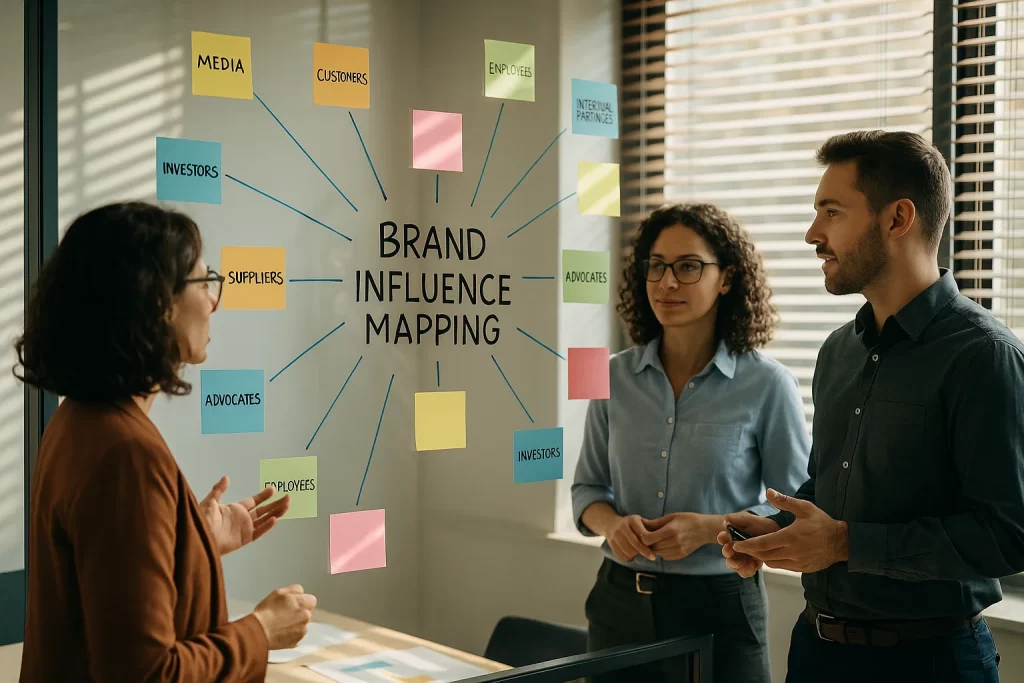
Before any measurement, visualization, or influence score is calculated, stakeholder identification is the foundational step in brand influence mapping. Without a precise understanding of who is in the network, every subsequent action — from brand sentiment analysis to narrative shaping — risks being misdirected.
The Power-Law Reality of Influence
Influence in markets doesn’t follow an even distribution — it follows a power-law curve. According to McKinsey research, 20% of stakeholders typically control 80% of the brand conversation in any given industry. That means overlooking even one or two key opinion leaders (KOLs) can skew perception models and misallocate resources.
For example, a mid-tier analyst at a respected industry research firm may have fewer social followers than a celebrity influencer — but their report could directly shape investor confidence, media narratives, and procurement decisions across an entire sector.
Types of Stakeholders That Shape Brand Influence
A comprehensive stakeholder map should include both visible and hidden actors in your influence network:
- Industry Analysts & Research Firms — publish reports that are cited across media and boardrooms.
- Journalists & Editors — set narratives that often cascade into social media discourse.
- Key Opinion Leaders (KOLs) — have niche but powerful influence in decision-making communities.
- Regulators & Policy Makers — control the legal frameworks that impact brand operations.
- Channel Partners & Suppliers — hold operational leverage that can influence brand reputation indirectly.
- Advocates & Critics — passionate customers, activists, or NGOs who can drive trust or spark reputational crises.
The Invisible Stakeholder Problem
One of the biggest fears for CMOs is fighting the wrong battles because of incomplete influence data. Many brands fall into the trap of mapping only the stakeholders who are easiest to find — usually those most visible online — and completely miss offline influencers who operate in conference halls, regulatory committees, and niche publications.
This creates what I call the “Silent Impact Gap” — the space where unseen stakeholders quietly move the needle while the marketing team is distracted by social buzz.
Expert Insight
“The stakeholders you don’t see are often the ones making the most impactful moves — and by the time you notice them, the narrative has already shifted.” — Sarah K., Director of Strategic Communications, Edelman
How to Identify Stakeholders Effectively
A robust stakeholder identification process should:
- Aggregate from multiple data sources — media mentions, event participation, patent filings, policy papers, industry awards.
- Map both direct and indirect influence — who talks about your brand, and who they influence in turn.
- Weight influence by context — a journalist might be high-value during a product launch, while a regulator might dominate during a compliance shift.
By anchoring your brand influence mapping in thorough stakeholder identification, you not only improve accuracy but also position your brand to act preemptively rather than reactively.
The Science of Measuring Brand Influence
Once stakeholders are identified, the next challenge is quantifying their influence in a way that is accurate, actionable, and adaptable. This is where brand influence measurement moves from art to science — leveraging data analytics, network theory, and sentiment weighting to reveal the true hierarchy of influence in your brand’s ecosystem.
From Vanity Metrics to Influence Intelligence
A common pitfall for marketing teams is mistaking activity for impact. Metrics like follower count, likes, or share volume can be misleading without understanding narrative penetration — the degree to which a stakeholder’s voice actually shifts perception, behavior, or decision-making.
Influence mapping science replaces these vanity metrics with multidimensional influence scores that blend:
- Network Centrality – How connected and strategically positioned a stakeholder is in the influence network.
- Sentiment Weighting – Whether their narrative contribution is positive, neutral, or negative, and the emotional intensity behind it.
- Topical Authority Score – How credible the stakeholder is in the subject area where they are influencing the conversation.
- Engagement Depth – Not just how many people they reach, but how meaningfully they interact with them.
The Measurement Framework
Modern brand influence analysis relies on a combination of quantitative and qualitative data streams:
- Graph Theory & Centrality Analysis
Tools like Gephi or Neo4j use graph centrality metrics (degree, betweenness, closeness) to measure how well-connected a stakeholder is to other high-value influencers. Example: A niche blogger with low reach might still be influential if they act as a “bridge” between two otherwise disconnected high-authority groups.
- Natural Language Processing (NLP)
NLP models assess tone, polarity, and framing in stakeholder communications.- Sentiment Polarity Tracking reveals whether the conversation trend is leaning toward brand advocacy or brand risk.
- Topic Modeling identifies emerging narratives where your brand is mentioned.
- Weighted Sentiment Scoring
Not all positive sentiment is equal — a compliment from a top industry analyst carries more weight than from a casual social media commenter. Scoring models apply influence multipliers based on the stakeholder’s authority. - Narrative Penetration Index
This measures how far a stakeholder’s message travels through secondary and tertiary networks. For example, a CEO’s LinkedIn post might be quoted in news outlets, shared by industry bodies, and discussed in private Slack communities — exponentially increasing its impact.
Integrating Influence Data into Brand Strategy
The most advanced brands don’t just measure influence — they integrate it into campaign planning, crisis prevention, and stakeholder engagement strategies. By mapping influence overlap and narrative convergence points, they identify power clusters where strategic outreach can shift entire conversations.
Customer Challenges Solved
Marketing leaders often say, “We have the data, but we don’t know what to do with it.” The science of measurement bridges this gap by producing action-ready intelligence, not just dashboards.
Outbound Link: Explore the Edelman Trust Barometer for insight into measuring trust and influence correlations.
Mapping the Stakeholder Influence Network
Once influence measurement data is collected, the next step is turning complex datasets into actionable visual intelligence. This is where stakeholder influence mapping comes alive — transforming raw metrics into dynamic, interactive maps that reveal who matters most, how they connect, and where narratives originate.
The Purpose of an Influence Map
An influence map isn’t just a pretty diagram. It’s a decision-making tool that helps leadership, marketing, and PR teams see:
- The clusters of influence that dominate brand perception.
- Hidden intermediaries who connect otherwise isolated groups.
- Narrative pipelines — how a message flows from origin to amplification.
In essence, it answers two questions critical to brand strategy execution:
- Who do we need to engage to shift perception?
- Which relationships should we strengthen, monitor, or disrupt?
The Mapping Process
- Data Collection Across Channels
Collect multi-source stakeholder data from:- Media coverage (trade press, mainstream news, blogs)
- Social graphs (Twitter/X, LinkedIn, Instagram)
- Industry event participation (conferences, panels, webinars)
- Regulatory and policy documents
- Partnership announcements and investment records
- Network Graph Construction
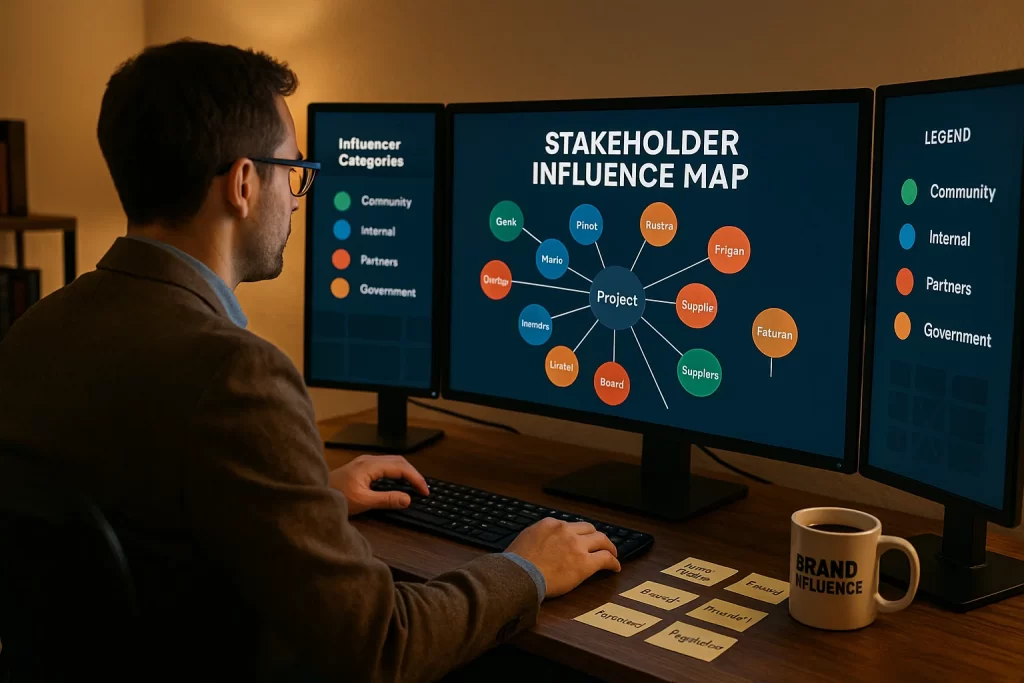
Use graph analytics tools like Gephi, Kumu, or Neo4j to create nodes (stakeholders) and edges (relationships, interactions, or co-mentions).- Node size = stakeholder influence score.
- Edge thickness = relationship strength or interaction frequency.
- Color coding = stakeholder category (e.g., analysts, media, regulators, customers).
- Influence Layering
Overlay different influence metrics to reveal multidimensional insights:- Sentiment Layer — shows whether stakeholders are positive, neutral, or negative toward the brand.
- Topic Layer — highlights stakeholders dominant in specific narratives (e.g., sustainability, product quality, pricing).
- Reach Layer — visualizes the scale of audience exposure.
- Identifying “Bridge” Stakeholders
In many networks, influence flows through connectors — individuals or organizations that link otherwise separate clusters. These bridge stakeholders are strategic leverage points for shifting narratives quickly.
Avoiding Map Bias
One of the biggest fears in brand influence mapping is creating a biased or incomplete map. This can happen when data sources are skewed toward digital-only visibility, ignoring offline influence networks.
Solution: Supplement social and digital data with qualitative intelligence from industry insiders, trade event reports, and expert interviews.
Expert Quote
“Your influence map is only as good as the diversity of your data sources. Over-reliance on social metrics is the quickest path to strategic blind spots.” — Karen S., London School of Economics
Practical Use Cases
- Crisis Management: Identify and engage high-trust voices to contain negative narratives.
- Product Launches: Pinpoint key amplifiers for maximum coverage.
- Policy Advocacy: Target decision-makers and their networks to influence regulatory outcomes.
Avoiding Common Pitfalls in Brand Influence Mapping
While brand influence mapping is a powerful strategic tool, it’s also vulnerable to misinterpretation, data bias, and execution missteps. These pitfalls can erode the credibility of your analysis and lead to misguided strategic actions. Understanding and avoiding these traps ensures that your influence map remains a reliable foundation for brand strategy and execution.
1. Overreliance on a Single Data Source
The Risk: Many teams rely solely on social listening tools or media monitoring dashboards for influence data. While these tools are valuable, they represent only a slice of the influence ecosystem — often skewed toward digitally active stakeholders.
The Impact: This can lead to digital bias, where offline influencers such as policy makers, trade association leaders, or niche industry analysts are overlooked.
The Solution: Use multi-channel intelligence gathering — combining social analytics, media tracking, event participation data, investor reports, and even qualitative insights from insider interviews.
2. Confusing Reach with Influence
The Risk: A stakeholder with a massive audience is not necessarily influential in shaping your brand narrative.
Example: A celebrity chef might have millions of followers but zero relevance to a B2B software brand.
The Impact: Wasted outreach efforts on irrelevant voices, diluting your influence strategy.
The Solution: Weight influence scores by contextual relevance and topic authority, not just audience size.
3. Static Mapping in a Dynamic Environment
The Risk: Treating influence maps as one-time reports instead of living documents. Influence networks shift quickly as new voices emerge, trends change, and crises alter public sentiment.
The Impact: Outdated maps can result in targeting former influencers while ignoring newly emerging stakeholders.
The Solution: Establish a continuous monitoring system that updates the influence map monthly or quarterly, depending on market volatility.
4. Ignoring Negative Influencer
The Risk: Many brands focus only on positive or neutral voices, overlooking critics, competitors, or advocacy groups that can significantly influence perception.
The Impact: Unpreparedness for negative sentiment spikes or coordinated reputational attacks.
The Solution: Include detractors in your mapping — not to amplify them, but to monitor, understand, and plan proactive engagement or counter-messaging.
5. Lack of Integration with Brand Strategy Execution
The Risk: Influence maps that stay locked in PowerPoint decks instead of informing campaign targeting, PR initiatives, or stakeholder engagement plans.
The Impact: Influence insights remain theoretical, never translating into tangible business outcomes.
The Solution: Directly integrate mapping insights into planning cycles. Align them with frameworks like Brand Strategy and Execution so every strategic action is rooted in real influence intelligence.
Case Study: Brand Influence Mapping in Action
To understand the real-world power of brand influence mapping, let’s look at a fictionalized but realistic example drawn from patterns seen in mid-market B2B technology companies.
The Challenge
A mid-sized SaaS provider — CloudSync Solutions — had built a strong product reputation for data security and compliance in regulated industries. Yet, in Q3, the company noticed a sharp decline in inbound enterprise leads. Sentiment analysis from their social listening tools revealed increased skepticism about their platform’s ability to meet emerging regulatory requirements in the EU.
The marketing team’s initial assumption was that a competitor’s aggressive advertising was behind the shift. But a deeper look revealed something different.
Step 1: Influence Mapping to Identify the Source
Using a multi-layered influence map, CloudSync’s team plotted:
- Media mentions across trade press and niche compliance blogs.
- LinkedIn activity from industry thought leaders.
- Key discussion threads in regulatory forums.
The analysis uncovered a critical “negative influencer” — an industry compliance analyst named Dr. Petra H., who had published a widely circulated LinkedIn article questioning whether CloudSync’s latest software update met the upcoming EU Data Trust Directive.
While Dr. Petra had fewer than 8,000 followers, her network included:
- Senior compliance officers in top-tier financial institutions.
- Editors of regulatory journals.
- Key members of EU tech policy advisory boards.
In other words, she was highly influential within the exact buyer network CloudSync targeted.
Step 2: Engagement and Narrative Shift
Instead of ignoring the critique, CloudSync’s team developed a targeted stakeholder engagement strategy:
- Technical Audit: The product team conducted an independent compliance audit to verify readiness for the EU Data Trust Directive.
- Direct Outreach: The CEO personally reached out to Dr. Petra, sharing the audit results and inviting her to a private product briefing.
- Collaborative Content: Dr. Petra agreed to co-author a whitepaper on compliance best practices, which was later presented at a leading FinTech regulatory summit.
Step 3: Measuring the Impact
Within 60 days, CloudSync’s brand sentiment score in the compliance sector improved by 18%. More importantly:
- Inbound enterprise leads from EU markets increased by 27%.
- The whitepaper co-authored with Dr. Petra became the most downloaded asset in the company’s history.
- Competitor share of voice in EU compliance conversations dropped by 15%.
Integrating Influence Mapping into Brand Strategy
Influence mapping is only as valuable as its integration into brand strategy and execution. Many organizations stop at the visualization stage, treating their stakeholder influence maps as interesting research rather than a strategic operating tool. The true competitive advantage comes when influence intelligence informs every stage of brand planning, engagement, and crisis management.
1. Aligning Influence Insights with Core Brand Objectives
A stakeholder influence map is most powerful when connected directly to brand objectives such as:
- Increasing trust scores in a new market segment.
- Building advocacy for a product launch.
- Protecting brand reputation during regulatory changes.
- Expanding thought leadership footprint in an emerging topic area.
For example, if the goal is to become the leading voice in sustainable manufacturing, the influence map should highlight environmental policy advocates, sustainability journalists, and green tech investors — then rank them by topic authority and network centrality.
2. Embedding Influence Mapping into Campaign Planning
Influence mapping should not be an afterthought; it should shape the campaign brief itself. This means:
- Selecting content formats preferred by target influencers (e.g., whitepapers, webinars, panel discussions).
- Timing campaigns around influencer activity cycles — such as industry events, report releases, or annual forums.
- Designing messaging pillars that align with the narratives these stakeholders already champion.
Example: If the influence map shows that regulatory analysts dominate the conversation in Q1 due to new legislation, a brand can time its thought leadership to align with that heightened attention window.
3. Influence Mapping for Crisis Preparedness
A living influence map doubles as a crisis radar. By tracking detractors, monitoring sentiment shifts, and mapping bridge stakeholders, brands can:
- Detect negative narrative trends before they escalate.
- Engage trusted allies early to provide counterbalance messaging.
- Control information flow during high-pressure events.
This approach mirrors the firebreak principle in forestry — creating strategic barriers that prevent small issues from becoming full-blown crises.
4. Cross-Departmental Integration
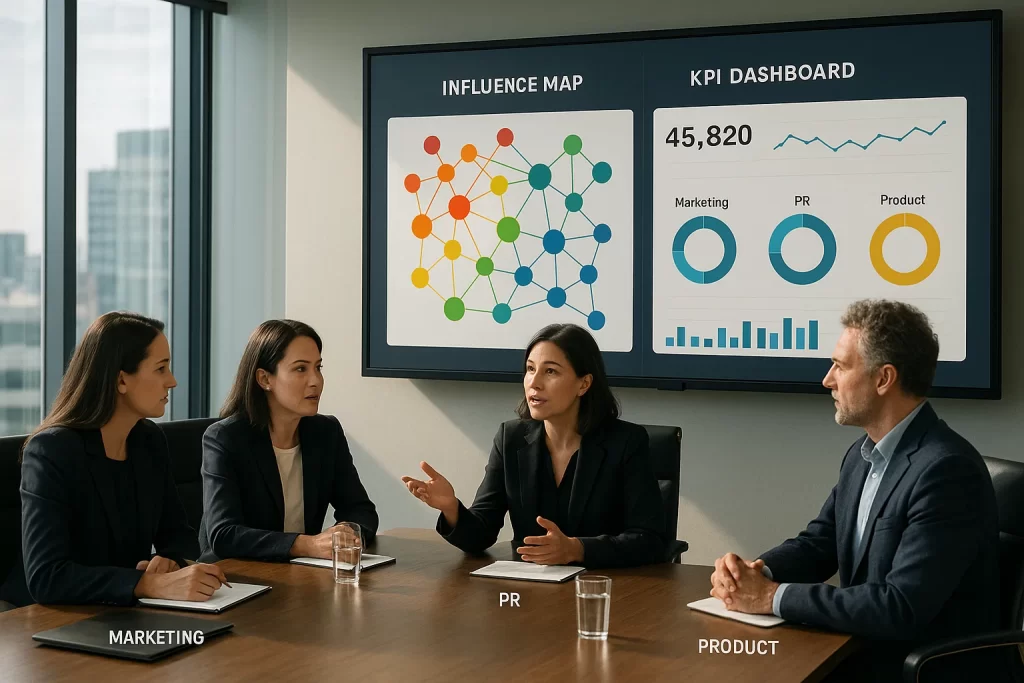
Influence mapping shouldn’t be siloed within marketing. When shared across functions, it creates alignment and speed:
- PR teams use it to target journalists and editors who can carry brand-friendly narratives.
- Sales teams leverage it to connect with stakeholders who influence purchase decisions.
- Product teams tap it to gather high-quality feedback from authoritative voices.
- Investor relations teams use it to strengthen credibility among analyst networks.
5. Measuring Strategic Impact
By tying influence mapping metrics to business KPIs, brands can prove ROI:
- Conversion rate shifts from campaigns targeted at mapped influencers.
- Sentiment improvement within key stakeholder groups.
- Decreased time-to-recovery after negative publicity.
Expert Quote:
“An influence map should be your brand’s GPS — not just telling you where you are, but guiding your every move toward the destination.” — Michael L., Former CMO, Global B2B Brand
Tools and Platforms for Influence Mapping
Building and maintaining an accurate brand influence map requires the right combination of data collection, analysis, and visualization tools. The choice of platform often determines whether influence mapping becomes a living strategic asset or a one-off research exercise. The right tools can automate data gathering, provide real-time sentiment tracking, and visualize complex stakeholder networks in a way that decision-makers can act on.
1. Enterprise-Grade Platforms
Meltwater
- Strengths: Comprehensive media monitoring, AI-driven sentiment analysis, influencer discovery across industries, and global news coverage.
- Use Case: Ideal for multinational brands with large PR and marketing teams.
- Standout Feature: Influence score calculation across earned, owned, and social media combined into a unified dashboard.
Brandwatch
- Strengths: Powerful social listening, competitive benchmarking, trend prediction, and integration with CRM tools.
- Use Case: Brands that need consumer sentiment mapping across multiple digital touchpoints.
- Standout Feature: Advanced topic clustering to identify emerging narratives before they peak.
Pulsar
- Strengths: Network graph visualizations, audience segmentation, and cross-platform behavior analysis.
- Use Case: Perfect for influence mapping in niche communities or multi-platform ecosystems.
- Standout Feature: Influence overlap detection to find stakeholders impacting multiple audience groups.
2. SMB-Friendly & Budget Options
BuzzSumo
- Strengths: Content performance tracking, influencer identification in specific niches, and backlink analysis.
- Use Case: Small to mid-sized brands focusing on content-led influence strategies.
- Standout Feature: Shows top-performing content and the influencers driving it.
Nexalogy
- Strengths: Automated topic discovery, trend graphs, and influence network visualization.
- Use Case: Ideal for brands needing a lightweight, visual-first influence mapping tool.
- Standout Feature: AI-generated summaries of influencer activity and topic shifts.
Followerwonk (for Twitter/X)
- Strengths: Audience segmentation, influencer comparison, and follower analysis.
- Use Case: Brands targeting thought leaders and journalists active on Twitter/X.
- Standout Feature: Graph-based mapping of mutual connections for targeted outreach.
3. Selection Criteria for Influence Mapping Tools
When choosing a platform, evaluate based on:
- Data Sources — Does it cover media, social, events, and offline data?
- Visualization Capabilities — Can it create multi-layer influence maps with sentiment, authority, and reach overlays?
- Integration — Can it sync with CRM, PR management, and analytics tools?
- Scalability — Will it handle larger datasets as your stakeholder network grows?
- Budget Fit — Do you need enterprise-level precision or lean SMB efficiency?
4. Integrating Tools into Brand Strategy Execution
The most effective brands pair influence mapping tools with a Brand Strategy and Execution framework, ensuring every insight feeds into campaigns, product roadmaps, and stakeholder engagement. This turns influence maps from static visuals into dynamic performance drivers.
Expert Quote
“Your tool is only as good as your process. Without a strategic integration plan, even the most advanced influence platform is just expensive eye candy.” — Sarah K., Strategic Communications Director, Edelman
Future Trends in Brand Influence Mapping
Brand influence mapping is evolving rapidly, shaped by emerging technologies, shifting media ecosystems, and changing consumer trust dynamics. Over the next 3–5 years, we will see the discipline move from static network analysis toward real-time, AI-driven influence prediction — enabling brands to act before perception shifts occur.
1. AI-Powered Predictive Influence Modeling
The next generation of influence mapping platforms will use machine learning to:
- Predict which stakeholders are likely to gain influence in specific topics before they reach peak visibility.
- Model narrative trajectories — simulating how a message will spread through an influence network.
- Forecast reputation risk scenarios and identify optimal intervention points.
For example, if a sustainability advocate’s follower growth, media mentions, and network engagement are accelerating, AI models could flag them as a “rising influencer” weeks before competitors take notice.
2. Real-Time Crisis Simulation
Future tools will combine influence mapping with dynamic scenario modeling, allowing brands to:
- Test “what if” situations — e.g., a product recall or a competitor’s controversial statement.
- Identify which stakeholders would amplify or dampen negative narratives.
- Pre-build engagement playbooks for high-risk network nodes.
This proactive crisis preparedness could significantly reduce both the cost and duration of reputational damage.
3. Immersive Stakeholder Mapping with AR/VR
Influence maps will move beyond 2D dashboards into immersive, 3D network environments where:
- Stakeholders appear as interactive nodes with live data feeds.
- Users can navigate networks in augmented or virtual reality to explore relationships in detail.
- Teams can run collaborative influence workshops inside virtual spaces for faster decision-making.
This innovation will help non-technical executives grasp the complexity of influence ecosystems instantly.
4. Deeper Integration with Brand Strategy and Execution
Influence mapping will become natively embedded in brand strategy platforms, with direct links to:
- Content planning tools — to suggest messaging that aligns with active narratives.
- CRM systems — to flag when high-value influencers engage with the brand.
- Marketing automation — to trigger targeted outreach at optimal moments.
This will shift influence mapping from being a research function to becoming a core operational capability.
5. Ethics and Transparency in Influence Tracking
As influence mapping becomes more advanced, ethical considerations will rise to the forefront:
- Stakeholder consent and data privacy will shape collection practices.
- Transparency in scoring algorithms will be necessary to maintain trust with internal teams and external partners.
- Regulations may emerge, requiring auditability of influence-based targeting strategies.
Forward-thinking brands will gain competitive advantage by adopting ethical standards early and openly communicating their practices.
Conclusion
In an era where brand perception is shaped by networks, not just audiences, brand influence mapping has emerged as one of the most powerful tools in the strategic marketer’s arsenal. By systematically identifying stakeholders, measuring their impact, and mapping the flow of influence, brands gain predictive intelligence that allows them to move from reactive to proactive strategy.
The process isn’t simply about spotting the loudest voices — it’s about finding the most consequential ones and understanding how their narratives travel, transform, and take hold. When integrated into Brand Strategy and Execution, influence mapping becomes the GPS of brand positioning:
- It guides campaign targeting toward the most impactful nodes.
- It informs crisis prevention by revealing vulnerable points in the network.
- It amplifies positive narratives by engaging bridge stakeholders who can multiply reach.
Brands that embrace influence mapping don’t just measure conversations — they shape them. They operate with the foresight to predict shifts, the agility to seize opportunities, and the resilience to withstand disruptions.
The future belongs to brands that understand influence is earned, mapped, and leveraged — not guessed. As tools, AI capabilities, and immersive mapping technologies evolve, influence mapping will move from an optional competitive advantage to an essential pillar of brand leadership.