
Brand Holistic Engagement: How to Boost Customer Connection with a Unified Strategy
Introduction
In the current landscape of brand overload, customers encounter over 5,000 brand exposures daily across channels—web, mobile, social, in-store, podcast, and packaging. Yet, only a handful of these interactions are remembered. Why? Because emotional continuity is the missing link. Neuroscience shows that emotionally charged experiences create episodic memories—rich, contextual memories tied to sensory and emotional states. These memories are significantly more likely to be recalled, influence perception, and drive repeated behavior.
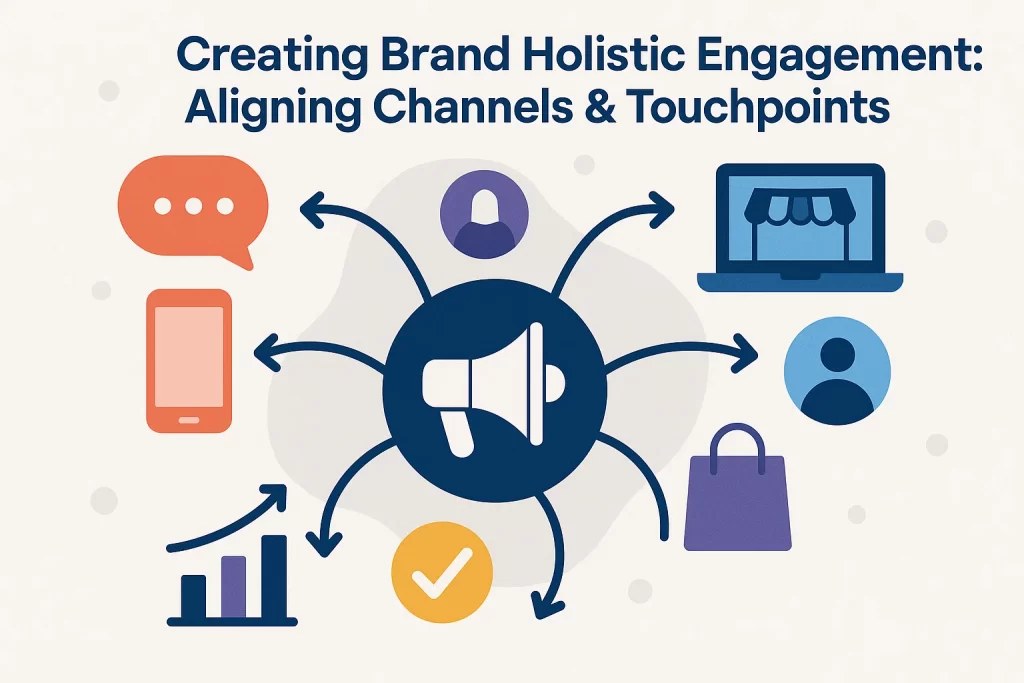
Brand holistic engagement addresses this by aligning every brand interaction—conscious or subconscious—into a synchronized, emotional storyline. It’s no longer about logos or consistent font usage. It’s about whether the packaging texture matches the ad’s mood, whether a support agent sounds like the brand’s Instagram tone, and whether the music in a retail store evokes the same emotion as the app background sound.
A recent Salesforce survey found that 80% of consumers say the experience a company provides is as important as its products. This underscores a critical shift: experiences, especially emotionally anchored ones, are strategic assets.
Understanding Brand Holistic Engagement in 2025
From Consistency to Emotional Synchronization
Branding in 2025 is a cognitive and emotional journey. The evolution began with logo consistency, matured through voice and narrative alignment, and now centers around emotional orchestration across touchpoints. This is brand holistic engagement.
The traditional brand funnel has been replaced by an emotion-loop framework—trigger (awareness), experience (emotion), memory (recall), and advocacy (retention). Each stage must feel part of a single orchestrated story. As per Deloitte’s Human Experience report, brands that focus on emotion-first design see double the customer lifetime value.
Omnichannel ≠ Holistic
While omnichannel strategies ensure presence across platforms, holistic engagement ensures narrative and emotional cohesion across those platforms. It’s the difference between broadcasting the same ad everywhere vs. tailoring emotional progression through each stage and device.
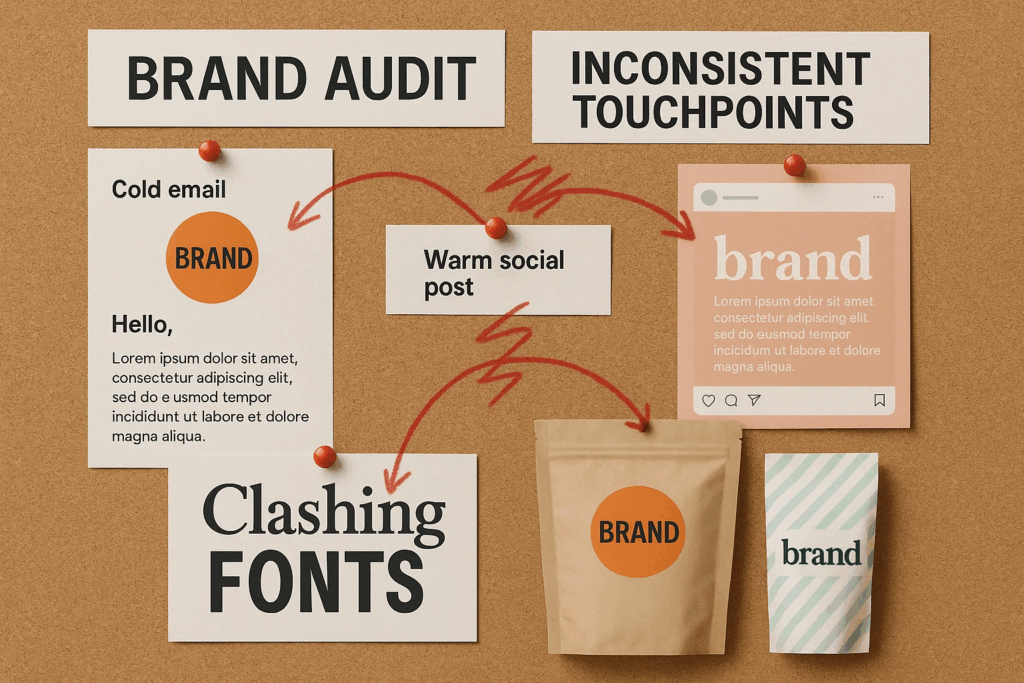
Customers feel disconnected when interactions don’t align. A playful tone on Instagram but cold tone in support emails leads to emotional dissonance—which damages trust.
Expert Insight: “When a brand’s emotional signal remains consistent across touchpoints, it triggers what we call semantic fluency—the brain’s comfort in linking disparate inputs into a single emotional truth.” – Dr. Lisa Feldman Barrett, author of ‘How Emotions Are Made’
The Psychology Behind Memorable Brand Experiences
Emotion as Memory Glue
Scientific studies show that emotion enhances memory encoding. When experiences activate the amygdala (emotion center), they increase hippocampal activity (memory center), creating long-term brand memories. This is why consumers remember how a brand made them feel, not necessarily what it said.
For example, Dove’s “Real Beauty” campaign is not remembered for its visuals but for the emotional truth it represented. This is emotional branding at its highest level—reframing identity and self-worth via storytelling.
Semantic Encoding & Cross-Modal Association
Humans encode brand interactions not as isolated events, but as multi-sensory narratives. Hearing a brand jingle while watching a heartfelt story and holding a branded product forms a cross-modal memory. Semantic encoding takes place when these stimuli are grouped with meaning. This is the essence of brand synesthesia—where visual, auditory, and tactile elements fuse into a single identity.
Example: The THX deep bass sound before a film evokes trust in the viewing experience, even though it’s only sound.
Client Challenges : Brands fail to leave a lasting impression when they focus on features over feelings.
Mapping the Multi-Touch Brand Journey
To execute holistic branding, companies must understand their emotional customer journey, not just transactional touchpoints.
Emotional Touchpoint Architecture
Every brand interaction contributes to emotional architecture—the composite of joy, relief, confusion, and satisfaction a user experiences. Journey mapping tools like Smaply or UXPressia now include emotion tracking overlays, mapping not just “when” but “how” a user feels.
Case in Point: Disney
Disney maps their user’s emotional journey from the time they book tickets to post-visit emails. The mobile app plays joyful sounds, theme parks smell of vanilla (known to evoke nostalgia), and post-visit mailers use the same tone as Mickey’s voice.
This is intentional emotional design. Each moment aligns with a macro-narrative of joy and wonder.
Tools to Use
- Hotjar/FullStory for behavioral heatmaps
- Typeform + NPS for emotional feedback
- Adobe Analytics for drop-off pattern tracing
Case Studies in Holistic Engagement
Apple: Tactile Harmony
Apple ensures that everything from packaging material to product boot sounds aligns with its brand emotion of “satisfying simplicity.” Opening a MacBook box is an emotional event—intentional vacuum resistance in packaging creates anticipation. The UI animations mirror the hardware aesthetic. Even their customer support emails follow Apple’s minimal, empathetic tone.
Nike: Multi-Channel Identity
Nike uses AR and location data to transform sneakers into content. Scanning QR codes in-store opens motivational stories, hyper-personalized workout plans, and digital collectibles. This forms a tribal emotional bond. The app tracks progress, while the social media reinforces identity: “You’re an athlete.”
IKEA: Sensorial Strategy
IKEA integrates texture, spatial awareness, and AR for brand resonance. Their stores are sensory environments: warm lights, wood grain, Swedish music, and scent of cinnamon buns. Their AR apps simulate this digitally.
Building Blocks of Holistic Brand Strategy
To craft truly resonant experiences, a brand must architect a strategy that synchronizes emotion, sensory engagement, and narrative logic across every interaction. Below are the essential components:
1. Sensory Consistency Across Touchpoints
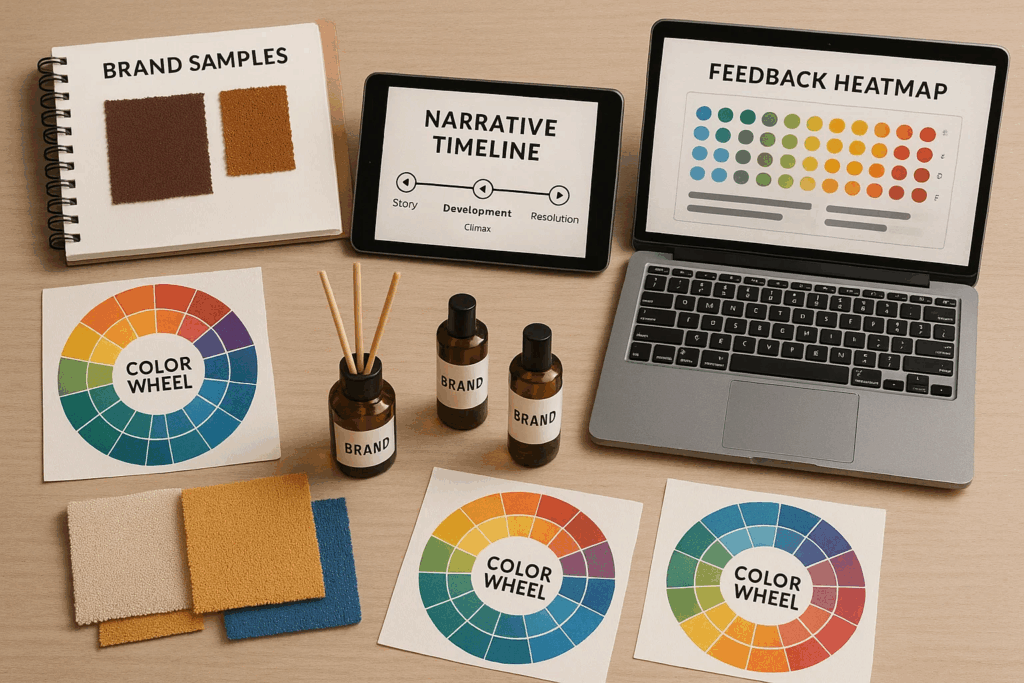
Humans process 80% of brand information through sensory input. Holistic brands engage multiple senses in harmony, known as brand synesthesia. This means your visual design should evoke the same feeling as your app sound design or the feel of your product packaging.
- Example: Singapore Airlines uses the same scent in lounges and planes, paired with traditional sarong uniforms and culturally curated music—creating a multi-sensory, consistent identity.
- Strategic Tool: Use multi-sensory branding audits—check how each channel sounds, feels, and looks.
2. Narrative Cohesion
Customers don’t just want consistent information—they crave progressive stories. Narrative cohesion means each touchpoint feels like a chapter in a larger plot.
- Example: Lego’s emails start a storyline that continues on YouTube with animated content, ending in in-store play zones. This is called narrative scaffolding.
- Strategy Tip: Design brand arcs like screenwriters—use emotion arcs, mid-story tension, and resolution to build loyalty.
3. Feedback Loops and Adaptive Personalization
Holistic brands don’t operate in a vacuum. They adapt experiences using sentiment tracking, behavior analytics, and feedback loops.
- Example: Netflix uses micro-feedback (thumbs up/down) to tweak recommendation engines, creating a feeling of “this brand gets me.”
- Tools: Use Typeform, Qualtrics, and Realeyes to track emotion and loop insights into creative cycles.
4. Tech-Enabled Emotional Fluidity
Use technology not as gimmick but to extend the emotional journey. AI, voice UX, and AR can enhance brand emotion—if aligned with intent.
- Example: L’Oréal’s virtual try-on doesn’t just showcase product—it mimics the in-store mirror moment, complete with subtle ambient background and social sharing triggers.
Implementing Your Holistic Engagement Blueprint
Moving from theory to action, brands must follow an execution framework that balances audit, alignment, emotion design, and analytics.
Step 1: Conduct a Full Touchpoint Audit
List every digital, physical, and interpersonal moment of customer interaction. Include:
- Website navigation
- Packaging feel
- Phone tone of customer support
- Social content tone
- In-app sound or loading screens
Use tools like Lucidchart or Notion databases to map the landscape.
Step 2: Score Emotional Continuity
For each touchpoint, ask:
- Does this feel like my brand?
- Does it evoke the intended emotion?
Use a scale from 1–10 on emotional clarity, continuity, and context. Build this into a heatmap.
Step 3: Design Emotion-Centric Templates
For each channel, define:
- What emotion should this touchpoint evoke?
- Which colors, sounds, tones will deliver this?
- How do we ensure semantic consistency?
Step 4: Align Brand Across Departments
Often, support, marketing, product, and HR operate with different emotional languages. Standardize brand tone guides and conduct empathy workshops.
Example: Zapier ensures every department uses the same “brand empathy ladder” to respond to users.
Step 5: Pilot and Measure Micro-Campaigns
Test new designs or narrative updates with smaller groups. Track:
- Emotional lift (sentiment/NPS)
- Time to conversion
- Recall (follow-up survey)
Use platforms like Adobe Target or UsabilityHub.
Step 6: Optimize with Journey Analytics
Track experience drop-offs not just by clicks but by emotional fatigue. Use:
- Session replay tools (FullStory)
- Sentiment overlays (Qualtrics XM)
- Emotion heatmaps (Realeyes, Affectiva)

Common Pitfalls in Multi-Touch Branding
Even well-intentioned brands falter in the execution. Here’s what to avoid:
1. Touchpoint Fatigue
When users encounter too many branded moments in a short span, cognitive overload kicks in. Every CTA doesn’t need a logo. Emotional peaks lose meaning without valleys.
Fix: Build in moments of silence, whitespace, and rest. This mirrors storytelling dynamics.
2. Fragmented Emotional Tone
A cheerful TikTok but robotic support email? That emotional mismatch causes cognitive friction and damages brand trust.
Fix: Centralize tone-of-voice assets and train cross-teams in its application.
3. Sensory Clutter in Digital Environments
Glowing buttons, autoplay videos, layered sound effects—this doesn’t add sensory depth, it erodes clarity.
Fix: Implement sensory hierarchy—a design principle that prioritizes one dominant sense per moment.
4. Siloed Data = Fragmented Memory Loops
Disconnected CRM, email, social, and retail data results in broken storytelling. Users get repetitive or conflicting messages.
Fix: Use Customer Data Platforms (CDPs) like Segment to create unified user memory profiles.
Expert Insight:
“Inconsistent experiences suggest brand inauthenticity. The subconscious brain flags these as trust violations.” – Harvard Business Review
FAQ
1. What is holistic brand engagement strategy?
Holistic brand engagement is a strategy that unifies emotion, story, and sensory design across all brand interactions. It’s about ensuring that whether a user encounters your brand via Instagram, an email, a chatbot, or physical packaging, the experience feels like one continuous narrative. It shifts the focus from transactional touchpoints to emotionally intelligent, memory-rich engagements.
2. How does emotion influence brand loyalty?
Emotion plays a foundational role in memory formation, which is the bedrock of brand recall. Studies from Harvard show that emotionally connected customers are 52% more valuable than highly satisfied ones. Emotional resonance fosters trust, loyalty, and advocacy. For instance, Apple users don’t just like the product—they feel empowered by it.
3. Can small businesses implement holistic branding?
Absolutely. You don’t need big budgets—just intentional design thinking. Start with a consistent tone, story arc, and sensory strategy across your primary channels. Use tools like:
- Canva for visual consistency
- Typeform for sentiment feedback
- Trello or Notion for journey mapping
4. How do I measure emotional resonance?
Emotional resonance can be tracked via both quantitative and qualitative metrics:
- Behavioral proxies: dwell time, bounce rate, scroll depth
- Sentiment analysis: tools like MonkeyLearn or Google NLP
- Biometric tech: Affectiva, Realeyes (for facial coding, pulse, eye-tracking)
- Surveys/NPS with emotion-specific questions
Also track user-generated content (UGC)—when customers create content for your brand, you’re emotionally resonant.
5. What’s an example of a seamless brand experience?
Amazon Prime is a textbook example. From the personalized homepage, seamless checkout, predictive product suggestions, to post-purchase updates and integrated content platform—each moment is emotionally consistent: fast, reliable, and frictionless. The user feels in control and valued.
Other examples:
- Spotify Wrapped – personal, nostalgic, shareable
- Lush Cosmetics – tactile in-store to bold social voice
- Airbnb – consistent emotional warmth from listing discovery to host follow-up
Conclusion
Brand holistic engagement isn’t an abstract ideal—it’s a replicable strategy grounded in neuroscience, design psychology, and narrative logic. In an era where consumers are overwhelmed by noise, only brands that act like trusted emotional companions will earn lasting attention.
Every touchpoint is an opportunity to encode memory. The challenge—and the advantage—is in making each one feel like a connected page in the same evolving story. Through synchronized sensory design, emotionally intelligent content, and cross-platform storytelling, brands can evolve from merely being memorable to becoming meaningful.
Too often, CMOs and brand teams still treat holistic engagement as a “nice to have”—a creative indulgence reserved for B2C lifestyle giants. But the data says otherwise. According to Forrester, emotionally connected customers are five times more likely to recommend and three times more likely to repurchase.
This is not just aesthetic strategy—it’s a performance imperative. Holistic engagement decreases churn, increases customer lifetime value, and most importantly, builds resilient brand equity based on trust and feeling.