
Boosting Revenue with Brand Cross-Sell & Up-Sell Strategies
Introduction
Brand cross-selling strategies are among the most powerful levers for increasing customer lifetime value, yet they remain widely misunderstood. Contrary to popular fear, effective cross-selling isn’t about pushing more products—it’s about serving the customer better.
Cross-selling works because the customer already trusts the brand. They’ve bought in—literally. This creates an opening to gently suggest additional value that aligns with their current purchase behavior. According to a McKinsey study, personalized product recommendations can account for 10–30% of ecommerce revenue.
Moreover, the Harvard Business Review reports that personalized cross-selling increases conversion rates by over 20% These are not marginal gains—they’re transformative.
Yet many brands avoid cross-selling. Why?
It’s not due to lack of tools. CRM systems, marketing automation, and AI-driven personalization platforms make technical execution relatively easy. The real reason is fear—fear of annoying loyal customers, fear of sounding like a desperate upseller, and fear of losing the very trust cross-selling depends on.
This guide challenges those fears by offering a brand-centric, customer-first approach to cross-selling. Rooted in the principles of Brand Strategy & Execution, the approach here emphasizes intentional, empathetic tactics that are embedded within the overall customer experience—not bolted on. You’ll learn:
- How to segment customers using behavioral signals and predictive analytics
- How to recommend the right product at the right time
- How to use copy that converts without pushing
- How to measure success in a way that respects customer relationships
At its best, cross-selling isn’t just a marketing tactic. It’s a manifestation of customer obsession—an operational extension of the brand’s promise.
This article’s big idea is that “cross-selling done right builds loyalty.” When implemented thoughtfully, it’s a strategy that helps—not hinders—the customer journey.
Why Cross‑Selling Works: Data, Psychology & Brand Strategy
Cross-selling works not because it tricks customers into buying more, but because it aligns with core psychological principles and strategic brand positioning. When customers feel understood and supported in their journey, they respond—not with skepticism, but with gratitude.
The Data Behind Cross-Sell Effectiveness
Brands that master brand cross-selling strategies consistently outperform those that don’t. In a recent study by McKinsey, companies that adopted personalized product suggestions saw conversion rates jump by up to 30%. Another study from the Harvard Business Review noted that cross-selling can improve overall customer retention by 20–40%, especially when the recommendations are relevant and timed appropriately.
More data:
- 42% of cross-sell offers are ignored—because they’re irrelevant, poorly placed, or lack clarity
- 67% of consumers expect brands to understand their needs and anticipate them
Clearly, the potential for growth is real—but only if cross-selling is executed with intelligence and empathy.
The Psychology Behind Why It Works
Cross-selling is powered by principles of behavioral economics and trust psychology:
- Reciprocity: When a brand helps a customer solve a problem, customers feel inclined to accept additional help (i.e., product suggestions).
- Salience: Well-timed cross-sell offers during the checkout or onboarding process leverage customer attention.
- Cognitive ease: Recommendations remove decision fatigue by reducing the perceived risk of additional choices.
- Loss aversion: Bundled or complementary offers help customers avoid the fear of missing out on full value.
“When a customer buys a DSLR camera and sees a relevant offer for a protective lens kit, they don’t feel sold to—they feel supported.”
This empathetic framing turns a transactional moment into a relational one.
Strategic Role in Brand Growth
Effective brand cross-selling strategies are a part of a broader customer value strategy, not just short-term revenue gains. Brands that see cross-selling as a loyalty-building function embed it into their customer experience, not just their sales funnel.
Consider:
- Apple’s seamless ecosystem encourages cross-selling through value integration (AirPods, iCloud, Watch).
- Amazon’s “frequently bought together” is less about sales pressure, more about convenience and relevance.
- DTC brands like Glossier and Allbirds cross-sell through lifestyle framing—making every new offer feel like part of a cohesive identity.
Cross-selling also lowers the cost of acquisition. Since existing customers are 60–70% more likely to buy than new ones (according to Marketing Metrics), investing in lifetime value through smart cross-selling yields far better ROI.
What Competitors Often Get Wrong
A major flaw in many competitor strategies is over-mechanical execution:
- Offering unrelated add-ons (“Want fries with your toothbrush?”)
- Over-saturating pages with pop-ups
- Using high-pressure or scarcity language (“Only 1 left!”)
These tactics backfire because they prioritize the brand’s urgency over the customer’s context. They also betray trust—undermining the long-term relationship in pursuit of short-term gain.
Instead, leading brands align cross-selling with brand values, customer journeys, and emotional tone. They know that loyalty is the outcome of value alignment, not volume.
Customer Segmentation for Empathetic Cross‑Sell
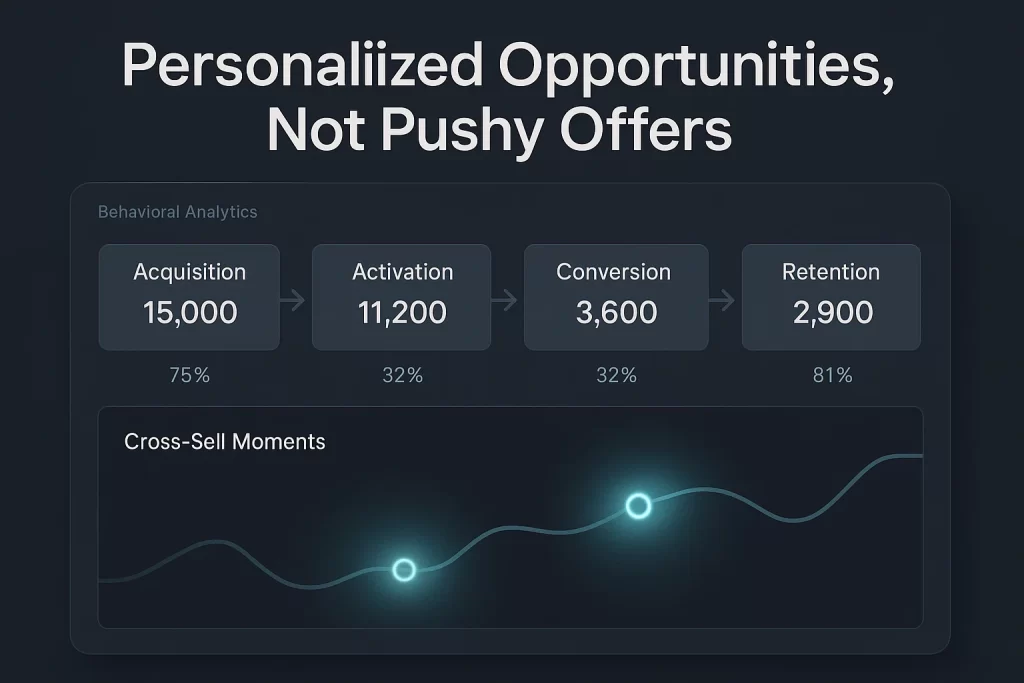
Effective cross-selling begins long before a product is offered. It starts with understanding who the customer is, where they are in their journey, and what they care about. That’s the role of customer segmentation—dividing your audience into meaningful groups so your cross-sell offer feels like a favor, not a pitch.
Why Segmentation Matters for Cross-Selling
One of the top pain points for brands is:
“Cross-selling just annoys my customers.”
This happens when all customers are treated the same. Offering an accessory to someone who hasn’t yet understood the core product, or promoting premium add-ons to a price-sensitive buyer, breaks trust.
Segmentation allows marketers to send the right message at the right time to the right person.
According to McKinsey, personalization based on segmentation delivers 5–8 times the ROI on marketing spend and can lift sales by 10%
Key Segmentation Models for Cross-Selling
1. Behavioral Segmentation
Groups users by actions: previous purchases, browsing history, click paths, cart abandonment.
Use case: Suggest complementary items based on real purchase behavior.
Example: A customer who bought a blazer might see tailored shirt suggestions.
2. Lifecycle Segmentation
Sorts users by where they are in the customer journey: new, onboarding, active, loyal, dormant.
Use case: Onboarding customers get “starter” bundles, loyal ones get premium extensions.
3. Psychographic Segmentation
Based on lifestyle, values, personality.
Use case: Suggest lifestyle-enhancing add-ons.
Example: A sustainability-conscious shopper gets zero-waste accessories.
4. Predictive Segmentation
Powered by machine learning, this groups users based on likely future behavior.
Use case: If a customer often bundles products, show pre-curated sets based on historical data.
5. Demographic Segmentation
Based on age, income, location, etc. Best used sparingly, in combination with behavior.
Use case: Regional cross-sells (e.g., weather-based apparel).
Empathy Through Segmentation
Empathetic cross-selling means honoring context:
- A customer trying your product for the first time? Don’t push bundles—offer usage tips and subtle add-ons.
- A returning buyer who’s already bought multiple SKUs? Recognize their loyalty and reward them with exclusive kits.
- A user who returned an item? Maybe skip the cross-sell and just ask for feedback.
This customer-centric approach answers the pain point:
“My team doesn’t know how to do it well.”
Train teams to start with “Who is this for?” not “What are we selling?”
Strategic Models: Buyer‑Back vs HQ‑Out
McKinsey describes two models:
- HQ-Out: Start with product lines, figure out how to push them.
- Buyer-Back: Start with customer goals, then reverse-engineer offerings.
Cross-selling thrives in the Buyer-Back model. You’re not stacking products—you’re completing experiences.
This level of segmentation doesn’t just make cross-selling more effective. It makes it more ethical. Customers feel heard, not harvested.
Personalized Recommendations: Tech & Tactics
Personalized cross-selling is no longer a luxury—it’s an expectation. Today’s customers are bombarded with choices. The brands that win are the ones that remove decision fatigue by surfacing the right product, at the right time, in the right tone.
This section demystifies how brands can build effective, scalable brand cross-selling strategies using technology—without turning customers into data points.
Why Personalization Matters
Consumers have made it clear:
- 71% expect brands to deliver personalized interactions
- 76% get frustrated when this doesn’t happen
And it pays off:
- 20–30% revenue uplift from recommendation engines
- 10–20% increase in conversion rates with relevant cross-sell suggestions (Harvard Business Review)
Cross-selling without personalization isn’t just ineffective—it’s invasive. It shows the customer you’re guessing, not listening.
The Core Tech Stack for Cross-Selling Personalization
1. Customer Data Platforms (CDPs)
Unify data from CRM, site behavior, email engagement, and more. Enables real-time segmentation.
2. Recommendation Engines
Algorithms trained on product catalog, customer journeys, and collaborative filtering.
Examples: Nosto, Dynamic Yield, Salesforce Einstein.
3. Email & SMS Personalization Tools
Trigger-based messaging (e.g., post-purchase follow-up offering accessory).
4. A/B Testing Platforms
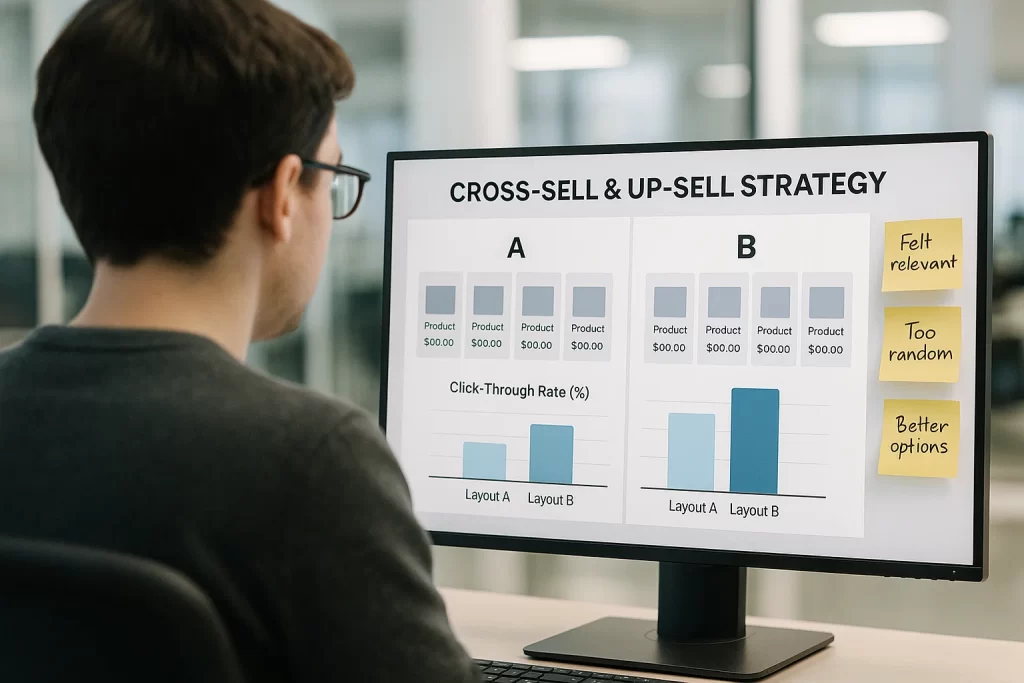
Tools like Optimizely or VWO let you test cross-sell modules, copy variations, timing, placements.
5. AI/ML Personalization Layers
Platforms like Pecan or Amperity forecast product affinity or churn risk to suggest strategic cross-sells.
“You don’t need to be Amazon to personalize. Even simple ‘Customers who bought X also loved Y’ can convert—if it’s relevant.”
Practical Personalization Tactics
Homepage Recommendations:
Tailor based on browsing history or category interest.
E.g., “Welcome back—still interested in productivity planners?”
Cart Page Cross-Sells:
Use purchase intent to suggest add-ons (not upgrades).
E.g., “Complete the look with matching earrings.”
Post-Purchase Emails:
One of the most underused tactics.
E.g., “Your tablet ships tomorrow. Want to add a protective case while it’s on the way?”
Onboarding Journeys:
In SaaS or services, cross-sell usage bundles as users activate.
E.g., “You’ve explored 3 integrations—want to unlock our automation suite?”
Exit Intent Popups:
Offer a cross-sell with a limited-time incentive, only if behavior signals hesitation.
A Word of Caution
Poor personalization is worse than none:
- Recommending items a customer already owns
- Showing irrelevant suggestions (e.g., pet products to someone buying baby gear)
- Being creepy (“Hi [Name], did you forget to buy X?”)
Cross-sell should anticipate needs, not stalk habits. That’s how you scale loyalty, not unsubscribes.
The takeaway? Technology is a tool. Strategy is empathy at scale. Personalization works when it proves that you see your customer as a person—not a profile.
Messaging That Feels Helpful, Not Pushy
The biggest reason customers resist cross-sells? It’s not the product—it’s the tone.
Even the most personalized, strategically-timed offer can fall flat—or worse, backfire—if the message feels aggressive, impersonal, or desperate. Great brand cross-selling strategies treat messaging not as an afterthought, but as a design challenge: How do we invite rather than interrupt?
Why Messaging is the Make-or-Break Moment
Imagine this scenario:
You buy a high-end blender. Seconds after purchase, an email hits your inbox:
“WAIT! You forgot this $100 juice booster!”
It’s loud. It’s caps-locked. It reeks of panic.
Now contrast that with:
“Love your new blender? Here’s how to unlock its full power—with our fresh-pressed starter kit.”
Same offer. Different reaction.
The first feels like a shout. The second feels like a service.
Tone Principles for Cross-Sell Copy
1. Educational, Not Salesy
Teach them why the product helps. Frame it as unlocking more value.
“This insulated sleeve keeps your tumbler hot for 8+ hours—great for long hikes or commutes.”
2. Contextual, Not Generic
Mention the product they’ve just viewed or bought to anchor relevance.
“Since you picked the Coral Lipstick, you might love this complementary lip liner.”
3. Soft Invitation, Not Urgency Spam
Avoid manipulative language like “Act NOW!” or “Only 1 left!” unless it’s authentic and respectful.
“A few of these are still in stock—but they go fast.”
4. Humble, Not Presumptive
Give them an easy out. Respect their autonomy.
“Not for you? No worries. Just thought we’d share in case it helps.”
5. Personal, Not Robotic
Even template-based emails can sound human. Use pronouns, warmth, and brand voice.
“You’re building something great. We’d love to support you with a few extras that make setup smoother.”
Visual Examples: Good vs Bad Cross-Sell Emails
These visuals help marketing teams gut-check: “Are we selling or helping?”
Real Use Case: Cross-Sell That Won a Customer
“I bought a coffee grinder and got a follow-up email saying, ‘This brush makes cleanup 3x faster. Want to save 10 minutes every morning?’ It was the only promo email I ever clicked ‘yes’ to.”
The copy didn’t talk about the product. It talked about their life. That’s powerful.
Messaging Formats to Explore
- Tooltips or inline prompts on product pages: “Pairs perfectly with…”
- Pack inserts: Include a subtle upsell card in shipped orders
- SMS nudges: “Just a heads-up—your fave pair now comes in eco leather.”
- Loyalty drip series: Cross-sell as a reward, not a push
Addressing Fear: “I Don’t Want to Sound Salesy”
This is one of the most cited fears from brands and small business owners alike.
Here’s the truth:
You only sound salesy when you’re not listening.
When your copy reflects insight, respect, and timing—it won’t feel like a pitch. It’ll feel like a service.
Measuring ROI and Continuous Optimization
For brand cross-selling strategies to gain long-term traction within an organization, they must not only feel good—they must perform well. Success needs to be tracked, tested, and optimized over time. Fortunately, cross-selling is a marketer’s dream when it comes to measurability.
In this section, we break down the KPIs, analytics approaches, and iterative testing strategies that help brands turn smart suggestions into consistent revenue streams—without compromising the customer experience.
The Core Cross-Sell Metrics to Monitor
1. Cross-Sell Conversion Rate (XCR)
The percentage of users who take a cross-sell offer.
Formula:
(Cross-sell purchases ÷ Cross-sell impressions) × 100
This helps identify how compelling your offer + placement + copy are.
2. Average Order Value (AOV)
Did the order total increase after implementing cross-sells?
Track AOV pre- and post-cross-sell campaigns to measure uplift.
3. Incremental Revenue
Direct revenue attributed to cross-sell products over a given period.
This is the metric leadership cares about most.
4. Attach Rate
The number of times a cross-sold product is bought alongside a primary SKU.
Useful for physical bundles or pre-set combos.
5. Email Click-Through Rate (CTR) on Cross-Sell Offers
Are your messages enticing clicks? A low CTR can signal mismatched timing, wording, or offer.
6. Retention/Upsell Overlap
Track whether cross-sell buyers also show improved retention or repeat purchase rates.
According to WiseNotify, cross-sell techniques boost revenue for 72% of businesses, and 44% of sales reps say they improve deal size (“https://wisernotify.com/blog/upselling-and-crossselling-stats/”).
The Optimization Loop: Learn, Test, Adjust
Cross-selling success isn’t set-it-and-forget-it. It thrives through iteration.
Step 1: Gather Baseline Data
Before launching any cross-sell initiative, track current AOV, conversion, and retention stats. This is your benchmark.
Step 2: A/B Test Everything
From recommendation placements (product page vs checkout) to tone (educational vs promotional), test variants against each other.
Tool Examples: Optimizely, Google Optimize, VWO.
Step 3: Segment Test Groups
Test cross-sell campaigns by lifecycle segment (new, repeat, loyal), geography, or device type to find nuanced wins.
Step 4: Analyze Behavioral Funnels
Look at where drop-offs happen. Are users clicking “Add” but abandoning cart? That suggests pricing or friction.
Step 5: Iterate Messaging
If CTR is low, consider:
- Shorter copy
- More relevant timing (e.g., post-purchase email instead of on-site prompt)
- Social proof: “Customers like you also added…”
Step 6: Retest + Scale Winners
Once you’ve identified high-performing combinations, gradually roll them out across other products or campaigns.
Avoiding Vanity Metrics
Don’t fall into the trap of chasing clicks at the expense of value. A flashy cross-sell may get attention, but if it leads to returns, unsubscribes, or buyer’s remorse—it’s harming your brand.
“We ran a ‘limited-time bundle’ test that boosted AOV by 15%, but saw return rates double. Lesson learned: urgency without context is a trap.” — VP of Growth, DTC skincare brand
Dashboard Example: Optimized Cross-Sell Funnel
This visualization helps teams align on what’s working and where to double down.
The Strategic Mindset: Lifetime Value Over Immediate Gain
Cross-selling isn’t just a short-term tactic—it’s a trust-building metric. If implemented with care, your analytics will reflect more than just higher sales. You’ll see:
- Fewer returns
- Higher engagement
- Faster repeat purchases
That’s when you know you’re not just optimizing conversions. You’re elevating the customer journey.
Ethical and Brand‑Friendly Cross‑Selling
Cross-selling is not just a marketing tactic—it’s a reflection of your brand values in action. When done poorly, it risks feeling manipulative, intrusive, or greedy. But when approached through an ethical lens, cross-selling can become a trust-building experience that reinforces loyalty and elevates the brand.
This section unpacks how to cross-sell in a way that aligns with customer consent, respects privacy, and fits naturally within your brand identity.
The Ethics of Recommendation
Modern consumers are savvy. They can sense when they’re being “targeted” in a way that violates trust. Ethics in cross-selling starts with these questions:
- Is this offer genuinely helpful for the customer?
- Would I recommend this product if I were face-to-face with them?
- Does this timing show I understand their context—or am I just pushing product?
When the answer is “no” to any of these, the offer becomes self-serving instead of customer-serving.
According to the Baymard Institute, 27% of users abandon their carts due to feeling manipulated by add-ons or upsells.
Transparency in Data Usage
If your cross-sell engine relies on behavioral data or machine learning predictions, communicate that to your users in clear, respectful terms:
- Use in-app prompts like: “We suggest based on your past purchases” or “This is what customers with similar interests bought.”
- Link to your personalization policy, and always offer an opt-out.
- For email/SMS, comply with GDPR, CCPA, and privacy frameworks by default.
Transparency builds digital trust—especially important in industries like finance, health, or education, where personalization can feel invasive if not handled properly.
Respect Frequency and Consent
Just because you can cross-sell, doesn’t mean you should every time.
Set frequency caps on:
- How often someone sees cross-sell banners
- How many follow-up emails they receive
- The number of recommendation prompts during onboarding
A single well-timed cross-sell outperforms a dozen nagging messages.
“I unsubscribed from a brand after they cross-promoted the same irrelevant item 5 times. It felt like they didn’t know me—just wanted my money.” — Reddit user, /r/EcommerceRants
Aligning Cross-Sell With Brand Voice
Cross-sell messaging should feel like your brand, not a separate sales department:
- If your tone is cheeky (e.g., Glossier), the cross-sell can be playful.
- If you’re a premium wellness brand, cross-sell with intention, calm, and care.
- If you’re educational (e.g., SaaS or coaching), offer cross-sells as “next steps”, not products.
Example:
Instead of “Buy this planner now!” try:
“You’ve mapped your goals—want a tool that makes tracking progress feel frictionless?”
It feels consultative, not commercial.
Avoiding Algorithmic Bias
If using AI-based personalization, audit for bias:
- Are certain users under-targeted or over-targeted based on zip code or device?
- Do recommendations inadvertently stereotype?
E.g., Avoid defaulting pink accessories to female-sounding names without context.
Bias doesn’t just harm customers—it harms the brand’s credibility and inclusiveness.
Sustainability and Ethical Consumption
Brands championing sustainability or conscious consumption must be especially thoughtful. Cross-selling “more stuff” can conflict with eco-ethics—unless reframed:
- Bundle refills instead of encouraging more new items.
- Promote quality upgrades, not quantity accumulation.
- Suggest products that extend product lifespan or minimize waste.

This visual reinforces that cross-selling should feel like a continuation of your brand promise, not a departure from it.
Case Studies & Real‑World Examples
Data and theory are critical, but nothing illustrates brand cross-selling strategies better than real-world examples. This section brings the strategy to life through actual use cases—highlighting what works, what backfires, and how smart cross-selling feels helpful, not salesy.
Case Study 1: Amazon’s Cross-Sell Ecosystem
Industry: Ecommerce (Marketplace)
Tactic Used: “Frequently Bought Together”
Outcome: Reportedly accounts for up to 35% of total revenue
Amazon doesn’t just recommend random accessories. Their system is trained on millions of behavioral touchpoints. By showing “Frequently Bought Together” items right on the product page, Amazon achieves two things:
- Increases basket size
- Builds perceived value by reinforcing complementary purchases
Case Study 2: Glossier’s Lifestyle-Based Cross-Sell
Industry: DTC Beauty
Tactic Used: Bundled sets based on mood, season, and self-care goals
Result: Increased AOV by 20% in targeted campaigns
Glossier doesn’t upsell “more makeup”—it curates experiences:
- *“The Dewy Set” for hydration lovers
- “The Wake Up Kit” for Monday moods
Each kit includes cross-sell items, but it’s story-driven. That emotional resonance drives action.
“I didn’t buy the blush because I needed it. I bought it because it made me feel like I was entering a new version of me.” — /r/MakeupAddiction
Case Study 3: Shopify Merchants Using Post-Purchase Cross-Sell
Industry: Retail + DTC
Tactic: Post-checkout product suggestion pages using ReConvert or CartHook
Result: Some merchants report 5–10% revenue lift on post-purchase flows
By suggesting lightweight add-ons after checkout, these stores reduce buyer resistance (the sale’s already made) while giving users one more chance to deepen value.
“Honestly loved the post-checkout option. Already in the buying mindset, and it didn’t interrupt my process.”
Case Study 4: Spotify’s Feature Cross-Sell (Digital)
Industry: SaaS / Entertainment
Tactic: Usage-triggered cross-sell to paid family plan
Result: Boosted upgrade rates significantly, especially among engaged users
Spotify surfaces the family plan upgrade when it detects multiple listeners under one login or after prolonged usage. It’s not aggressive—it’s contextual.
“We noticed you’ve got a few people listening. Want to upgrade so everyone has their own music space?”
The offer is framed as a convenience upgrade, not a sell.
What Not to Do: A Quick Fail Example
Industry: Fashion Retail
Mistake: Generic email blast: “Buy more—your cart’s waiting!”
No personalization. No product names. No context. Result?
- Open rates plummeted
- Unsubscribes spiked
- Customers complained about being “nagged”
By analyzing these brands, one truth becomes clear:
Great cross-selling starts with understanding.
Understanding your customer’s mood, context, and journey—not just their cart.
FAQ
1. How can I cross-sell without annoying my customers?
The key is relevance, timing, and tone. Use behavioral data to understand what your customer wants before you offer them anything. For instance, if someone just bought a camera, offer them a compatible tripod—not a random lens.
Use soft, educational language like:
“Want to protect your new camera on the go? Our bestselling case was made for this model.”
Avoid urgency-based pressure (“Only 1 left!”) unless it’s truly urgent.
“I actually appreciate cross-sells when they’re thoughtful. But if it’s just noise? I’m out.” Also, cap how often cross-sell offers appear. Once per purchase journey is enough. More than that feels desperate.
2. What are good examples of cross-selling in retail?
Some of the most effective retail cross-sell strategies include:
- IKEA’s add-on bins near checkout: “You might need batteries, hangers, or clips.”
- Sephora’s “Complete the Look” section: based on your past purchases and shade matches.
- Apple’s accessory bundles: shown only after a primary product is chosen.
In each case, the offer is contextual, brand-aligned, and framed as value enhancement, not a pushy upsell.
3. What does “brand synergy” mean in cross-sell?
Brand synergy means that products offered together make more sense when sold as a unit than separately. The products should:
- Fit the customer’s lifestyle
- Reflect shared use cases or goals
- Reinforce the emotional promise of your brand
Example:
Allbirds offers wool shoes—and their cross-sell is eco-friendly socks. It reinforces their sustainability ethos. Selling leather polish or unrelated gadgets would break synergy.
Ask: “Does this cross-sell deepen our brand story—or dilute it?”
4. How do I write a cross-sell email that converts—but doesn’t sound salesy?
Use the following formula:
- Subject Line: Make it benefit-focused
“Make your [product] even better…” - Intro: Reference their recent activity
“Since you just ordered X…” - Offer: Show how the add-on makes life easier
“This case keeps your charger & stylus together—no more tangled mess.” - Close: Give them control
“Totally optional, of course. Just thought we’d share it with you.”
5. How do I measure whether cross-selling is working?
Focus on incremental lift, not just clicks:
- Cross-Sell Conversion Rate (XCR): Are they taking the offer?
- Average Order Value (AOV): Is the order size growing?
- Return Rate: Are you recommending products that actually add value?
- Customer Retention: Are cross-sell customers coming back more often?
Use A/B testing to compare messaging styles and placement. One simple test can show you whether friendly, personalized messaging converts better than pushy tactics.
Conclusion
Cross-selling isn’t just a tactic—it’s a strategic art form that, when executed with empathy, intelligence, and alignment, becomes a growth engine for your brand.
The best brand cross-selling strategies are rooted in deep customer understanding, powered by data, and delivered through respectful, helpful messaging. They start with segmentation, evolve through personalization, and get refined through continuous measurement. Most importantly, they feel good on both sides—your customer gets more value, and your brand earns more trust.
Here’s what we’ve learned:
- Cross-selling works because it extends value—not because it pushes more stuff.
- Segmentation is empathy at scale.
- Personalized recommendations outperform guesswork by 20–30%.
- Messaging matters as much as timing.
- Ethics and brand synergy make cross-sell sustainable and lovable.
- Real-world examples—from Amazon to Glossier—prove that thoughtful cross-selling builds long-term loyalty.
When you treat every cross-sell moment as an extension of your brand promise—not a grab for profit—you don’t just increase order size.